
This is Introduction to Trigonometry Class 10 — Chapter 8 of the NCERT Class 10 Mathematics textbook, running from printed NCERT page 113 to page 132. The chapter teaches the six trigonometric ratios, the standard values for 0°, 30°, 45°, 60° and 90°, and the three trigonometric identities — and the official chapter PDF is right below. This page is maintained for the 2026-27 session.
Introduction to Trigonometry Class 10 Chapter PDF
The official Introduction to Trigonometry Class 10 NCERT PDF opens the complete chapter on ncert.nic.in — all five sections, Table 8.1 and the three exercises — so you can read it on screen or save it for offline study.
For the whole book, NCERT’s official Class 10 Mathematics textbook page lists every chapter and confirms the current edition.
Reference: NCERT Class 10 Mathematics textbook, chapter 8, official edition on ncert.nic.in.
| What the chapter holds | Count | Where it is used |
|---|---|---|
| Printed pages | 20 | |
| Sections in the chapter | 5 | |
| Figures with NCERT captions | 11 | |
| Tables | 1 | |
| Worked examples | 1 | solved step by step in our NCERT Solutions |
| Exercise questions | 19 | answered in our NCERT Solutions |
| Official NCERT PDF | Download the chapter PDF | the chapter exactly as NCERT publishes it |
Chapter at a Glance: What Is Inside This PDF
Use the table below to see the size and shape of the chapter before you open it — how many sections, figures, worked examples and exercise questions the file holds.
The chapter is organised as five sections: 8.1 Introduction, 8.2 Trigonometric Ratios, 8.3 Trigonometric Ratios of Some Specific Angles, 8.4 Trigonometric Identities and 8.5 Summary, with Exercises 8.1, 8.2 and 8.3 spread through it.
What This Chapter Covers, Section by Section
The chapter turns the sides of a right triangle into ratios. Once one angle and one side are known, those ratios find heights and distances you would otherwise have to climb or cross to measure (p.113).
- 8.1 Introduction (p.113-114): three real situations — a student looking up at the Qutub Minar, a girl on a balcony looking at a flower pot on a temple stair across a river, and a hot air balloon drifting overhead — each becomes a right triangle. The word trigonometry comes from Greek tri (three), gon (sides) and metron (measure); trigonometry is the study of the relationships between the sides and angles of a triangle.
- 8.2 Trigonometric Ratios (p.114-121): naming the three sides relative to an acute angle, the definitions of the six ratios, the notation conventions, and the method for finding all six ratios when only one is known (Examples 1-5, Exercise 8.1).
- 8.3 Trigonometric Ratios of Some Specific Angles (p.122-127): building the values for 0°, 30°, 45°, 60° and 90° from triangles you already know, collected in Table 8.1 (Examples 6-8, Exercise 8.2).
- 8.4 Trigonometric Identities (p.128-131): three identities obtained by dividing the Pythagoras equation by each side in turn, then using them to express one ratio in terms of another and to prove relations (Examples 9-12, Exercise 8.3).
- 8.5 Summary (p.132): the chapter’s own closing list of the results you should now be able to use.
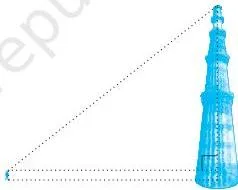
Read the river figure as the chapter’s first lesson: the girl’s height is one short side, the river’s width is the other, and the line of sight to the pot is the hypotenuse. The triangle is imaginary — no one draws it in the air — but it converts an unmeasurable width into a solvable triangle (p.113).
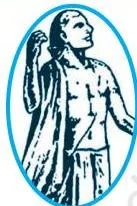
The book pauses for a short history (p.116): Aryabhata used the word ardha-jya for the half-chord in the Aryabhatiyam (AD 500); the word travelled as jya, became sinus in Latin, and later sine. Edmund Gunter introduced the abbreviation ‘sin’, and cosine grew from the need to compute the sine of the complementary angle — Aryabhata called it kotijya.
These names are abbreviations of whole phrases, not variables to be multiplied.
Key Concepts: The Six Trigonometric Ratios, Plainly Explained
For a fixed acute angle, the shape of the right triangle is fixed — only its size can change. That is why the ratios of its sides are fixed numbers: they describe the angle itself, not the size of the triangle (p.115).
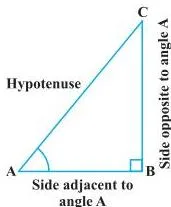
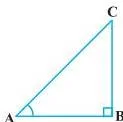
In Fig 8.4 (p.114) the angle under study is A. The side facing it, BC, is the side opposite to angle A; AC is the hypotenuse, across from the right angle; and AB is the side adjacent to angle A.
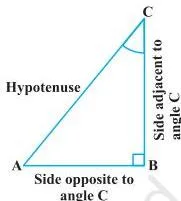
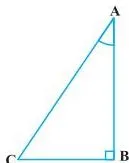
Everything swaps when the angle changes. In Fig 8.5 (p.115), for angle C, the opposite side is now AB, the adjacent side is BC, and the hypotenuse stays AC. Label the sides for your angle before substituting anything, or every ratio comes out wrong.
With the sides named, the six trigonometric ratios of angle A in right triangle ABC are defined as follows (p.115):
\[ \sin A = \frac{\text{opposite}}{\text{hypotenuse}} = \frac{BC}{AC}, \qquad \cos A = \frac{\text{adjacent}}{\text{hypotenuse}} = \frac{AB}{AC}, \qquad \tan A = \frac{\text{opposite}}{\text{adjacent}} = \frac{BC}{AB} \]
\[ \cosec A = \frac{1}{\sin A} = \frac{AC}{BC}, \qquad \sec A = \frac{1}{\cos A} = \frac{AC}{AB}, \qquad \cot A = \frac{1}{\tan A} = \frac{AB}{BC} \]
Notice the built-in structure: the last three are the reciprocals of the first three, and the two quotient relations below always connect them (p.115).
| Ratio | Its reciprocal | Quotient form |
|---|---|---|
| \(\sin A\) | \(\cosec A = \frac{1}{\sin A}\) | — |
| \(\cos A\) | \(\sec A = \frac{1}{\cos A}\) | — |
| \(\tan A\) | \(\cot A = \frac{1}{\tan A}\) | \(\tan A = \frac{\sin A}{\cos A}\) |
| \(\cot A\) | — | \(\cot A = \frac{\cos A}{\sin A}\) |
Two notation rules from p.117 save most of the marks lost in this chapter:
- sin A is a single symbol meaning “sine of angle A”. sin separated from A has no meaning, so sin × A is nonsense.
- \(\sin^2 A\) means \((\sin A)^2\). And \(\sin^{-1}A\) is not cosec A — it is inverse sine, a different idea left for higher classes. The same conventions hold for the other five ratios.
The ratios also do not depend on how big the triangle is: any smaller or larger triangle with the same angle A is similar to it (AA criterion, Fig 8.6, p.116-117), so the corresponding sides stay in the same proportion. The angle fixes the shape, and the shape fixes the ratios.
Trigonometric Ratios of 0°, 30°, 45°, 60° and 90°: Building Table 8.1
Where does \(\sin 30^\circ = \frac{1}{2}\) come from? Each standard value comes from a triangle you already know, so none of Table 8.1 needs blind memorising.
45° from an isosceles right triangle (p.122): if one acute angle is 45°, the other is 45° too, so the two legs are equal. Let \(BC = AB = a\). Then by Pythagoras, \(AC = a\sqrt{2}\). This gives \(\sin 45^\circ = \frac{a}{a\sqrt{2}} = \frac{1}{\sqrt{2}}\), \(\cos 45^\circ = \frac{1}{\sqrt{2}}\), and \(\tan 45^\circ = \frac{a}{a} = 1\).
30° and 60° from an equilateral triangle (p.122-123): take an equilateral triangle of side \(2a\). The altitude AD splits it into two congruent right triangles, each with hypotenuse \(2a\), one leg \(a\), and the other leg \(a\sqrt{3}\) (by Pythagoras). In the half-triangle ΔABD, \(\angle BAD = 30^\circ\) and \(\angle ABD = 60^\circ\). Read the ratios straight from the figure:
\[ \sin 30^\circ = \frac{BD}{AB} = \frac{a}{2a} = \frac{1}{2}, \qquad \cos 30^\circ = \frac{AD}{AB} = \frac{a\sqrt{3}}{2a} = \frac{\sqrt{3}}{2}, \qquad \tan 30^\circ = \frac{BD}{AD} = \frac{1}{\sqrt{3}} \]
\[ \sin 60^\circ = \frac{AD}{AB} = \frac{\sqrt{3}}{2}, \qquad \cos 60^\circ = \frac{1}{2}, \qquad \tan 60^\circ = \sqrt{3} \]
Watch how the figure decides everything: 30° sits at A, so the short leg BD is opposite it — hence \(\sin 30^\circ = \frac{1}{2}\). The 60° angle sits at B, so the long leg AD is opposite it — hence \(\sin 60^\circ = \frac{\sqrt{3}}{2}\). Same triangle, two angles, two answers.


0° and 90° by a limiting argument (p.123-124): these are definitions, not measurements. In Fig 8.16, as angle A shrinks toward 0°, side BC collapses toward 0 and AC nearly coincides with AB. So \(\sin A \to 0\) and \(\cos A \to 1\).
We define \(\sin 0^\circ = 0\) and \(\cos 0^\circ = 1\), which gives \(\tan 0^\circ = 0\) and \(\sec 0^\circ = 1\); \(\cosec 0^\circ\) and \(\cot 0^\circ\) are not defined, because they would divide by \(\sin 0^\circ = 0\).
In Fig 8.18 the opposite happens: as angle A grows toward 90°, side AB shrinks toward 0 and AC nearly coincides with BC. So \(\sin A \to 1\) and \(\cos A \to 0\). We define \(\sin 90^\circ = 1\) and \(\cos 90^\circ = 0\); \(\tan 90^\circ\) and \(\sec 90^\circ\) are not defined.
All five angles, collected in Table 8.1 (p.125) for ready reference:
| \(\angle A\) | \(0^\circ\) | \(30^\circ\) | \(45^\circ\) | \(60^\circ\) | \(90^\circ\) |
|---|---|---|---|---|---|
| \(\sin A\) | 0 | \(\frac{1}{2}\) | \(\frac{1}{\sqrt{2}}\) | \(\frac{\sqrt{3}}{2}\) | 1 |
| \(\cos A\) | 1 | \(\frac{\sqrt{3}}{2}\) | \(\frac{1}{\sqrt{2}}\) | \(\frac{1}{2}\) | 0 |
| \(\tan A\) | 0 | \(\frac{1}{\sqrt{3}}\) | 1 | \(\sqrt{3}\) | Not defined |
| \(\cosec A\) | Not defined | 2 | \(\sqrt{2}\) | \(\frac{2}{\sqrt{3}}\) | 1 |
| \(\sec A\) | 1 | \(\frac{2}{\sqrt{3}}\) | \(\sqrt{2}\) | 2 | Not defined |
| \(\cot A\) | Not defined | \(\sqrt{3}\) | 1 | \(\frac{1}{\sqrt{3}}\) | 0 |
One pattern makes the table self-checking (p.125): as A goes from 0° to 90°, \(\sin A\) rises from 0 to 1 while \(\cos A\) falls from 1 to 0. Every row agrees with that sentence.
Worked example (original numbers): In ΔABC, right-angled at B, the hypotenuse \(AC = 12\) cm and \(\angle A = 60^\circ\).
Find the sides BC and AB.
Step 1: BC is opposite angle A, so use \(\sin A = \frac{BC}{AC}\).
\[ \frac{BC}{12} = \sin 60^\circ = \frac{\sqrt{3}}{2} \quad \Rightarrow \quad BC = 12 \times \frac{\sqrt{3}}{2} = 6\sqrt{3}\ \text{cm} \]
Step 2: AB is adjacent to angle A, so use \(\cos A = \frac{AB}{AC}\).
\[ \frac{AB}{12} = \cos 60^\circ = \frac{1}{2} \quad \Rightarrow \quad AB = 6\ \text{cm} \]
Check with Pythagoras: \((6)^2 + (6\sqrt{3})^2 = 36 + 108 = 144 = 12^2\).
The sides fit.
Final answer: \(BC = 6\sqrt{3}\) cm (opposite the 60° angle) and \(AB = 6\) cm.
Mnemonic: learn only the sine row of Table 8.1 — 0, \(\frac{1}{2}\), \(\frac{1}{\sqrt{2}}\), \(\frac{\sqrt{3}}{2}\), 1 — and read the cosine row backwards: 1, \(\frac{\sqrt{3}}{2}\), \(\frac{1}{\sqrt{2}}\), \(\frac{1}{2}\), 0. Since \(\tan A = \frac{\sin A}{\cos A}\), the tangent row then comes free.
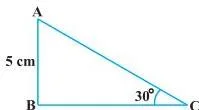
Fig 8.19 (p.125) demonstrates the method to copy for every such problem: choose the ratio that contains exactly the side you know and the side you want. In that figure the known side AB is opposite angle C, so tan C links it to the adjacent side BC, and sin C links it to the hypotenuse AC.
One Ratio Is Enough: The k Method with a Worked Example
If you know one ratio, you know the triangle’s shape — and the shape gives every ratio. The k method makes the shape explicit: write the two known sides as multiples of one letter k, find the third side by Pythagoras, and let k cancel at the end.
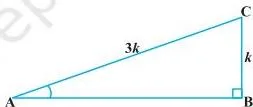
Fig 8.7 (p.117) is the chapter’s own illustration: when \(\sin A = \frac{1}{3}\), the sides BC and AC are in the ratio 1 : 3, so writing \(BC = k\) and \(AC = 3k\) draws the triangle at any scale you like.
Worked example (original numbers): In ΔABC, right-angled at B, \(\cos A = \frac{5}{13}\).
Find all six trigonometric ratios of angle A.
Step 1: By definition \(\cos A = \frac{AB}{AC} = \frac{5}{13}\).
Write \(AB = 5k\) and \(AC = 13k\), with \(k \gt 0\).
Step 2: Use Pythagoras to find the third side BC.
\[ BC^2 = AC^2 – AB^2 = (13k)^2 – (5k)^2 = 169k^2 – 25k^2 = 144k^2 \quad \Rightarrow \quad BC = 12k \]
Step 3: Write all six ratios.
Every ratio is a quotient of two sides, so k appears in both numerator and denominator and cancels.
\[ \sin A = \frac{12k}{13k} = \frac{12}{13}, \quad \tan A = \frac{12k}{5k} = \frac{12}{5}, \quad \cosec A = \frac{13}{12}, \quad \sec A = \frac{13}{5}, \quad \cot A = \frac{5}{12} \]
Final answer: \(\sin A = \frac{12}{13}\), \(\cos A = \frac{5}{13}\), \(\tan A = \frac{12}{5}\), \(\cosec A = \frac{13}{12}\), \(\sec A = \frac{13}{5}\), \(\cot A = \frac{5}{12}\).
Why AB is taken as \(+5k\) and not \(-5k\): a side length is a positive distance, so we keep the positive root — the same decision the book makes at p.117. The numbers 5, 12, 13 form a Pythagorean triple, so a 5-12-13 triangle is quick to recognise in further problems.
One consequence worth remembering (p.118): \(\sin A\) and \(\cos A\) can never exceed 1, because the hypotenuse is the longest side of a right triangle, so the opposite or adjacent side divided by it is at most 1. Exercise 8.1 Q3-Q5 (p.121) are exactly this k-method type.
Trigonometric Identities: The Three Formulas and Where They Come From
An identity is an equation true for every allowed angle — not just a few lucky values (p.128). The three identities of this chapter are not separate facts: all three are the Pythagoras equation \(AB^2 + BC^2 = AC^2\) divided by one side at a time.
In ΔABC of Fig 8.21 (p.128), right-angled at B, Pythagoras gives \(AB^2 + BC^2 = AC^2\). Dividing every term by \(AC^2\), then by \(AB^2\), then by \(BC^2\), turns each side length into a ratio — and each ratio is a trigonometric function:
| Identity | How it is obtained | Valid for |
|---|---|---|
| \(\sin^2 A + \cos^2 A = 1\) | Divide \(AB^2 + BC^2 = AC^2\) by \(AC^2\) | \(0^\circ \leq A \leq 90^\circ\) |
| \(1 + \tan^2 A = \sec^2 A\) | Divide by \(AB^2\) | \(0^\circ \leq A \lt 90^\circ\) |
| \(\cot^2 A + 1 = \cosec^2 A\) | Divide by \(BC^2\) | \(0^\circ \lt A \leq 90^\circ\) |
Why the ranges differ: an identity is valid only where every ratio in it is defined. At \(A = 90^\circ\), \(\cos 90^\circ = 0\), so \(\tan 90^\circ = \frac{\sin 90^\circ}{\cos 90^\circ}\) and \(\sec 90^\circ = \frac{1}{\cos 90^\circ}\) both divide by zero.
That is why \(1 + \tan^2 A = \sec^2 A\) stops being valid at 90° while \(\sin^2 A + \cos^2 A = 1\) remains perfectly fine there: \(\sin^2 90^\circ + \cos^2 90^\circ = 1 + 0 = 1\). Similarly, \(\cot^2 A + 1 = \cosec^2 A\) fails at 0° because \(\sin 0^\circ = 0\) leaves cosec and cot undefined (p.128-129).
Using the identities to move between ratios (original numbers): suppose \(\tan A = \frac{5}{12}\).
- Step 1: Immediately, \(\cot A = \frac{12}{5}\).
- Step 2: From \(1 + \tan^2 A = \sec^2 A\):
\[ \sec^2 A = 1 + \left(\frac{5}{12}\right)^2 = 1 + \frac{25}{144} = \frac{169}{144} \quad \Rightarrow \quad \sec A = \frac{13}{12}, \quad \cos A = \frac{12}{13} \]
Step 3: Then \(\sin A = \tan A \times \cos A = \frac{5}{12} \times \frac{12}{13} = \frac{5}{13}\), giving \(\cosec A = \frac{13}{5}\).
Final answer: \(\sin A = \frac{5}{13}\), \(\cos A = \frac{12}{13}\), \(\tan A = \frac{5}{12}\), \(\cosec A = \frac{13}{5}\), \(\sec A = \frac{13}{12}\), \(\cot A = \frac{12}{5}\).
This is the same 5-12-13 triangle the k method produced earlier — the identities give the same answers the k method gives, which makes an excellent consistency check (p.129 shows the book’s own chain with \(\tan A = \frac{1}{\sqrt{3}}\)).
How to Prove an Identity: A Strategy That Works
Identity proofs look intimidating but follow a short playbook. Exercise 8.3 Q4 (p.131-132) has ten parts, and every one of them uses one of the moves below.
- Start from the more complicated side — usually the LHS — and work toward the simpler RHS.
- Write everything in terms of \(\sin A\) and \(\cos A\) first: \(\cot A = \frac{\cos A}{\sin A}\), \(\sec A = \frac{1}{\cos A}\), \(\cosec A = \frac{1}{\sin A}\).
- Look for \(1 – \sin^2 A\) or \(1 – \cos^2 A\) — they collapse into \(\cos^2 A\) and \(\sin^2 A\) by the first identity.
- Use the conjugate trick: \((1 – \sin A)(1 + \sin A) = \cos^2 A\).
- When sec and tan appear together, divide the numerator and denominator by \(\cos \theta\) — the move Example 12 makes on p.130-131, because \(\frac{\sin \theta}{\cos \theta} = \tan \theta\) and \(\frac{1}{\cos \theta} = \sec \theta\).
Worked proof (original): Prove that \(\dfrac{1}{1 – \sin A} + \dfrac{1}{1 + \sin A} = 2\sec^2 A\).
Step 1: Combine the two fractions on the LHS over a common denominator.
\[ \text{LHS} = \frac{(1 + \sin A) + (1 – \sin A)}{(1 – \sin A)(1 + \sin A)} = \frac{2}{1 – \sin^2 A} \]
Step 2: Replace \(1 – \sin^2 A\) with \(\cos^2 A\).
\[ \frac{2}{1 – \sin^2 A} = \frac{2}{\cos^2 A} = 2\sec^2 A = \text{RHS} \]
Hence proved.
The two moves that did all the work — a common denominator and the conjugate identity — are exactly the moves Exercise 8.3 Q4 keeps asking for.
Reading the Figures: What Each Diagram Shows
Every diagram above has already been explained in its section; this sequence is for finding each one again in your own book. One or two sentences per figure is all you need.
- Fig 8.2 (p.113): the river scene — a real situation drawn with the imaginary right triangle that models it.
- Fig 8.4 (p.114): how the side opposite, side adjacent and hypotenuse are named for angle A. The naming changes the moment the angle changes.
- Fig 8.5 (p.115): the same triangle viewed from angle C — opposite and adjacent have swapped.
- Fig 8.7 (p.117): sides in the ratio 1 : 3 for \(\sin A = \frac{1}{3}\), the seed of the k method.
- Fig 8.15 (p.122): the equilateral triangle cut by altitude AD. Each half has angles 30° and 60° with sides \(a\), \(a\sqrt{3}\), \(2a\) — this single figure produces the 30° and 60° rows of Table 8.1.
- Fig 8.16 (p.123): angle A shrinking toward 0°, so \(BC \to 0\) and \(AC \approx AB\) — the reason \(\sin 0^\circ = 0\) and \(\cos 0^\circ = 1\).
- Fig 8.18 (p.124): angle A growing toward 90°, so \(AB \to 0\) and \(AC \approx BC\) — the reason \(\sin 90^\circ = 1\) and \(\cos 90^\circ = 0\).
- Fig 8.19 (p.125): the example triangle for choosing the ratio that links a known side to the side you want.
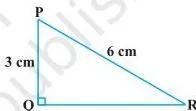
- Fig 8.20 (p.126): triangle PQR with \(PQ = 3\) cm and \(PR = 6\) cm; \(\sin R = \frac{1}{2}\) gives \(\angle R = 30^\circ\) and \(\angle QPR = 60^\circ\) — reading angles backwards from ratios.
- Fig 8.21 (p.128): the right triangle carrying the Pythagoras equation from which all three identities come.
Definitions You Need, in Plain Words
A quick glossary for looking up one term without re-reading the chapter:
- Trigonometry — the study of the relationships between the sides and angles of a triangle (p.114).
- Acute angle — an angle less than 90°; the ratio definitions in this chapter use only acute angles (p.114).
- Side opposite / side adjacent / hypotenuse — the three sides named relative to the chosen acute angle; the labels swap when the angle changes (p.115).
- Trigonometric ratios — the six ratios of the sides of a right triangle taken with respect to an acute angle (p.115).
- Trigonometric identity — an equation involving trigonometric ratios that is true for all values of the angle(s) involved (p.128).
- Notation conventions — \(\sin A\) is a single symbol, not sin × A; \(\sin^2 A\) means \((\sin A)^2\); \(\sin^{-1}A\) is inverse sine, not cosec (p.117).
Common Mistakes and How to Avoid Them
Most marks lost in this chapter come from notation and from forgetting what is actually allowed. The book’s own true/false questions in Exercise 8.1 Q11 (p.121) and Exercise 8.2 Q4 (p.127) are built around exactly these traps.
| Mistake | Correct rule | How to check your answer |
|---|---|---|
| Treating sin A as sin × A | sin alone has no meaning; \(\sin A\) abbreviates “sine of angle A” (p.117) | Ask whether the quantity contains an angle: \(\sin 30^\circ\) is a number; sin × 30 is not. |
| Writing \(\sin^{-1}A\) for cosec A | The reciprocal of \(\sin A\) is \(\cosec A\); \(\sin^{-1}A\) is inverse sine, a different idea (p.117) | Recite: reciprocal = cosec. Leave \(\sin^{-1}A\) for higher classes. |
| Thinking tan A is always less than 1 | \(\tan 60^\circ = \sqrt{3} \approx 1.73\), greater than 1 (Ex 8.1 Q11(i), p.121) | Since \(\tan A = \frac{\sin A}{\cos A}\) and sin can exceed cos, tan can exceed 1. |
| Thinking sin θ can exceed 1 | Impossible: the hypotenuse is the longest side, so \(\frac{\text{opposite}}{\text{hypotenuse}} \leq 1\) (Ex 8.1 Q11(v), p.121; p.118) | If your sin value is greater than 1, the fraction is upside down. |
| Using the wrong opposite/adjacent when the angle changes | For angle C the labels swap: AB becomes opposite, BC becomes adjacent (p.115) | Circle the angle you are working with and name the three sides for that angle first. |
| Confusing cos A with cosecant, or cot A with cot × A | cos and cosec are different ratios; \(\cot A\) is a single symbol (Ex 8.1 Q11(iii)-(iv), p.121) | Write the six definitions side by side before substituting. |
| Applying \(1 + \tan^2 A = \sec^2 A\) at \(A = 90^\circ\) | At 90°, tan and sec are undefined because \(\cos 90^\circ = 0\), so the identity has no meaning there (p.128) | Check the angle: use this identity only for angles from 0° up to but not including 90°. |
Exam Notes: What Chapter 8 Expects You to Be Able to Do
Here is the full skill list the chapter builds, mapped to its exercises — the observable things you should be able to do when you close the book.
- Name the six ratios fast from a labelled triangle (Exercise 8.1 Q1-Q2, p.121).
- Move from one known ratio to all the others using the k method and Pythagoras (Exercise 8.1 Q3-Q5, p.121).
- Recall the standard values and evaluate compound expressions such as \(\sin 60^\circ \cos 30^\circ + \sin 30^\circ \cos 60^\circ\) (Exercise 8.2 Q1, p.127).
- Judge true/false claims about ratio sizes and notation (Exercise 8.1 Q11 and Exercise 8.2 Q4, p.121, p.127).
- Use the three identities to re-express ratios in terms of each other and to prove given relations (Exercise 8.3 Q1-Q4, p.131-132).
For a full-marks answer: label the three sides on the diagram before substituting, write “opposite to which angle” next to every ratio, and open every identity proof with LHS and close with RHS, showing the step where any denominator is rewritten.
Rationalise denominators such as \(\frac{1}{\sqrt{2}}\) when comparing answers — \(\frac{1}{\sqrt{2}}\) and \(\frac{\sqrt{2}}{2}\) are equal, but a single consistent form avoids careless errors.
One honest note: textbook contents and the examinable syllabus are not always identical — check the current official CBSE syllabus to see exactly what is examinable this session.
Key Formulas from Chapter 8 in One Table
The table below collects the key formulas the chapter uses, what each one means, and the NCERT page where it appears. Keep it as a night-before reference.
| Formula | What it means | NCERT page |
|---|---|---|
| \(\sin A = \frac{\text{opposite}}{\text{hypotenuse}}\) | The side facing angle A divided by the hypotenuse | p.115 |
| \(\cos A = \frac{\text{adjacent}}{\text{hypotenuse}}\) | The side next to angle A divided by the hypotenuse | p.115 |
| \(\tan A = \frac{\text{opposite}}{\text{adjacent}}\) | The side facing angle A divided by the side next to it | p.115 |
| \(\cosec A = \frac{1}{\sin A}\), \(\sec A = \frac{1}{\cos A}\), \(\cot A = \frac{1}{\tan A}\) | The three reciprocal ratios | p.115, p.132 |
| \(\tan A = \frac{\sin A}{\cos A}\), \(\cot A = \frac{\cos A}{\sin A}\) | Quotient relations connecting the ratios | p.115 |
| Standard values of sin, cos, tan for 0°, 30°, 45°, 60°, 90° | Values from Table 8.1, each built from a known triangle | p.125 |
| \(\sin^2 A + \cos^2 A = 1\) | Pythagoras divided by \(AC^2\); valid for angles 0° to 90° | p.132 |
| \(\sec^2 A – \tan^2 A = 1\) | Pythagoras divided by \(AB^2\); valid for angles 0° up to but not including 90° | p.132 |
| \(\cosec^2 A = 1 + \cot^2 A\) | Pythagoras divided by \(BC^2\); valid for angles above 0° up to 90° | p.132 |
Reminder for the standard values: learn the sine row 0, \(\frac{1}{2}\), \(\frac{1}{\sqrt{2}}\), \(\frac{\sqrt{3}}{2}\), 1, and read the cosine row backwards — 1, \(\frac{\sqrt{3}}{2}\), \(\frac{1}{\sqrt{2}}\), \(\frac{1}{2}\), 0. Then \(\tan A = \frac{\sin A}{\cos A}\) gives every tangent.
What to Remember from Chapter 8
The chapter closes with its own list of results (8.5 Summary, p.132); here are those points in plainer words.
- \(\sin A = \frac{\text{opposite}}{\text{hypotenuse}}\).
- \(\cos A = \frac{\text{adjacent}}{\text{hypotenuse}}\).
- \(\tan A = \frac{\text{opposite}}{\text{adjacent}}\).
- \(\cosec A = \frac{1}{\sin A}\), \(\sec A = \frac{1}{\cos A}\), \(\cot A = \frac{1}{\tan A}\).
- \(\tan A = \frac{\sin A}{\cos A}\).
- If one trigonometric ratio of an acute angle is known, all the rest can be determined.
- The standard values for 0°, 30°, 45°, 60° and 90° come from known triangles — reconstruct them, do not memorise blindly.
- \(\sin A\) and \(\cos A\) never exceed 1, while \(\sec A\) (for angles 0° to just below 90°) and \(\cosec A\) (for angles just above 0° to 90°) are always at least 1.
- \(\sin^2 A + \cos^2 A = 1\).
- \(\sec^2 A – \tan^2 A = 1\) for \(0^\circ \leq A \lt 90^\circ\), and \(\cosec^2 A = 1 + \cot^2 A\) for \(0^\circ \lt A \leq 90^\circ\).
Where This Chapter Leads: Related NCERT Pages
The ratios learned here are used immediately: Chapter 9, Some Applications of Trigonometry, puts sin, cos and tan to work on heights and distances, while Chapter 7, Coordinate Geometry is the book’s other coordinate-heavy chapter. For the full set of chapters, see the Class 10 Mathematics NCERT book page.
For revision beyond the book, the CBSE notes index organises the whole syllabus; the Class 10 study notes and Class 10 Mathematics notes carry chapter-level material, including Coordinate Geometry notes and Some Applications of Trigonometry notes.
And one reminder: textbook contents and the examinable syllabus are not always identical — the current official CBSE syllabus is the final authority on what is examinable.
Sources and Data Verification
- The content on this page describes Chapter 8, Introduction to Trigonometry, of the NCERT Class 10 Mathematics textbook (Mathematics, published by NCERT), official edition available on ncert.nic.in.
- This page covers that single chapter and its three exercises — it does not cover the rest of the book or any other subject.
- The listing is maintained for the current session using the NCERT information available to us.
- NCERT settles textbooks, editions and official PDFs; CBSE settles the curriculum, syllabus and examinations.
Reference: NCERT Class 10 Mathematics textbook, chapter 8, official edition on ncert.nic.in.
Frequently Asked Questions About Class 10 Trigonometry
What are the six trigonometric ratios and how do I remember them?
The six ratios of an acute angle A in a right triangle are sin A, cos A, tan A, cosec A, sec A and cot A (p.115).
Remember them in pairs: \(\sin A\) is opposite/hypotenuse and \(\cosec A\) is its reciprocal; \(\cos A\) is adjacent/hypotenuse and \(\sec A\) is its reciprocal; \(\tan A\) is opposite/adjacent and \(\cot A\) is its reciprocal. Name the three sides for your angle first, then form the pairs — the structure removes most of the memorising.
How do I remember the standard values of sin, cos and tan for 0°, 30°, 45°, 60° and 90°?
Learn only the sine row of Table 8.1 (p.125): 0, \(\frac{1}{2}\), \(\frac{1}{\sqrt{2}}\), \(\frac{\sqrt{3}}{2}\), 1. The cosine row is that same list backwards: 1, \(\frac{\sqrt{3}}{2}\), \(\frac{1}{\sqrt{2}}\), \(\frac{1}{2}\), 0. Then use \(\tan A = \frac{\sin A}{\cos A}\): for example, \(\tan 60^\circ = \frac{\sqrt{3}/2}{1/2} = \sqrt{3}\).
Why is tan 90° not defined?
Because \(\tan 90^\circ = \frac{\sin 90^\circ}{\cos 90^\circ} = \frac{1}{0}\), and division by zero has no value (p.128). For the same reason \(\sec 90^\circ\) is undefined: \(\sec A = \frac{1}{\cos A}\), and \(\cos 90^\circ = 0\).
Is sin 2A equal to 2 sin A?
No. The statement \(\sin 2A = 2\sin A\) is true only at \(A = 0^\circ\), where both sides are 0 (Exercise 8.2 Q2(iii), p.127). Test it at \(A = 30^\circ\): \(\sin 60^\circ = \frac{\sqrt{3}}{2} \approx 0.87\), but \(2\sin 30^\circ = 2 \times \frac{1}{2} = 1\). The two sides are not equal.
Why is the value of sin A never greater than 1?
Because \(\sin A = \frac{\text{opposite}}{\text{hypotenuse}}\), and the hypotenuse is the longest side of a right triangle — so the numerator is never larger than the denominator (p.118). The same argument limits \(\cos A\).
Which class 10 chapter uses trigonometry next?
Chapter 9, Some Applications of Trigonometry. It takes the same sin, cos and tan from this chapter and uses them to find heights and distances — for example, the height of a building from its angle of elevation.
Reference: NCERT Class 10 Mathematics textbook, chapter 8, official edition on ncert.nic.in.
Explore Class 10 Mathematics Books
- Previous: Coordinate Geometry
- Next: Some Applications of Trigonometry
Class 10 Mathematics on LearnCBSE:
Related chapters:
- Real Numbers
- Polynomials
- Pair of Linear Equations in Two Variables