
Areas Related to Circles Class 10 is NCERT Mathematics Chapter 11, and the official chapter PDF is on this page, for the 2026-27 session. The chapter teaches the sector and segment of a circle and the three formulas that measure them.
Everything below explains what the chapter contains — the derivations, the worked examples and the exercise — so you can follow the printed book with this page beside it.
Download the Areas Related to Circles Class 10 NCERT PDF
The official Areas Related to Circles Class 10 NCERT PDF is the chapter file from the NCERT Mathematics textbook for Class 10, Chapter 11, hosted on the NCERT website — open it to read the chapter as printed and to follow its figures and exercises alongside this page.
| What the chapter holds | Count | Where it is used |
|---|---|---|
| Printed pages | 7 | |
| Sections in the chapter | 2 | |
| Figures with NCERT captions | 4 | |
| Exercise questions | 14 | answered in our NCERT Solutions |
| Official NCERT PDF | Download the chapter PDF | the chapter exactly as NCERT publishes it |
Chapter 11 at a glance
The table below lists what the chapter file contains — its sections, figures, worked examples and exercise questions — so you can see the size of the chapter before you start.
What this chapter covers
The chapter opens on page 154 by recalling what a sector and a segment of a circle are, and it fixes the vocabulary that every question uses: minor and major sectors, minor and major segments.
It then derives three formulas. The area of a sector and the length of an arc come from the unitary method (NCERT, p. 155) — each is the same fraction of the whole circle. The area of a segment follows as sector minus triangle (NCERT, p. 156).
Two worked examples apply them: Example 1 finds a minor and a major sector (p. 156), and Example 2 finds a segment when the chord subtends 120° (pp. 157–158).
The exercise puts the formulas on real objects — a clock’s minute hand, a horse in a field, a brooch, an umbrella, car wipers, a lighthouse — and the chapter closes with a summary on page 160.
After this chapter you can find the area of any sector or segment, the length of any arc, and solve word problems that hide the sector angle inside a story.
Areas Related to Circles Class 10: key concepts and formulas
The whole chapter is about two regions cut out of a circle and the formulas that measure them. The subsections below build each formula from the picture, not from memory.
What a sector and a segment are
Before any formula, the chapter fixes what these two regions are — otherwise the numbers that follow attach to nothing.
- Sector: the region of the circular disc enclosed by two radii and the arc between them. In Fig 11.1 that region is OAPB, and \(\angle AOB\) is the angle of the sector (NCERT, p. 154).
- Segment: the region enclosed between a chord and the arc it cuts off (NCERT, p. 154).
Every chord and every pair of radii creates two regions that together fill the circle — a small one and a large one. The minor sector OAPB has angle less than \(180^\circ\); the major sector OAQB has angle \(360^\circ – \theta\). The same naming applies to minor and major segments.
NCERT puts a remark on page 154 that saves re-reading the word ‘minor’ on every page: “When we write ‘segment’ and ‘sector’ we will mean the ‘minor segment’ and the ‘minor sector’ respectively, unless stated otherwise.”
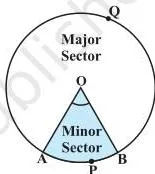
| Region | Bounded by | Named angle | Formula that applies |
|---|---|---|---|
| Sector | two radii + the arc between them | \(\theta\) between the radii | \(\frac{\theta}{360}\times \pi r^2\) |
| Segment | a chord + the arc it cuts off | \(\theta\) subtended by the chord at the centre | sector area − triangle area |
Use the table as a quick check: if the region’s straight edges meet at the centre, it is a sector; if its straight edge is a chord, it is a segment.
Area of a sector: why theta by 360
The sector-area formula is not something to memorise cold — it is the circle’s area multiplied by the fraction of a full turn the sector covers.
The book argues by the unitary method (NCERT, p. 155). A full turn of 360° sweeps the whole disc, whose area is \(\pi r^2\). So:
- \(1^\circ\) of angle covers \(\frac{\pi r^2}{360}\),
- \(\theta^\circ\) of angle covers \(\frac{\theta}{360}\times \pi r^2\).
That gives the single formula the chapter is built on:
\[ \text{Area of a sector of angle } \theta = \frac{\theta}{360}\times \pi r^2 \]
Here \(\theta\) is the sector angle in degrees and \(r\) the radius; the answer comes in square units (\(\text{cm}^2\), \(\text{m}^2\)). Keep \(\theta\) in degrees — the clock question later trips students who treat minutes as degrees.
Length of an arc
A sector also has a curved edge — the arc — and its length is the same fraction of the circumference as the sector is of the disc.
By the same unitary method (NCERT, p. 155), the arc takes the same fraction of the circumference \(2\pi r\):
\[ \text{Length of an arc of a sector of angle } \theta = \frac{\theta}{360}\times 2\pi r \]
The two formulas are exact twins with one difference: area uses \(\pi r^2\), arc length uses \(2\pi r\). Mixing the two is the most common error in this chapter. Arc length comes out in length units (cm, m).
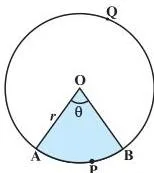
The diagram shows where each label lives: \(r\) feeds both formulas, \(\theta\) decides the fraction of the circle, and the arc APB is the length the second formula measures.
Area of a segment: subtract the triangle
A segment looks like a sector whose pointed wedge has been cut off, so its area is the difference of the two.
\[ \text{Area of a segment} = \text{area of the sector} – \text{area of the triangle formed by the two radii and the chord} \]
That relation is NCERT’s definition of the segment area on page 156. The only work left is the triangle, and Example 2 (pp. 157–158) shows the standard move.
Drop a perpendicular OM from the centre O to the chord AB. Since OA = OB, the two right triangles formed are congruent (RHS), so M is the midpoint of AB and OM bisects \(\angle AOB\). Trigonometry in the right triangle OMA gives OM and AM, and then the triangle’s area is \(\frac{1}{2}\times AB\times OM\).
Two shortcuts are worth noting. When \(\theta = 90^\circ\) the triangle is right-angled with area \(\frac{1}{2}r^2\) — the clean case in the worked example below. When \(\theta = 60^\circ\) or \(120^\circ\) the triangle brings in \(\sqrt{3}\), which is why Exercise questions 6 and 7 supply its value.
Page 156 also records the companion relations that close the circle: major sector \(= \pi r^2 -\) minor sector, and major segment \(= \pi r^2 -\) minor segment.
Worked example: radius 14 cm, angle 90 degrees
One fully worked case shows the whole method end to end. These numbers are original to this page, so you can work them yourself and check against a clean 90° example.
Step 1 — sector area.
Use the sector formula with \(\theta = 90^\circ\), \(r = 14\ \text{cm}\), \(\pi = \frac{22}{7}\):
\[ \frac{90}{360}\times \frac{22}{7}\times 14^2 = \frac{1}{4}\times \frac{22}{7}\times 196 = 154\ \text{cm}^2 \]
Step 2 — arc length.
Same fraction, but of the circumference:
\[ \frac{90}{360}\times 2\times \frac{22}{7}\times 14 = \frac{1}{4}\times 88 = 22\ \text{cm} \]
Step 3 — triangle for the segment.
The chord AB with radii OA, OB forms a triangle in which OA = OB = 14 cm and \(\angle AOB = 90^\circ\), so it is right-angled and isosceles:
\[ \text{Area of } \triangle OAB = \frac{1}{2}\times 14\times 14 = 98\ \text{cm}^2 \]
Step 4 — segment area.
Subtract the triangle from the sector:
\[ 154 – 98 = 56\ \text{cm}^2 \]
Final answer: sector area \(154\ \text{cm}^2\), arc length \(22\ \text{cm}\), segment area \(56\ \text{cm}^2\).
The 90° angle keeps \(\sqrt{3}\) out of the working. For 60° or 120°, the method is identical — sector first, triangle second, subtract — only the triangle brings in \(\sqrt{3}\).
Formula sheet: key formulas from the chapter
One table holds the key formulas from the chapter. Keep it open while you attempt the exercise.
| Formula | What it gives | Symbols and units |
|---|---|---|
| \(\frac{\theta}{360}\times \pi r^2\) | area of a sector of angle \(\theta\) | \(\theta\) in degrees, \(r\) radius; square units (\(\text{cm}^2\), \(\text{m}^2\)) |
| \(\frac{\theta}{360}\times 2\pi r\) | length of the arc of a sector | \(\theta\) in degrees; length units (cm, m) |
| sector area − triangle area | area of a segment | triangle = the one with the two radii and the chord |
| \(\pi r^2 -\) minor sector | area of the major sector | \(\pi r^2\) is the whole disc |
| \(\pi r^2 -\) minor segment | area of the major segment | whole disc minus the minor part |
Note that \(\theta\) is always the sector angle in degrees, and the major sector’s angle is \(360^\circ – \theta\). NCERT’s chapter summary on page 160 lists the first three of these — arc length, sector area and segment area — as the chapter’s core results.
Figure walkthrough: what the diagrams show
This chapter has few diagrams, but each one carries a formula or an exercise. Work through them in the order they appear in the book.
Fig 11.1 — the picture behind sector and segment
Two radii OA and OB divide the circle into exactly two parts, and both are sectors: the shaded minor sector OAPB and the unshaded major sector OAQB. Adding them gives the whole circle, so ‘minor’ and ‘major’ are just size labels — the minor angle is less than \(180^\circ\), the major angle is \(360^\circ – \angle AOB\).
The figure sits behind the remark on page 154 that ‘sector’ alone means the minor one.
Fig 11.3 — the figure both formulas come from
This single diagram carries both formulas of the chapter. The label \(r\) is the radius — it feeds \(\pi r^2\) in the area formula and \(2\pi r\) in the arc formula. The angle \(\theta\) decides the fraction of the circle, and the arc APB is the curved boundary whose length the second formula measures.
Redraw this figure before attempting any exercise question — every sector question in the exercise is this picture with numbers.
Fig 11.8 — the grazing horse is a quarter circle
This figure belongs to Exercise question 8 (textbook p. 158). The horse is tied to a peg at the corner of a square field, and a corner is a right angle — so the 5 m rope can swing only through 90°.
The grazed region is therefore a sector of angle 90° and radius 5 m, a quarter circle: \(\frac{1}{4}\times 3.14 \times 5^2 \approx 19.6\ \text{m}^2\). Part (ii) is the same quarter circle with radius 10 m.
The whole question is the sector formula once you read the corner as 90°.

Fig 11.9 — a brooch divided into equal sectors
This figure belongs to Exercise question 9 (textbook p. 159). Five diameters drawn across a circle produce ten equal sectors, so each sector has angle \(\frac{360^\circ}{10} = 36^\circ\), and each sector’s area is one tenth of the circle’s area.
The silver-wire part of the question is a perimeter: the circle’s circumference plus the five diameters. Read the figure that way and both parts of the question become routine.
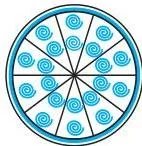
Two figures this page cannot render are still worth naming from the question text. Fig 11.10 shows the umbrella of question 10: eight equally spaced ribs cut the circle into sectors of \(\frac{360^\circ}{8} = 45^\circ\) each. Fig 11.11 shows the round table cover of question 13: six equal designs sit in six sectors of \(\frac{360^\circ}{6} = 60^\circ\).
Definitions you must know before the formulas
A quick glossary of the chapter’s vocabulary, with page references:
- Sector — the region enclosed by two radii and the arc between them (NCERT, p. 154).
- Angle of the sector — \(\angle AOB\), the angle between the two radii (NCERT, p. 154).
- Minor and major sector — the two regions a pair of radii makes; their angles add to 360°, so the major angle is \(360^\circ – \theta\) (NCERT, p. 154).
- Segment — the region enclosed between a chord and the arc it cuts off (NCERT, p. 154).
- Minor and major segment — the two regions a chord makes; the larger one is the major segment.
- Quadrant — a sector of angle 90°, named in Exercise question 2.
- The page-154 remark — ‘sector’ and ‘segment’ alone mean the minor ones unless stated otherwise.
Common mistakes in this chapter (and how to avoid them)
Every one of these errors shows up in students’ attempts at Exercise 11.1 — name the trap before it catches you.
| Mistake | Correct rule | How to check your answer |
|---|---|---|
| Using the arc-length formula when the question asks for area, or vice versa. | Arc length uses \(2\pi r\) (a length); sector area uses \(\pi r^2\) (an area). | Check the units: an area answer must be in square units, a length in plain units. |
| Forgetting to subtract the triangle when finding a segment. | Segment = sector − triangle; a segment is never just the sector (NCERT, p. 156). | A segment must be smaller than the sector it came from; if your segment equals your sector, the triangle never left. |
| Using the minor angle for a major-sector question. | Major sector = \(\frac{360^\circ – \theta}{360}\times \pi r^2\), or \(\pi r^2\) minus the minor sector (NCERT, p. 156). | The major sector is more than half the circle, so your answer should beat \(\frac{1}{2}\pi r^2\). |
| Treating the clock’s 5 minutes as 5°. | The minute hand moves 6° per minute, so 5 minutes = 30° (Exercise question 3). | 5 minutes is \(\frac{5}{60} = \frac{1}{12}\) of the dial, and \(\frac{1}{12}\times 360^\circ = 30^\circ\). |
| Assuming the chord triangle is equilateral when the chord subtends 120°. | The triangle is isosceles: base angles are \(\frac{180^\circ – 120^\circ}{2} = 30^\circ\), and the perpendicular from the centre bisects the chord (Example 2, pp. 157–158). | The perpendicular splits the triangle into two 30-60-90 right triangles; use \(\cos 60^\circ\) and \(\sin 60^\circ\) for the height and half-chord. |
Exam notes: using the formulas on paper
The exercise is the whole test of this chapter, and it uses the three formulas in three shapes. These notes tell you how each shape works.
- Use the π the question prints. The exercise opens with “Unless stated otherwise, use \(\pi = \frac{22}{7}\)” (NCERT, p. 158). Several questions override this with \(\pi = 3.14\), and the chord questions also supply \(\sqrt{3}\) — for example, \(\sqrt{3} = 1.73\) in questions 6 and 7, and \(\sqrt{3} = 1.7\) in question 13. The decimal answers differ, so do not switch values mid-question.
- The three question shapes. The early questions apply the sector formula directly. The middle questions bring in a chord, so they need the segment formula and a triangle. The later questions dress the sector up as a real object: the horse at the corner of a field (angle 90°), the brooch (36° per sector), the umbrella (45° between ribs), the car wipers (115°), the lighthouse beam (80°). In every case the exam skill is extracting \(\theta\) from the situation.
- The clock conversion. For question 3, the minute hand of length 14 cm is a radius, and 5 minutes is a 30° turn, so the area swept is \(\frac{30}{360}\times \frac{22}{7}\times 14^2 \approx 51.3\ \text{cm}^2\).
- Question 14, by elimination. Options (A) and (C) contain only \(2\pi R\), which is linear in \(R\) — an area must contain \(R^2\), so both are wrong. The fraction of the circle must be \(p/360\), which rules out (B). Option (D), \(\frac{p}{720}\times 2\pi R^2\), simplifies to \(\frac{p}{360}\times \pi R^2\), the sector formula, so (D) is correct.
- One honest syllabus note. Textbook contents and the examinable syllabus are not always identical — check the current official CBSE syllabus for what is examinable this session.
Quick revision summary
The whole chapter reduces to three results, which NCERT itself lists in the summary on page 160.
- Length of an arc: \(\frac{\theta}{360}\times 2\pi r\).
- Area of a sector: \(\frac{\theta}{360}\times \pi r^2\).
- Area of a segment: area of the corresponding sector − area of the corresponding triangle.
Two subtraction relations from page 156 complete the set: major sector = \(\pi r^2\) − minor sector, and major segment = \(\pi r^2\) − minor segment. The major sector’s angle is \(360^\circ – \theta\). If \(\theta\) is hidden in a word problem — clock, corner, ribs, wipers, lighthouse — find it first; every question in this chapter is then the sector formula with a number for \(\theta\).
Related chapters and resources
This chapter sits between two others that matter to it. Chapter 10, Circles, supplies the chord and tangent facts the segment triangle leans on, and Chapter 12, Surface Areas and Volumes, reuses circle area inside cylinders and cones. For the rest of the book, open the Class 10 Mathematics notes page or the Class 10 hub.
- Class 10 Mathematics notes — all chapters of the book on one page.
- Class 10 hub — every subject for the class.
- Circles (Chapter 10) — the previous chapter, whose chord facts this chapter’s segment triangle uses.
- Surface Areas and Volumes (Chapter 12) — the next chapter, which builds cylinders and cones on circle area.
- CBSE notes home — the full notes library.
Sources and data verification
Four things, plainly stated.
- This page describes the NCERT Mathematics textbook for Class 10, Chapter 11, “Areas Related to Circles”, in the printing marked Reprint 2026-27; figure and formula references point to the printed textbook pages 153–160.
- It covers only Chapter 11 of the Class 10 Mathematics book — not other chapters of the book, and not other subjects.
- The page is maintained using the NCERT textbook information available to us. The current edition of the book and every chapter can be verified on the official NCERT textbook download portal.
- NCERT settles textbooks, editions and official PDFs; CBSE settles curriculum, syllabus and examinations. Textbook contents and the examinable syllabus are not always identical — check the current official CBSE syllabus.
Reference: NCERT Class 10 Mathematics textbook, chapter 11, official edition on ncert.nic.in.
Frequently asked questions
Short answers to the questions students search for when this chapter does not click at first read.
What is the formula for the area of a sector of a circle in Class 10?
\(\text{Area of a sector} = \frac{\theta}{360}\times \pi r^2\), where \(\theta\) is the sector angle in degrees and \(r\) is the radius. It is the whole circle’s area \(\pi r^2\) multiplied by the fraction of a full turn the sector covers (NCERT, p. 155). The answer comes in square units.
What is the difference between a sector and a segment of a circle?
A sector is bounded by two radii and the arc between them — a wedge with its point at the centre. A segment is bounded by a chord and the arc between that chord and the circle (NCERT, p. 154). Think of a segment as a sector with the pointed part cut off.
How do you find the area of a segment of a circle?
Area of a segment = area of the corresponding sector − area of the triangle formed by the two radii and the chord (NCERT, p. 156). To find the triangle’s area, drop a perpendicular from the centre to the chord; it bisects the chord and the sector angle, and trigonometry gives the height (Example 2, pp. 157–158).
What angle does the minute hand of a clock sweep in 5 minutes?
30°. The minute hand turns 360° in 60 minutes, so it turns 6° per minute. Five minutes is therefore \(5 \times 6^\circ = 30^\circ\) — a sector of angle 30°, one twelfth of the circle, not 5°.
Why do some questions in Exercise 11.1 use pi = 22/7 and others pi = 3.14?
The exercise opens with “Unless stated otherwise, use \(\pi = \frac{22}{7}\)” (NCERT, p. 158). Questions that want a decimal answer state \(\pi = 3.14\) instead, and chord questions that need it also supply \(\sqrt{3}\), for example \(\sqrt{3} = 1.73\) in questions 6 and 7. Always use the value the question prints.
Which option is correct in question 14 of Exercise 11.1?
Option (D), \(\frac{p}{720}\times 2\pi R^2\). An area must contain \(R^2\), which rules out (A) and (C); the fraction of the circle must be \(p/360\), which rules out (B). Option (D) simplifies to \(\frac{p}{360}\times \pi R^2\), exactly the sector formula (NCERT, p. 160).
Explore Class 10 Mathematics Books
- Previous: Circles 10
- Next: Surface Areas and Volumes 12
Class 10 Mathematics on LearnCBSE:
Related chapters: