
Real Numbers is Chapter 1 of the NCERT Class 10 Mathematics textbook — 9 printed pages covering the Fundamental Theorem of Arithmetic, HCF and LCM by prime factorisation, and proofs that numbers like \( \sqrt{2} \) and \( \sqrt{3} \) are irrational.
The official real numbers class 10 NCERT chapter PDF is available on this page, and below it you will find what the chapter actually contains and how to use it for revision.
Download the Real Numbers Class 10 NCERT Chapter PDF
Get the real numbers class 10 NCERT chapter PDF straight from the official NCERT textbook page on ncert.nic.in — the same file your school uses, with the chapter’s full text, figures and exercises in one document.
| What the chapter holds | Count | Where it is used |
|---|---|---|
| Printed pages | 9 | |
| Sections in the chapter | 4 | |
| Figures with NCERT captions | 2 | |
| Exercise questions | 10 | answered in our NCERT Solutions |
| Official NCERT PDF | Download the chapter PDF | the chapter exactly as NCERT publishes it |
Chapter 1 Real Numbers at a Glance
This table shows the chapter’s structure — how many sections, figures and exercises it holds — so you can see the size of the chapter before you start.
| What is in the chapter | Details |
|---|---|
| Sections | 1.1 Introduction · 1.2 The Fundamental Theorem of Arithmetic · 1.3 Revisiting Irrational Numbers · 1.4 Summary · A Note to the Reader |
| Figures | 2 — factor tree of 32760 (NCERT p. 2), portrait of Carl Friedrich Gauss (NCERT p. 3) |
| Exercises | 2 — Exercise 1.1 (7 questions), Exercise 1.2 (3 questions) |
What This Chapter Covers: From Prime Factors to Proofs
The chapter moves through three connected ideas. First, it establishes the Fundamental Theorem of Arithmetic — that every composite number is a product of primes in exactly one way. This idea is introduced on NCERT page 2 and stated as a theorem on page 3.
Second, it turns that theorem into a working tool: a prime factorisation method for finding HCF and LCM, with the handy relation \( \text{HCF}(a,b) \times \text{LCM}(a,b) = a \times b \) for two numbers (NCERT p. 4–5).
Third, it uses the theorem to prove that numbers are irrational — \( \sqrt{2} \), \( \sqrt{3} \) and, in general, \( \sqrt{p} \) for any prime \( p \) (NCERT p. 6–9). The introduction also points forward to a fourth application: using the prime factorisation of the denominator of a rational number to decide whether its decimal expansion is terminating.
Fundamental Theorem of Arithmetic — The Chapter’s Core Result
This theorem is the reason the whole chapter exists. It guarantees that no matter how you break a composite number into primes, you always reach the same list.
Theorem 1.1 (Fundamental Theorem of Arithmetic): every composite number can be expressed as a product of primes, and this factorisation is unique apart from the order in which the primes occur (NCERT p. 3).
The word “unique” is the whole point. \( 2 \times 3 \times 5 \times 7 \) and \( 5 \times 7 \times 2 \times 3 \) are the same factorisation in a different order.
To make the uniqueness precise, the convention is to write primes in ascending order, so a composite number \( x \) is written as \( x = p_1 p_2 \dots p_n \) with \( p_1 \le p_2 \le \dots \le p_n \) (NCERT p. 4). Once that order is fixed, only one factorisation is possible.
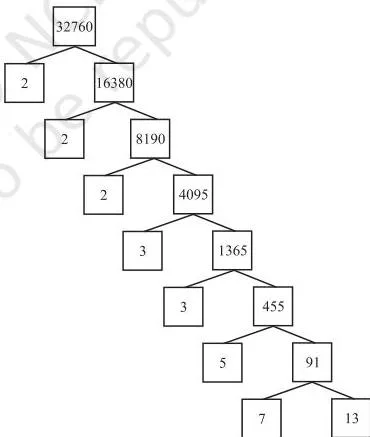
The factor tree above shows how 32760 is broken down until only primes are left, giving \( 32760 = 2^3 \times 3^2 \times 5 \times 7 \times 13 \). Because the factors are written in ascending order, this representation is unique (NCERT p. 4).
The chapter also records the history: an equivalent statement was first recorded as Proposition 14 of Book IX in Euclid’s Elements, but the first correct proof came from Carl Friedrich Gauss in his Disquisitiones Arithmeticae (NCERT p. 3).
HCF and LCM by Prime Factorisation: The Method That Gets Marks
This is where the theorem becomes a calculation you can use. The rule is simple: factorise every number into primes, then pick out the right powers.
- HCF = product of the smallest power of each common prime factor.
- LCM = product of the greatest power of each prime factor involved in the numbers.
These definitions come straight from NCERT page 4. For any two positive integers \( a \) and \( b \), the chapter proves the shortcut \( \text{HCF}(a, b) \times \text{LCM}(a, b) = a \times b \) (NCERT p. 4).
Example 1 — HCF and LCM of 90 and 84 (original numbers):
Step 1: Prime factorise each number in ascending order.
\[ 90 = 2 \times 3^2 \times 5, \qquad 84 = 2^2 \times 3 \times 7 \]
Step 2: HCF = product of the smallest power of each common prime.
The common primes are 2 and 3, and the smallest powers are \( 2^1 \) and \( 3^1 \).
\[ \text{HCF}(90, 84) = 2 \times 3 = 6 \]
Step 3: LCM = product of the greatest power of every prime present.
The greatest powers are \( 2^2, 3^2, 5^1, 7^1 \).
\[ \text{LCM}(90, 84) = 2^2 \times 3^2 \times 5 \times 7 = 1260 \]
Step 4: Verify with the shortcut.
\[ \text{HCF} \times \text{LCM} = 6 \times 1260 = 7560 = 90 \times 84 \]
Final answer: HCF = 6, LCM = 1260, and \( \text{HCF} \times \text{LCM} = 90 \times 84 \), as the theorem requires.
Example 2 — three numbers: 24, 36 and 50 (original numbers):
Step 1: Prime factorise each number.
\[ 24 = 2^3 \times 3, \qquad 36 = 2^2 \times 3^2, \qquad 50 = 2 \times 5^2 \]
Step 2: HCF uses only primes common to all three numbers, with the smallest power.
Only \( 2^1 \) is common to all three.
\[ \text{HCF}(24, 36, 50) = 2 \]
Step 3: LCM takes the greatest power of every prime appearing anywhere.
\[ \text{LCM}(24, 36, 50) = 2^3 \times 3^2 \times 5^2 = 1800 \]
Step 4: Compare the products.
\[ \text{HCF} \times \text{LCM} = 2 \times 1800 = 3600, \qquad 24 \times 36 \times 50 = 43200 \]
Final answer: HCF = 2, LCM = 1800. Notice \( \text{HCF} \times \text{LCM} \neq \) the product of the three numbers — that is exactly the warning NCERT gives on page 5 and in the Note to the Reader on page 9.
When HCF is already known, the two-number relation saves work. For example, Exercise 1.1 Q4 gives \( \text{HCF}(306, 657) = 9 \), so \( \text{LCM}(306, 657) = \dfrac{306 \times 657}{9} = 22338 \).
Revisiting Irrational Numbers: Proofs in Exercise 1.2
This section teaches the technique you need for Exercise 1.2 — proof by contradiction. The idea: assume the opposite of what you want to prove, follow the logic until it forces an impossibility, and conclude the original statement must be true.
Two theorems power every proof in this section. Theorem 1.2 states: if \( p \) is a prime and \( p \) divides \( a^2 \), then \( p \) divides \( a \), where \( a \) is a positive integer (NCERT p. 6). Its proof is a direct use of the Fundamental Theorem of Arithmetic — if \( p \) appears in the factorisation of \( a^2 \), it must already appear in the factorisation of \( a \).
Theorem 1.3 then uses contradiction to prove that \( \sqrt{2} \) is irrational (NCERT p. 6–7).
Every contradiction proof in this chapter follows the same four-move pattern:
- Assume the number is rational, so it equals \( \frac{a}{b} \) with integers \( a \), \( b \neq 0 \).
- Make \( a \) and \( b \) coprime — cancel any common factor. This step is what creates the contradiction later.
- Square both sides and use Theorem 1.2 to show the prime divides \( a \), then substitute \( a = pc \) to force the same prime to divide \( b \).
- Contradiction: \( a \) and \( b \) have a common factor, which contradicts step 2. So the original assumption was wrong.
Worked outline — prove \( \sqrt{5} \) is irrational (Exercise 1.2 Q1, completed in original words so you can compare your attempt):
Step 1: Suppose, to the contrary, that \( \sqrt{5} \) is rational.
Then \( \sqrt{5} = \frac{a}{b} \), where \( b \neq 0 \), and we may take \( a \) and \( b \) to be coprime (no common factor other than 1).
Step 2: Square both sides and rearrange.
\[ 5b^2 = a^2 \]
Step 3: So 5 divides \( a^2 \).
By Theorem 1.2 with \( p = 5 \), 5 divides \( a \).
Write \( a = 5c \) for some integer \( c \).
\[ 5b^2 = (5c)^2 = 25c^2 \; \Rightarrow \; b^2 = 5c^2 \]
- Step 1: So 5 divides \( b^2 \), and again by Theorem 1.2, 5 divides \( b \).
- Step 2: Now 5 divides both \( a \) and \( b \), contradicting the fact that they are coprime.
The assumption was wrong.
Final answer: \( \sqrt{5} \) is irrational.
Exercise 1.2 Q2–3 use the same idea built on known results: the sum of a rational and an irrational is irrational, and the product of a non-zero rational and an irrational is irrational (NCERT p. 8).
Figure Walkthrough: The Two Figures in This Chapter
This short chapter has only two figures, and both earn their place. Here is what each one shows and why the textbook includes it.
Figure 1 (NCERT p. 2) — the factor tree of 32760. The tree splits the number into two factors, then splits those further, and keeps going until every branch ends in a prime. Reading the tips of the branches gives \( 32760 = 2^3 \times 3^2 \times 5 \times 7 \times 13 \).
The figure matters because it shows the factorisation process visually — and the ascending-order writing at the end is what makes the result unique.
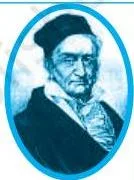
Figure 2 (NCERT p. 3) — portrait of Gauss. The chapter shows why this man belongs in a chapter about prime factorisation: although the statement was known to Euclid, the first correct proof of the Fundamental Theorem of Arithmetic was given by Gauss, alongside Archimedes and Newton one of the three greatest mathematicians of all time.
Definitions You Must Know for Real Numbers Class 10
Use this list to check terms quickly while doing homework — each definition sits on the NCERT page it comes from.
| Term | Meaning | NCERT page |
|---|---|---|
| Prime number | A natural number whose only factors are 1 and itself — e.g. 2, 3, 7, 11, 23. | p. 2 |
| Composite number | A number that can be expressed as a product of primes — the subject of the Fundamental Theorem of Arithmetic. | p. 3 |
| HCF | Product of the smallest power of each common prime factor of the numbers. | p. 4 |
| LCM | Product of the greatest power of each prime factor involved in the numbers. | p. 4 |
| Irrational number | A number that cannot be written as \( \frac{p}{q} \), where \( p \) and \( q \) are integers and \( q \neq 0 \) — e.g. \( \sqrt{2}, \sqrt{3}, \pi \). | p. 6 |
| Coprime numbers | Two integers with no common factor other than 1 — the condition used in every contradiction proof. | p. 7 |
Common Mistakes in This Chapter (and How to Avoid Them)
Each of these errors is one the chapter itself warns about. Read the list before attempting the exercises, and check your working against the right column.
| Mistake | Correct rule | How to check your answer |
|---|---|---|
| Writing the prime factorisation in any order and calling it a different factorisation | Write primes in ascending order — then the factorisation is unique (NCERT p. 4) | Rearrange your factors in increasing order and compare with a classmate’s — they must match exactly |
| Applying \( \text{HCF} \times \text{LCM} = \) product to three numbers | The relation holds for two numbers only; \( \text{HCF}(p,q,r) \times \text{LCM}(p,q,r) \neq p \times q \times r \) (NCERT p. 5, p. 9) | For 24, 36, 50: HCF \( \times \) LCM = 3600 but the product is 43200 — the mismatch shows the rule cannot apply |
| Thinking 1 is a prime factor | 1 is neither prime nor composite; primes start at 2 | If 1 appears in your factorisation, remove it and verify the number is unchanged |
| In proofs, forgetting that \( a \) and \( b \) were made coprime | The contradiction is the common factor — if \( a \) and \( b \) were not coprime, no contradiction follows (NCERT p. 7) | Every proof must end by naming the common factor and the earlier coprime assumption it contradicts |
| Concluding something rational when the premise says irrational | If \( 5 – \sqrt{3} = \frac{a}{b} \), rearranging forces \( \sqrt{3} \) to equal a rational — contradicting the known fact that \( \sqrt{3} \) is irrational (NCERT p. 8) | Finish the rearranged equation and state explicitly which known irrationality it contradicts |
Exam Notes: How to Use This Chapter for Board Preparation
Textbook contents and the examinable syllabus are not always identical — check the current official syllabus to confirm which parts of the chapter are examinable. A note on NCERT page 6 marks the proof of Theorem 1.2 with “not from the examination point of view”, so let the syllabus, not this page, decide how deeply you prepare it.
Here is what each exercise practises, mapped from the NCERT questions themselves:
| Exercise | What it tests | What a full-marks answer includes |
|---|---|---|
| 1.1 Q1 | Prime factorisation of five numbers | Complete factorisation with factors in ascending order |
| 1.1 Q2–3 | HCF and LCM by the prime factorisation method (two and three numbers) | Factorisation shown, HCF and LCM stated separately, verification \( \text{LCM} \times \text{HCF} = \) product where asked |
| 1.1 Q4 | \( \text{HCF} \times \text{LCM} = a \times b \) as a shortcut | Substitution into the relation with the calculation shown |
| 1.1 Q5 | The ‘ends with digit 0’ argument using uniqueness of factorisation | State that ending in 0 means divisibility by 5, then show 5 is not a prime factor of \( 6^n \) |
| 1.1 Q6 | Recognising composite numbers from their factor structure | Factor out the common prime and cite the Fundamental Theorem |
| 1.1 Q7 | Real-life LCM application | Identify the problem as LCM(18, 12) and state the unit (minutes) in the answer |
| 1.2 Q1–3 | Proof by contradiction for irrationality | Assume rational, enforce coprimality, square, apply Theorem 1.2, state the contradiction |
Revising the board syllabus? The full set of Class 10 Mathematics notes is in our CBSE Class 10 Mathematics notes.
Quick Revision Summary of Real Numbers (From NCERT’s Summary)
NCERT’s own summary (p. 9) leaves the chapter with three results. If you remember only these, you have the tools the exercises test:
- Fundamental Theorem of Arithmetic: every composite number can be factorised as a product of primes, and this factorisation is unique apart from the order of the factors.
- Prime divisor rule: if \( p \) is prime and \( p \) divides \( a^2 \), then \( p \) divides \( a \).
- Irrationality results: \( \sqrt{2} \) and \( \sqrt{3} \) are irrational — and the technique extends to \( \sqrt{p} \) for any prime \( p \).
Exercise 1.1 tests the first tool (factorisation, HCF and LCM); Exercise 1.2 tests the second and third (proofs).
Related Resources
This listing is maintained for the 2026-27 academic session using the NCERT textbook information available to us. NCERT remains the authority for confirming the latest edition.
Continue your Class 10 preparation with the Class 10 study hub, the main CBSE notes index, and the next chapter, Polynomials Class 10 notes, which builds directly on factorisation.
Sources and Data Verification
This page describes the NCERT Class 10 Mathematics textbook, Chapter 1 (Real Numbers), official edition on ncert.nic.in. It covers the chapter’s sections, figures and exercises — not the entire CBSE syllabus. It is maintained for the current academic session using NCERT’s published information. NCERT settles textbook editions and content; CBSE settles the curriculum and examinations.
FAQs on Real Numbers Class 10
Is HCF × LCM = product of two numbers always true?
Yes — for any two positive integers \( a \) and \( b \), \( \text{HCF}(a, b) \times \text{LCM}(a, b) = a \times b \) (NCERT p. 4). Exercise 1.1 Q2 asks you to verify it, and Q4 uses it as a shortcut to find LCM.
Does HCF × LCM = product hold for three numbers?
No. NCERT’s Note to the Reader (p. 9) states plainly that \( \text{HCF}(p, q, r) \times \text{LCM}(p, q, r) \neq p \times q \times r \). For example, for 24, 36 and 50, the products are 3600 and 43200 — not equal.
Why can’t \( 4^n \) or \( 6^n \) end with the digit 0?
A number ending in 0 must be divisible by 5, so 5 would have to appear in its prime factorisation. But \( 4^n = 2^{2n} \) contains only the prime 2, and \( 6^n = 2^n \times 3^n \) contains only 2 and 3. By the uniqueness of prime factorisation, 5 can never appear — so no natural number \( n \) works (NCERT p. 4 and Exercise 1.1 Q5).
What is the proof that \( \sqrt{2} \) is irrational?
Assume \( \sqrt{2} = \frac{a}{b} \) with coprime integers \( a, b \). Squaring gives \( 2b^2 = a^2 \), so 2 divides \( a^2 \) and, by Theorem 1.2, 2 divides \( a \). Writing \( a = 2c \) forces \( b^2 = 2c^2 \), so 2 divides \( b \) as well — contradicting coprimality. Hence \( \sqrt{2} \) is irrational (NCERT p. 6–7).
Where can I download the official NCERT Class 10 Maths Chapter 1 Real Numbers PDF?
From the real numbers class 10 NCERT chapter PDF link on ncert.nic.in, which hosts the full official textbook.
Reference: NCERT Class 10 Mathematics textbook, chapter 1, official edition on ncert.nic.in.
Explore Class 10 Mathematics Books
Class 10 Mathematics on LearnCBSE:
Related chapters: