
Here is the pair of linear equations in two variables class 10 chapter — Chapter 3 of the NCERT Class 10 Mathematics textbook, published by NCERT. It runs 14 printed pages starting at page 23, and the official PDF of the current edition is right here.
Use the download to read the chapter itself, then this page to understand every section, method and exercise in it.
Open the official NCERT Class 10 Maths Chapter 3 Pair of Linear Equations in Two Variables PDF straight from ncert.nic.in — the chapter in its original layout, with all examples, exercises and the closing summary included.
| What the chapter holds | Count | Where it is used |
|---|---|---|
| Printed pages | 14 | |
| Sections in the chapter | 6 | |
| Figures with NCERT captions | 2 | |
| Tables | 4 | |
| Worked examples | 2 | solved step by step in our NCERT Solutions |
| Exercise questions | 12 | answered in our NCERT Solutions |
| Official NCERT PDF | Download the chapter PDF | the chapter exactly as NCERT publishes it |
Chapter 3 at a glance
The table below shows what is inside the chapter file — its sections, exercises, figures, examples and question counts.
The chapter moves in this order: 3.1 Introduction, 3.2 Graphical Method followed by Exercise 3.1, 3.3 Algebraic Methods with 3.3.1 Substitution and Exercise 3.2, 3.3.2 Elimination and Exercise 3.3, and it closes with 3.4 Summary. These are the book’s own section headings.
What this chapter covers, section by section
The chapter opens with a real-life puzzle and then builds two ways to solve a pair of linear equations: first by drawing the lines (the graphical method), then by pure algebra (substitution and elimination). The tour below follows the book’s own order, so you always know where you are in the chapter.
Section 3.1: the Giant Wheel and Hoopla problem that opens the chapter
At the fair, Akhila plays Hoopla half as many times as she rides the Giant Wheel; each ride costs ₹3, each Hoopla game ₹4, and she spends ₹20. The book’s move (p. 25) is to name the unknowns: let x be the number of rides and y the number of Hoopla games. The situation becomes two equations:
\[ y = \frac{1}{2}x \quad \text{and} \quad 3x + 4y = 20 \]
You could guess by counting cases — one ride? two rides? — but the book’s point is that guessing is slow and never proves the answer is the only one. A pair of equations is the systematic route, and the whole chapter is about solving that pair.
Turning a word problem into equations — use this checklist, with the quiz problem from Exercise 3.1 (10 students; girls are 4 more than boys):
- Name the unknowns: let x = number of boys, y = number of girls.
- Turn each sentence into an equation: total students gives \( x + y = 10 \); “4 more girls than boys” gives \( y = x + 4 \).
- Write both in the general form \( ax + by + c = 0 \) before comparing ratios: \( x + y – 10 = 0 \) and \( x – y + 4 = 0 \).
- Choose your method, solve, then check the answer against the words of the problem.
Section 3.2: the graphical method and the three possible line pictures
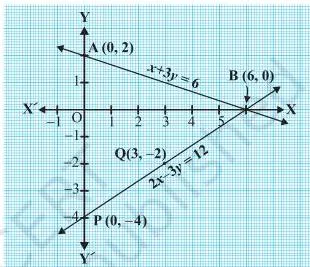
Two straight lines can sit in exactly three ways, and how they sit decides how many solutions the pair has: they intersect once, coincide completely, or stay parallel. The section states the three-case rule (p. 25), builds Table 3.1 comparing the coefficient ratios for all three cases (p. 26), works three examples — including the graph in Fig. 3.1 (p. 27) — and closes with Exercise 3.1.
The detailed reading of the ratio test and Fig. 3.1 comes later on this page.
Section 3.3.1: the substitution method
The book starts this section with a real weakness of graphs: when the solution has coordinates like \( \sqrt{3} \) or awkward fractions, reading them off graph paper invites mistakes (p. 30). Substitution removes the graph entirely — write one variable in terms of the other, put that expression into the second equation, and solve.
The full procedure and a worked example are in the key concepts section below; the section ends with Exercise 3.2.
Section 3.3.2: the elimination method
Elimination makes the coefficients of one variable numerically equal, then adds or subtracts the equations so that variable disappears (Example 8, p. 34). The Remarks at p. 35 add two things worth remembering: you may eliminate x instead of y, and the same problem could also be solved by substitution or by graphs — all three routes must give the same answer.
The section ends with Exercise 3.3, after Examples 9 and 10, which show the no-solution case and a digit problem whose conditions fit two different numbers.
Section 3.4: the chapter’s own summary
The chapter closes with a five-point summary (p. 37): the two methods of solving, the three line pictures with their names, the three coefficient-ratio conditions, and the note that some situations that are not linear to start with can be rearranged into linear pairs. The revision checklist further down this page has remade that summary as tick-boxes.
Key concepts: what a pair of linear equations really means
A single linear equation in two variables has infinitely many solutions — a whole line of them. A pair of equations asks for the point, or points, that the two lines share. Everything in this chapter hangs on that contrast.
The general form and what a solution is
The book writes every equation in the general form \( a_1x + b_1y + c_1 = 0 \), with the second equation using \( a_2, b_2, c_2 \), so the coefficients can be compared directly (p. 26). Here a is the coefficient of x, b the coefficient of y, and c the constant term.
A solution of the pair is an ordered pair (x, y) that satisfies both equations at once. With one equation, any point on its line works; the pair narrows that down to the shared points, which is why the graph of a pair is two lines.
Three ways two lines can lie, and what each gives
These three pictures are the geometry behind the whole chapter (p. 25-26):
| How the lines lie | Common points | Solution | Name |
|---|---|---|---|
| Intersect at one point | Exactly one | Unique solution | Consistent (p. 25-26) |
| Coincide (one line on top of the other) | Every point | Infinitely many | Dependent, always consistent (p. 25) |
| Parallel | None | No solution | Inconsistent (p. 25) |
The ratio test from Table 3.1
Instead of drawing the lines, compare three ratios of the coefficients. Both equations must be in general form, \( a_1x + b_1y + c_1 = 0 \) and \( a_2x + b_2y + c_2 = 0 \) (p. 26):
- \( \frac{a_1}{a_2} \neq \frac{b_1}{b_2} \) — intersecting lines — exactly one solution (unique).
- \( \frac{a_1}{a_2} = \frac{b_1}{b_2} = \frac{c_1}{c_2} \) — coincident lines — infinitely many solutions.
- \( \frac{a_1}{a_2} = \frac{b_1}{b_2} \neq \frac{c_1}{c_2} \) — parallel lines — no solution.
The converse is also true (p. 26): if you already know how the lines lie, the ratios must match the pattern above. Test it on the three pairs in Table 3.1 and you will see each row.
Memory rule. The ratios \( \frac{a_1}{a_2} \) and \( \frac{b_1}{b_2} \) control the tilt of the lines. If the tilts differ, the lines must cross somewhere — so “not equal” means a unique solution. If the tilts match, the lines are parallel or identical; now \( \frac{c_1}{c_2} \) decides.
Same tilt and same c means the same line (infinitely many); same tilt but different c means parallel (none).
Warning: put both equations in the form \( ax + by + c = 0 \) before comparing. The sign of c matters, and Table 3.1 always clears every equation to this form first (p. 26).
Substitution method, step by step
The book’s three steps, in plainer words (p. 30-31):
- From either equation, write one variable in terms of the other. Pick the equation where this is easiest — an x or y with coefficient 1 is ideal.
- Substitute that expression into the other equation. This gives one equation in one variable; solve it.
- Put that value back into the expression from Step 1 to get the second variable.
If Step 2 leaves a statement with no variable at all, stop and read the “true or false” section below: a true statement means infinitely many solutions, a false one means none (p. 31).
Worked example (original numbers): solve \( 4x + 3y = 21 \) and \( x + 2y = 9 \).
- Step 1: The second equation gives \( x = 9 – 2y \), because x already has coefficient 1.
- Step 2: Substitute into the first equation:
\[ 4(9 – 2y) + 3y = 21 \;\Rightarrow\; 36 – 8y + 3y = 21 \;\Rightarrow\; -5y = -15 \;\Rightarrow\; y = 3 \]
Step 3: \( x = 9 – 2(3) = 3 \).
Final answer: \( x = 3,\ y = 3 \). Check: \( 4(3) + 3(3) = 12 + 9 = 21 \) and \( 3 + 2(3) = 3 + 6 = 9 \).
Elimination method, step by step
The book’s four steps (p. 34-35):
- Multiply one or both equations by suitable non-zero constants so the coefficients of one variable are numerically equal.
- Add the equations when those matching coefficients have opposite signs; subtract when they have the same sign. One variable is eliminated.
- Solve the one-variable equation that remains.
- Substitute the value into either original equation to find the second variable.
If Step 2 produces a statement with no variable, apply the same rule as in substitution: true statement means infinitely many solutions; false statement means no solution (p. 35).
Worked example (original numbers): solve \( 3x + 2y = 12 \) and \( 4x – 2y = 2 \).
- Step 1: The y coefficients are already 2 and -2 — numerically equal, so no multiplication is needed.
- Step 2: The signs are opposite, so add the equations: \( 3x + 4x = 12 + 2 \), giving \( 7x = 14 \), so \( x = 2 \).
- Step 3: Substitute into the first equation: \( 3(2) + 2y = 12 \), so \( 2y = 6 \) and \( y = 3 \).
Final answer: \( x = 2,\ y = 3 \). Check in both equations: \( 3(2) + 2(3) = 12 \) and \( 4(2) – 2(3) = 2 \).
The chapter’s tip (p. 35): you could have eliminated x instead, or solved the same pair by substitution or by drawing the graph. All three routes must give (2, 3).
Which method to pick. All three methods always work on a linear pair; this table is about speed (the book notes at p. 35 that any pair can be done by substitution, elimination or graphs):
| Situation | Fastest route |
|---|---|
| A neat graph with integer crossing points is easy to draw | Graphical method |
| One variable already has coefficient 1 or -1 | Substitution — write it in terms of the other (p. 30) |
| Coefficients can be matched by small multipliers | Elimination (p. 34) |
| The answer may involve fractions or surds | Substitution or elimination — graphs read these inaccurately (p. 30) |
| You want to check an answer quickly | Solve again by a different method and compare |
When algebra leaves a true or false statement behind
This is the chapter’s most confusing moment. You substitute or eliminate correctly and, instead of \( x = \) a number, you are left with \( 18 = 18 \) or \( -4 = 0 \). Both variables have vanished — the leftover tells you what the pair of lines looks like.
- True statement, like \( 18 = 18 \) (Example 6, p. 32): the two equations are really the same line drawn twice. Every point of one lies on the other, so there are infinitely many solutions — and no single unique answer exists.
- False statement, like \( -4 = 0 \) (Example 7, p. 33) or \( 0 = 9 \) (Example 9, p. 35): the lines are parallel and never meet, so there is no solution and the pair is inconsistent.
Keep the picture in mind: true statement means one line drawn twice; false statement means parallel lines. The ratio test would have told you the same thing before you started.
Reading the chapter’s figures
Graphs turn the algebra into pictures: each equation is a straight line, and the solution of the pair is where the two lines meet. NCERT prints two figures in this chapter — the fair illustration that opens it, and Fig. 3.1, the graph behind the graphical method. Both are shown below, and each gets a full walkthrough.
Fig. 3.1: the common point of two lines is the answer
This graph is the whole graphical method in one picture (p. 27). The book solves the pair \( x + 3y = 6 \) and \( 2x – 3y = 12 \). Table 3.2 gives two points for each line: for the first equation, \( y = \frac{6 – x}{3} \) produces A(0, 2) and B(6, 0); for the second, \( y = \frac{2x – 12}{3} \) produces P(0, -4) and Q(3, -2).
Joining A to B draws line AB; joining P to Q draws line PQ; the lines cross at B(6, 0).
Why is B the answer? Because it lies on both lines, its coordinates satisfy both equations — check: \( 6 + 3(0) = 6 \) and \( 2(6) – 3(0) = 12 \). One common point means one unique solution, so the pair is consistent; the caption records exactly that: point B(6, 0) is common to both lines AB and PQ.
Rule for graph questions: label the crossing point, state x and y separately, then verify in both equations before writing the final answer.
The fair scene: a word problem as a picture
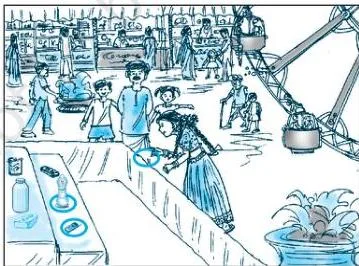
The chapter-opening illustration shows the fair itself — the Giant Wheel ride and the Hoopla stall from the opening problem — and the sentence beside it invites you to “try it by considering different cases” (p. 24). The picture exists to make the word problem concrete before the algebra begins.
Read it with equations: if x is the number of rides and y the number of Hoopla games, the scene becomes \( y = \frac{1}{2}x \) and \( 3x + 4y = 20 \) (p. 25). The picture is the problem; the equations, graph and algebraic methods that follow are the machinery that solves it.
Definitions to keep straight: consistent, inconsistent, dependent
Consistent, inconsistent and dependent are the chapter’s words for whether two lines have one, zero or infinitely many common points. These terms appear again in the exercises (for example, Exercise 3.1 Q3 and Q4), so get them exact.
| Term | Plain meaning | Line picture | Where defined |
|---|---|---|---|
| Consistent pair | Has at least one solution — the two equations can be true together | Intersecting or coincident lines | p. 25-26 |
| Inconsistent pair | Has no solution — no (x, y) satisfies both equations | Parallel lines | p. 25 |
| Dependent pair | The equations are equivalent, so every point of one line lies on the other; infinitely many common solutions | Coincident lines | p. 25 |
One trap: a dependent pair is always consistent (p. 25) — coincident lines clearly have common points, infinitely many of them. The chapter’s summary (p. 37) lists all three cases using the same terms.
The formulas and ratio conditions on one page
This chapter has almost no plug-in formulas — its working tools are the three coefficient comparisons and two algebraic procedures. Everything you must recall fits here.
Table 1 — General form. Every equation in the chapter is written as \( a_1x + b_1y + c_1 = 0 \) and \( a_2x + b_2y + c_2 = 0 \), where a, b, c are the coefficient of x, the coefficient of y, and the constant term respectively (p. 26).
Table 2 — The three ratio conditions (p. 26), with both equations in general form:
| Ratio comparison | Line picture | Number of solutions | Classification |
|---|---|---|---|
| \( \frac{a_1}{a_2} \neq \frac{b_1}{b_2} \) | Intersecting | Exactly one | Consistent |
| \( \frac{a_1}{a_2} = \frac{b_1}{b_2} = \frac{c_1}{c_2} \) | Coincident | Infinitely many | Dependent (consistent) |
| \( \frac{a_1}{a_2} = \frac{b_1}{b_2} \neq \frac{c_1}{c_2} \) | Parallel | None | Inconsistent |
Table 3 — The two algebraic procedures, side by side:
| Substitution (p. 30-31) | Elimination (p. 34-35) |
|---|---|
| 1. Express one variable in terms of the other. | 1. Multiply one or both equations to make one pair of coefficients numerically equal. |
| 2. Substitute into the other equation and solve. | 2. Add (opposite signs) or subtract (same signs) to eliminate that variable. |
| 3. Back-substitute to find the second variable. | 3. Solve the one-variable equation; 4. substitute back into either original equation. |
Common mistakes in this chapter and how to avoid them
Most wrong answers here come from a handful of repeatable slips, not from not knowing the method. The table names each mistake before you make it, with the fix and a way to check yourself.
| Mistake | Correct rule | How to check your answer |
|---|---|---|
| Comparing ratios before both equations are in the form \( ax + by + c = 0 \), so the constant’s sign is wrong. | Rewrite each equation with everything on one side first. Table 3.1 always does this before comparing (p. 26). | Recompute \( \frac{c_1}{c_2} \) with corrected signs; e.g. \( 3x + 4y = 20 \) has \( c = -20 \). |
| Misreading the leftover statement — treating \( 18 = 18 \) as “no answer”. | True statement (\( 18 = 18 \), Example 6, p. 32) means infinitely many solutions; false statement (\( -4 = 0 \), p. 33; \( 0 = 9 \), p. 35) means no solution. | Cross-check with the ratio test: are all three ratios equal, or only the first two? |
| Age problems shifting only one age. | “Seven years ago” subtracts from BOTH ages: \( (s – 7) = 7(t – 7) \), not \( s – 7 = 7t \) (Example 5, p. 31). | Put your ages back into the sentence, not just the equation. |
| Elimination slips: forgetting to multiply the constant term, or subtracting when the signs are opposite. | Multiply every term of the equation, constant included. Add when matching coefficients have opposite signs; subtract when they are the same (Example 8, p. 34 subtracts because both y coefficients are -12). | Substitute the answer into both original equations and check each. |
| Reading the graph: guessing the crossing point by eye. | Mark the intersection, write x and y separately, and verify both in the equations (Example 1, p. 27). | For Fig. 3.1: \( 6 + 3(0) = 6 \) and \( 2(6) – 3(0) = 12 \) — the point really is (6, 0). |
Age problems, properly: both ages move together through time. In Example 5 (p. 31) Aftab says, “Seven years ago, I was seven times as old as you were then.” With s = Aftab’s age and t = his daughter’s age, that sentence is \( s – 7 = 7(t – 7) \): seven years ago Aftab was \( s – 7 \) and his daughter was \( t – 7 \).
“Three years from now, I shall be three times as old as you will be” is \( s + 3 = 3(t + 3) \). Solving gives the book’s answer: \( s = 42, t = 12 \). Check against the words: seven years ago they were 35 and 5 (7 times 5 = 35, correct); three years from now they will be 45 and 15 (3 times 15 = 45, correct).
Using this chapter for exam preparation
The exercises in this chapter train two skills that matter most in any test: classifying a pair of equations quickly, and translating a word problem into equations. Here is what each exercise is for, so you can revise purposefully. (This page makes no predictions about questions or marks.)
- Ratio test: Exercise 3.1 Q2 and Q3 drill the three comparisons until classifying any pair is instant. Q6 asks you to write a second equation that makes the pair intersecting, parallel or coincident — put your answer in general form and check the ratios against Table 3.1 before finishing.
- Word problems: Exercise 3.2 Q3 and Exercise 3.3 Q2 are slow-reveal problems — forming the two equations correctly is half the answer. Use the checklist from Section 3.1 above.
- Method check: Exercise 3.3 Q1 asks for the same pairs solved by both elimination and substitution. That is a built-in verification: the two methods must agree, so use one to check the other.
- Graph work: Exercise 3.1 Q1, Q4 and Q7 are graphical. Plot accurately, label the intersection, and verify it in both equations. Q7 adds finding the triangle vertices formed with the x-axis.
- Textbook contents and the examinable syllabus are not always identical — check the current official syllabus for what applies to your board examination.
Revision checklist for the chapter
This checklist rewrites the chapter’s own summary (p. 37) into things you can tick off the night before.
- I can solve a pair of linear equations by the graphical method and by an algebraic method.
- I know the graph of a pair of linear equations is two lines.
- Intersecting lines give a unique solution — the pair is consistent.
- Coincident lines give infinitely many solutions — the pair is dependent (consistent).
- Parallel lines give no solution — the pair is inconsistent.
- I can apply the substitution method and the elimination method correctly.
- For \( a_1x + b_1y + c_1 = 0 \) and \( a_2x + b_2y + c_2 = 0 \): \( \frac{a_1}{a_2} \neq \frac{b_1}{b_2} \) means consistent; \( \frac{a_1}{a_2} = \frac{b_1}{b_2} \neq \frac{c_1}{c_2} \) means inconsistent; \( \frac{a_1}{a_2} = \frac{b_1}{b_2} = \frac{c_1}{c_2} \) means dependent and consistent.
- I know that some situations which are not linear to start with can be rearranged to reduce to a pair of linear equations.
Related chapters and resources
This chapter assumes you can handle a single linear equation from Class 9 and feeds directly into solving quadratic equations. Useful next steps:
- NCERT Class 10 Maths Chapter 2 Polynomials — the previous chapter; it covers the graphs and zeroes you need for drawing lines.
- NCERT Class 10 Maths Chapter 4 Quadratic Equations — the next chapter, which applies the same algebraic techniques to quadratics.
- All NCERT Class 10 Mathematics chapters — the set of chapter pages and notes for this book.
- Class 10 study material — notes across subjects for Class 10.
- CBSE notes home — notes for all classes and subjects.
Sources and data verification
- The section names, page numbers and figure references on this page describe the NCERT Class 10 Mathematics textbook, Chapter 3 “Pair of Linear Equations in Two Variables”, official edition published by NCERT and available on ncert.nic.in.
- This page covers that single chapter. It does not reproduce the chapter text, and it does not cover the remaining chapters of the Class 10 Mathematics book.
- This listing is maintained for the current academic session using the NCERT information available to us.
- NCERT settles textbooks, editions and PDFs; CBSE settles the curriculum, syllabus and examinations. Textbook contents and the examinable syllabus are not always identical — check the current official syllabus. This page has not been reviewed by external subject experts.
Frequently asked questions about this chapter
How can I tell whether a pair of linear equations has a unique solution, no solution or infinitely many solutions?
Put both equations in general form and compare the three ratios (p. 26): \( \frac{a_1}{a_2} \neq \frac{b_1}{b_2} \) means a unique solution; \( \frac{a_1}{a_2} = \frac{b_1}{b_2} = \frac{c_1}{c_2} \) means infinitely many; \( \frac{a_1}{a_2} = \frac{b_1}{b_2} \neq \frac{c_1}{c_2} \) means none. Graphically, the lines intersect, coincide or stay parallel.
What is the difference between a consistent and an inconsistent pair of linear equations?
A consistent pair has at least one solution — the lines meet at a point or lie on top of each other. An inconsistent pair has no solution: the lines are parallel (p. 25). Every dependent pair is consistent.
When should I use the substitution method and when the elimination method?
Substitution is quickest when one variable already has coefficient 1 or -1, so you can write it in terms of the other in one line (p. 30). Elimination is quickest when small multipliers make the coefficients of one variable match (p. 34). Both methods always work, and the book notes any linear pair can also be solved graphically (p. 35).
Why do I get 18 = 18 or -4 = 0 while solving a pair of equations, and what do these statements mean?
Both variables have been eliminated. A true leftover, like \( 18 = 18 \) (Example 6, p. 32), means the two equations are the same line, so there are infinitely many solutions. A false leftover, like \( -4 = 0 \) (Example 7, p. 33) or \( 0 = 9 \) (Example 9, p. 35), means the lines are parallel and there is no solution.
What is a dependent pair of linear equations?
A dependent pair is one in which the two equations are equivalent — every solution of one is a solution of the other — so the lines coincide and there are infinitely many common solutions (p. 25). Example from the book: \( 2x + 3y – 9 = 0 \) and \( 4x + 6y – 18 = 0 \) (Table 3.1, p. 26). A dependent pair is always consistent.
Where can I download the official NCERT Class 10 Maths Chapter 3 PDF?
From ncert.nic.in. The link at the top of this page — NCERT Class 10 Maths Chapter 3 Pair of Linear Equations in Two Variables PDF — opens the official NCERT edition of the chapter (current reprint 2026-27).
Reference: NCERT Class 10 Mathematics textbook, chapter 3, official edition on ncert.nic.in.
Explore Class 10 Mathematics Books
- Previous: Polynomials
- Next: Quadratic Equations
Class 10 Mathematics on LearnCBSE:
Related chapters:
- Real Numbers
- Arithmetic Progressions
- Triangles 6