
This is the NCERT Class 10 Mathematics chapter Surface Areas and Volumes 12 — the chapter on finding surface areas, volumes and capacities of objects made by joining two or more basic solids.
The official Surface Areas and Volumes 12 Class 10 PDF is right below. This page tells you what the chapter contains, which rule to use at the joints, and where students lose marks.
The chapter runs about 10 printed pages, and this page is maintained for the current academic session. Use the table of contents below to jump straight to the formula sheet, the common mistakes table or the FAQs.
Download the Surface Areas and Volumes 12 Class 10 PDF
The official file is published on the NCERT website, so it matches the printed textbook exactly. Open the Surface Areas and Volumes 12 Class 10 PDF when you want the full chapter text, diagrams and exercises in front of you, and keep this page open for the explanations and the step-by-step solving routine.
| What the chapter holds | Count | Where it is used |
|---|---|---|
| Printed pages | 10 | |
| Sections in the chapter | 4 | |
| Figures with NCERT captions | 12 | |
| Exercise questions | 17 | answered in our NCERT Solutions |
| Official NCERT PDF | Download the chapter PDF | the chapter exactly as NCERT publishes it |
Chapter 12 at a glance
In reading order, the chapter moves through:
- 12.1 Introduction — the Class IX solids and the everyday objects they form when joined
- 12.2 Surface Area of a Combination of Solids
- Exercise 12.1
- 12.3 Volume of a Combination of Solids
- Exercise 12.2
- 12.4 Summary
The two skills arrive in that order, and they follow different rules at the joints: surface area loses hidden faces, while volume adds everything. The table below lists what the chapter contains — its sections, figures, worked examples and exercise questions.
What this chapter covers, and why combined solids are different
The chapter takes the solids you already know — cuboid, cone, cylinder and sphere, with the hemisphere joining them as the fifth building block — and asks what happens to their surface areas and volumes when they are joined together (NCERT, p. 161).
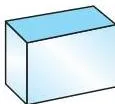
Fig. 12.1 is the starting point. These are the four solids you measured in Class IX. A truck with an oil container (Fig. 12.2) is not a fifth kind of solid — it is a cylinder closed at each end by a hemisphere. A test tube is the same idea with two parts: a cylinder standing on a hemisphere (Fig. 12.3).
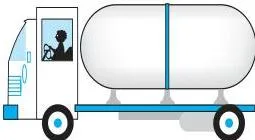
The chapter’s whole point is that such objects cannot be classified as a single basic solid (NCERT, p. 161). The method is to split each object into the parts you already know how to measure — that split is the one skill every problem in the chapter reuses.
How to find the surface area of a combined solid
The rule in one sentence: when two solids are joined, the faces that touch each other disappear from the outside, so the surface area of the combined solid is the sum of only the curved surfaces that remain visible (NCERT, p. 162).

Fig. 12.4 shows the container of Fig. 12.2 as a cylinder with a hemisphere stuck to each end. Looking at the assembled object, you can see the curved surface of the cylinder and the curved surfaces of the two hemispheres — and nothing else, so:
\[ \text{TSA of new solid} = \text{CSA of one hemisphere} + \text{CSA of cylinder} + \text{CSA of other hemisphere} \]
TSA and CSA stand for Total Surface Area and Curved Surface Area (NCERT, p. 162). The flat circular faces where the parts meet are counted nowhere.
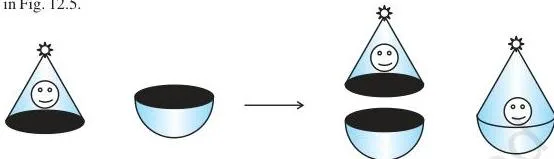
Now take the toy of Fig. 12.5: a cone placed on a hemisphere. For the toy to have a smooth surface, the base radius of the cone must equal the radius of the hemisphere — otherwise there is a step at the joint (NCERT, p. 163). The surface area is then CSA of the hemisphere plus CSA of the cone.
Worked example (original numbers): A cone of radius 3 cm and slant height 5 cm rests on a hemisphere of the same radius 3 cm.
Find the total surface area of the toy.
Use \(\pi = 3.14\).
Step 1: Both curved surfaces are visible, so TSA of the toy = CSA of hemisphere + CSA of cone.
\[ \text{CSA of hemisphere} = 2\pi r^2 = 2 \times 3.14 \times (3)^2 = 2 \times 3.14 \times 9 = 56.52\ \text{cm}^2 \]
Step 2: The slant height is given as 5 cm, so no Pythagoras step is needed.
\[ \text{CSA of cone} = \pi r l = 3.14 \times 3 \times 5 = 47.1\ \text{cm}^2 \]
Step 3: Add the two curved areas.
\[ \text{TSA of the toy} = 56.52 + 47.1 = 103.62\ \text{cm}^2 \]
Final answer: \( 103.62\ \text{cm}^2 \).
Notice what was not added: the total surface area of the toy is not the sum of the total surface areas of the cone and hemisphere. NCERT’s Example 1 ends with exactly this warning (NCERT, p. 164) — the cone’s base and the hemisphere’s top have merged into the joint and are invisible.
Joints, rings and depressions: surfaces that appear or disappear
These are the problems where students lose marks, because the surface area of a combined solid is not always two curved areas added together. Three NCERT examples cover the extras.
Case 1: a hemisphere on a cube — the joint removes one circle
In Example 2 (NCERT, p. 164) a hemisphere of diameter 4.2 cm sits on a cube of edge 5 cm. Start with the cube’s TSA, \(6 \times 5^2 = 150\ \text{cm}^2\). The circle where the hemisphere sits is covered, so subtract its area \(\pi r^2\), then add the hemisphere’s curved surface \(2\pi r^2\):
\[ \text{TSA of block} = 150 – \pi r^2 + 2\pi r^2 = 150 + \pi r^2 \approx 163.86\ \text{cm}^2 \]
Case 2: a cone over a smaller cylinder — an exposed ring appears
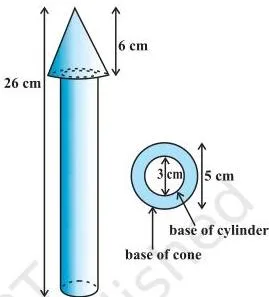
Example 3 (NCERT, p. 165) is a wooden toy rocket: a cone of base radius 2.5 cm mounted on a cylinder of radius 1.5 cm. Because the cone is wider than the cylinder, a ring of the cone’s base remains visible and must be painted orange. The orange area is:
\[ \text{Orange area} = \pi r l + \pi r^2 – \pi (r’)^2 \]
with \(r = 2.5\ \text{cm}\), \(r’ = 1.5\ \text{cm}\), and slant height \(l = \sqrt{2.5^2 + 6^2} = 6.5\ \text{cm}\). That gives \(3.14 \times 20.25 = 63.585\ \text{cm}^2\).
Case 3: a bird-bath — the depression still has a surface
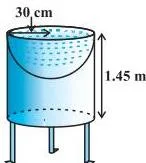
Example 4 (NCERT, p. 166) is a cylinder of height 1.45 m and radius 30 cm with a hemispherical depression scooped from one end. The hollow is not empty air: its curved wall is still part of the visible surface, so:
\[ \text{TSA of bird-bath} = 2\pi r h + 2\pi r^2 = 2\pi r (h + r) \]
The trap is the units. Convert 1.45 m to 145 cm first: \(2 \times \frac{22}{7} \times 30 \times (145 + 30) = 33000\ \text{cm}^2 = 3.3\ \text{m}^2\).
How to find the volume of a combined solid
The volume rule differs from the surface area rule at the joints: when faces disappear from the surface, the material behind them does not disappear. The volume of a combined solid is the sum of the volumes of its parts (NCERT, p. 167).
Shed: cuboid plus half cylinder (Example 5)
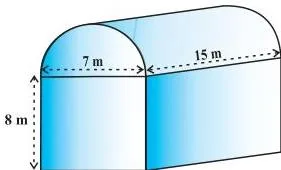
Fig. 12.12 shows a shed whose walls are a cuboid \(15\ \text{m} \times 7\ \text{m} \times 8\ \text{m}\) and whose roof is half a cylinder of diameter 7 m and length 15 m. The air the shed can hold is:
\[ 15 \times 7 \times 8 + \frac{1}{2}\left( \frac{22}{7} \times (3.5)^2 \times 15 \right) = 840 + 288.75 = 1128.75\ \text{m}^3 \]
The example then subtracts what occupies that air: \(300\ \text{m}^3\) of machinery plus 20 workers at \(0.08\ \text{m}^3\) each, leaving \(1128.75 – 301.6 = 827.15\ \text{m}^3\) (NCERT, p. 168).
Juice glass: apparent versus actual capacity (Example 6)
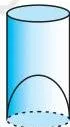
Fig. 12.13 shows a cylindrical glass with a raised hemisphere at the bottom. The apparent capacity is the full geometric volume of the cylinder, \(3.14 \times (2.5)^2 \times 10 = 196.25\ \text{cm}^3\). The raised hemisphere occupies space the juice cannot fill, so subtract its volume, \(\frac{2}{3} \times 3.14 \times (2.5)^3 = 32.71\ \text{cm}^3\). The actual capacity is \(196.25 – 32.71 = 163.54\ \text{cm}^3\) (NCERT, p. 168).
Toy inside a circumscribing cylinder (Example 7)
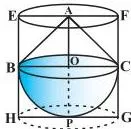
Fig. 12.14 gives a toy that is a hemisphere of radius 2 cm with a cone of height 2 cm on top. The toy’s volume is \(\frac{2}{3}\pi r^3 + \frac{1}{3}\pi r^2 h = 25.12\ \text{cm}^3\). The cylinder that exactly surrounds it has radius 2 cm and height \(2 + 2 = 4\) cm, so its volume is \(3.14 \times 2^2 \times 4 = 50.24\ \text{cm}^3\). The difference is \(50.24 – 25.12 = 25.12\ \text{cm}^3\) (NCERT, p. 169).
Worked example (original numbers): A solid is made by placing a cone of radius 4 cm and height 9 cm on a hemisphere of radius 4 cm.
Find the volume of the solid.
Use \(\pi = 3.14\).
Step 1: The shared radius is 4 cm, so the parts join exactly.
For volume, nothing is lost at the joint.
\[ \text{Volume of hemisphere} = \frac{2}{3}\pi r^3 = \frac{2}{3} \times 3.14 \times (4)^3 = \frac{2}{3} \times 3.14 \times 64 = 133.97\ \text{cm}^3 \]
Step 2: The cone’s height is given as 9 cm.
\[ \text{Volume of cone} = \frac{1}{3}\pi r^2 h = \frac{1}{3} \times 3.14 \times (4)^2 \times 9 = \frac{1}{3} \times 3.14 \times 16 \times 9 = 150.72\ \text{cm}^3 \]
Step 3: Add the two volumes.
\[ \text{Total volume} = 133.97 + 150.72 = 284.69\ \text{cm}^3 \]
Final answer: \( 284.69\ \text{cm}^3 \).
Reading the figures: what to look for in each diagram
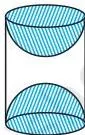
Each diagram in the chapter shows one structural fact about the joint. Two figures below are new — the test tube and the capsule — and the table collects the teaching point of every key figure at a glance.
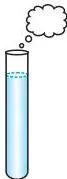
Fig. 12.3 (NCERT, p. 162) is the test tube. Read it as a cylinder resting on a hemisphere: the two solids share one circular face, and that shared circle is exactly what disappears from the surface area.
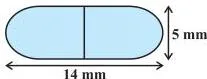
Fig. 12.10 (NCERT, p. 166) is the medicine capsule, 14 mm long and 5 mm in diameter. Two hemispheres cap a cylinder, so the cylinder’s length is \(14 – 5 = 9\) mm; the two hemispheres together form one sphere, contributing \(4\pi r^2\).
| Figure | NCERT page | What the diagram is there to show |
|---|---|---|
| Fig. 12.3 | 162 | Test tube = cylinder + hemisphere sharing one circular face |
| Fig. 12.4 | 162 | Container split into cylinder + two hemispheres; only curved surfaces show |
| Fig. 12.5 | 163 | Cone and hemisphere joined face to face; equal radii give a smooth surface |
| Fig. 12.8 | 165 | Rocket: cone base wider than cylinder top, so a ring of the cone base remains visible |
| Fig. 12.9 | 166 | Bird-bath: the hemispherical depression still has a curved surface to count |
| Fig. 12.10 | 166 | Capsule: cylinder length is the total length minus one full diameter |
| Fig. 12.12 | 167 | Shed: cuboid + half cylinder, added for volume |
| Fig. 12.13 | 168 | Juice glass: the raised hemisphere is the part subtracted from apparent capacity |
| Fig. 12.14 | 169 | Toy in a circumscribing cylinder: cylinder height = cone height + hemisphere radius |
Terms you need for this chapter
These are the labels the chapter uses, and confusing two of them is where mistakes start.
| Term | What it means in this chapter |
|---|---|
| TSA | Total Surface Area — the area of the whole outside of a solid (NCERT, p. 162) |
| CSA | Curved Surface Area — the area of the curved part only, without flat bases (NCERT, p. 162) |
| Slant height (l) | The distance along a cone’s sloping surface from apex to the rim; \( l = \sqrt{r^2 + h^2} \) (NCERT, p. 164) |
| Capacity | The volume a vessel can hold |
| Apparent capacity | The full geometric volume of a vessel, as if its inside were empty (NCERT, p. 168) |
| Actual capacity | Apparent capacity minus the volume of any raised part inside the vessel (NCERT, p. 168) |
Formula sheet for Chapter 12
This chapter introduces no new formulas for individual solids — it reuses the Class IX formulas and adds the rule for what to add or subtract at the joints.
| Solid | Curved surface area | Total surface area | Volume |
|---|---|---|---|
| Cuboid (l × b × h) | \( 2h(l + b) \) | \( 2(lb + bh + hl) \) | \( lbh \) |
| Cube (edge a) | \( 4a^2 \) | \( 6a^2 \) | \( a^3 \) |
| Cylinder (radius r, height h) | \( 2\pi rh \) | \( 2\pi r(r + h) \) | \( \pi r^2 h \) |
| Cone (radius r, height h, slant height l) | \( \pi r l \) | \( \pi r (l + r) \) | \( \frac{1}{3}\pi r^2 h \) |
| Sphere (radius r) | \( 4\pi r^2 \) | \( 4\pi r^2 \) | \( \frac{4}{3}\pi r^3 \) |
| Hemisphere (radius r) | \( 2\pi r^2 \) | \( 3\pi r^2 \) | \( \frac{2}{3}\pi r^3 \) |
Here r is the radius, h the height, l the slant height of a cone and a the edge of a cube. Areas come out in square units, volumes in cubic units.
The two chapter rules sit on top of this table:
- For the surface area of a combined solid, add the curved surface areas of the parts that remain visible.
- For the volume of a combined solid, add the volumes of all its parts.
Common mistakes in combined solids problems
Every error below is one NCERT’s own examples flag. Read the correction before you need it.
| Mistake | Correct rule | How to check your answer |
|---|---|---|
| Adding the total surface areas of the parts | Add only the curved surface areas that remain visible after joining (NCERT, p. 164) | Cover the joint with your finger: the hidden faces must not appear in your sum |
| Forgetting that the joint face is hidden | Subtract the covered circle from the lower solid: cube + hemisphere gives \( 150 – \pi r^2 + 2\pi r^2 \) (NCERT, p. 164) | Check that you subtracted one circular area for the covered face, then added the curved surface on top |
| Ignoring the exposed ring when the upper base is larger | Add the cone’s base area and subtract the cylinder’s base area: \( \pi r l + \pi r^2 – \pi (r’)^2 \) (NCERT, p. 165) | Compare the two base radii: if \( r \gt r’ \), a ring is visible and must be painted |
| Ignoring a raised part when finding capacity | Actual capacity = apparent capacity − volume of the raised part (NCERT, p. 168) | Ask whether the part sticks up inside the vessel (subtract it from capacity) or is hollowed out of a solid (subtract it from the solid’s volume) |
| Mixing units in one formula | Convert every length to one unit before substituting (NCERT, p. 166) | Write 1.45 m as 145 cm and 30 cm as is, then check that all lengths share the same unit |
| Using the diameter where the formula needs the radius | Halve the diameter first: \( r = \frac{d}{2} \) (NCERT, p. 163) | For a diameter of 3.5 cm, use 1.75 cm in every formula |
Exam notes: a reliable order for solving combined solids problems
Combined solid problems stop being confusing when you work in a fixed order. Run through these nine steps for every question:
- Name the basic solids in the object (cylinder, cone, hemisphere, cuboid).
- Mark the shared radius — the radius of the circular joint, common to both parts.
- Find any missing slant height with \( l = \sqrt{r^2 + h^2} \), taking h as the height of the conical part only.
- Decide the question type: surface area or volume?
- For surface area, list the visible curved surfaces; for volume, list every part.
- Note what to subtract: a covered face, a hidden ring, a raised part inside a vessel.
- Use the π value the question gives — \( \frac{22}{7} \) or 3.14 — and carry it through.
- Convert all lengths to one unit before substituting.
- Write the final unit: square units for area, cubic units for volume.
The chapter splits cleanly: Exercise 12.1, after Section 12.2, practises surface area of combined solids; Exercise 12.2, after Section 12.3, practises volume.
One honest note: textbook contents and the examinable syllabus are not always identical, so check the current official syllabus for what is examinable this year.
The two rules that carry the chapter
The whole chapter rests on two rules, which NCERT’s own Summary states at the end of the chapter (NCERT, p. 170):
- Rule one — surface area. To find the surface area of an object made by combining any two basic solids, add the surface areas of the parts that are visible.
- Rule two — volume. To find the volume of the same object, add the volumes of the constituent parts.
If you need the individual solid formulas, scroll back to the formula sheet above — the two rules decide what to add or subtract, and the formula sheet supplies the pieces.
Related chapters and resources
This listing is maintained for the 2026-27 academic session using the NCERT textbook information available to us. NCERT remains the authority for confirming the latest edition.
Surface areas of cylinders and cones build directly on circles, so if the formulas feel shaky, revisit the previous chapter, Areas Related to Circles Class 10. The next chapter in the book is Statistics.
For the whole book, use the Class 10 Mathematics notes or the Class 10 hub, and browse other subjects from the CBSE notes home. The authoritative source for the chapter itself is the NCERT portal at ncert.nic.in, which publishes the official chapter PDF used above.
Sources and data verification
The counts and figures on this page describe the NCERT Class 10 Mathematics textbook, Chapter 12, “Surface Areas and Volumes”, in the official edition published on ncert.nic.in.
This page covers that single chapter of that single book; it is not a listing of the CBSE scheme of subjects.
Textbook contents and the examinable syllabus are not always identical, so confirm what is examinable in the current official CBSE syllabus.
NCERT settles textbooks, editions and PDFs; CBSE settles curriculum, syllabus and examinations.
Reference: NCERT Class 10 Mathematics textbook, chapter 12, official edition on ncert.nic.in.
Frequently asked questions about Surface Areas and Volumes Class 10
Why is the surface area of a combined solid not the sum of the total surface areas of its parts?
Because the faces that join the solids are covered and stop being part of the outside. When a cone sits on a hemisphere, the cone’s circular base is hidden by the hemisphere, so counting it again double-counts the joint.
The surface area of a combined solid is the sum of the curved surface areas of the parts that remain visible (NCERT, p. 164).
How do I find the slant height of a cone in a combined solid?
Use \( l = \sqrt{r^2 + h^2} \), where r is the cone’s base radius and h is the height of the conical part only. If the cone is mounted on a hemisphere, subtract the hemisphere’s radius from the total height to get the cone’s height — NCERT’s Example 1 does exactly this: \( 5 – \frac{3.5}{2} = 3.25\ \text{cm} \), giving \( l \approx 3.7\ \text{cm} \) (NCERT, p. 164).
What is the difference between apparent capacity and actual capacity of a vessel?
Apparent capacity is the volume the vessel would hold if its inside were a plain geometric solid; actual capacity is that volume minus the volume of any part that rises up inside it.
In the juice glass of Example 6, the apparent capacity was \( 196.25\ \text{cm}^3 \) and the raised hemisphere took up \( 32.71\ \text{cm}^3 \), so the actual capacity was \( 163.54\ \text{cm}^3 \) (NCERT, p. 168).
When a solid is dropped into a cylinder full of water, how do I find the water that overflows?
The overflow equals the volume of the solid that goes under the water. The water left in the cylinder is the cylinder’s volume minus the solid’s volume. Exercise 12.2, Question 7 uses this for a cone-on-hemisphere placed in a full cylinder: you subtract the combined volume of the solid from the cylinder’s volume.
Which exercise in this chapter covers surface area and which covers volume?
Exercise 12.1, which closes Section 12.2, practises surface area of combined solids. Exercise 12.2, which closes Section 12.3, practises volume of combined solids. Each exercise assumes \(\pi = \frac{22}{7}\) unless the question states a different value.
Explore Class 10 Mathematics Books
Class 10 Mathematics on LearnCBSE:
Related chapters: