
These Coordinate Geometry Class 10 notes cover every formula and concept you need for the 2026-27 board exams: the distance formula, the section formula, midpoints, and collinearity. Use them as your night-before revision page.
Coordinate Geometry Basics: Abscissa, Ordinate and the Plane
Every point on a coordinate plane is described by an ordered pair \((x, y)\) (NCERT, p. 100). The x-coordinate, or abscissa, is the distance from the y-axis. The y-coordinate, or ordinate, is the distance from the x-axis.
- A point on the x-axis has coordinates \((x, 0)\).
- A point on the y-axis has coordinates \((0, y)\).
Chapter Overview: What You Will Learn
This chapter uses algebra as a tool to study geometry (NCERT, p. 100). You learn two formula families: one to find the length between two points, and one to find the coordinates of a point dividing a segment in a ratio.
| Concept | Formula | Typical exam use |
|---|---|---|
| Distance between two points | \( \sqrt{(x_2-x_1)^2+(y_2-y_1)^2} \) | Classify triangles, check collinearity |
| Section formula | \( \left( \frac{m_1x_2 + m_2x_1}{m_1+m_2}, \frac{m_1y_2 + m_2y_1}{m_1+m_2} \right) \) | Find a point dividing a segment, midpoints |
Distance Formula: Finding Length Between Two Points
The distance formula comes from the Pythagoras theorem (NCERT, p. 102). For two points \( P(x_1, y_1) \) and \( Q(x_2, y_2) \), you build a right triangle with base \( PT = x_2 – x_1 \) and height \( QT = y_2 – y_1 \). Because \( PQ^2 = PT^2 + QT^2 \), the hypotenuse is the distance.
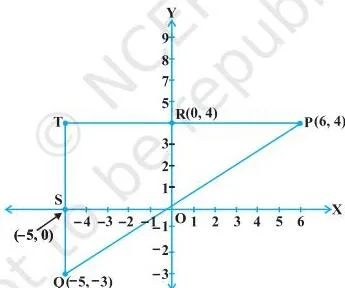
\[ PQ = \sqrt{(x_2 – x_1)^2 + (y_2 – y_1)^2} \]
For the distance from the origin \( O(0,0) \), the formula becomes \( OP = \sqrt{x^2 + y^2} \) (NCERT, p. 102).
Key Definitions in Coordinate Geometry
| Term | Meaning | Example |
|---|---|---|
| Abscissa | The x-coordinate; distance from the y-axis | In the point (5, -2), the abscissa is 5 |
| Ordinate | The y-coordinate; distance from the x-axis | In the point (5, -2), the ordinate is -2 |
| Collinear points | Points lying on the same straight line; checked by showing \( AB + BC = AC \) | For points A, B, C, if AB=3, BC=4, AC=7, they are collinear |
| Distance formula | The length of the straight line segment joining two given points | Distance between (1,3) and (4,7) is 5 |
| Section formula | Coordinates of a point dividing a line segment internally in a given ratio | A point dividing a segment in ratio 1:2 |
| Mid-point | The point that divides a segment in the ratio 1:1 | Midpoint of (2,4) and (4,6) is (3,5) |
Formulas and Symbol Meanings
Here is a single reference block for every formula in the chapter. Note that distance is always positive; you take only the positive square root (NCERT, p. 102).
| Formula | What it finds | Symbols used |
|---|---|---|
| \( PQ = \sqrt{(x_2-x_1)^2+(y_2-y_1)^2} \) | Distance between two points | \( (x_1,y_1), (x_2,y_2) \) are the coordinates of P and Q |
| \( OP = \sqrt{x^2+y^2} \) | Distance of a point from the origin | \( (0,0) \) is the origin, \( (x,y) \) is the point |
| \( \left( \frac{m_1x_2+m_2x_1}{m_1+m_2}, \frac{m_1y_2+m_2y_1}{m_1+m_2} \right) \) | Internal division of a segment | P divides AB such that \( PA:PB = m_1:m_2 \) |
| \( \left( \frac{x_1+x_2}{2}, \frac{y_1+y_2}{2} \right) \) | Midpoint of a segment | Ratio \( m_1:m_2 \) is 1:1 |
Worked Example: Identifying a Right Triangle using Distance
- Step 1: The method is triangle classification via the distance formula and the converse of Pythagoras theorem. We are given A(1, 4), B(2, -3), C(-1, -2).
- Step 2: Calculate the three sides. Start with AB, where \( (x_1,y_1) = (1,4) \) and \( (x_2,y_2) = (2,-3) \).
\[ AB = \sqrt{(2-1)^2 + (-3-4)^2} = \sqrt{(1)^2 + (-7)^2} = \sqrt{1+49} = \sqrt{50} \]
Step 3: Calculate BC, where \( (x_1,y_1) = (2,-3) \) and \( (x_2,y_2) = (-1,-2) \).
\[ BC = \sqrt{(-1-2)^2 + (-2-(-3))^2} = \sqrt{(-3)^2 + (1)^2} = \sqrt{9+1} = \sqrt{10} \]
Step 4: Calculate CA, where \( (x_1,y_1) = (-1,-2) \) and \( (x_2,y_2) = (1,4) \).
\[ CA = \sqrt{(1-(-1))^2 + (4-(-2))^2} = \sqrt{(2)^2 + (6)^2} = \sqrt{4+36} = \sqrt{40} \]
Step 5: Check for a right angle.
The longest side is AB, so if it is a right triangle, the square of the longest side must equal the sum of the squares of the other two sides.
\( AB^2 = 50 \).
\( BC^2 + CA^2 = 10 + 40 = 50 \).
\[ 50 = 50 \]
Step 6: State the conclusion.
By the converse of Pythagoras theorem, the angle opposite AB is 90 degrees.
Final answer: Triangle ABC is a right-angled triangle, with the right angle at vertex C.
Worked Example: Finding a Point on the y-axis Equidistant from Two Points
- Step 1: The method is equating squared distances from an unknown point on the y-axis. We are given P(2, 5) and Q(-4, 3). A point on the y-axis has coordinates \( R(0, y) \).
- Step 2: The condition is PR = QR. Squaring both sides gives \( PR^2 = QR^2 \).
- Step 3: Write the distance squared formula for PR, where R is \( (0,y) \) and P is \( (2,5) \): \( PR^2 = (2-0)^2 + (5-y)^2 \).
- Step 4: Write the distance squared formula for QR, where Q is \( (-4,3) \): \( QR^2 = (-4-0)^2 + (3-y)^2 \).
- Step 5: Equate the two expressions and substitute the values.
\[ (2)^2 + (5-y)^2 = (-4)^2 + (3-y)^2 \]
\[ 4 + 25 – 10y + y^2 = 16 + 9 – 6y + y^2 \]
Step 6: Simplify by cancelling \( y^2 \) from both sides and collecting like terms.
The \( y^2 \) terms vanish, which is the whole point — you are left with a linear equation.
\[ 29 – 10y = 25 – 6y \]
\[ 29 – 25 = -6y + 10y \]
\[ 4 = 4y \]
\[ y = 1 \]
Final answer: The required point on the y-axis is \( R(0, 1) \).
Section Formula: Dividing a Line Segment in a Ratio
Imagine a telephone company placing a relay tower P between two towns A and B such that the distance from B is twice the distance from A (NCERT, p. 106). This means P divides AB in the ratio 1:2. To find the coordinates of P, you use similar triangles (AA criterion) to set up a proportion.
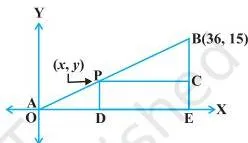
The formula for a point P dividing AB internally in the ratio \( m_1 : m_2 \) is (NCERT, p. 108):
\[ \left( \frac{m_1x_2 + m_2x_1}{m_1+m_2}, \frac{m_1y_2 + m_2y_1}{m_1+m_2} \right) \]
Memory Device: To avoid flipping the multipliers, remember the convention \( PA : PB = m_1 : m_2 \). This means \( m_1 \) (first part of the ratio) always pairs with the second point’s coordinates \( (x_2, y_2) \), and \( m_2 \) (second part) pairs with the first point’s coordinates \( (x_1, y_1) \). Think: “first ratio number grabs the far point.”
Midpoint and Trisection: Special Cases of Section Formula
When the ratio is 1:1, the point is the midpoint of the segment (NCERT, p. 108):
\[ \left( \frac{x_1+x_2}{2}, \frac{y_1+y_2}{2} \right) \]
Trisection means dividing a segment into three equal parts (NCERT, p. 110). The two trisection points divide the segment in the ratios 1:2 and 2:1 respectively. You apply the section formula twice, once for each ratio.
Worked Example: Applying the Section Formula
- Step 1: The method is the internal section formula. We are given A(-2, 6) and B(8, -4). Find point P dividing AB in ratio 3:2.
- Step 2: Identify the values. \( m_1 = 3 \), \( m_2 = 2 \), \( x_1 = -2 \), \( y_1 = 6 \), \( x_2 = 8 \), \( y_2 = -4 \). Using the memory device, remember \( m_1 \) pairs with \( x_2 \) and \( m_2 \) pairs with \( x_1 \).
- Step 3: Apply the formula for the x-coordinate.
\[ x = \frac{m_1x_2 + m_2x_1}{m_1+m_2} \]
\[ x = \frac{(3)(8) + (2)(-2)}{3+2} \]
\[ x = \frac{24 – 4}{5} = \frac{20}{5} = 4 \]
Step 4: Apply the formula for the y-coordinate.
\[ y = \frac{m_1y_2 + m_2y_1}{m_1+m_2} \]
\[ y = \frac{(3)(-4) + (2)(6)}{3+2} \]
\[ y = \frac{-12 + 12}{5} = \frac{0}{5} = 0 \]
Step 5: Note that the y-coordinate is zero, which means P lies on the x-axis.
Final answer: The required point is \( P(4, 0) \), which lies on the x-axis.
Distance vs Section Formula: When to Use?
This comparison table helps you decide the right formula approach for common exam question types. For more on triangle properties, see our Triangles notes.
| Exam Question Type | Formula to Use | How to Set It Up |
|---|---|---|
| Checking Collinearity | Distance formula (or area formula) | Show \( AB + BC = AC \) for points in order |
| Finding a point on the y-axis equidistant from two points | Distance formula | Let the point be \( (0, y) \), equate squared distances, solve for y |
| Verifying parallelogram diagonals | Midpoint formula (special case of Section) | Equate the midpoints of the two diagonals |
| Finding the ratio in which an axis divides a segment | Section formula (write as \( k:1 \)) | Set the coordinate for that axis to 0 and solve for k |
Misconception Autopsy: Why Sign Matters in One Formula But Not the Other
Students often treat coordinate differences as too trivial to matter. This causes two opposite errors. A thorough understanding of Introduction to Trigonometry also reveals that sign conventions are not arbitrary; they carry geometric meaning.
- Step 1: Analyse the error. A student thinks: “Because \( (-4)^2 = 16 \) and \( 4^2 = 16 \), signs never matter.” This is half true.
- Step 2: The misconception autopsy. Inside the distance formula, sign does NOT matter because the differences are squared. \( (x_2-x_1)^2 \) is the same as \( (x_1-x_2)^2 \). A negative base yields a positive square. This is why you can plug the points into the formula in either order without changing the result.
- Step 3: The misconception autopsy continued. Inside the section formula numerator, sign matters CRITICALLY. Here you have a weighted average: \( m_1x_2 + m_2x_1 \). There is no squaring step to save you. If \( x_1 = -2 \), you must carry the negative sign all the way through: \( m_2(-2) \). Forgetting the negative sign moves P to a completely incorrect position on the line.
Conclusion: Signs vanish inside the distance formula because of squaring, but they persist inside the section formula because there is no even power to cancel them.
Common Mistakes Students Make in Coordinate Geometry
| Mistake | Correct rule | How to check your answer |
|---|---|---|
| Reversing the convention as \( PA:PB = m_2:m_1 \), meaning \( m_2 \) multiplies \( x_2 \) | \( PA:PB = m_1:m_2 \), so \( m_1 \) (first ratio part) always multiplies the far point’s coordinates \( x_2 \) | Write the ratio above the formula — put \( m_1 \) above \( x_2 \) and \( m_2 \) above \( x_1 \) so the multiplication is visual. |
| Forgetting to square negative differences inside the distance formula, e.g., writing \( (-4-2) = -6 \) instead of \( 36 \) | \( (-4 – 2)^2 = (-6)^2 = 36 \). The square always yields a positive number. | Add a second step line after substitution: just squaring the bracket and writing the positive value. |
| Using the external division formula (often from reference books) | Class 10 syllabus covers only internal division. | If the divisor point lies between A and B in the problem statement, it is internal. |
| Claiming three points are collinear without verifying the order | Three points are collinear only if the sum of the two smaller distances equals the largest distance. | State which side is largest before checking \( AB + BC = AC \). You can also check our CBSE Class 10 Mathematics notes for collinearity. |
Exam Notes: How Coordinate Geometry is Tested
From the patterns observed in CBSE examinations, coordinate geometry is a consistent source of 3-mark and 4-mark questions. The distance formula is often combined with triangle classification (right, isosceles, equilateral) or collinearity checks. Section formula frequently appears as a ‘find ratio’ or ‘find point on axis’ question.
- Axis Point Problems: If asked to find a point on the x-axis, the step where you write let the point be (x, 0) earns a full mark. Likewise, writing let the point be (0, y) for the y-axis earns the setup mark. Always state this assumption explicitly.
- Parallelogram Problems: The expected first step is stating the property that diagonals of a parallelogram bisect each other, then equating the midpoints of the diagonals.
Figure Walkthrough: Understanding the Distance Geometry
The figure below illustrates the general distance situation. Point P and Q lie in the plane. You drop perpendiculars from both points to the x-axis, and draw a horizontal line from P to meet Q’s perpendicular.
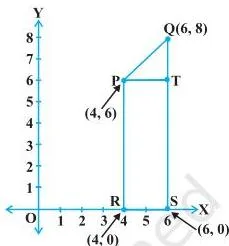
This creates a right triangle where the hypotenuse is the distance PQ, the base is the difference in the x-coordinates, and the height is the difference in the y-coordinates. Pythagoras gives the formula.
This is exactly why the signs of the coordinate differences do not matter inside the square; a triangle’s base and height are lengths, which are always positive quantities.
Revision Summary: Coordinate Geometry in One Page
For a broader recap across all chapters, see our main CBSE notes hub and the Class 10 notes portal.
| What to find | Method | Key condition |
|---|---|---|
| Distance between two points | \( \sqrt{(x_2-x_1)^2+(y_2-y_1)^2} \) | Always take positive square root |
| Distance from origin | \( \sqrt{x^2+y^2} \) | Origin must be \( (0,0) \) |
| Internal division point | Section formula | \( PA:PB = m_1:m_2 \) |
| Midpoint of a segment | Average of individual coordinates | Ratio is 1:1 |
| Collinearity of three points | \( AB + BC = AC \) | Points must be taken in order, e.g., A, B, C |
| Diagonal of a parallelogram | Midpoints of diagonals must be equal | Diagonals bisect each other |
Frequently Asked Questions on Coordinate Geometry
Does it matter which point is (x1, y1) and which is (x2, y2) in the distance formula?
No, it does not matter. Because the coordinate differences are squared, the sign of the difference disappears. The expression \( (x_2-x_1)^2 \) yields the exact same positive number as \( (x_1-x_2)^2 \).
How do I find a point on the x-axis that is equidistant from two given points?
Let the required point be \( (x, 0) \) since any point on the x-axis has a y-coordinate of 0. Apply the distance formula to find the distance from \( (x,0) \) to each of the two given points. Equate the two squared distance expressions. You will be left with a linear equation in x, which you can solve.
Can I use the distance formula to check if four points form a parallelogram?
You can check by showing opposite sides are equal, but using the midpoint formula is much faster. A quadrilateral is a parallelogram if and only if its diagonals bisect each other. You simply find the midpoint of the first diagonal and equate it to the midpoint of the second diagonal. This requires fewer calculations.
What is the difference between internal and external division of a line segment?
Internal division means the required point P lies between the endpoints A and B on the line segment AB. External division means P lies outside the segment AB, on the line extending AB. The Class 10 syllabus covers only internal division. The section formula you study is for a point dividing the segment internally in a given ratio.
How do I find the ratio in which a point divides a line segment if the ratio is not given?
Assume the unknown ratio is \( k : 1 \). Apply the section formula to get the coordinates of the dividing point in terms of k. You will be given one piece of information, like the point lies on the y-axis. Set the x-coordinate to 0 (for the y-axis) or the y-coordinate to 0 (for the x-axis) to form an equation in k.
Solve for k to find the ratio.
Reference: NCERT Class 10 Mathematics textbook, Coordinate Geometry chapter summary.
Reference: NCERT Class 10 Mathematics textbook, chapter Coordinate Geometry.
Explore Class 10 Mathematics Notes
More for this chapter:
Class 10 Mathematics on LearnCBSE:
Related chapters: