
Some Applications of Trigonometry Class 10 is NCERT Mathematics Chapter 9 — the chapter that puts trigonometric ratios to work on real scenes. It measures heights and distances such as towers, chimneys and river widths.
The chapter opens at NCERT page 132 and runs about a dozen printed pages. The official PDF of the full chapter, figures and Exercise 9.1 included, is offered right here, from the NCERT Class 10 Mathematics textbook.
Get the complete chapter text with all its figures and the full Exercise 9.1 — download the Some Applications of Trigonometry Class 10 NCERT chapter PDF straight from the official NCERT website.
| What the chapter holds | Count | Where it is used |
|---|---|---|
| Printed pages | 11 | |
| Sections in the chapter | 2 | |
| Figures with NCERT captions | 9 | |
| Exercise questions | 15 | answered in our NCERT Solutions |
| Official NCERT PDF | Download the chapter PDF | the chapter exactly as NCERT publishes it |
Chapter 9 at a glance: what the PDF contains
The table below lists what the chapter contains — its sections, figures, worked examples and exercise questions.
The structure is simple. Section 9.1, Heights and Distances, opens at page 132 and carries all the teaching; Exercise 9.1 runs over pages 142-143; and the chapter closes with the short section 9.2 and its summary on page 143.
What Chapter 9 covers: one idea, seven examples
This is the pay-off chapter for the trigonometry of Chapter 8. Instead of abstract triangles, the ratios now measure real scenes — a minar seen across a road, a tower’s shadow, a ladder resting against a pole (NCERT, p. 133).
Every worked example below is the same idea in a new costume: a right triangle hidden in an everyday situation, solved with one trigonometric ratio.
| Example | The scene | What it finds | NCERT page |
|---|---|---|---|
| Example 1 | Tower 15 m from a ground point, elevation \( 60^\circ \) | Height of the tower, \( 15\sqrt{3} \) m | pp. 135-136 |
| Example 2 | Electrician on a 5 m pole, must reach 1.3 m below the top; ladder at \( 60^\circ \) | Ladder length 4.28 m (approx.) and foot distance 2.14 m (approx.) | pp. 136-137 |
| Example 3 | Observer 1.5 m tall, 28.5 m from a chimney, elevation \( 45^\circ \) | Chimney height — the 1.5 m is added at the end | p. 137 |
| Example 4 | 10 m building with a flagstaff on top, elevations \( 30^\circ \) and \( 45^\circ \) | Flagstaff length 7.32 m; distance \( 10\sqrt{3} \) m from the point | pp. 137-138 |
| Example 5 | Shadow 40 m longer when the sun’s altitude is \( 30^\circ \) than \( 60^\circ \) | Height of the tower, \( 20\sqrt{3} \) m | pp. 138-139 |
| Example 6 | Depressions \( 30^\circ \) and \( 45^\circ \) to an 8 m building from a taller one | Height of the taller building and the distance between the buildings | pp. 139-140 |
| Example 7 | Bridge 3 m above a river, depressions \( 30^\circ \) and \( 45^\circ \) to the two banks | Width of the river, \( 3(\sqrt{3}+1) \) m | pp. 140-141 |
The exercise that follows gives practice problems of exactly these types; the mapping table further down shows which example to study for each question.
The method behind every heights and distances question
Every problem in this chapter is a right triangle hiding inside a real scene. Find the triangle, and the trigonometric ratios do the measuring.
The book’s own habit is to start every solution by drawing that triangle — “First let us draw a simple diagram to represent the problem” (NCERT, p. 136). Follow the same habit, and the method settles into four steps:
- Draw a simple labelled diagram of the scene — the figure is your map.
- Mark the horizontal at the observer’s eye, and put the given angle there: elevation above the horizontal, depression below it.
- Label the side you know and the side you need inside the right triangle.
- Choose the ratio that contains both, substitute and solve — rationalising and adding any observer height before writing the unit.
Why the choice works: the chapter asks which ratio has the two values we have and the one we need to determine (NCERT, p. 135). In the minar problem, only \( \tan A \) or \( \cot A \) joins the known horizontal distance to the unknown height.
In the ladder problem, where the hypotenuse is the unknown, the same test leads to \( \sin 60^\circ \) (NCERT, p. 136).
| What you know and what you need | Ratio to use | Seen in |
|---|---|---|
| Opposite and adjacent known | \( \tan A = \frac{\text{opposite}}{\text{adjacent}} \) | Example 1 (NCERT, p. 135) |
| Hypotenuse and opposite known | \( \sin A = \frac{\text{opposite}}{\text{hypotenuse}} \) | Example 2 (NCERT, p. 136) |
| Hypotenuse and adjacent known | \( \cos A = \frac{\text{adjacent}}{\text{hypotenuse}} \) | Completes the set; not needed by the chapter’s examples |
| Opposite known, adjacent needed | \( \cot A = \frac{\text{adjacent}}{\text{opposite}} \) | Example 2 (NCERT, p. 137) |
The method in action: a worked example with new numbers
Here is the same four-step method on a fresh problem. The numbers are original, so this is not a solution you have already read in the book.
Problem. An observer 1.6 m tall stands on level ground, 24 m from the foot of a tree. The angle of elevation of the top of the tree from her eyes is \( 30^\circ \). Find the height of the tree.
Step 1 — Draw and label.
Let A be the top of the tree, D the observer’s eyes, E the point on the tree at eye level, and B the foot of the tree.
The right triangle is ADE, right-angled at E, with \( DE = 24 \) m and \( EB = 1.6 \) m.
Step 2 — Mark the angle.
The angle of elevation \( \angle ADE = 30^\circ \) sits at the eye D, on the horizontal DE.
Step 3 — Choose the ratio.
The known side DE is adjacent to the angle and the wanted side AE is opposite it, so use tan:
\[ \tan 30^\circ = \frac{AE}{DE} \]
Step 4 — Substitute and solve.
With \( \tan 30^\circ = \frac{1}{\sqrt{3}} \) and \( DE = 24 \) m:
\[ \frac{1}{\sqrt{3}} = \frac{AE}{24} \quad\Rightarrow\quad AE = \frac{24}{\sqrt{3}} = 8\sqrt{3} \approx 13.9\ \text{m} \]
Step 5 — Add the eye height.
The triangle reaches only to eye level, so the full tree height is:
\[ AB = AE + EB = 8\sqrt{3} + 1.6 \approx 13.9 + 1.6 = 15.5\ \text{m} \]
Final answer: the tree is approximately 15.5 m tall. The step where students most often lose the mark is Step 5 — forgetting the 1.6 m of the observer’s own height.
Notice the shape of the answer: a surd plus the observer’s height. Questions built on Example 3’s structure end the same way, so keep the surd in the final answer unless the question asks for an approximate value.
The ratio values this chapter actually uses
The chapter never needs full trigonometric tables — only the standard angles \( 30^\circ, 45^\circ \) and \( 60^\circ \) you already met in Chapter 8. These are the exact values that appear in the worked examples.
| Value | Where the chapter uses it | NCERT page |
|---|---|---|
| \( \sin 60^\circ = \frac{\sqrt{3}}{2} \) | Example 2 — ladder length BC | p. 136 |
| \( \tan 60^\circ = \sqrt{3} \) | Examples 1 and 5 — tower height at elevation \( 60^\circ \) | pp. 135, 139 |
| \( \tan 45^\circ = 1 \) | Examples 3, 4 and 6 — chimney, flagstaff, opposite building | pp. 137-140 |
| \( \tan 30^\circ = \frac{1}{\sqrt{3}} \) | Examples 4, 5, 6 and 7 — the \( 30^\circ \) elevation or depression cases | pp. 137-141 |
| \( \cot 60^\circ = \frac{1}{\sqrt{3}} \) | Example 2 — distance DC of the ladder foot | pp. 136-137 |
| \( \cot 30^\circ = \sqrt{3} \) | Example 6 — the \( BD = PD\sqrt{3} \) rearrangement | p. 140 |
Where NCERT rounds a value, it says so explicitly. Example 2 gives \( BC = 4.28 \) m (approx.) and \( DC = 2.14 \) m (approx.) (NCERT, p. 136).
If your final answer carries a surd in the denominator, rationalise it the way Example 6 does: \( \frac{8}{\sqrt{3}-1} = 4(\sqrt{3}+1) \) (NCERT, p. 140).
Reading the NCERT figures of Chapter 9
NCERT draws a labelled diagram for every situation, so the right triangle is visible before any calculation starts. The chapter’s teaching figures are below, each with its page and the idea it fixes.
Fig. 9.2, a small sketch of the head-raised position, is not reproduced here; Figs. 9.11-9.13 belong to individual exercise questions.
Figures 9.1 and 9.3: the two angles defined
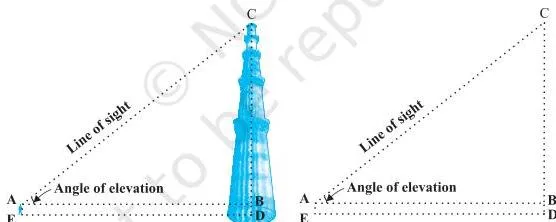
Fig. 9.1 redraws the opening situation of the previous chapter: a student looking up at a minar. The line AC from the student’s eye to the top of the minar is the line of sight.
The angle BAC, formed by the line of sight with the horizontal AB, is the angle of elevation of the top of the minar (NCERT, p. 133). The angle lives at the observer’s eye, on the horizontal — never at the object itself.
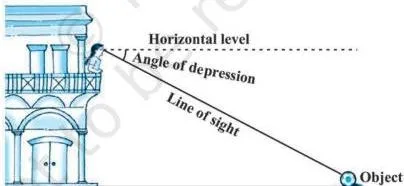
Here the line of sight sits below the horizontal: the girl on the balcony looks down at a flower pot on a temple stair. The angle the line of sight makes with the horizontal is the angle of depression (NCERT, p. 134). Elevation raises your head; depression lowers it — the two definitions are mirror images.
Figures 9.4 to 9.10: the examples in pictures
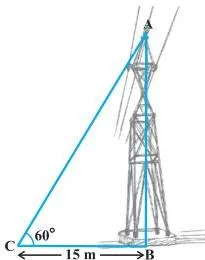
Example 1’s diagram: AB is the tower, C is the point 15 m from its foot, and \( \angle ACB = 60^\circ \). The ratio \( \tan 60^\circ = \frac{AB}{BC} \) uses exactly the two sides the diagram shows (NCERT, p. 135).
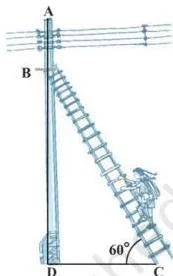
Fig. 9.5 shows why the working starts before any trigonometry. The electrician needs point B on the pole, 1.3 m below the top, so \( BD = 5 – 1.3 = 3.7 \) m; BC is the ladder and the hypotenuse of the right triangle BDC, which is why the ratio is sin, not tan (NCERT, p. 136).
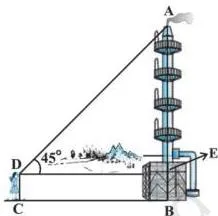
Example 3’s figure places the right triangle at eye level: AB is the chimney, CD the 1.5 m observer, and \( \angle ADE \) the angle of elevation. Because the triangle never reaches the ground, the 1.5 m is added at the end (NCERT, p. 137).
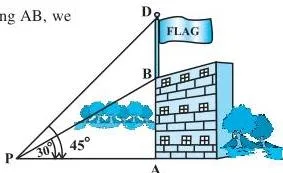
This diagram holds two right triangles on one base: PAB for the 10 m building and PAD for the building plus flagstaff. Solve PAB first — its known height 10 m gives \( AP = 10\sqrt{3} \) m — then use PAD to find the flagstaff (NCERT, pp. 137-138).
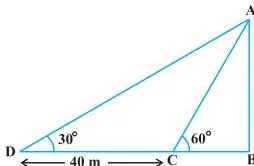
The same tower AB casts two shadows: BC when the sun’s altitude is \( 60^\circ \), DB when it is \( 30^\circ \). The lower sun gives the longer shadow, so with \( BC = x \) m the book writes \( DB = (40 + x) \) m (NCERT, pp. 138-139).
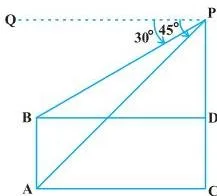
This is the chapter’s most important diagram move. PB is a transversal to the parallel horizontals PQ and BD, so the depression angle \( \angle QPB \) equals the interior alternate angle \( \angle PBD = 30^\circ \) — the given depression angle transfers straight into the triangle (NCERT, p. 140).
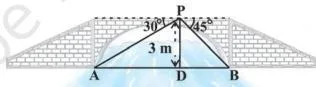
The river width AB is broken into two pieces, AD and DB, each solved in its own right triangle. With \( DP = 3 \) m, the \( 45^\circ \) bank gives \( BD = 3 \) m and the \( 30^\circ \) bank gives \( AD = 3\sqrt{3} \) m (NCERT, pp. 140-141).
Line of sight, angle of elevation, angle of depression: definitions
These three terms are the vocabulary of every problem in the chapter. Know which angle is which, and the rest is ratio work.
| Term | Meaning | How to spot it in a diagram |
|---|---|---|
| Line of sight | The straight line drawn from the observer’s eye to the point viewed (NCERT, p. 133) | The drawn line from the eye to the object — it becomes the hypotenuse of the right triangle |
| Angle of elevation | The angle the line of sight makes with the horizontal when the point is above the horizontal — you raise your head (NCERT, p. 134) | The viewed point is higher than the observer; the angle opens upward from the horizontal |
| Angle of depression | The angle the line of sight makes with the horizontal when the point is below the horizontal — you lower your head (NCERT, pp. 134-135) | The viewed point is lower than the observer; the angle opens downward from the horizontal |
Both angles are measured from the horizontal, never from the vertical — the most common misreading in the chapter. And a depression angle given in a question is not automatically inside your triangle: in Example 6 it enters only because the transversal PB transfers it by alternate angles (NCERT, p. 140). Figs. 9.1 and 9.3 above show both cases at a glance.
Where students go wrong in heights and distances
The arithmetic is a single ratio — the mistakes come from misreading the scene, not from calculating. Here are the six this chapter’s examples are designed to prevent.
| Mistake | Correct rule | How to check your answer |
|---|---|---|
| Angle drawn at the object instead of at the observer’s eye | Both angles live at the eye, measured from the horizontal — elevation above it, depression below it (NCERT, p. 134) | The vertex of the given angle sits on your eye-level line, never on the object or the ground |
| Forgetting the observer’s height | Add the eye height after the triangle is solved: Example 3 adds 1.5 m on top of \( AE = 28.5 \) m (NCERT, p. 137) | Does the question mention a person? If yes, the final height is the triangle height plus the eye height |
| Choosing the wrong ratio | Pick the ratio that contains the side you know and the side you need (NCERT, p. 135) | Name the two sides you have and the one you want, then match them to the decision table above |
| Setting the longer shadow as \( x – 40 \) | A lower sun means a longer shadow, so \( DB = (40 + x) \) m, where \( x \) is the \( 60^\circ \) shadow (NCERT, pp. 138-139) | Check that the \( 30^\circ \) shadow is longer than the \( 60^\circ \) shadow; \( 40 + x \) is longer, \( x – 40 \) is not |
| Leaving the depression angle outside the triangle | Move it in using alternate angles: PB is a transversal to the parallel horizontals, so \( \angle PBD = 30^\circ \) (NCERT, p. 140) | If your diagram has no place for the given angle, look for a pair of parallel horizontals to transfer across |
| Dropping units or leaving a surd in the denominator | Answer with the unit, and rationalise: \( \frac{8}{\sqrt{3}-1} = 4(\sqrt{3}+1) \) (NCERT, p. 140); write “approx.” where the book does (NCERT, p. 136) | Re-read the question for its unit, and re-do any step whose denominator still has \( \sqrt{3} \) |
How to approach a heights and distances question
One plan fits every question in Exercise 9.1, and every question mirrors one of the chapter’s worked examples. Learn the plan, then use the mapping table to find the example your question was built on.
- Draw the scene and label every named point.
- Mark the horizontal at the observer’s eye and set the given angle on it.
- Write down the known side and the wanted side inside the right triangle.
- Select the ratio joining them and substitute the values.
- Solve — rationalise denominators, add any observer height, and attach the unit.
| Question | Type | Example to study first |
|---|---|---|
| Q1 | Rope from pole top to ground, angle \( 30^\circ \) | Example 2 — the rope is the hypotenuse; use \( \sin 30^\circ \) |
| Q2 | Tree broken by storm, top touches the ground | Build the standing part and the fallen part as the two sides of one right triangle |
| Q3 | Two slides at \( 30^\circ \) and \( 60^\circ \) | Example 2 — each slide length is a hypotenuse found with sin |
| Q4 | Tower 30 m away, elevation \( 30^\circ \) | Example 1 — \( \tan 30^\circ = \frac{\text{height}}{30} \) |
| Q5 | Kite string at \( 60^\circ \), no slack | Example 2 — string length is the hypotenuse from \( \sin 60^\circ \) |
| Q6 | Boy walks toward a 30 m building, elevation rises from \( 30^\circ \) to \( 60^\circ \) | Example 5’s two-position setup, plus a 1.5 m eye height |
| Q7 | Transmission tower on a 20 m building, elevations \( 45^\circ \) and \( 60^\circ \) | Example 4 — object on top of a known building |
| Q8 | Statue 1.6 m tall on a pedestal, elevations \( 60^\circ \) and \( 45^\circ \) | Example 4 — subtract the two triangle heights |
| Q9 | Building and tower seen from each other’s feet | Two triangles sharing one base |
| Q10 | Two equal poles across an 80 m road | Example 7 — the distance splits into two parts |
| Q11 | TV tower across a canal, second point 20 m away | Example 5 — two points on the same side of the object |
| Q12 | Cable tower seen from a 7 m building, elevation and depression | Example 6 — the depression angle transfers by alternate angles |
| Q13 | Lighthouse 75 m high, two ships in a line | Example 6 — two depression angles, subtract the distances |
| Q14 | Balloon drifting, elevation falls from \( 60^\circ \) to \( 30^\circ \) | Examples 4 and 5 combined |
| Q15 | Car approaching a tower at uniform speed | Example 6’s distance idea plus time-speed reasoning |
Textbook contents and the examinable syllabus are not always identical — check the current official syllabus before deciding what to revise.
Chapter 9 in sixty seconds: what to remember
The chapter’s closing section fixes its vocabulary and its method in a few lines (NCERT, p. 143). In short:
- Line of sight — the straight line from the observer’s eye to the point viewed.
- Angle of elevation — the line of sight is above the horizontal; you raise your head to look (NCERT, p. 134).
- Angle of depression — the line of sight is below the horizontal; you lower your head to look (NCERT, pp. 134-135).
- The method — a right triangle plus one trigonometric ratio determines any height, length or distance the problem names (NCERT, p. 143).
Related NCERT chapters and where to go next
This chapter runs entirely on the ratios of Chapter 8: if \( \tan 30^\circ = \frac{1}{\sqrt{3}} \) is not instant, revise Introduction to Trigonometry first. The same right-triangle geometry returns in Circles, where a tangent meets a radius at a right angle. For the full set of chapters, open the Class 10 Mathematics notes, the Class 10 hub, or the CBSE notes index.
Sources and data verification
This listing is maintained for the 2026-27 academic session using the NCERT textbook information available to us. NCERT remains the authority for confirming the latest edition.
- This page describes Chapter 9 of the NCERT Class 10 Mathematics textbook, official edition published on ncert.nic.in; the download above is that chapter’s official PDF.
- It covers the NCERT textbook chapter only, not the full CBSE subject scheme.
- It is maintained for the current academic session against the edition available on ncert.nic.in.
- NCERT settles textbooks, editions and official PDFs; CBSE settles the curriculum, syllabus and examinations.
Frequently asked questions about Chapter 9
What is the difference between the angle of elevation and the angle of depression?
Both are measured from the horizontal at the observer’s eye. When the line of sight is above the horizontal — you raise your head — the angle is the angle of elevation (NCERT, p. 134).
When the line of sight is below the horizontal — you lower your head — it is the angle of depression (NCERT, pp. 134-135). Figs. 9.1 and 9.3 above show the two cases side by side.
How do I choose the right trigonometric ratio for a heights and distances question?
Use the chapter’s own test (NCERT, p. 135): which ratio contains the two values I have and the one I need? Opposite and adjacent known means tan; hypotenuse and opposite known means sin; opposite known and adjacent needed means cot. Examples 1 and 3 show the tan choice, and Example 2 shows the switch to sin.
Why do some questions add the observer’s height at the end?
Because the right triangle sits at eye level, not at ground level. In Example 3 the triangle gives \( AE = 28.5 \) m above the eye, and adding the 1.5 m observer gives the chimney height \( AB = 30 \) m (NCERT, p. 137). Skip the addition and you lose the whole bottom part of the object.
How many questions are there in Exercise 9.1 of this chapter?
Exercise 9.1 has 15 questions, printed on pages 142-143 of the chapter. They run from single right triangles (Q1-Q5) to two-triangle and depression-angle problems (Q11-Q15); the mapping table above names the example to study for each one.
Are the worked examples in the chapter enough to solve all the exercise questions?
Yes. Every exercise question is built on the structure of one of the chapter’s examples: Q1, Q3 and Q5 mirror Example 2’s hypotenuse setup, Q7 and Q8 mirror Example 4’s object-on-top setup, and Q11-Q15 mirror the two-triangle structures of Examples 5 and 6. Study the matched example, then attempt the question.
What does “the shadow is 40 m longer” mean for setting up the problem?
It means the shadow at the lower sun altitude is the longer one. With \( x \) as the \( 60^\circ \) shadow, the \( 30^\circ \) shadow is \( DB = (40 + x) \) m (NCERT, p. 139); writing \( x – 40 \) would make the longer shadow shorter, which inverts the scene. Example 5 then solves the two triangles together.
Reference: NCERT Class 10 Mathematics textbook, chapter 9, official edition on ncert.nic.in.
Explore Class 10 Mathematics Books
- Previous: Introduction to Trigonometry
- Next: Circles 10
Class 10 Mathematics on LearnCBSE:
Related chapters:
- Real Numbers
- Polynomials
- Pair of Linear Equations in Two Variables