
These areas related to circles class 10 notes cover Chapter 11 of the rationalised NCERT textbook for the current academic session. The chapter builds directly on the perimeter and area concepts you learned in Class 9 by dividing a circle into smaller regions: sectors and segments.
Board questions frequently wrap these formulas around real-life objects like clocks, umbrellas, and brooches, so learning to identify the radius and central angle inside a word problem is as important as the formulas themselves. You can find this chapter placed among our broader Class 10 Mathematics notes.
Sector and Segment of a Circle: The Basic Parts
Before calculating any area, you need to know exactly which region a question is asking about. A circle can be split into two named regions depending on whether you cut it using two radii or a single chord (NCERT, p. 155).
| Term | Meaning | Key feature |
|---|---|---|
| Sector | Region enclosed by two radii and the corresponding arc. | Has a central angle called the angle of the sector. |
| Minor sector | The smaller sector formed by two radii. | Central angle is less than \( 180^{\circ} \). |
| Major sector | The larger remaining sector. | Angle is \( 360^{\circ} – \theta \). |
| Segment | Region enclosed between a chord and the corresponding arc. | Bounded by a straight chord, not radii. |
| Minor segment | The smaller segment cut off by a chord. | Lies on the side of the chord closer to the centre. |
| Major segment | The larger remaining segment. | Lies on the opposite side of the chord. |
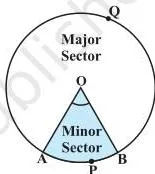
An important textbook remark: unless a question specifically states otherwise, the words sector and segment always refer to the minor versions (NCERT, p. 155). Always assume you are dealing with the minor region unless the question asks for the major one.
Key Formulas for Arc Length and Area of a Sector
The sector and arc formulas are derived using the unitary method. The full circle area \( \pi r^2 \) corresponds to a full \( 360^{\circ} \) at the centre. To find the region for an angle \( \theta \), you simply scale down by the factor \( \frac{\theta}{360} \) (NCERT, p. 156).
| Quantity | Formula | Symbol meanings and units |
|---|---|---|
| Area of a sector | \( \frac{\theta}{360} \times \pi r^2 \) | \( \theta \) = central angle (degrees), \( r \) = radius (cm, m). Unit of area: \( \text{cm}^2 \) or \( \text{m}^2 \). |
| Length of an arc | \( \frac{\theta}{360} \times 2\pi r \) | Same symbols. Unit of length: cm or m. |
| Area of major sector | \( \pi r^2 – \text{Area of minor sector} \) | Equivalently: \( \frac{360 – \theta}{360} \times \pi r^2 \). |
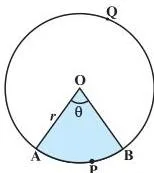
Because \( \theta \) is measured in degrees, you must convert any radian values if a question happens to give them. Most board problems simplify nicely when you use \( \pi = \frac{22}{7} \), but you must always check whether the question mandates \( \pi = 3.14 \). This foundational geometry is also applied in our notes on Circles.
Finding the Area of a Segment of a Circle
A segment does not have its own direct formula. You calculate it by subtracting the area of the central triangle from the area of the corresponding sector (NCERT, p. 156).
\[ \text{Area of segment} = \text{Area of the corresponding sector} – \text{Area of the corresponding } \Delta \]
The sector area uses the standard formula. However, finding the triangle’s area is the step where most students lose marks. The textbook method (NCERT, p. 158) requires you to:
- Draw a perpendicular \( OM \) from the centre \( O \) to the chord \( AB \).
- Use trigonometric ratios (\( \sin \) and \( \cos \)) in the right-angled triangle \( OMA \) to find the base \( AB \) and the height \( OM \).
- Calculate the triangle area as \( \frac{1}{2} \times \text{base} \times \text{height} \).
- Subtract this triangle area from the sector area.
The angle inside the right-angled triangle is always half of the central angle \( \theta \), because the two triangles formed by the perpendicular are congruent (RHS rule).
Worked Examples: Solving Sector and Segment Problems
Example 1: Area of a sector
Find the area of a sector of a circle with a radius of \( 10 \) \( \text{cm} \) and a central angle of \( 60^{\circ} \). Use \( \pi = \frac{22}{7} \).
- Step 1: State the method. Use the sector area formula \( \frac{\theta}{360} \times \pi r^2 \).
- Step 2: Substitute the values \( \theta = 60^{\circ} \), \( r = 10 \) \( \text{cm} \), \( \pi = \frac{22}{7} \).
\[ \text{Area} = \frac{60}{360} \times \frac{22}{7} \times (10)^2 \]
Step 3: Simplify the fraction and multiply.
\[ \frac{1}{6} \times \frac{22}{7} \times 100 = \frac{2200}{42} = \frac{1100}{21} \]
Final answer: The area of the sector is \( \frac{1100}{21} \) \( \text{cm}^2 \) (approx. \( 52.38 \) \( \text{cm}^2 \)).
Example 2: Area of a segment (90-degree right-angled triangle)
Find the area of the minor segment of a circle with a radius of \( 14 \) \( \text{cm} \) where the central angle is \( 90^{\circ} \). Use \( \pi = \frac{22}{7} \).
Step 1: Find the sector area. Substitute \( \theta = 90^{\circ} \), \( r = 14 \) \( \text{cm} \).
\[ \text{Sector area} = \frac{90}{360} \times \frac{22}{7} \times (14)^2 = \frac{1}{4} \times \frac{22}{7} \times 196 = 154 \text{ cm}^2 \]
Step 2: Find the triangle area. Because the angle is \( 90^{\circ} \) and the two radii are equal, the central triangle is a right-angled isosceles triangle. You can find its area directly without trigonometry: \( \frac{1}{2} \times \text{base} \times \text{height} \).
\[ \text{Triangle area} = \frac{1}{2} \times 14 \times 14 = 98 \text{ cm}^2 \]
Step 3: Subtract the triangle area from the sector area.
\[ \text{Segment area} = 154 – 98 = 56 \text{ cm}^2 \]
Final answer: The area of the minor segment is \( 56 \) \( \text{cm}^2 \).
Common Mistakes Students Make in Circle Area Problems
| Mistake | Correct rule | How to check your answer |
|---|---|---|
| Using the arc length formula \( 2\pi r \) instead of the area formula \( \pi r^2 \). | Arc length gives a linear measure (cm); area gives a surface measure (\( \text{cm}^2 \)). Check the units your final answer needs. | Look at the unit asked in the question. If it is \( \text{cm}^2 \), you must use the area formula. |
| Forgetting to subtract the triangle area when finding the segment area. | \( \text{Segment area} = \text{Sector area} – \text{Triangle area} \). | Ensure your final answer is strictly smaller than the sector area you calculated first. |
| Plugging the diameter directly into the formula instead of the radius. | Formulas use \( r \), which is half the diameter. Always divide the diameter by \( 2 \) before substituting. | Double-check the starting values: if the text says \( 35 \) \( \text{mm} \) diameter, your working must show \( r = 17.5 \) \( \text{mm} \). |
| Leaving the final answer without units. | Always write the unit: cm for length, \( \text{cm}^2 \) for area. | Read the last line of your solution before moving to the next question. |
Exam Pointers: How Board Questions Are Framed
CBSE board questions in this chapter follow specific patterns. Recognising them helps you secure the calculation marks. You can match these against the exercise questions on page 159 of the textbook to see the patterns in action.
- Segment angles: Questions involving \( 60^{\circ} \), \( 90^{\circ} \), or \( 120^{\circ} \) are frequent. For \( 90^{\circ} \), the triangle is right-angled isosceles (area \( = \frac{1}{2}r^2 \)). For \( 60^{\circ} \) and \( 120^{\circ} \), you must use trigonometric ratios.
- Clock and grazing problems: Word problems involving clock minute hands (Q3) or horses tied to a corner (Q8) require you to calculate the swept angle from the given time before using the sector formula. The radius is simply the length of the hand or the rope.
- Multi-object problems: Objects like brooches (Q9) and umbrellas (Q10) test division. You calculate the full circle area first, then divide by the number of sectors or ribs given.
- Pi values and roots: Always note the requested value of \( \pi \) (like \( 3.14 \) vs \( \frac{22}{7} \)) and any given square root approximation (e.g., \( \sqrt{3} = 1.73 \)) early in your working to secure the final calculation mark.
For further practice applying these concepts across different shapes, refer to our notes on Surface Areas and Volumes or the general Class 10 notes hub. You can also consult the official NCERT website for the prescribed textbook and supplementary materials.
Quick Revision Recap of Areas Related to Circles
This recap distills the chapter summary on page 160 for night-before-exam reading:
- Length of an arc: \( \frac{\theta}{360} \times 2\pi r \)
- Area of a sector: \( \frac{\theta}{360} \times \pi r^2 \)
- Area of a segment: Area of corresponding sector – Area of corresponding triangle.
Frequently Asked Questions on Circle Areas
How do you find the area of a segment when the angle is not 90 degrees?
You must use trigonometric ratios. Draw a perpendicular from the centre to the chord, which splits the central triangle into two right-angled triangles. The angle inside these smaller triangles is half the central angle. Use \( \sin \) and \( \cos \) to find the base and height, calculate the triangle area, and subtract it from the sector area.
What is the difference between a sector and a segment of a circle?
A sector is bounded by two radii and an arc, whereas a segment is bounded by a chord and an arc. Sectors have a central angle formed by the radii; segments are formed by a straight chord cutting across the circle.
How do you identify the radius and angle in word problems like clock hands or grazing horses?
In clock minute hand problems, the length of the hand is the radius, and the swept angle is calculated from the time elapsed (e.g., 5 minutes means 30 degrees, since 60 minutes covers 360 degrees). In grazing problems, the rope length is the radius, and the angle depends on the corner of the field the horse is tied to (e.g.
, 90 degrees for a square field).
Reference: NCERT Class 10 Mathematics textbook, chapter Areas Related to Circles.
Explore Class 10 Mathematics Notes
Related chapters: