
These polynomials class 10 notes cover the complete chapter for your board exam revision. In Class 9, you studied the degrees of polynomials and their types. Class 10 takes this further by introducing the geometrical meaning of zeroes and the relationship between the zeroes and coefficients of quadratic and cubic polynomials (NCERT, p. 1).
This page gives you all definitions, formulas, and worked examples in one place. The current academic session follows the rationalised NCERT textbook, which has removed the division algorithm section. For a broader overview of the syllabus, you can visit our Class 10 Mathematics notes hub.
Types of Polynomials by Degree: Linear, Quadratic, Cubic
The highest power of the variable in a polynomial is its degree. Based on this degree, we classify polynomials into three main types relevant to this chapter (NCERT, p. 1). A key rule for all types is that the leading coefficient (the coefficient of the highest power) must not be zero.
| Term | Meaning & General Form | Example |
|---|---|---|
| Linear polynomial | Degree 1; form ax + b, where a ≠ 0 | 2x – 3, √3x + 5 |
| Quadratic polynomial | Degree 2; form ax^2 + bx + c, where a ≠ 0 | 3y^2 – 5y + 1 |
| Cubic polynomial | Degree 3; form ax^3 + bx^2 + cx + d, where a ≠ 0 | 4t^3 – t + 2 |
What is NOT a Polynomial?
Expressions with variables in the denominator or under a root are not polynomials. For instance, 1/(x-1), √x + 2, and 1/(x^2 + 2x + 3) do not qualify because the variable’s power is not a non-negative integer. If you need a refresher on number systems that underpin these coefficients, check our Real Numbers notes.
Degree vs. Maximum Number of Zeroes
The degree of a polynomial dictates the maximum number of zeroes it can have. A polynomial of degree n can intersect the x-axis at most n times, meaning it has at most n real zeroes. The below comparison table serves as a useful memory device for this rule.
| Polynomial Type | Degree | Max Zeroes (x-axis intersections) |
|---|---|---|
| Linear | 1 | 1 |
| Quadratic | 2 | 2 |
| Cubic | 3 | 3 |
Zero of a Polynomial: Meaning and How to Find It
A real number k is a zero of a polynomial p(x) if p(k) = 0 (NCERT, p. 1). Finding a zero simply means solving the equation formed by setting the polynomial equal to zero.
Do not confuse a zero with the value of a polynomial. The value p(k) is what you get when you substitute k into the expression; this value is only a zero if it perfectly equals zero. Zeroes are intersections, values are just coordinates.
For a linear polynomial p(x) = ax + b (where a ≠ 0), you can find the zero directly without graphing. By setting ax + b = 0, the zero is x = -b/a. Note the negative sign.
- Step 1: Start with a linear polynomial, say p(x) = 4x – 10.
- Step 2: Apply the zero rule, p(x) = 0.
\[ 4x – 10 = 0 \]
Step 3: Solve for x using x = -b/a.
\[ x = \frac{-(-10)}{4} = \frac{10}{4} = 2.5 \]
Final answer: The zero of the polynomial is 2.5.
Geometrical Meaning of Zeroes: Where the Graph Cuts the X-axis
Geometrically, the zeroes of a polynomial are the x-coordinates of the points where its graph intersects the x-axis (NCERT, p. 2). A linear polynomial is a straight line, so it cuts the axis exactly once. A quadratic polynomial forms a U-shaped or inverted U-shaped curve called a parabola. A cubic polynomial makes an S-shaped curve.
Quadratic Parabola Cases
A parabola opens upward if the leading coefficient a > 0 and downward if a < 0. For a quadratic polynomial, there are three possible cases of x-axis intersections:
| Case | Graph Behaviour | Resulting Zeroes |
|---|---|---|
| Case (i) | Graph cuts the x-axis at two distinct points | Two distinct zeroes |
| Case (ii) | Graph touches the x-axis at exactly one point (coincident points) | One repeated zero |
| Case (iii) | Graph is completely above or below the x-axis | No real zeroes |
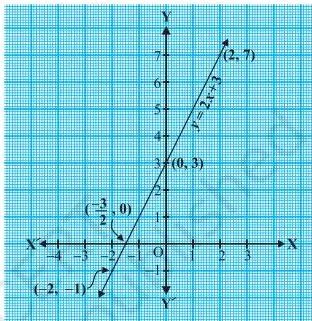
As shown in the linear graph above, a straight line will always pass through the x-axis at exactly one location, matching its single zero.
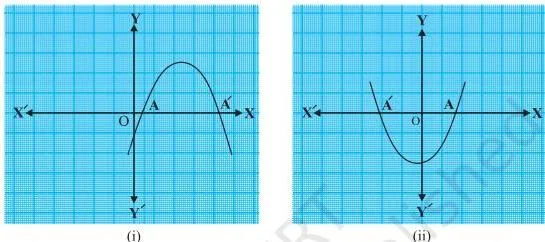
The parabola above illustrates Case (i), where the curve crosses the axis twice, meaning the polynomial has two distinct real zeroes.
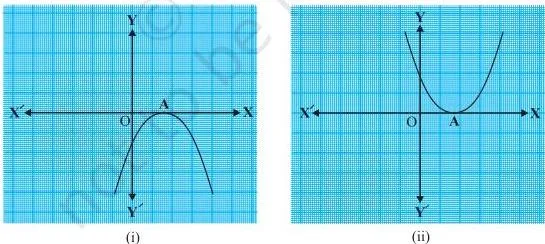
This image shows Case (ii). The graph merely touches the axis and turns around, meaning the two zeroes are identical. You can practice identifying these by checking the CBSE notes hub for related materials.
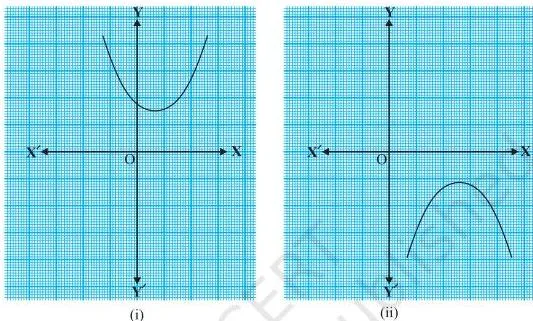
In Case (iii), shown above, the curve never touches the axis, so this quadratic polynomial has no real zeroes.
Relationship Between Zeroes and Coefficients: Quadratic
For a quadratic polynomial p(x) = ax^2 + bx + c with zeroes α and β, the zeroes are directly linked to the coefficients (NCERT, p. 10).
- Step 1: Express the polynomial using its factors: ax^2 + bx + c = k(x – α)(x – β).
- Step 2: Expand the right side.
\[ k(x – \alpha)(x – \beta) = k[x^2 – (\alpha + \beta)x + \alpha\beta] = kx^2 – k(\alpha + \beta)x + k\alpha\beta \]
Step 3: Compare coefficients of x^2, x, and the constant term.
\[ a = k, \quad b = -k(\alpha + \beta), \quad c = k\alpha\beta \]
From this comparison, we get the two core formulas. Here, a is the coefficient of x^2, b of x, and c is the constant term.
| Formula | Expression |
|---|---|
| Sum of Zeroes | \( \alpha + \beta = \frac{-b}{a} \) |
| Product of Zeroes | \( \alpha\beta = \frac{c}{a} \) |
Memory Device: Think “Sum has a minus, Product has none.” The formula for the sum of zeroes carries a negative sign because of the middle term expansion, while the product formula directly relates the constant terms without a sign flip.
Relationship Between Zeroes and Coefficients: Cubic
For a cubic polynomial p(x) = ax^3 + bx^2 + cx + d with zeroes α, β, and γ, the logic extends further (NCERT, p. 12). There are three formulas to remember:
| Formula | Expression |
|---|---|
| Sum of Zeroes | \( \alpha + \beta + \gamma = \frac{-b}{a} \) |
| Sum of Products (Two at a time) | \( \alpha\beta + \beta\gamma + \gamma\alpha = \frac{c}{a} \) |
| Product of Zeroes | \( \alpha\beta\gamma = \frac{-d}{a} \) |
Memory Device for Cubic: The signs alternate as you move down the list. The sum is negative (-b/a), the pairwise sum is positive (c/a), and the product is negative (-d/a). Follow the -, +, – pattern to avoid sign errors. The National Council of Educational Research and Training provides the official textbook pages for this Polynomials chapter.
Formulas at a Glance: Zeroes and Coefficients Summary
Use this single table for night-before exam revision. It consolidates the polynomial types, their zero formulas, and the coefficient relationships.
| Polynomial | Zero Formula | Sum of Zeroes | Product of Zeroes |
|---|---|---|---|
| Linear (ax + b) | \( \frac{-b}{a} \) | — | — |
| Quadratic (ax^2 + bx + c) | From factorisation | \( \frac{-b}{a} \) | \( \frac{c}{a} \) |
| Cubic (ax^3 + bx^2 + cx + d) | From factorisation | \( \frac{-b}{a} \) | \( \frac{-d}{a} \) |
Extra Note for Cubic: The sum of products taken two at a time is αβ + βγ + γα = c/a.
Worked Examples
Worked Example: Find and Verify Zeroes of a Quadratic
- Step 1: Consider the polynomial p(x) = 6x^2 – 13x + 6. We need to split the middle term. The product is 6 × 6 = 36. We need two numbers that multiply to 36 and add to -13. These are -9 and -4.
- Step 2: Rewrite and factorise.
\[ 6x^2 – 9x – 4x + 6 = 3x(2x – 3) – 2(2x – 3) = (3x – 2)(2x – 3) \]
Step 3: Identify zeroes by setting each factor to zero.
\[ x = \frac{2}{3} \quad \text{and} \quad x = \frac{3}{2} \]
Step 4: Verify the sum.
\[ \text{Sum} = \frac{2}{3} + \frac{3}{2} = \frac{13}{6} \]
\[ \frac{-b}{a} = \frac{-(-13)}{6} = \frac{13}{6} \quad \text{(Verified)} \]
Step 5: Verify the product.
\[ \text{Product} = \frac{2}{3} \times \frac{3}{2} = 1 \]
\[ \frac{c}{a} = \frac{6}{6} = 1 \quad \text{(Verified)} \]
Final answer: The zeroes are 2/3 and 3/2. The coefficient relationships hold true.
Worked Example: Build a Quadratic from Sum and Product
- Step 1: Given sum of zeroes = 1/4 and product = -2. Let the polynomial be x^2 – (sum)x + product.
- Step 2: Substitute the values.
\[ x^2 – \left(\frac{1}{4}\right)x + (-2) = x^2 – \frac{1}{4}x – 2 \]
Step 3: Multiply by 4 to clear fractions and get a standard polynomial.
\[ 4(x^2 – \frac{1}{4}x – 2) = 4x^2 – x – 8 \]
Step 4: Check.
Sum should be -(-1)/4 = 1/4, product should be -8/4 = -2.
Both match.
Final answer: The required polynomial is 4x^2 – x – 8.
Worked Example: Verify Zeroes of a Cubic Polynomial
Step 1: Let p(x) = 2x^3 – 9x^2 + 13x – 6.
Claimed zeroes are 1, 2, and 3/2.
Verify p(1) = 0.
\[ p(1) = 2(1)^3 – 9(1)^2 + 13(1) – 6 = 2 – 9 + 13 – 6 = 0 \]
Step 2: Verify p(2) = 0.
\[ p(2) = 2(2)^3 – 9(2)^2 + 13(2) – 6 = 16 – 36 + 26 – 6 = 0 \]
Step 3: Verify p(3/2) = 0.
\[ p\left(\frac{3}{2}\right) = 2\left(\frac{27}{8}\right) – 9\left(\frac{9}{4}\right) + 13\left(\frac{3}{2}\right) – 6 = \frac{27}{4} – \frac{81}{4} + \frac{39}{2} – 6 \]
\[ = \frac{27}{4} – \frac{81}{4} + \frac{78}{4} – \frac{24}{4} = \frac{0}{4} = 0 \]
Step 4: Verify the sum of zeroes: α + β + γ.
\[ 1 + 2 + \frac{3}{2} = \frac{9}{2} \]
\[ \frac{-b}{a} = \frac{-(-9)}{2} = \frac{9}{2} \quad \text{(Verified)} \]
Step 5: Verify the sum of products two at a time: αβ + βγ + γα.
\[ (1)(2) + (2)\left(\frac{3}{2}\right) + \left(\frac{3}{2}\right)(1) = 2 + 3 + \frac{3}{2} = \frac{13}{2} \]
\[ \frac{c}{a} = \frac{13}{2} \quad \text{(Verified)} \]
Step 6: Verify the product: αβγ.
\[ (1)(2)\left(\frac{3}{2}\right) = 3 \]
\[ \frac{-d}{a} = \frac{-(-6)}{2} = 3 \quad \text{(Verified)} \]
Final answer: The zeroes 1, 2, and 3/2 are correct, and all three coefficient relationships are satisfied.
Common Mistakes Students Make with Zeroes and Coefficients
Below are five strict error-correction pairs specific to this chapter. Analyzing these mistakes before an exam is a strong misconception autopsy.
| Mistake | Correct Rule | How to Check Your Answer |
|---|---|---|
| Students write sum of zeroes as b/a | Correct is -b/a because the formula has a negative sign from expanding k[x^2-(α+β)x+αβ]. | Re-read the formula from the derivation step to spot the minus sign. |
| Students use d/a for the cubic product | Correct is -d/a because the constant term d carries a sign that flips during comparison. | Check the -, +, – alternating sign pattern for cubic formulas. |
| Confusing zeroes with polynomial value | Zero means p(k)=0; value p(k) is just substitution and need not be zero. | Verify that your final computed number equals 0 if claiming a zero. |
| Counting intersections as the degree | Degree is the highest power, not intersections; a cubic can have 1, 2, or 3 zeroes. | Ensure the total number of real zeroes never exceeds the degree. |
| Missing the sign on the cubic product formula | Correct is αβγ = -d/a, not d/a; the negative sign is easy to miss. | Relate it back: product equals negative constant over leading coefficient. |
Exam Notes: What Examiners Look For
Written with an examiner’s mindset, here are the observed patterns for this chapter. Observations are based on standard marking schemes, not predictions.
- Verification earns the mark: In “verify the relationship” questions, computing the sum and product and showing they equal -b/a and c/a earns the final mark. Skipping this step loses a full step even if zeroes are correct.
- Show the split: When splitting the middle term, writing the two numbers you chose, their product, and their sum earns partial credit even if the rest goes wrong.
- Graph counting: For graph-based questions (number of zeroes from graph), simply counting x-axis intersections earns the full mark; no algebra is needed.
- Reverse problems: Applying x^2 – (sum)x + (product) directly is the fastest route.
Revision Summary: Polynomials in One Page
- Types: Linear (deg 1), Quadratic (deg 2), Cubic (deg 3).
- Max Zeroes: Degree n implies at most n real zeroes.
- Zero: p(k) = 0 means k is a zero of p(x).
- Geometrical Meaning: Zeroes are x-axis intersections of the graph.
- Quadratic Formulas: Sum = -b/a; Product = c/a.
- Cubic Formulas: Sum = -b/a; Pairwise Sum = c/a; Product = -d/a.
- Construction Approach: Use x^2 – (sum)x + product to build a quadratic from given sums and products.
If you need notes for the next chapter, see our guide on Pair of Linear Equations in Two Variables. For general board coverage, refer to our Class 10 notes index.
Frequently Asked Questions About Polynomials Revision
How many zeroes can a cubic polynomial have at most?
A cubic polynomial can have at most 3 zeroes, but it can also have 1 or 2 zeroes if some roots coincide or are non-real (meaning the graph touches but does not cross the x-axis).
What does verify the relationship between zeroes and coefficients mean in an exam?
It means that after finding the zeroes, you must compute their sum and product and explicitly show they equal -b/a and c/a for a quadratic polynomial. This final verification step carries distinct marks.
Why is the sum of zeroes formula negative b over a and not b over a?
Because the formula derives from ax^2 + bx + c = k(x – α)(x – β), and expanding gives b = -k(α + β), so the negative sign appears when isolating the sum of zeroes.
Can a quadratic polynomial have no zeroes?
Yes. Geometrically, the parabola never cuts the x-axis if the discriminant (b^2 – 4ac) is negative. This means the polynomial has no real roots.
How do I form a quadratic polynomial when only the sum and product of its zeroes are given?
Use the direct construction formula: x^2 – (sum)x + (product). You can multiply the entire polynomial by a non-zero constant to clear fractions if needed.
Reference: NCERT Class 10 Mathematics textbook, chapter Polynomials.
Explore Class 10 Mathematics Notes
More for this chapter:
Class 10 Mathematics on LearnCBSE:
Related chapters: