
These Pair of Linear Equations in Two Variables Class 10 Notes cover the complete chapter for the current academic session. A pair of linear equations in two variables represents two conditions that must be true at the same time.
You will learn how to set up these equations, interpret them on a graph, test if they have a solution, and solve them algebraically using substitution and elimination. For more resources, visit our Class 10 Mathematics notes hub.
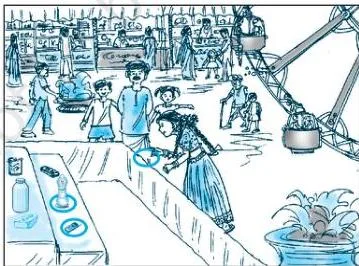
The textbook introduces this idea with a scenario: Akhila goes to a fair and wants to ride the Giant Wheel and play Hoopla. The number of times she played Hoopla is half the number of rides she took. Each ride costs ₹ 3 and a game of Hoopla costs ₹ 4, with a total spend of ₹ 20 (NCERT, p. 1).
If x is the number of rides and y is the number of Hoopla games, the conditions form two equations: \( y = \frac{1}{2}x \) and \( 3x + 4y = 20 \). This is a pair of linear equations in two variables.
Chapter Overview: Graphs, Ratios, and Algebra
A pair of linear equations in two variables takes the general form:
\[ a_1x + b_1y + c_1 = 0 \]
\[ a_2x + b_2y + c_2 = 0 \]
Here, a1, b1, c1 are coefficients from the first equation, and a2, b2, c2 are coefficients from the second. The terms x and y are the variables. You must ensure a1 and a2 are not both zero (NCERT, p. 2).
The chapter builds these skills in a specific order:
- Form equations: Translate word problems into two linear equations.
- Graphical method & ratio test: Plot the equations as lines and compare their slopes and intercepts.
- Substitution: Solve algebraically by expressing one variable in terms of the other (NCERT, p. 7).
- Elimination: Remove one variable by multiplying and adding or subtracting the equations (NCERT, p. 11).
Graphs help you visualize the solution, but algebra gives you the exact answer. You can connect this to your previous work on Polynomials and Real Numbers.
Key Concepts: Consistent, Inconsistent, and Dependent Pairs
When you plot a pair of linear equations, the two lines can behave in one of three ways. Each behavior tells you how many solutions exist (NCERT, p. 2).
Fresh Analogy: Think of two linear equations as two roads drawn on a map. Intersecting roads meet at exactly one crossroad, giving you one specific meeting point (a unique solution). Parallel roads never meet, so there is no common point (no solution).
Overlapping roads are the same path, meaning every point on the road is a shared point (infinitely many solutions).
| Behavior of Lines | Pair Type | Number of Solutions |
|---|---|---|
| Intersecting at one point | Consistent | Unique (exactly one) |
| Coincident (overlapping) | Dependent (consistent) | Infinitely many |
| Parallel | Inconsistent | Zero (no solution) |
A dependent pair is always consistent because it has solutions. An inconsistent pair has no solution and represents contradictory conditions that cannot both be true.
Definitions Every Class 10 Student Needs
Use this table to lock down the vocabulary before solving problems.
| Term | Meaning | Example |
|---|---|---|
| Consistent pair | A pair of equations that has at least one solution. | \( x + y = 5 \) and \( x – y = 1 \) |
| Inconsistent pair | A pair of equations that has no solution. | \( x + y = 5 \) and \( x + y = 10 \) |
| Dependent pair | Equations representing the same line, giving infinitely many solutions. | \( x + y = 5 \) and \( 2x + 2y = 10 \) |
| Unique solution | Exactly one value pair that satisfies both equations. | \( x = 3, y = 2 \) |
| General form | The standard structure for a pair of linear equations. | \( a_1x + b_1y + c_1 = 0 \) |
Ratio Test Formula: Checking Consistency Without Graphing
You do not always need a graph to know how many solutions a pair has. Compare the ratios of the coefficients using the Ratio Test to determine the nature of the lines (NCERT, p. 2).
| Ratio Comparison | Line Behavior | Solution Type |
|---|---|---|
| \( \frac{a_1}{a_2} \neq \frac{b_1}{b_2} \) | Intersecting | Unique solution (consistent) |
| \( \frac{a_1}{a_2} = \frac{b_1}{b_2} \neq \frac{c_1}{c_2} \) | Parallel | No solution (inconsistent) |
| \( \frac{a_1}{a_2} = \frac{b_1}{b_2} = \frac{c_1}{c_2} \) | Coincident | Infinitely many solutions (dependent) |
Memory Device: Same slopes with different intercepts means parallel lines and no solution. If the ratio of the x and y coefficients are equal but the constant term’s ratio breaks the pattern, the lines climb at the same angle but never touch.
For deeper practice on non-linear cases, see our Quadratic Equations notes. You can explore more study materials on our main CBSE notes page.
Solved Examples: Substitution and Elimination Step-by-Step
Algebraic methods are preferred for precise answers. The graphical method is not convenient when the solution has non-integer or complex coordinates (NCERT, p. 7). Here we demonstrate substitution and elimination step-by-step.
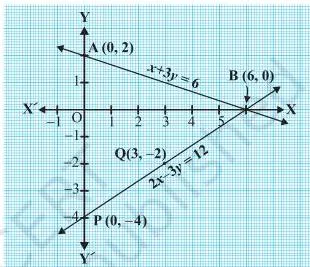
The graph illustrates two lines intersecting at a single shared point. The vertex where they cross provides the unique values for both variables.
Example 1: Substitution Method
Solve the pair of equations: \( 5x – 2y = 7 \) and \( x + 3y = 16 \).
- Step 1: Name the method: Substitution. Express one variable from the simpler equation. From \( x + 3y = 16 \), write \( x = 16 – 3y \).
- Step 2: Substitute this expression into the other equation.
\[ 5(16 – 3y) – 2y = 7 \]
\[ 80 – 15y – 2y = 7 \]
\[ 80 – 17y = 7 \]
\[ -17y = 7 – 80 \]
\[ -17y = -73 \]
\[ y = \frac{73}{17} \]
Step 3: Substitute y back into the expression for x.
\[ x = 16 – 3(\frac{73}{17}) = \frac{272}{17} – \frac{219}{17} = \frac{53}{17} \]
Final answer: The solution is \( x = \frac{53}{17} \) and \( y = \frac{73}{17} \). Verify by checking these values in both original equations.
Example 2: Elimination Method
Solve the pair of equations: \( 4p + 3q = 23 \) and \( 3p + 2q = 16 \).
Step 1: Name the method: Elimination.
Multiply the first equation by 2 and the second by 3 to make the coefficients of q numerically equal.
\[ 2(4p + 3q = 23) \Rightarrow 8p + 6q = 46 \]
\[ 3(3p + 2q = 16) \Rightarrow 9p + 6q = 48 \]
Step 2: Subtract the new first equation from the new second equation to eliminate q.
\[ (9p + 6q) – (8p + 6q) = 48 – 46 \]
\[ p = 2 \]
Step 3: Substitute \( p = 2 \) into the first original equation to find q.
\[ 4(2) + 3q = 23 \]
\[ 8 + 3q = 23 \]
\[ 3q = 15 \]
\[ q = 5 \]
Final answer: The verified solution is \( p = 2 \) and \( q = 5 \). Verification: \( 4(2) + 3(5) = 8 + 15 = 23 \) and \( 3(2) + 2(5) = 6 + 10 = 16 \).
Common Mistakes Students Make with Linear Pairs
Correct these typical errors to avoid losing marks.
| Mistake | Correct rule | How to check your answer |
|---|---|---|
| Comparing \( \frac{a_1}{a_2} = \frac{b_1}{b_2} \) and stopping early. | Must check \( \frac{c_1}{c_2} \) to distinguish parallel from coincident (NCERT, p. 2). | Always write out all three ratios before concluding. |
| Forgetting to distribute negative signs in substitution. | Correctly multiply the negative sign across the entire bracket. | Substitute a simple value first to test the bracket expansion. |
| Adding equations when signs are the same to eliminate. | You must SUBTRACT if the signs are the same to cancel one variable out. | Check that the target variable’s coefficients sum to zero after the operation. |
For example, if you are eliminating y and both equations have a positive y term, adding them will only create a larger y coefficient. You must subtract one equation from the other to cancel the terms.
Exam Notes: What the Board Expects
Examiners look for specific steps when grading these solutions. Writing the correct pair of linear equations earns the first mark in a 3-mark word problem.
- Forming equations: State what each variable represents before writing the equations.
- Method naming: Name the substitution or elimination method at the top of your solution.
- Step presentation: Show the multiplication of coefficients clearly before subtracting or adding.
- Word problem translation: For age problems, use expressions like x – 5 for five years ago. For digit problems, write a two-digit number as \( 10x + y \) (NCERT, p. 10).
Find more exam context on our Class 10 notes index. The session aligns with the official NCERT Chapter 3 Mathematics textbook page for complete reference.
Compact Revision Recap
Use this table for a quick review before tests.
| Method | When to use | Key step |
|---|---|---|
| Graphical | When estimating or visualizing the solution. | Plot two points for each equation and draw the lines. |
| Substitution | When one variable is easy to isolate. | Express one variable in terms of the other and substitute. |
| Elimination | When coefficients are easy to match by multiplying. | Multiply to get equal coefficients, then add or subtract. |
Rapid ratio test reminder:
- Unique solution: \( \frac{a_1}{a_2} \neq \frac{b_1}{b_2} \)
- No solution: \( \frac{a_1}{a_2} = \frac{b_1}{b_2} \neq \frac{c_1}{c_2} \)
- Infinitely many solutions: \( \frac{a_1}{a_2} = \frac{b_1}{b_2} = \frac{c_1}{c_2} \)
Frequently Asked Questions on Linear Equations
Which method is better: substitution or elimination?
It depends on the equations. Use substitution if one variable has a coefficient of 1 or is easy to isolate. Use elimination if the coefficients are easy to match by multiplying both equations.
What does it mean if substitution gives a true statement like 0 = 0?
If substitution eliminates all variables and leaves a true statement, the original equations are equivalent. This means they represent coincident lines and have infinitely many solutions.
How do I form linear equations from age-based word problems?
Assign variables to the present ages. Use addition or subtraction to represent the past or future. For example, five years ago is written as \( x – 5 \), and three years from now is \( x + 3 \).
Can I use the elimination method if the coefficients are not multiples of each other?
Yes. Multiply each equation by a suitable non-zero constant to make the coefficients of one variable numerically equal. Then add or subtract the equations to eliminate that variable.
Reference: NCERT Class 10 Mathematics textbook, chapter Pair of Linear Equations in Two Variables.
Explore Class 10 Mathematics Notes
More for this chapter:
Class 10 Mathematics on LearnCBSE:
Related chapters: