These introduction to trigonometry class 10 notes cover Chapter 8 for the current session. Trigonometry links the angles of a right triangle to ratios of its sides, letting you measure heights and distances you cannot reach directly. For broader revision, see our Class 10 Mathematics notes and the CBSE Class 10 notes hub.
What Trigonometry Actually Does (Chapter Roadmap)
The word trigonometry comes from three Greek roots: tri (three), gon (sides), and metron (measure). It is the study of relationships between the sides and angles of a triangle (NCERT, p. 114).
NCERT opens the chapter with three real situations: a student looking at the top of Qutub Minar, a girl on a balcony looking down at a flower pot across a river, and a hot-air balloon moving between two sighting points.
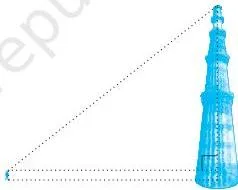
In each case, a right triangle is imagined, and the unknown height or distance is found using side ratios—without measuring it directly. The chapter builds three skills: the six ratios, their values at specific angles, and the identities connecting them.
Naming the Sides: Opposite, Adjacent, Hypotenuse
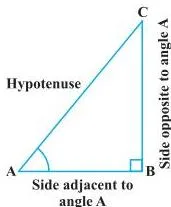
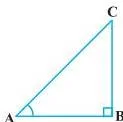
Before writing any ratio, fix one acute angle and label the three sides relative to it. The figure below shows angle A marked in a right triangle (NCERT, p. 115).
Switch the focus from angle A to angle C, and the labels swap.
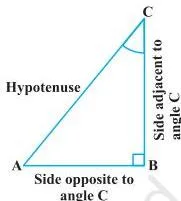
Fresh analogy: think of the chosen angle as a camera angle. What is “opposite” or “adjacent” depends entirely on where the camera points. Rotate the camera from one acute angle to the other, and the two legs swap roles; only the hypotenuse stays fixed because it is always across from the right angle.
| Term | Meaning | Example for angle A |
|---|---|---|
| Side opposite | The leg across from the chosen acute angle (not the hypotenuse) | BC |
| Side adjacent | The leg that forms part of the chosen angle (not the hypotenuse) | AB |
| Hypotenuse | The longest side, across from the right angle (always fixed) | AC |
The Six Trigonometric Ratios (Formulas Box)
Using the three sides from the previous section, we define six trigonometric ratios of angle A (NCERT, p. 115).
| Ratio | Formula | Meaning |
|---|---|---|
| sin A | \( \frac{\text{opposite}}{\text{hypotenuse}} = \frac{BC}{AC} \) | Sine of angle A |
| cos A | \( \frac{\text{adjacent}}{\text{hypotenuse}} = \frac{AB}{AC} \) | Cosine of angle A |
| tan A | \( \frac{\text{opposite}}{\text{adjacent}} = \frac{BC}{AB} \) | Tangent of angle A |
| cosec A | \( \frac{1}{\sin A} = \frac{AC}{BC} \) | Reciprocal of sin |
| sec A | \( \frac{1}{\cos A} = \frac{AC}{AB} \) | Reciprocal of cos |
| cot A | \( \frac{1}{\tan A} = \frac{AB}{BC} \) | Reciprocal of tan |
Two quotient relationships follow directly from the table:
\[ \tan A = \frac{\sin A}{\cos A} \quad \text{and} \quad \cot A = \frac{\cos A}{\sin A} \]
Critical remark from NCERT (p. 116): the symbol \( \sin A \) is an abbreviation for “the sine of angle A.” It is not a product of “sin” and \( A \). Writing \( \sin \times A \) is meaningless.
Also, if the angle stays the same, the ratio values do not change even if the triangle is enlarged or shrunk, because the ratios of corresponding sides remain equal (NCERT, p. 117).
Finding All Ratios from One Given Ratio (Worked Steps)
The standard method: given one ratio, draw the right triangle, assign sides using a constant \( k \), apply Pythagoras for the third side, then write all six ratios. The figure below shows this setup when \( \sin A = \frac{1}{3} \) in the textbook (NCERT, p. 117).
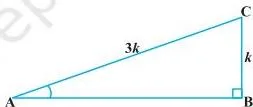
Worked Example: Given \( \sec P = \frac{17}{8} \), find sin P, cos P, tan P, cosec P, and cot P.
- Step 1: Interpret the given ratio. \( \sec P = \frac{\text{hypotenuse}}{\text{adjacent}} = \frac{17}{8} \), so let hyp \( = 17k \) and adjacent \( = 8k \).
- Step 2: Find the opposite side using the Pythagoras theorem.
\[ \text{opp} = \sqrt{(17k)^2 – (8k)^2} = \sqrt{289k^2 – 64k^2} = \sqrt{225k^2} = 15k \]
Step 3: Write the six ratios using \( \text{opp} = 15k \), \( \text{adj} = 8k \), \( \text{hyp} = 17k \).
\[ \sin P = \frac{15}{17}, \quad \cos P = \frac{8}{17}, \quad \tan P = \frac{15}{8} \]
\[ \cosec P = \frac{17}{15}, \quad \cot P = \frac{8}{15} \]
Final answer: \( \sin P = \frac{15}{17},\ \cos P = \frac{8}{17},\ \tan P = \frac{15}{8},\ \cosec P = \frac{17}{15},\ \cot P = \frac{8}{15} \).
Common mistake to avoid here: students sometimes label the adjacent side as the hypotenuse. The hypotenuse is always opposite the right angle and is always the longest side. If your “hypotenuse” is not the longest side, the assignment is wrong.
Trigonometric Ratios for 0°, 30°, 45°, 60°, 90°
These values are derived from two special triangles.
Deriving 45° (isosceles right triangle)
In a right triangle where both acute angles are \( 45^\circ \), the two legs are equal. Let each leg \( = a \). The hypotenuse is \( a\sqrt{2} \) (NCERT, p. 122). This gives \( \sin 45^\circ = \frac{1}{\sqrt{2}} \), \( \cos 45^\circ = \frac{1}{\sqrt{2}} \), and \( \tan 45^\circ = 1 \).
Deriving 30° and 60° (half equilateral triangle)
Take an equilateral triangle and drop a perpendicular from one vertex to the opposite side. This splits it into two congruent right triangles with angles \( 30^\circ \) and \( 60^\circ \) (NCERT, p. 123).
If each side of the equilateral triangle is \( 2a \), then the half-base is \( a \) and the perpendicular is \( a\sqrt{3} \). This gives \( \sin 30^\circ = \frac{1}{2} \), \( \cos 30^\circ = \frac{\sqrt{3}}{2} \), \( \tan 30^\circ = \frac{1}{\sqrt{3}} \).
Deriving 0° and 90° (limiting logic)
As angle A shrinks toward \( 0^\circ \), the opposite side shrinks to 0, and the hypotenuse aligns with the adjacent side (NCERT, p. 124). At the opposite extreme, as angle A approaches \( 90^\circ \), the adjacent side shrinks to 0, and the hypotenuse aligns with the opposite side.

Standard value table (Table 8.1, NCERT p. 125)
| \( \angle A \) | \( 0^\circ \) | \( 30^\circ \) | \( 45^\circ \) | \( 60^\circ \) | \( 90^\circ \) |
|---|---|---|---|---|---|
| sin A | \( 0 \) | \( \frac{1}{2} \) | \( \frac{1}{\sqrt{2}} \) | \( \frac{\sqrt{3}}{2} \) | \( 1 \) |
| cos A | \( 1 \) | \( \frac{\sqrt{3}}{2} \) | \( \frac{1}{\sqrt{2}} \) | \( \frac{1}{2} \) | \( 0 \) |
| tan A | \( 0 \) | \( \frac{1}{\sqrt{3}} \) | \( 1 \) | \( \sqrt{3} \) | Not defined |
| cosec A | Not defined | \( 2 \) | \( \sqrt{2} \) | \( \frac{2}{\sqrt{3}} \) | \( 1 \) |
| sec A | \( 1 \) | \( \frac{2}{\sqrt{3}} \) | \( \sqrt{2} \) | \( 2 \) | Not defined |
| cot A | Not defined | \( \sqrt{3} \) | \( 1 \) | \( \frac{1}{\sqrt{3}} \) | \( 0 \) |
Trend: as the angle goes from \( 0^\circ \) to \( 90^\circ \), sin increases from 0 to 1, cos decreases from 1 to 0 (NCERT, p. 125).
Memory device for the sin row: read the five values as square roots of fractions with denominator 4:
\[ \sqrt{\frac{0}{4}},\ \sqrt{\frac{1}{4}},\ \sqrt{\frac{2}{4}},\ \sqrt{\frac{3}{4}},\ \sqrt{\frac{4}{4}} \]
That gives \( 0, \frac{1}{2}, \frac{1}{\sqrt{2}}, \frac{\sqrt{3}}{2}, 1 \). The cos row is the reverse of the sin row.
Applying Angle Values: Height and Unknown Side Examples
One known side plus one known acute angle lets you find every other side. The figure below shows the textbook solution method for Example 6 (NCERT, p. 126).
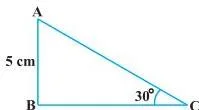
Worked Example: In \( \Delta XYZ \), right-angled at Y, \( XY = 12 \) cm and \( \angle XZY = 30^\circ \). Find YZ and XZ.
Step 1: Choose the ratio for YZ.
YZ is adjacent to \( \angle Z \) and XY is opposite to \( \angle Z \), so \( \tan 30^\circ = \frac{\text{opp}}{\text{adj}} = \frac{XY}{YZ} \).
\[ \frac{1}{\sqrt{3}} = \frac{12}{YZ} \]
\[ YZ = 12\sqrt{3}\ \text{cm} \]
Step 2: Choose the ratio for XZ.
XZ is the hypotenuse and XY is opposite to \( \angle Z \), so \( \sin 30^\circ = \frac{XY}{XZ} \).
\[ \frac{1}{2} = \frac{12}{XZ} \]
\[ XZ = 24\ \text{cm} \]
Final answer: \( YZ = 12\sqrt{3} \) cm and \( XZ = 24 \) cm.
Worked Example: If \( \sin(A – B) = \frac{1}{2} \) and \( \cos(A + B) = \frac{1}{2} \), \( 0^\circ \lt A + B \leq 90^\circ \), \( A \gt B \), find A and B.
- Step 1: Read \( \sin(A – B) = \frac{1}{2} \). Since \( \sin 30^\circ = \frac{1}{2} \), \( A – B = 30^\circ \). (Equation 1)
- Step 2: Read \( \cos(A + B) = \frac{1}{2} \). Since \( \cos 60^\circ = \frac{1}{2} \), \( A + B = 60^\circ \). (Equation 2)
- Step 3: Add Equation 1 and Equation 2.
\[ 2A = 90^\circ \implies A = 45^\circ \]
Step 4: Substitute A into Equation 1.
\[ 45^\circ – B = 30^\circ \implies B = 15^\circ \]
Final answer: \( A = 45^\circ \) and \( B = 15^\circ \).
Once you know one side and one acute angle of a right triangle, you can determine all remaining sides and angles (NCERT, p. 127). For problems involving real-life heights, the Some Applications of Trigonometry chapter extends these methods.
The Three Trigonometric Identities
An equation involving trigonometric ratios is a trigonometric identity if it is true for all values of the angle for which the expressions are defined (NCERT, p. 128). Deriving the identities, consider triangle ABC (right-angled at B):
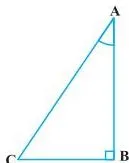
Start with the Pythagoras theorem: \( AB^2 + BC^2 = AC^2 \).
- Divide by \( AC^2 \): \( \cos^2 A + \sin^2 A = 1 \).
- Divide by \( AB^2 \): \( 1 + \tan^2 A = \sec^2 A \).
- Divide by \( BC^2 \): \( \cot^2 A + 1 = \cosec^2 A \).
Each identity is valid only where all ratios in it are defined (NCERT, p. 133). The comparison table below shows the valid ranges and which ratios break down at each boundary.
| Identity | Valid range | Undefined at the boundary |
|---|---|---|
| \( \sin^2 A + \cos^2 A = 1 \) | \( 0^\circ \leq A \leq 90^\circ \) | None — both sin and cos exist everywhere in this range |
| \( 1 + \tan^2 A = \sec^2 A \) | \( 0^\circ \leq A \lt 90^\circ \) | \( \tan A \) and \( \sec A \) undefined at \( 90^\circ \) |
| \( 1 + \cot^2 A = \cosec^2 A \) | \( 0^\circ \lt A \leq 90^\circ \) | \( \cot A \) and \( \cosec A \) undefined at \( 0^\circ \) |
This table matters: using \( 1 + \tan^2 A = \sec^2 A \) at \( A = 90^\circ \) is wrong because \( \tan 90^\circ \) and \( \sec 90^\circ \) do not exist.
Proving Trigonometric Identities (Simplified Worked Example)
The reliable strategy (NCERT Examples 10–12, pp. 130–131): convert to sin and cos, simplify one or both sides, apply a Pythagorean identity to collapse.
Prove that \( \frac{1 – \cos A}{1 + \cos A} = (\cosec A – \cot A)^2 \)
Method: Convert to sin and cos, then use the Pythagorean identity \( \sin^2 A + \cos^2 A = 1 \).
Step 1: Multiply numerator and denominator of the LHS by \( (1 – \cos A) \).
\[ \text{LHS} = \frac{(1 – \cos A)(1 – \cos A)}{(1 + \cos A)(1 – \cos A)} = \frac{(1 – \cos A)^2}{1 – \cos^2 A} \]
Step 2: Replace \( 1 – \cos^2 A \) with \( \sin^2 A \).
\[ \text{LHS} = \frac{(1 – \cos A)^2}{\sin^2 A} = \left( \frac{1 – \cos A}{\sin A} \right)^2 = \left( \frac{1}{\sin A} – \frac{\cos A}{\sin A} \right)^2 \]
Step 3: Recognise \( \frac{1}{\sin A} = \cosec A \) and \( \frac{\cos A}{\sin A} = \cot A \).
\[ \text{LHS} = (\cosec A – \cot A)^2 = \text{RHS} \]
Hence proved.
Writing the name of the identity used at each step earns partial credit even if you get stuck before the last line.
Common Mistakes Students Make in Trigonometry
| Mistake | Correct rule | How to check your answer |
|---|---|---|
| Writing \( \sin^2 A \) as \( \sin A^2 \) | \( \sin^2 A \) means \( (\sin A)^2 \); the square applies to the whole ratio | Expand mentally: \( \sin^2 A = \sin A \times \sin A \) |
| Writing \( \cosec A = \sin^{-1} A \) | \( \cosec A = \frac{1}{\sin A} \). \( \sin^{-1} A \) is inverse sine, a different concept | Check: \( \cosec A \) takes an angle and yields a ratio; \( \sin^{-1} A \) takes a ratio and yields an angle |
| Forgetting the hypotenuse is longest, so sin/cos exceed 1 | \( \sin A \) and \( \cos A \) are always \( \leq 1 \). If you get \( \sin A = \frac{5}{4} \), sides are swapped | Verify hypotenuse is the denominator of sin and cos |
| Using \( 1 + \tan^2 A = \sec^2 A \) at \( A = 90^\circ \) | Identity is valid only for \( 0^\circ \leq A \lt 90^\circ \); \( \tan 90^\circ \) and \( \sec 90^\circ \) are undefined | Substitute the angle: if it is \( 90^\circ \), the identity fails |
| Claiming \( \sin(A + B) = \sin A + \sin B \) | Ratios are not linear functions; this is false for all angles | Test with \( A = 30^\circ, B = 30^\circ \): \( \sin 60^\circ = \frac{\sqrt{3}}{2} \neq 2 \times \frac{1}{2} = 1 \) |
For polynomial-based revision connected to this chapter, see our Coordinate Geometry notes and the main CBSE notes index.
Exam Pointers: What Scores the Marks Here
Questions from this chapter appear in predictable patterns, based on the NCERT exercises.
- Evaluate-type 1-mark or 2-mark questions use the angle-value table directly (Exercise 8.2 Q1 pattern). Write the value you are substituting at each step.
- Given-one-ratio questions (Exercise 8.1 Q3–Q5 and Q7–Q8) carry 3–4 marks. The method mark goes for assigning sides as \( k \) and using the Pythagoras theorem; the final mark goes for writing all required ratios.
- Identity proofs (Exercise 8.3 Q4 style) carry 2–3 marks. The step of converting to sin and cos earns partial credit even if the final line is missed. Always write the name of the identity or ratio you use—examiners look for that as a mark-earning step.
- Angle-sum equations (Exercise 8.2 Q3 pattern) ask you to split into two linear equations after identifying standard angles. State which standard angle value you matched at each step.
For the authoritative source, the official NCERT Class 10 Mathematics Chapter 8 page provides the full chapter text.
Chapter Revision Recap
Below is a compact summary of the chapter, enough to rebuild it from memory.
Box 1 — The six ratio definitions
\[ \sin A = \frac{\text{opp}}{\text{hyp}},\ \cos A = \frac{\text{adj}}{\text{hyp}},\ \tan A = \frac{\text{opp}}{\text{adj}} \]
Box 2 — Reciprocal and quotient relations
\[ \cosec A = \frac{1}{\sin A},\ \sec A = \frac{1}{\cos A},\ \cot A = \frac{1}{\tan A},\ \tan A = \frac{\sin A}{\cos A} \]
Box 3 — Standard angle values
Use the table in the specific-angles section above. The sin row rises \( 0 \to 1 \); the cos row falls \( 1 \to 0 \).
Box 4 — The three identities with validity ranges
- \( \sin^2 A + \cos^2 A = 1 \) for \( 0^\circ \leq A \leq 90^\circ \)
- \( 1 + \tan^2 A = \sec^2 A \) for \( 0^\circ \leq A \lt 90^\circ \)
- \( 1 + \cot^2 A = \cosec^2 A \) for \( 0^\circ \lt A \leq 90^\circ \)
Key bounds: \( \sin A \leq 1 \) and \( \cos A \leq 1 \); \( \sec A \geq 1 \) and \( \cosec A \geq 1 \).
Frequently Asked Questions on Introduction to Trigonometry
Why is the value of sin A or cos A always less than or equal to 1?
In a right triangle, the hypotenuse is always the longest side. Since \( \sin A = \frac{\text{opposite}}{\text{hypotenuse}} \) and \( \cos A = \frac{\text{adjacent}}{\text{hypotenuse}} \), and a leg can be equal to the hypotenuse only at \( 0^\circ \) or \( 90^\circ \), both ratios stay \( \leq 1 \).
What does “Not defined” mean for tan 90° and cosec 0° in the trigonometric table?
\( \tan 90^\circ = \frac{\sin 90^\circ}{\cos 90^\circ} = \frac{1}{0} \), and division by zero is not defined. Similarly, \( \cosec 0^\circ = \frac{1}{\sin 0^\circ} = \frac{1}{0} \), which is not defined.
How do I find all six trigonometric ratios if only tan A is given?
Write \( \tan A = \frac{\text{opposite}}{\text{adjacent}} = \frac{p}{q} \), set opposite \( = pk \) and adjacent \( = qk \), find the hypotenuse using \( \sqrt{p^2 + q^2} \, k \), then write all six ratios.
Why does the value of sin A not change when the sides of the right triangle change length?
All right triangles with the same acute angle are similar by the AA criterion, so their corresponding sides are in the same ratio. The ratio opposite/hypotenuse stays fixed regardless of scale.
What is the difference between sin squared A and sin inverse A in trigonometry?
\( \sin^2 A \) means \( (\sin A)^2 \) — the square of a ratio. \( \sin^{-1} A \) means inverse sine — a function that takes a ratio and returns an angle, a concept from higher classes. \( \cosec A = \frac{1}{\sin A} \), not \( \sin^{-1} A \).
Reference: NCERT Class 10 Mathematics textbook, chapter Introduction to Trigonometry.
Explore Class 10 Mathematics Notes
More for this chapter:
Class 10 Mathematics on LearnCBSE:
Related chapters: