
These triangles class 10 notes cover Chapter 6 in a teacher’s order—definitions first, Thales theorem next, similarity criteria after, and worked examples last. In the CBSE 2026-27 syllabus, Chapter 6 builds on the idea of shape versus size, moving from congruence (same shape and size) to similarity (same shape).
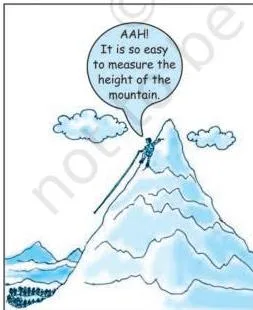
If the chapter hooks you with an analogy, study it: photographers enlarge pictures using a constant ratio, and surveyors use similar triangles to measure a mountain’s height without a tape. The same ratio concept powers the theorems below.
What This Chapter Builds On: From Congruence to Similarity
In Class IX, you learned that two figures are congruent if they have the same shape and the same size (NCERT, p. 74). In this chapter, you study figures that share the same shape but need not share the same size. Such figures are called similar figures.
A key relation to fix in your head: all congruent figures are similar, but similar figures need not be congruent (NCERT, p. 75). A small triangle and a larger copy of it are similar, but their sides differ in length, so they are not congruent.
The same idea runs through a photographer’s darkroom. A 35 mm negative enlarged to 45 mm stretches every line segment by the ratio 45:35, while angles stay fixed (NCERT, p. 76). That fixed ratio of corresponding sides is called the scale factor (or Representative Fraction), the same tool used to draw world maps and building blueprints.
When students want a broader set of chapter summaries for Class 10 Maths, our Class 10 Mathematics notes page collects them in one place.
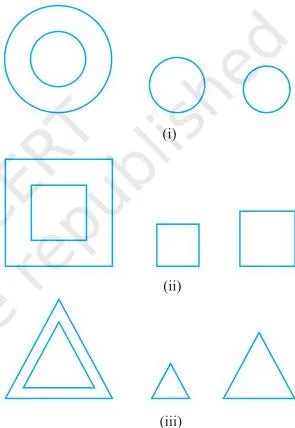
Similarity of Polygons: The Two Conditions You Must Check
For two polygons to be similar, checking just one property is not enough. The textbook flags that either condition alone is insufficient for a pair of polygons (NCERT, p. 78). Two conditions must hold together:
- Their corresponding angles are equal.
- Their corresponding sides are in the same ratio (proportional).
Misconception Autopsy: Why One Condition Is Not Enough
Many students think one condition alone guarantees similarity. The textbook shows two specific counterexamples on p. 78 to correct this.
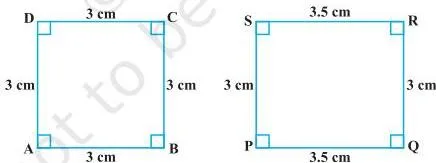
| Pair | Equal angles? | Sides proportional? | Similar? |
|---|---|---|---|
| Square vs Rectangle | Yes, all 90° | No | No |
| Square vs Rhombus | No | Yes (1:1) | No |
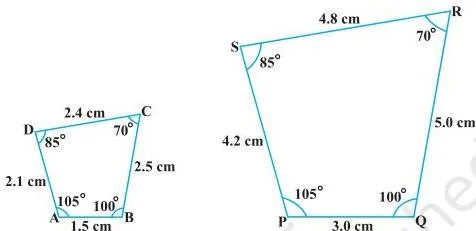
Note the special status of triangles: because of the theorems on p. 88 and p. 89, if one of the two conditions holds for a pair of triangles, the other follows automatically. That is why the four criteria below do not require both checks—unlike general polygons where you must verify both.
Key Definitions and Formula Summary
Use this table for a fast recall of the terms used across the chapter. The symbol ~ stands for ‘is similar to’; the order of vertices in that symbol fixes the correspondence (for example, \( \Delta ABC \sim \Delta DEF \) maps A→D, B→E, C→F).
| Term | Meaning | Example |
|---|---|---|
| Similar figures | Same shape, not necessarily same size | Any two circles |
| Equiangular triangles | Two triangles whose corresponding angles are equal | \( \Delta PQR, \Delta XYZ \) with \( \angle P = \angle X, \angle Q = \angle Y, \angle R = \angle Z \) |
| Scale factor | The common ratio of corresponding sides of two similar figures | Photos 1:2.5 |
| BPT (Thales) | Line parallel to one side divides other two sides in same ratio | \( \frac{AD}{DB} = \frac{AE}{EC} \) |
\[ \frac{AD}{DB} = \frac{AE}{EC} \quad (\text{BPT ratio, units cancel}) \]
\[ \frac{AB}{DE} = \frac{BC}{EF} = \frac{CA}{FD} \quad (\text{similarity ratio, units cancel}) \]
Lengths in this chapter are usually given in cm or m; ratios themselves are dimensionless since equal units cancel.
Basic Proportionality Theorem (Thales Theorem) and Its Converse
Theorem 6.1 (BPT): If a line is drawn parallel to one side of a triangle to intersect the other two sides in distinct points, it divides those two sides in the same ratio (NCERT, p. 80).
Proof Idea (we do not reproduce the textbook proof)
Join BE and CD; draw \( DM \perp AC \) and \( EN \perp AB \) (NCERT, p. 80). The idea is to rewrite the required ratios as ratios of areas of two triangles that share the same base DE.
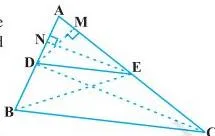
The two key area-ratio steps reduce as follows (note that the common height factors cancel, leaving the base ratio):
\[ \frac{\text{ar}(\Delta ADE)}{\text{ar}(\Delta BDE)} = \frac{\frac{1}{2} \cdot AD \times EN}{\frac{1}{2} \cdot DB \times EN} = \frac{AD}{DB} \]
\[ \frac{\text{ar}(\Delta ADE)}{\text{ar}(\Delta DEC)} = \frac{\frac{1}{2} \cdot AE \times DM}{\frac{1}{2} \cdot EC \times DM} = \frac{AE}{EC} \]
Because \( \Delta BDE \) and \( \Delta DEC \) stand on the same base DE and between the same parallels DE and BC, they have equal areas; therefore the two ratios equate to \( AD/DB = AE/EC \).
Theorem 6.2 (Converse of BPT): If a line divides any two sides of a triangle in the same ratio, then the line is parallel to the third side (NCERT, p. 82).
| Theorem | Given | To prove |
|---|---|---|
| 6.1 (BPT) | \( DE \parallel BC \) | \( \frac{AD}{DB} = \frac{AE}{EC} \) |
| 6.2 (Converse) | \( \frac{AD}{DB} = \frac{AE}{EC} \) | \( DE \parallel BC \) |
Memory device for the two results:
- Parallel line → Proportional sides (Theorem 6.1)
- Proportional sides → Parallel line (Theorem 6.2)
Use 6.1 when DE || BC is given and you must find a side. Use the converse when the ratio is given and you must prove lines parallel—typical in trapezium diagonal questions.
Criteria for Similarity of Triangles: AAA, AA, SSS, SAS
For triangles we can cut the checks down from six pairs of corresponding parts to three, using four criteria proved in the textbook (NCERT, pp. 87-91). The reason fewer checks suffice is the same triangle angle-sum property: two equal angles force the third to be equal.
| Criterion | What you check | What follows | Exam usage |
|---|---|---|---|
| AAA (Th. 6.3) | \( \angle A = \angle D, \angle B = \angle E, \angle C = \angle F \) | Sides proportional | Parallel lines, intersecting lines |
| AA (Remark) | Any two angles equal | Third angle equal → similar | Shadow/height problems |
| SSS (Th. 6.4) | \( \frac{AB}{DE} = \frac{BC}{EF} = \frac{CA}{FD} \) | Angles equal | All sides known |
| SAS (Th. 6.5) | Two sides proportional + included angle equal | Similar | Two sides + angle given |
| RHS (Note) | Hypotenuse and one side proportional (right triangles) | Similar | Bonus for right-triangle cases |
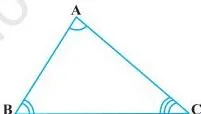
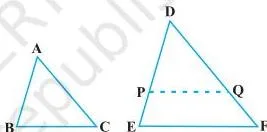
RHS Similarity (bonus): The “Note to the Reader” (NCERT, p. 98) adds that in two right triangles, if the hypotenuse and one side of one are proportional to the hypotenuse and one side of the other, the triangles are similar. It is not a numbered theorem; use it as a quick shortcut, especially in Chapter 8 problems.
Worked Examples: Applying BPT and Similarity Criteria
Example 1 (BPT): Find EC given DE || BC
Step 1: Identify the theorem.
Since DE is parallel to BC, the Basic Proportionality Theorem applies.
\[ \frac{AD}{DB} = \frac{AE}{EC} \]
Step 2: Substitute.
Let \( AD = 3.6 \text{ cm}, DB = 2.4 \text{ cm}, AE = 5.4 \text{ cm} \).
\[ \frac{3.6}{2.4} = \frac{5.4}{EC} \]
- Step 1: Simplify the left ratio: \( \frac{3.6}{2.4} = 1.5 \).
- Step 2: Solve for EC.
\[ 1.5 = \frac{5.4}{EC} \implies EC = \frac{5.4}{1.5} = 3.6 \text{ cm} \]
Final answer: \( EC = 3.6 \text{ cm} \).
Example 2 (AA / Shadow): Find the length of the shadow after 5 seconds
A boy 1.5 m tall walks away from a lamp-post at 1.5 m/s for 5 seconds. The lamp is 4.5 m above the ground. Find the length of his shadow after 5 s.
Step 1: Calculate distance walked.
\[ \text{Distance} = 1.5 \text{ m/s} \times 5 \text{ s} = 7.5 \text{ m} \]
- Step 1: Form similar triangles. The boy is vertical and the lamp-post is vertical to the ground.
- Step 2: Identify equal angles.
- Both triangles are right-angled (lamp-post and boy are perpendicular to the ground): \( \angle B = \angle D = 90^\circ \).
- They share the angle at the tip of the shadow: \( \angle E = \angle E \).
Step 4: Apply AA similarity to the large lamp-shadow triangle and the small boy-shadow triangle.
\[ \Delta ABE \sim \Delta CDE \implies \frac{BE}{DE} = \frac{AB}{CD} \]
Step 5: Substitute.
Let \( DE = x \) m, so \( BE = 7.5 + x \) m, \( AB = 4.5 \) m, \( CD = 1.5 \) m.
\[ \frac{7.5 + x}{x} = \frac{4.5}{1.5} = 3 \]
Step 6: Solve the equation.
\[ 7.5 + x = 3x \implies 2x = 7.5 \implies x = 3.75 \text{ m} \]
Final answer: The boy’s shadow is 3.75 m long after 5 seconds.
Example 3 (SAS): Prove similarity and find the third side ratio
In two right triangles, two pairs of corresponding sides are proportional and the included angle is equal.
Step 1: Identify the rule.
By SAS similarity, if the included angle is equal and the two sides around it are proportional, the triangles are similar.
Step 2: When two triangles are similar, every pair of corresponding sides is in the same ratio.
Therefore the third sides are in the same ratio.
\[ \frac{AB}{DE} = \frac{BC}{EF} = \frac{CA}{FD} = \frac{5}{8} \]
Final answer: The third-side ratio is \( \frac{5}{8} \).
If your course load is heavy, pairing this chapter with Arithmetic Progressions notes and Coordinate Geometry notes lets you revise related skill sets together.
Common Mistakes Students Make in Triangles
Below are error-correction pairs specific to this chapter. The right column tells you how to check your answer before you submit.
| Mistake | Correct rule | How to check your answer |
|---|---|---|
| \( \Delta ABC \sim \Delta EDF \) (wrong order) | Order must match angle/side correspondence; \( A \leftrightarrow D, B \leftrightarrow E, C \leftrightarrow F \) | Verify each pair in the ratio stays consistent. |
| Using SAS similarity with a non-included angle | The angle in SAS must be the included angle between the two proportional sides (NCERT, p. 90) | Check that the angle sits between the two sides. |
| Believing proportional sides alone make two polygons similar | For polygons you need equal angles too; in triangles, proportional sides imply equal angles by SSS (NCERT, p. 78) | For polygons, verify both conditions. |
| Confusing congruence with similarity | Congruent figures have a scale factor of 1 and are automatically similar | Confirm: is the ratio 1? Both count as congruent. |
Exam Notes: What Examiners Look For
Examiner feedback highlights these patterns in the Triangles chapter.
- Always write the full similarity statement, \( \Delta ABC \sim \Delta DEF \), with the correct correspondence, before extracting any ratio.
- Write the theorem or criterion name as you apply it: “By AA similarity criterion…” earns the method mark.
- Shadow and height problems (Example 7 type, NCERT, p. 92) and trapezium-diagonal ratio problems (Exercise 6.2, Q9-Q10) are frequent.
- Always state the unit of the final answer.
For adjacent geometry chapters, our Circles notes cover the properties you’ll need for combined questions. Our main Class 10 CBSE notes index lists every chapter in one place. You can also cross-check any page reference with the official NCERT Class 10 Mathematics textbook, Chapter 6.
Real-Life Application: How Heights and Distances Use Similarity
The chapter opens with a question you cannot answer with a tape: how did surveyors measure Mount Everest? The technique is indirect measurement, using two similar triangles (NCERT, p. 74). In the shadow method, a pole of known height is planted upright. The sun casts shadows of the pole and the mountain at the same instant.
The two triangles formed (by each object and its shadow on flat ground) are both right-angled and share the sun’s elevation angle, so by AA they are similar.
Setting the ratio of corresponding sides equal:
\[ \frac{\text{height of mountain}}{\text{height of pole}} = \frac{\text{shadow of mountain}}{\text{shadow of pole}} \]
This simple proportion—multiply the height of the pole by the ratio of the shadows—gives the mountain’s height. The same principle was historically used to estimate the distance to the moon using angles measured at two different points on Earth; the two observer-and-moon triangles are similar by AA.
Quick Revision Recap of Triangles
- Similar = same shape, not necessarily same size.
- All congruent figures are similar; the converse is false.
- Polygons are similar only if corresponding angles are equal AND corresponding sides are proportional.
- BPT (Th. 6.1): \( DE \parallel BC \implies \frac{AD}{DB} = \frac{AE}{EC} \).
- Converse BPT (Th. 6.2): ratio equal implies \( DE \parallel BC \).
- AAA similarity (Th. 6.3): equal corresponding angles.
- AA similarity: two angles equal is enough.
- SSS similarity (Th. 6.4): all three pairs of sides proportional.
- SAS similarity (Th. 6.5): two sides proportional + included angle equal.
- RHS similarity (p. 98 Note): hypotenuse and one side proportional in right triangles.
Frequently Asked Questions on Triangles
Can two triangles be similar but not congruent?
Yes. Similar triangles need the same shape, but their sizes may differ. For example, a triangle with sides 4 cm, 5 cm, 6 cm and another with sides 8 cm, 10 cm, 12 cm are similar (SSS) but not congruent, because the scale factor is 2.
What is the difference between SAS congruence and SAS similarity?
In SAS congruence, the two sides and the included angle must be equal. In SAS similarity, the two sides must be proportional and the included angle must be equal (NCERT, p. 90).
How do I decide which similarity criterion to use for a given problem?
Look at what is given. If two angles are known equal, use AA. If three sides are known, use SSS. If two sides and the angle between them are known, use SAS. If a parallel line is drawn, Thales theorem comes into play.
Is RHS similarity a formal theorem in this chapter?
No. It appears only in the “Note to the Reader” on p. 98, not as a numbered theorem. You may use it for right-triangle cases, but answer in the chapter by referencing the main theorems first.
Why does the order of vertices matter in the similarity symbol?
The order fixes the vertex correspondence. Writing \( \Delta ABC \sim \Delta DEF \) means A ↔ D, B ↔ E, C ↔ F. A wrong order (for example, \( \Delta ABC \sim \Delta EDF \)) falsely implies the wrong correspondence and changes which sides sit opposite which angles.
Reference: NCERT Class 10 Mathematics textbook, chapter Triangles.
Explore Class 10 Mathematics Notes
More for this chapter:
Class 10 Mathematics on LearnCBSE:
Related chapters: