
These Real Numbers class 10 notes cover the three pillars of NCERT Chapter 1 for the current academic session: the Fundamental Theorem of Arithmetic, HCF and LCM by prime factorisation, and the proof-by-contradiction method for irrational numbers. In Class IX, you met irrational numbers like \( \sqrt{2} \) on the number line without proving why they cannot be written as fractions.
This chapter closes that gap using the unique factorisation of integers. If you are revising for a class test or the CBSE board, use this page as your complete revision sheet — definitions, formulas, stepwise worked examples, and common mark-losing mistakes are all here. For broader mathematics revision, start from our Class 10 Mathematics notes hub.
The Fundamental Theorem of Arithmetic
Every natural number greater than 1 is either a prime or can be built by multiplying primes. The Fundamental Theorem of Arithmetic (Theorem 1.1, NCERT p. 3) states this in a precise way: every composite number can be expressed as a product of primes, and this factorisation is unique, apart from the order in which the prime factors occur (NCERT, p. 3).
“Unique apart from order” means the list of primes is fixed even if you shuffle them. So \( 2 \times 3 \times 5 \times 7 \) and \( 3 \times 5 \times 7 \times 2 \) count as the same factorisation. Once you arrange the primes in ascending order, there is exactly one way to write the number as powers of primes.
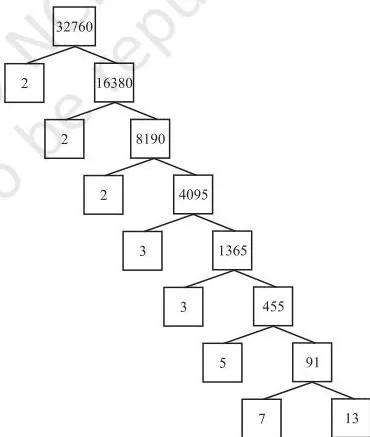
The factor tree above shows the theorem in action. Starting with 32760, the diagram splits the number step by step until every branch ends in a prime. The result is \( 32760 = 2^3 \times 3^2 \times 5 \times 7 \times 13 \) (NCERT, p. 3). No matter what route you take to split 32760, you will land on this exact set of primes. That uniqueness is what the theorem guarantees.
Why does uniqueness matter? It means prime factorisation behaves like a fingerprint for every integer. If two numbers share the same prime fingerprint, they are the same number. This property is the foundation for finding HCF and LCM, proving irrationality, and even securing digital communication.
Finding HCF and LCM by Prime Factorisation
Once every number is written as powers of primes, the HCF and LCM follow two simple selection rules (NCERT, p. 4):
- HCF = product of the smallest power of each common prime factor.
- LCM = product of the greatest power of each prime factor involved.
For example, \( 6 = 2^1 \times 3^1 \) and \( 20 = 2^2 \times 5^1 \). The only common prime is 2. Its smallest power is \( 2^1 \), so \( \text{HCF}(6, 20) = 2 \). The greatest powers across both numbers are \( 2^2, 3^1, 5^1 \), so \( \text{LCM}(6, 20) = 60 \) (NCERT, p. 4).
For any two positive integers \( a \) and \( b \), the identity \( \text{HCF}(a, b) \times \text{LCM}(a, b) = a \times b \) holds (NCERT, p. 4). You can use this to find the LCM directly when the HCF is already known.
The LCM also solves meeting-time word problems. On page 5, Sonia takes 18 minutes for one round and Ravi takes 12 minutes. They meet at the starting point after \( \text{LCM}(18, 12) = 36 \) minutes — the first time both intervals line up.
Two-Number vs Three-Number Method: A Comparison
The table below compares the prime factorisation method and the HCF-LCM identity method for two and three numbers, including why the product identity fails for three numbers.
| Term | Two Numbers (e.g., \(a, b\)) | Three Numbers (e.g., \(p, q, r\)) |
|---|---|---|
| Prime Factorisation Method | Works directly: pick smallest powers for HCF, greatest for LCM. | Works directly: pick smallest powers for HCF, greatest for LCM. |
| HCF × LCM Identity | \( \text{HCF}(a, b) \times \text{LCM}(a, b) = a \times b \) — holds. | \( \text{HCF}(p, q, r) \times \text{LCM}(p, q, r) \neq p \times q \times r \) — fails. |
| Why the identity behaves this way | The union and intersection of prime powers balance exactly for two numbers. | For three numbers, the LCM counts the highest powers of all primes, while the HCF counts only the lowest powers common to all three. The product overcounts primes present in some but not all numbers. |
| Verification Example | \( 6 \times 20 = 120 \) and \( \text{HCF} \times \text{LCM} = 2 \times 60 = 120 \). | \( 6 \times 72 \times 120 = 51840 \) but \( \text{HCF}(6, 72, 120) \times \text{LCM}(6, 72, 120) = 6 \times 360 = 2160 \neq 51840 \) (NCERT, p. 5). |
Proving Irrationality: The Contradiction Method
A number is irrational if it cannot be written as \( \frac{p}{q} \) where \( p \) and \( q \) are integers and \( q \neq 0 \) (NCERT, p. 6). To prove that numbers like \( \sqrt{2} \) or \( \sqrt{3} \) are irrational, the textbook uses a technique called proof by contradiction (NCERT, p. 6).
Before the main proof, you need a supporting result. Theorem 1.2 (NCERT, p. 6) states: if \( p \) is a prime and \( p \) divides \( a^2 \), then \( p \) divides \( a \), where \( a \) is a positive integer. This follows directly from the Fundamental Theorem: if \( a = p_1 p_2 \dots p_n \), then \( a^2 = p_1^2 p_2^2 \dots p_n^2 \).
The primes in \( a^2 \) are exactly those in \( a \), so if a prime \( p \) divides \( a^2 \), it must be one of the primes in \( a \).
The contradiction method for proving \( \sqrt{p} \) irrational follows a fixed structure:
- Assume to the contrary that \( \sqrt{p} \) is rational.
- Write \( \sqrt{p} = \frac{a}{b} \) where \( a \) and \( b \) are coprime integers.
- Square both sides and rearrange to get \( p \) divides \( a^2 \).
- Apply Theorem 1.2 to conclude \( p \) divides \( a \), so \( a = pc \).
- Substitute back to show \( p \) divides \( b^2 \), hence \( p \) divides \( b \).
- Now \( a \) and \( b \) share the factor \( p \), contradicting the coprime assumption.
- conclude \( \sqrt{p} \) is irrational.
The coprime assumption is the engine of the proof. It sets up the contradiction by guaranteeing \( a \) and \( b \) share no common factor, which the algebra then violates.
Real-Life Application: Cryptography and RSA Encryption
The textbook does not make this connection, but the ideas in this chapter underpin modern digital security. RSA encryption, the system that secures online banking and messaging, relies on the difficulty of factoring very large composite numbers into primes.
If the Fundamental Theorem of Arithmetic did not hold — if a number had two different prime factorisations — the entire system would break, because the public and private keys would not stay linked. The irrationality proofs you study here are an early exercise in the number theory that makes cryptography possible.
Key Definitions and Theorems
| Term / Theorem | Meaning | Example |
|---|---|---|
| Composite Number | A natural number greater than 1 that is not prime, so it has factors other than 1 and itself (NCERT, p. 2). | 15 (factors 1, 3, 5, 15); \( 15 = 3 \times 5 \). |
| Coprime Integers | Two integers whose only common positive factor is 1; their HCF is 1. | 8 and 15 share no prime factor, so they are coprime. |
| Fundamental Theorem of Arithmetic | Every composite number factors into primes in a unique way, apart from the order of factors (NCERT, p. 3). | \( 90 = 2 \times 3^2 \times 5 \) and no other prime set gives 90. |
| Theorem 1.2 (Prime divides \(a^2\)) | If a prime \( p \) divides \( a^2 \), then \( p \) divides \( a \) (NCERT, p. 6). | If 3 divides \( 36 = 6^2 \), then 3 divides 6. |
| Irrational Number | A number that cannot be written as \( \frac{p}{q} \) with integers \( p, q \) and \( q \neq 0 \) (NCERT, p. 6). | \( \sqrt{2}, \sqrt{3}, \pi \). |
| Proof by Contradiction | Assume the opposite of what you want to prove, then show that assumption leads to an impossibility. | Assume \( \sqrt{2} \) is rational; show this forces a contradiction. |
Formulas and Identities for Real Numbers
| Formula / Identity | What it means | When it applies |
|---|---|---|
| \( \text{HCF}(a, b) \times \text{LCM}(a, b) = a \times b \) | The product of HCF and LCM of two numbers equals the product of the numbers (NCERT, p. 4). | Exactly two positive integers only. |
| \( \text{HCF}(p, q, r) \times \text{LCM}(p, q, r) \neq p \times q \times r \) | The product identity does not extend to three numbers (NCERT, p. 5, 9). | Three or more numbers — never use the simple identity. |
| \( \text{LCM}(p, q, r) = \frac{p \cdot q \cdot r \cdot \text{HCF}(p, q, r)}{\text{HCF}(p, q) \cdot \text{HCF}(q, r) \cdot \text{HCF}(p, r)} \) | Extended LCM formula for three numbers (NCERT, p. 9, enrichment note). | Enrichment — not the core exam focus, but useful for advanced problems. |
| \( \text{HCF}(p, q, r) = \frac{p \cdot q \cdot r \cdot \text{LCM}(p, q, r)}{\text{LCM}(p, q) \cdot \text{LCM}(q, r) \cdot \text{LCM}(p, r)} \) | Extended HCF formula for three numbers (NCERT, p. 9, enrichment note). | Enrichment — useful but outside the core examination scope. |
| If prime \( p \) divides \( a^2 \), then \( p \) divides \( a \) | Theorem 1.2; a consequence of unique prime factorisation (NCERT, p. 6). | Inside contradiction proofs for irrationality. |
The extended three-number formulas appear in the official NCERT Class 10 Mathematics textbook chapter 1 under the “A Note to the Reader” section (p. 9). They are marked as enrichment, so use them only if a question explicitly involves three numbers and asks for a relation beyond direct prime factorisation.
Worked Example: HCF, LCM, and the Last-Digit Problem
Example 1: Find HCF and LCM of 84 and 270 by prime factorisation
Step 1 (Method: Prime Factorisation): Break each number into powers of primes.
\[ 84 = 2^2 \times 3 \times 7 \]
\[ 270 = 2 \times 3^3 \times 5 \]
Step 2: For HCF, take the smallest power of each common prime.
The common primes are 2 and 3.
\[ \text{HCF}(84, 270) = 2^1 \times 3^1 = 6 \]
Step 3: For LCM, take the greatest power of each prime involved across both numbers.
The primes are 2, 3, 5, and 7.
\[ \text{LCM}(84, 270) = 2^2 \times 3^3 \times 5 \times 7 = 3780 \]
Step 4: Verify using the identity \( \text{HCF} \times \text{LCM} = 84 \times 270 \).
\[ \text{HCF} \times \text{LCM} = 6 \times 3780 = 22680 \]
\[ 84 \times 270 = 22680 \]
Final answer: \( \text{HCF} = 6 \), \( \text{LCM} = 3780 \). The identity holds.
Example 2: Given HCF(252, 594) = 18, find LCM using the identity
Step 1 (Method: HCF-LCM Identity): Use \( \text{HCF}(a, b) \times \text{LCM}(a, b) = a \times b \).
Step 2: Rearrange to solve for LCM.
\[ \text{LCM}(252, 594) = \frac{252 \times 594}{\text{HCF}(252, 594)} = \frac{252 \times 594}{18} \]
Step 3: Simplify the fraction.
\[ \frac{252}{18} = 14 \]
\[ \text{LCM}(252, 594) = 14 \times 594 = 8316 \]
Final answer: \( \text{LCM}(252, 594) = 8316 \).
Example 3: Check whether 12n can end with the digit 0 for any natural number n
Step 1 (Method: Unique Prime Factorisation): A number ending in 0 must be divisible by 10, so its prime factorisation must contain both 2 and 5.
Step 2: Write the prime factorisation of \( 12^n \).
\[ 12 = 2^2 \times 3 \]
\[ 12^n = (2^2 \times 3)^n = 2^{2n} \times 3^n \]
- Step 1: The only primes in the factorisation of \( 12^n \) are 2 and 3. There is no factor of 5.
- Step 2: By the uniqueness part of the Fundamental Theorem of Arithmetic, no other primes can appear in this factorisation.
Final answer: Since \( 12^n \) lacks the prime 5, it can never end with the digit 0 for any natural number \( n \).
Worked Example: Proving a Number is Irrational
Prove that 4 + √5 is irrational
Step 1 (Method: Proof by Contradiction): Assume, to the contrary, that \( 4 + \sqrt{5} \) is rational.
Step 2: Then it can be written as a fraction of two coprime integers.
\[ 4 + \sqrt{5} = \frac{a}{b} \text{, where } a, b \text{ are coprime and } b \neq 0 \]
Step 3: Isolate \( \sqrt{5} \).
\[ \sqrt{5} = \frac{a}{b} – 4 = \frac{a – 4b}{b} \]
- Step 1: Since \( a \) and \( b \) are integers, \( a – 4b \) is an integer. Therefore \( \frac{a – 4b}{b} \) is a rational number.
- Step 2: This means \( \sqrt{5} \) is rational. But \( \sqrt{5} \) is a known irrational number (proven by the same contradiction structure using Theorem 1.2 with \( p = 5 \)).
- Step 3: This contradiction has arisen because of our incorrect assumption that \( 4 + \sqrt{5} \) is rational.
Final answer: \( 4 + \sqrt{5} \) is irrational.
The logic mirrors Example 6 in the textbook (p. 8), where \( 5 – \sqrt{3} \) is shown to be irrational by the same isolation and contradiction structure. The key is that the sum or difference of a rational and an irrational number is always irrational.
Common Mistakes Students Make in Real Numbers
The table below collects the specific errors that cost marks in this chapter. Each one is tied to a rule from the NCERT text.
| Mistake | Correct rule | How to check your answer |
|---|---|---|
| Students apply \( \text{HCF} \times \text{LCM} = \text{product} \) to three numbers. | The identity only holds for exactly two positive integers. For three numbers, it fails (NCERT, p. 5). | Multiply the three numbers and compare with HCF times LCM. If they do not match, you used the wrong rule. |
| Students skip stating “let \( a \) and \( b \) be coprime” in contradiction proofs. | The coprime assumption is what creates the contradiction later; omitting it breaks the logical chain. | Check that your first assumption line includes the word coprime. |
| Students write \( 6^n \) ends with 0 because it is even. | A number ending in 0 needs both 2 and 5 as prime factors. \( 6^n = 2^n \times 3^n \) lacks the prime 5. | Write the prime factorisation and look for a 5. If it is absent, the number cannot end in 0. |
Exam Notes: How CBSE Tests Real Numbers
Exercise 1.1 (NCERT, p. 5) contains three types of questions: direct prime factorisation (Q1), HCF and LCM of pairs and triples with verification (Q2, Q3), and reasoning problems including the last-digit question (Q5) and the circular path meeting-time problem (Q7). Exercise 1.2 (p. 9) is entirely proof-based: prove \( \sqrt{5} \) is irrational, prove \( 3 + 2\sqrt{5} \) is irrational, and prove three expressions involving square roots are irrational.
Here is what an examiner looks for in each type:
- Contradiction proofs: The first written line must be “assume, to the contrary, that [the number] is rational.” This earns the method mark. Without it, the proof structure is incomplete even if the algebra is correct.
- Last-digit problems: Stating that the number “must contain both 2 and 5 as prime factors” earns the key logic mark. The uniqueness of prime factorisation is the reason — if 5 is missing, no power can create it.
- Three-number LCM/HCF: Factorising all three numbers correctly earns the setup marks even if the final power selection goes wrong. Write each factorisation on its own line so the examiner can follow the working.
- Identity verification: For Q2, the verification step \( \text{HCF} \times \text{LCM} = a \times b \) is a separate mark. Show the multiplication on both sides — do not just state they are equal.
For a different perspective on how CBSE structures proof questions across chapters, see our Polynomials notes, which also uses assumption-contradiction logic in zero-finding problems. For the full set of revision pages, visit our Class 10 notes index or the main CBSE notes hub.
Revision Summary: Real Numbers at a Glance
The NCERT Summary (p. 9) distills the chapter into three points. Here they are in revision form:
- Fundamental Theorem of Arithmetic: every composite number factors into primes in a unique way, apart from the order of factors.
- Theorem 1.2: if a prime \( p \) divides \( a^2 \), then \( p \) divides \( a \).
- Irrationality proofs: \( \sqrt{2} \) and \( \sqrt{3} \) are irrational, proven by contradiction.
Memory device for the selection rule: Smallest powers = HCF, Greatest powers = LCM. When you line up the prime factorisations of the given numbers, scan down each prime column. Pick the lowest exponent for HCF and the highest exponent for LCM.
Frequently Asked Questions on Real Numbers
What is the difference between Euclid’s division algorithm and the Fundamental Theorem of Arithmetic?
Euclid’s division algorithm deals with division and remainders — it says any positive integer \( a \) divided by another positive integer \( b \) leaves a remainder smaller than \( b \) (NCERT, p. 1). It is used to compute HCF by repeated division.
The Fundamental Theorem of Arithmetic deals with multiplication — it says every composite number can be written as a product of primes in a unique way (NCERT, p. 3). It is used to compute HCF and LCM by prime factorisation and to prove irrationality.
Why does the HCF times LCM formula fail for three numbers?
For two numbers, the union and intersection of their prime powers balance exactly, so \( \text{HCF} \times \text{LCM} = a \times b \). For three numbers, the LCM picks the greatest power of every prime involved, but the HCF only picks the smallest power common to all three.
Primes that appear in some but not all numbers are counted fully in the LCM but not at all in the HCF, so the two products no longer match. The NCERT textbook confirms this with the example \( 6 \times 72 \times 120 \neq \text{HCF}(6, 72, 120) \times \text{LCM}(6, 72, 120) \) (p. 5).
How do you start a proof by contradiction for irrational numbers?
Write: “Assume, to the contrary, that the number is rational.” Then express it as \( \frac{a}{b} \) where \( a \) and \( b \) are coprime integers and \( b \neq 0 \). This coprime assumption is essential — the contradiction later comes from showing \( a \) and \( b \) must share a common factor, which violates it.
Can 16 to the power n end with zero for any natural number n?
No. For a number to end with zero, its prime factorisation must contain both 2 and 5. Since \( 16 = 2^4 \), we have \( 16^n = 2^{4n} \). The only prime factor is 2, and the prime 5 is missing. By the uniqueness guaranteed by the Fundamental Theorem of Arithmetic, no power of 16 can ever contain a 5, so it cannot end with the digit 0.
When are two integers called coprime and why is it needed in irrationality proofs?
Two integers are coprime if their only common positive factor is 1, meaning their HCF is 1. In an irrationality proof, you assume the number is rational and write it as a fraction \( \frac{a}{b} \) in lowest terms. If \( a \) and \( b \) were not coprime, you could cancel their common factor first.
The coprime condition is what the contradiction attacks — once the algebra shows \( a \) and \( b \) share a prime factor, the assumption collapses.
Reference: NCERT Class 10 Mathematics textbook, chapter Real Numbers.
Explore Class 10 Mathematics Notes
More for this chapter:
Class 10 Mathematics on LearnCBSE:
Related chapters: