
These quadratic equations class 10 notes cover the complete Chapter 4 mathematics syllabus for the current academic session. A quadratic equation links directly to the polynomials you studied earlier and serves as a foundational tool for solving ages, dimensions, speeds, and distances. Use these notes to revise the standard form, factorisation, the quadratic formula, and the discriminant before your test.
What is a Quadratic Equation? Standard Form and Roots
A quadratic equation in the variable \( x \) is an equation of the form \( ax^2 + bx + c = 0 \), where \( a \), \( b \), and \( c \) are real numbers and \( a \neq 0 \) (NCERT, p. 2). The condition \( a \neq 0 \) is essential; if \( a \) were zero, the \( x^2 \) term would vanish, leaving a linear equation.
The expression \( ax^2 + bx + c = 0 \) written in descending powers of \( x \) is called the standard form.
Not every equation appears quadratic at first glance. Some are disguised through expansion or factoring. You must simplify both sides completely before judging the degree. For instance, Example 2 on page 2 shows that \( (x + 2)^3 = x^3 – 4 \) looks cubic. When you expand the left side, you get \( x^3 + 6x^2 + 12x + 8 = x^3 – 4 \).
Subtracting \( x^3 \) from both sides leaves \( 6x^2 + 12x + 12 = 0 \), which simplifies to the quadratic equation \( x^2 + 2x + 2 = 0 \).
In Chapter 2, you found the zeroes of a polynomial. A real number \( \alpha \) is a root of the quadratic equation \( ax^2 + bx + c = 0 \) if substituting it yields \( a\alpha^2 + b\alpha + c = 0 \) (NCERT, p. 5). This means the roots of a quadratic equation and the zeroes of its corresponding quadratic polynomial are the exact same values.
Method 1: Solving Quadratic Equations by Factorisation
The factorisation method builds directly on the Class 9 skill of splitting the middle term. If you can break the quadratic expression \( ax^2 + bx + c \) into a product of two linear factors, you can set each factor to zero to find the roots. We use the zero-product property: if \( (px + q)(rx + s) = 0 \), then either \( px + q = 0 \) or \( rx + s = 0 \).
Factorisation Walkthrough
Let us solve an original equation: \( 3x^2 – 14x + 8 = 0 \).
- Step 1: Find the product of the leading coefficient and the constant term: \( 3 \times 8 = 24 \).
- Step 2: Find two numbers whose product is \( 24 \) and whose sum is the middle coefficient \( -14 \). Those numbers are \( -12 \) and \( -2 \).
- Step 3: Split the middle term using these numbers: \( 3x^2 – 12x – 2x + 8 = 0 \).
\[ 3x^2 – 12x – 2x + 8 = 0 \]
\[ 3x(x – 4) – 2(x – 4) = 0 \]
\[ (3x – 2)(x – 4) = 0 \]
Step 4: Equate each linear factor to zero to find the roots.
\[ 3x – 2 = 0 \implies x = \frac{2}{3} \]
\[ x – 4 = 0 \implies x = 4 \]
Final answer: The roots of the equation are \( x = \frac{2}{3} \) and \( x = 4 \).
Method 2: The Quadratic Formula
When factorisation is difficult or the coefficients involve irrational numbers, the quadratic formula provides a direct path to the roots. The ancient Indian mathematician Sridharacharya (C.E. 1025) derived this formula using the method of completing the square (NCERT, p. 1).
The formula relies on the coefficients \( a \), \( b \), and \( c \) taken directly from the standard form \( ax^2 + bx + c = 0 \). Always ensure your equation equals zero before plugging in the values.
- Step 1: Identify \( a \), \( b \), and \( c \) from \( ax^2 + bx + c = 0 \).
- Step 2: Substitute them into the formula:
\[ x = \frac{-b \pm \sqrt{b^2 – 4ac}}{2a} \]
Final answer: The expression yields the two roots corresponding to the plus and minus signs.
You can read the full historical context and chapter mandate on the official NCERT Class 10 Mathematics textbook chapter page for Quadratic Equations.
The Discriminant: Predicting Nature of Roots
The expression inside the square root of the quadratic formula, \( b^2 – 4ac \), is the discriminant (NCERT, p. 7). It is denoted by \( D \). The discriminant dictates the nature and number of roots without requiring you to solve the entire equation. A student revising the night before can save time by calculating just the discriminant.
Why does this work? If \( D \lt 0 \), you are trying to find the square root of a negative real number. That is impossible in the real number system, so the equation has no real roots. If \( D = 0 \), the \( \pm \) sign disappears, leaving you with exactly one repeated real root. If \( D \gt 0 \), the square root yields two distinct real values.
Reference Example 7 and Example 9 from pages 7â8 to see this tested in the textbook.
| Condition on \( D \) (\( b^2 – 4ac \)) | Nature of Roots | Real or Not |
|---|---|---|
| \( D \gt 0 \) (and a perfect square) | Two distinct real roots | Rational |
| \( D \gt 0 \) (not a perfect square) | Two distinct real roots | Irrational (conjugate pair) |
| \( D = 0 \) | Two equal real roots (coincident) | Rational |
| \( D \lt 0 \) | No real roots | Not real (imaginary) |
Worked Examples: Finding k and Solving Word Problems
Finding k for Equal Roots
Boards frequently ask you to find an unknown coefficient \( k \) that forces a quadratic equation to have two equal real roots. For equal roots, the discriminant must equal exactly zero. Let us solve an original problem: Find the value of \( k \) for which \( kx^2 – 10x + 3 = 0 \) has two equal roots.
- Step 1: Set the condition for equal roots: Discriminant \( D = 0 \).
- Step 2: Identify coefficients: \( a = k \), \( b = -10 \), \( c = 3 \).
\[ D = b^2 – 4ac \]
\[ (-10)^2 – 4(k)(3) = 0 \]
\[ 100 – 12k = 0 \]
Step 3: Solve the linear equation for \( k \).
\[ 100 = 12k \]
\[ k = \frac{100}{12} = \frac{25}{3} \]
Final answer: For \( k = \frac{25}{3} \), the equation has two equal real roots.
Word Problem: Right Triangle Dimensions
Let us apply equations to a geometry scenario. A right triangle has a base of \( x \) cm, a height of \( (x – 3) \) cm, and a hypotenuse of \( 15 \) cm. We will find the other two sides.
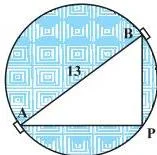
The figure below illustrates the pole problem from Example 8 (NCERT, p. 8). As the diagram shows, a pole \( P \) is located on the boundary of a circular park. It demonstrates how geometric constraintsâlike the diameter forming a right angle via Pythagoras theoremâgenerate a quadratic equation from real-world physical distances.
Step 1: Apply the Pythagoras theorem: \( \text{base}^2 + \text{height}^2 = \text{hypotenuse}^2 \).
\[ x^2 + (x – 3)^2 = 15^2 \]
\[ x^2 + x^2 – 6x + 9 = 225 \]
Step 2: Simplify into the standard quadratic form.
\[ 2x^2 – 6x – 216 = 0 \]
\[ x^2 – 3x – 108 = 0 \]
Step 3: Solve using the quadratic formula.
Here \( a = 1 \), \( b = -3 \), \( c = -108 \).
\[ x = \frac{-(-3) \pm \sqrt{(-3)^2 – 4(1)(-108)}}{2(1)} \]
\[ x = \frac{3 \pm \sqrt{9 + 432}}{2} \]
\[ x = \frac{3 \pm \sqrt{441}}{2} \]
\[ x = \frac{3 \pm 21}{2} \]
Step 4: Evaluate both roots.
\[ x = \frac{3 + 21}{2} = 12 \quad \text{or} \quad x = \frac{3 – 21}{2} = -9 \]
Step 5: Reject the negative root because a physical length cannot be negative.
Final answer: The base is \( 12 \) cm and the height is \( 12 – 3 = 9 \) cm.
Common Mistakes in Quadratic Equations
Correcting frequent student errors is the fastest way to secure marks. The table below highlights strict error and correction pairs specific to this chapter.
| Mistake | Correct Rule | How to Check Your Answer |
|---|---|---|
| Cancelling \( x^2 \) across an equation before factoring (e.g., dividing \( 2x^2 = x \) by \( x \)). | Bring all terms to one side and factor out the common \( x \): \( 2x^2 – x = 0 \implies x(2x – 1) = 0 \). Dividing by \( x \) assumes \( x \neq 0 \), which illegally destroys the valid root \( x = 0 \). | Always test \( x = 0 \) in the original equation to see if it is a valid hidden root you might have cancelled out. |
| Misidentifying \( a \), \( b \), and \( c \) when the equation is not in standard form (e.g., \( 3x^2 = 5x – 2 \)). | Rewrite as \( 3x^2 – 5x + 2 = 0 \) before assigning \( a = 3 \), \( b = -5 \), \( c = 2 \). | Ensure the equation equals zero and terms are ordered by descending powers of \( x \). |
| Accepting a negative answer for a physical dimension or age in a word problem. | Reject the negative root when solving for lengths, speeds, ages, or time. Only positive values make sense in real life. | Read the question context. If the variable represents distance or age, label negative roots as rejected. |
Definitions and Formulas Revision Box
This compact summary table is designed for a quick night-before-exam read. Every essential term and constraint is listed here.
| Term / Formula | Meaning / Expression | Key Constraint |
|---|---|---|
| Standard Form | \( ax^2 + bx + c = 0 \) | \( a \neq 0 \); \( a, b, c \) are real numbers |
| Root of an Equation | A real number \( \alpha \) satisfies \( a\alpha^2 + b\alpha + c = 0 \) | Identical to the zeroes of the polynomial \( ax^2 + bx + c \) |
| Discriminant (\( D \)) | \( D = b^2 – 4ac \) | Determines if roots are real, equal, or do not exist |
| Quadratic Formula | \( x = \frac{-b \pm \sqrt{b^2 – 4ac}}{2a} \) | Valid only when \( D \geq 0 \) |
| Equal Roots Condition | \( b^2 – 4ac = 0 \) | Result is \( x = \frac{-b}{2a} \) (repeated twice) |
Exam Pointers for Quadratic Equations
Writing the standard form correctly before identifying \( a \), \( b \), and \( c \) earns the initial setup mark. Examiners look for this structural step before you substitute values into any formula.
Word problems from the Exercise 4.2 and 4.3 types commonly appear as 3-4 mark questions. Questions involving geometry constraints (speed, distance, perimeter, right triangles) require you to explicitly reject the negative root. For physical dimensions, much like the pole problem on page 8, discarding the extraneous negative value is a required step for full marks.
Never leave an examiner guessing why you chose one root over the other; write a sentence stating the rejection and the real-world reason (like distance must be positive). For broader revision across mathematics chapters, review our Class 10 Mathematics notes or our complete Class 10 revision notes hub.
Chapter Summary and Revision Recap
Here is a two-minute bulleted recap of Chapter 4, adapted from the textbook summary (NCERT, p. 10).
- A quadratic equation takes the standard form \( ax^2 + bx + c = 0 \) where \( a \neq 0 \).
- A real number \( \alpha \) is a root if substituting it into the equation yields zero. The roots of the equation are exactly the zeroes of the polynomial.
- If you can split the middle term and factor the expression into two linear binomials, equate each factor to zero to find the roots.
- The quadratic formula \( x = \frac{-b \pm \sqrt{b^2 – 4ac}}{2a} \) solves any valid quadratic equation.
- If the discriminant \( b^2 – 4ac \gt 0 \), there are two distinct real roots; if \( b^2 – 4ac = 0 \), there are two equal real roots; if \( b^2 – 4ac \lt 0 \), there are no real roots.
Because quadratics build on Polynomials and parallel the solving methods seen in Pair of Linear Equations in Two Variables or Arithmetic Progressions, mastering them unlocks the rest of your algebra syllabus. Explore all subjects on our main CBSE notes portal.
Frequently Asked Questions on Quadratic Equations
How do you check if an equation is actually quadratic?
Simplify both sides completely by expanding brackets and bringing all terms to one side. If the highest power of \( x \) is exactly 2 and the coefficient of \( x^2 \) is not zero, it is a quadratic equation.
When does a quadratic equation have no real roots?
A quadratic equation has no real roots when the discriminant is negativeâmeaning \( b^2 – 4ac \lt 0 \). Taking the square root of a negative number is impossible within the real number system.
What is the difference between zeroes of a polynomial and roots of a quadratic equation?
Mathematically, they are the exact same values. We call them zeroes when discussing the polynomial expression \( ax^2 + bx + c \), and we call them roots when the polynomial is set to zero as an equation \( ax^2 + bx + c = 0 \).
How do you find the value of k for a quadratic equation to have equal roots?
Set the discriminant equal to zero: \( b^2 – 4ac = 0 \). Identify \( a \), \( b \), and \( c \) from the standard form, substitute them into the discriminant equation, and solve the resulting linear equation for \( k \).
Reference: NCERT Class 10 Mathematics textbook, chapter Quadratic Equations.
Explore Class 10 Mathematics Notes
More for this chapter:
Class 10 Mathematics on LearnCBSE:
Related chapters: