
If you are revising Chapter 10 of Mathematics for your session 2026-27 exams, these circles class 10 notes will help you quickly grasp tangents and their properties. We cover exactly what the CBSE syllabus asks: the meaning of a tangent, the two key circle theorems, and how to solve tangent length problems.
You can find this chapter within our broader Class 10 Mathematics revision notes.
The essence of the chapter is quite small. A circle can have lines that miss it, cut through it, or just touch it. The line that touches the circle at exactly one point is called a tangent.
These notes explain everything you need for your board preparation alongside our Class 10 notes collection.
Circles Class 10 Notes: Introduction to Tangents
You already know that a circle is the set of all points in a plane at a fixed distance (the radius) from a centre. When you draw a straight line PQ on the same plane as a circle, only three things can happen (NCERT, p. 145).
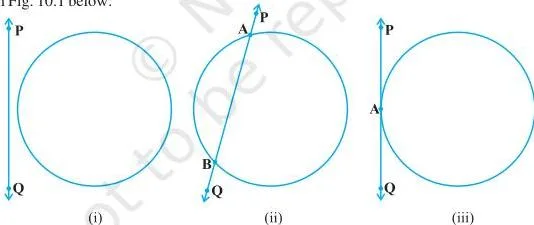
- No common point: The line stays completely outside the circle. It is a non-intersecting line.
- Two common points: The line cuts through the circle at two points, A and B. This line is called a secant.
- One common point: The line just touches the boundary at exactly one point, A. This line is called a tangent.
A useful analogy from daily life is a pulley over a well. The rope hanging on either side of the pulley is a straight line touching the wheel at one point each, forming a tangent (NCERT, p. 145). Similarly, a bicycle wheel rolling on the ground moves along a path tangent to the circle of the wheel.
Chapter Overview: What You Will Revise
This chapter is short and built on two main geometric results. In the next ten minutes, you will study the teaching order that a teacher would actually build in class:
- Tangent definition: How a secant becomes a tangent when its two intersection points merge.
- Theorem 10.1: The radius to the point of contact is perpendicular to the tangent line.
- Number of tangents: Whether a point lies inside, on, or outside the circle determines how many tangents pass through it.
- Theorem 10.2: Two tangent segments drawn from an outside point are equal in length.
The entire chapter summary (NCERT, p. 153) boils down to the definition of a tangent, the 90-degree right angle with the radius, and the equal lengths of tangents from an external point.
Existence of a Tangent and Theorem 10.1
To understand how a tangent actually exists, imagine a circular wire fixed to a straight wire at a point P. As you rotate the straight wire, it usually cuts the circle at a second point, acting as a secant.
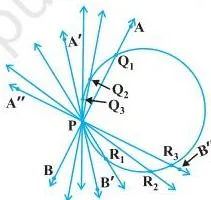
At one specific angle, the second point slides so close to P that they merge into a single point. The line now touches the circle at only one place. A memory device for this is to picture a pair of scissors closing: the two blades (the secant’s two intersection points) come closer and closer until they snap shut into a single point. That collapsed secant is your tangent.
Because the tangent is just a special case of a secant with merged endpoints, we can prove its defining property.
Theorem 10.1: The tangent at any point of a circle is perpendicular to the radius through the point of contact.
The proof relies on simple logic using the shortest distance (NCERT, p. 147).
Assume a circle with centre O and a tangent XY touching at point P. We need to prove that OP is perpendicular to XY.
Pick any other point Q on the line XY. Because XY is a tangent, it only touches the circle once. Therefore, point Q cannot be inside or on the boundary of the circle; it must lie completely outside.
Because Q is outside the circle, the distance from the centre to Q is greater than the radius OP. In mathematical terms:
\[ OQ \gt OP \]
This is true for absolutely every point you pick on XY other than P. Since OP is smaller than the distance to every other point on that line, OP is the shortest distance from the centre O to the line XY.
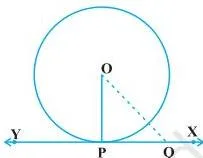
The shortest distance from a point to a line is always the perpendicular. Thus, OP must be perpendicular to XY. We rely on this fundamental geometry notes fact throughout the chapter.
Number of Tangents from a Point on a Circle
How many tangent lines can you draw through a given point? It depends on where that point sits relative to the circle (NCERT, p. 148).
| Position of Point P | Number of Tangents | Reason |
|---|---|---|
| Inside the circle | 0 | Any line through a point inside cuts the circle in two places, making a secant, not a tangent. |
| On the circle | 1 | Only one unique line can graze the boundary at that exact point. |
| Outside the circle | 2 | You can draw exactly two tangents from an external point, touching two different points on the boundary. |
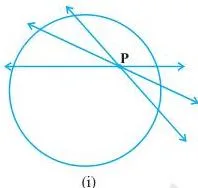
When the point is outside, the distance from the external point P to the actual point of contact on the circle is called the length of the tangent.
Key Definitions for Circles Class 10 Notes
Here is a quick-scan table of every term you must know for this chapter’s exam questions.
| Term | Meaning | Example / Note |
|---|---|---|
| Secant | A line that intersects a circle at two distinct points. | Cuts completely through the boundary. |
| Tangent | A line that touches the circle at exactly one point. | Collapsed secant; the word comes from Latin meaning ‘to touch’. |
| Point of Contact | The single common point where the tangent touches the circle. | Denoted as P in Theorem 10.1. |
| Length of Tangent | The distance between the external point and the point of contact. | Used in Pythagoras theorem calculations for distance from centre. |
| Normal | The line containing the radius through the point of contact. | Always perpendicular to the tangent at that point. |
Theorem 10.2: Equal Tangents from an External Point
Statement: The lengths of tangents drawn from an external point to a circle are equal (NCERT, p. 149).
Proof using RHS Congruence
Given a circle with centre O and an external point P, two tangents PQ and PR are drawn to the circle.
Join OP, OQ, and OR to form two right-angled triangles. By Theorem 10.1, the angle between the radius and the tangent is 90 degrees, so we form two right triangles with a shared hypotenuse and equal radii.
- Right angle: \(\angle OQP = \angle ORP = 90^\circ\) (Radius is perpendicular to tangent).
- Hypotenuse: OP is common to both triangles OQP and ORP.
- Side: OQ = OR (Both are radii of the same circle).
\[ \Delta OQP \cong \Delta ORP \]
Because the triangles are congruent by RHS, their corresponding parts are equal (CPCT).
\[ PQ = PR \]
Remember this Pythagoras method alternative: since \(OQ = OR\), the relation \(OP^2 – OQ^2 = OP^2 – OR^2\) guarantees \(PQ^2 = PR^2\), so \(PQ = PR\). You can use either proof in the exam if a question asks for verification.
Important Formulas and Angle Relations
When solving numericals or proofs, keep this summary box of relations handy. These formulas connect the radius, the tangent length, and the angles between them.
| Relation / Formula | What it Means |
|---|---|
| \( OP \perp XY \) | Radius \( OP \) is at \( 90^\circ \) to tangent \( XY \) at point \( P \). |
| \( PT_1 = PT_2 \) | Two tangent segments from an external point \( P \) are equal. |
| \( OP^2 = OT^2 + PT^2 \) | Right triangle formed by external point \( T \), point of contact, and centre \( O \). |
| \( \angle PTQ + \angle POQ = 180^\circ \) | Angle between tangents is supplementary to the central angle (Exercise 10.2, Q10). |
Worked Examples: Applying Circle Theorems
Let us solve two original numerical problems using the properties we just revised.
Example 1: Finding a Tangent Length using Pythagoras
- Step 1: A tangent is drawn from a point T that lies 13 cm from the centre O of a circle. If the circle has a radius of 5 cm, find the length of the tangent TP, where P is the point of contact.
- Step 2: Apply Theorem 10.1. The radius is perpendicular to the tangent at the point of contact, forming a right-angled triangle \( \Delta OPT \) where the right angle is at \( P \).
\[ \angle OPT = 90^\circ \]
Step 3: Apply the Pythagoras theorem to right triangle \( OPT \).
\[ OT^2 = OP^2 + TP^2 \]
Step 4: Substitute the given values (with units): \( OT = 13 \) cm, \( OP = 5 \) cm.
\[ (13)^2 = (5)^2 + TP^2 \]
\[ 169 = 25 + TP^2 \]
\[ TP^2 = 169 – 25 = 144 \]
Step 5: Take the square root to find the tangent length.
\[ TP = \sqrt{144} = 12 \text{ cm} \]
Final answer: The length of the tangent is \( 12 \) cm.
Example 2: Tangents at Chord Ends Meeting Outside
- Step 1: A chord PQ of length 8 cm exists in a circle of radius 5 cm. Tangents at P and Q meet at an outside point T. Find the length of the tangent TP.
- Step 2: Join the centre \( O \) to the external point \( T \). By Theorem 10.2, \( TP = TQ \), so triangle \( TPQ \) is isosceles. The line \( OT \) bisects the chord \( PQ \) perpendicularly at a midpoint \( R \).
\[ PR = RQ = \frac{8}{2} = 4 \text{ cm} \]
Step 3: Find the distance \( OR \) from the centre to the chord using Pythagoras in triangle \( OPR \).
\[ OR = \sqrt{OP^2 – PR^2} = \sqrt{5^2 – 4^2} = \sqrt{25 – 16} = \sqrt{9} = 3 \text{ cm} \]
Step 4: Use AA similarity.
The right triangle \( \Delta TRP \) is similar to \( \Delta PRO \) because they share equal angles.
This similarity sets up the ratio for the tangent length.
\[ \frac{TP}{PO} = \frac{RP}{RO} \]
Step 5: Substitute the values into the ratio to solve for \( TP \).
\[ \frac{TP}{5} = \frac{4}{3} \]
\[ TP = \frac{20}{3} \text{ cm} \]
Final answer: The length of the tangent \( TP \) is \( \frac{20}{3} \) cm (or approximately \( 6.67 \) cm).
Common Mistakes in Tangent Problems
Examiners frequently see these exact errors. Here is a strict error-correction guide to avoid losing marks.
| Mistake | Correct rule | How to check your answer |
|---|---|---|
| Assuming any line touching the circle is automatically a tangent. | A tangent must touch the circle at exactly ONE point. A line passing completely through it is a secant. | Count the intersection points. If there are two, it is not a tangent. |
| Forgetting to state that the radius is perpendicular to the tangent before using Pythagoras. | You must state Theorem 10.1 first to justify the 90-degree angle needed to form the right triangle. | Check your working: did you explicitly mention that the angle is \( 90^\circ \)? If not, add it. |
| Writing that a point inside the circle has tangents. | A point strictly inside the circle has zero tangents. Every line through an internal point is a secant. | Verify the point’s location. In board numericals, external points always have exactly two tangents. |
Exam Notes: How Proofs and Calculations Are Marked
In CBSE board marking schemes, the logical structure of your proof matters as much as the final answer.
- Earning the right-angle mark: When proving tangent equality or parallel tangents (like Exercise 10.2 Q4), explicitly state Theorem 10.1 to establish the \( 90^\circ \) angle. Writing just the angle symbol without stating the theorem rule can lose a half-mark.
- Concentric circle problems: If numericals involve concentric circles (Exercise 10.2 Q7), stating that the perpendicular from the centre bisects the chord is the key marking step before applying the Pythagoras theorem.
- Circumscribed quadrilaterals: A common repeat question is the circumscribed quadrilateral proof where you must show \( AB + CD = AD + BC \). Use the equal tangent lengths from each vertex to substitute values.
- Statement and reason: Geometry proofs require a clear ‘Given’, ‘To Prove’, and ‘Construction’ headers for full credit. Ensure tangent contact points are properly joined to the centre by a line before you cite angle relations.
Revision Summary: Circles in a Nutshell
For last-minute reading before the exam, remember these three core takeaways:
- A tangent is a line touching the circle at exactly one point. It is the limiting case of a secant when its two intersection points merge.
- Theorem 10.1: The radius drawn to the point of contact is always perpendicular to the tangent.
- Theorem 10.2: Two tangent segments drawn from an external point to a circle are equal in length.
Frequently Asked Questions on Circles Class 10 Notes
How is a tangent different from a secant in a circle?
A secant passes through the circle, intersecting it at two distinct points. A tangent touches the boundary at exactly one point without entering the interior.
Why is the tangent always perpendicular to the radius?
Because the shortest distance from the centre of the circle to the tangent line is along the radius to the point of contact. That tangent line must remain outside the circle everywhere else, making the radius the perpendicular shortest distance.
How many parallel tangents can a circle have at most?
A circle can have exactly two parallel tangents at most, one on each side of the circle, resembling parallel lines drawn on opposite edges of the boundary.
How do you calculate the length of a tangent from an external point to a circle?
Use the Pythagoras theorem. If the distance from the external point to the centre is \( d \) and the radius is \( r \), the tangent length \( l \) is found by \( l^2 + r^2 = d^2 \), giving \( l = \sqrt{d^2 – r^2} \).
Reference the official NCERT Mathematics textbook chapter page on ncert.nic.in to read the full text and activities. To extend your revision to real-world angle distance problems, you can explore our Applications of Trigonometry notes or the Areas Related to Circles notes.
Reference: NCERT Class 10 Mathematics textbook, chapter Circles.
Explore Class 10 Mathematics Notes
More for this chapter:
Class 10 Mathematics on LearnCBSE:
Related chapters: