Triangles Class 10 formulas — this sheet collects the similarity results of NCERT Chapter 6: when two figures are similar, the scale factor, the Basic Proportionality Theorem (Thales’ Theorem), its converse, and the five similarity criteria — AAA, AA, SSS, SAS and RHS. Each result below comes with the condition that makes it valid and the meaning of every symbol.
Formulas are grouped by topic, followed by a symbol table, per-formula “when to use” guidance and three worked examples with original numbers. For the derivations and full reasoning behind each theorem, see the Triangles Class 10 notes — this page deliberately keeps only the formulas, not the proofs.
Formulas at a Glance
| Purpose | Formula |
|---|---|
| Test whether two polygons of the same number of sides are similar | Both conditions together: corresponding angles equal and \( \frac{AB}{A’B’} = \frac{BC}{B’C’} = \frac{CD}{C’D’} = \frac{DA}{D’A’} \) |
| Scale factor — the common value of every corresponding-side ratio | \( k = \frac{AB}{A’B’} = \frac{BC}{B’C’} = \frac{CD}{C’D’} = \frac{DA}{D’A’} \) |
| Basic Proportionality Theorem (Thales): a line parallel to a side divides the other two sides proportionally | \( DE \parallel BC \Rightarrow \frac{AD}{DB} = \frac{AE}{EC} \) |
| Whole-side form (derived from the BPT in Example 1) | \( \frac{AD}{AB} = \frac{AE}{AC} \) |
| Converse of the BPT: equal division implies a parallel line | \( \frac{AD}{DB} = \frac{AE}{EC} \Rightarrow DE \parallel BC \) |
| Trapezium division (derived in Example 2) | \( AB \parallel DC,\ EF \parallel AB \Rightarrow \frac{AE}{ED} = \frac{BF}{FC} \) |
| AAA and AA criteria: equal angles force proportional sides, hence similarity | \( \angle A = \angle D,\ \angle B = \angle E,\ \angle C = \angle F \Rightarrow \triangle ABC \sim \triangle DEF \) |
| SSS criterion: proportional sides force equal angles, hence similarity | \( \frac{AB}{DE} = \frac{BC}{EF} = \frac{CA}{FD} \Rightarrow \triangle ABC \sim \triangle DEF \) |
| SAS criterion: two proportional sides with the included angle equal | \( \frac{AB}{DE} = \frac{AC}{DF} \text{ and } \angle A = \angle D \Rightarrow \triangle ABC \sim \triangle DEF \) |
| RHS criterion for right triangles: hypotenuse and one side proportional | \( \angle B = \angle E = 90^\circ \text{ and } \frac{AC}{DF} = \frac{AB}{DE} \Rightarrow \triangle ABC \sim \triangle DEF \) |
| Medians of similar triangles are in the same ratio as the sides (derived in Example 8) | \( \triangle ABC \sim \triangle PQR \Rightarrow \frac{CM}{RN} = \frac{AB}{PQ} \) |
Each row above is explained in the grouped list below. To verify any statement against the official source, open the NCERT Class 10 Mathematics textbook; for other chapters, see the Class 10 maths formula sheets.
All Formulas, Grouped by Topic
Similar Figures
Two polygons with the same number of sides are similar only when both conditions hold together: every pair of corresponding angles is equal, and every pair of corresponding sides is in the same ratio (NCERT, p. 75).
\[ \angle A = \angle A’,\ \angle B = \angle B’,\ \angle C = \angle C’,\ \angle D = \angle D’ \]
and \[ \frac{AB}{A’B’} = \frac{BC}{B’C’} = \frac{CD}{C’D’} = \frac{DA}{D’A’} \]
The common value of all the side ratios is the scale factor, also called the Representative Fraction (NCERT, p. 76):
\[ k = \frac{AB}{A’B’} = \frac{BC}{B’C’} = \frac{CD}{C’D’} = \frac{DA}{D’A’} \]
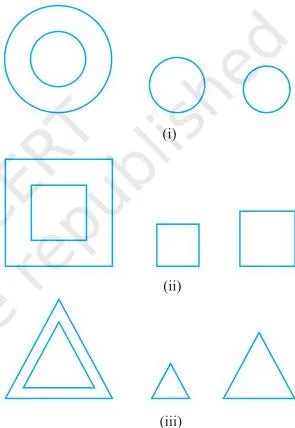
Figure 6.1 shows the simplest cases: all circles are similar, all squares are similar and all equilateral triangles are similar, because the shape matches even when the size changes. A circle and a square are not similar.
One consequence worth memorising: all congruent figures are similar, but similar figures need not be congruent (NCERT, p. 75) — the scale factor of congruent figures is exactly 1.
Basic Proportionality Theorem
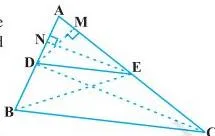
Theorem 6.1 (Basic Proportionality Theorem, or Thales’ Theorem): in triangle ABC, if the line DE is parallel to side BC and meets AB at D and AC at E, then the other two sides are divided in the same ratio (NCERT, p. 80):
\[ DE \parallel BC \quad \Rightarrow \quad \frac{AD}{DB} = \frac{AE}{EC} \]
Figure 6.10 shows this setting. The proof of the theorem compares the areas of the small triangles formed: triangles on the same base and between the same parallels have equal areas, which is why the two ratios must match.
Whole-side form (derived in Example 1): when the whole sides are wanted instead of the separate segments (NCERT, p. 82):
\[ \frac{AD}{AB} = \frac{AE}{AC} \]
Theorem 6.2 (converse of the BPT): if a line divides two sides of a triangle in the same ratio, then the line is parallel to the third side (NCERT, p. 82):
\[ \frac{AD}{DB} = \frac{AE}{EC} \quad \Rightarrow \quad DE \parallel BC \]
Trapezium result (derived in Example 2): in a trapezium ABCD with AB parallel to DC, if EF is drawn parallel to AB, meeting AD at E and BC at F, then (NCERT, p. 83):
\[ \frac{AE}{ED} = \frac{BF}{FC} \]
The converse also proves quick results such as: if \( \frac{PS}{SQ} = \frac{PT}{TR} \) in triangle PQR, then ST is parallel to QR (Example 3, NCERT, p. 84).
Criteria for Similarity of Triangles
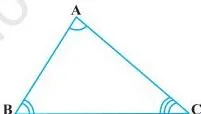
Two triangles ABC and DEF are similar, written \( \triangle ABC \sim \triangle DEF \), when their corresponding angles are equal and their corresponding sides are in the same ratio (NCERT, p. 85):
\[ \angle A = \angle D,\ \angle B = \angle E,\ \angle C = \angle F \]
and \[ \frac{AB}{DE} = \frac{BC}{EF} = \frac{CA}{FD} \]
The order of the vertices in the symbol matters: \( \triangle ABC \sim \triangle DEF \) already declares that A corresponds to D, B to E and C to F (NCERT, p. 86). Figure 6.22 shows this correspondence.
Unlike general polygons, a triangle needs only one of the two conditions — each condition forces the other. The chapter gives five criteria for spotting this quickly.
AAA criterion (Theorem 6.3): if the three corresponding angles are equal, the corresponding sides are automatically in the same ratio (NCERT, p. 87):
\[ \angle A = \angle D,\ \angle B = \angle E,\ \angle C = \angle F \quad \Rightarrow \quad \triangle ABC \sim \triangle DEF \]
AA criterion: two equal pairs of angles are enough for triangles, because the angle sum property then forces the third pair to be equal too (NCERT, p. 88):
\[ \angle A = \angle D,\ \angle B = \angle E \quad \Rightarrow \quad \triangle ABC \sim \triangle DEF \]
SSS criterion (Theorem 6.4): if the three sides of one triangle are proportional to the three sides of the other, the corresponding angles are equal (NCERT, p. 88):
\[ \frac{AB}{DE} = \frac{BC}{EF} = \frac{CA}{FD} \quad \Rightarrow \quad \triangle ABC \sim \triangle DEF \]
SAS criterion (Theorem 6.5): if one angle of a triangle equals one angle of the other and the sides forming that angle are proportional, the triangles are similar (NCERT, p. 90). The angle must be the one included between the two proportional sides:
\[ \frac{AB}{DE} = \frac{AC}{DF} \ \text{and}\ \angle A = \angle D \quad \Rightarrow \quad \triangle ABC \sim \triangle DEF \]
RHS criterion (Note to the Reader): in two right triangles, if the hypotenuse and one side of one triangle are proportional to the hypotenuse and one side of the other, the triangles are similar (NCERT, p. 98). With the right angles at B and E:
\[ \angle B = \angle E = 90^\circ \ \text{and}\ \frac{AC}{DF} = \frac{AB}{DE} \quad \Rightarrow \quad \triangle ABC \sim \triangle DEF \]
Medians in similar triangles (derived in Example 8): if \( \triangle ABC \sim \triangle PQR \) and CM, RN are the medians to the sides AB, PQ, then the medians are in the same ratio as the corresponding sides (NCERT, p. 94):
\[ \frac{CM}{RN} = \frac{AB}{PQ} = \frac{BC}{QR} = \frac{CA}{RP} \]
What Each Symbol Means
| Symbol | What it means | Unit / nature |
|---|---|---|
| \( \triangle ABC \sim \triangle DEF \) | Triangle ABC is similar to triangle DEF; the order of vertices fixes which parts correspond | Symbolic statement |
| \( \angle A,\ \angle B,\ \angle C \) | Angles of a triangle at its vertices A, B and C | Angle (degrees) |
| \( AB,\ BC,\ CA \) | Lengths of the sides joining the named vertices | Length (cm or m) |
| \( AD,\ DB,\ AE,\ EC \) | The four segments created when a line DE cuts sides AB and AC | Length (cm or m) |
| \( \frac{AD}{DB},\ \frac{AE}{EC} \) | The ratios in which the line DE divides the two sides | Dimensionless ratio |
| \( \frac{AB}{DE},\ \frac{BC}{EF},\ \frac{CA}{FD} \) | Ratios of the corresponding sides of two similar triangles | Dimensionless ratio |
| \( k \) | Scale factor — the single value that every corresponding-side ratio equals | Dimensionless number |
| \( DE \parallel BC \) | Line DE is parallel to side BC | Geometric relation |
| \( \triangle ABC \cong \triangle DPQ \) | Triangle ABC is congruent to triangle DPQ — same shape and same size | Symbolic statement |
| \( CM,\ RN \) | Medians: segments from a vertex to the midpoint of the opposite side | Length (cm or m) |
When to Use Each Formula
| Situation | Formula or criterion to use |
|---|---|
| “Are these two polygons (say quadrilaterals) similar?” | The two-condition test: every corresponding angle equal AND every corresponding side in the same ratio |
| A line parallel to one side cuts the other two sides, and one segment is missing | BPT: \( \frac{AD}{DB} = \frac{AE}{EC} \) |
| The question gives or asks for whole sides AB and AC instead of the pieces AD, DB | Whole-side form: \( \frac{AD}{AB} = \frac{AE}{AC} \) |
| You must prove a line is parallel to a side, and ratios of division are given | Converse of the BPT |
| You can show two angles equal — parallel lines, a common angle, vertically opposite angles | AA criterion |
| Only the side lengths of the two triangles are known | SSS criterion — compare all three ratios |
| Two sides and the angle between them are known | SAS criterion — the angle must be the included one |
| Both triangles are right-angled; you can compare hypotenuse and one leg | RHS criterion |
| Similar triangles with medians; find a median or a side | Medians ratio: \( \frac{CM}{RN} = \frac{AB}{PQ} \) |
| A height or distance you cannot measure directly — a pole, a tower or their shadows | Form similar right triangles (AA) and equate the side ratios |
If the formula you need belongs to another chapter, start from the maths formulas index.
Worked Examples
Three uses of the sheet’s formulas, with original numbers. After these, practise on the textbook’s own questions in the NCERT solutions for Chapter 6 Triangles.
Worked Example 1: Find EC using the Basic Proportionality Theorem
Problem: In triangle ABC, DE is parallel to BC, with D on AB and E on AC.
AD = 3.2 cm, DB = 4.8 cm and AE = 4 cm.
Find EC.
Step 1 — choose the formula: DE is parallel to BC, so the BPT applies:
\[ \frac{AD}{DB} = \frac{AE}{EC} \]
Step 2 — substitute the given lengths:
\[ \frac{3.2}{4.8} = \frac{4}{EC} \]
Step 3 — solve for EC:
\[ EC = \frac{4 \times 4.8}{3.2} = 6 \]
Final answer: EC = 6 cm.
Worked Example 2: Test whether EF is parallel to QR (converse of the BPT)
Problem: In triangle PQR, E lies on PQ and F on PR.
PE = 5.4 cm, EQ = 8.1 cm, PF = 4.8 cm, FR = 7.2 cm.
State whether EF is parallel to QR.
Step 1 — choose the formula: this is a parallelism test, so use Theorem 6.2: EF is parallel to QR exactly when \( \frac{PE}{EQ} = \frac{PF}{FR} \).
Step 2 — compare the two ratios:
\[ \frac{PE}{EQ} = \frac{5.4}{8.1} = \frac{2}{3}, \qquad \frac{PF}{FR} = \frac{4.8}{7.2} = \frac{2}{3} \]
Step 3 — conclusion: both ratios are equal, so the line divides sides PQ and PR in the same ratio.
Final answer: EF is parallel to QR.
Worked Example 3: Find a tower’s height from shadows (AA criterion)
Problem: A vertical pole 2.4 m tall casts a shadow 3.2 m long.
At the same time a tower casts a shadow 24 m long.
Find the height of the tower.
Step 1 — set up the similarity: the pole and the tower both stand vertical, so both make a right angle with the ground, and the sun’s rays strike both at the same angle.
The two right triangles are therefore similar by the AA criterion.
Step 2 — write the side ratio: let h be the tower’s height.
Corresponding sides are proportional, so \[ \frac{\text{height of pole}}{h} = \frac{\text{shadow of pole}}{\text{shadow of tower}} \quad \Rightarrow \quad \frac{2.4}{h} = \frac{3.2}{24} \]
Step 3 — solve:
\[ h = \frac{2.4 \times 24}{3.2} = 18 \]
Final answer: the tower is 18 m tall.
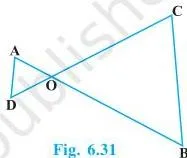
Figure 6.32 shows the same set-up with a lamp-post and a girl — the two similar right triangles give the shadow length by the same ratio method.
Common Mistakes to Avoid
The errors below are the most frequent when applying these ratios and criteria.
| Mistake | Correct rule | How to check your answer |
|---|---|---|
| Writing the similarity with wrong vertex order, e.g. \( \triangle ABC \sim \triangle EDF \) | The listed order fixes the correspondence: \( \triangle ABC \sim \triangle DEF \) means A corresponds to D, B to E, C to F | Read your statement aloud: the angles you proved equal must match the positions in your statement |
| Using \( \frac{AD}{AB} \) where the BPT needs \( \frac{AD}{DB} \) | The BPT compares the two segments of each side: \( \frac{AD}{DB} = \frac{AE}{EC} \); \( \frac{AD}{AB} = \frac{AE}{AC} \) is the separate whole-side form | Ask: does each ratio use the two pieces of the same side? |
| Applying SAS with an angle that is not between the two proportional sides | The equal angle must be the one included between the two sides named in the ratio | Name the two sides and the angle: the angle’s arms must be exactly those two sides |
| Declaring SSS similarity after checking only two side ratios | All three ratios must be equal: \( \frac{AB}{DE} = \frac{BC}{EF} = \frac{CA}{FD} \) | Test the third pair — if its ratio differs, the triangles are not similar |
| Mixing units in shadow and height problems, e.g. 90 cm with metres | Convert every length to the same unit before forming the ratio: 90 cm = 0.9 m | Recompute with converted units; the answer must be unchanged |
| Concluding a polygon is similar from one condition only | For polygons both conditions are needed: a square and a rectangle have equal angles but different side ratios, while a square and a rhombus have the same side ratio but unequal angles (NCERT, p. 77) | For triangles one criterion is enough; for quadrilaterals the figure must pass both tests |
Frequently Asked Questions
What is the difference between congruent and similar figures?
Congruent figures have the same shape and the same size; similar figures have the same shape but not necessarily the same size. Every congruent pair is also similar (their scale factor is 1), but a similar pair need not be congruent (NCERT, p. 75).
Why is AA enough to prove similarity? Don’t all three angles have to match?
For triangles, two matches force the third. If \( \angle A = \angle D \) and \( \angle B = \angle E \), the angle sum property gives \( \angle C = 180^\circ – \angle A – \angle B = 180^\circ – \angle D – \angle E = \angle F \). So AA is AAA with less work (NCERT, p. 88).
When do I use the Basic Proportionality Theorem and when its converse?
Use Theorem 6.1 when a line is known to be parallel to a side and you need a missing segment or a proportion. Use Theorem 6.2 when the ratios of division are given and you must prove the line is parallel to the third side.
In SAS similarity, can the equal angle be any angle of the triangle?
No. The angle must be the one included between the two sides whose ratio you compare. That is why SAS needs an angle, while SSS uses only sides.
Reference: NCERT Class 10 Mathematics textbook, chapter Triangles.
Explore Class 10 Maths Formulas
More for this chapter:
Class 10 Maths on LearnCBSE:
Related chapters: