Welcome to your Probability class 10 notes for the current academic session. In Class 9, you studied empirical probability based on actual experiments. This year, you shift to theoretical probability, which predicts outcomes using simple assumptions instead of repeated trials.
Why does this matter? Repeating trials is sometimes impossible or expensive. You cannot repeatedly launch a satellite to find the probability of its failure. By assuming outcomes are equally likely, you can calculate exact probabilities. This approach was formalised by mathematician Pierre Simon Laplace in 1795 (NCERT, p. 204).
These notes are designed for quick exam revision. If you need broader revision, check our Class 10 Mathematics notes or the main CBSE Class 10 notes hub. You can also explore all CBSE revision notes available on the site.
Equally Likely Outcomes and the Core Probability Formula
The entire chapter rests on one assumption: equally likely outcomes. If you toss a fair coin, there is no reason for heads to appear more often than tails. Each face has the exact same chance of showing. The phrase at random means there is no bias in how the object is thrown or drawn (NCERT, p. 203).
Because the outcomes are equally likely, you skip the physical experiment and use the main theoretical probability formula:
\[ P(E) = \frac{\text{Number of outcomes favourable to } E}{\text{Number of all possible outcomes of the experiment}} \]
Here, P(E) is the probability of event E. The numerator counts the outcomes you want, and the denominator counts the total outcomes. LearnCBSE grounding notes point out that probability is a dimensionless number—it has no units like metres or kilograms. The value of P(E) is always between 0 and 1.
Types of Events in Probability
In exams, questions ask for the probability of specific types of events. You must identify the event type before applying the formula. The table below covers the four main types you will encounter (NCERT, pp. 204–207).
| Term | Meaning | Example from NCERT |
|---|---|---|
| Elementary event | An event having only one outcome of the experiment. | Getting a head when tossing a coin once. |
| Complementary event | The event ‘not E’. The sum of E and ‘not E’ equals 1. | Not getting an ace when drawing a card. |
| Impossible event | An event that cannot occur; probability equals 0. | Getting an 8 on a standard six-faced die. |
| Sure event | An event certain to occur; probability equals 1. | Getting a number less than 7 on a die. |
From these definitions flows the most important bounding rule in the chapter: 0 ≤ P(E) ≤ 1. The numerator can never exceed the denominator, so a probability of 1.5 or -0.2 is impossible (NCERT, p. 207).
For any event E, you use the complementary event rule heavily for indirect probability:
\[ P(\bar{E}) = 1 – P(E) \]
This is useful when it is easier to count what you do not want and subtract it from the total. For example, to find the probability of getting at least one head from two coins, it is simpler to subtract the probability of getting no heads from 1.
Sample Space: Coins, Dice, and Cards
To solve problems correctly, you must know the total number of outcomes (the sample space) for standard experiments. Memorise these standard counts to build your denominator accurately.
| Experiment | Standard Outcomes | Total Count |
|---|---|---|
| One coin tossed | H, T | 2 |
| Two coins tossed | HH, HT, TH, TT | 4 |
| One die rolled | 1, 2, 3, 4, 5, 6 | 6 |
| Two dice rolled | Ordered pairs like (1,1), (1,2) | 36 |
Pay close attention to the two-coin outcomes. HT and TH are distinct ordered pairs. Treating them as identical is a frequent mathematical error. When you roll two dice, the ordered pair (1, 4) is different from (4, 1), giving 36 unique outcomes.
Composition of a Standard 52-Card Deck
Card probability problems cause the most confusion because students forget the exact composition of the deck. This breakdown is essential for solving card problems. For deeper grounding, you can view the official NCERT Class 10 Mathematics textbook Probability chapter.
- Total cards: 52
- Suits: 4 (Spades, Hearts, Diamonds, Clubs)
- Cards per suit: 13
- Red cards: 26 (Hearts and Diamonds)
- Black cards: 26 (Spades and Clubs)
- Face cards: 12 (Kings, Queens, and Jacks of all suits)
- Aces: 4 (one per suit)
When a question asks for the probability of drawing a face card, your favourable count is 12 and the total is 52. Always set up the fraction carefully.
Solving Probability Problems Step-by-Step
Let us work through three original examples that mirror CBSE patterns.
Example 1: Drawing Marbles from a Jar
Question: A jar contains 6 green, 4 blue, and 5 red marbles.
A marble is drawn at random.
What is the probability that it is (i) blue?
(ii) not green?
Step 1: Calculate total possible outcomes.
\[ \text{Total marbles} = 6 \text{ (green)} + 4 \text{ (blue)} + 5 \text{ (red)} = 15 \]
Step 2: Find P(blue) for part (i).
\[ P(\text{Blue}) = \frac{4}{15} \]
Step 3: Use the complement rule for part (ii).
\[ P(\text{Not Green}) = 1 – P(\text{Green}) \]
\[ P(\text{Not Green}) = 1 – \frac{6}{15} = \frac{15}{15} – \frac{6}{15} = \frac{9}{15} \]
Final answer: (i) \( P(\text{Blue}) = \frac{4}{15} \). (ii) \( P(\text{Not Green}) = \frac{3}{5} \).
Example 2: Card Probability
Question: One card is drawn from a well-shuffled deck of 52 cards.
Find the probability that it is (i) a black king?
(ii) not a face card?
Step 1: Count favourable outcomes for the black king.
There are 2 black kings (one spade, one club).
\[ P(\text{Black King}) = \frac{2}{52} = \frac{1}{26} \]
Step 2: Find favourable outcomes for not a face card.
Subtract the 12 face cards from the total.
\[ \text{Not Face Cards} = 52 – 12 = 40 \]
Step 3: Compute the probability.
\[ P(\text{Not Face Card}) = \frac{40}{52} = \frac{10}{13} \]
Final answer: (i) \( P(\text{Black King}) = \frac{1}{26} \). (ii) \( P(\text{Not Face Card}) = \frac{10}{13} \).
Example 3: Rolling Two Dice
Question: Two dice are rolled simultaneously.
Find the probability that the sum is (i) 10?
(ii) less than or equal to 4?
- Step 1: The total outcomes are 36. We find ordered pairs that sum to 10.
- Step 2: The pairs summing to 10 are (4, 6), (5, 5), and (6, 4). That gives 3 favourable pairs.
\[ P(\text{Sum} = 10) = \frac{3}{36} = \frac{1}{12} \]
Step 3: Find favourable pairs for sums less than or equal to 4.
\[ \text{Sum} = 2: (1, 1) \text{ (1 pair)} \]
\[ \text{Sum} = 3: (1, 2), (2, 1) \text{ (2 pairs)} \]
\[ \text{Sum} = 4: (1, 3), (2, 2), (3, 1) \text{ (3 pairs)} \]
\[ \text{Total favourable pairs} = 1 + 2 + 3 = 6 \]
Step 4: Compute the probability.
\[ P(\text{Sum} \leq 4) = \frac{6}{36} = \frac{1}{6} \]
Final answer: (i) \( P(\text{Sum} = 10) = \frac{1}{12} \). (ii) \( P(\text{Sum} \leq 4) = \frac{1}{6} \).
Rolling two dice links directly to your data handling skills. To see how probabilities connect to data groupings, review our Class 10 Statistics notes.
Common Mistakes in Calculating Probability
Certain chapter-specific errors cost marks repeatedly. Use the table below to audit your answers before submission.
| Mistake | Correct rule | How to check your answer |
|---|---|---|
| Treating HT and TH as the same outcome when tossing two coins. | HT and TH are distinct ordered pairs. | Ensure total is 4 for two coins, not 3. |
| Using a probability of 1/11 for the sum of two dice because 11 sums exist. | The 11 sums are not equally likely; build the count from the 36-pair grid. | Check if all numerators sum to 36. |
| Forgetting to subtract the ‘not’ event from 1 for indirect probability. | Always use \( P(E) = 1 – P(\text{not } E) \) when direct counting is hard. | Verify fav + not fav equals total. |
The 1/11 logic misconception deserves a closer look. A student sees the sums 2 through 12 (which are 11 numbers) and assumes each has a probability of 1/11. This would assume equal likelihood, which fails here. To achieve a sum of 2, you need exactly (1, 1). To achieve a sum of 7, you have six pairs: (1,6), (2,5), (3,4), (4,3), (5,2), and (6,5). Therefore, P(sum=2) is 1/36, but P(sum=7) is 7/36.
They are not equal (NCERT, p. 217).
Exam Notes: Scoring Strategy for Probability
Examiners look for method and logic. Scoring full marks requires clear presentation, not just the final fraction. Here are observed exam requirements for this chapter.
- Always write the total number of outcomes before writing the probability fraction. This explicit step earns method marks.
- Draw the grid for two-dice problems. Writing the 6×6 grid or listing favourable pairs earns full marks even if your mental arithmetic struggles.
- Adjust totals for without-replacement draws. When a problem says a card or bulb is ‘not replaced’, the total count decreases by one for the second draw (NCERT, p. 215).
Area-Based Probability (Visualising Geometry Problems)
NCERT includes examples measuring probability across geometric space. Although marked with an asterisk as not for the exam point of view, they are foundational for higher classes. For exam insight, view our CBSE notes mathematics index.

This number line shows the possible outcomes lie between 0 and 2 minutes. The event occurs within the first half-minute (from 0 to 0.5). The probability is the ratio of distances: (1/2) divided by 2, which yields 1/4.
This logic extends to two-dimensional areas. The next figure shows a rectangular region where a helicopter might crash, containing a smaller lake area.
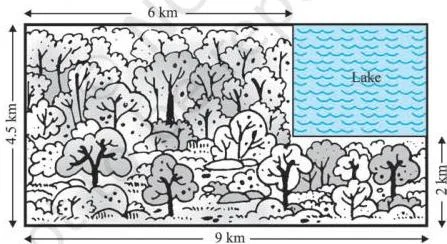
As the diagram illustrates, if a helicopter is missing somewhere in the larger rectangle, it is equally likely to be anywhere inside. To find the probability it crashed inside the lake, you divide the lake’s area by the total area. The logic translates to favourable area / total area.
Revision Recap: Formulas and Rules
Use this brief summary to review the night before your exam. These points mirror the official NCERT chapter summary (NCERT, p. 216).
- Theoretical Probability: \( P(E) = \frac{\text{favourable outcomes}}{\text{total outcomes}} \)
- Sure event: Probability is 1.
- Impossible event: Probability is 0.
- Valid probability range: \( 0 \leq P(E) \leq 1 \)
- Complementary events: \( P(E) + P(\text{not } E) = 1 \)
- Deck of cards: 52 total, 26 red, 26 black, 12 face cards, 4 aces.
Frequently Asked Questions About Probability
Why do we assume outcomes are equally likely in theoretical probability?
Assuming equal likelihood lets us calculate probability directly without running expensive or impossible repeated trials. It works for fair coins, fair dice, and well-shuffled cards.
How is throwing one die twice different from throwing two dice at the same time?
They are treated as the same experiment. Both generate a 36-outcome sample space using ordered pairs. The outcome (3, 4) in a single die rolled twice represents 3 on the first roll and 4 on the second.
Can the probability of an event be negative or greater than 1?
No. Probability is a fraction where the numerator never exceeds the denominator. Therefore, it is always between 0 and 1 inclusive.
How do you solve probability problems involving a deck of cards?
Memorise the deck breakdown: 52 cards, 4 suits, 26 red, 26 black, 12 face cards, and 4 aces. Count your favourable cards using this breakdown, then place that count over 52 to form your probability fraction.
Reference: NCERT Class 10 Mathematics textbook, chapter Probability.
Explore Class 10 Mathematics Notes
More for this chapter:
Class 10 Mathematics on LearnCBSE:
Related chapters: