
These some applications of trigonometry class 10 notes cover Chapter 9 for the current academic session. The chapter shows how the ratios you learnt earlier solve real measurement problems.
Heights and Distances: What This Chapter Adds
This chapter is a direct continuation of Introduction to Trigonometry. You need the ratios from Chapter 8 as a prerequisite. Here, you apply those ratios to find heights of towers, distances of objects, and lengths of shadows without measuring them directly (NCERT, p. 134).
The chapter is short and contains a single exercise. However, it carries significant Class 10 board exam weight. One well-drawn diagram and the correct ratio usually earn the marks. These notes sit within our wider CBSE notes and Class 10 Mathematics collections.
Line of Sight, Angle of Elevation and Depression
Three terms appear in every problem. Label the triangle correctly first.
| Term | Meaning | Visual Cue |
|---|---|---|
| Line of sight | Line drawn from the observer’s eye to the point being viewed (NCERT, p. 134). | Slant line from eye to object. |
| Angle of elevation | Angle formed by the line of sight with the horizontal when the object is above eye level (NCERT, p. 134). | Head tilted up; angle opens upward. |
| Angle of depression | Angle formed by the line of sight with the horizontal when the object is below eye level (NCERT, p. 135). | Head tilted down; angle opens downward. |
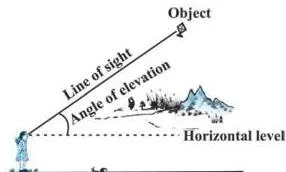
The figure above shows what happens when the object is above the observer. The slant line is the line of sight. The angle it makes with the horizontal line is the angle of elevation. Notice the horizontal is drawn from the eye, not the ground.
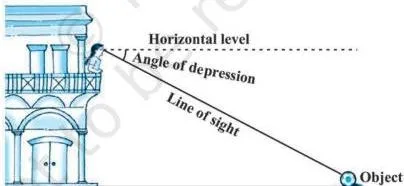
In the second figure, the observer is above the object. The line of sight goes downward. The horizontal line is still the reference, so the angle of depression is measured from the horizontal, not the vertical.
Memory device
Remember: Elevation = Elevated object (look up), Depression = Downward look. Both angles are always measured from the horizontal line, never the vertical.
Choosing the Right Trigonometric Ratio
Most problems give the base distance and ask for height, or vice versa. The tangent ratio is the most used because it links the side opposite the angle with the side adjacent to it (NCERT, p. 135). Cotangent is the reciprocal and works equally well.
When a ladder, rope, or string is the hypotenuse, use sine or cosine because those ratios involve the hypotenuse.
| Known sides | Ratio to use |
|---|---|
| Opposite and Adjacent | \( \tan \theta = \frac{\text{Opp}}{\text{Adj}} \) or \( \cot \theta \) |
| Opposite and Hypotenuse | \( \sin \theta = \frac{\text{Opp}}{\text{Hyp}} \) |
| Adjacent and Hypotenuse | \( \cos \theta = \frac{\text{Adj}}{\text{Hyp}} \) |
Check which side the given value belongs to before writing the equation. Identifying the sides correctly is the step where most students lose marks.
The Two-Triangle Problem Pattern
Board questions often set up two right triangles that share a common side. One observation point gives two different angles (say, \( 30^\circ \) and \( 60^\circ \)), creating two triangles (NCERT, p. 137).
The trick is to write a tangent equation for each triangle. The side common to both triangles (usually the distance or the height) links the two equations, letting you solve for the unknown.
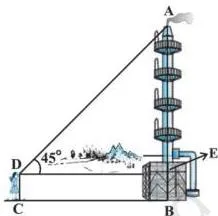
The figure above shows the setup from Example 4. Triangle PAB has angle \( 30^\circ \), and triangle PAD has angle \( 45^\circ \). The shared side AP (distance from the point to the building) appears in both tangent equations. Find AP from the first triangle, then use it in the second.
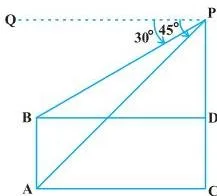
In the second figure (Example 6), horizontal lines from the two building tops are parallel. The angle of depression at the top equals the angle of elevation at the bottom because they are alternate interior angles. That is why \( \angle PBD = 30^\circ \) (NCERT, p. 139).
Key Formulas and Rationalisation Trick
Here is a quick reference for the ratios and standard angles.
| Ratio | Formula | \( 30^\circ \) | \( 45^\circ \) | \( 60^\circ \) |
|---|---|---|---|---|
| \( \sin \theta \) | \( \frac{\text{Opp}}{\text{Hyp}} \) | \( \frac{1}{2} \) | \( \frac{1}{\sqrt{2}} \) | \( \frac{\sqrt{3}}{2} \) |
| \( \cos \theta \) | \( \frac{\text{Adj}}{\text{Hyp}} \) | \( \frac{\sqrt{3}}{2} \) | \( \frac{1}{\sqrt{2}} \) | \( \frac{1}{2} \) |
| \( \tan \theta \) | \( \frac{\text{Opp}}{\text{Adj}} \) | \( \frac{1}{\sqrt{3}} \) | \( 1 \) | \( \sqrt{3} \) |
Rationalising denominators
Answers with a square root in the denominator must be rationalised. In Example 6 (NCERT, p. 139), the denominator \( \sqrt{3} – 1 \) appears. Multiply the numerator and denominator by the conjugate \( \sqrt{3} + 1 \).
\[ \frac{8}{\sqrt{3} – 1} \times \frac{\sqrt{3} + 1}{\sqrt{3} + 1} = \frac{8(\sqrt{3} + 1)}{(\sqrt{3})^2 – (1)^2} = \frac{8(\sqrt{3} + 1)}{3 – 1} = 4(\sqrt{3} + 1) \]
This step simplifies the answer to \( 4(\sqrt{3} + 1) \) metres. Always state units (m) at every step.
Worked Example: Finding the Height of a Tower
A tower stands vertically on the ground. From a point 20 m away from the foot of the tower, the angle of elevation of the top is \( 60^\circ \). Find the height of the tower.
- Step 1: Draw right triangle ABC, right-angled at B. Let AB be the height of the tower and BC be the distance from the foot, so \( BC = 20 \) m.
- Step 2: Use the tangent ratio since the opposite side (AB) and adjacent side (BC) are involved.
\[ \tan 60^\circ = \frac{AB}{BC} \]
Step 3: Substitute \( \tan 60^\circ = \sqrt{3} \) and \( BC = 20 \) m.
\[ \sqrt{3} = \frac{AB}{20} \]
Step 4: Solve for AB.
\[ AB = 20\sqrt{3} \text{ m} \]
Final answer: The height of the tower is \( 20\sqrt{3} \) m, which is approximately 34.64 m.
Worked Example: The Two-Position Shadow Problem
The shadow of a tower is 30 m longer when the Sun’s altitude is \( 30^\circ \) than when it is \( 60^\circ \). Find the height of the tower.
- Step 1: Set up two right triangles sharing the tower’s height h. Let the shorter shadow be x m, so the longer shadow is \( (x + 30) \) m.
- Step 2: In the first triangle, use \( \tan 60^\circ = \frac{h}{x} \).
\[ \sqrt{3} = \frac{h}{x} \implies h = x\sqrt{3} \quad (1) \]
Step 3: In the second triangle, use \( \tan 30^\circ = \frac{h}{x + 30} \).
\[ \frac{1}{\sqrt{3}} = \frac{h}{x + 30} \quad (2) \]
Step 4: Substitute h from equation (1) into equation (2).
\[ \frac{1}{\sqrt{3}} = \frac{x\sqrt{3}}{x + 30} \implies x + 30 = 3x \implies x = 15 \]
Step 5: Find h.
\[ h = 15\sqrt{3} \text{ m} \]
Final answer: The height of the tower is \( 15\sqrt{3} \) m, which is approximately 25.98 m.
Shadow diagram reference
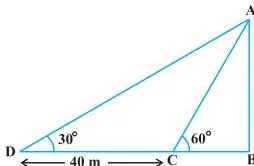
The figure above shows the structure. The tower AB is shared. When the Sun’s altitude is \( 60^\circ \), the shadow is BC. When it drops to \( 30^\circ \), the shadow lengthens to BD. The difference DB minus CB gives the extra 30 m.
Common Mistakes in Heights and Distances
The table below lists errors that cost marks, the correct rule, and how to check your answer.
| Mistake | Correct rule | How to check |
|---|---|---|
| Measuring the angle of depression from the vertical line (NCERT, p. 134). | It is always measured from the horizontal line. | Draw the horizontal first; the angle opens downward from it. |
| Forgetting to add the observer’s height to the calculated triangle height (NCERT, p. 134). | Total height = triangle height + observer’s eye level height. | Check if the problem states the observer is standing on the ground. |
| Mixing up opposite and adjacent sides when writing the tan ratio. | Opposite is across from the angle; adjacent is next to it. | Mark the angle first, then label sides relative to it. |
| Leaving denominators irrational, like \( \frac{1}{\sqrt{3}} \). | Always rationalise by multiplying by \( \frac{\sqrt{3}}{\sqrt{3}} \). | Confirm no square roots remain in the denominator. |
Exam Notes: What Earns the Marks
These points reflect observed patterns in the board exam. They are not predictions.
- Draw the diagram first. A correctly labelled diagram earns the first step mark, even if the calculation goes wrong later.
- Write the ratio equation explicitly. Stating \( \tan 60^\circ = \frac{AB}{BC} \) earns a method mark. Do not skip straight to the number substitution.
- Angles \( 30^\circ \), \( 45^\circ \), and \( 60^\circ \) are the most frequent in board questions. Memorise their values for sin, cos, and tan.
- State the final answer with units. Writing \( 20\sqrt{3} \) without m or km can lose a half-mark. Always include units.
- Questions map to Exercise 9.1. Direct concept questions (single triangle) include Q1, Q4, Q5. Numericals involving the observer’s height include Q6 and Q14. Two-triangle reasoning questions include Q7, Q8, Q9, Q10, and Q12. A full-marks answer needs the diagram, the ratio statement, the substitution, and the unit.
Real-Life Applications NCERT Skips
NCERT focuses on textbook problems. Here are real uses of these concepts.
- Surveyors use instruments called theodolites to measure angles of elevation. They map terrain and calculate heights of hills without climbing them.
- Pilots use the angle of depression to calculate the distance to a runway during descent. This helps determine the correct approach angle.
- Astronomers use angles of elevation to track stars and satellites. The angle changes as Earth rotates, letting them calculate positions.
Each use relies on the same logic you practise in this chapter: measure an angle and a distance, then use a ratio to find the unknown height or length.
Chapter Revision Recap
Use this table for a quick night-before-exam review.
| Topic | Key point |
|---|---|
| Line of sight | Line from the observer’s eye to the object viewed. |
| Angle of elevation | Formed with the horizontal when the object is above eye level. |
| Angle of depression | Formed with the horizontal when the object is below eye level. |
| Most used ratio | \( \tan \theta \), because problems give base and ask for height. |
| Shared-side pattern | Two triangles share a side; write a tangent equation for each and link them. |
| Rationalisation | Multiply by the conjugate to remove roots from the denominator. |
Frequently Asked Questions
What is the difference between angle of elevation and angle of depression?
The angle of elevation is formed when the object is above the observer’s eye level; you raise your head to look at it. The angle of depression is formed when the object is below eye level; you lower your head. Both are measured from the horizontal line.
Which trigonometric ratio is used most often in heights and distances problems?
The tangent ratio is used most often because most problems give the distance from the object (adjacent side) and ask for its height (opposite side). \( \tan \theta = \frac{\text{Opp}}{\text{Adj}} \) links these two sides directly. Cotangent is its reciprocal.
Do I always need to add the observer’s height to the calculated height?
You add the observer’s height when the observer stands on the ground and the angle is measured from their eye level, not the ground. The total height of the object equals the triangle height plus the observer’s height. If the problem does not state the observer’s height, you do not need to add it.
How do I solve questions with two right triangles sharing a side?
Write a separate trigonometric ratio equation for each triangle. The shared side links the two equations. Solve one equation for the shared side or the unknown, then substitute into the other equation to find the remaining value.
For the original chapter text, you can refer to the official NCERT textbook Chapter 9 PDF. Related geometry applications also appear in our Circles notes.
Reference: NCERT Class 10 Mathematics textbook, chapter Some Applications of Trigonometry.
Explore Class 10 Mathematics Notes
More for this chapter:
Class 10 Mathematics on LearnCBSE:
Related chapters: