
These surface areas and volumes class 10 notes cover Chapter 12 for the current academic session. The chapter has only one new idea: calculating measurements for objects built by joining basic solids you already know. We break down every rule, formula, and step so you can revise the night before a test or board exam.
Combining Basic Solids: The Core Idea of This Chapter
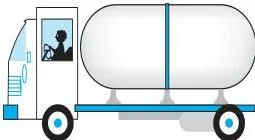
In our daily life, we see objects that are not single shapes but combinations of two or more basic solids. A water tanker on the road looks like a cylinder with two hemispheres stuck at its ends (NCERT, p. 1). A lab test tube is a cylinder joined to a hemisphere.
To find the surface area or volume of these combined objects, we break them down into the basic solids we already know: cuboid, cube, cone, cylinder, sphere, and hemisphere. You can revise those basic shapes on our Class 10 Mathematics notes hub.
The central hinge of this chapter is understanding how measurements differ when parts join. For surface area, the flat faces that touch each other disappear from the outside. For volume, no space disappears—every part still holds space, whether joined externally or hollowed out.
Surface Area of Combined Solids: What Stays and What Disappears
When two solids join, only their visible outer surfaces count toward the new surface area. The flat faces that press against each other are hidden inside and must be subtracted.
Look at the oil tanker below. Its body is a cylinder with a hemisphere at each end. If you trace your finger along the outside, you touch only the curved surfaces—never a flat circle. Therefore, the Total Surface Area (TSA) is simply the sum of the curved surface areas (CSAs) of all three parts (NCERT, p. 2).

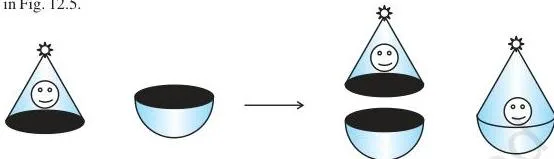
Now consider a toy made by joining a cone to a hemisphere. Their flat circular bases touch and disappear inside the toy. The rule is: TSA of new solid = Sum of visible CSAs. You write this as: TSA = CSA of hemisphere + CSA of cone.
Sometimes a solid sits on top of another, hiding part of the base solid’s surface. For a hemisphere on a cube, the circular base of the hemisphere hides a piece of the cube’s top face. The rule adjusts to: TSA of block = TSA of cube – base area of hemisphere + CSA of hemisphere (NCERT, p. 4).
Volume of Combined Solids: Simple Addition
For volume, there is no disappearance problem. Whether solids are joined externally or one is hollowed out from another, every bit of space still counts.
When solids are joined externally, you just add them: V_total = V1 + V2. A solid toy combining a cone and hemisphere holds the cone’s volume plus the hemisphere’s volume (NCERT, p. 9).
When a cavity is hollowed out, you subtract the scooped volume: V_remaining = V_big – V_scooped. A vessel full of water with a solid dropped in leaves behind the vessel’s volume minus the solid’s volume.
Essential Formulas and Symbol Meanings
This reference table is the spine of your revision. All areas use square units (\( \text{cm}^2 \)); all volumes use cubic units (\( \text{cm}^3 \)).
| Solid | CSA / TSA Formula | Volume Formula | Symbol Key |
|---|---|---|---|
| Cuboid | \( 2(lb + bh + hl) \) | \( lbh \) | \( l, b, h \) = length, breadth, height |
| Cube | \( 6a^2 \) | \( a^3 \) | \( a \) = edge |
| Cylinder | \( 2\pi rh \) (CSA) | \( \pi r^2 h \) | \( r \) = radius, \( h \) = height |
| Cone | \( \pi rl \) (CSA) | \( \frac{1}{3}\pi r^2 h \) | \( l \) = slant height, \( h \) = perpendicular height |
| Sphere | \( 4\pi r^2 \) | \( \frac{4}{3}\pi r^3 \) | \( r \) = radius |
| Hemisphere | \( 2\pi r^2 \) (CSA) | \( \frac{2}{3}\pi r^3 \) | \( r \) = radius |
Key Terms and Definitions You Must Know
Examiners use specific language to test whether you understand what a question is asking. Learn these terms directly.
| Term | Meaning | Example from this Chapter |
|---|---|---|
| Curved Surface Area (CSA) | The area of only the curved outer surface, excluding flat bases. | The round outside of a hemisphere (\( 2\pi r^2 \)). |
| Total Surface Area (TSA) | CSA plus the area of any visible flat bases. | Adding the top circle of a cylinder to its CSA. |
| Slant Height (\( l \)) | The distance from the tip of a cone to any point on its base circle. | Found using \( l = \sqrt{r^2 + h^2} \). |
| Combination of Solids | A single object formed by joining two or more basic solids. | A test-tube or a medicine capsule. |
| Hemispherical Depression | A hemisphere scooped out from a surface, creating a hollow bowl. | Hemispherical ends scooped from a wooden cylinder. |
Worked Example: Surface Area of a Cone-on-Hemisphere Toy
Method: TSA = CSA of hemisphere + CSA of cone. We use original values: a toy is a cone surmounted on a hemisphere. The common diameter is 4.2 cm, and the total height is 6.5 cm. We take \( \pi = \frac{22}{7} \).
The diagram below shows how the toy’s flat circular base disappears inside, leaving only the curved cone and curved hemisphere visible.
- Step 1: Find the common radius. \( r = \frac{4.2}{2} = 2.1 \) cm.
- Step 2: Find the height of the cone. The hemisphere’s height equals its radius. \( h = 6.5 – 2.1 = 4.4 \) cm.
- Step 3: Find the slant height \( l \).
\[ l = \sqrt{r^2 + h^2} = \sqrt{(2.1)^2 + (4.4)^2} = \sqrt{4.41 + 19.36} = \sqrt{23.77} \approx 4.88 \text{ cm} \]
Step 4: Calculate the CSA of the hemisphere.
\[ \text{CSA}_{\text{hemi}} = 2\pi r^2 = 2 \times \frac{22}{7} \times (2.1)^2 = 27.72 \text{ cm}^2 \]
Step 5: Calculate the CSA of the cone.
\[ \text{CSA}_{\text{cone}} = \pi r l = \frac{22}{7} \times 2.1 \times 4.88 = 32.22 \text{ cm}^2 \]
Step 6: Add the two curved surface areas.
\[ \text{TSA} = 27.72 + 32.22 = 59.94 \text{ cm}^2 \]
Final answer: The surface area of the toy to colour is \( 59.94 \text{ cm}^2 \).
Worked Example: Volume of a Cylinder with Hemispherical Ends
Method: V_total = V_cylinder + 2 × V_hemisphere. We use original values: a solid is a cylinder with two hemispheres at its ends. The common diameter is 5.6 cm, and the total length is 18 cm. We take \( \pi = \frac{22}{7} \).
- Step 1: Find the common radius. \( r = \frac{5.6}{2} = 2.8 \) cm.
- Step 2: Find the height of the cylinder. The two hemispheres take up \( 2 \times 2.8 = 5.6 \) cm of the total length.
\[ h = 18 – 5.6 = 12.4 \text{ cm} \]
Step 3: Calculate the volume of the cylinder.
\[ V_{\text{cyl}} = \pi r^2 h = \frac{22}{7} \times (2.8)^2 \times 12.4 = 305.15 \text{ cm}^3 \]
Step 4: Calculate the total volume of the two hemispheres.
\[ 2 \times V_{\text{hemi}} = 2 \times \left( \frac{2}{3}\pi r^3 \right) = 2 \times \frac{2}{3} \times \frac{22}{7} \times (2.8)^3 = 91.96 \text{ cm}^3 \]
Step 5: Add the volumes.
\[ V_{\text{total}} = 305.15 + 91.96 = 397.11 \text{ cm}^3 \]
Final answer: The total volume of the solid is \( 397.11 \text{ cm}^3 \).
Common Mistakes Students Make in Surface Area and Volume
| Mistake | Correct rule | How to check your answer |
|---|---|---|
| Students add the TSAs of both solids. | Add only visible CSAs, subtract overlapping flat faces. | Trace your finger on the diagram; if a face is hidden, it is not in the TSA. |
| Forgetting to subtract the hemisphere base when it sits on a cube. | Subtract \( \pi r^2 \) from the cube’s TSA, then add the hemisphere’s CSA. | Check if the solid’s top face is fully intact; a piece is always blocked by the attached base. |
| Using total height as cylinder height when a cone/hemisphere is on top. | Subtract the height (or radius) of the top solid to get the cylinder height. | Ensure the cylinder height \( h \) only covers the straight, cylindrical section. |
| Using \( h \) instead of \( l \) in cone CSA. | CSA of cone = \( \pi rl \), not \( \pi rh \). | Verify you calculated the slant height using \( \sqrt{r^2 + h^2} \). |
How to Read the Combined Solid Diagrams
Diagrams are the main source of errors in this chapter. You must correctly identify which surfaces are visible and which are hidden.
The truck container below is a cylinder with two hemispheres at its ends. All flat faces are tucked inside where the parts meet. Your TSA only includes the curved surface of the cylinder and the curved surfaces of both hemispheres.
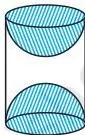
Now look at the wooden article below. A hemisphere has been scooped out from each end of a solid cylinder. For the surface area, those flat circular faces of the original cylinder are gone. You are left with the CSA of the cylinder plus the inner CSAs of the two scooped hemispheres (NCERT, p. 7).
Exam Notes: What Examiners Look For
Examiners check for specific steps that show you understand the method, not just the final number.
- Cost calculations: A 3-4 mark question often asks for the cost of paint, canvas, or material. Finding the area alone without multiplying by the rate loses the final mark.
- Units: Writing \( \text{cm}^2 \) for area and \( \text{cm}^3 \) for volume is strictly checked. Missing or wrong units cost a half-mark.
- Number of lead shots: In water-displacement problems, examiners look for the step where you divide the displaced volume by the volume of one shot to find the total count. This intermediate step earns the method mark.
Real-Life Applications of Combined Solids
Understanding these combinations matters beyond exams.
- Oil tankers: Fuel capacity is the total volume of the cylinder and hemispherical ends; paint required is the total surface area.
- Medicine capsules: Cylinders with hemispherical ends. Surface area determines the coating material, while volume determines the dosage capacity (NCERT, p. 6).
- Floral arrangements: Vases shaped like test tubes (cylinder + hemisphere) dictate the volume of water needed to keep flowers fresh.
Surface Area vs Volume: A Quick Comparison
This table nails down the biggest source of confusion in the chapter.
| Aspect | Surface Area | Volume |
|---|---|---|
| What to add | Visible CSAs only | Volumes of all parts |
| What happens at the join | Flat faces disappear | Nothing disappears |
| Typical question clues | ‘paint’, ‘canvas’, ‘cost of coating’ | ‘capacity’, ‘water’, ‘air’, ‘mass’ |
| Unit | \( \text{cm}^2 \) | \( \text{cm}^3 \) |
Revision Recap: Your Five-Minute Chapter Summary
Read this summary right before walking into the exam hall.
- Surface Area Rule: Add only visible curved surface areas. Subtract any overlapping flat faces (like the base of a hemisphere on a cube).
- Volume Rule: Add all parts if joined externally. Subtract the scooped part if a cavity is hollowed out.
- Six Basic Formulas: Know the CSA and Volume for cuboid, cube, cylinder, cone, sphere, and hemisphere. Remember cone CSA uses slant height \( l \), but volume uses perpendicular height \( h \).
- Common Traps: Using total height instead of cylinder height; using \( h \) instead of \( l \) in cone CSA; forgetting to subtract hidden base areas.
Frequently Asked Questions on Surface Areas and Volumes
Why do we subtract the base area when a hemisphere is placed on a cube?
The flat circular base of the hemisphere covers a piece of the cube’s top face, making that piece invisible. Because total surface area only counts visible surfaces, you must remove that covered flat area from the calculation.
How do you find the height of the cylinder when a cone is mounted on it and only total height is given?
You subtract the height of the cone from the total height. If the total given height includes a hemisphere instead, you subtract the hemisphere’s radius, since the height of a hemisphere equals its radius.
When a conical cavity is hollowed out from a cylinder, what is the surface area of the remaining solid?
The remaining surface area equals the CSA of the cylinder plus the CSA of the cone. The flat base of the cone is open inside the cylinder, so you add the inner curved surface of the cone to the outer curved surface of the cylinder.
How do you find the volume of water left after lead shots are dropped into a vessel?
First, find the total volume of water the vessel holds. Then find the total volume of the lead shots dropped inside. The remaining water equals the vessel’s volume minus the volume of the shots.
What is the difference between apparent capacity and actual capacity of a glass with a raised bottom?
Apparent capacity is the total space inside the cylinder using its flat bottom as the base. Actual capacity is less because a raised hemispherical bottom takes up space; you subtract the hemisphere’s volume from the apparent capacity (NCERT, p. 8).
You can read the full chapter on the official NCERT textbook page for Surface Areas and Volumes. For more revision, explore our Class 10 notes or browse all CBSE study notes available on the site. You may also find our Areas Related to Circles notes helpful for related practice.
Reference: NCERT Class 10 Mathematics textbook, chapter Surface Areas and Volumes.
Explore Class 10 Mathematics Notes
More for this chapter:
Class 10 Mathematics on LearnCBSE:
Related chapters: