This page gives you the Surface Areas and Volumes Class 10 Formulas from NCERT Chapter 12 — the surface-area and volume formulas this chapter uses for solids made by combining two or more basic shapes: cuboid, cube, cylinder, cone, sphere and hemisphere.
You get the curved-surface formula for each part, the addition rules for a combined solid’s surface area and volume, and the subtraction case for actual capacity, with every symbol and its unit.
Each formula is grouped by the chapter’s two topics — surface area of a combination of solids and volume of a combination of solids — with a symbol table, when-to-use guidance, worked examples using original numbers, and chapter-specific common mistakes. For the detailed explanations and derivations behind these formulas, see the Surface Areas and Volumes Class 10 notes.
Formulas at a Glance
The table below is the index for this page. Every formula comes from the chapter’s worked examples; the meanings of the symbols are in the next section.
| Purpose (what you are finding) | Formula |
|---|---|
| Surface area of a combined solid — add only the surfaces you can see | \( \text{TSA of solid} = \text{sum of the CSAs of the exposed parts} \) |
| Curved surface area of a hemisphere | \( \frac{1}{2}(4\pi r^2) = 2\pi r^2 \) |
| Curved surface area of a cone | \( \pi r l \) |
| Slant height of a cone | \( l = \sqrt{r^2 + h^2} \) |
| Curved surface area of a cylinder | \( 2\pi r h \) |
| Total surface area of a cube | \( 6(\text{edge})^2 = 6a^2 \) |
| Bird-bath: cylinder with a hemispherical depression at one end (derived) | \( 2\pi r h + 2\pi r^2 = 2\pi r(h + r) \) |
| Toy: cone mounted on a hemisphere (derived — add the exposed curved surfaces) | \( 2\pi r^2 + \pi r l \) |
| Cube with a hemisphere on top or scooped out (derived — covered face removed) | \( 6a^2 – \pi r^2 + 2\pi r^2 = 6a^2 + \pi r^2 \) |
| Capsule: cylinder with a hemisphere at each end (derived) | \( 2\pi r h + 2(2\pi r^2) \) |
| Volume of a combined solid — always add the part volumes | \( V = V_1 + V_2 + \dots \) |
| Volume of a cuboid | \( \text{length} \times \text{breadth} \times \text{height} \) |
| Volume of a cylinder | \( \pi r^2 h \) |
| Volume of a cone | \( \frac{1}{3}\pi r^2 h \) |
| Volume of a hemisphere | \( \frac{2}{3}\pi r^3 \) |
| Shed: cuboid with a half-cylinder roof (derived) | \( \text{length} \times \text{breadth} \times \text{height} + \frac{1}{2}\pi r^2 h \) |
| Juice glass: actual capacity (derived — cylinder minus raised hemisphere) | \( \pi r^2 h – \frac{2}{3}\pi r^3 \) |
All Formulas, Grouped by Topic
This is the chapter’s formula inventory, grouped under the two topics NCERT uses in the chapter.
Surface Area of a Combination of Solids
An object made by joining two or more basic solids cannot be treated as a single one of them. The NCERT method is to split it into its basic parts and add only the surfaces you can actually see (NCERT, p. 163):
\[ \text{TSA of new solid} = \text{CSA of one hemisphere} + \text{CSA of the cylinder} + \text{CSA of the other hemisphere} \]
The flat faces pressed together disappear from the visible surface. That is why the surface-area rule uses curved surface areas (CSA) of the parts, never their total surface areas (TSA) — the chapter notes this explicitly after Example 1.
The curved surface of a hemisphere is half the curved surface of the full sphere (NCERT, p. 164):
\[ \text{CSA of hemisphere} = \frac{1}{2}(4\pi r^2) = 2\pi r^2 \]
A cone’s curved surface uses the slant height \( l \), which you find from the vertical height and the radius (NCERT, p. 165):
\[ \text{CSA of cone} = \pi r l, \qquad l = \sqrt{r^2 + h^2} \]
The curved wall of a cylinder (NCERT, p. 166) and the total surface of a cube (NCERT, p. 165):
\[ \text{CSA of cylinder} = 2\pi r h, \qquad \text{TSA of cube} = 6(\text{edge})^2 = 6a^2 \]
Adding the exposed curved surfaces of the parts gives the combined forms used in the examples.
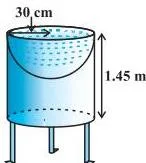
Bird-bath — a cylinder with a hemispherical depression at one end (NCERT, p. 166):
\[ \text{TSA of bird-bath} = 2\pi r h + 2\pi r^2 = 2\pi r(h + r) \]
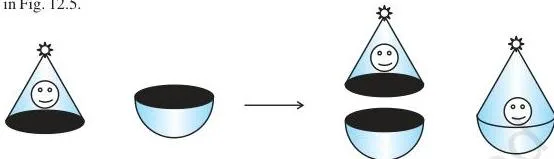
Toy — a cone mounted on a hemisphere, with both base radii equal (NCERT, p. 164):
\[ \text{TSA of toy} = \text{CSA of hemisphere} + \text{CSA of cone} = 2\pi r^2 + \pi r l \]
Cube with a hemisphere fixed on top — the covered face of the cube is removed (NCERT, p. 165):
\[ \text{TSA of block} = 6a^2 – \pi r^2 + 2\pi r^2 = 6a^2 + \pi r^2 \]
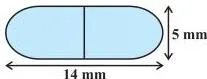
Capsule or tanker — a cylinder with a hemisphere stuck at each end (NCERT, p. 163):
\[ \text{TSA} = 2\pi r h + 2(2\pi r^2) \]
Here \( h \) is the length of the cylindrical part — the total length minus \( 2r \) for the two hemispherical ends.
Volume of a Combination of Solids
Joining hides surface, but it hides no volume. The volume of the solid formed by joining two basic solids is the sum of the volumes of the constituents (NCERT, p. 168):
\[ \text{Volume of combined solid} = V_1 + V_2 + \dots \]
The volume formulas for the individual parts (NCERT, pp. 168–170):
\[ V_{\text{cylinder}} = \pi r^2 h, \qquad V_{\text{cuboid}} = \text{length} \times \text{breadth} \times \text{height} \]
\[ V_{\text{cone}} = \frac{1}{3}\pi r^2 h, \qquad V_{\text{hemisphere}} = \frac{2}{3}\pi r^3 \]
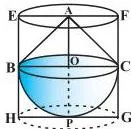
Toy — a hemisphere surmounting a cone (NCERT, p. 170):
\[ V_{\text{toy}} = \frac{2}{3}\pi r^3 + \frac{1}{3}\pi r^2 h \]
Shed — a cuboid with a half-cylinder roof: cuboid volume plus half the cylinder’s volume (NCERT, p. 168):
\[ V_{\text{shed}} = \text{length} \times \text{breadth} \times \text{height} + \frac{1}{2}\pi r^2 h \]
Juice glass — apparent capacity minus the raised hemisphere’s volume gives the actual capacity (NCERT, p. 169):
\[ \text{Actual capacity} = \pi r^2 h – \frac{2}{3}\pi r^3 \]
The shed is the one case where a fraction of a basic solid appears; the glass is the one case where a volume is subtracted from another volume.
What Each Symbol Means
This table gives the meaning and unit of every symbol used in the formulas above.
| Symbol | What it means | Unit / nature |
|---|---|---|
| \( r \) | Radius of a circular base — of the cylinder, cone or hemisphere in the combined solid | cm, m (a length) |
| \( h \) | Vertical (perpendicular) height of a cylinder or cone — not the slant height | cm, m (a length) |
| \( l \) | Slant height of a cone — the distance from the rim of the base to the vertex along the sloping side | cm, m (a length) |
| \( a \) | Edge (side) of the cube | cm, m (a length) |
| \( r’ \) | Radius of a part that differs from the other part’s radius — the rocket’s cylinder in NCERT Example 3 | cm, m (a length) |
| \( \pi \) | Pi — the ratio of a circle’s circumference to its diameter | Dimensionless; the question fixes it as \( \frac{22}{7} \) or 3.14 |
| CSA | Curved surface area — the curved part only, flat faces excluded | cm², m² (square units) |
| TSA | Total surface area — all exposed curved surfaces and flat faces | cm², m² (square units) |
| \( V \) | Volume (capacity) of a solid or of one part | cm³, m³ (cubic units) |
For a cuboid, the three dimensions — length, breadth and height — are multiplied together; do not confuse the cuboid’s breadth with the radius \( r \) of a curved surface.
When to Use Each Formula
One line per decision: read the situation, then reach for the formula in the second column.
| Situation | Formula |
|---|---|
| A solid is made by joining two or more basic solids and you need its outer surface — count only the surfaces you can see | \( \text{TSA} = \text{sum of the CSAs of the exposed parts} \) |
| There is a hemisphere as a dome, an end, or a depression | \( 2\pi r^2 \) |
| A conical part (tent top, toy top, conical cavity) contributes its curved surface — the slant height \( l \) is required | \( \pi r l \) |
| A cone’s slant height is not given, only its height and radius | \( l = \sqrt{r^2 + h^2} \) |
| The cylindrical wall between the ends of a solid | \( 2\pi r h \) |
| A cubical block is part of the solid | \( 6a^2 \), then adjust for the covered face |
| A cylinder with a hemispherical end or depression (bird-bath, vessel) | \( 2\pi r(h + r) \) |
| A cone mounted on a hemisphere or a hemisphere on a cone (toy, top) — the two parts share the same radius \( r \) | \( 2\pi r^2 + \pi r l \) |
| Finding capacity, air, water, syrup or material held in a combined solid | Sum of the volumes of the parts |
| One basic part’s volume on its own | \( \pi r^2 h \), \( \frac{1}{3}\pi r^2 h \), \( \frac{2}{3}\pi r^3 \), or length × breadth × height |
| A cylinder partly occupied by a raised hemisphere (glass) | \( \pi r^2 h – \frac{2}{3}\pi r^3 \) |
Both exercises of this chapter are pure numerical work. Exercise 12.1 (NCERT, p. 167) tests surface area of combined solids only — a full-marks solution names the two parts, lists the exposed surfaces, and keeps one consistent \( \pi \) value.
Exercise 12.2 (NCERT, p. 170) tests volumes: Q1–Q4 add volumes of two parts, Q5 counts identical small spheres by the water they displace, Q6 converts volume to mass using density, Q7 subtracts the solid’s volume from the cylinder’s, and Q8 checks a claimed capacity. Step-by-step working of every question is in the Chapter 12 NCERT solutions.
Worked Examples
Three worked examples, each using original numbers so you can test the formula rather than recall an answer. All three use shapes that appear in the chapter’s own examples.
Worked Example 1: Surface area of a capsule (cylinder + two hemispheres)
Step 1: A capsule has no flat ends, so only curved surfaces show.
Take the total length 20 cm and diameter 7 cm, with \( \pi = \frac{22}{7} \).
Radius \( r = \frac{7}{2} = 3.5 \) cm; length of the cylindrical part \( h = 20 – 2 \times 3.5 = 13 \) cm.
Step 2: Select the capsule formula, as in Fig. 12.10: \( \text{TSA} = 2\pi r h + 2(2\pi r^2) \).
\[ 2\pi r h = 2 \times \frac{22}{7} \times 3.5 \times 13 = 286\ \text{cm}^2 \]
\[ 2(2\pi r^2) = 4 \times \frac{22}{7} \times (3.5)^2 = 154\ \text{cm}^2 \]
\[ \text{TSA} = 286 + 154 = 440\ \text{cm}^2 \]
Final answer: The surface area of the capsule is \( 440\ \text{cm}^2 \).
Worked Example 2: The radius of a bird-bath from its surface area
Step 1: The bird-bath (Fig. 12.9) is a cylinder with a hemispherical depression at one end.
The depth of the cylindrical part is 10 cm, the total surface area is \( 748\ \text{cm}^2 \), and \( \pi = \frac{22}{7} \).
Select the bird-bath formula: \( \text{TSA} = 2\pi r(h + r) \).
Step 2: Substitute the given values.
\[ 748 = 2 \times \frac{22}{7} \times r(10 + r) = \frac{44}{7}(10r + r^2) \]
Step 3: Solve for \( r \).
\[ 10r + r^2 = 748 \times \frac{7}{44} = 119 \]
\[ r^2 + 10r – 119 = 0 \Rightarrow (r + 17)(r – 7) = 0 \]
Step 4: The radius is positive, so reject \( r = -17 \).
Final answer: The radius of the bird-bath is \( 7\ \text{cm} \). Check: \( 2 \times \frac{22}{7} \times 7 \times 17 = 748\ \text{cm}^2 \).
Worked Example 3: Volume of a toy (hemisphere + cone)
Step 1: A toy is a right circular cone of height 6 cm standing on a hemisphere of radius 3 cm (same style as Fig. 12.14), with \( \pi = 3.14 \).
Volume is the sum of the two parts.
\[ V = \frac{2}{3}\pi r^3 + \frac{1}{3}\pi r^2 h \]
\[ V_{\text{hemisphere}} = \frac{2}{3} \times 3.14 \times 3^3 = 56.52\ \text{cm}^3 \]
\[ V_{\text{cone}} = \frac{1}{3} \times 3.14 \times 3^2 \times 6 = 56.52\ \text{cm}^3 \]
\[ V = 56.52 + 56.52 = 113.04\ \text{cm}^3 \]
Final answer: The volume of the toy is \( 113.04\ \text{cm}^3 \).
Common Mistakes to Avoid
| Mistake | Correct rule | How to check your answer |
|---|---|---|
| Adding the full total surface areas of both parts | Add only the exposed curved surfaces — the joined faces vanish, so the toy uses \( 2\pi r^2 + \pi r l \), not TSA(cone) + TSA(hemisphere). | Your expression should contain no term for the two touching faces; the combined surface is smaller than the sum of the two totals. |
| Using the given diameter as the radius | Halve any given diameter first: \( r = \frac{d}{2} \) (a diameter of 3.5 cm gives \( r = 1.75 \) cm). | The area has \( r^2 \) in it — using the diameter instead makes the area about four times too large. |
| Putting the vertical height into the cone’s curved surface formula | \( \pi r l \) needs the slant height; find \( l = \sqrt{r^2 + h^2} \) first whenever only \( h \) is given. | A cone always has \( l \geq h \); if your slant height is smaller than the height, you swapped them. |
| Mixing units (metres and centimetres in the same substitution) | Convert every length to one unit before substituting — NCERT converts 1.45 m to 145 cm before using \( 2\pi r(h + r) \). | The unit of the answer tells you: cm² comes only from cm lengths, m² only from m lengths. |
| Subtracting the curved surface of a scooped-out part | A depression or cavity exposes its curved wall, so add its CSA to the surface; only its volume is subtracted (bird-bath adds \( 2\pi r^2 \), glass capacity subtracts \( \frac{2}{3}\pi r^3 \)). | The remaining solid’s surface is larger than the original outer surface — scooping out adds visible surface, never removes it. |
Frequently Asked Questions
Why is the surface area of a joined solid not the sum of the two total surface areas?
Because the faces that touch are hidden after joining. When a cone sits on a hemisphere, the cone’s circular base and the hemisphere’s flat face coincide, and both disappear from the visible surface. You therefore add only the curved surfaces: \( 2\pi r^2 + \pi r l \), which is less than TSA(cone) + TSA(hemisphere).
NCERT states this directly after Example 1 (NCERT, p. 165).
When a hemisphere is scooped out or a cavity is hollowed, do I add or subtract?
Surface and volume follow opposite rules. A scooped-out depression exposes its curved wall, so add its CSA — the bird-bath formula \( 2\pi r(h + r) \) adds \( 2\pi r^2 \) for the depression. But the hollow removes material, so its volume is subtracted — the juice glass’s actual capacity is \( \pi r^2 h – \frac{2}{3}\pi r^3 \) (NCERT, p. 169).
What is the difference between apparent capacity and actual capacity?
Apparent capacity is what the container would hold if it were a full cylinder, \( \pi r^2 h \). Actual capacity is what it really holds after the raised hemisphere at the bottom takes up space: \( \pi r^2 h – \frac{2}{3}\pi r^3 \) (NCERT, p. 169).
When do I use \( \pi = \frac{22}{7} \) instead of 3.14?
Use the value the question states. The exercises open with “Unless stated otherwise, take \( \pi = \frac{22}{7} \)” (NCERT, p. 167), while some worked examples fix \( \pi = 3.14 \). The two values give slightly different decimals, so stick to the value printed in the question.
This sheet sits in the Class 10 Maths formulas hub; the Maths formulas index covers every other chapter the same way. Every formula above follows the Rationalised NCERT Class 10 Mathematics textbook, Chapter 12, which you can open from the NCERT textbook portal.
Reference: NCERT Class 10 Mathematics textbook, chapter 12 Surface Areas and Volumes.
Explore Class 10 Maths Formulas
More for this chapter:
Class 10 Maths on LearnCBSE:
Related chapters: