The Some Applications of Trigonometry Class 10 formulas below are the ratios and relations this chapter uses to find heights and distances without measuring them directly: the line of sight, the angle of elevation and the angle of depression, plus the formulas that connect height, distance and length in the right triangles these problems form.
Each formula is grouped by topic, with the meaning of every symbol, guidance on when to use it, and worked examples using original numbers. For the step-by-step explanations and derivations, see the Some Applications of Trigonometry Class 10 Notes.
Formulas at a Glance
The inventory below lists the formulas used in the chapter’s worked examples — the trigonometric ratios first, then the height and distance forms built from them. Conditions for each formula are in the “When to Use” section.
| Purpose (what you are finding) | Formula |
|---|---|
| Opposite-to-adjacent ratio of an angle | \( \tan\theta = \dfrac{\text{opposite}}{\text{adjacent}} \) |
| Adjacent-to-opposite ratio of an angle | \( \cot\theta = \dfrac{\text{adjacent}}{\text{opposite}} \) |
| Opposite-to-hypotenuse ratio of an angle | \( \sin\theta = \dfrac{\text{opposite}}{\text{hypotenuse}} \) |
| Height of an object from the ground distance and angle of elevation | \( h = d\tan\theta \) |
| Length of a ladder, rope or string reaching a known height (from the sin ratio) | \( L = \dfrac{h}{\sin\theta} \) |
| Horizontal distance from the foot of an object when the height is known (from the cot ratio) | \( d = h\cot\theta \) |
| Total height when the observer’s eye height adds to the triangle height (derived form) | \( H = d\tan\theta + h_{\text{eye}} \) |
| Height of a building split into an upper part and a lower part | \( PC = PD + DC \) |
| Width of a river as the sum of two distances from a point on the bridge | \( AB = AD + DB \) |
| Angle of depression at the observer equals the angle of elevation at the lower point (alternate angles) | \( \angle QPB = \angle PBD \) |
| Two-position method when the shadow changes length (derived form) | \( \tan\theta_1 = \dfrac{h}{x},\ \tan\theta_2 = \dfrac{h}{x+\Delta d} \) |
All Formulas, Grouped by Topic
Every formula in this section comes from Section 9.1, Heights and Distances, of the Rationalised NCERT Class 10 Mathematics textbook — the official chapter PDF is jemh109.pdf on ncert.nic.in.
Line of Sight, Elevation and Depression
The line of sight is the straight line from the eye of the observer to the point being viewed (NCERT, p. 134). The angle of elevation is the angle the line of sight makes with the horizontal when the point viewed is above the horizontal level — the case when you raise your head.
The angle of depression is that same angle with the horizontal when the point viewed is below the horizontal level — the case when you lower your head (NCERT, p. 134). Both angles are measured with the horizontal, never with the vertical.
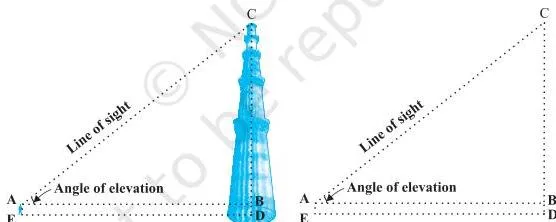
This is the chapter’s opening picture: the student’s eye is at A, the top of the minar at C, and the line of sight AC meets the horizontal at A, forming the angle of elevation \( \angle BAC \). Every heights-and-distances problem repeats this diagram with different labels.
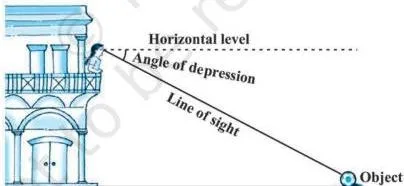
Fig. 9.3 is the mirror situation: the observer looks down, so the line of sight falls below the horizontal, and the angle between them is the angle of depression. In both diagrams the angle is drawn against the horizontal line through the eye.
The Core Trigonometric Ratios
Once the elevation or depression angle is marked, the problem reduces to one right triangle. The decision rule the chapter uses: pick the ratio that contains the two sides you know and the side you need (NCERT, p. 135). In the minar problem this narrows the choice to tan or cot, because those involve the height and the ground distance.
\[ \tan\theta = \frac{\text{opposite}}{\text{adjacent}} \qquad \cot\theta = \frac{\text{adjacent}}{\text{opposite}} \qquad \sin\theta = \frac{\text{opposite}}{\text{hypotenuse}} \]
The opposite and adjacent sides are named relative to the angle \( \theta \) inside the triangle. The chapter writes these exactly as \( \tan A = \frac{BC}{AB} \) (height over distance) and \( \cot A = \frac{AB}{BC} \) (NCERT, p. 135).
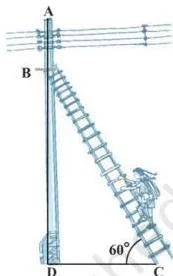
The ladder example uses \( \sin 60^\circ = \frac{BD}{BC} \) — the opposite side over the hypotenuse (NCERT, p. 136). In this chapter’s worked examples cos is never needed: the ratios that appear are tan, cot and sin.
Height of an Object
The basic height formula comes straight from \( \tan\theta = \frac{h}{d} \): with the observer on the ground at distance d from the foot and angle of elevation \( \theta \), the height is
\[ h = d\tan\theta \]
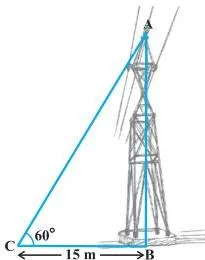
Example 1 applies it with \( \tan 60^\circ = \frac{AB}{15} \), giving \( AB = 15\sqrt{3} \) m (NCERT, p. 135). When the observer’s eye is not at ground level, the triangle only covers the part above the eye, and the eye height is added at the end:
\[ H = d\tan\theta + h_{\text{eye}} \]
Example 3 works this way: \( \tan 45^\circ = \frac{AE}{28.5} \), then the chimney height is \( AE + 1.5 = 30 \) m (NCERT, p. 137). A tall building can also be split at a horizontal line — Example 6 uses \( PC = PD + DC \), the upper part plus the lower storey (NCERT, p. 140).
Length and Distance
\[ L = \frac{h}{\sin\theta} \qquad d = h\cot\theta \qquad AB = AD + DB \]
The first two come from the ladder problem (NCERT, p. 136). To reach a point at height h with a ladder inclined at \( \theta \), the ladder is the hypotenuse, so \( L = \frac{h}{\sin\theta} \) — Example 2 gets \( BC = \frac{3.7 \times 2}{\sqrt{3}} \approx 4.28 \) m.
The distance of the foot from the pole uses the reciprocal ratio \( \cot\theta = \frac{d}{h} \), giving \( DC = \frac{3.7}{\sqrt{3}} \approx 2.14 \) m. The third form builds a width from two parts: in Example 7 the river is \( AB = AD + DB = 3\sqrt{3} + 3 = 3(\sqrt{3}+1) \) m (NCERT, p. 141).
The Two-Position (Shadow) Method
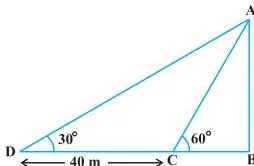
When the same object is viewed from two positions and the distance between the positions is known, write the height twice — once from each triangle — and solve the pair of equations. Example 5 measures the shadow of a tower at two Sun altitudes (NCERT, p. 139):
\[ \tan 60^\circ = \frac{h}{x} \qquad \tan 30^\circ = \frac{h}{x+40} \]
Here h is the tower height and x the shadow length at \( 60^\circ \). Substituting \( h = x\sqrt{3} \) into the second equation gives \( 3x = x + 40 \), so \( x = 20 \) and \( h = 20\sqrt{3} \) m. In general, with the larger angle giving the shorter shadow:
\[ \tan\theta_1 = \frac{h}{x}, \qquad \tan\theta_2 = \frac{h}{x + \Delta d} \]
The Depression–Elevation Link
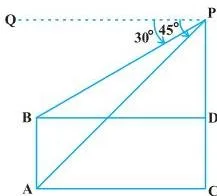
Depression angles are given at the observer’s eye, but the right triangle you actually solve sits at the lower point. The two horizontals (eye level and ground) are parallel, and the line of sight is a transversal, so the alternate interior angles are equal:
\[ \angle QPB = \angle PBD \]
Example 6 uses this to turn a \( 30^\circ \) depression angle into \( \tan 30^\circ = \frac{PD}{BD} \) inside the lower triangle (NCERT, p. 139). Whenever a problem quotes a depression angle, replace it by the equal elevation angle at the ground point before writing the ratio.
Standard Values Used in the Examples
These are the exact values that appear in the chapter’s worked examples (NCERT, pp. 135–139).
| Angle \( \theta \) | \( \tan\theta \) | \( \sin\theta \) | \( \cot\theta \) |
|---|---|---|---|
| \( 30^\circ \) | \( \dfrac{1}{\sqrt{3}} \) | — | — |
| \( 45^\circ \) | \( 1 \) | — | — |
| \( 60^\circ \) | \( \sqrt{3} \) | \( \dfrac{\sqrt{3}}{2} \) | \( \dfrac{1}{\sqrt{3}} \) |
Only the values used in this chapter’s examples are listed. Notice that \( \cot 60^\circ = \frac{1}{\sqrt{3}} \) is the reciprocal of \( \tan 60^\circ = \sqrt{3} \) — that is exactly why cot converts a height into a distance in one step, as in Example 2.
What Each Symbol Means
Symbols used in the formulas above. The unit column gives the nature of the quantity, because this is a pure-maths chapter working in metres and degrees.
| Symbol | What it means | Unit / nature |
|---|---|---|
| \( \theta \) | The angle of elevation or the angle of depression inside the right triangle | Degrees (angle) |
| \( h \) | Height of the object — the opposite side in the elevation triangle | Metres |
| \( d \) | Horizontal distance from the observation point to the foot of the object — the adjacent side | Metres |
| \( L \) | Length of the inclined object: ladder, rope or string — the hypotenuse | Metres |
| \( H \) | Total height of the object, including the observer’s eye height | Metres |
| \( h_{\text{eye}} \) | Height of the observer’s eye above ground level | Metres |
| \( x \) | A distance such as the shadow length at the larger angle, used in the two-position method | Metres |
| \( \Delta d \) | The extra distance between the two positions — for example, how much longer the shadow becomes | Metres |
| \( \angle QPB \), \( \angle PBD \) | The angle of depression at the observer and the equal alternate angle at the ground point | Degrees (angle) |
| \( AB, BC, BD, CD, AD, DB, PC, PD, DC \) | Labelled sides of the problem’s right triangles; the letters come from the figure | Metres |
| opposite, adjacent, hypotenuse | The three sides of the right triangle taken relative to the marked angle | No unit — ratios are dimensionless |
When to Use Each Formula
One line per situation — reach for a formula only when its condition holds.
| Situation | Formula |
|---|---|
| Observer on the ground, distance from the foot known and the angle of elevation given; height asked | \( h = d\tan\theta \) |
| Height to be reached is known and the ladder or rope makes a given angle with the horizontal; length asked | \( L = \dfrac{h}{\sin\theta} \) |
| Height known and the distance of the ladder’s foot from the pole asked | \( d = h\cot\theta \) |
| The angle is measured from a person’s eye or a balcony, not from ground level | \( H = d\tan\theta + h_{\text{eye}} \) |
| The observer looks down from a building, bridge or lighthouse — depression angles given | Replace each depression angle by its equal alternate angle at the lower point, then use the same ratio formulas |
| The same object’s shadow is given at two different Sun altitudes | \( \tan\theta_1 = \dfrac{h}{x},\ \tan\theta_2 = \dfrac{h}{x+\Delta d} \) |
| Two points lie on opposite sides of the observer (river banks); width asked | Add the distances: \( AB = AD + DB \) |
| Two points lie on the same side of the observer (two ships in a line); gap asked | Subtract the smaller distance from the larger |
Exam map: in Exercise 9.1 the question types follow the same patterns — Q1–Q5 use a single ratio in one right triangle; Q6, Q11, Q14 and Q15 track one moving object from two positions; Q7–Q10 combine two triangles from the ground (building with transmission tower, pedestal with statue, two poles); Q12–Q13 use angles of depression from a height.
Worked Examples
Three worked examples with original numbers, each showing the ratio-selection step first, because that is where most marks are decided. To practise these formulas on the textbook’s own questions, see the NCERT Solutions for Chapter 9 — Some Applications of Trigonometry.
Worked Example 1: Height of a Tower Using tan
Step 1: Set up the right triangle.
A tower stands vertically on level ground.
From a point 20 m from its foot, the angle of elevation of the top is \( 60^\circ \).
The figure below shows this standard setup — AB is the tower, CB the ground distance, \( \angle ACB \) the angle of elevation (NCERT, p. 135).
Step 2: Identify the sides.
The height AB is opposite to \( 60^\circ \), and CB = 20 m is adjacent to \( 60^\circ \).
Choose tan, the ratio that contains exactly these two sides.
\[ \tan 60^\circ = \frac{AB}{CB} = \frac{h}{20} \]
\[ \sqrt{3} = \frac{h}{20} \;\Rightarrow\; h = 20\sqrt{3} = 20 \times 1.732 \approx 34.6\ \text{m} \]
Final answer: The height of the tower is \( 20\sqrt{3} \) m, approximately 34.6 m.
Worked Example 2: Ladder Length and Foot Distance Using sin and cot
Step 1: Find the height to be climbed.
A 7 m pole has a fault at a point 1.5 m below its top, so \( BD = 7 – 1.5 = 5.5 \) m.
In Fig. 9.5 the ladder BC is inclined at \( 60^\circ \) to the horizontal (NCERT, p. 136).
Step 2: Ladder length BC.
The known side BD = 5.5 m is opposite to \( 60^\circ \) and the required side BC is the hypotenuse — use sin.
\[ \sin 60^\circ = \frac{BD}{BC} = \frac{5.5}{BC} \;\Rightarrow\; \frac{\sqrt{3}}{2} = \frac{5.5}{BC} \]
\[ BC = \frac{5.5 \times 2}{\sqrt{3}} = \frac{11}{\sqrt{3}} = \frac{11\sqrt{3}}{3} \approx 6.35\ \text{m} \]
Step 3: Foot distance DC.
The known side BD is opposite to \( 60^\circ \) and DC is adjacent — use cot.
\[ \cot 60^\circ = \frac{DC}{BD} = \frac{1}{\sqrt{3}} \;\Rightarrow\; DC = \frac{5.5}{\sqrt{3}} = \frac{5.5\sqrt{3}}{3} \approx 3.18\ \text{m} \]
Final answer: The ladder should be about 6.35 m long, with its foot placed about 3.18 m from the pole.
Worked Example 3: Two-Position (Shadow) Method
Step 1: Set up the two positions.
The shadow of a tower is 30 m longer when the Sun’s altitude is \( 30^\circ \) than when it is \( 60^\circ \).
Let h be the tower height and x the shadow at \( 60^\circ \); then the shadow at \( 30^\circ \) is \( x + 30 \) m.
Fig. 9.8 shows this two-shadow setup (NCERT, p. 139).
Step 2: Write h from the \( 60^\circ \) triangle.
\[ \tan 60^\circ = \frac{h}{x} \;\Rightarrow\; h = x\sqrt{3} \]
Step 3: Write h from the \( 30^\circ \) triangle and equate the two expressions.
\[ \tan 30^\circ = \frac{h}{x+30} \;\Rightarrow\; \frac{1}{\sqrt{3}} = \frac{h}{x+30} \]
\[ x\sqrt{3} = \frac{x+30}{\sqrt{3}} \;\Rightarrow\; 3x = x + 30 \;\Rightarrow\; x = 15\ \text{m} \]
\[ h = 15\sqrt{3} \approx 15 \times 1.732 \approx 26.0\ \text{m} \]
Step 4 (check): At \( 30^\circ \) the shadow is 45 m, and \( \frac{h}{x+30} = \frac{25.98}{45} \approx 0.577 = \frac{1}{\sqrt{3}} \) — the value of tan \( 30^\circ \), so the answer is consistent.
Final answer: The height of the tower is \( 15\sqrt{3} \) m, approximately 26.0 m.
Common Mistakes to Avoid
The errors below are specific to heights-and-distances problems — each row gives the fix and a check you can run on your own answer.
| Mistake | Correct rule | How to check your answer |
|---|---|---|
| Writing \( \tan 60^\circ = \dfrac{\text{adjacent}}{\text{opposite}} \) — the ratio inverted | The angle sits at the observer’s eye; the height is the opposite side, the ground distance the adjacent side, so \( \tan\theta = \dfrac{\text{height}}{\text{distance}} \) | For \( 60^\circ \), \( \tan 60^\circ = \sqrt{3} \approx 1.73 \), so height \( \approx 1.73 \times \) distance; if your height is smaller than the distance at \( 60^\circ \), the ratio was inverted |
| Forgetting the observer’s height in problems where a boy or a girl is watching | Add the eye height only when the angle is measured from a person’s eye above the ground; a point on the ground needs no addition | The total height must be greater than the height obtained from the triangle alone |
| Putting \( 90^\circ – \theta \) inside the triangle for a depression angle | The angle of depression is measured from the horizontal, so the interior angle at the lower point is the equal alternate angle, never its complement | The interior angle must equal the given depression angle (NCERT, p. 139), not \( 90^\circ \) minus it |
| Adding distances for points on the same side of the observer | Opposite sides → add the distances (river banks); same side → subtract (two ships in a line, one behind the other) | A gap between two objects is always positive and never exceeds the larger distance from the observer |
| Leaving an unsimplified surd such as \( \dfrac{5.5}{\sqrt{3}} \) as the final answer | Rationalize as the textbook does: \( \dfrac{8}{\sqrt{3}-1} \rightarrow 4(\sqrt{3}+1) \) (NCERT, p. 140) | Multiply numerator and denominator by the conjugate (or by \( \sqrt{3} \) when the denominator is a single surd) and simplify |
Frequently Asked Questions
What is the difference between the angle of elevation and the angle of depression?
Both are formed by the line of sight with the horizontal. In an angle of elevation the viewed point is above the horizontal level and you raise your head; in an angle of depression the point is below the horizontal level and you lower your head (NCERT, p. 134).
The key word in both definitions is horizontal — the angle is never measured with the vertical.
How do I choose between sin, tan and cot in a heights-and-distances question?
List the two sides you know and the side you are asked for. If they are the opposite side and the adjacent side, use \( \tan\theta = \dfrac{\text{opposite}}{\text{adjacent}} \) (or its reciprocal \( \cot\theta \)). If they are the opposite side and the hypotenuse, use \( \sin\theta = \dfrac{\text{opposite}}{\text{hypotenuse}} \).
This is the chapter’s own selection rule: use the ratio that involves the two known values and the one required (NCERT, p. 135).
Why is the angle of depression equal to the angle of elevation at the lower point?
Because the two horizontal lines — the observer’s eye level and the ground — are parallel, and the line of sight cuts across them as a transversal. Alternate interior angles formed by a transversal with parallel lines are equal, so the depression angle equals the elevation angle at the object (NCERT, p. 139).
Do I always add the observer’s height at the end?
Only when the angle was measured from a point above ground level, such as a person’s eye or a balcony. In Example 3 the observer’s 1.5 m eye height is added to the height found from the triangle (NCERT, p. 137).
When the observation point lies on the ground at the same level as the foot of the object, there is no height to add.
Revising other chapters? Browse the Class 10 Maths formulas index or the main maths formulas hub.
Reference: NCERT Class 10 Mathematics textbook, chapter Some Applications of Trigonometry.
Explore Class 10 Maths Formulas
More for this chapter:
Class 10 Maths on LearnCBSE:
Related chapters: