This page gathers the Introduction to Trigonometry Class 10 formulas you need for revision: the six trigonometric ratios of an acute angle in a right triangle, the values of those ratios at 0°, 30°, 45°, 60° and 90°, and the three trigonometric identities that let you move between ratios.
Every formula is grouped by the textbook topic it belongs to, with a table of symbol meanings, guidance on when to use each formula, and three worked examples built on fresh numbers. For the derivations — why \( \sin 45^\circ = \frac{1}{\sqrt{2}} \) and how the identities follow from Pythagoras’ theorem — see the Introduction to Trigonometry Class 10 notes.
Formulas at a Glance
| Purpose | Formula |
|---|---|
| Sine — opposite over hypotenuse | \( \sin A = \frac{\text{opposite}}{\text{hypotenuse}} = \frac{BC}{AC} \) |
| Cosine — adjacent over hypotenuse | \( \cos A = \frac{\text{adjacent}}{\text{hypotenuse}} = \frac{AB}{AC} \) |
| Tangent — opposite over adjacent | \( \tan A = \frac{\text{opposite}}{\text{adjacent}} = \frac{BC}{AB} = \frac{\sin A}{\cos A} \) |
| Cosecant — reciprocal of sine | \( \cosec A = \frac{1}{\sin A} = \frac{\text{hypotenuse}}{\text{opposite}} \) |
| Secant — reciprocal of cosine | \( \sec A = \frac{1}{\cos A} = \frac{\text{hypotenuse}}{\text{adjacent}} \) |
| Cotangent — reciprocal of tangent | \( \cot A = \frac{1}{\tan A} = \frac{\cos A}{\sin A} \) |
| First identity | \( \sin^2 A + \cos^2 A = 1 \quad (0^\circ \leq A \leq 90^\circ) \) |
| Second identity (not valid at 90°) | \( 1 + \tan^2 A = \sec^2 A \quad (0^\circ \leq A \lt 90^\circ) \) |
| Third identity (not valid at 0°) | \( \cosec^2 A = 1 + \cot^2 A \quad (0^\circ \lt A \leq 90^\circ) \) |
| Sine at the five standard angles (full table below) | \( \sin 0^\circ = 0,\ \sin 30^\circ = \frac{1}{2},\ \sin 45^\circ = \frac{1}{\sqrt{2}},\ \sin 60^\circ = \frac{\sqrt{3}}{2},\ \sin 90^\circ = 1 \) |
All Formulas, Grouped by Topic
Trigonometric Ratios
For a right triangle ABC, right-angled at B, with acute angle A, the six ratios are defined from the sides as follows (NCERT, pp. 114-115):
\[ \sin A = \frac{\text{side opposite to angle }A}{\text{hypotenuse}} = \frac{BC}{AC}, \qquad \cos A = \frac{\text{side adjacent to angle }A}{\text{hypotenuse}} = \frac{AB}{AC} \]
\[ \tan A = \frac{\text{side opposite to angle }A}{\text{side adjacent to angle }A} = \frac{BC}{AB} \]
\[ \cosec A = \frac{1}{\sin A} = \frac{\text{hypotenuse}}{\text{side opposite to angle }A} = \frac{AC}{BC}, \qquad \sec A = \frac{1}{\cos A} = \frac{\text{hypotenuse}}{\text{side adjacent to angle }A} = \frac{AC}{AB} \]
\[ \cot A = \frac{1}{\tan A} = \frac{\text{side adjacent to angle }A}{\text{side opposite to angle }A} = \frac{AB}{BC} \]
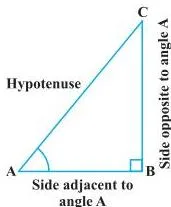
These three labels are the whole game: the opposite side faces the angle, the adjacent side helps to form the angle, and the hypotenuse is always the longest side.
Dividing the sine and cosine ratios gives two quotient relations that are used constantly in identity questions (NCERT, p. 116):
\[ \tan A = \frac{\sin A}{\cos A}, \qquad \cot A = \frac{\cos A}{\sin A} \]
Two written conventions matter here (NCERT, p. 117): \( \sin^2 A \) is shorthand for \( (\sin A)^2 \), and \( \cosec A = (\sin A)^{-1} \), which is not the same as \( \sin^{-1} A \) — inverse sine has a different meaning studied in higher classes.
The ratios do not depend on the size of the triangle: any right triangle drawn with the same acute angle is similar to the original, so its sides are proportional and every ratio comes out the same (NCERT, p. 117).
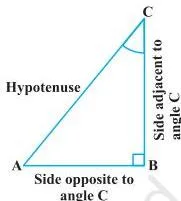
Because the hypotenuse is the longest side, \( \sin A \) and \( \cos A \) never exceed 1, while \( \sec A \) (for \( 0^\circ \leq A \lt 90^\circ \)) and \( \cosec A \) (for \( 0^\circ \lt A \leq 90^\circ \)) are always at least 1 (NCERT, p. 118).
Trigonometric Ratios of Some Specific Angles
Two constructions generate all the standard values: the isosceles right triangle gives 45°, and half an equilateral triangle gives 30° and 60° (NCERT, pp. 122-123).
\[ \sin 45^\circ = \cos 45^\circ = \frac{1}{\sqrt{2}}, \qquad \tan 45^\circ = 1 \]
\[ \sin 30^\circ = \frac{1}{2}, \quad \cos 30^\circ = \frac{\sqrt{3}}{2}, \quad \tan 30^\circ = \frac{1}{\sqrt{3}} \]
\[ \sin 60^\circ = \frac{\sqrt{3}}{2}, \quad \cos 60^\circ = \frac{1}{2}, \quad \tan 60^\circ = \sqrt{3} \]
Their reciprocals follow from \( \cosec A = \frac{1}{\sin A} \), \( \sec A = \frac{1}{\cos A} \) and \( \cot A = \frac{1}{\tan A} \):
\[ \cosec 45^\circ = \sec 45^\circ = \sqrt{2}, \quad \cot 45^\circ = 1 \]
\[ \cosec 30^\circ = 2, \quad \sec 30^\circ = \frac{2}{\sqrt{3}}, \quad \cot 30^\circ = \sqrt{3}, \qquad \cosec 60^\circ = \frac{2}{\sqrt{3}}, \quad \sec 60^\circ = 2, \quad \cot 60^\circ = \frac{1}{\sqrt{3}} \]
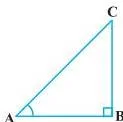
The values at 0° and 90° come from watching the sides change. As angle A shrinks to 0°, the opposite side BC shrinks to zero and AC nearly equals AB, so \( \sin 0^\circ = 0 \) and \( \cos 0^\circ = 1 \); \( \tan 0^\circ = 0 \) and \( \sec 0^\circ = 1 \), while \( \cosec 0^\circ \) and \( \cot 0^\circ \) are not defined (NCERT, p. 124).

As angle A grows towards 90°, the side AB shrinks to zero and AC almost coincides with BC, so \( \sin 90^\circ = 1 \) and \( \cos 90^\circ = 0 \); \( \tan 90^\circ \) and \( \sec 90^\circ \) are not defined, while \( \cosec 90^\circ = 1 \) and \( \cot 90^\circ = 0 \) (NCERT, p. 124).

These values are collected in Table 8.1 (NCERT, p. 125). Notice the pattern: as A increases from 0° to 90°, sin A increases from 0 to 1 and cos A decreases from 1 to 0.
| \( \angle A \) | 0° | 30° | 45° | 60° | 90° |
|---|---|---|---|---|---|
| \( \sin A \) | 0 | \( \frac{1}{2} \) | \( \frac{1}{\sqrt{2}} \) | \( \frac{\sqrt{3}}{2} \) | 1 |
| \( \cos A \) | 1 | \( \frac{\sqrt{3}}{2} \) | \( \frac{1}{\sqrt{2}} \) | \( \frac{1}{2} \) | 0 |
| \( \tan A \) | 0 | \( \frac{1}{\sqrt{3}} \) | 1 | \( \sqrt{3} \) | not defined |
| \( \cosec A \) | not defined | 2 | \( \sqrt{2} \) | \( \frac{2}{\sqrt{3}} \) | 1 |
| \( \sec A \) | 1 | \( \frac{2}{\sqrt{3}} \) | \( \sqrt{2} \) | 2 | not defined |
| \( \cot A \) | not defined | \( \sqrt{3} \) | 1 | \( \frac{1}{\sqrt{3}} \) | 0 |
The same table is printed in Chapter 8 of the NCERT Class 10 Mathematics textbook — open the official chapter PDF to cross-check any entry.
Trigonometric Identities
Starting from Pythagoras’ theorem \( AB^2 + BC^2 = AC^2 \) and dividing by \( AC^2 \), \( AB^2 \) and \( BC^2 \) in turn gives the three identities (NCERT, pp. 128-129):
\[ \sin^2 A + \cos^2 A = 1 \quad \text{for } 0^\circ \leq A \leq 90^\circ \]
\[ 1 + \tan^2 A = \sec^2 A \quad \text{for } 0^\circ \leq A \lt 90^\circ \]
\[ \cosec^2 A = 1 + \cot^2 A \quad \text{for } 0^\circ \lt A \leq 90^\circ \]
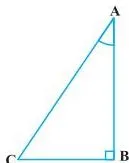
The first identity holds at every angle from 0° to 90°. The other two carry conditions because \( \tan A \) and \( \sec A \) are not defined at 90°, while \( \cosec A \) and \( \cot A \) are not defined at 0°. The chapter summary also writes the second in the form \( \sec^2 A – \tan^2 A = 1 \).
Derived forms (from identity 1, NCERT, p. 130): when only sin A is known, \[ \cos A = \sqrt{1 – \sin^2 A}, \qquad \tan A = \frac{\sin A}{\sqrt{1 – \sin^2 A}}, \qquad \sec A = \frac{1}{\sqrt{1 – \sin^2 A}} \]
The positive square root is taken because A is acute, so \( \cos A \) is positive.
What Each Symbol Means
| Symbol | What it means | Nature / unit |
|---|---|---|
| \( A \) or \( \theta \) | the acute angle of the right triangle for which the ratios are defined; \( \theta \) (theta) is another common name for the angle | angle, measured in degrees (here \( 0^\circ \) to \( 90^\circ \)) |
| \( BC \) | side opposite to angle A — the side that faces angle A and does not touch it | length (cm, m, etc.) |
| \( AB \) | side adjacent to angle A — the side that helps to form angle A | length (cm, m, etc.) |
| \( AC \) | hypotenuse — the longest side, opposite the right angle | length (cm, m, etc.) |
| \( \sin A, \cos A, \tan A, \cosec A, \sec A, \cot A \) | the six trigonometric ratios of the angle A | pure numbers — ratios of two lengths, so dimensionless |
| \( \sin^2 A \) | shorthand for \( (\sin A)^2 \); the same convention applies to the other ratios | pure number |
| \( \cosec A \) | also written \( \csc A \); the reciprocal of \( \sin A \) | pure number |
When to Use Each Formula
| Formula or group | Reach for it when … |
|---|---|
| The six definitions of \( \sin, \cos, \tan, \cosec, \sec, \cot \) | two sides of a right triangle are known and you need the ratio of one side to another for a given acute angle. |
| Reciprocal relations: \( \cosec A = \frac{1}{\sin A} \), \( \sec A = \frac{1}{\cos A} \), \( \cot A = \frac{1}{\tan A} \) | one ratio is given and you want its reciprocal, or the question names a reciprocal ratio directly. |
| Quotient relations: \( \tan A = \frac{\sin A}{\cos A} \), \( \cot A = \frac{\cos A}{\sin A} \) | you need to rewrite tan or cot in terms of sin and cos — the standard opening move in identity proofs. |
| Table 8.1 standard values | an expression contains only 0°, 30°, 45°, 60° or 90°: substitute the exact value and simplify (Exercise 8.2-style evaluation). |
| Standard values read backwards | a ratio equals a standard value, e.g. \( \sin R = \frac{1}{2} \) — then \( R = 30^\circ \), because an acute angle is fixed by any one of its ratios. |
| \( \sin^2 A + \cos^2 A = 1 \) | one of sin A or cos A is known and the other is needed; valid for every angle from 0° to 90°, inclusive. |
| \( 1 + \tan^2 A = \sec^2 A \) | converting between tan A and sec A, or proving identities involving tan and sec; only for \( 0^\circ \leq A \lt 90^\circ \). |
| \( \cosec^2 A = 1 + \cot^2 A \) | converting between cosec A and cot A, or proving identities involving them; only for \( 0^\circ \lt A \leq 90^\circ \). |
Worked Examples
Worked Example 1: Finding the Three Main Ratios from Two Sides
Step 1: In \( \Delta ABC \), right-angled at B, take \( AB = 8\ \text{cm} \) and \( BC = 15\ \text{cm} \).
For angle A, BC is the side opposite, AB is the side adjacent, and AC is the hypotenuse.
Step 2: Find the hypotenuse using Pythagoras’ theorem:
\[ AC = \sqrt{AB^2 + BC^2} = \sqrt{8^2 + 15^2} = \sqrt{64 + 225} = \sqrt{289} = 17\ \text{cm} \]
Step 3: Apply the three definitions directly:
\[ \sin A = \frac{BC}{AC} = \frac{15}{17}, \qquad \cos A = \frac{AB}{AC} = \frac{8}{17}, \qquad \tan A = \frac{BC}{AB} = \frac{15}{8} \]
Final answer: \( \sin A = \frac{15}{17} \), \( \cos A = \frac{8}{17} \), \( \tan A = \frac{15}{8} \). Check with the first identity: \( \sin^2 A + \cos^2 A = \frac{225 + 64}{289} = 1 \). ✓
Worked Example 2: Finding a Missing Side from a Standard Angle
Step 1: In \( \Delta ABC \), right-angled at B, take \( AB = 7\ \text{cm} \) and \( \angle ACB = 30^\circ \).
Relative to angle C, AB is opposite, BC is adjacent, and AC is the hypotenuse.
Step 2: The ratio connecting the opposite side AB and the adjacent side BC is tangent:
\[ \tan 30^\circ = \frac{AB}{BC} \quad \Rightarrow \quad \frac{1}{\sqrt{3}} = \frac{7}{BC} \quad \Rightarrow \quad BC = 7\sqrt{3}\ \text{cm} \]
Step 3: Now use sine (opposite over hypotenuse) to get AC:
\[ \sin 30^\circ = \frac{AB}{AC} \quad \Rightarrow \quad \frac{1}{2} = \frac{7}{AC} \quad \Rightarrow \quad AC = 14\ \text{cm} \]
Final answer: \( BC = 7\sqrt{3}\ \text{cm} \) (about 12.1 cm) and \( AC = 14\ \text{cm} \). Check by Pythagoras: \( (7\sqrt{3})^2 + 7^2 = 147 + 49 = 196 = 14^2 \). ✓
Worked Example 3: Using an Identity to Find the Remaining Ratios
Step 1: Given \( \sin \theta = \frac{12}{13} \) with \( \theta \) acute, use the identity \( \sin^2 \theta + \cos^2 \theta = 1 \):
\[ \cos^2 \theta = 1 – \sin^2 \theta = 1 – \frac{144}{169} = \frac{25}{169} \]
- Step 1: Since \( \theta \) is acute, \( \cos \theta \gt 0 \), so \( \cos \theta = \frac{5}{13} \).
- Step 2: Use the quotient relation \( \tan \theta = \frac{\sin \theta}{\cos \theta} \):
\[ \tan \theta = \frac{12/13}{5/13} = \frac{12}{5} \]
Final answer: \( \cos \theta = \frac{5}{13} \) and \( \tan \theta = \frac{12}{5} \). Check with the second identity: \( 1 + \tan^2 \theta = 1 + \frac{144}{25} = \frac{169}{25} \), so \( \sec \theta = \frac{13}{5} \) and \( \cos \theta = \frac{5}{13} \). ✓
Practise these formulas on the textbook’s own problems — see the NCERT solutions for Chapter 8: Introduction to Trigonometry.
Common Mistakes to Avoid
| Mistake | Correct rule | How to check your answer |
|---|---|---|
| Treating \( \sin A \) as the product \( \sin \times A \) | sin A is the abbreviation for “the sine of the angle A”; ‘sin’ separated from A has no meaning, and the same holds for cos, tan and the other ratios. | \( \sin 30^\circ \) is a single number, \( \frac{1}{2} \), never a product. |
| Writing \( \cosec A \) as \( \sin^{-1} A \) | \( \cosec A = (\sin A)^{-1} = \frac{1}{\sin A} \), whereas \( \sin^{-1} A \) is inverse-sine notation with a different meaning, studied in higher classes. | At \( A = 30^\circ \), \( \cosec 30^\circ = 2 \); check that you computed \( 1/\sin A \). |
| Using the opposite and adjacent sides from the wrong angle | The opposite and adjacent labels swap when you move from angle A to angle C (Fig. 8.5); only the hypotenuse keeps its name. | The side you call “opposite” must face the marked angle and must not touch it. |
| Accepting an impossible ratio such as \( \sin A = \frac{4}{3} \) or \( \sec A = \frac{1}{2} \) | \( \sin A \) and \( \cos A \) never exceed 1 because the hypotenuse is the longest side; \( \sec A \) and \( \cosec A \) are always at least 1 where they are defined. Tan is not bounded by 1 — \( \tan 60^\circ = \sqrt{3} \). | Compare your fraction with 1: sine or cosine above 1, or secant/cosecant below 1, means two sides were swapped. |
| Applying \( 1 + \tan^2 A = \sec^2 A \) at \( A = 90^\circ \), or \( \cosec^2 A = 1 + \cot^2 A \) at \( A = 0^\circ \) | \( \tan 90^\circ \) and \( \sec 90^\circ \) are not defined, so the second identity holds only for \( 0^\circ \leq A \lt 90^\circ \); the third holds only for \( 0^\circ \lt A \leq 90^\circ \). | Try the excluded angle: at \( A = 90^\circ \) the expression \( 1 + \tan^2 A \) cannot even be evaluated. |
Frequently Asked Questions
What are the six trigonometric ratios and how are they written?
For an acute angle A in a right triangle they are sine, cosine, tangent and their reciprocals:
\[ \sin A = \frac{\text{opposite}}{\text{hypotenuse}}, \quad \cos A = \frac{\text{adjacent}}{\text{hypotenuse}}, \quad \tan A = \frac{\text{opposite}}{\text{adjacent}} \]
\[ \cosec A = \frac{1}{\sin A}, \quad \sec A = \frac{1}{\cos A}, \quad \cot A = \frac{1}{\tan A} \]
Each ratio is a pure number, because it is a ratio of two lengths.
How do I remember the trigonometric ratios of 0°, 30°, 45°, 60° and 90°?
Write the sine row as fractions with the square root sign on top: \( \frac{\sqrt{0}}{2}, \frac{\sqrt{1}}{2}, \frac{\sqrt{2}}{2}, \frac{\sqrt{3}}{2}, \frac{\sqrt{4}}{2} \), which simplifies to 0, \( \frac{1}{2} \), \( \frac{1}{\sqrt{2}} \), \( \frac{\sqrt{3}}{2} \), 1. Cosine reads the same row backwards. For tangent, use \( \tan A = \frac{\sin A}{\cos A} \), which gives 0, \( \frac{1}{\sqrt{3}} \), 1, \( \sqrt{3} \), and not defined at 90°.
Why is tan 90° not defined while tan 0° = 0?
Because \( \tan A = \frac{\sin A}{\cos A} \). At \( A = 0^\circ \), \( \cos 0^\circ = 1 \), so \( \tan 0^\circ = \frac{0}{1} = 0 \). At \( A = 90^\circ \), \( \cos 90^\circ = 0 \) and \( \sin 90^\circ = 1 \), so \( \tan 90^\circ = \frac{1}{0} \), which is not defined. The same zero-denominator reason makes \( \sec 90^\circ \), \( \cosec 0^\circ \) and \( \cot 0^\circ \) undefined as well.
Which Introduction to Trigonometry Class 10 formulas are the most important?
Most exercises in this chapter are either evaluation questions (which use Table 8.1 for 0°, 30°, 45°, 60° and 90°) or identity proofs (which use the three identities \( \sin^2 A + \cos^2 A = 1 \), \( 1 + \tan^2 A = \sec^2 A \) and \( \cosec^2 A = 1 + \cot^2 A \)). Also remember the conditions on the last two — 90° is excluded from the tan-sec identity and 0° from the cosec-cot identity.
For more chapters, browse the complete Maths formulas section and the Class 10 Maths formulas collection.
Reference: NCERT Class 10 Mathematics textbook, chapter Introduction to Trigonometry.
Explore Class 10 Maths Formulas
More for this chapter:
Class 10 Maths on LearnCBSE:
Related chapters: