This circles class 10 formulas sheet collects the results you need from NCERT Chapter 10 Circles: the tangent to a circle, the number of tangents from a point, the tangent length, and the angle relations between two tangents.
Every formula is grouped by topic, with a symbol table, when-to-use guidance, and three worked examples using fresh numbers. The proofs behind the theorems are on the Circles Class 10 notes page — this sheet quotes the results rather than re-deriving them.
Circles Class 10 Formulas at a Glance
| Purpose (what you are finding) | Formula |
|---|---|
| Radius perpendicular to the tangent at the point of contact (Theorem 10.1) | \( OP \perp XY \) |
| Tangent length from an external point, from centre-distance and radius (derived from the Pythagoras form) | \( PQ = \sqrt{OP^2 – OQ^2} \) |
| Lengths of the two tangents from the same external point (Theorem 10.2) | \( PQ = PR \) |
| Centre lies on the bisector of the angle between the two tangents | \( \angle OPQ = \angle OPR \) |
| Angle between two tangents in terms of the angle at a point of contact (Example 2) | \( \angle PTQ = 2\angle OPQ \) |
| Angle between tangents is supplementary to the angle at the centre (Exercise 10.2 Q10) | \( \angle PTQ + \angle POQ = 180^\circ \) |
| Base angles of the isosceles triangle formed by the two tangents | \( \angle TPQ = \angle TQP = 90^\circ – \frac{1}{2}\angle PTQ \) |
| Chord of a larger circle touching an inner circle is bisected at the point of contact (Example 1) | \( OP \perp AB \Rightarrow AP = BP \) |
| Sums of opposite sides of a quadrilateral circumscribing a circle (Exercise 10.2 Q8) | \( AB + CD = AD + BC \) |
| Number of tangents that can be drawn from a point (Section 10.3) | \( 0 \) inside, \( 1 \) on the circle, \( 2 \) outside |
All Formulas, Grouped by Topic
The groups follow the NCERT chapter: Section 10.2 (tangent to a circle) and Section 10.3 (number of tangents from a point), then the angle and circumscribed-figure results used in the exercises.
Tangent to a Circle (Section 10.2)
A tangent to a circle is a line that meets the circle in only one point; that point is the point of contact. A line meeting the circle at two points is a secant, and a line with no common point is non-intersecting (NCERT, p. 145). Fig. 10.1 shows the three positions.
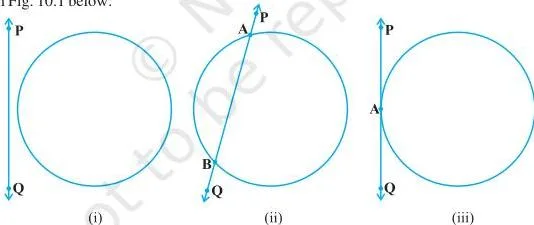
The tangent is the limiting case of the secant: as the two intersection points of a line slide together, the secant becomes a tangent. At any point of a circle there is exactly one tangent, and no more than two tangents can be drawn parallel to a given secant (NCERT, pp. 146–147).
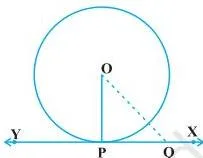
Theorem 10.1. The tangent at any point of a circle is perpendicular to the radius through the point of contact (NCERT, p. 147):
\[ OP \perp XY \]
So at the point of contact, the angle between the radius and the tangent is \( 90^\circ \).
Why it is true (Fig. 10.5): every other point Q of the tangent lies outside the circle, so \( OQ \gt OP \). Since OP is the shortest distance from O to the line XY, it is the perpendicular to XY.
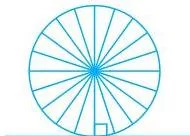
You see the same property in the wheel of Fig. 10.4: the ground acts as a tangent, and the radius through the point of contact stands at right angles to it.
Number of Tangents from a Point (Section 10.3)
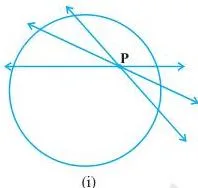
Where the point lies decides how many tangents pass through it (NCERT, p. 148), as Fig. 10.6 shows:
- point inside the circle — no tangent;
- point on the circle — one tangent;
- point outside the circle — exactly two tangents.
Theorem 10.2. The lengths of tangents drawn from an external point to a circle are equal (NCERT, p. 149):
\[ PQ = PR \]
Why it holds: the radii \( OQ \) and \( OR \) are equal, \( OP \) is common, and the angles at Q and R are right angles by Theorem 10.1, so the right triangles are congruent by RHS (NCERT, p. 149).
A one-line alternative uses Pythagoras: \( PQ^2 = OP^2 – OQ^2 = OP^2 – OR^2 = PR^2 \), which again gives \( PQ = PR \).
Tangent length from Pythagoras. In the same right triangle, the length of a tangent from an external point is (NCERT, p. 149):
\[ PQ = \sqrt{OP^2 – OQ^2} \]
Here \( OQ \) is the radius to the point of contact, so \( OP \gt OQ \) whenever the point is outside the circle.
Angle bisector property. The centre lies on the bisector of the angle between the two tangents (NCERT, p. 149):
\[ \angle OPQ = \angle OPR \]
Angle Relations Between Two Tangents
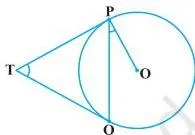
In the standard figure with external point T and tangents TP, TQ touching at P and Q (Fig. 10.9), triangle TPQ is isosceles because \( TP = TQ \). The chapter gives two angle results (NCERT, p. 150):
\[ \angle PTQ = 2\angle OPQ \]
\[ \angle TPQ = \angle TQP = 90^\circ – \frac{1}{2}\angle PTQ \]
and, from Exercise 10.2 Q10 (NCERT, p. 152), the angle between the two tangents is supplementary to the angle subtended at the centre by the chord joining the points of contact:
\[ \angle PTQ + \angle POQ = 180^\circ \]
Tangents in Circumscribed Figures
Concentric circles (Example 1, NCERT, p. 150). When a chord AB of the larger circle touches the smaller inner circle at P, the radius OP is perpendicular to the chord, and the perpendicular from the centre bisects the chord:
\[ OP \perp AB \quad \text{and} \quad AP = BP \]
Quadrilateral circumscribing a circle (Exercise 10.2 Q8, NCERT, p. 152). For a quadrilateral ABCD whose four sides all touch one circle:
\[ AB + CD = AD + BC \]
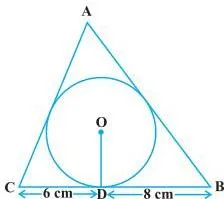
The equality of tangents (Theorem 10.2) works at every vertex of a circumscribed figure: the two tangent segments drawn from any one vertex are equal. Fig. 10.14 shows a triangle circumscribing a circle, the figure used in Exercise 10.2 Q12.
What Each Symbol Means
| Symbol | What it means | Unit / nature |
|---|---|---|
| \( O \) | centre of the circle | point (no unit) |
| \( r \), \( OQ \), \( OR \) | radius of the circle (radii drawn to points of contact) | length (cm) |
| \( XY \) | a tangent line to the circle | line (no unit) |
| \( P \) (in Theorem 10.1) | point of contact of the tangent on the circle | point (no unit) |
| \( P, T \) (external point) | point outside the circle from which tangents are drawn | point (no unit) |
| \( Q, R \) | points of contact of the tangents from the external point | point (no unit) |
| \( PQ, PR \) | lengths of the tangent segments from the external point to the circle | length (cm) |
| \( OP, OT \) | distance of the external point from the centre | length (cm) |
| \( \angle PTQ \) | angle between the two tangents from the external point | angle (degrees) |
| \( \angle POQ \) | angle subtended at the centre by the chord joining the points of contact | angle (degrees) |
| \( \angle OPQ \) | angle between the radius and the tangent segment at a point of contact | angle (degrees) |
| \( AB, BC, CD, AD \) | sides of a quadrilateral circumscribing the circle | length (cm) |
| \( AP, BP \) | two parts into which the perpendicular from the centre divides a chord | length (cm) |
NCERT reuses the letters P, Q, R in different figures. Before substituting, check which point is the centre, which lies on the circle, and which lies outside it.
When to Use Each Formula
| Result | Reach for it when | Condition |
|---|---|---|
| \( OP \perp XY \) | you have a tangent and need a right angle, for Pythagoras or triangle congruence | the perpendicular is at the point of contact only |
| \( PQ = \sqrt{OP^2 – OQ^2} \) | you know the distance of the external point from the centre and the radius | point outside the circle: \( OP \gt OQ \) |
| \( PQ = PR \) | two tangents come from the same external point, or you label equal segments in a circumscribed figure | both segments start at the same external point |
| \( \angle OPQ = \angle OPR \) | you need to split the angle between two tangents, or prove the centre is on its bisector | both tangents from the same external point |
| \( \angle PTQ = 2\angle OPQ \) | the angle between the tangents is wanted and you know the angle between the radius and a tangent segment | tangents at the ends of one chord (Example 2 set-up) |
| \( \angle PTQ + \angle POQ = 180^\circ \) | you need the quickest link between the tangents’ angle and the central angle | tangents drawn at the ends of the chord PQ |
| \( \angle TPQ = \angle TQP = 90^\circ – \frac{1}{2}\angle PTQ \) | you are finding the base angles of the isosceles triangle TPQ | \( TP = TQ \) by Theorem 10.2 |
| \( OP \perp AB \Rightarrow AP = BP \) | a chord of one circle touches an inner concentric circle | the chord is tangent to the inner circle |
| \( AB + CD = AD + BC \) | a quadrilateral is drawn around a circle so all four sides touch it | every side of the quadrilateral is tangent to the circle |
Need another chapter? The full Class 10 Maths formulas list is one click away.
Worked Examples
Example 1: Tangent length from an external point
Given: A point P is 13 cm from the centre O of a circle of radius 5 cm.
A tangent from P touches the circle at Q.
Find PQ.
Formula selected: By Theorem 10.1, \( OQ \perp PQ \), so triangle OPQ is right-angled with hypotenuse OP.
Use the derived Pythagoras form \( PQ = \sqrt{OP^2 – OQ^2} \).
\[ PQ = \sqrt{13^2 – 5^2} = \sqrt{169 – 25} = \sqrt{144} = 12 \]
Final answer: The tangent length \( PQ \) is 12 cm.
Example 2: Finding the distance of the external point
Given: The tangent from a point A to a circle of radius 8 cm is 15 cm long.
Find the distance of A from the centre O.
Formula selected: The radius to the point of contact is perpendicular to the tangent, so in the right triangle, OA is the hypotenuse: \( OA = \sqrt{15^2 + 8^2} \).
\[ OA = \sqrt{225 + 64} = \sqrt{289} = 17 \]
Final answer: The point A is 17 cm from the centre.
Example 3: Angle between two tangents
Given: Two tangents TP and TQ are drawn to a circle with centre O, and the chord of contact PQ subtends \( 120^\circ \) at the centre.
Find the angle between the tangents.
Formula selected: The angle between the tangents is supplementary to the angle at the centre: \( \angle PTQ = 180^\circ – \angle POQ \).
\[ \angle PTQ = 180^\circ – 120^\circ = 60^\circ \]
Check: In isosceles triangle TPQ, \( \angle TPQ = 90^\circ – \frac{1}{2}\angle PTQ = 60^\circ \), and \( \angle PTQ = 2\angle OPQ \) gives \( \angle OPQ = 30^\circ \), consistent with the right triangle at P.
Final answer: The angle between the tangents is \( 60^\circ \).
For step-by-step working of every textbook question, see the NCERT solutions for Class 10 Maths Chapter 10 Circles.
Common Mistakes to Avoid
| Mistake | Correct rule | How to check your answer |
|---|---|---|
| Writing the Pythagoras relation as \( PQ^2 = OP^2 + OQ^2 \), treating the tangent as the hypotenuse. | The right angle is at the point of contact Q, so the hypotenuse is OP (centre to external point). Use \( PQ^2 = OP^2 – OQ^2 \). | A tangent length is always smaller than the distance of the external point from the centre (so \( 12 \lt 13 \), never the reverse). |
| Applying the \( 90^\circ \) property with any radius. | Theorem 10.1 holds only for the radius drawn through the point of contact. | Locate the point of contact first; the right angle sits there, not at the centre. |
| Treating the angle between the tangents as equal to the angle at the centre. | The two angles are supplementary: \( \angle PTQ + \angle POQ = 180^\circ \). | Add the two angles; the sum must be \( 180^\circ \) (e.g. \( 110^\circ + 70^\circ \)). |
| Quoting \( PQ = PR \) for tangents drawn from two different points. | Equal tangent lengths hold only for tangents from the same external point. | Trace both tangent segments back; they must meet at one point. |
Frequently Asked Questions
How many tangents can a circle have?
Infinitely many. A tangent can be drawn at every point of the circle, and at any one point there is one and only one tangent (NCERT, p. 147). This is the answer to Exercise 10.1 Q1.
Why is a tangent perpendicular to the radius at the point of contact?
If a point Q on the tangent other than the point of contact P were inside the circle, the line would meet the circle twice and be a secant. So every point Q on the tangent gives \( OQ \gt OP \), making P the closest point of the line to the centre.
The shortest distance from a point to a line is along the perpendicular, so \( OP \perp XY \) (Theorem 10.1, NCERT, p. 147).
Are the two tangents from an external point always equal in length?
Yes. The radii to the points of contact are equal, the hypotenuse OP is common, and both triangles are right-angled by Theorem 10.1, so the triangles are congruent by RHS. Hence \( PQ = PR \) (Theorem 10.2, NCERT, p. 149).
If the chord of contact subtends 100° at the centre, what is the angle between the tangents?
80°. The two angles are supplementary, so the angle between the tangents is \( 180^\circ – 100^\circ = 80^\circ \).
Every subject’s formula sheets are organised in the maths formulas index.
Reference: NCERT Class 10 Mathematics textbook (Rationalised NCERT), chapter 10 Circles. Verify the chapter in the official textbook at ncert.nic.in.
Explore Class 10 Maths Formulas
More for this chapter:
Class 10 Maths on LearnCBSE:
Related chapters: