
Kinship, Caste and Class is Chapter 3 of Themes in Indian History Part I, the first NCERT History book for Class 12. It runs from page 52 to page 81 of the printed textbook — roughly 30 pages — and studies early Indian society between about 600 BCE and 600 CE through the Mahabharata, inscriptions and other texts.
The official NCERT PDF is right here, and the guide below it walks through what the chapter contains, section by section.
Download the official NCERT PDF for Kinship, Caste and Class Class 12
Open the Kinship, Caste and Class Class 12 NCERT chapter PDF to read or download the official chapter file published by NCERT on ncert.nic.in — it matches the printed chapter exactly, figures and timelines included. This is the official edition of the NCERT Themes in Indian History Part I textbook.
You can also browse the NCERT textbook page for Themes in Indian History Part I, which lists every chapter of the book.
| What the chapter holds | Count | Where it is used |
|---|---|---|
| Printed pages | 30 | |
| Sections in the chapter | 15 | |
| Figures with NCERT captions | 10 | |
| Tables | 2 | |
| Official NCERT PDF | Download the chapter PDF | the chapter exactly as NCERT publishes it |
Kinship, Caste and Class at a glance
This is a text-heavy history chapter rather than a visual one: it is built from long excerpts — a Rigveda marriage mantra, the Manusmriti’s marriage rules, Satavahana inscriptions, parts of the Mahabharata, a Pali Jataka, a Buddhist dialogue and a Tamil Sangam poem.
The chapter closes with two timelines of textual traditions and several exercise groups, from short answers to essays, map work and a project.
Use the counts table on this page to see at a glance exactly how many sections, figures and exercise groups the chapter holds.
What this chapter covers: seven movements from the Mahabharata to social history
The chapter is organised as a sequence of movements that carry the reader from the epic’s text to the society behind it. It is not a retelling of the Mahabharata story — it is about how historians reconstruct social history from texts. The table below maps each section to the pages where it appears.
| Chapter section | What it does | NCERT pages |
|---|---|---|
| Opening and the Critical Edition of the Mahabharata | Explains how scholars reconstructed the most reliable version of the epic from Sanskrit manuscripts found across the subcontinent | pp. 53–54 |
| Kinship and marriage | Families (kula, jnati, vamsha), patriliny, rules of marriage, gotra — and inscriptional evidence that practice differed from the codes | pp. 55–60 |
| Within and beyond the framework of caste | Varna occupations, non-Kshatriya kings, jatis and guilds, and groups placed outside the four varnas | pp. 61–67 |
| Resources and status | How gender and varna controlled access to property, with Buddhist and Tamil alternatives | pp. 68–71 |
| A social contract | The Buddhist myth of the great elect, making kingship a human choice | p. 72 |
| Historians and the Mahabharata | Language, narrative versus didactic content, authors and dates, and the archaeology of Hastinapura | pp. 72–76 |
| A dynamic text | How retellings kept reshaping the epic, ending with Mahashweta Devi’s Kunti O Nishadi | pp. 77–79 |
| Timelines and exercises | Two timelines of textual traditions and the chapter’s exercise groups | pp. 79–81 |
Key concepts in Kinship, Caste and Class explained
The chapter studies early Indian society between roughly 600 BCE and 600 CE using the Mahabharata alongside law books, Buddhist texts, Tamil poems and inscriptions. Six ideas carry the whole argument — fix these first and the rest of the chapter follows.
- Patriliny and family — descent traced from father to son; sons could claim their father’s resources, including the throne, so the family line controlled wealth and power (NCERT, p. 55).
- Gotra and marriage rules — gotras were named after Vedic seers; women were expected to adopt the husband’s gotra and same-gotra marriage was banned, a rule the Satavahanas did not always follow (NCERT, p. 58).
- Varna and occupation — four categories with prescribed duties, presented as divinely created in the Purusha sukta (NCERT, p. 61).
- Jati and social mobility — birth-based groups with no fixed number, used to absorb new or occupational groups; jatis could organise into guilds or shrenis (NCERT, p. 63).
- Gendered access to property — sons inherited; women could not claim a share but could keep stridhana, gifts received at marriage (NCERT, p. 68).
- The Buddhist social contract — kingship as a human choice and taxes as payment for services, in place of a divine order (NCERT, p. 72).
The Critical Edition of the Mahabharata: why a chapter on society starts here
The chapter opens with scholarship, not story, because historians must decide which version of the Mahabharata they are reading before they can use it as evidence about society. The answer came from the Critical Edition, one of the largest textual projects ever undertaken in India.
- It began in 1919 under the Sanskritist V.S. Sukthankar, with a team of dozens of scholars.
- The team collected Sanskrit manuscripts in many scripts — from Kashmir and Nepal in the north to Kerala and Tamil Nadu in the south.
- They compared the verses, kept those common to most versions, and published the result in volumes running to over 13,000 pages. The project took 47 years to complete.
- More than half of those pages record regional variations in footnotes and appendices.
Two conclusions followed. First, a common core of the story existed across the subcontinent. Second, the text had absorbed enormous local variation — evidence of what the chapter calls a dialogue between dominant traditions and resilient local ideas, marked by conflict as well as consensus (NCERT, p. 54).
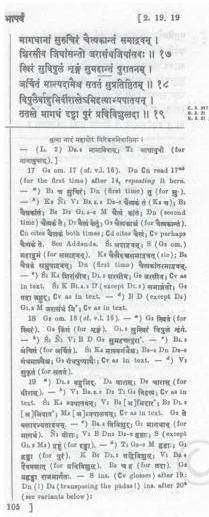
The page above shows the method on paper: the selected main text in bold, the variants catalogued beneath it. The Critical Edition also grounds the chapter’s caution about sources — nineteenth- and twentieth-century historians tended to take normative Sanskrit texts at face value, believing everything laid down was practised.
Later study of works in Pali, Prakrit and Tamil showed that Brahmanical norms were recognised as authoritative but also questioned, and occasionally rejected (NCERT, p. 54).
Kinship and marriage: patriliny, gotra and the rules of marriage
This is the family half of the chapter: how households were organised, why sons mattered, and how marriage was regulated. Sanskrit texts use kula for the family, jnati for the wider network of kinfolk, and vamsha for lineage (NCERT, p. 55).
Patriliny — tracing descent from father to son — was the ideal for elite families. Sons could claim the resources of their dead fathers, including the throne in royal families, and the Mahabharata‘s central story ends by proclaiming patrilineal succession after the war.
A Rigveda marriage mantra from about 1000 BCE chants the wish that the bride will bear ‘fine sons’, showing the same concern among ritual specialists and wealthy high-status families (NCERT, p. 56).
Daughters had no claim to household resources, and marrying them outside the kin group — exogamy — was considered desirable, so much so that the gift of a daughter (kanyadana) became an important religious duty of the father.
As towns grew and social life became more complex, Brahmanas responded by laying down detailed codes of behaviour, compiled in Sanskrit texts from about 500 BCE.
The most important of these, the Manusmriti (c. 200 BCE–200 CE), recognised as many as eight forms of marriage: the first four were considered ‘good’ and the remaining four condemned — the condemned forms were possibly practised by people who did not accept Brahmanical norms (NCERT, p. 58).
- Endogamy — marriage within a unit: a kin group, caste or locality.
- Exogamy — marriage outside that unit.
- Polygyny — a man having several wives.
- Polyandry — a woman having several husbands (NCERT, p. 57).
Gotra rules (evident from about 1000 BCE) divided people, especially Brahmanas, into groups named after Vedic seers. Women were expected to give up the father’s gotra and adopt the husband’s, and members of the same gotra could not marry (NCERT, p. 58).
The Satavahanas, who ruled parts of western India and the Deccan (c. second century BCE–second century CE), give historians a way to test these rules: their inscriptions name rulers such as raja Gotami-puta Siri-Satakani and raja Vasithi-puta Siri-Pulumayi, where -puta is a Prakrit word meaning ‘son’.
The list of seven rulers includes three Gotami-putas and two Vasithi/Vasathi-putas (NCERT, p. 59). Women who married Satavahana rulers kept names derived from their own fathers’ gotras, and some were of the same gotra as one another — direct evidence of endogamy, marriage within the kin group, against the Brahmanical ideal of exogamy.
The chapter’s conclusion is worth keeping: real social relations were more complicated than the codes claim (NCERT, p. 60).
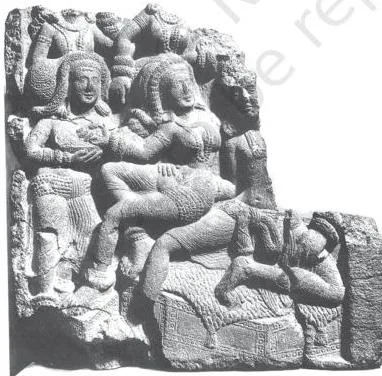
The relief above comes from the wall of a cave donated to Buddhist monks — a reminder that the dynasty that claimed Brahmana status also left its mark in Buddhist spaces, and that sculpture is itself a source for how rulers wanted to be seen (NCERT, p. 59).
Were mothers important? Metronymics and what they do not prove
Names such as Gotami-puta look like evidence that mothers mattered a great deal — and the chapter takes the question seriously before answering it carefully. Metronymics are names derived from the mother’s name: Gotami-puta means ‘son of Gotami’. Gotami and Vasithi are feminine forms of the Vedic seers Gotama and Vasistha, after whom gotras were named (NCERT, p. 59).
Metronymics were not unusual: the Brihadaranyaka Upanishad, one of the earliest Upanishads, lists successive generations of teachers and students, many designated by metronymics (NCERT, p. 60). Yet the chapter’s caution is direct — metronymics do not prove matriliny, because in the case of the Satavahanas succession to the throne was generally patrilineal (NCERT, p. 60).
Within the epic itself, mothers appear as moral voices: Gandhari’s last appeal to Duryodhana warns him against war in the name of dharma and artha. The chapter treats such passages as representations of how mothers were viewed in early Indian societies, not as literal reports (NCERT, p. 60).
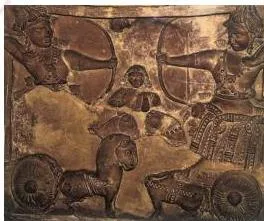
The terracotta above shows the epic moving from courts into temple art by the fifth century CE. The chapter places it here as a visual reminder that the Mahabharata was being reshaped in new settings while the kinship rules it debated were still being worked out (NCERT, p. 60).
Caste and society: varna, jati and people outside the system
The caste half of the chapter sets the Brahmanical ideal against a wide range of evidence.
The Dharmasutras assigned each varna an occupation: Brahmanas were to study and teach the Vedas, perform sacrifices and give and receive gifts; Kshatriyas were to wage war, protect people and administer justice; Vaishyas those duties plus agriculture, pastoralism and trade; Shudras only the service of the three higher varnas (NCERT, p. 61).
Brahmanas presented this as a divine order, citing the Purusha sukta of the Rigveda, in which the four varnas are born from the mouth, arms, thighs and feet of the primeval man (NCERT, p. 61). They reinforced the claim in three ways — asserting divine origin, advising kings to enforce the norms, and persuading people that status was fixed by birth.
When persuasion was not enough, stories did the work. The Ekalavya story is the chapter’s clearest example: Drona, a Brahmana, refuses to teach the forest-dwelling nishada Ekalavya, who then practises before a clay image of his teacher and finally cuts off his thumb as the teacher’s fee, so that Arjuna remains unrivalled.
Read as a composed message, the story tells nishadas their place and reminds Kshatriyas of Brahmana authority (NCERT, p. 62).
Political reality was more varied. The social background of the Mauryas was hotly debated — Buddhist texts said they were Kshatriyas, Brahmanical texts described them as of ‘low’ origin. The Shungas and Kanvas, their immediate successors, were Brahmanas.
The Shakas, who came from Central Asia, were called mlechchhas (outsiders), yet Rudradaman, the best-known Shaka ruler, rebuilt the Sudarshana lake and left one of the earliest inscriptions in Sanskrit. The Satavahanas claimed to be Brahmanas and destroyers of Kshatriya pride, and claimed to prevent intermarriage among the four varnas — while entering a marriage alliance with Rudradaman’s kin (NCERT, pp. 62–63).
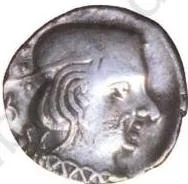
The silver coin above is part of the Shaka rulers’ own record — a reminder that a dynasty the Brahmanical texts classed as outsiders actually held and advertised political power (NCERT, p. 63).
The term jati covered groups that did not fit neatly into four varnas: it was birth-based but unlimited in number, absorbing forest-dwellers such as the nishadas and occupational groups like the suvarnakara (goldsmith). Jatis sharing a craft sometimes organised into shrenis (guilds).
The Mandasor inscription (c. fifth century CE) records silk weavers who migrated from Lata in Gujarat to Dashapura (Mandasor) and collectively invested their wealth in a sun temple — evidence that a guild could be a community, not just a workshop, and that members took up other occupations alongside weaving (NCERT, pp. 63–64).
Likewise the merchant Charudatta in the play Mrichchhakatika is both a Brahmana and a sarthavaha, and a fifth-century inscription names two donors as kshatriya-vaniks: real occupations crossed the neat Shastra boundaries (NCERT, p. 64).
At the edges of the order stood groups classed as outside — nishadas, mlechchhas, and the chandalas placed at the very bottom for performing tasks connected with death, regarded as ‘polluting’.
The Manusmriti prescribed that chandalas live outside the village, use discarded utensils, wear clothes of the dead and ornaments of iron, and not walk about in villages and cities at night. The Chinese pilgrims Fa Xian (c. fifth century CE) and Xuan Zang (c. seventh century CE) report the same exclusion (NCERT, p. 66).
The chapter adds a non-Brahmanical voice: in the Matanga Jataka, a Pali text, the Bodhisattva is born a chandala, and when his own son refuses him alms, he answers that those proud of their birth and ignorant do not deserve gifts — the worthy are those free from vices (NCERT, p. 67).
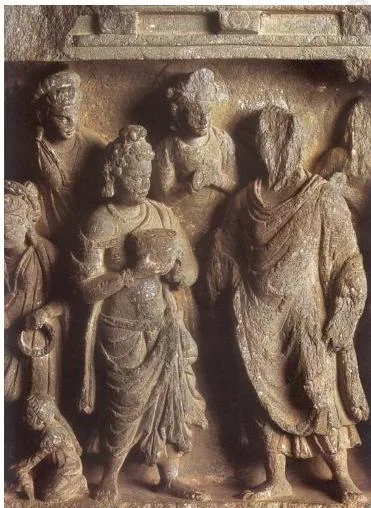
The Gandhara sculpture above sits at the point in the chapter where it discusses social roles and traditions beyond the Brahmanical frame. Read it as an image of a renunciant’s role — the chapter does not claim a direct link to the chandalas (NCERT, p. 66).
Resources and status: property, gender and wealth
This listing is maintained for the 2026-27 academic session using the NCERT textbook information available to us. NCERT remains the authority for confirming the latest edition.
This section asks how access to property shaped social rank, and how gender and varna controlled that access. The chapter’s way in is the dice-game episode: Yudhishthira staked and lost his gold, his kingdom, the property of his subjects, his brothers, himself, and finally their common wife Draupadi.
Two opinions were argued — that a wife remained under her husband’s control even after he had lost himself, so she could be staked; and that an unfree man could not stake another person. The question stayed unresolved until Dhritarashtra restored their freedom — an episode that suggests wives could be treated as the property of their husbands (NCERT, p. 68).
The law books drew the same lines. Under the Manusmriti, the paternal estate was divided equally among sons after the death of the parents, with a special share for the eldest; women could not claim a share of these resources.
What women could keep was stridhana — literally ‘a woman’s wealth’, the gifts received on the occasion of marriage — which their children could inherit and on which the husband had no claim. The same text warned women against hoarding family property, or even their own valuables, without the husband’s permission (NCERT, p. 68).
The Manusmriti also listed how wealth could be acquired — and the lists are gendered (NCERT, p. 69):
| Men — seven means of acquiring wealth | Women — six means of acquiring wealth |
|---|---|
| Inheritance, finding, purchase, conquest, investment, work, and acceptance of gifts from good people. | What was given in front of the fire (at marriage) or the bridal procession, a token of affection, what she got from her brother, mother or father, any subsequent gift, and whatever her ‘affectionate’ husband gave her. |
Varna regulated access to wealth too, since the Shudra’s only prescribed occupation was service. The wealthy Shudra dialogue from the Majjhima Nikaya (a Pali Buddhist text) pushes back: if a Shudra had wealth, Kachchana asks, could he not command servants of any varna?
The king concedes that on this count the four varnas are ‘exactly the same’ — wealth, not birth, explains social standing (NCERT, p. 70).
The Tamil world offered yet another value scale: in the Puranaruru, a bard praises a chief who has little wealth but never refuses to share, and who is expected to have a spear forged so he can keep giving — chiefs were respected for generosity, not accumulation (NCERT, p. 71).
A social contract: the Buddhist alternative to the varna order
Buddhists did not stop at questioning varna; they built an alternative account of where social order comes from. A myth in the Sutta Pitaka describes human beings living in an idyllic state, then growing greedy, vindictive and deceitful.
To regulate themselves, they choose one person — mahasammata, ‘the great elect’ — who will be wrathful when indignation is right, censure what should be censured and banish who deserves banishment, and they give him a proportion of the rice in return (NCERT, p. 72).
The implications matter more than the myth: kingship rests on human choice, taxes are payment for services rendered, and because people created the arrangement, people could change it. Against the Purusha sukta’s divine, fixed, birth-based order, this is a fully human one (NCERT, p. 72).
The chapter draws on three source traditions, and each argues for its own social world. Keeping the perspective in mind changes how you read the evidence:
| Source tradition | Texts used in this chapter | What it does to the evidence |
|---|---|---|
| Brahmanical | Dharmasutras, Manusmriti, Purusha sukta, parts of the Mahabharata | Prescribes norms; presents the varna order as divine and fixed by birth — best read as an ideal, not a description of practice |
| Buddhist | Matanga Jataka, Majjhima Nikaya, Sutta Pitaka | Critiques birth-based status; values conduct and wealth over birth; offers a human-created social contract |
| Tamil | Puranaruru (Sangam poems) | Values generosity over accumulation; shows chiefdoms where sharing marked high status |
Historians and the Mahabharata: language, dates, archaeology and a dynamic text
The chapter’s method section asks how historians decide what the Mahabharata can and cannot prove.
They consider the language (Prakrit, Pali and Tamil were probably used by ordinary people; Sanskrit was meant almost exclusively for priests and elites), the kind of text (a mantra chanted by ritual specialists versus a story anyone could hear and retell), the author, the intended audience, and the date and place of composition (NCERT, pp. 72–73).
On language: the epic’s Sanskrit is far simpler than that of the Vedas or the prashastis, so it was probably widely understood. Historians divide the contents into narrative (sections containing stories) and didactic (sections containing prescriptions about social norms) — a division that is not watertight, but generally the didactic portions were added later (NCERT, p. 73).
The most important didactic section is the Bhagavad Gita.
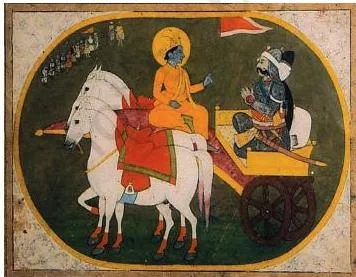
This scene, the chapter observes, is frequently depicted in painting and sculpture — evidence of how persistently the epic’s instructional layer was reproduced (NCERT, p. 73).
The text is described as an itihasa, literally ‘thus it was’, which is why it is usually translated as ‘history’. Whether a real war lies behind it is unsettled: some historians see the memory of an actual conflict among kinfolk preserved in the narrative; others point out that there is no other corroborative evidence of the battle (NCERT, p. 73).
On authorship, the chapter gives a distinct history. The original story was probably composed by sutas, charioteer-bards who accompanied Kshatriya warriors and composed poems celebrating their victories, and the compositions circulated orally. From about the fifth century BCE, Brahmanas took over the story and began committing it to writing, as the Kuru-Panchala chiefdoms became kingdoms. Two further phases followed: c.
200 BCE–200 CE, when the worship of Vishnu was growing and Krishna came to be identified with Vishnu; and c. 200–400 CE, when large didactic sections resembling the Manusmriti were added. What began as a text of perhaps fewer than 10,000 verses grew to about 100,000 — a growth traditionally attributed to the sage Vyasa (NCERT, p. 74).
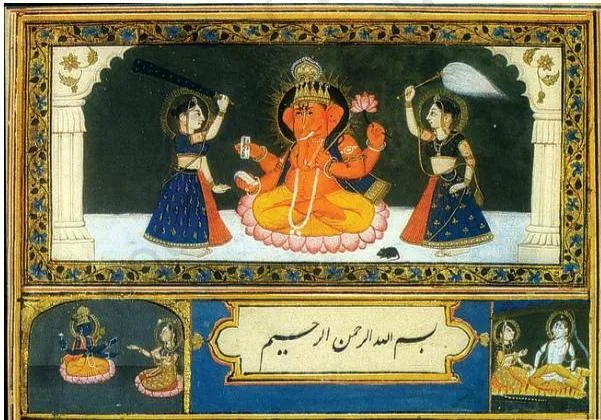
The illustration above captures the traditional picture of single authorship — Vyasa dictating, Ganesha writing — which the composition history complicates. Its date also shows the epic’s later circulation in Persian translation (NCERT, p. 74).
Convergence with archaeology: in 1951–52 the archaeologist B.B. Lal excavated at Hastinapura in Meerut district, in the Upper Ganga doab where the Kuru kingdom lay. He found evidence of five occupational levels.
In the second phase (c. twelfth–seventh centuries BCE) houses were of mud and mud-brick, some with reed walls plastered over with mud; in the third phase (c. sixth–third centuries BCE) houses were of mud-brick and burnt brick, with soakage jars, brick drains and terracotta ring-wells (NCERT, p. 75).
The epic describes a city ‘bursting like the ocean, packed with hundreds of mansions’ — a grandeur the excavation does not match, so the description may have been added later when cities actually flourished, or may be a flight of poetic fancy that archaeology cannot verify (NCERT, p. 76).
Draupadi’s polyandrous marriage is the chapter’s test case for reading narrative. The epic offers three explanations for it: Kunti’s command to share whatever the brothers had brought, the claim that the Pandavas were incarnations of Indra whose wife had been reborn as Draupadi, and the story of a woman who prayed to Shiva five times.
Three explanations for one episode suggest the authors felt the practice needed defending — polyandry gradually fell into disfavour among the Brahmanas who reworked the text, even though it remained prevalent in the Himalayan region and may have existed among ruling elites (NCERT, pp. 76–77).
The chapter’s final caution applies to the whole epic: creative literature often has its own narrative requirements and does not always literally reflect social realities (NCERT, p. 77).
A dynamic text. The epic kept growing in other languages and media, and regional stories entered it.
Mahashweta Devi’s short story ‘Kunti O Nishadi’ retells the house-of-lac episode from the nishada woman’s side: the nishadi confronts Kunti about the six innocent lives lost in the fire that saved the Pandavas — a retelling that draws attention to exactly what the Sanskrit text stays silent on (NCERT, pp. 78–79).
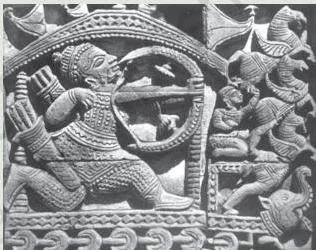
The terracotta above, made in West Bengal in the seventeenth century, is an image of that dynamism: the Mahabharata shaped in clay by Bengali artists more than a millennium after the Sanskrit text took its present form (NCERT, p. 53).
Figures in the chapter and what they show
The figures in this chapter are evidence, not decoration — each one supports a specific claim, and each appears above in the section where it does that work. The table below consolidates them so you can revise the visual evidence at a glance.
| Figure | What it shows | What it evidences | NCERT page |
|---|---|---|---|
| Fig. 3.1 | Terracotta scene, West Bengal, c. seventeenth century | The epic travelled far beyond Sanskrit-speaking elites | p. 53 |
| Fig. 3.2 | Critical Edition page: bold main text with variant readings | How the text was reconstructed from thousands of manuscripts | p. 54 |
| Fig. 3.3 | Satavahana ruler and his wife, cave sculpture, c. second century BCE | A rare sculptural record of a ruler; Buddhist patronage | p. 59 |
| Battle scene | Terracotta from a temple at Ahichchhatra, c. fifth century CE | The epic in temple art; one of the earliest sculptural depictions | p. 60 |
| Shaka coin | Silver coin of a Shaka ruler | Rulers classed as mlechchhas held and advertised political power | p. 63 |
| Fig. 3.6 | Gandhara mendicant seeking alms, c. third century CE | A renunciant social role in traditions beyond the Brahmanical frame | p. 66 |
| Krishna and Arjuna | Eighteenth-century painting of the Gita | The Gita as the epic’s central didactic section | p. 73 |
| Fig. 3.9 | Ganesha the scribe, Persian translation, c. 1740–50 | The Vyasa tradition and the epic’s later circulation | p. 74 |
Read as a set, the images tell the chapter’s story: a text that began among warriors and bards (the Ahichchhatra battle scene), was stabilised by scholarship (the Critical Edition page), was carved into cave temples (the Satavahana relief), depicted mendicants in Gandhara, was painted in later courts (Krishna and Arjuna, Ganesha the scribe), and was remade in Bengal in the seventeenth century.
Each figure is a station in the epic’s journey through Indian society.
Definitions and terms used in the chapter
Keep this glossary open while you read, and the technical terms will stop tripping you up.
| Term | Plain meaning | NCERT page |
|---|---|---|
| kula | The family, in Sanskrit texts | p. 55 |
| jnati | The larger network of kinfolk around a family | p. 55 |
| vamsha | Lineage — a line of descent | p. 55 |
| patriliny | Tracing descent from father to son, grandson and so on | p. 55 |
| matriliny | Tracing descent through the mother | p. 55 |
| endogamy | Marriage within a unit — a kin group, caste or locality | p. 57 |
| exogamy | Marriage outside that unit | p. 57 |
| polygyny | A man having several wives | p. 57 |
| polyandry | A woman having several husbands | p. 57 |
| gotra | A group named after a Vedic seer; members of one gotra were held to be his descendants and could not marry each other | p. 58 |
| metronymic | A name derived from the mother’s name, such as Gotami-puta | p. 60 |
| varna | The four-category Brahmanical social order: Brahmana, Kshatriya, Vaishya, Shudra | p. 61 |
| jati | A birth-based social group; unlimited in number, unlike the four varnas | p. 63 |
| shreni | A guild — jatis sharing an occupation organised into one | p. 63 |
| nishada | A forest-dwelling hunting community, placed outside the varna order in Brahmanical texts | p. 62 |
| mlechchha | The Brahmanical label for outsiders, including non-Sanskrit speakers and the Shakas | p. 62 |
| chandala | A category at the very bottom of the social order, classed as ‘untouchable’ for performing polluting tasks connected with death | p. 66 |
| stridhana | Literally ‘a woman’s wealth’; the gifts a woman received at marriage, on which her husband had no claim | p. 68 |
| mahasammata | ‘The great elect’ — the ruler chosen by the people in the Buddhist myth of the social contract | p. 72 |
| narrative | The story sections of the Mahabharata | p. 73 |
| didactic | Sections meant for instruction — prescriptions of social norms | p. 73 |
Common mistakes students make in this chapter
The chapter itself warns against each of these — read the corrections before the errors cost you marks.
| Mistake | Correct rule | How to check your answer |
|---|---|---|
| Reading Dharmashastra rules as descriptions of real practice | The law books are normative — they prescribe an ideal, and the chapter repeatedly shows practice differed, from gotra rules to marriage forms | Compare the prescription with inscriptional evidence, e.g., Satavahana women keeping their father’s gotra and marrying within it |
| Taking metronymics as proof of matriliny | A name like Gotami-puta only names the mother; Satavahana succession to the throne was generally patrilineal | Ask who inherited the throne, not who the ruler was named after |
| Assuming every king was a Kshatriya | Political power was open to whoever could command support — the Mauryas were disputed, the Shungas and Kanvas were Brahmanas, the Shakas were mlechchhas, the Satavahanas claimed Brahmana status | For each dynasty, ask what its own inscriptions and its rivals’ texts claim |
| Treating all eight forms of marriage as equally approved | Only the first four were considered ‘good’; the remaining four were condemned | Re-read the Manusmriti list and note which forms it accepts |
| Treating the Mahabharata as the work of one author | Composition spanned phases from c. 500 BCE to c. 400 CE — sutas composed, Brahmanas wrote and expanded, didactic layers were added later | Look for multiple explanations of one episode, e.g., Draupadi’s marriage |
| Reading the Ekalavya, Hidimba or Matanga stories as literal history | They are composed messages that reinforce or question norms — the chapter reads them for their message, not their facts | Ask: what message was this story meant to convey, and to whom? |
Exam notes for this chapter
What the end of the chapter actually asks you to do, and how to answer it well. The chapter closes with short-answer questions to be answered in 100–150 words, essay questions of about 500 words, a map exercise and a project (NCERT, pp. 80–81).
The short answers test patriliny among elite families, whether kings in early states were invariably Kshatriyas, a three-way comparison of the Drona, Hidimba and Matanga stories, the Buddhist social contract against the Purusha sukta, and the criteria in Yudhishthira’s list of greetings.
The essays take up the Winternitz quotation, single authorship, gender differences in early societies, and the evidence that Brahmanical prescriptions about kinship and marriage were not universally followed.
Use a source-based method for this chapter. For every question built on a quoted source — Yudhishthira’s greetings, the Manusmriti excerpts, the Jataka — a full answer identifies the source, names its perspective (Brahmanical, Buddhist, or royal), states what it prescribes or claims, and says what it cannot prove. That one shape works for most questions in this chapter.
Model outline for the Drona–Hidimba–Matanga essay:
- Open with what the three stories share: all three place people outside the Brahmanical order — a nishada, a rakshasa woman, a chandala — and each defines dharma from outside it.
- Drona: the Brahmana teacher enforces the caste line, refusing the nishada pupil and later taking his thumb; the story teaches forest communities their place and Kshatriyas that Brahmana authority rules.
- Hidimba: a rakshasa woman who breaks every marriage norm is accepted into the royal family, and her son Ghatotkacha serves the Pandavas — the term rakshasa, historians suggest, marked people whose practices differed from Brahmanical norms, yet integration was possible.
- Matanga: the Bodhisattva as a chandala whose own son refuses him alms; the story’s answer — worth comes from conduct, not birth — directly inverts the Drona logic.
Close by noting that the contrast shows the epic carrying both the norm and its critique — which is why the chapter reads it as dialogue, not doctrine.
Could the Mahabharata have had a single author? The chapter’s evidence points away. The sutas composed the original story orally; Brahmanas began committing it to writing from about 500 BCE; a further phase ran c. 200 BCE–200 CE; and large didactic sections resembling the Manusmriti were added between c. 200 and 400 CE.
The text grew from fewer than 10,000 verses to about 100,000, and one episode — Draupadi’s marriage — carries three different explanations. The traditional attribution to Vyasa is best understood as a way of giving a layered text a single author, not as a historical fact (NCERT, p. 74).
Syllabus caution: textbook contents and the examinable syllabus are not always identical — check the current official CBSE syllabus for which parts of this chapter are assessable.
One-page revision summary of Kinship, Caste and Class
The chapter’s claims about early society, with the evidence it uses for each:
- The Critical Edition (begun 1919 under V.S. Sukthankar, completed after 47 years) preserved a common core of the Mahabharata and recorded regional variations in more than half of its 13,000+ pages.
- Patriliny — descent through the male line — was the ideal for elite families: sons could claim a dead father’s resources, including the throne.
- Marriage rules prescribed exogamy and banned same-gotra marriage, but Satavahana inscriptions show endogamy and women keeping their father’s gotra — practice was more complicated than the codes.
- Metronymics such as Gotami-puta do not prove matriliny: Satavahana succession was patrilineal.
- Varna duties were a Brahmanical ideal presented as divine in the Purusha sukta, not a full description of society — the Mauryas, Shungas, Kanvas, Shakas and Satavahanas all complicate the ‘only Kshatriyas rule’ rule.
- Jatis and shrenis allowed mobility and new identities — as with the Mandasor silk weavers who built a sun temple.
- Gender and varna shaped access to property: sons inherited, women kept only stridhana, and the wealthy Shudra dialogue questioned whether birth should decide status at all.
- The Buddhist social contract offered a human-created alternative to the divine varna order: kingship by choice, taxes as payment, and a system humans could change.
- Historians study language, narrative versus didactic content, authors and dates; the epic grew over about 1,000 years from under 10,000 to about 100,000 verses.
- The epic remained dynamic through retellings — in Sanskrit and regional languages, in sculpture and painting, and in modern works such as Mahashweta Devi’s Kunti O Nishadi.
Related chapters and resources
Chapter 2 of this book, Kings, Farmers and Towns, supplies the economic and political background this chapter builds on — towns, trade and the mahajanapadas of the same 600 BCE–600 CE period. The next chapter, Thinkers, Beliefs and Buildings notes, continues the story on the religious side with Buddhism and Sanchi.
For the whole paper, work from the Class 12 History notes hub, where later chapters such as Rebels and the Raj are also covered. The wider revision notes library and the Class 12 notes section carry the other subjects.
For the official files, open the Kinship, Caste and Class Class 12 NCERT chapter PDF linked at the top of this page, or browse the full Themes in Indian History Part I textbook page on ncert.nic.in to reach every chapter of the book.
Reference: NCERT Class 12 History textbook, chapter 3, official edition on ncert.nic.in.
Sources and data verification
This page describes the current NCERT edition: Themes in Indian History Part I, Class 12 History, Chapter 3, ‘Kinship, Caste and Class’, official edition on ncert.nic.in. The page numbers, figure captions and exercise groups quoted above come from that edition of the textbook.
This page covers the Class 12 History Part I chapters only, not Parts II and III, which are separate books. This listing is maintained for the current academic session using the NCERT information available to us. NCERT settles textbooks, editions and PDFs; CBSE settles the curriculum, syllabus and examinations.
A chapter appearing in the textbook does not by itself prove that every part of it is examinable — check the official CBSE syllabus.
Frequently asked questions about Kinship, Caste and Class Class 12
Kinship, Caste and Class Class 12 is in which NCERT book?
It is Chapter 3 of Themes in Indian History Part I — the first of the three NCERT History books for Class 12, covering early Indian history. The chapter runs from page 52 to page 81 of the printed book.
What is the difference between varna and jati in this chapter?
Varna is the Brahmanical scheme of four fixed, divinely-ordained categories (Brahmana, Kshatriya, Vaishya, Shudra), with the number fixed at four. Jati is a birth-based social group whose number was never fixed — Brahmanical authorities classified new or occupational groups, such as the nishadas or goldsmiths, as jatis. Jatis sharing a craft could organise into shrenis or guilds (NCERT, p. 63).
Why are Satavahana kings called Gotami-puta and Vasithi-puta?
Those are metronymics — names derived from the mother’s name. Gotami-puta means ‘son of Gotami’, and Gotami and Vasithi are feminine forms of the Vedic seers Gotama and Vasistha. The names come from the kings’ own inscriptions. They do not prove the Satavahanas were matrilineal: succession to the throne was generally patrilineal (NCERT, pp. 59–60).
Why does the chapter say the Mahabharata is a dynamic text?
Because it never stopped growing. Versions were written in many languages, regional stories entered the epic, and episodes were retold in sculpture, painting and performance. The chapter’s example is Mahashweta Devi’s ‘Kunti O Nishadi’, which retells the house-of-lac episode from the nishada woman’s side (NCERT, pp. 77–79).
How is the Buddhist theory of a social contract different from the Brahmanical varna order?
The Purusha sukta presents the varna order as divine and fixed — the four varnas are born from the body of the primeval man.
The Buddhist myth in the Sutta Pitaka says people themselves chose a ruler, the mahasammata or great elect, to punish and judge, paying him a share of the rice: kingship is a human choice, taxes are payment for services, and what humans created they can change (NCERT, p. 72).
What types of questions are at the end of Chapter 3 of Class 12 History?
The chapter ends with short-answer questions to be answered in 100–150 words, essay questions of about 500 words, one map exercise and a project. The short answers cover patriliny, non-Kshatriya kings, the Drona–Hidimba–Matanga comparison, the Buddhist social contract and Yudhishthira’s greetings; the essays cover the Winternitz quotation, single authorship, gender differences, and whether Brahmanical norms were actually followed (NCERT, pp. 80–81).
Explore Class 12 History Books
Related chapters: