
Mahatma Gandhi and the Nationalist Movement: Civil Disobedience and Beyond is the third chapter of the Class 12 NCERT History book Themes in Indian History Part III. The chapter runs over about thirty printed pages (285-315) and covers Gandhi’s political career from 1915 to 1948, ending with a lesson in the kinds of sources historians use.
The official free PDF from ncert.nic.in is linked below, followed by a section-by-section tour of the chapter, its figures and its teaching.
Download the Mahatma Gandhi and the Nationalist Movement Class 12 PDF
You are looking at the official document published by NCERT for this chapter.
For it, open the Mahatma Gandhi and the Nationalist Movement Class 12 PDF, hosted free of charge on NCERT’s own website (ncert.nic.in) — the file holds the entire book Themes in Indian History Part III, with this chapter printed at pages 285-315 exactly as the board’s textbook carries it. No login is needed; any PDF reader will open it.
| What the chapter holds | Count | Where it is used |
|---|---|---|
| Printed pages | 30 | |
| Sections in the chapter | 8 | |
| Figures with NCERT captions | 15 | |
| Tables | 1 | |
| Official NCERT PDF | Download the chapter PDF | the chapter exactly as NCERT publishes it |
Chapter at a glance
The table carries the chapter’s basic measures; the list under it names the sections in the order they are printed, so you can find your place in the book quickly.
| Measure | Count |
|---|---|
| Printed pages | 30 (pp. 285-315) |
| Main sections | 8 |
| Figures | 15 |
| Exercise tasks | 12 |
| Discussion prompts inside the chapter | 3 |
- 1. A Leader Announces Himself — pp. 287-289. Gandhi’s return from South Africa, his first public appearance at Banaras, and the promise of a wider nationalism.
- 2. The Making and Unmaking of Non-Cooperation — pp. 289-295. From Champaran to Chauri Chaura: how the first mass movement was built and why it was withdrawn.
- 3. The Civil Disobedience section — 3.1 Dandi, 3.2 Dialogues — pp. 295-302. The Salt March, the Gandhi-Irwin Pact, the Round Table Conferences and the separate electorates debate.
- 4. Quit India — pp. 303-305. The third major movement and its underground phase, including the Satara prati sarkar.
- 5. The Last Heroic Days — pp. 305-307. Partition, the fast in Calcutta, and the assassination.
- 6. Knowing Gandhi — 6.1-6.4 — pp. 307-314. Public writings, private letters, autobiographies, police reports and newspapers as sources.
- Timeline — p. 314. The chapter’s own revision skeleton.
- Exercises and further reading — pp. 314-315. Twelve tasks and a short shelf of historians.
What this chapter covers
This section is a map of the whole chapter, so you know what it is trying to do before you start reading.
The chapter opens (NCERT, p. 286) by pointing out how often a single individual is identified with the making of a nation — Garibaldi with Italy, George Washington with America, Ho Chi Minh with Vietnam — and Mahatma Gandhi is the Indian instance of that pattern.
But the book immediately adds the caution that runs through everything that follows: Gandhi’s political career was shaped and constrained by the society he lived in. Individuals, even great ones, are made by history even as they make history.
The chapter then does two things at once. First, it tells the story of Gandhi’s activities in India from 1915 to 1948: the Rowlatt satyagraha, non-cooperation, civil disobedience and the Salt March, the Quit India rising, the slide to Partition, and Gandhi’s last days.
Second, it introduces the different kinds of sources historians use to reconstruct that story — public writings, private letters, autobiographies, government records and newspapers. The political narrative and the source lesson are the two halves of the chapter, and the closing section, Knowing Gandhi, is devoted entirely to the second half.
Gandhi’s three mass movements, 1919-1942
A mass movement, in this chapter, means a campaign that reaches beyond educated professionals to peasants, workers and artisans. Gandhi’s career is treated as a series of such campaigns built on each other, so the order matters. The journey comes in five stages.
From South Africa to the BHU speech (1915-1916)
This subsection explains where Gandhi’s methods came from before he entered Indian politics.
Gandhi returned to India in January 1915 after two decades abroad, mostly in South Africa, where he had gone as a lawyer and become a leader of the Indian community there.
The historian Chandran Devanesan calls South Africa “the making of the Mahatma” (NCERT, p. 287): it was there that Gandhi first forged the distinctive techniques of non-violent protest known as satyagraha, first promoted harmony between religions, and first alerted upper-caste Indians to their discriminatory treatment of low castes and women.
The India he returned to was far more active politically than the one he had left.
The Congress had branches in most major cities; the Swadeshi movement of 1905-07 had broadened its middle-class appeal; and the militant leaders Bal Gangadhar Tilak, Bipin Chandra Pal and Lala Lajpat Rai — “Lal, Bal and Pal” — stood against the Moderates, among whom were Gandhi’s acknowledged mentor Gokhale and the young lawyer Mohammad Ali Jinnah (NCERT, pp. 287-288).
On Gokhale’s advice, Gandhi spent a year travelling the country.
His first major public appearance came at the opening of the Banaras Hindu University in February 1916.
Before an audience of princes, philanthropists and senior Congress leaders, he turned the celebration into a challenge (NCERT, p. 288): the “gorgeous show” before him contrasted with the millions of poor Indians absent from it, and there was no salvation for India unless the elite held its wealth in trust for the poor.
Lawyers, doctors and rich landlords would not secure India’s salvation, he insisted — “our salvation can only come through the farmer.” In December 1916, at the Lucknow Congress, a Champaran peasant approached him about the harsh treatment of peasants by British indigo planters, giving him the chance to put that conviction into practice (NCERT, p. 289).
Non-cooperation rises and falls (1919-1922)
This subsection covers the launch, the growth and the dramatic end of Gandhi’s first all-India campaign.
Gandhi spent 1917 in Champaran working for the peasants’ security of tenure and their freedom to cultivate the crops of their choice; in 1918 he intervened for textile mill workers in Ahmedabad and joined the peasants of Kheda in asking for tax remission after a failed harvest (NCERT, p. 289).
These were localised struggles, but they marked him as a nationalist with deep sympathy for the poor. In 1919 the Rowlatt Act — which continued wartime press censorship and detention without trial — gave him an issue for a much wider movement.
His call for a countrywide bandh brought life to a standstill in towns across north and west India, with protests particularly intense in the Punjab, where men who had served the British in the War felt betrayed (NCERT, p. 290). In April 1919 at Amritsar, troops fired on a nationalist meeting at Jallianwala Bagh, killing more than four hundred people.
It was the Rowlatt satyagraha that made Gandhi a truly national leader.
Emboldened, Gandhi now called for non-cooperation: Indians who wanted colonial rule to end were asked to give up government schools, colleges and law courts, and to refuse to pay taxes — in effect, to sever every voluntary tie with the colonial state. If it was carried out effectively, he promised, India would win swaraj within a year (NCERT, p. 290).
To widen the struggle he joined hands with the Khilafat Movement, an Indian Muslim movement led by Muhammad Ali and Shaukat Ali that demanded the Turkish Sultan (the Khalifa) keep control of the Muslim sacred places in the former Ottoman empire and that jazirat-ul-Arab remain under Muslim sovereignty (NCERT, p. 291).
The response was unprecedented. Students left government schools, lawyers refused to attend court, and the working class struck — by official figures, 396 strikes in 1921 involving 600,000 workers and a loss of seven million workdays (NCERT, p. 291). Hill tribes of northern Andhra breached the forest laws, farmers of Awadh withheld taxes, and peasants of Kumaun refused to carry loads for colonial officials.
As the chapter stresses, these groups interpreted the call to non-cooperate in ways that suited their own interests — sometimes in defiance of the local nationalist leadership.
The end came in February 1922. At Chauri Chaura in the United Provinces, a group of peasants attacked and burned a police station, and several constables died. For Gandhi the violence was intolerable — no provocation, he insisted, could justify the killing of defenceless men — and he called the whole movement off (NCERT, p. 291).
He was arrested in March 1922 and tried for sedition. In court, Justice C.N.
Broomfield told him he was in a different category from anyone he had ever tried: in the eyes of millions of his countrymen he was a great patriot and a leader of high ideals, of even saintly life — and no one, the judge added, would be better pleased than himself if the government reduced the six-year sentence. He was imprisoned.
Civil Disobedience, the Salt March and the Round Table Conferences (1928-1931)
This subsection runs from the Simon Commission to the Second Round Table Conference, with the salt monopoly explained as Gandhi’s tactical choice.
After the non-cooperation years, Gandhi turned to social reform — promoting khadi and the abolition of untouchability (NCERT, p. 295). In 1928 he re-entered politics: he blessed, but did not lead, the all-India opposition to the all-White Simon Commission and a peasant satyagraha at Bardoli.
At the Lahore Congress of December 1929, Jawaharlal Nehru took the presidency and the Congress proclaimed its goal of Purna Swaraj, complete independence (NCERT, p. 296).
On 26 January 1930, “Independence Day” was observed across the country, with Gandhi issuing precise instructions — whole villages and cities to make the declaration at the identical minute, the time advertised by the beating of drums, the rest of the day given to constructive work.
Soon after, Gandhi announced his march to break the salt law. The choice of salt was deliberately tactical (NCERT, p. 297): salt was indispensable in every Indian household, yet people were forbidden to make it even for their own use and had to buy it from the state monopoly at a high price.
He called the salt monopoly a “fourfold curse” (NCERT, p. 298): it killed a simple village industry, wasted what nature produced freely, made the nation pay for that waste, and then extracted from a starving people a tax that could exceed 1,000 per cent of the salt’s value.
The march began on 12 March 1930 from Sabarmati and reached the sea at Dandi on 6 April, where Gandhi picked up a fistful of natural salt — an act that made him a criminal in the eyes of the law (NCERT, p. 297).
In his speech of 5 April he had declared, “Tomorrow we shall break the salt tax law” (NCERT, p. 298), and he told his audience that when a whole nation is roused and on the march, no leader is necessary. Nearly 60,000 Indians were arrested in the aftermath.
Parallel protests spread: peasants breached the hated forest laws, factory workers struck, lawyers boycotted British courts, and students refused government institutions (NCERT, p. 298).
The chapter gives three reasons the Salt March matters (NCERT, p. 300). First, it was this event that first brought Gandhi to world attention, with the European and American press covering the march.
Second, it was the first nationalist activity in which women participated in large numbers — the socialist activist Kamaladevi Chattopadhyay persuaded Gandhi not to restrict the protests to men, and she was herself among the women who courted arrest.
Third, and most significant, it forced the British to realise that their Raj would not last forever and that some power would have to be devolved.
The British convened Round Table Conferences in London. The first, in November 1930, was held without Gandhi and proved futile. Released from prison in January 1931, Gandhi met the Viceroy in long talks that produced the Gandhi-Irwin Pact of March 1931: civil disobedience would be called off, prisoners released, and salt manufacture allowed along the coast (NCERT, p. 300).
Radical nationalists criticised the pact because Gandhi obtained no commitment to political independence — only an assurance of talks. At the Second Round Table Conference in late 1931, which Gandhi attended for the Congress, his claim to represent all India was challenged from three sides: the Muslim League, the Princes, and B.R. Ambedkar (NCERT, pp. 300-301).
Gandhi and Ambedkar: the separate electorates debate (1931-1932)
This subsection sets out the chapter’s most quoted confrontation as a debate, with both sources named.
At the Round Table Conference, Gandhi argued that separate electorates for the Depressed Classes would ensure them “bondage in perpetuity” — the demand would permanently segregate them from other caste Hindus and perpetuate the stigma of untouchability; what was needed, he insisted, was the destruction of untouchability itself (NCERT, p. 301, Source 5).
Ambedkar answered in “What Congress and Gandhi Have Done to the Untouchables,” collected in his Writings and Speeches, vol. 9 (NCERT, p. 302, Source 6).
His argument ran the other way: here was a class branded by religion, economically dependent on high-caste Hindus for its daily bread, with every door to advancement bolted against it — for a community so handicapped, some share of political power to protect itself against organised tyranny was a paramount necessity.
| Point of comparison | Gandhi at the Round Table Conference (NCERT, p. 301) | Ambedkar, “What Congress and Gandhi Have Done to the Untouchables” (NCERT, p. 302) |
|---|---|---|
| Core argument | Separate electorates would mean “bondage in perpetuity” and keep the stigma alive; destroy untouchability first | A community so handicapped needs political power to protect itself against organised tyranny |
| The fear behind it | Permanent segregation of the Depressed Classes from the rest of Hindu society | Continued helplessness — no voice, no protection, every door bolted |
| What he wanted | A common electorate, with the stigma removed | A guaranteed share of political power for the Depressed Classes |
The chapter itself invites you to stage this clash: one of its discussion prompts asks you to write an imaginary dialogue between Ambedkar and Mahatma Gandhi on the issue of separate electorates (NCERT, p. 303).
Quit India, Partition and the last days (1942-1948)
The final political arc runs from the failure of the Cripps Mission to the assassination.
When the Second World War broke out in 1939, Gandhi and Nehru — both strongly critical of Hitler — promised Congress support for the war effort if the British promised independence once hostilities ended (NCERT, p. 302). The offer was refused, and the Congress ministries resigned in October 1939.
In 1942, Winston Churchill sent Sir Stafford Cripps to forge a compromise; the talks broke down when the Congress insisted that an Indian be appointed as the Defence Member of the Viceroy’s Executive Council (NCERT, pp. 302-303).
Gandhi then launched his third major movement, Quit India, in August 1942 (NCERT, p. 303). He was jailed at once, and younger socialist activists organised the resistance underground — Jayaprakash Narayan among the most active.
In several districts independent governments were proclaimed, in Satara in the west and Medinipur in the east, and the British needed more than a year to suppress the rebellion.
The Satara prati sarkar of 1943 ran volunteer corps (seba dals) and village units (tufan dals), held people’s courts and organised constructive work; dominated by kunbi peasants and supported by dalits, it functioned until the 1946 elections despite government repression and, later, Congress disapproval (NCERT, p. 304).
While the Congress leaders were in jail, Jinnah and the Muslim League worked patiently to expand into Punjab and Sind, provinces where they had previously had scarcely any presence (NCERT, p. 303). Gandhi was released in June 1944 and held fruitless meetings with Jinnah. In 1945 a Labour government in Britain committed itself to Indian independence.
The elections of early 1946 completed the polarisation: the Congress swept the General seats, while the League won the reserved Muslim seats overwhelmingly (NCERT, p. 304).
A Cabinet Mission failed to reconcile the two parties; Jinnah called a Direct Action Day, and on 16 August 1946 bloody riots broke out in Calcutta, spreading to rural Bengal, Bihar, the United Provinces and the Punjab, with Muslims the main sufferers in some places and Hindus in others.
In February 1947, Mountbatten announced that British India would be freed but divided; the formal transfer of power came on 15 August (NCERT, pp. 304-305).
The chapter’s last section is a portrait of the post-Partition Gandhi (NCERT, pp. 305-307). He was not in Delhi on 15 August; he spent the day fasting in Calcutta, marking freedom he saw as bought at an unacceptable price — a nation divided, Hindus and Muslims at each other’s throats.
The Congress, at his and Nehru’s initiative, passed a resolution on the rights of minorities and committed India to remain a democratic, secular state protecting all citizens regardless of religion.
In Delhi his prayer meetings were disrupted by refugees who objected to readings from the Koran and asked why he did not speak more of the sufferings of Hindus and Sikhs in Pakistan. There was an attempt on his life on 20 January 1948; on 30 January 1948, at his evening prayer meeting, Nathuram Godse shot him dead.
The grief was worldwide — Time, which had once mocked him, compared his martyrdom to Abraham Lincoln’s.
The table below compresses the three movements the chapter describes, so you can compare their triggers and outcomes at a glance.
| Movement | Years | Trigger | Method | Turning point and result |
|---|---|---|---|---|
| Rowlatt satyagraha | 1919 | The Rowlatt Act, continuing wartime censorship and detention without trial | Countrywide bandh — shops shut, schools closed, life at a standstill in north and west India | Jallianwala Bagh massacre (April 1919); made Gandhi a national leader (NCERT, pp. 289-290) |
| Non-cooperation and Khilafat | 1920-22 | Jallianwala Bagh; the promise of swaraj within a year; Khilafat grievances | Severing voluntary ties with the state: leaving schools and courts, refusing taxes, strikes, charkha and khadi | Chauri Chaura violence (Feb 1922); Gandhi withdrew the movement and was jailed (NCERT, pp. 290-291) |
| Civil Disobedience | 1930 | The Purna Swaraj pledge; the salt monopoly | The Salt March (12 March-6 April 1930); breaking salt and forest laws; boycotts and strikes | About 60,000 arrests; the Gandhi-Irwin Pact (March 1931); the Raj forced to negotiate (NCERT, pp. 296-301) |
Symbols, rumours and organisation: how Gandhi drew the masses in
The movements would not have worked on speeches alone. This is the chapter’s social-history core: the symbols, the rumours and the organisational machinery that carried Gandhi’s message to people who never attended a Congress meeting.
The identification with the poor began with dress. While other nationalist leaders wore a Western suit or an Indian bandgala, Gandhi went among the people in a simple dhoti or loincloth; in 1921, during a tour of South India, he shaved his head and took to the loincloth to identify with the poor (NCERT, p. 292).
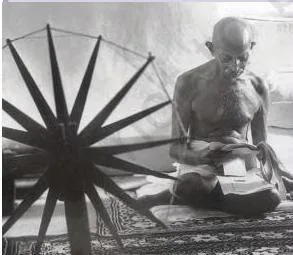
His new appearance also symbolised asceticism and abstinence against the consumerist culture of the modern age. He spent part of each day at the spinning wheel, the charkha, and the chapter calls the image of Gandhi with the charkha the most abiding image of Indian nationalism.
The charkha was also an argument. Gandhi was profoundly critical of a machine age in which machines enslaved humans and displaced labour — in Young India (13 November 1924) he attacked the craze for labour-saving machinery that left thousands without work, and on 17 March 1927 he defended khaddar as regulating the machine’s growth and serving the poorest in their own cottages (NCERT, pp. 292-293).
The wheel, he argued, could supply the poor with supplementary income and make them self-reliant.
| Symbol | What it meant | What different groups read into it |
|---|---|---|
| Dhoti / loincloth | Identification with the poor; asceticism and abstinence | Peasants saw a leader who dressed and lived like them; educated nationalists saw a rejection of Western consumerism (NCERT, p. 292) |
| Charkha | A society that would not glorify machines; self-reliance | Supplementary income and dignity for the poor; a daily discipline of manual labour for the privileged (NCERT, pp. 292-293) |
| Khadi | Home-spun, home-woven cloth | Breaking dependence on imported mill cloth; a uniform of belonging to the movement (NCERT, p. 295) |
| Salt (1930) | A universal household necessity under state monopoly | A grievance every home understood; the cheapest possible symbol of protest (NCERT, pp. 297-298) |
The historian Shahid Amin has studied how the peasants of eastern Uttar Pradesh received Gandhi. A Hindi newspaper of Gorakhpur reported the ecstatic crowds as his train passed in February 1921 — fifteen to twenty thousand people at some stations, people weeping, currency raining onto a spread sheet at Chauri Chaura (NCERT, p. 293).
But the more revealing evidence is the rumours (NCERT, pp. 293-294).
Villagers told of a boiling pan of sugar-cane juice that split in two when a doubter named the test, a wheat field that turned to sesamum overnight, a man’s house catching fire after he mocked the charkha, a gambler’s goat bitten by his own dogs after he abused Gandhi, and brickbats that stopped mid-air when Gandhi’s name was spoken.
To historians, rumours like these reveal the structure of belief of the time: Gandhi appeared to the peasant as Gandhi baba, Gandhi Maharaj, a saviour who had come to end high taxes and oppressive officials and restore dignity to their lives.
Charisma alone, however, would have dissolved. The chapter is careful to show the organisation underneath (NCERT, pp. 294-295): new branches of the Congress across India, Praja Mandals in the princely states, the nationalist message carried in the mother tongue rather than English, and provincial committees organised on linguistic lines.
A band of gifted followers attached themselves to Gandhi between 1917 and 1922 — Mahadev Desai, Vallabhbhai Patel, J.B. Kripalani, Subhas Chandra Bose, Abul Kalam Azad, Jawaharlal Nehru, Sarojini Naidu, Govind Ballabh Pant and C. Rajagopalachari — men of different regions and different religious traditions. Rich industrialists such as G.D.
Birla supported the movement openly or tacitly, expecting the end of the favours their British competitors enjoyed. The chapter’s point is blunt: peasants and industrialists followed Gandhi for different, even opposed, reasons.
Knowing Gandhi: the four kinds of sources
This listing is maintained for the 2026-27 academic session using the NCERT textbook information available to us. NCERT remains the authority for confirming the latest edition.
The political story is half of this chapter; the other half is a lesson in reading evidence. Historians reconstruct Gandhi from four kinds of sources, each with its own bias and its own uses.
Public voice and private letters
This subsection teaches the difference between what a leader said in public and what he wrote in private.
The first distinction the chapter draws is between speeches and letters (NCERT, p. 308). Speeches give us a person’s public voice; private letters show anger and pain, dismay and anxiety, hopes and frustrations that rarely appear in public statements.
But the line blurs: many letters are written to individuals and are also meant for the public, and the fear that a letter may be printed shapes what people write. Gandhi regularly published the letters others wrote to him in his journal Harijan, and Nehru collected letters written to him during the movement into A Bunch of Old Letters (1958).
The chapter works through one event in letters (NCERT, pp. 308-310). In 1936, Nehru’s turn to socialism — deepened by his return from Europe in 1928 and his closeness to socialists like Jayaprakash Narayan and Narendra Dev — alarmed the conservatives in the Congress, led by Rajendra Prasad and Sardar Patel, who threatened to resign from the Working Committee.
Gandhi mediated at his ashram at Wardha. Nehru later published the exchange: Prasad’s letter of 1 July 1936 withdrawing the resignation and explaining the conservatives’ hurt; Nehru’s reply of 5 July, wounded and defensive, calling himself an “intolerable nuisance”; and Gandhi’s answer of 15 July telling Nehru to keep the “crown of thorns” of the presidency and recover his humour at committee meetings.
The exchange is a method in miniature: it shows how a rift inside the Congress was managed, why Gandhi’s mediation mattered, and how personality shapes politics.
Autobiographies and their silences
A short section, but a warning you must remember: autobiographies are not transparent records.
Autobiographies give the past in rich human detail, but they are retrospective accounts written from memory (NCERT, p. 310). They tell us what the author recollected, what he or she valued or was keen to recount, and how the author wanted the life to be viewed. Writing an autobiography is a way of framing a picture of yourself.
The historian’s job is therefore to notice what the author does not tell — those wilful or unwitting acts of forgetting — and to ask why that silence is there.
Police fortnightly reports
This subsection introduces the colonial state’s own records and shows why they must be read against the grain.
From the early twentieth century, the colonial Home Department compiled fortnightly reports based on police information from the localities (NCERT, p. 311). They are a vital source, but they often expressed what higher officials saw, or wanted to believe: they watched for sedition and rebellion while assuring themselves that the fears were unwarranted.
The reports on the Salt March month after month insisted that the march was a drama, an antic — and yet, in the same paragraphs, recorded its spread.
The extracts the chapter prints (NCERT, pp. 311-313) carry the contradiction: Gujarat reported peasants busy harvesting a good rabi and students preparing for examinations; Bengal found little enthusiasm while noting that ladies were attending meetings in increasing numbers; Madras called the march theatrical but viewed the possibility of Gandhi’s arrest with “considerable misgiving”; the United Provinces reported the Salt Act openly defied at Agra, Cawnpore, Benaras and Allahabad among other towns, and Nehru arrested at Cheoki station on 14 April; and Bengal warned that if action were taken against Gandhi, “a spark will be set to much inflammable material.”
The four questions the chapter asks about these reports (NCERT, p. 313) — especially why Gandhi was not arrested — are answered by the officials’ own lines: they were afraid of what an arrest would unleash.
Newspapers as sources
The last source type is the press, with its claim to immediacy — and its unavoidable bias.
Newspapers in English and Indian languages tracked Gandhi’s movements and represented what ordinary Indians thought of him, but no paper was unprejudiced: each was published by people with their own political opinions, and a London paper reported the same events differently from an Indian nationalist paper (NCERT, pp. 313-314). The chapter’s running example is Time magazine (NCERT, pp. 298-299).
In its first report on the Salt March it mocked Gandhi’s “spindly frame” and doubted the “emaciated saint” could finish the walk; within a week, as the march’s following grew, it reported the British as “desperately anxious” and saluted Gandhi as a saint and statesman.
The lesson: no source is a transparent window — every account must be checked against the situation and the interests of its author.
To see why cross-checking matters, read the same march through three sources at once:
| Source | What it says | What a historian does with it |
|---|---|---|
| Gandhi’s speech at Dandi, 5 April 1930 (Collected Works, NCERT p. 298) | He had reached Dandi through the power of peace and non-violence; the government had felt ashamed to arrest “this army of peace” | The movement’s own understanding of itself — notice how Gandhi addresses the colonial state |
| Home Department fortnightly reports (NCERT, pp. 311-313) | The march was theatrical; peasants were busy harvesting, students busy with examinations; yet the Salt Act was openly defied across the United Provinces | An official source with a clear interest in proving the movement was failing; read against the grain |
| Time magazine (NCERT, pp. 298-299) | First scornful of Gandhi’s “spindly frame”; a week later the British were “desperately anxious” and Gandhi a “saint and statesman” | A foreign press source showing how world attention shifted as the movement grew |
None of the three is neutral, and none cancels the others; together they let a historian reconstruct both what happened and how it was perceived.
The chapter’s images: reading pictures as sources
The book is unusual in treating photographs and prints as evidence alongside documents. The images fall into four groups; each is worth learning to “read” as a historian would.
Photographs that track a transformation
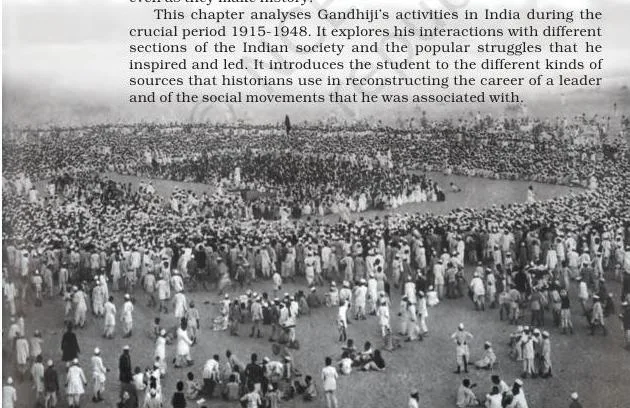
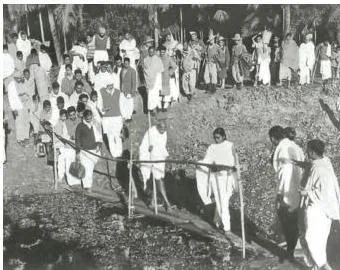
The opening image of the chapter frames everything that follows: people gathered on the banks of the Sabarmati River to hear Gandhi speak before he set out on the Salt March in 1930 (NCERT, p. 286).
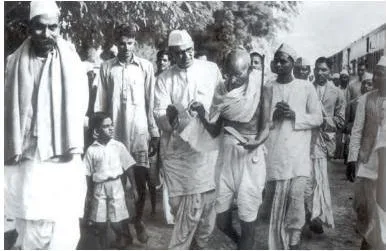
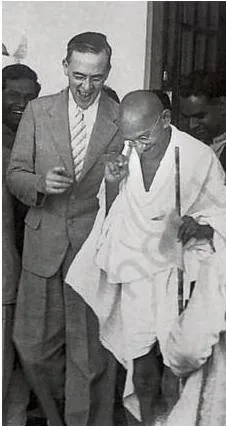
Then come two portraits made decades apart. The Johannesburg portrait catches the lawyer who went to South Africa and forged satyagraha there; the Karachi portrait shows the leader of the nationalist movement back in India (NCERT, pp. 287-288).
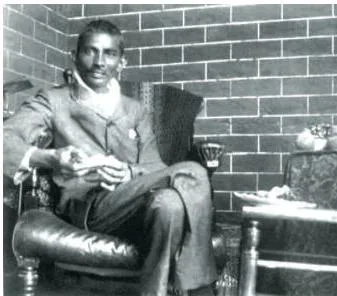
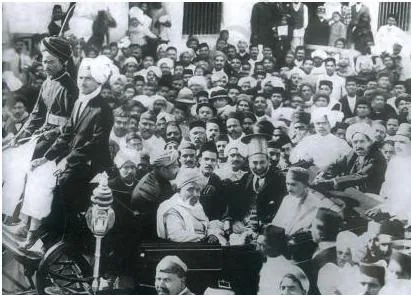
Read together, the three photographs show a public self being transformed. Photographs themselves are sources too — chosen, framed and published — and a historian asks what each frame includes, what it excludes, and who published it.
The movement in action
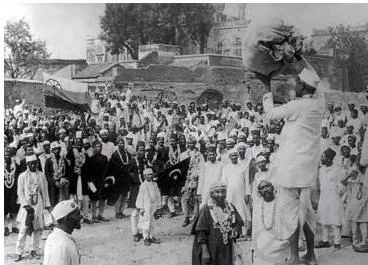
Four images show what the movements looked like on the ground. The July 1922 photograph of foreign cloth collected for bonfires is the visible ritual of non-cooperation — imported cloth, the symbol of economic submission, publicly destroyed (NCERT, p. 291).
The charkha photograph is the chapter’s most important single image — the book’s caption calls Gandhi with the spinning wheel the most abiding image of Indian nationalism, carrying the loincloth, asceticism and self-reliance that millions read as a programme (NCERT, p. 292).
The two Dandi photographs frame the Salt March itself — the column walking from Sabarmati, and the satyagrahis bending to pick up natural salt at the end of the march on 6 April 1930 (NCERT, pp. 296-297).
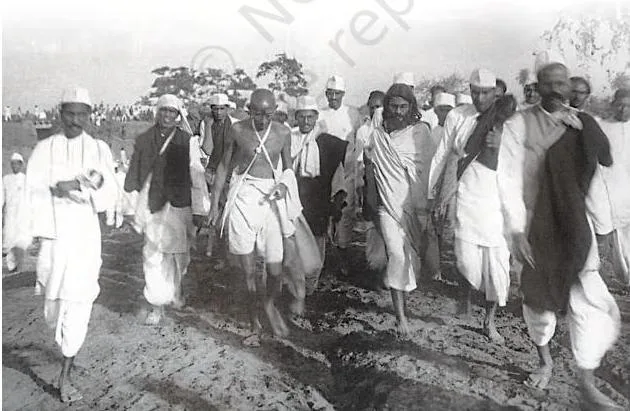
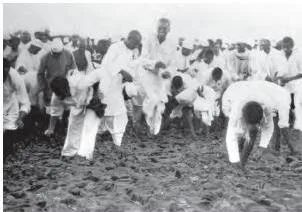
The second of these is the act that made Gandhi “a criminal in the eyes of the law” — and its calm, almost domestic ordinariness is precisely the point. Contrast it with the police reports that insisted nothing was happening.
Gandhi among other leaders
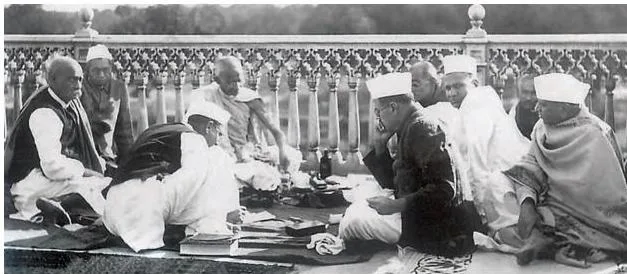
Photographs of Gandhi in company show how the movement was actually led. At Allahabad in 1931, after his release from prison in January, the working leadership posed together — from right to left, Jawaharlal Nehru, Jamnalal Bajaj, Subhas Chandra Bose, Gandhi, Mahadev Desai in front, and Sardar Patel (NCERT, p. 299).
Two photographs date the failed dialogues with the British: Gandhi and Rajendra Prasad on their way to meet Viceroy Linlithgow on 13 October 1939, when the nature of India’s involvement in the War was discussed and the Congress ministries would resign; and Gandhi with Stafford Cripps in March 1942, the mission that broke down over the demand for an Indian Defence Member (NCERT, p. 302).
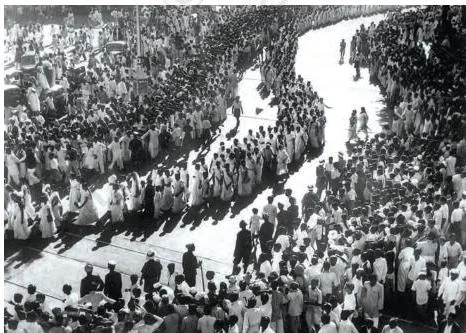
The women’s procession in Bombay records the mass entry of women into the Quit India movement — a change the Salt March had begun when Kamaladevi Chattopadhyay insisted that women not be excluded from the protests (NCERT, p. 303).
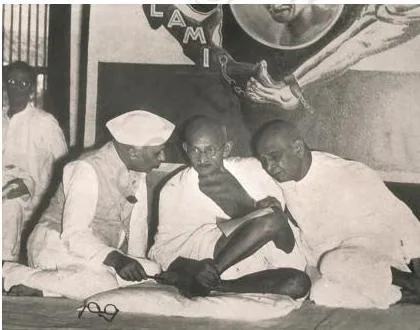
And the photograph of Gandhi conferring with Nehru on his right and Patel on his left is the chapter’s own illustration of two political tendencies — the socialist and the conservative — with Gandhi mediating between them (NCERT, p. 304).
Popular prints and the last days
The final group shows how the public framed Gandhi. The photograph of him on the way to a riot-torn area belongs to the post-Partition months — the Gandhi who walked to wounded communities instead of celebrating in Delhi (NCERT, p. 305).
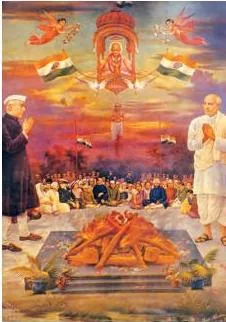
The popular print of the death of the Mahatma is the chapter’s key teaching image (NCERT, p. 306). Nehru and Patel stand on two sides of the pyre, representing the two strands of the Congress; Gandhi himself appears above, in a heavenly realm, blessing them both — the Mahatma deified as the unifying force of the national movement.
It is not a photograph; it is evidence of how ordinary people mythologised him.
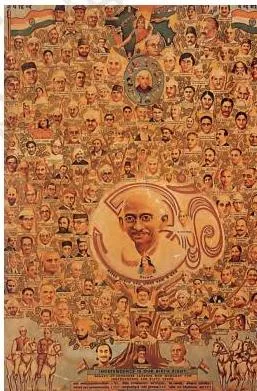
The same frame is at work in the tree of nationalism, where Gandhi looms at the centre surrounded by small images of other leaders and sages (NCERT, p. 313). Popular prints are records of perception, not of fact — and that is exactly what makes them evidence.
Key terms in this chapter
These are the words you must be able to define in an answer, with the page where the book explains each.
| Term | Plain meaning | NCERT page |
|---|---|---|
| Satyagraha | The distinctive technique of non-violent protest that Gandhi first forged in South Africa — holding to truth through suffering, without violence | p. 287 |
| Non-cooperation | The campaign to sever every voluntary tie with the colonial state — leaving its schools and courts, refusing its titles and taxes | p. 290 |
| Khilafat Movement | An Indian Muslim movement led by Muhammad Ali and Shaukat Ali to protect the Khalifa and the Muslim sacred places of the former Ottoman empire; Gandhi conjoined it with non-cooperation | p. 291 |
| Purna Swaraj | Complete independence; proclaimed as the Congress goal at the Lahore Congress of December 1929 | p. 296 |
| Civil disobedience | The deliberate, non-violent breaking of a specific law — here the salt law — in order to force the state’s hand | pp. 296-297 |
| Separate electorates | Reserved voting constituencies for a community; Gandhi opposed them for the Depressed Classes, Ambedkar demanded them | pp. 301-302 |
| Prati sarkar | Parallel government; the Satara district’s independent administration of 1943, with its volunteer corps and people’s courts | p. 304 |
| Charkha | The spinning wheel; symbol of a society that would not glorify machines, and a source of supplementary income for the poor | pp. 292-293 |
| Khadi | Home-spun cloth; wearing it marked self-reliance and broke dependence on imported mill cloth | p. 295 |
| Fortnightly reports | Confidential Home Department reports, compiled from police information, that expressed what higher officials saw or wanted to believe | p. 311 |
Common mistakes students make with this chapter
Seven confusions cost marks here. The table gives each wrong impression, the correct fact, and the page to check.
| Common mistake | The correct fact | How to check your answer |
|---|---|---|
| “The Salt March was Gandhi’s first mass movement.” | The sequence is Rowlatt satyagraha (1919), non-cooperation (1920-22), civil disobedience (1930). The Salt March belongs to the third. | NCERT, pp. 289-297 |
| “Jallianwala Bagh happened during non-cooperation.” | It happened in April 1919, during the Rowlatt satyagraha — before non-cooperation was launched. | NCERT, p. 290 |
| “Chauri Chaura was police firing on protesters.” | Peasants attacked and burned the police station; several constables died. That violence made Gandhi withdraw the movement. | NCERT, p. 291 |
| “Quit India was Gandhi-led mass action on the streets.” | Gandhi was jailed immediately; underground activists such as Jayaprakash Narayan organised strikes and sabotage. | NCERT, p. 303 |
| “The Round Table Conferences were one thing.” | First RTC, November 1930, without Gandhi; Gandhi-Irwin Pact, March 1931, between them; second RTC, late 1931, with Gandhi challenged by the League, the Princes and Ambedkar. | NCERT, pp. 300-301 |
| “The fortnightly reports are neutral fact.” | They are official sources written to prove the movement was failing — they must be read against the grain. | NCERT, p. 311 |
| “Gandhi demanded separate electorates for the Depressed Classes.” | The demand came from Ambedkar; the opposition came from Gandhi, who called it “bondage in perpetuity.” | NCERT, pp. 301-302 |
Exam preparation: how the chapter’s own exercises work
This section maps the exercises the chapter itself sets, so you know exactly what NCERT expects you to be able to do with this material — no promises about marks, just the tasks as printed.
- Short answers (100-150 words) — five questions (NCERT, p. 314): how Gandhi sought to identify with the common people; how peasants perceived him; why the salt laws became an issue of struggle; why newspapers matter as a source; why the charkha was chosen as a symbol. A full answer names the concept, gives one concrete example from the chapter, and states where it appears.
- Short essays (250-300 words) — four questions (NCERT, p. 315): how non-cooperation was a form of protest; why the Round Table dialogues were inconclusive; how Gandhi transformed the national movement; what private letters and autobiographies tell us and how they differ from official accounts. These reward an argument, not a list — take a position and support it with the chapter’s evidence.
- Map work — one task (NCERT, p. 315): plot the route of the Dandi March on a map of Gujarat, marking the major towns and villages it passed.
- Projects — two options (NCERT, p. 315): compare two autobiographies of nationalist leaders, or study a local leader of your region through their letters and speeches.
The chapter also carries three discussion prompts that work as revision drills: the rumours-and-belief question (p. 294), the imaginary Ambedkar-Gandhi dialogue (p. 303), and the conflict between the Bombay police-clash image and the fortnightly reports (p. 311). The four questions on the fortnightly reports (p. 313) are a ready-made exercise in source criticism — practise them and you have mastered the chapter’s method.
The timeline on p. 314 is the ready-made skeleton for a final revision. For a chapter-by-chapter revision set built on this book, see the Class 12 History notes on this site.
One honest note: textbook contents and the examinable syllabus are not always identical — check the current official syllabus before you decide what to study.
Recap: the chapter’s key dates and takeaways
The book closes with a timeline on page 314; the table below expands it with why each date matters, adding 1947 and 1948 from the text of section 5.
| Year | Event | Why it matters |
|---|---|---|
| 1915 | Gandhi returns from South Africa | The techniques of satyagraha come home with him. |
| 1917 | Champaran movement | First peasant struggle — for tenure security and choice of crops. |
| 1918 | Kheda and Ahmedabad movements | Marks him as a nationalist with deep sympathy for the poor. |
| 1919 | Rowlatt Satyagraha (March-April) | First all-India campaign; makes him a national leader. |
| 1919 | Jallianwala Bagh massacre (April) | The bloodiest moment of the Rowlatt protests — more than four hundred killed. |
| 1921 | Non-cooperation and Khilafat movements | The first true mass movement, on a combined Hindu-Muslim front. |
| 1928 | Peasant movement in Bardoli | A satyagraha Gandhi blessed but did not lead. |
| 1929 | “Purna Swaraj” accepted at the Lahore Congress (December) | Complete independence becomes the Congress goal; Nehru takes the presidency. |
| 1930 | Civil Disobedience begins; Dandi March (March-April) | The salt law broken; nearly 60,000 arrests follow. |
| 1931 | Gandhi-Irwin Pact (March); Second Round Table Conference (December) | The Raj forced to negotiate; Gandhi faces the League, the Princes and Ambedkar. |
| 1935 | Government of India Act | Promises some form of representative government. |
| 1939 | Congress ministries resign | Protest at being dragged into the War without a promise of freedom. |
| 1942 | Quit India Movement begins (August) | The third major movement; the demand for British departure made explicit. |
| 1946 | Gandhi visits Noakhali and other riot-torn areas | His last great peace work, walking between communities. |
| 1947 | 15 August: independence, with Partition (pp. 304-305) | Freedom at the price of division; Gandhi marks the day fasting in Calcutta. |
| 1948 | 30 January: assassination (p. 306) | Nathuram Godse shoots him at his prayer meeting; the world grieves. |
Two halves, one question. The chapter’s three mass movements were built on each other — each wider than the last, each followed by a moment of dialogue or repression. And every event in the story is viewed through sources that disagree with each other: speeches, letters, police files, newspapers and pictures.
That is the historian’s question, and it runs through the whole chapter: what can we know about the past, and how can we know it?
Related resources
For the rest of the book and for quick revision, use these pages:
- Class 12 History notes — chapter-by-chapter revision for Themes in Indian History.
- Class 12 study material — notes across subjects for one-stop revision.
- The full index of CBSE notes — everything on the site, organised by class and subject.
- Neighbouring themes of this book: Rebels and the Raj and the theme that follows.
The chapter itself recommends a short shelf of historians, all listed on its final page (NCERT, p. 315): Sekhar Bandyopadhyay, From Plassey to Partition (2004); Sarvepalli Gopal, Jawaharlal Nehru: A Biography, Volume I (1975); David Hardiman, Gandhi in His Time and Ours (2003); Gyanendra Pandey, The Ascendancy of the Congress in Uttar Pradesh, 1926-34 (1978); and Sumit Sarkar, Modern India, 1885-1947 (1983).
Its “You could visit” recommendation is GandhiServe’s online edition of the Collected Works of Mahatma Gandhi — the same collected writings from which the chapter quotes the salt-tax statement and the speech of 5 April 1930.
Sources and data verification
Four facts about where this page’s information comes from:
- The figures and page numbers on this page describe the NCERT Class 12 History textbook Themes in Indian History Part III, official NCERT edition published on ncert.nic.in.
- This page covers only the chapter “Mahatma Gandhi and the Nationalist Movement: Civil Disobedience and Beyond” (printed pages 285-315) — not the other themes of the book.
- This listing is maintained for the current academic session using the NCERT information available to us; newer NCERT editions supersede any older printings.
- NCERT settles the textbooks, their editions and the official PDFs; CBSE settles the curriculum, the syllabus and the examinations.
Frequently asked questions
Where can I download the Mahatma Gandhi and the Nationalist Movement Class 12 PDF?
The official PDF of Themes in Indian History Part III, in which this is chapter 3 at pages 285-315, is published free by NCERT on its own website — download it from ncert.nic.in. There is no registration, and the same file contains all the themes of the book.
Why did Mahatma Gandhi choose the salt tax for the civil disobedience movement?
Because salt was indispensable in every household and the state held a monopoly over it — people were forbidden to make salt even for their own use and had to buy it at a high price (NCERT, p. 297).
Gandhi called the salt monopoly a “fourfold curse” whose tax could exceed 1,000 per cent of the salt’s value (NCERT, p. 298); a grievance this universal was the cheapest possible symbol of protest.
What is the difference between the non-cooperation movement and civil disobedience?
Non-cooperation (1920-22) meant cutting every voluntary tie with the state — leaving its schools and courts, refusing its taxes. Civil disobedience (1930) meant actively breaking a specific law — the salt law — and courting arrest (NCERT, pp. 290 and 296-297). Non-cooperation withheld cooperation; civil disobedience disobeyed, openly and non-violently.
Why did Mahatma Gandhi call off the non-cooperation movement in 1922?
Because of the violence at Chauri Chaura in February 1922, where peasants attacked and burned a police station and several constables died (NCERT, p. 291). Non-violence was the foundation of Gandhi’s method, so he insisted that no provocation could justify the killings and withdrew the movement.
What was the disagreement between Gandhi and Ambedkar over separate electorates?
Gandhi opposed separate electorates for the Depressed Classes, saying they would mean “bondage in perpetuity” and preserve the stigma of untouchability; Ambedkar answered that a community so handicapped needed political power to protect itself against organised tyranny (NCERT, pp. 301-302). One saw segregation, the other saw protection.
Why are the Home Department fortnightly reports considered a biased source?
Because they are confidential official documents that expressed what higher officials saw, or wanted to believe (NCERT, p. 311). Throughout the Salt March they insisted the movement was failing — calling it theatrical — while their own entries recorded the Salt Act being openly defied across the United Provinces. They must be read against the grain.
Reference: NCERT Class 12 History textbook, chapter 3, official edition on ncert.nic.in.
Explore Class 12 History Books
Related chapters:
- Bricks, Beads and Bones
- Kings, Farmers and Towns
- Kinship, Caste and Class