
Kings, Farmers and Towns Class 12 is Chapter 2 of the NCERT History textbook Themes in Indian History Part I. It covers early states and economies in the subcontinent from roughly c. 600 BCE to 600 CE, on printed pages 27–51 of the book.
The official NCERT PDF of the chapter is linked right below. This page also walks you through the chapter’s sections, key terms, figures and question sets, so you can jump straight to the part you need.
Download the Kings, Farmers and Towns Class 12 NCERT PDF
The complete chapter — including its maps, margin questions and two closing timelines — is in the official file. The NCERT Class 12 History Chapter 2 Kings, Farmers and Towns PDF is published by NCERT itself, so what you open is the chapter exactly as printed in the current edition of Themes in Indian History Part I.
| What the chapter holds | Count | Where it is used |
|---|---|---|
| Printed pages | 25 | |
| Sections in the chapter | 18 | |
| Figures with NCERT captions | 7 | |
| Tables | 5 | |
| Official NCERT PDF | Download the chapter PDF | the chapter exactly as NCERT publishes it |
Kings, Farmers and Towns at a Glance: What the Chapter Holds
The table below shows how long the chapter runs and what sits inside it. Use it to judge what the chapter will ask of you before you start reading.
| What the chapter holds | Count |
|---|---|
| Printed pages | 25 (pages 27–51 of the book) |
| Thematic sections | 8, from “Prinsep and Piyadassi” to “The Limitations of Inscriptional Evidence” |
| Figures | 7 |
| Tables and timelines | 5 |
| Source extracts | 11 |
| “Discuss” prompts in the margin | 6 |
| End-of-chapter questions | 12 |
The chapter closes with two timelines and a full question set: short-answer questions, essays, map work and a project. A quick scan of the opening and closing pages tells you exactly where the book is taking you.
What Kings, Farmers and Towns Covers, Section by Section
The chapter does two things at once: it surveys about 1,200 years of early Indian political and economic history, and it shows historians at work on inscriptions. Use the section map below to jump to the block you need.
1. Prinsep and Piyadassi (NCERT, p. 28). This opening block introduces epigraphy — the study of inscriptions. In the 1830s James Prinsep, an officer in the East India Company’s mint, deciphered the Brahmi and Kharosthi scripts used on the earliest inscriptions and coins. Most named a king Piyadassi (“pleasant to behold”); a few also named Asoka — the same ruler, as Prinsep’s work showed.
2. The sixteen mahajanapadas and the rise of Magadha (NCERT, pp. 29–32). Early Buddhist and Jaina texts name sixteen mahajanapadas — Vajji, Magadha, Koshala, Kuru, Panchala, Gandhara and Avanti among them. Most were kingdoms, but some, called gana or sangha, were oligarchies.
Magadha became the strongest because of productive agriculture, accessible iron, elephants and river routes — or, as early writers put it, because of ambitious rulers like Bimbisara and Ajatasattu.
3. An early empire: the Mauryas (NCERT, pp. 32–35). The block surveys the sources — archaeology, Megasthenes, the Arthashastra, later literature and Asoka’s inscriptions — then administration: five political centres, dhamma, the dhamma mahamattas, and the machinery of communication. Historians now doubt that one uniform administration ran the whole empire, and they question how important a 150-year empire really was.
4. Chiefs, kings and divine rulers (NCERT, pp. 35–38). After the Mauryas came the Cholas, Cheras and Pandyas in Tamilakam, the Satavahanas and Shakas, and the Kushanas, whose rulers took the title devaputra (“son of god”). The Guptas are known largely through prashastis — poems in praise of kings such as the Prayaga Prashasti — which the book reads as poetry, not literal history.
5. Agriculture and rural society (NCERT, pp. 38–42). Plough agriculture with iron-tipped shares, transplantation of paddy and irrigation all raised output, though the benefits were uneven. Rural society split into large landholders (gahapatis), small peasants and labourers — in Tamil country, vellalar, uzhavar and adimai. Land grants to Brahmanas created new rural elites, as the grant of the village of Danguna shows.
6. Towns and trade (NCERT, pp. 42–45). New cities grew along river, land and sea routes from c. sixth century BCE. Archaeology finds glossy Northern Black Polished Ware, ornaments and tools; votive inscriptions and guilds (shrenis) name the townspeople. Long-distance trade reached the Roman Empire — pepper, textiles and medicinal plants across the Arabian Sea, as the Periplus describes.
7. Coins and kings (NCERT, pp. 45–46). Coinage runs from punch-marked silver and copper, through the first ruler-named coins of the Indo-Greeks, to Kushana gold, Yaudheya copper and Gupta gold. After c. 600 CE gold-coin finds taper off — the chapter leaves the reasons open to debate.
8. How inscriptions are deciphered — and their limits (NCERT, pp. 46–49). The book ends by showing the craft: working backwards from modern scripts to read Brahmi in 1838, using bilingual Indo-Greek coins to read Kharosthi, and then facing the limits — faint letters, lost inscriptions, and records commissioned by the powerful.
The chapter then closes with two timelines of major developments (NCERT, pp. 50–51) and a full exercise set (NCERT, pp. 51–52), both described later on this page.
The Core Ideas: States, Kingship, Agriculture and Trade
The chapter is built on one frame: political power (kings), economic production (farmers) and exchange (towns) grew together, and rulers drew resources from cultivators, artisans and traders. The table below collects the ideas the whole chapter turns on.
| Concept | What it means here | NCERT page |
|---|---|---|
| Epigraphy | The study of inscriptions — writings engraved on hard surfaces such as stone, metal or pottery | p. 28 |
| Piyadassi | A royal title meaning “pleasant to behold”; Prinsep showed it named the same ruler as Asoka | p. 28 |
| Janapada vs mahajanapada | A janapada is the land where a jana (a people, clan or tribe) settles; a mahajanapada is a large early state that grew from such settlements | pp. 29–30 |
| Gana / sangha | A state run as an oligarchy, with power shared among many rajas, as in Vajji | p. 30 |
| Magadha’s rise | Explained by geography (fertile land, iron, elephants, Ganga routes) or by ambitious rulers (Bimbisara, Ajatasattu, Mahapadma Nanda) | p. 31 |
| Dhamma | Asoka’s message: respect for elders, generosity, kind treatment of slaves and servants, respect for other religions — spread by special officers | pp. 32–34 |
| Uniform administration | Historians doubt one common system ran the whole empire; control was probably strongest near the capital and provincial centres | p. 33 |
| Chief vs king | Chiefs draw support from kin and receive gifts; kings collect taxes and maintain armies and officials | p. 35 |
| Devaputra | “Son of god” — a title adopted by Kushana rulers, possibly inspired by Chinese rulers’ “sons of heaven” | p. 36 |
| Prashasti and samanta | Prashastis are poems in praise of kings; samantas are local lords owing homage and military support, who could become kings | pp. 36–37 |
| Plough, transplantation, irrigation | The iron-tipped ploughshare in alluvial valleys, transplanting paddy saplings for higher yields, and wells, tanks and canals | pp. 38–39 |
| Gahapati | Head of a household, owner of its land and resources; also a status marker for wealthy urban men | p. 40 |
| Land grants and agrahara | Grants of land, usually to Brahmanas or religious institutions; an agrahara was exempt from dues and gave the donee the right to collect them | pp. 40–41 |
| NBPW, votive inscriptions, shrenis | Glossy fine pottery; inscriptions recording gifts, naming donors and occupations; guilds of craft producers and merchants | pp. 42–43 |
| Coin sequence | Punch-marked to Indo-Greek (first with ruler names) to Kushana gold, Yaudheya copper and Gupta gold; finds taper after c. 600 CE | pp. 45–46 |
| Decipherment | Brahmi read by working back from Devanagari and Bengali; Kharosthi read through bilingual Indo-Greek coins | pp. 46–47 |
Inscriptions, texts and coins: what each source reveals about the Mauryas
Each source for the Mauryan empire was produced for a different purpose, so historians cross-check rather than trust any single one. This comparison is exactly what an essay on Mauryan administration or on the value of inscriptions has to keep in mind.
| Source | What it can reveal | What it cannot | NCERT page |
|---|---|---|---|
| Asokan inscriptions (rocks and pillars) | The king’s own message: dhamma, arrangements for receiving reports, the five political centres, the empire’s reach | Only the ruler’s perspective; nothing on what subjects thought; the anguish edict is missing from Orissa itself | pp. 32–34, 47–48 |
| Megasthenes’ account | Mauryan officialdom: officers over rivers, land measurement, sluices and taxes; a six-committee military system | Survives only in fragments; a foreign observer’s view; troop numbers may be exaggerated | pp. 32, 34–35 |
| Arthashastra | Minute administrative and military rules, such as how to capture elephants for the army | Only parts were probably composed by Kautilya; a manual of how things should work, not proof they did | p. 32 |
| Buddhist, Jaina, Puranic and Sanskrit literature | Dynastic genealogies and the reputation of rulers such as Asoka, known from Buddhist texts | Written later, from religious traditions; not contemporary records | p. 32 |
| Punch-marked coins | The spread of exchange networks from c. sixth century BCE onwards | Symbols cannot be confidently tied to specific dynasties; merchants, bankers and townspeople may have issued some coins | p. 45 |
Reading the Chapter’s Inscriptions and Coin Images
These are the images the book itself uses to teach its method — how an inscription looks on stone, how scripts spread across regions, and how coins are read. Work through them with the captions open.
Fig 2.1 — an inscription is a physical object
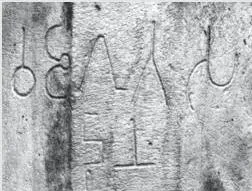
This is the chapter’s opening image, and it makes the book’s first point: an inscription is not just text, it is a physical object cut into stone. Inscriptions usually record what those who commissioned them chose to say — the exploits of kings, or donations made by women and men to religious institutions.
This Sanchi record, from about the second century BCE, is precisely such a gift record.
Languages and scripts across Asoka’s empire
The map shows why decipherment was hard: there was no single script or language. Most Asokan inscriptions were in Prakrit written in Brahmi, but some in the northwest used Kharosthi, and inscriptions in Afghanistan used the Aramaic and Greek scripts. The regional spread is also evidence of how far the empire’s message travelled.
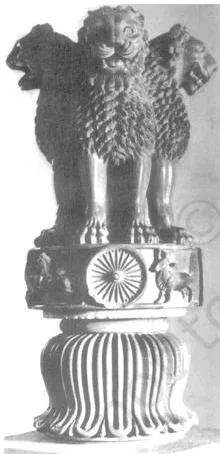
Gupta histories and the prashasti
This image sits inside the discussion of how we know about the Guptas. The key idea: prashastis are court poetry. Historians try to draw factual information from them, but the people who composed and read them treasured them as poetry, not as literally true accounts.
A claim such as those in the Prayaga Prashasti — composed by Harishena for Samudragupta — has to be assessed, not quoted as fact.
Fortified cities and what archaeology recovers
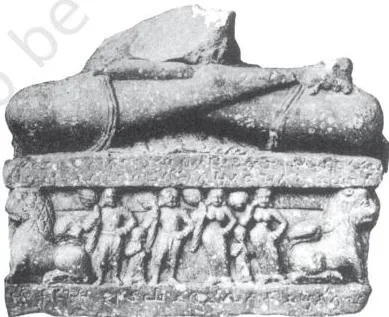
The image accompanies the chapter’s turn to archaeology. From early cities, excavators have recovered fine glossy bowls and dishes of Northern Black Polished Ware, probably used by rich people, along with ornaments, tools, weapons, vessels and figurines made of gold, silver, copper, bronze, ivory, glass, shell and terracotta.
Fortified walls cost resources — which is why kings needed taxes from farmers and traders, and why “farmers” and “towns” share a chapter with “kings”.
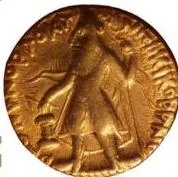
Coins: what numismatists read
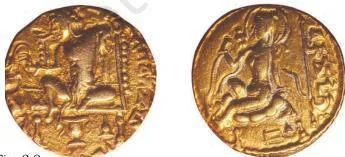
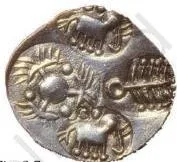
These two images together define numismatics and its hardest question. Studying scripts, images, metal and find-spots lets historians trace the sequence — punch-marked coins, the Indo-Greek coins that first named rulers, Kushana gold almost identical in weight to Roman and Parthian issues, Yaudheya copper, and Gupta gold. The debate: does the tapering of gold-coin finds after c.
600 CE mean crisis, or simply that coins circulated instead of being hoarded?
Fig 2.10 — an inscription as an epigraphist sees it
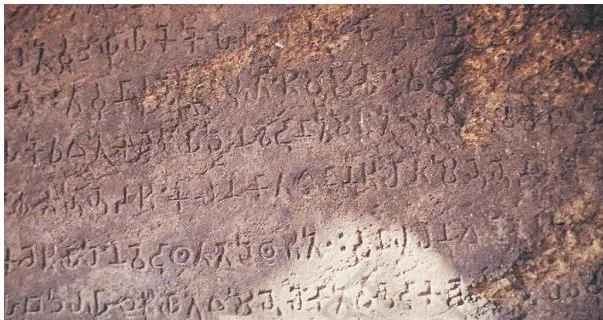
The book prints this rock inscription with a table of Asokan Brahmi letters and their Devanagari equivalents beside it, so the reader can compare shapes. Notice what the inscription does not say: the ruler’s name Asoka never appears. Instead it uses the titles devanampiya (“beloved of the gods”) and piyadassi.
Epigraphists concluded these were the same king by finding other inscriptions that use both titles and the name, and by matching content, style, language and palaeography.
Worked reading: the Kalinga edict — statement, inference and a missing puzzle
This worked reading of Source 11 is the chapter’s best lesson in handling evidence: separate what the inscription states from what historians infer, then face what is missing.
What the inscription states (report it as written, NCERT, pp. 47–48):
- Kalinga (present-day coastal Orissa) was conquered in the eighth year of the king’s rule.
- 150,000 people were deported, 100,000 were killed, and many more died.
- Since the conquest, the king has been devoted to an intense study of dhamma.
- The king calls the slaughter, death and deportation painful and deplorable.
What historians infer: the edict is usually read as repentance and as a change in attitude towards warfare. But the book warns that the situation becomes complex once you move beyond reading at face value. The casualty figures themselves must be assessed — historians constantly judge whether statements in inscriptions are true, plausible or exaggerated.
The puzzle: Asokan inscriptions have been found in present-day Orissa, yet this anguish edict has not — it is missing from the very region it describes. The book leaves the question open: was the recent conquest too painful to address in the conquered region?
A strong answer states the facts, names the inference, and flags the missing edict as an unresolved question historians continue to debate.
Key Terms in Kings, Farmers and Towns, Explained in Plain Language
This chapter is term-heavy because its sources — Prakrit, Pali, Tamil and Sanskrit — carry concepts that have no single English word. Scan this glossary the night before an exam.
| Term | Plain meaning | NCERT page |
|---|---|---|
| Epigraphy | The study of inscriptions — writings engraved on stone, metal or pottery | p. 28 |
| Piyadassi | A royal title meaning “pleasant to behold”, used in Asoka’s inscriptions | p. 28 |
| Janapada / mahajanapada | A janapada is where a jana (a people, clan or tribe) settles; a mahajanapada is a large early state formed from such settlements | pp. 29–30 |
| Gana / sangha | A state ruled as an oligarchy, with power shared among many rajas, e.g. Vajji | p. 30 |
| Oligarchy | A form of government where power is exercised by a group of men | p. 30 |
| Palaeography | The study of old styles of writing, used to date inscriptions that carry no date | p. 30 |
| Chief | A powerful man who draws support from kin and receives gifts rather than taxes | p. 35 |
| Devaputra | “Son of god” — a title adopted by Kushana rulers | p. 36 |
| Prashasti | A poem composed in praise of a king or patron | p. 36 |
| Samanta | A local lord who owed homage and military support to a ruler; a powerful samanta could become a king | pp. 36–37 |
| Transplantation | Growing paddy by broadcasting seeds, then replanting saplings in waterlogged fields for higher survival and yields | p. 38 |
| Gahapati | Head of a household and owner of its land and resources; also a status marker for wealthy urban men | p. 40 |
| Vellalar / uzhavar / adimai | Tamil terms for large landowners, ploughmen and slaves in early Tamil villages | p. 40 |
| Agrahara | Land granted to a Brahmana, exempt from land revenue, with the right to collect local dues | p. 41 |
| Shreni | A guild — an organisation of craft producers and merchants | p. 43 |
| Periplus | A Greek word meaning “sailing around”; also the name of a c. first century CE sailors’ guide to trade routes | p. 44 |
| Numismatics | The study of coins — scripts, images, metal analysis and find contexts | p. 45 |
| Devanampiya / pativedaka | “Beloved of the gods” (Asoka’s title) and “reporter”, an officer who reported the affairs of the people to the king | p. 47 |
Common Mistakes Students Make with Mahajanapadas, Mauryas and Inscriptions
These are exactly the places where the book’s own margin questions press hardest. Correct these eight and the chapter’s argument falls into place.
| Mistake | Correct rule | How to check your answer |
|---|---|---|
| “Piyadassi and Asoka were two different kings.” | Piyadassi is a title — “pleasant to behold”. Prinsep’s breakthrough was showing the title and the name belong to the same ruler (NCERT, p. 28). | Quote a real inscription: most use only the title; a few use both title and name. |
| “Every mahajanapada was a kingdom ruled by one king.” | Most were monarchies, but the ganas/sanghas, like Vajji, were oligarchies — many rajas shared power, sometimes holding resources like land collectively (NCERT, p. 30). | Name both forms and give one example of each: a kingdom (Magadha) and an oligarchy (Vajji). |
| “The earliest inscriptions were written in Sanskrit.” | Most Asokan inscriptions are in Prakrit; the Sanskrit assumption actually slowed decipherment for decades (NCERT, pp. 30, 46). | Mention that Brahmi was first read from Prakrit texts, and that the northwest used Aramaic, Greek and Kharosthi. |
| “A chief is just a small king.” | Chiefs are supported by kin, receive gifts and redistribute them; kings collect taxes, maintain armies and employ officials. Chiefdoms generally have no standing armies (NCERT, p. 35). | Test with the Pandya chief: he receives gifts, not tax revenue. |
| “Prashastis are reliable history because they were composed for kings.” | They are court poetry; readers treasured them as poetry. Historians assess claims such as those in the Prayaga Prashasti rather than taking them literally (NCERT, pp. 36–37). | Ask which claims could be checked against coins, other inscriptions or independent texts. |
| “Whatever an inscription states is fact.” | Statements must be tested — for example, Asoka’s claim that earlier rulers had no report system, and the puzzle that the Kalinga anguish edict is missing from Orissa itself (NCERT, pp. 47–48). | Separate what the inscription states from what historians infer, and flag anything that cannot be checked. |
| “Fewer gold coins after c. 600 CE proves an economic crisis.” | Historians are divided. Some link the decline to the collapse of the Western Roman Empire; others point to new towns and trade networks, and to fewer finds because coins circulated instead of being hoarded (NCERT, p. 45). | Present both readings, with the evidence each side cites. |
| “Inscriptions tell us everything important about the past.” | They focus on grand, unique events and project the perspective of whoever commissioned them. Routine life and marginalised groups are almost never recorded (NCERT, pp. 48–49). | List what inscriptions cannot show: daily agricultural practice, the joys and sorrows of ordinary existence. |
Preparing for Questions on Kings, Farmers and Towns
The surest self-test is the chapter’s own question set. Work through the twelve end questions on NCERT pages 51–52; every answer lives in the chapter sections mapped below.
| End question | What it tests | Where the answer lives |
|---|---|---|
| 1. Evidence of craft production: Early Historic vs Harappan cities | Urban crafts — NBPW, tools, ornaments — and a comparison with an earlier civilisation | Section 6, especially pp. 42–43, against Chapter 1’s Harappan evidence |
| 2. Salient features of the mahajanapadas | Definition, forms of rule, fortified capitals, resources | Section 2.1, NCERT, pp. 29–31 |
| 3. Reconstructing the lives of ordinary people | Using stories when inscriptions are silent | Section 5.1 on popular perceptions, NCERT, p. 38, e.g. the Gandatindu Jataka |
| 4. Pandya chief’s gifts vs the village of Danguna | Comparing two different economies from two sources | Sources 3 and 8, NCERT, pp. 36 and 40–41 (worked example below) |
| 5. Problems faced by epigraphists | Technical limits of reading inscriptions | Section 8, NCERT, pp. 48–49 |
| 6. Main features of Mauryan administration | Officials, five political centres, communication, army, dhamma | Sections 3.1–3.2, NCERT, pp. 32–34, using Megasthenes and the Arthashastra |
| 7. D.C. Sircar: “No aspect of Indian life is not reflected in inscriptions” | Assessing the limits of inscriptional evidence | Section 8, NCERT, pp. 48–49 — the limitations discussion answers this directly |
| 8. Post-Mauryan notions of kingship | Chiefs, divine kings, devaputra, prashastis, samantas | Section 4, NCERT, pp. 35–38 |
| 9. Transformation of agricultural practices | Plough, transplantation, irrigation, rural stratification, land grants | Section 5, NCERT, pp. 38–42 |
| 10. Map work: mahajanapadas vs the Mauryan empire | Reading Maps 1 and 2 together | Maps on pp. 29 and 32–33, with the list of mahajanapadas on pp. 30–31 |
| 11. Project: newspaper reports on public works | Comparing modern official statements with inscriptions on resources and rulers | Sections on rulers and resources, especially NCERT, pp. 40–42 |
| 12. Project: currency notes and coins in circulation | Observing obverse and reverse, materials, scripts, symbols | Section 6.4 on coins and kings, NCERT, pp. 45–46 |
The six “Discuss” prompts scattered through the chapter work as free practice questions — they are NCERT’s own revision set:
- Different explanations for the growth of Magadhan power (p. 31)
- How useful are Megasthenes and the Arthashastra for Mauryan administration? (p. 34)
- Why do you think kings claimed divine status? (p. 37)
- Are plough agriculture, irrigation and transplantation prevalent in your state — and what alternatives exist? (pp. 41–42)
- What transactions does trade involve, and which are not evident from the sources? (p. 45)
- Looking at Map 2, do you notice patterns in the location of Asokan inscriptions? (p. 48)
Answered example: comparing the Pandya chief’s gifts with the village of Danguna
Question 4 is the chapter’s best practice in comparing two economies. It asks you to contrast the forest gifts brought to the Pandya chief with everything produced in the village of Danguna.
| Feature | Pandya chief’s forest gifts (Source 3, NCERT, p. 36) | Village of Danguna (Source 8, NCERT, pp. 40–41) |
|---|---|---|
| What flows to the powerful | Gifts: ivory, fragrant wood, honey, sandalwood, red ochre, antimony, turmeric, cardamom, pepper, plus fruits, coconuts, mangoes, sugarcane, bananas | The king’s revenue rights: major and minor taxes, the right to mines and khadira trees, flowers, milk, hidden treasures and deposits |
| Who gives | Forest dwellers who come down the mountain singing and dancing | The gramakutumbinas (householders and peasants), Brahmanas and others living in the village |
| The relationship | A chief receives gifts and redistributes them among supporters — a gift economy | A royal charter transfers the villagers’ obligations to a Brahmana lord — a land-grant and tax economy |
| What is exempted | Not applicable | No entry by soldiers and policemen; exempt from grass, hides, charcoal, buying liquor, digging salt, mines, flowers and milk |
| Source type | A Tamil epic, the Silappadikaram | A Sanskrit charter inscription of Prabhavati Gupta |
Similarities worth stating: both show resources flowing from non-royal people to a powerful figure, and both reveal rulers drawing on very different ecologies — forest products in one case, settled agriculture in the other. Differences: gift and redistribution versus tax and transferred rights; mobile forest people versus settled villagers.
A full answer names the source and language of each passage, describes the two economies, and states one similarity and two differences.
Textbook contents and the examinable syllabus are not always identical — check the current official syllabus before examinations.
The two closing timelines (NCERT, pp. 50–51) work as ready-made revision anchors. The first covers major political and economic developments, the second major advances in epigraphy — from the founding of the Asiatic Society in 1784 and Prinsep’s 1838 decipherment to D.C. Sircar’s publications in 1965–66.
Note the book’s own caution: the date of Kanishka’s accession is not certain, and economic dates are the earliest known, with enormous regional variation.
The Chapter in One Page: From Prinsep to the Limits of Epigraphy
This pass reconstructs the whole argument in revision order: the historian’s entry point, then the political arc, the economic arc, and finally the evidence itself.
- The historian’s entry point. Prinsep’s decipherment of Brahmi and Kharosthi in the 1830s identified Piyadassi with Asoka and turned inscriptions into usable evidence for early Indian political history.
- The political arc. Sixteen mahajanapadas from c. sixth century BCE; Magadha first among them; the Mauryan empire (c. 321–185 BCE) and the question of its importance; then chiefs and divine kings — the Kushanas, prashastis and samantas.
- The economic arc. Agricultural expansion through plough, transplantation and irrigation; rural stratification into gahapatis, peasants and labourers; new towns, craft production and long-distance trade; the coin sequence from punch-marked to Gupta gold.
- The evidence itself. Inscriptions are read and dated through palaeography, but they are partial — commissioned by the powerful, focused on grand events, and only a fraction of what was inscribed survives.
These are the major developments, reorganised thematically from the chapter’s own century-by-century timeline (NCERT, pp. 50–51):
| Theme | c. 600–300 BCE | c. 300 BCE–100 CE | c. 100–600 CE |
|---|---|---|---|
| States | Mahajanapadas emerge; Magadha consolidates power from c. 500–400 BCE; Alexander’s invasion c. 327–325 BCE | Chandragupta Maurya c. 321 BCE; Asoka’s reign c. 272/268–231 BCE; end of the Mauryan empire c. 185 BCE; Indo-Greek rule in the northwest c. 200–100 BCE; Cholas, Cheras and Pandyas in the south | Shaka rulers and Roman trade c. 100 BCE–200 CE; accession of Kanishka c. 78 CE?; Gupta rule from c. 320 CE (Samudragupta c. 335–375; Chandragupta II c. 375–415); Chalukyas and Pallavas c. 500–600 CE |
| Agriculture | Paddy transplantation from c. 600–500 BCE | — | Earliest inscriptional evidence of land grants c. 100–200 CE; grants continue under the Guptas |
| Coinage and trade | Punch-marked coins from c. 600–500 BCE | — | Gold coinage c. 100 BCE–200 CE; Gupta gold coins; finds taper off after c. 600 CE |
Related Chapters and Resources
The previous chapter, Bricks, Beads and Bones, studies the Harappan civilisation — and this chapter’s opening explicitly picks up in the 1,500 years after it ended. All the chapters we cover, with revision help, live on the Class 12 History notes page.
The next chapter, Kinship, Caste and Class (Chapter 3), is where the book returns to the world of the Buddha and Mahavira and to the Satavahanas’ claims to social status — both signposted from this chapter. The site also covers chapters from the later books in the Class 12 History set, such as Colonialism and the Countryside.
For the wider subject set, use the Class 12 hub, and for every class, the main CBSE notes index. You can verify the current NCERT edition and browse every official textbook at the NCERT website.
Reference: NCERT Class 12 History (Themes in Indian History Part I) textbook, chapter 2, official edition on ncert.nic.in.
Sources and Data Verification
What the details describe: this page describes the NCERT Class 12 History textbook, Themes in Indian History Part I, Chapter 2, “Kings, Farmers and Towns” (Early States and Economies, c. 600 BCE–600 CE), printed pages 27–51 of the current NCERT edition. Page references follow the printed textbook.
What this page covers: Chapter 2 of Themes in Indian History Part I only. It does not describe the other two books in the Class 12 History set (Parts II and III) or the Class 11 history books.
Session: this listing is maintained for the CBSE academic session 2026-27.
Who settles what: NCERT settles textbooks, editions and official PDFs, published at ncert.nic.in. CBSE settles the curriculum, syllabus and examinations.
Frequently Asked Questions
Who deciphered Brahmi and Kharosthi, and when?
James Prinsep, an officer in the mint of the East India Company, deciphered both scripts in the 1830s; his reading of Asokan Brahmi came in 1838 (NCERT, pp. 28, 46). The breakthrough let scholars connect the title Piyadassi with the Asoka known from Buddhist texts.
What were the sixteen mahajanapadas and how were they ruled?
The sixteen mahajanapadas are early states named in Buddhist and Jaina texts, with Vajji, Magadha, Koshala, Kuru, Panchala, Gandhara and Avanti among the most important (NCERT, pp. 29–30). Most were ruled by kings, but some, called ganas or sanghas, were oligarchies in which many rajas shared power.
Why did Magadha become the most powerful mahajanapada?
Modern historians point to productive agriculture, accessible iron mines, elephants for the army and river communication along the Ganga (NCERT, p. 31). Early Buddhist and Jaina writers instead credited ambitious rulers — Bimbisara, Ajatasattu and Mahapadma Nanda — and their ministers.
How is a chief different from a king?
A chief draws his support from kin, performs rituals and leads in war, and receives gifts, which he redistributes among his supporters (NCERT, p. 35). A king collects taxes, maintains armies and employs officials — chiefdoms generally have no regular armies.
Why are historians divided on the decline of gold coins after the sixth century CE?
Some read the tapering finds as an economic crisis linked to the collapse of the Western Roman Empire and the decline of long-distance trade (NCERT, p. 45). Others note that new towns and trade networks were emerging, that coins still appear in texts and inscriptions, and that fewer finds may simply mean coins circulated instead of being hoarded.
Where can I download the NCERT Class 12 History Chapter 2 PDF?
The official file is published by NCERT at ncert.nic.in, and the NCERT Class 12 History Chapter 2 Kings, Farmers and Towns PDF is linked at the top of this page. It contains the complete chapter exactly as printed in Themes in Indian History Part I.
Explore Class 12 History Books
Related chapters: