
Bricks, Beads and Bones is Theme 1 of the NCERT Class 12 History book Themes in Indian History Part I (current NCERT edition): a 27-page chapter that studies the Harappan or Indus Valley civilisation through archaeological evidence. The official NCERT PDF of the chapter is right below.
Under it, this guide maps what the chapter contains — its sections, key ideas, figures and exercises — so you know what you are opening before you read a page.
| What the chapter holds | Count | Where it is used |
|---|---|---|
| Printed pages | 27 | |
| Sections in the chapter | 18 | |
| Figures with NCERT captions | 25 | |
| Tables | 2 | |
| Official NCERT PDF | Download the chapter PDF | the chapter exactly as NCERT publishes it |
Bricks, Beads and Bones Class 12 Chapter 1 PDF
If you searched for the chapter file, here it is: Download the Bricks, Beads and Bones Class 12 Chapter 1 PDF from the official NCERT website — the complete 27-page theme exactly as printed in the textbook, free to open, save or print.
If you need the whole book instead, the NCERT contents page for Class 12 History lists this chapter and all the other themes of Themes in Indian History Part I in one place.
Chapter at a Glance
This table shows the size and shape of the chapter — how long it runs and how much material it carries — before you open the file.
| Item | Count |
|---|---|
| Printed pages | 27 |
| Numbered sections and sub-sections | 18 |
| Figures | 25 |
| Captioned figures | 12 |
| Summary tables | 2 |
| Discussion prompts | 11 |
The chapter opens with the Harappan seal (Fig. 1.1), then moves through numbered sections from Beginnings to Problems of Piecing Together the Past.
It embeds source extracts from excavators such as Mackay, Marshall, Wheeler and Dales, closes with two summary tables on p. 25 — Major Periods in Early Indian Archaeology and Major Developments in Harappan Archaeology — and ends with a twelve-part exercise set on p. 26-27: five short answers (100-150 words), four essays (about 500 words), one map exercise and a project with two options.
What This Chapter Covers, Section by Section
This section maps the chapter’s own headings to the pages they occupy, so you can jump straight to the part you need. Each row gives the section name, the NCERT pages it runs across, and what it covers in one line.
| Section | NCERT pages | What it covers |
|---|---|---|
| Terminologies, Places and Time | p. 1-2 | Why ‘Harappan civilisation’ and ‘Indus Valley civilisation’ are both used; the three phases; dating abbreviations |
| Beginnings | p. 2 | Early farming communities from c. 7000 BCE; small pre-urban settlements with agriculture, pastoralism and crafts |
| Subsistence Strategies | p. 2-4 | Diet from charred grains and bones; agricultural techniques; the ploughed field at Kalibangan; food processing |
| A Planned Urban Centre | p. 5-8 | Citadel and Lower Town; four million person-days of labour; standardised bricks; streets, drains and the Great Bath |
| Burials and Looking for Luxuries | p. 9-10 | Detecting social differences through burial pits and the utilitarian-versus-luxury classification |
| Finding Out About Craft Production | p. 10-12 | Chanhudaro as a craft centre; bead-making; the four signs of a production site |
| Strategies for Procuring Materials | p. 12-14 | Lapis lazuli, carnelian, copper and gold; settlements near sources; contact with Oman, Dilmun and Mesopotamia |
| Seals, Script and Weights | p. 15-16 | Sealings for exchange; the undeciphered script; the binary-decimal weight system |
| Ancient Authority | p. 16-17 | The ‘priest-king’ problem; three views on whether Harappan society had rulers |
| The End of the Civilisation | p. 17-18 | Abandonment from c. 1800 BCE; disappearance of seals, script and standard weights; proposed causes |
| Discovering the Harappan Civilisation | p. 19-21 | Cunningham’s confusion; mounds and stratigraphy; Marshall’s 1924 announcement; Wheeler’s methods |
| Problems of Piecing Together the Past | p. 22-24 | Classifying finds by material and function; speculative reconstructions of religion |
| Two closing tables | p. 25 | Major periods in early Indian archaeology; major developments in Harappan archaeology |
| Exercise set | p. 26-27 | Five short answers, four essays, one map exercise and a project |
Key Concepts: The Ideas You Must Carry
These are the ideas the whole chapter turns on, each tied to the page where NCERT develops it. If a paragraph in the book did not make sense, find its idea here first.
The time frame: three phases and the dating abbreviations (p. 1-2)
The civilisation spans 6000-1300 BCE in three phases (NCERT, p. 1). The Early Harappan phase (6000-2600 BCE) was formative — small settlements, agriculture and crafts. The Mature Harappan phase (2600-1900 BCE) was the urban, prosperous peak. The Late Harappan phase (1900-1300 BCE) was the decline.
The chapter’s dates use four abbreviations: BP (Before Present), BCE (Before Common Era), CE (Common Era) and c. (circa, meaning approximate) (NCERT, p. 1-2). Knowing these saves you from misreading every date that follows.
Settlements and the five major cities (p. 2)
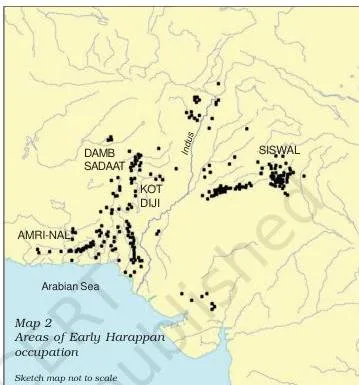
More than 2000 Harappan sites have been found, most between the Indus and Saraswati basins — nearly two-thirds of them in the Saraswati basin (NCERT, p. 2). Among these, five major cities stand out:
- Rakhigarhi — the biggest Harappan city, in Haryana
- Mohenjodaro — the best-known, best-preserved site
- Harappa — the first site to be discovered
- Dholavira — in Gujarat, with its stone reservoirs
- Ganweriwala
Remember the set with the mnemonic Ram Met His Dear Guru (R-M-H-D-G). Every other site falls into a category such as regional centre, agricultural village, port or manufacturing centre.
What made it a city: planning at Mohenjodaro (p. 5-8)
Mohenjodaro shows the signature of deliberate planning (NCERT, p. 5-6). The settlement had two parts — the Citadel, smaller but higher because buildings stood on mud-brick platforms, and the much larger Lower Town; both were walled.
Archaeologists calculate that laying the Lower Town’s platforms alone would have needed four million person-days of labour — so mobilising workers on a huge scale was a condition of city life.
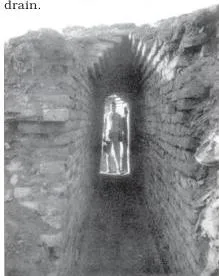
Two more signs of planning (NCERT, p. 6-7): bricks everywhere followed a standard ratio (length and breadth were four times and twice the height), and streets with drains were laid out first, with houses built along them afterwards, so every house could connect its waste water to the street drain.
Mohenjodaro had about 700 wells, and its citadel carried the two special public structures — the Great Bath and the warehouse (NCERT, p. 8).
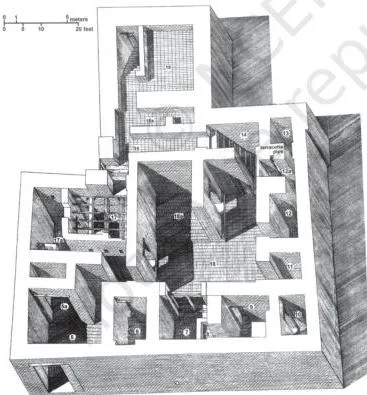
This photograph shows the arrangement in practice: every house had its own bathroom paved with bricks, with drains connected through the wall to the street drains (NCERT, p. 7).
Mackay judged the Mohenjodaro system the most complete ancient drainage system yet discovered — and it was not confined to the big cities: at Lothal, drains were made of burnt bricks even where houses were of mud bricks.
Feeding the city (p. 2-4)
Diet is reconstructed from charred grains and animal bones (NCERT, p. 2-3). Harappans ate wheat, barley, lentil, chickpea and sesame; millets come from Gujarat sites and rice finds are rare.
Cattle, sheep, goat, buffalo and pig were domesticated, and bones of wild species — boar, deer, gharial — also appear, though we do not know if the Harappans hunted them or bought meat from hunting communities.
Agriculture in semi-arid land probably needed irrigation: traces of canals survive at Shortughai in Afghanistan, and the stone-masonry reservoirs at Dholavira likely stored water for farming (NCERT, p. 3-4). At Kalibangan a ploughed field with two sets of furrows at right angles suggests two crops were grown together, and terracotta plough models come from Cholistan and Banawali (NCERT, p. 3).
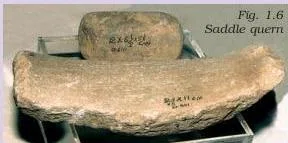
Processing grain needed grinding equipment. These rough stone saddle querns are the kind of everyday object archaeologists interpret through present-day analogies — Mackay, excavating Mohenjodaro, compared his finds with querns still used in his own kitchen, a strategy the chapter asks you to judge (NCERT, p. 4).
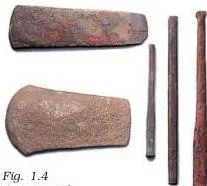
Whether harvesters used stone blades set in wooden handles or metal tools is unresolved. These copper tools come with the chapter’s own prompt: could they have been used for harvesting? The point is that a tool’s function is inferred, not obvious.
Making things and moving them: crafts and trade (p. 10-14)
The tiny settlement of Chanhudaro (less than 7 hectares against Mohenjodaro’s 125) was almost wholly devoted to craft production — bead-making, shell-cutting, metal-working, seal-making and weight-making (NCERT, p. 10). Beads were made from carnelian, jasper, crystal, quartz and steatite; from metals like copper, bronze and gold; and from shell, faience and terracotta.
Experiments show the red of carnelian came from firing the yellowish raw stone — nodules were chipped, flaked, ground, polished and drilled (NCERT, p. 10-11).
Archaeologists identify a craft centre by four traces of work: raw material, tools, unfinished objects, and rejects or waste — waste is one of the best indicators, since cut shell or stone leaves discard at the work site (NCERT, p. 11).
Materials had to travel. Clay was local, but stone, timber and metal came from outside the alluvial plain, and the settlement map shows strategy: Shortughai sat near the best source of lapis lazuli, Lothal near carnelian (from Bharuch), steatite and metal, while the Khetri region of Rajasthan probably supplied copper (NCERT, p. 12).
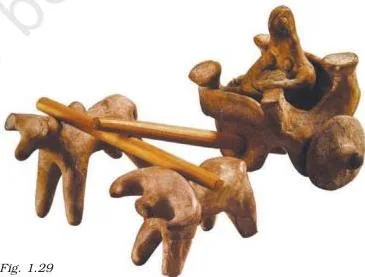
Terracotta toy models of bullock carts such as this one are evidence that bullock carts moved goods overland, alongside riverine and coastal routes (NCERT, p. 12).
Contact reached further still: Omani copper and Harappan metal both carry traces of nickel, suggesting a common origin, and Mesopotamian texts name Magan (probably Oman), Dilmun (probably Bahrain) and Meluhha (possibly the Harappan region), listing Meluhha’s products as carnelian, lapis lazuli, copper, gold and wood (NCERT, p. 13-14).
Reading society from burials and objects (p. 9-10, 15-16)
To detect social differences, archaeologists study burials. Harappan dead were usually laid in pits; some pits were lined with bricks, but whether that marks social difference is uncertain (NCERT, p. 9).
Pottery and ornaments in graves may indicate a belief in the afterlife, and ornaments appear with both men and women — one Harappa grave held shell rings, a jasper bead and hundreds of micro-beads near a male skull. But on the whole the Harappans did not bury precious things, and there are no royal burials like Egypt’s.
Artefacts are sorted as utilitarian (daily objects of ordinary materials, found everywhere) or luxuries (rare, or costly, or technically hard to make) (NCERT, p. 9). The test blurs: a spindle whorl of faience looks like a daily tool but is made of a difficult, precious material (NCERT, p. 10). Rare objects concentrate in the big cities.
Seals and sealings, meanwhile, served long-distance exchange — a sealing pressed on wet clay over a knot showed a package had not been opened and identified the sender (NCERT, p. 15).
The question of rulers (p. 16-17)
Uniform bricks, planned settlements and mobilised labour all suggest decisions taken and enforced — but by whom? The stone statue called the ‘priest-king’ got that label because archaeologists knew Mesopotamian priest-kings, not because Indus evidence proves one existed; the building labelled a palace had no spectacular finds (NCERT, p. 16).
Archaeologists hold three positions: a society with no rulers, several rulers (one per city), or a single state spanning the region (NCERT, p. 16-17).
Why the civilisation ended (p. 17-18)
By c. 1800 BCE most Mature Harappan sites in regions like Cholistan had been abandoned, with population shifting into Gujarat, Haryana and western Uttar Pradesh (NCERT, p. 17). The distinctive markers of the civilisation — seals, script, standard weights, special beads, long-distance trade, craft specialisation — disappeared, and a rural way of life followed in the ‘Late Harappan’ successor cultures.
Proposed causes include climatic change, deforestation, floods, shifting or drying rivers, and overuse of the landscape. The chapter’s key caution: some of these may fit particular settlements, but no single cause explains the collapse of the entire civilisation (NCERT, p. 17).
Archaeology as interpretation (p. 19-24)
The last sections turn the lens on archaeology itself. Sites build up as mounds of occupational debris, arranged in layers; the study of layers is stratigraphy, and the sequence of cultural periods a site shows is its cultural sequence (NCERT, p. 20).
Finds are classified by material and by function, and function is often judged by resemblance to present-day objects and by the context a find was dug from (NCERT, p. 22-23). The chapter’s deepest lesson is that interpretations change — the invasion theory was overturned by re-examining the same evidence (NCERT, p. 18).
Figure Walkthrough: Reading the Harappan Evidence

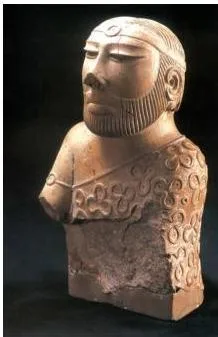
The figures are the evidence this chapter argues from, so learning to read them is learning the chapter. Each figure below comes with what archaeologists infer from it — and, just as often, what they cannot yet infer.
The seal and the script (p. 1, 15)
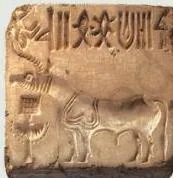
The Harappan seal is possibly the most distinctive artefact of the civilisation (NCERT, p. 1). Made of steatite, it carries an animal motif and a line of signs from a script that remains undeciphered.
Seals usually bore a short inscription — probably the owner’s name and title — and the animal motif may have conveyed meaning to those who could not read (NCERT, p. 15).
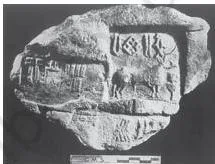
Writing was not confined to seals. This object from Dholavira is considered a signboard — and writing has been found on copper tools, jar rims, tablets, jewellery, bone rods and more (NCERT, p. 15). The spread of writing across so many ordinary objects raises a question the chapter leaves open: could literacy have been widespread?
City planning in plan and stone (p. 4, 8)
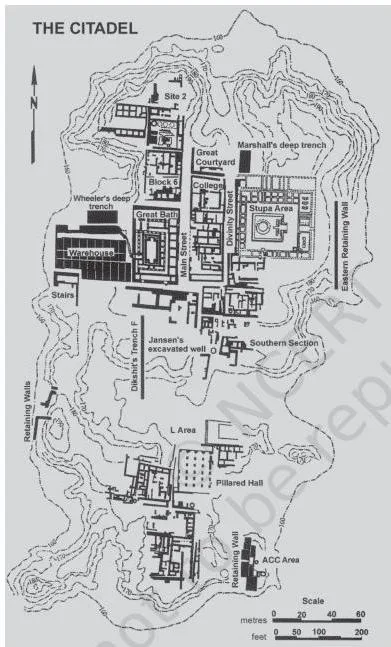
This plan of the citadel at Mohenjodaro shows the two structures set apart from ordinary houses — the warehouse and the Great Bath (NCERT, p. 8).
The Bath was a large rectangular tank made watertight with bricks set on edge and gypsum mortar, reached by steps from the north and south, with a well in a side room; its uniqueness suggests a special ritual bath. The citadel’s height and walls mark it as physically separate from the Lower Town (NCERT, p. 5-6).
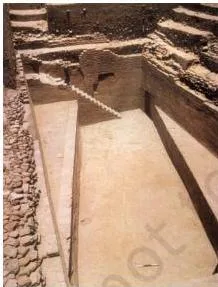
At Dholavira the water story is written in stone. This reservoir, with its masonry work, was probably used to store water for agriculture in a semi-arid region (NCERT, p. 4). Alongside canals at Shortughai and wells at Mohenjodaro, it shows how seriously the Harappans managed water.
Crafts: the standard weights (p. 1, 15)
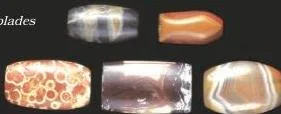
This photograph groups three kinds of finds — beads, weights and blades (NCERT, p. 1). The striking part is the weights: usually cubical, made of chert, and carrying no markings at all (NCERT, p. 15). Their system is precise, and precision tells us exchanges were regulated. Lower denominations are binary — 1, 2, 4, 8, 16, 32 — while higher denominations follow the decimal system — 160, 200, 320, 640.
The smaller weights were probably used for weighing jewellery and beads.
Long-distance contact (p. 14)
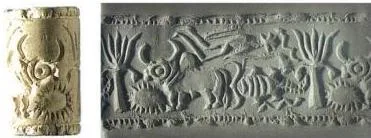
This cylinder seal is typical of Mesopotamia, yet the humped bull motif on it appears to be derived from the Indus region (NCERT, p. 14) — a small, concrete sign of contact between the two civilisations.
Mesopotamian texts add the names: Dilmun (probably Bahrain), Magan (probably Oman) and Meluhha (possibly the Harappan region), and list Meluhha’s exports as carnelian, lapis lazuli, copper, gold and wood.
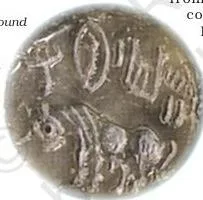
This seal depicting a boat is part of the case for sea routes (NCERT, p. 14): ships and boats appear on seals, and Mesopotamian texts describe Meluhha as a land of seafarers. The likely route ran by sea from the Harappan coast to Oman, Bahrain and Mesopotamia.
Discovery and interpretation (p. 19, 23)
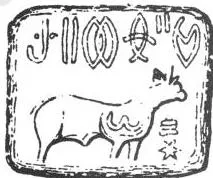
Before the civilisation was recognised, the first-known Harappan seal reached Alexander Cunningham, first Director-General of the Archaeological Survey of India. This is his sketch of the seal — he drew it, but misdated it, because he assumed Indian history began with the Early Historic cities of the Ganga valley (NCERT, p. 19).
He lacked a frame of reference, and the artefact could not speak until that frame existed.
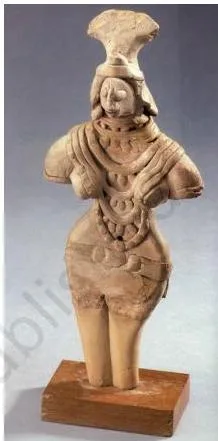
Interpretation can run ahead of evidence. A figure seated cross-legged in a yogic posture, sometimes surrounded by animals, was labelled ‘proto-Shiva’ — an early form of a major Hindu deity (NCERT, p. 23). But the earliest religious text, the Rigveda, describes Rudra neither as Pashupati (lord of animals) nor as a yogi.
The match fails, so some scholars now suggest a shaman instead. The figure is a warning: archaeologists move from the known to the unknown, and the further they go, the more speculative the reading.
Reading a burial (p. 9, 26)
Burials are one of the chapter’s main windows onto social difference. The pattern across Harappan sites: the dead laid in pits, sometimes with brick-lined hollows, with pottery and ornaments placed beside them — possibly for use in an afterlife — and ornaments found with both men and women (NCERT, p. 9).
What is absent matters just as much: no pyramids, no spectacular royal graves, no general habit of burying precious things. The chapter’s own burial photograph (Fig. 1.30, p. 26) is the subject of Exercise 5, and it is shown and read through in the Exam Notes section below.
Definitions: The Terms This Chapter Uses
These are the technical words the chapter throws at you, in plain language. Each row gives the term, what it means in this chapter, and the page where NCERT introduces it.
| Term | What it means in this chapter | NCERT page |
|---|---|---|
| steatite | Soft stone used for seals; easily worked, and even moulded from powder paste | p. 1 |
| BP / BCE / CE / c. | Dating abbreviations — Before Present, Before Common Era, Common Era, and circa (approximate) | p. 1-2 |
| citadel and Lower Town | The smaller, higher, walled part of a Harappan city and the much larger lower section | p. 5-6 |
| sealing | Clay pressed over a knot with a seal’s impression, proving a package was not tampered with | p. 15 |
| chert | Stone used for the standard, unmarked cubical weights | p. 15 |
| utilitarian / luxuries | Objects of daily use in ordinary materials versus rare or costly objects made with complex technology | p. 9 |
| faience | Ground sand or silica mixed with colour and gum, then fired; difficult to make, so treated as precious | p. 9 |
| hoards | Objects kept carefully in containers — jewellery or metal saved for reuse — often never retrieved | p. 10 |
| archaeo-botanists / zoo-archaeologists | Specialists in ancient plant remains and in animal bones | p. 2-3 |
| lapis lazuli | Highly valued blue stone whose best source lay near Shortughai in Afghanistan | p. 12 |
| Magan / Dilmun / Meluhha | Regions named in Mesopotamian texts — probably Oman, Bahrain and the Harappan region | p. 13-14 |
| mound | The build-up of occupational debris where people lived and rebuilt over centuries | p. 20 |
| stratigraphy / cultural sequence | The study of layers in a mound; the order of cultural periods a site displays | p. 20 |
| archaeogenetics | The study of DNA of ancient populations to understand population history | p. 19 |
| shaman | Men and women who claimed magical and healing powers and contact with the other world | p. 23 |
One caution: the labels the chapter prints in quotation marks — ‘priest-king’, ‘proto-Shiva’, ‘mother goddesses’ — are archaeologists’ working guesses, not proven facts. The Common Mistakes section below shows why.
Common Mistakes Students Make in This Chapter
The chapter is as much about how we know as about what we know, so its traps are interpretive. Students most often state as fact three things the book treats as doubtful — and mix up three dates and labels.
The biggest trap is the claim that the Aryans destroyed Mohenjodaro. The story ran: R.E.M. Wheeler, in 1947, read skeletons from the ‘Deadman Lane’ area as a massacre and concluded that, on circumstantial evidence, Indra stood accused (NCERT, p. 18).
In the 1960s George Dales dismantled the evidence: the skeletons belonged to different periods, there was no destruction level, no extensive burning and no armed defenders (NCERT, p. 18). Then the Rakhigarhi DNA study closed the case further.

Archaeogenetic research at Rakhigarhi — the largest Harappan city, in Haryana’s Hisar district — extracted DNA from skeletons and showed the Harappans’ genetic roots reach back to about 10,000 BCE, with unbroken continuity for roughly 5000 years (NCERT, p. 18-19). That rules out large-scale immigration of ‘so-called Aryans’. The reconstructed facial features of the Harappans show remarkable similarity to the modern population of Haryana.
| Mistake | Correct rule | How to check your answer |
|---|---|---|
| “The Aryans destroyed Mohenjodaro.” | Wheeler’s 1947 invasion theory was overturned: the skeletons are not from one event, and there is no destruction level (Dales, 1960s). Rakhigarhi DNA shows indigenous continuity for about 5000 years (p. 18-19). | Ask: is there a single dated massacre layer? Dales found none. Does the DNA show a break? It does not. |
| “The Harappan script has been deciphered.” | It remains undeciphered. It is not an alphabet but has 375-400 signs, it was written right to left, and the longest inscription has about 26 signs (p. 15). | If someone claims to read it, ask for the bilingual inscription — none has been found. |
| Confusing the phases and their dates. | The civilisation spans 6000-1300 BCE; only the Mature phase (2600-1900 BCE) is urban; decline begins c. 1900 BCE and Cholistan sites are abandoned by c. 1800 BCE (p. 1, 17). | Before naming any city or artefact, recite the three phases with their dates. |
| “Mohenjodaro was the first site discovered.” | Harappa was the first site discovered; Mohenjodaro is merely the best preserved (p. 5, 19). | Remember that Cunningham’s 1875 report and his sketch came from Harappa. |
| “The priest-king proves a priest-ruler existed.” | The label is borrowed from Mesopotamian parallels; the building called a palace had no spectacular finds; archaeologists hold three different views on rulers (p. 16-17). | Ask what the label rests on — resemblance to Mesopotamia, not Indus evidence. |
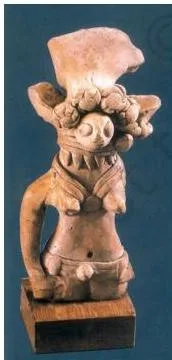
| “Mother goddesses and proto-Shiva prove a Harappan religion.” | These are reconstructions that move from the known to the unknown; Rigvedic Rudra does not match the proto-Shiva figure, and Mackay himself thought the small polished cones could be gamesmen rather than lingas (p. 23-24). | Check whether the evidence supports the label, or only resembles a later tradition. |
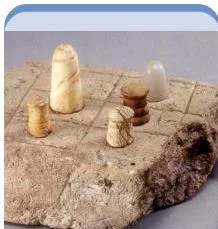
Even the excavators could not decide what some objects were. NCERT itself captions this figure ‘Gamesmen or lingas?’ — the question mark is the lesson (NCERT, p. 24).
And one classification trap the chapter flags on p. 10: a faience spindle whorl looks utilitarian but is made of a rare, hard-to-make material, so the utilitarian-versus-luxury split is not always clean — a good answer will say so.
Exam Notes: What the Chapter’s Exercises Demand
The chapter closes with its own tests, and knowing what they ask tells you what matters. The set runs: five short answers of 100-150 words (Q1-Q5), four essays of about 500 words (Q6-Q9), one map exercise (Q10) and a project with two options (Q11-Q12) (NCERT, p. 26-27).
The chapter also embeds five short source extracts — Mackay on saddle querns (p. 4), Mackay on drains (p. 7), Marshall on the Deadman Lane skeletons (p. 18), Wheeler’s ‘Indra stands accused’ (p. 18), and Dales’ rebuttal (p. 18). These are exactly the kind of short sources a source-based question is built from, so they double as practice material.
| Question | What it asks | Section and pages that answer it |
|---|---|---|
| Q1 | Food available in Harappan cities and the groups who provided it | Subsistence Strategies, p. 2-4 |
| Q2 | How archaeologists trace socio-economic differences | Burials and Looking for Luxuries, p. 9-10 |
| Q3 | Whether the drainage system indicates town planning | A Planned Urban Centre, p. 6-7 |
| Q4 | Materials used for beads and how one kind was made | Craft Production, p. 10-11 |
| Q5 | Describe the burial figure — body, objects, sex | Burials, p. 9; Fig. 1.30, p. 26 |
| Q6 | Distinctive features of Mohenjodaro | A Planned Urban Centre, p. 5-8 |
| Q7 | Raw materials for craft production and how they were obtained | Procuring Materials, p. 12-14 |
| Q8 | How archaeologists reconstruct the past | Discovering and Problems of Piecing, p. 19-24 |
| Q9 | Functions rulers may have performed in Harappan society | Ancient Authority, p. 16-17 |
| Q10 | Map work on Map 1 — agriculture, craft and raw-material sites | Settlements, p. 2; Map 1, p. 27 |
| Q11-Q12 | Project options — a museum report, or a modern-versus-Harappan object comparison | Project, p. 27 |
Worked model: how to answer the burial-figure question (Q5)
Question 5 asks you to look at Fig. 1.30 and describe what you see — how the body is placed, what lies near it, and whether anything on the body indicates the skeleton’s sex. The figure is one of the chapter’s own pieces of evidence, so the answer starts by reading it carefully.
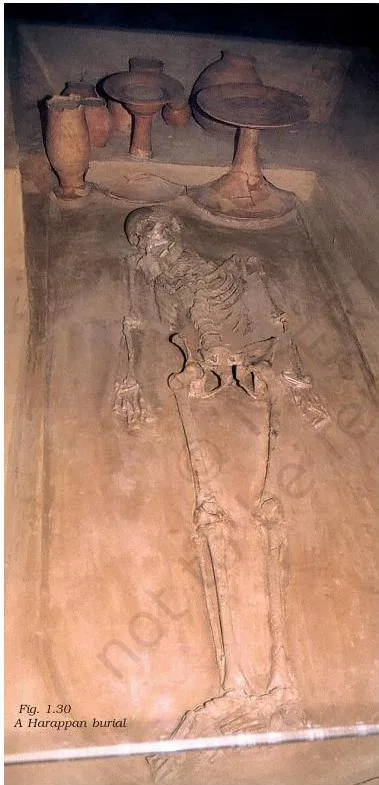
Read the figure first: the body lies extended in a pit, and objects — pottery and ornaments — have been placed beside it. Nothing on the body itself clearly marks the sex of the skeleton.
Then build the answer from section 4.1 (NCERT, p. 9) in four moves:
- Describe what you see in 2-3 sentences: the position of the body, the pit, the objects beside it.
- Interpret the grave goods: pottery and ornaments may indicate a belief in the afterlife.
- Add the variation archaeologists notice: some burial pits were lined with bricks — a possible sign of social difference, but the chapter stresses we are not sure.
- State the limits: ornaments are found with both men and women, and unlike Egypt there are no rich royal burials — the Harappans did not generally bury precious things with the dead.
That structure fits the 100-150 word limit and answers the question’s separate parts in order. A full answer names both what is present (pottery and ornaments) and what is absent (nothing on the body clearly marking its sex), because the question’s last two parts ask exactly that.
One honest note: textbook contents and the examinable syllabus are not always identical — check the current official CBSE syllabus before you decide what to revise.
Revision Map: The Whole Chapter on One Page
If you have ten minutes, read this section. It compresses the chapter into two tables and a short list of the facts you must not forget, built from the chapter’s own closing tables (p. 25).
| Phase | Dates | Character | Key evidence and sites |
|---|---|---|---|
| Early Harappan | 6000-2600 BCE | Formative: small settlements, agriculture and pastoralism, some crafts, no large buildings; urban life grows out of early farming communities from c. 7000 BCE | Ploughed field at Kalibangan; terracotta plough models |
| Mature Harappan | 2600-1900 BCE | Urban and prosperous: cities, script, standard weights, long-distance trade | The five major cities; the Great Bath; seals; the weight system |
| Late Harappan | 1900-1300 BCE | Decline: seals, script and standard weights disappear; craft specialisation and long-distance trade end; a rural way of life in ‘successor cultures’ | Abandonment of Cholistan sites by c. 1800 BCE; new settlement in Gujarat, Haryana and western Uttar Pradesh |
| Year | Development |
|---|---|
| 1875 | Cunningham reports on a Harappan seal and sketches it, but dates it wrongly |
| 1921 | Daya Ram Sahni begins excavations at Harappa |
| 1922 | Rakhal Das Banerji finds similar seals at Mohenjodaro |
| 1924 | John Marshall announces a new civilisation in the Indus valley to the world |
| 1944-46 | Wheeler follows the stratigraphy at Harappa, and later proposes the invasion theory |
| 1960s | George Dales questions the Mohenjodaro massacre |
| 2013-19 | Vasant Shinde’s archaeogenetic research at Rakhigarhi shows indigenous continuity of about 5000 years |
If you remember nothing else, remember these ten:
- Three phases and their dates: Early 6000-2600, Mature 2600-1900, Late 1900-1300 BCE (p. 1)
- The five cities and the mnemonic Ram Met His Dear Guru (p. 2)
- Mohenjodaro’s drainage-first planning: streets and drains laid before houses (p. 6-7)
- The utilitarian-versus-luxury test, and why faience spindle whorls break it (p. 9-10)
- The four markers of craft production: raw material, tools, unfinished objects, waste (p. 11)
- The Meluhha-Magan-Dilmun trade network and Meluhha’s exports (p. 13-14)
- The undeciphered script: 375-400 signs, written right to left, longest about 26 signs (p. 15)
- The three theories of authority: no rulers, several rulers, a single state (p. 16-17)
- Why the invasion theory collapsed: Dales plus the Rakhigarhi DNA study (p. 18-19)
- The meta-lesson: interpretations change (p. 18, 24)
Related Resources
This listing is maintained for the 2026-27 academic session using the NCERT textbook information available to us. NCERT remains the authority for confirming the latest edition.
This chapter is Theme 1 of Themes in Indian History Part I. To keep reading early Indian history, the next theme, Kings, Farmers and Towns, follows the same region into the age of the Mahajanapadas and the Mauryas.
The full set of chapter notes is on the Class 12 History notes page, the Class 12 hub collects notes for the other subjects, and the main CBSE notes page organises everything by class.
Reference: NCERT Class 12 History textbook, chapter 1, official edition on ncert.nic.in.
Sources and Data Verification
Four things are worth stating plainly about the information on this page:
- Page and figure descriptions on this page follow the NCERT textbook Themes in Indian History Part I, Theme 1 ‘Bricks, Beads and Bones’, 27 pages, as published on ncert.nic.in.
- This page covers Theme 1 only; the other themes of the book are linked in Related Resources.
- This listing is maintained for the current academic session using the NCERT information available to us.
- NCERT settles textbook editions and official PDFs; CBSE settles the curriculum, syllabus and examinations.
Frequently Asked Questions
Is the Harappan script deciphered?
No. The script remains undeciphered: it is not an alphabet, since it has 375-400 signs, and it was written from right to left; the longest known inscription has about 26 signs (NCERT, p. 15). A bilingual inscription could settle questions about the Harappan language, but none has been found (p. 24).
Why is the Harappan civilisation also called the Indus Valley civilisation?
Because the civilisation was first identified at Harappa, and most of its early known sites lie along the Indus and its tributaries (NCERT, p. 1). The book uses ‘Harappan’ because that is where the civilisation was identified.
What are the three phases of the Harappan civilisation and their dates?
Early Harappan (6000-2600 BCE) — the formative phase; Mature Harappan (2600-1900 BCE) — the urban, prosperous phase; Late Harappan (1900-1300 BCE) — the phase of decline (NCERT, p. 1).
Did the Aryans or an invasion destroy Mohenjodaro?
No. The skeletons were later shown to belong to different periods, with no destruction level, no burning and no armed defenders (Dales, 1960s; NCERT, p. 18). The Rakhigarhi DNA study, showing long indigenous continuity, further rules out large-scale Aryan immigration (p. 18-19).
What did the Rakhigarhi DNA study find about the Harappans?
DNA extracted from skeletons at Rakhigarhi, the biggest Harappan city (550 hectares, in Haryana), showed that Harappan genetic roots go back to about 10,000 BCE and that unbroken genetic and cultural continuity lasted roughly 5000 years (NCERT, p. 18-19). The reconstructed facial features resemble the modern population of Haryana.
Which are the five major Harappan cities and where are they located?
Rakhigarhi, Mohenjodaro, Harappa, Dholavira and Ganweriwala (NCERT, p. 2). Rakhigarhi (Haryana) and Dholavira (Gujarat) are in India; the major known sites including Harappa and Mohenjodaro became part of Pakistan after partition (p. 21). Remember the set with the mnemonic Ram Met His Dear Guru — R, M, H, D, G.
Explore Class 12 History Books
Related chapters: