
This page carries the official NCERT PDF of Thinkers, Beliefs and Buildings — Theme 4 of Class 12 History (Themes in Indian History Part I), maintained for the current academic session.
The chapter runs 33 printed pages (pp. 82-114 of the book) and covers roughly the thousand years from 600 BCE to 600 CE — the age of the Buddha and Mahavira, the Upanishads, the Sanchi stupa and the first temples. The official PDF is linked right below, and the rest of this page explains what is inside the file.
Download the Official Chapter PDF
Download the NCERT Class 12 History Theme 4 PDF — Thinkers, Beliefs and Buildings This is the official English edition of the chapter from NCERT, hosted on the NCERT website (ncert.nic.in), so the file you get is exactly the textbook chapter — all 33 pages including every figure, the source boxes, both timelines and the complete exercise section.
Open it on screen, print it, or keep it beside you as the authoritative text while you work through the explanations below.
| What the chapter holds | Count | Where it is used |
|---|---|---|
| Printed pages | 33 | |
| Sections in the chapter | 15 | |
| Figures with NCERT captions | 23 | |
| Tables | 3 | |
| Official NCERT PDF | Download the chapter PDF | the chapter exactly as NCERT publishes it |
Chapter at a Glance: What Is Inside Theme 4
Before you open the file, here is its size and shape at a glance. The table below describes this NCERT chapter only — it is not the CBSE syllabus.
| What the chapter holds | How much |
|---|---|
| Printed pages | 33 (pp. 82-114) |
| Chapter sections | 15 |
| Figures | 35 |
| Captioned figures | 16 |
| Tables (including the timeline) | 3 |
| Discussion prompts (“Discuss” boxes) | 9 |
| Exercise section | Short answers, essays, map work and project options |
In this theme the figures are not decoration: the exercises expect you to describe and interpret sculptures and the stupa plan, so the figure walkthrough below is where much of the revision value sits.
What This Chapter Covers, Section by Section
The map below lets you find any part of Theme 4 and land on the right page of the PDF in seconds. Read one row at a time, or use the whole table to see the chapter’s arc before you read deeply.
| Chapter part | What it deals with | NCERT pages |
|---|---|---|
| Opening: Sanchi in the nineteenth century | How the stupa was described, nearly carried off to Europe, and preserved by the begums of Bhopal | 82-84 |
| Sacrifices and debates | The Vedic sacrificial tradition, new Upanishadic questions, the 64 schools, fatalists and materialists | 84-88 |
| The message of Mahavira | Jainism, the tirthankaras, ahimsa, karma and the five vows | 88-90 |
| The Buddha and the quest for enlightenment | Siddhartha’s sheltered youth, the four sights, enlightenment | 90-91 |
| The teachings of the Buddha | anicca, anatta, dukkha, the middle path, nibbana | 92-93 |
| Followers of the Buddha | The sangha, monks and nuns, the Therigatha, Vinaya rules | 93-95 |
| Stupas | Why they were built, how and by whom, the structure of the mound | 96-98 |
| The fate of Amaravati and Sanchi | How the two stupas were discovered and why only one survived | 98-100 |
| Sculpture and paintings from the past | Stories in stone, symbols of worship, popular traditions, the Ajanta caves | 100-103 |
| The development of Mahayana Buddhism | The saviour idea, the Bodhisatta, the labels Mahayana and Hinayana | 103-104 |
| The growth of Puranic Hinduism and building temples | Vaishnavism, Shaivism, avatars, bhakti, the garbhagriha and the shikhara | 104-108 |
| Can we see everything? | The historian’s problems: unfamiliar images, and text and image that do not match | 108-110 |
| End matter | Timelines and the exercise section (short answers, essays, map work, projects) | 110-114 |
The arc matters for essay answers: the chapter moves from ideas (sacrifice, debate, Jainism, Buddhism) to the community built around them (the sangha), then to the buildings and images those ideas produced (stupas, sculpture, temples), and closes with the historian’s own problems in reading all of it.
The chapter refers back to Chapters 2 and 3 of this book — the themes on kings and cities of the Ganga valley and on social groups — so keep those themes nearby when you revise.
Key Concepts: What the Chapter Is Really About
This theme is not about memorising facts on three religions. It is about how new ideas challenged an older order, and how those ideas survive in texts, stone and architecture. Fix these five ideas first and every part of the chapter falls into place.
The sacrificial world and the questions that challenged it
The early Vedic tradition, known from the Rigveda (c. 1500-1000 BCE), consisted of hymns to deities such as Agni, Indra and Soma, chanted when sacrifices were performed — people prayed for cattle, sons, good health and long life (p. 84).
At first these sacrifices were collective; from about 1000 BCE households performed their own, and chiefs and kings commissioned elaborate rituals such as the rajasuya and ashvamedha, which depended on Brahmana priests.
The Upanishads (c. sixth century BCE) show those certainties being questioned: thinkers asked whether rebirth was caused by past actions, and what ultimate reality was — while some outside the Vedic tradition doubted whether a single ultimate reality existed at all (p. 85).
A verse from the Chhandogya Upanishad pushes the paradox to its limit: the self within the heart is smaller than a grain of millet, yet greater than the earth (p. 86).
This mattered far beyond religion. Many teachers, including Mahavira and the Buddha, questioned the authority of the Vedas and insisted on individual agency — that men and women could strive for liberation themselves — in marked contrast to the Brahmanical position that a person’s existence was determined by birth in a specific caste or gender (p. 85).
What Mahavira taught: ahimsa, karma and the five vows
Jaina philosophy was already in existence before Vardhamana — later called Mahavira — was born in the sixth century BCE, and Jaina tradition holds that he was preceded by 23 tirthankaras, “those who guide men and women across the river of existence” (p. 88).
The most important idea is that the entire world is animated: even stones, rocks and water have life, so non-injury (ahimsa) to living beings is central — a principle that left its mark on Indian thinking as a whole (p. 88).
Karma shapes the cycle of birth and rebirth, and only asceticism, penance and renunciation can free a person from it; monastic existence is a necessary condition of salvation. Jaina monks and nuns took five vows: to abstain from killing, stealing and lying; to observe celibacy; and to abstain from possessing property (p. 89).
Jainism spread widely and produced literature in Prakrit, Sanskrit and Tamil, and some of the earliest stone sculptures connected with religious traditions were made by devotees of the tirthankaras (p. 89).
The Buddha’s core teaching: change, sorrow and the middle path
The Buddha’s life is known from hagiographies written down at least a century after his time — hagiography meaning a biography of a saint that praises the saint and may not be literally accurate (p. 90).
Siddhartha, the sheltered son of a Sakya chief, saw on his first journey into the city an old man, a sick man and a corpse, and realised that the decay of the human body was inevitable; he also saw a homeless mendicant at peace with these facts.
He left the palace, nearly died through extreme penance, abandoned that path, and after days of meditation became the Buddha, the Enlightened One (pp. 90-91).
The core teaching is three ideas in Pali: anicca — the world is transient and constantly changing; anatta — it is soulless, with nothing permanent or eternal in it; and dukkha — sorrow is intrinsic to human existence (p. 92).
The answer is the middle path, moderation between severe penance and self-indulgence, pursued through individual effort and righteous action until the ego and desire are extinguished — nibbana (p. 92). In the earliest forms of Buddhism, whether god existed was irrelevant; tradition records his last words as “Be lamps unto yourselves.”
The sangha: a community of equals
The Buddha founded a sangha, an order of monks who lived on alms — receiving food in a bowl once a day from the laity — and were therefore known as bhikkhus. At first only men were admitted; women entered through Ananda’s mediation, and the Buddha’s foster mother Mahapajapati Gotami was the first woman ordained as a bhikkhuni (p. 93).
Members came from every social group — kings, wealthy men and gahapatis, but also workers, slaves and craftspeople — and once inside the sangha all were regarded as equal, having shed their earlier social identities (p. 93). Decisions were made by discussion and, when consensus failed, by vote, following the traditions of the ganas and sanghas.
The Therigatha, a collection of verses by nuns, preserves women’s own voices: Punna, a slave woman who carried water, is recorded debating a Brahmana about his bathing rituals (p. 94).
From stupas to temples: Mahayana, bhakti and image worship
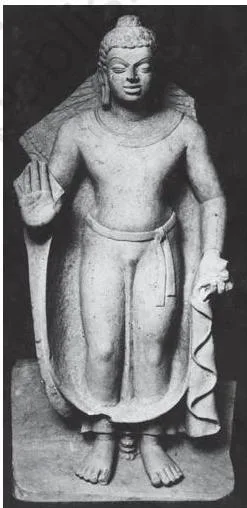
By the first century CE the idea of a saviour had emerged. The Bodhisatta was a deeply compassionate being who accumulated merit but deferred nibbana in order to help others, and the worship of images of the Buddha and Bodhisattas became important (p. 104).
This new way of thinking called itself Mahayana, the “great vehicle”, and described the older tradition as Hinayana, the “lesser vehicle” — though the older tradition’s own followers called themselves Theravadins, followers of the old teachers (p. 104).
Similar ideas grew outside Buddhism. In Vaishnavism and Shaivism, a chosen deity was worshipped with love and devotion (bhakti); Vishnu was recognised in ten avatars, forms he assumed to save the world whenever evil threatened it, and Shiva was symbolised by the linga (p. 105).
The first temples were small square rooms — the garbhagriha — with a single doorway, later covered by a tall shikhara; some were rock-cut caves hollowed from living rock (pp. 106-107).
Vedic sacrifice, Jainism and Buddhism side by side
The comparison below is the quickest way to see how the three traditions answered the same questions — a favourite shape for essay introductions.
| Aspect | Vedic sacrificial tradition | Jainism | Buddhism |
|---|---|---|---|
| Authority | The Vedas, with Brahmana priests conducting the rituals; a person’s existence thought to be determined by birth in a caste or gender (pp. 84-85) | Questioned Vedic authority; the message of the tirthankaras, with ahimsa and karma at the centre (p. 88) | Questioned Vedic authority; teaching through reason and persuasion; whether god existed was irrelevant (pp. 92-93) |
| Path to liberation | Correct performance of sacrifice, from household rites to the rajasuya and ashvamedha (p. 84) | Renunciation, asceticism and penance; monastic existence is a necessary condition of salvation (pp. 88-89) | The middle path between severe penance and self-indulgence; individual effort and righteous action leading to nibbana (p. 92) |
| Place of the individual | Determined by caste and gender (p. 85) | Individual effort through the five vows, open to monks and nuns (p. 89) | Individual agency emphasised; the sangha accepted kings, workers, slaves and craftspeople as equals (p. 93) |
Reading the Figures: Sanchi, Sculpture and Symbols
The images in this theme are historical evidence, not illustrations. Historians read them the way they read texts — and often disagree about what they show. This walkthrough teaches you to see what they see, which is exactly the skill the exercises test.
The Great Stupa and its guardians
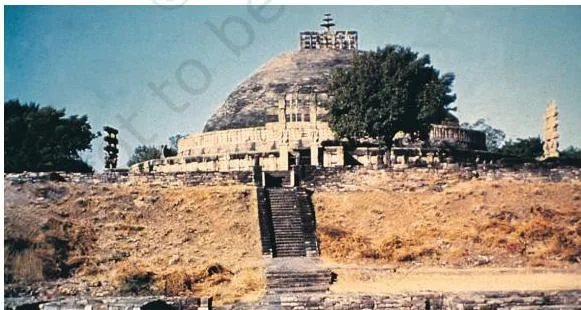
The chapter opens, before any text about Buddhism, with a sculpture from Sanchi. That is deliberate: historians reconstruct this world of ideas from texts and from material remains — monuments and inscriptions — and this figure introduces that second kind of source.
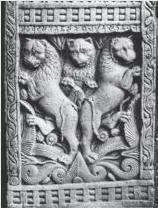
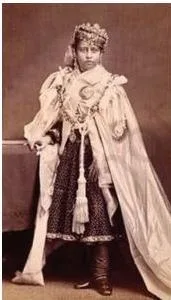
Fig. 4.2 shows Shahjehan Begum, Nawab of Bhopal (ruled 1868-1901). Her 1876 description of Sanchi opens the chapter, and the money she and her successor Sultan Jehan Begum provided preserved the site — funding the museum, the guesthouse and John Marshall’s published volumes on Sanchi.
Why did Sanchi need saving while other stupas were lost?
Compare Amaravati: a local raja stumbled on its ruins in 1796 while looking for building stone and treasure; Colin Mackenzie visited and drew the sculptures, but his reports were never published; in 1854 Walter Elliot carried panels away to Madras (the “Elliot marbles”); and new officials kept removing sculptures because earlier ones had done the same. The archaeologist H.H.
Cole called this “a suicidal and indefensible policy” and argued that originals should stay in situ — on the spot — with museums receiving plaster casts (p. 99). Amaravati was too far gone, but his policy was adopted at Sanchi, which was found in 1818 with three gateways still standing.
That, plus the begums’ money, is why Sanchi survives and the great Amaravati stupa is now an insignificant little mound (p. 100).
The plan of the Great Stupa is the most important figure in the chapter — learn to name its parts, because both the “Discuss” boxes and the essay questions expect you to.
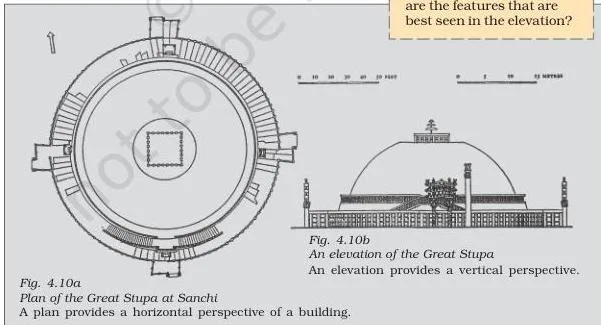
Reading the plan from the outside in: a railing rings the whole monument, separating the sacred space from the secular world; the four gateways stand at the four cardinal points; inside the circle is the great anda mound; on top of the anda sits the harmika, a balcony-like structure representing the abode of the gods; from the harmika rises the yashti mast, usually topped by a chhatri or umbrella (p. 97).
Worshippers entered through the eastern gateway and walked around the mound clockwise, keeping it on the right — imitating the sun’s course through the sky.
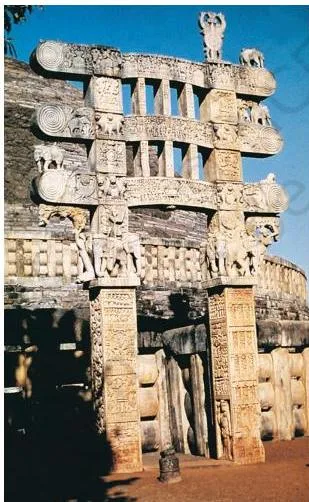
Fig. 4.11, the eastern gateway, shows what “richly carved” means: the caption tells you to notice the vibrant sculpture. Gateways were expensive — inscriptions record that the ivory workers’ guild financed part of one of them, one piece of evidence that building a stupa was a social act involving many kinds of people.
Inscriptions make the social act concrete. Fig. 4.9 is a votive inscription from Sanchi — a record of a donation. Hundreds of similar inscriptions at Sanchi, Bharhut and Amaravati name the donors: kings, guilds, monks, nuns, and hundreds of ordinary women and men with their occupations and home towns (p. 97).
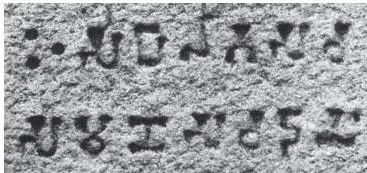
The Buddha in stone: narrative and symbol
Fig. 4.7, from Amaravati (c. 200 CE), shows the departure of the Buddha from his palace. The chapter asks the sharp question: if you did not know the Buddha’s life story, would you be able to tell what the sculpture depicts?
The scene is only readable because you bring the hagiography to it — which is exactly the historian’s problem with most religious sculpture (p. 91).
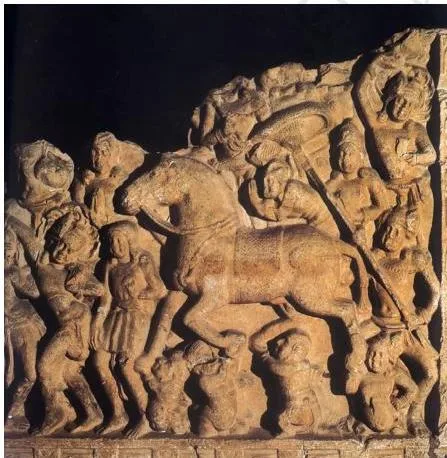
Fig. 4.8, a woman water-carrier from Mathura (c. third century CE), is the visual companion to Punna’s verses in the Therigatha. Punna was a dasi, a slave woman, who fetched water each morning and used the meeting to debate a Brahmana about his ritual bathing. The sculpture makes concrete the ordinary lives of the women who joined the sangha (p. 94).
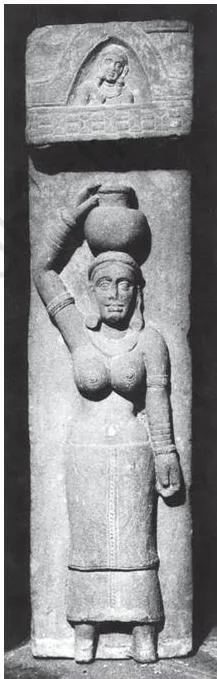
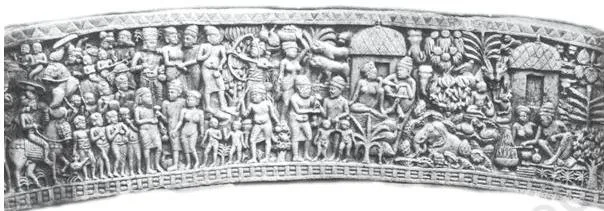
Fig. 4.13, part of the northern gateway, first looks like a rural scene — thatched huts and trees. Art historians identify it as the Vessantara Jataka, the story of a generous prince who gave everything away to a Brahmana and went to live in the forest with his wife and children.
The identification was made by comparing image with text — the method the chapter calls “stories in stone” (p. 100).
The elephant carvings at Sanchi are among its finest animal depictions. Animals drew viewers into lively scenes, but they also carried meaning: elephants, for example, signified strength and wisdom (p. 102).
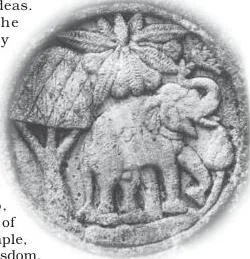
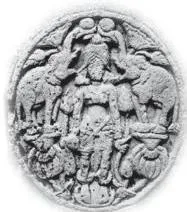
Fig. 4.19 shows a woman surrounded by lotuses while elephants sprinkle water over her as if performing an abhisheka, a consecration. Historians are divided: is she Maya, the mother of the Buddha, or Gajalakshmi, the goddess of good fortune — or, as the chapter suggests, both at once for different viewers (p. 103)?
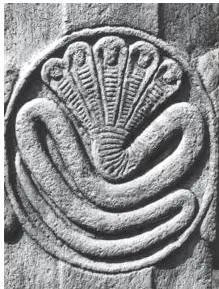
The serpent carved on pillars at Sanchi comes from popular traditions that were not always recorded in texts (p. 103). Because it is undocumented in the surviving literature, the serpent is a reminder that the texts tell only part of the story of ancient belief.
Alongside these scenes, early sculptors showed the Buddha’s presence through symbols rather than his body: the empty seat indicated his meditation, the stupa represented the mahaparinibbana, and the wheel stood for the first sermon delivered at Sarnath (p. 101).
None of these can be read literally — the tree does not stand simply for a tree, but symbolises an event in the Buddha’s life. This is why historians warn against taking early Buddhist sculpture at face value.
Temples, paintings and the limits of seeing
Stone survives the ravages of time best, but painting was also used — and the finest surviving examples are on the cave walls of Ajanta in Maharashtra.
The Ajanta paintings depict stories from the Jatakas, with courtly life, processions, men and women at work, and festivals; the artists used shading to give the figures a three-dimensional quality, and some paintings are extremely naturalistic (p. 103).
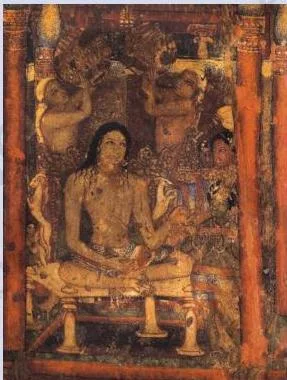
Fig. 4.25, the temple at Deogarh (c. fifth century CE), belongs to the chapter’s section on building temples. The exercise attached to it asks you to identify the remains of the shikhara — the tall tower over the central shrine — and the entrance to the garbhagriha, the small square inner room where the image was housed (p. 106).
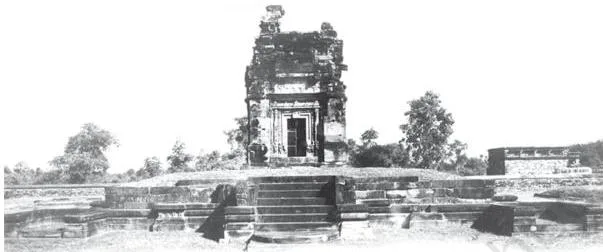
Fig. 4.26 shows Vishnu reclining on the serpent Sheshnag, also from Deogarh. It belongs to Puranic sculpture: to understand it you need the stories of the deity, his attributes and his symbols — the same skill that Buddhist sculpture demanded, now applied to Vaishnavism (p. 107).
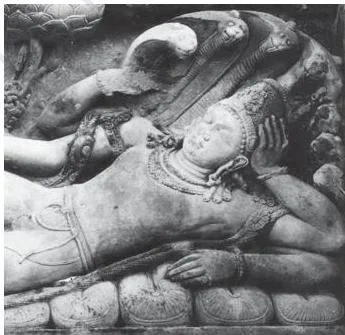
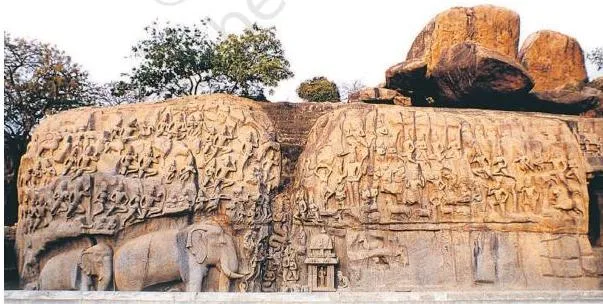
Fig. 4.30 is the chapter’s best example of text and image refusing to match.
The huge rock-cut panel at Mahabalipuram is clearly a vivid story, but historians are sharply divided: some read the natural cleft through the rock as the descent of the river Ganga from heaven, others as Arjuna’s penance from the Mahabharata, pointing to the central figure of an ascetic (p. 109).
Together these figures are what the exercises test: describing a scene from its architecture, plants, animals and activities; judging how far Buddhist literature explains the sculpture at Sanchi; and spotting popular motifs that the texts never recorded. Practise on the plates in the PDF, then test yourself on the two scenes printed with the exercise section.
Key Terms and Definitions
This theme is full of Pali and Sanskrit terms that carry the meaning, so here they are in one place. Each definition is brief — treat this as a lookup table, not a second explanation — and the page reference points to where the chapter explains the term.
| Term | Meaning | NCERT page |
|---|---|---|
| Tipitaka | “Three baskets” — the earliest compilations of the Buddha’s teachings | 87 |
| Vinaya Pitaka | The basket holding rules and regulations for the sangha | 87 |
| Sutta Pitaka | The basket holding the Buddha’s teachings | 87 |
| Abhidhamma Pitaka | The basket dealing with philosophical matters | 87 |
| sangha | The monastic order of the Buddha’s followers | 87, 93 |
| bhikkhu / bhikkhuni | A monk / a nun, living on alms received once a day | 93 |
| theri | A woman who attained liberation and became a respected elder | 93 |
| hagiography | A biography of a saint that praises the saint and may not be literally accurate | 90 |
| tirthankara | A Jaina teacher — “one who guides men and women across the river of existence” | 88 |
| ahimsa | Non-injury to living beings, central to Jaina philosophy | 88 |
| anicca | The Buddhist idea that the world is transient and constantly changing | 92 |
| anatta | The Buddhist idea that the world is soulless — nothing is permanent or eternal | 92 |
| dukkha | Sorrow, held to be intrinsic to human existence | 92 |
| nibbana | The extinguishing of ego and desire, ending the cycle of suffering | 92 |
| Bodhisatta | A compassionate being who defers nibbana in order to help others | 104 |
| Mahayana | The “great vehicle” — the newer Buddhist tradition built around the saviour figure | 104 |
| Hinayana | The “lesser vehicle” — the label Mahayana supporters gave the older tradition | 104 |
| Theravada | The older tradition’s own name — the path of the old, respected teachers, the theras | 104 |
| chaitya | A sacred site, often with a small shrine attached | 96 |
| anda | The semi-circular mound of the stupa | 97 |
| harmika | The balcony-like structure above the anda, representing the abode of the gods | 97 |
| yashti | The mast arising from the harmika | 97 |
| chhatri | The umbrella surmounting the yashti | 97 |
| shalabhanjika | A woman whose touch was believed to make trees flower and bear fruit | 102 |
| in situ | “On the spot” — keeping originals where they were found | 100 |
| garbhagriha | The small square inner room of a temple, housing the image | 106 |
| shikhara | The tall tower built over the central shrine | 106 |
| avatar | An incarnation of a deity, especially of Vishnu | 105 |
Common Mistakes Students Make in This Chapter
These are the points where the textbook itself warns readers off. Each row names the wrong idea first, then the correction and a way to check yourself.
| The mistake | What the chapter actually says | How to check your answer |
|---|---|---|
| Calling the older Buddhist tradition “Hinayana” as if it were its own name | Hinayana (“lesser vehicle”) was the label used by Mahayana supporters; followers of the older tradition described themselves as Theravadins, followers of the old teachers (p. 104) | When you write about early Buddhism, use “Theravada” for the older tradition and say who used the label “Hinayana” |
| Reading early Buddhist symbols literally | The empty seat, the tree, the stupa and the wheel each stand for an event in the Buddha’s life; the tree does not stand simply for a tree (p. 101) | For every early symbol, ask: which event in the Buddha’s life does it point to? |
| Assuming the Buddha was worshipped as a god from the start | In the earliest forms of Buddhism whether god existed was irrelevant; the saviour figure and image worship belong to the later Mahayana turn (pp. 92, 104) | Notice the date — early art used symbols; human-form Buddha images are a later development |
| Calling stupas mere burial mounds | They contained relics and were venerated as emblems of both the Buddha and Buddhism; building them was a social act (p. 97) | When asked about stupas, name who built them — kings, guilds, monks, nuns and hundreds of named donors |
| Mixing up the three baskets | Vinaya Pitaka holds the rules for the sangha, Sutta Pitaka the teachings, Abhidhamma Pitaka the philosophical matters (p. 87) | Match each basket to its job: conduct, teaching, philosophy |
| Trusting the first scholarly reading of an image | James Fergusson read Sanchi as a centre of tree and serpent worship because the Buddhist literature had not yet been translated and he worked from images alone (p. 103) | Ask what textual evidence supports an identification before accepting it |
One more error is really a preservation lesson: the Amaravati stupa was stripped because officials kept removing sculpture from the site, and H.H. Cole’s plea that originals stay in situ came too late for Amaravati — though it was adopted at Sanchi (pp. 99-100).
How to Prepare This Chapter for the Exam
The chapter’s own exercise section is the closest guide to what the book expects. Use it as your revision checklist; the four blocks below are what it asks.
| Exercise block | What it asks | What a full answer needs |
|---|---|---|
| Five short answers (100-150 words) | Upanishadic thinkers vs the fatalists and materialists; the central teachings of Jainism; the begums of Bhopal; the Dhanavati inscription; why women and men joined the sangha | A clear position in the first line, two or three reasons, and at least one specific name, term or teaching from the chapter |
| Four essays (about 500 words) | How Buddhist literature helps in understanding the Sanchi sculpture; describing and identifying two Sanchi scenes as rural or urban; sculpture and architecture of Vaishnavism and Shaivism; how and why stupas were built | A structured argument that names evidence — figures, inscriptions, texts — and applies the source-based method the chapter teaches |
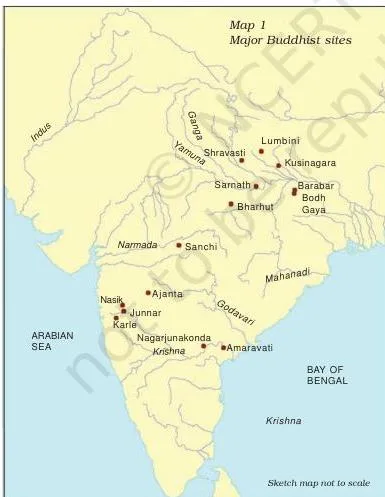
| One map question | Mark the areas to which Buddhism spread and trace the land and sea routes | Route practice, connecting each region to the teachers and texts that carried Buddhism there |
| Two project options | A field study of a religious tradition in your neighbourhood, or a picture-interpretation experiment | Follow the chapter’s own method: describe, compare, and report honestly |
- Learn the chapter’s timeline of major religious developments (p. 110) — the dates anchor every answer you write.
- Practise reading an inscription for its date, donor, text and teacher; the Dhanavati question below shows the method step by step (p. 112).
- Practise describing a figure through its architecture, plants and animals, and activities — exactly what question 7 asks (p. 113).
- Treat every “Discuss” box in the chapter as rehearsal for source-based questions — they are the book rehearsing you.
- For notes that follow these themes chapter by chapter, see the Class 12 History notes hub, and for a wider revision set, the Class 12 notes collection.
Worked example: answering the Dhanavati inscription
Exercise 4 of the chapter (p. 112) prints a real inscription and asks five short questions about it. Here is the inscription, then a model answer to each part.
“In the year 33 of the maharaja Huvishka (a Kushana ruler), in the first month of the hot season on the eighth day, a Bodhisatta was set up at Madhuvanaka by the bhikkhuni Dhanavati, the sister’s daughter of the bhikkhuni Buddhamita, who knows the Tipitaka, the female pupil of the bhikkhu Bala, who knows the Tipitaka, together with her father and mother.”
(a) How did Dhanavati date her inscription? She dated it by the ruling king’s regnal year — year 33 of the maharaja Huvishka — together with the month (the first month of the hot season) and the day (the eighth). Inscriptions of this period commonly dated themselves by the reign of the king rather than by a calendar era.
(b) Why do you think she installed an image of the Bodhisatta? By Huvishka’s time the saviour idea had taken hold within Buddhism, and the worship of Bodhisatta images had become an established practice — the inscription is itself evidence of that Mahayana development.
It also shows that such images were set up not only by kings but by individual devotees.
(c) Who were the relatives she mentioned? Her maternal aunt, the bhikkhuni Buddhamita, and her father and mother, who joined her in making the gift.
(d) What Buddhist text did she know? The Tipitaka — the three baskets of Buddhist texts, which by then a learned nun could be said to “know”.
(e) From whom did she learn this text? From the bhikkhu Bala, who also knew the Tipitaka; she is described as his female pupil.
Describing Sanchi scenes: the rural-urban method
Question 7 gives you two Sanchi scenes and asks you to describe each, then decide which is rural and which urban. Work through four cues in order, and state what you see before you judge:
- Architecture — thatched huts versus multi-storeyed buildings, gateways and railings.
- Plants and animals — trees and forest creatures versus elephants, horses, monkeys and cattle in settlement settings.
- Activities — field labour and forest life versus processions, trade and courtly scenes.
- People — their dress, posture and what they carry.
The northern gateway scene, for instance, reads as rural from its thatched huts and trees — until art historians compare it with the Vessantara Jataka and identify the story (p. 100). That is why the method always pairs observation with textual evidence.
The two scenes for question 7 (Figs. 4.32 and 4.33) are printed in the exercise section of the PDF; open that page when you practise.
Finally, remember that textbook contents and the examinable syllabus are not always identical — check the current official syllabus for the exact scope of the exam.
Revision Summary: The Whole Chapter in One Reading
The mid-first millennium BCE is treated in the chapter as a turning point in world history — the age of Zarathustra in Iran, Kong Zi in China, Socrates and Plato in Greece, and Mahavira and the Buddha in India, all trying to understand existence and the cosmic order (p. 84).
This was also the time of new kingdoms and cities in the Ganga valley, so these thinkers were responding to real, rapid social change.
The old religious order centred on sacrifice: the Rigveda’s hymns to Agni, Indra and Soma, collective rituals, then household sacrifices and the great rajasuya and ashvamedha conducted by chiefs and kings with Brahmana priests (p. 84).
The Upanishads raised new questions about rebirth, past action and ultimate reality, and Buddhist texts mention as many as 64 schools of thought debating in kutagarashalas (pp. 85-87).
Two great answers emerged. Jainism taught that the whole world is animated — even stones and water have life — so ahimsa and the five vows of renunciation were central, with karma shaping rebirth (pp. 88-89).
The Buddha taught that the world is transient (anicca), soulless (anatta) and marked by sorrow (dukkha), and that the middle path between penance and indulgence, pursued through individual effort, leads to nibbana (p. 92).
Around the Buddha grew the sangha, a community of equals — monks and nuns who lived on alms and shed their earlier identities of caste, gender and class; the Therigatha preserves the voices of women such as Punna (pp. 93-94).
The stupas at Sanchi, Bharhut and Amaravati were built as emblems of the Buddha and Buddhism, paid for by kings, guilds and hundreds of named donors (p. 97).
From about the first century CE, Buddhism turned towards the saviour figure of the Bodhisatta — the Mahayana path — while Vaishnavism and Shaivism grew around bhakti, avatars and the first temples with their garbhagriha and shikhara (pp. 103-107).
The chapter closes with the historian’s caution: much of what people believed was never recorded, and what survives is only the tip of the iceberg (p. 109).
Here is the chapter’s own chronological skeleton, restated:
| Period | Religious developments |
|---|---|
| c. 1500-1000 BCE | Early Vedic traditions — the Rigveda and its hymns |
| c. 1000-500 BCE | Later Vedic traditions — household and royal sacrifices |
| c. sixth century BCE | Early Upanishads; the beginnings of Jainism and Buddhism |
| c. third century BCE | The first stupas |
| c. second century BCE onwards | Development of Mahayana Buddhism, Vaishnavism, Shaivism and goddess cults |
| c. third century CE | The earliest temples |
Five archaeology dates from the preservation story are worth keeping separate from the religious timeline (pp. 110-111): Amaravati was stumbled upon in 1796; Sanchi was found in 1818 with three gateways still standing; Alexander Cunningham published Bhilsa Topes, one of the earliest works on Sanchi, in 1854; the Treasure Trove Act of 1888 gave the government the right to acquire objects of archaeological interest; and Sanchi was declared a World Heritage Site in 1989.
Related NCERT Pages for Class 12 History
The rest of the book is also covered on this site. Use these pages to move between the themes this chapter refers back to, or to return to the full list.
- The NCERT Class 12 History book page — the full list of themes in this book, including Parts II and III.
- Theme 3: Kinship, Caste and Class — the previous theme of Part I, which this chapter builds on for social groups and for Asoka.
- The Class 12 NCERT books hub — every Class 12 subject in one place.
For notes across subjects and classes, see the CBSE notes hub; later themes of Class 12 History, such as Theme 11, have their own pages as well.
Sources and Data Verification
This listing is maintained for the 2026-27 academic session using the NCERT textbook information available to us. NCERT remains the authority for confirming the latest edition.
Four things are worth stating plainly about where the information on this page comes from.
- The figures, page numbers and contents described here are those of the NCERT Class 12 History textbook, Themes in Indian History Part I, Theme 4 — Thinkers, Beliefs and Buildings, official edition on ncert.nic.in (chapter file lehs104).
- This page covers Theme 4 of Part I only; the other themes of Part I and the themes of Parts II and III have their own pages.
- This listing is maintained for the current academic session, using the NCERT edition currently listed on ncert.nic.in.
- NCERT settles textbooks, editions and PDFs; CBSE settles the curriculum, syllabus and examinations — textbook contents and the examinable syllabus are not always identical.
Reference: NCERT Class 12 History textbook, chapter 4, official edition on ncert.nic.in.
FAQs on Thinkers, Beliefs and Buildings
Where can I download the NCERT Class 12 History Theme 4 “Thinkers, Beliefs and Buildings” PDF?
From the link at the top of this page — Download the NCERT Class 12 History Theme 4 PDF — which points to the official chapter file (lehs104.pdf) on ncert.nic.in, the NCERT website. The file is the official English edition of Theme 4 of Themes in Indian History Part I, covering pp. 82-114 including all figures and the complete exercise section.
Why were stupas built, and what do the parts of the Sanchi stupa mean?
Stupas were mounds raised over relics of the Buddha — his bodily remains or objects he used — and the whole stupa came to be venerated as an emblem of both the Buddha and Buddhism (p. 97).
The anda is the mound; above it the harmika represents the abode of the gods; the yashti mast rises from the harmika with a chhatri umbrella on top; and a railing separates the sacred space from the secular world. Worshippers walked clockwise around the mound keeping it on the right, imitating the sun’s course (p. 97).
What is the difference between Mahayana Buddhism and Theravada Buddhism?
Mahayana, the “great vehicle”, developed from about the first century CE around the idea of a saviour and of compassionate Bodhisattas, and made the worship of images important (p. 104). Its supporters called the older tradition Hinayana, the “lesser vehicle”, but the older tradition’s own followers described themselves as Theravadins — followers of the old, respected teachers, the theras (p. 104).
Why is the Buddha shown through symbols like the empty seat and the wheel in early Buddhist sculpture?
Early sculptors did not usually show the Buddha in human form; symbols stood for events in his life — the empty seat for his meditation, the stupa for the mahaparinibbana, and the wheel for the first sermon delivered at Sarnath (p. 101).
Such sculpture cannot be understood literally: the tree does not stand simply for a tree, but symbolises an event in the Buddha’s life.
Why was the Amaravati stupa destroyed while the Sanchi stupa survived?
Amaravati was stumbled upon in 1796, before scholars understood the value of the finds, and officials kept removing sculptures from the site; H.H. Cole’s plea for in situ preservation came too late for it (pp. 99-100).
Sanchi, found in 1818, was in better condition, benefited from the funding of the begums of Bhopal, and its preservation adopted Cole’s in situ policy — so it stands while Amaravati is reduced to an insignificant mound.
What do anicca, anatta and dukkha mean in the Buddha’s teaching?
Anicca means the world is transient and constantly changing; anatta means it is soulless, with nothing permanent or eternal in it; dukkha means sorrow is intrinsic to human existence (p. 92). By following the path of moderation between severe penance and self-indulgence, human beings can rise above these worldly troubles (p. 92).
Explore Class 12 History Books
Related chapters: