
This page gives you the Rebels and the Raj Class 12 chapter — the official NCERT History Chapter 2 of Themes in Indian History Part III, pages 258–285. The official PDF appears right below, before anything else. Use this page to see how the chapter is organised and what its main ideas are.
Download Rebels and the Raj Class 12 PDF
The file below is the official NCERT edition of Themes in Indian History Part III, chapter 2. It carries the full text, all figures, the timeline and the closing questions exactly as printed.
Open the NCERT Class 12 History Chapter 2 Rebels and the Raj PDF below when you need the chapter’s exact wording, its figures and its questions for study or reference — the file is published by NCERT itself on its textbook portal.
| What the chapter holds | Count | Where it is used |
|---|---|---|
| Printed pages | 28 | |
| Sections in the chapter | 17 | |
| Figures with NCERT captions | 19 | |
| Tables | 1 | |
| Official NCERT PDF | Download the chapter PDF | the chapter exactly as NCERT publishes it |
Chapter at a glance
The table below summarises what the chapter holds — its sections, figures and exercise material — so you can judge its size at a glance.
Beyond the counts, the chapter is organised into these named parts:
- The Revolt of 1857 and its Representations — the opening theme that frames mutiny, rebellion and memory.
- 1. Pattern of the Uprising — how the mutinies began (1.1), lines of communication (1.2), leaders and followers (1.3), rumours and prophecies (1.4), and why people believed the rumours (1.5).
- The Awadh section (2.1–2.3) — “A cherry that will drop into our mouth one day”, “The life was gone out of the body”, and Firangi raj and the end of a world.
- 3. What the Rebels Wanted — the vision of unity, the attack on symbols of oppression, and the search for alternative power.
- 4. Repression — the legal and military machinery that crushed the revolt.
- 5. Images of the Revolt — celebrating saviours, English women and British honour, vengeance, terror, clemency, and nationalist imageries.
- Timeline — the chapter’s own 1801–1858 chronology.
- Closing questions — short answers, essays, map work and projects.
Along the way the chapter places Discuss prompts beside its sources — the book’s built-in reading practice — before each section moves on.
What this chapter covers
The chapter asks one question and follows it through: how did a sepoy mutiny at Meerut become a mass rebellion, and then a war fought in paintings, cartoons and memories? The notes below follow the book’s own order, with the NCERT pages where each idea appears.
How the uprising began and spread
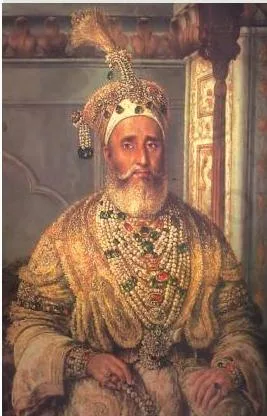
On the evening of 10 May 1857 the sepoys at Meerut broke into mutiny: they seized the bell of arms, plundered the treasury, burnt government buildings and cut the telegraph line to Delhi (NCERT, p. 258). The next morning they reached the Red Fort and pressed the aged Mughal emperor Bahadur Shah to accept their leadership (NCERT, p. 258).
In cantonment after cantonment the mutiny followed the same five-step pattern, described at the start of “Pattern of the Uprising”:
- Signal: the firing of the evening gun or the sounding of the bugle.
- Bell of arms seized: the storehouse where weapons were kept.
- Treasury plundered.
- Government buildings attacked: jail, treasury, telegraph office, record room, bungalows — with all records burned.
- Proclamations put up in Hindi, Urdu and Persian, calling Hindus and Muslims to unite and rise against the firangis (NCERT, pp. 259–260).
Think of the five S’s — Signal, Storehouse, Silver, Structures, Statements — and the order of every cantonment uprising is anchored.
The likeness of the pattern came from planning and contact between sepoy lines. The 7th Awadh Irregular Cavalry, after refusing the new cartridges, wrote to the 48th Native Infantry that they had acted for their faith and awaited its orders (NCERT, p. 260).
François Sisten, a native Christian police inspector, met a Muslim tahsildar from Bijnor who asked, “How does the work progress, brother?” — evidence that plans were discussed openly, and that the tahsildar assumed Sisten was a rebel too (NCERT, p. 261).
At Kanpur, Charles Ball recorded that panchayats met nightly in the sepoy lines, deciding matters collectively. For the book, this is proof that “the sepoys were the makers of their own rebellion” (NCERT, p. 261).
Leadership came from two directions. In the towns, crowds turned to the old rulers — Nana Sahib in Kanpur, Rani Lakshmi Bai in Jhansi under popular pressure, Kunwar Singh in Arrah, and the boy Birjis Qadr in Lucknow (NCERT, p. 262).
In the countryside, leadership was local. Shah Mal of pargana Barout mobilised the chaurasee des (eighty-four villages) at night, held court in an English officer’s bungalow, and ran an intelligence network (NCERT, p. 263).
Maulvi Ahmadullah Shah, known as Danka Shah for the drummers who walked before him, preached jehad and was elected leader by the mutinous 22nd Native Infantry. He fought at the Battle of Chinhat, where Henry Lawrence’s forces were defeated (NCERT, pp. 263–264).
The spark was the rumour of the greased cartridges. The new Enfield cartridges, the sepoys believed, were greased with the fat of cows and pigs, and biting them would destroy the faith of Hindu and Muslim alike (NCERT, p. 264).
The book even traces the rumour’s origin: a khalasi working at the magazine in Dum Dum told a Brahmin sepoy who refused him water that he would soon have to bite such cartridges (NCERT, p. 264).
Around the cartridges gathered other fears — bone dust of cows and pigs mixed into the atta, a British plot to convert India to Christianity, and the prophecy that British rule would end on the centenary of the Battle of Plassey, 23 June 1857 (NCERT, p. 265).
Chapattis passed from village to village, each watchman asked to make five more and send them on. Their meaning is not clear even today, but people read them as an omen of upheaval (NCERT, p. 265).
Why did people believe? The book’s answer is its key move: rumours circulate only when they resonate with deeper fears. From the late 1820s the British had reformed and annexed — Western education, the abolition of sati in 1829, widow remarriage, the annexation of Awadh, Jhansi and Satara — while missionaries pressed conversion.
To many, everything cherished seemed under attack, so the rumours felt true (NCERT, pp. 265–266).
Awadh: a cherry the British were waiting to pluck
Awadh explains why 1857 became a popular revolt rather than a soldiers’ affair. In 1851 Dalhousie called the kingdom “a cherry that will drop into our mouth one day”; in 1856 the British plucked it (NCERT, p. 266).
- The Nawab’s exile. Wajid Ali Shah, a widely loved ruler, was dethroned and exiled to Calcutta on the plea of misgovernment. One observer wrote that the life had gone out of the town’s body; the court dissolved, and musicians, dancers, poets, artisans, cooks, retainers and officials lost their livelihoods (NCERT, pp. 266–267).
- The taluqdars’ loss. These landholders had kept armed retainers — the largest with as many as 12,000 foot-soldiers — and forts under the Nawab. After annexation they were disarmed, their forts destroyed, and the Summary Settlement of 1856 cut their share of Awadh’s villages from 67 per cent to 38 per cent (NCERT, pp. 268–269).
- The peasants’ burden. Revenue demand rose by 30 to 70 per cent in some places, collection was inflexible, and the taluqdar’s old protection in bad years disappeared (NCERT, p. 269).
- The sepoys’ grievances. Awadh was called the “nursery of the Bengal Army”; most Bengal Army sepoys came from its villages. In the 1820s officers had wrestled and gone hawking with their men; by the 1840s they treated them as racial inferiors, and abuse and violence became common (NCERT, pp. 269–270).
The taluqdars’ own attitude survives in Hanwant Singh’s farewell to a British officer he had saved: his king had been driven out and his ancestral lands taken “at one blow” — and now he marched on Lucknow to drive the British out (NCERT, pp. 269–270).
What the rebels wanted
The rebels’ voice is the hardest evidence to recover, and the chapter is honest about why. The British won, kept the records, and dismissed the rebels as “a bunch of ungrateful and barbaric people”; most rebels were ordinary, non-literate sepoys and villagers who left nothing behind.
Apart from a few proclamations and ishtahars, almost all our evidence is British (NCERT, pp. 270–271). What survives, and what it tells a historian:
| Surviving rebel source | What it tells us |
|---|---|
| Ishtahars and proclamations (for example, the Azamgarh Proclamation) | The rebels’ public vision — what leaders promised each social group to win support (NCERT, pp. 271–273) |
| The sepoy arzi | What the sepoys believed they were fighting for — their faith — in their own words (NCERT, p. 273) |
| Letters written by rebel leaders | Personal positions and appeals that the proclamations do not carry (NCERT, p. 277) |
| British official accounts, newspapers and mutiny records | The officials’ minds and fears, and demands for revenge — not the rebels’ perspective (NCERT, pp. 270–271, 277) |
The vision itself had two faces. The proclamations appealed for unity — issued under the standards of both Muhammad and Mahavir — and promised each group a better world under the Badshahi government (NCERT, p. 271). The Azamgarh Proclamation of 25 August 1857 is the fullest example; its five sections address five social groups directly.
| Section of the proclamation | Promise under the Badshahi government | The grievance it names |
|---|---|---|
| I — Zemindars | Light revenue (jumas), dignity and honour safe, absolute rule within their own zemindary | Exorbitant revenue demand; estates auctioned for arrears; zemindars hauled into court, arrested and disgraced even at a servant’s suit; stamp costs and subscriptions for schools, hospitals, roads |
| II — Merchants | Trade in every article, by land and water, opened to Indian merchants | British monopoly of fine goods such as indigo and cloth; profits taxed with postages, tolls and subscriptions; imprisonment on a worthless man’s complaint |
| III — Public servants | Salaries of 200–300 rupees a month now, high posts later | Natives kept to low pay, little respect and no influence, while posts of dignity went to Englishmen |
| IV — Artisans | Employment in the service of kings, rajahs and the rich | English machine-made goods threw weavers, cotton dressers, carpenters, blacksmiths and shoemakers out of work, reducing them to beggary |
| V — Pundits, fakirs and learned men | A share in the holy war | The Europeans as enemies of both Hindu and Muslim religion |
The proclamation frames all five sections as a religious duty. It opens by declaring that the people of Hindostan are being ruined under the tyranny of the English, and that astrologers, pundits and miracle workers all agree the English will lose their footing in India (NCERT, p. 272).
Set the proclamation beside two other rebel voices and the differences between social groups come into focus:
| Voice | Who spoke | The grievance put first |
|---|---|---|
| Azamgarh Proclamation (25 August 1857) | A rebel leader writing in the name of an emerging Badshahi government | Economic ruin of every group and the destruction of religion |
| The sepoy arzi | Mutinous sepoys of the Bengal Army | The greased cartridges and bone-dust atta that would pollute faith; eighty-four troopers jailed for refusing to bite; “we have fought for two years in order that our faith and religion may not be polluted” (NCERT, p. 273) |
| Hanwant Singh, Raja of Kalakankar | A dispossessed taluqdar, speaking to a British officer he had saved | Annexation itself — the king driven out and hereditary lands taken; he saved the officer, then joined the march on Lucknow (NCERT, pp. 269–270) |
Beneath the proclamations ran a sharper vision they never printed. Village rebels burned account books and ransacked moneylenders’ houses — an attack on the local allies of the British and on traditional hierarchy itself, suggesting a more egalitarian society than the leaders’ world of kings and zemindars (NCERT, p. 274).
Where British rule collapsed, rebel leaders tried to rebuild authority — appointing officials, collecting revenue, paying troops, ordering an end to loot — harking back to the eighteenth-century Mughal world (NCERT, pp. 274–275).
Repression: how the British answered the revolt
The British answer had two instruments: special law and overwhelming force. The Acts of May and June 1857 put the whole of North India under martial law and made death the only punishment for rebellion (NCERT, p. 275).
The reconquest was two-pronged — one force from Calcutta, one from the largely peaceful Punjab — and Delhi was recaptured only in late September 1857 after heavy fighting (NCERT, pp. 275–276).
Awadh held out until March 1858; one official, Forsyth, estimated that three-fourths of its adult male population was in rebellion (NCERT, pp. 275–276).
An officer reporting from rural Awadh called the villagers “nearly intangible to Europeans” — they melted away and collected again, which is why reconquest had to proceed village by village (NCERT, p. 275).
Force was not the only instrument. Where big landholders and peasants had fought together, the British broke that unity by promising loyal big landholders their estates; rebel landholders were dispossessed, and many died fighting or fled to Nepal (NCERT, pp. 276–277).
Images of the revolt
The chapter’s last major theme is that 1857 was also fought in pictures. British paintings, cartoons and photographs did not record events neutrally — they justified reactions to them.
Newspapers in Britain printed the mutineers’ violence in gory detail, inflaming public feeling and provoking demands for retribution (NCERT, p. 277).
Celebrating the saviours: Thomas Jones Barker’s Relief of Lucknow (1859) places the British heroes at centre, with the damaged Residency behind them — reassuring the British public that the trouble was over and British power re-established (NCERT, pp. 277–278).
Women and honour: Joseph Noel Paton’s In Memoriam (1859) shows English women and children huddled and helpless, awaiting dishonour and death — the violence only suggested, never shown, to stir anger (NCERT, pp. 278–279).
Vengeance: cartoons such as Justice showed an allegorical female figure, aggressive and raging, trampling sepoys while Indian women with children cower — making violent reprisal look like justice itself (NCERT, p. 280).
Terror: execution prints from the Illustrated London News show mutineers blown from guns or hanging — punishment staged in the open, “the performance of terror”, so that it would be seen and feared (NCERT, pp. 281–282).
No mercy: when Governor General Canning urged leniency, the British press mocked him (NCERT, p. 283).
In the twentieth century the nationalist movement turned the same events into the First War of Independence, with Rani Lakshmi Bai as a masculine warrior — children grow up on Subhadra Kumari Chauhan’s lines, “Khoob lari mardani woh to Jhansi wali rani thi” (NCERT, p. 283).
The chapter’s closing point: images both reflect and shape feeling. British images fed public sanction for brutal repression; nationalist imageries helped shape the nationalist imagination (NCERT, pp. 283–284).
Timeline and the chapter’s closing questions
Two built-in study aids close the chapter. The timeline runs from the Subsidiary Alliance of 1801 to the death of Rani Lakshmi Bai in June 1858 — annexation, outbreak, reconquest — and is the fastest way to anchor the sequence (NCERT, p. 284).
The closing questions work through four types: short answers of 100–150 words, essays of 250–300 words, a map exercise, and projects.
The short-answer set opens by asking why mutinous sepoys turned to erstwhile rulers for leadership; the essays ask why the revolt was particularly widespread in Awadh and what the rebels wanted (NCERT, pp. 284–285).
One question asks you to examine a visual and a text source for the point of view of victor and vanquished. The map question asks you to plot the centres of revolt against the three colonial cities, and the projects send you to a biography of a rebel leader or a film on 1857 (NCERT, p. 285).
A running Discuss prompt sits beside nearly every source: how the Delhi Urdu Akhbar viewed the actions of the people (p. 260), what the Sisten–tahsildar conversation reveals about planning (p. 261), why people mourned Wajid Ali Shah (p. 268), what Hanwant Singh meant by “the people of the land” (pp. 269–270), the obstacles to reconstructing the rebels’ point of view (pp. 274–275), and identifying the artist’s perspective in each visual (p. 283).
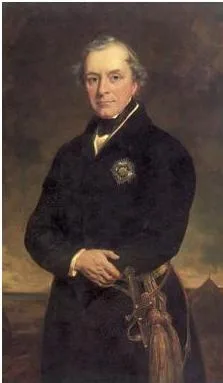
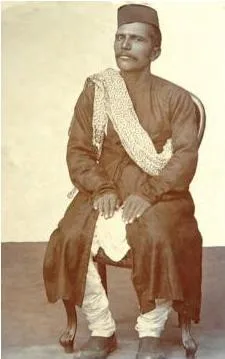
The “Faces of rebels” portraits (Fig. 10.19) stand beside the questions on page 284; the figure walkthrough below reads them as evidence.
Key concepts: six ideas that unlock the chapter
These six ideas stop the chapter from becoming a list of dates. Each is a historian’s tool that makes the events intelligible, and each carries the NCERT page where it is developed.
- Mutiny versus revolt — the book’s own margin distinction (p. 262): mutiny is collective disobedience inside the armed forces; revolt is the civilian uprising against authority. 1857 was both, and conflating them blurs who acted.
- Why rumours persuade — rumours spread only when they resonate with people’s deeper fears (pp. 264–266). The reforming laws, annexations and missionaries made the cartridge rumour believable.
- The sepoy–village link — most Bengal Army sepoys came from Awadh villages (pp. 269–270), so sepoy grievances and village grievances fed each other and the mutiny became a rebellion.
- The proclamation as political vision — the Azamgarh Proclamation shows rebels imagining the pre-British world restored, with each group’s place in it (pp. 271–273).
- The record problem — nearly all evidence is British; the rebels’ own voice survives in a few proclamations and petitions (pp. 270–271, 277).
- Images as arguments — paintings and cartoons do not just record events; they justify actions, from British calls for revenge to nationalist memory (pp. 277–284).
| Concept | One-line idea | NCERT page |
|---|---|---|
| Mutiny vs revolt | 1857 was a sepoy mutiny and a civilian revolt at once | p. 262 |
| Why rumours persuade | Rumours stick when they match existing fears | pp. 264–266 |
| The sepoy–village link | Awadh villages fed the Bengal Army, joining soldier and peasant grievances | pp. 269–270 |
| Proclamation as vision | Rebels promised a restored pre-British world | pp. 271–273 |
| The record problem | British sources dominate; rebel sources are rare | pp. 270–271, 277 |
| Images as arguments | Pictures shaped feeling, not just recorded it | pp. 277–284 |
Figure walkthrough: reading the chapter’s pictures
The chapter’s approach to images is itself a lesson: pictures are never neutral illustrations. Each one below was made to do something — reassure, enrage, frighten or inspire — and historians read them for the maker’s perspective.
The captions are the chapter’s own; the commentary shows what each image was meant to do.
The revolt in pictures: Meerut and Lucknow
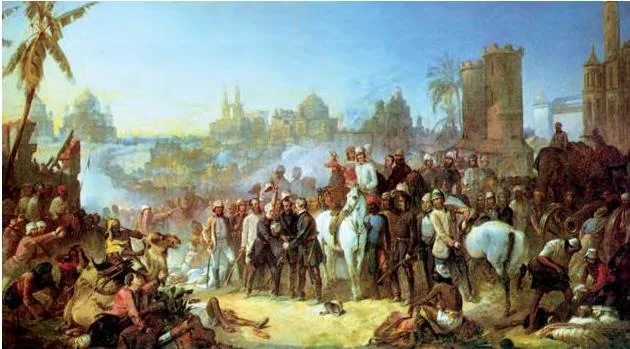
This is the chapter’s opening image (NCERT, p. 258). It fixes the date and the place — the cantonment at Meerut — and shows the mutiny breaking out of the sepoy lines into the town.
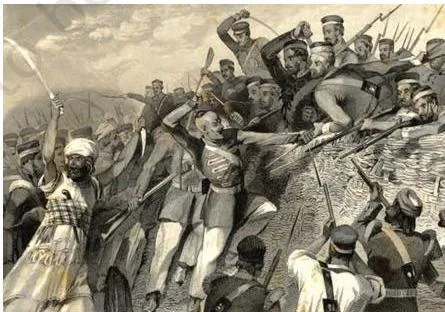
Fig. 10.2 is the book’s visual proof that this was more than a mutiny: ordinary townspeople and villagers, not soldiers in uniform, join the sepoys in attacking the British in Lucknow (NCERT, pp. 259–260).
The contrast with the first image is the argument — once civilians join, the mutiny has become a rebellion.
Rani Lakshmi Bai: from rebel queen to popular image
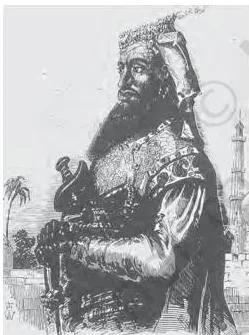
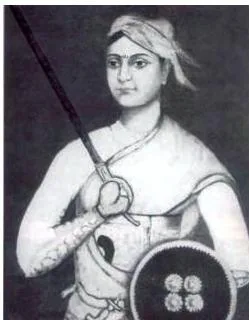
This popular print (NCERT, p. 262) shows the Rani in battle armour, sword in hand, on horseback — the tradition the chapter returns to at the end, where nationalist imageries cast her as a warrior and children learn Subhadra Kumari Chauhan’s lines about her (NCERT, pp. 283–284).
Photographs of ruin: the Delhi Ridge and Secundrah Bagh
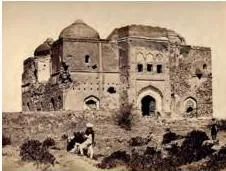
Felice Beato photographed the ruins of the Delhi Ridge after the fighting (NCERT, p. 276). The chapter groups such photographs under “images of desolation and ruin” — records of what the war destroyed, taken by the victors.
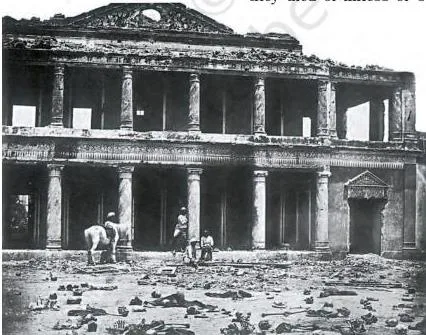
Secundrah Bagh had been a pleasure garden of Nawab Wajid Ali Shah; British forces under Campbell killed more than 2,000 rebel sepoys who held it in 1857. The skeletons scattered on the ground were, in the book’s words, “meant to be a cold warning of the futility of rebellion” (NCERT, pp. 276–277).
Innocence and vengeance: ‘In Memoriam’ and ‘Justice’
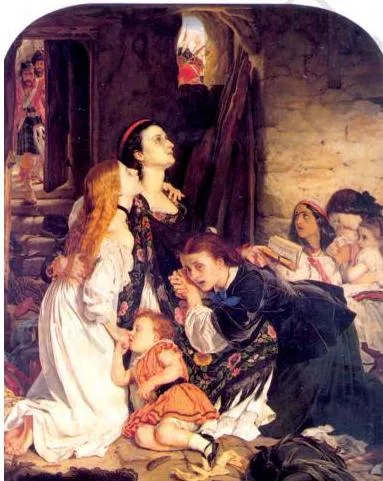
In Memoriam (NCERT, p. 279) shows English women and children huddled together, helpless, waiting. The violence is not shown — only suggested — while rescue forces arrive in the background.
The chapter’s reading: the picture stirs the spectator’s imagination and provokes anger, representing the rebels as violent and brutish even though they stay invisible (NCERT, p. 279).
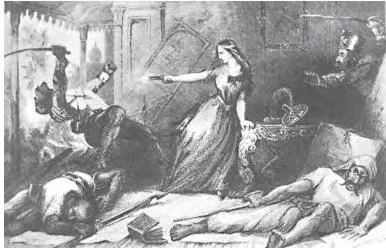
The Punch cartoon Justice (NCERT, p. 280) turns the idea of justice into a weapon: an allegorical female figure, sword in one hand and shield in the other, aggressive in posture, tramples sepoys while Indian women with children cower.
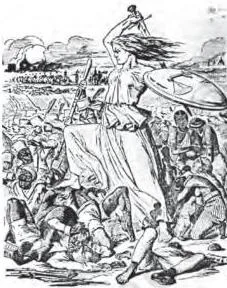
Its caption declares that the news of the massacre at Kanpur produced “an outburst of fiery indignation and wild desire for revenge throughout the whole of England” (NCERT, p. 280).
The cartoon is also the cleanest place to practise reading a British 1857 image in four steps:
- Identify the source. Who made it, where, and when? Justice is a cartoon in Punch, the British comic journal, published 12 September 1857 (NCERT, p. 280).
- Describe exactly what is shown. Note the figures and symbols without interpreting yet: an armed female allegory trampling sepoys; Indian women with children cowering.
- Read the caption. The caption tells you the intended mood: “fiery indignation and wild desire for revenge” (NCERT, p. 280).
- Ask whose argument it makes. The cartoon makes violent reprisal look like justice; the book says such images sanctioned brutal repression (NCERT, pp. 280–281).
‘The British Lion’s Vengeance on the Bengal Tiger’
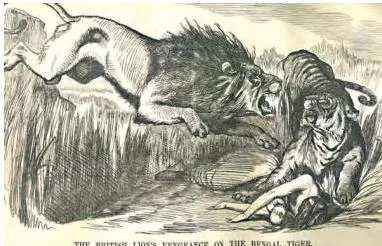
This Punch cartoon (NCERT, p. 281) is an allegory, and the chapter sets it as an exercise: what does the lion represent, what does the tiger represent, and what do the woman and child depict?
Its title — “The British Lion’s Vengeance on the Bengal Tiger” — and its place in the vengeance section tell you the argument: the British press sanctioned brutal repression and violent reprisal (NCERT, p. 281).
The performance of terror: executions in Peshawar
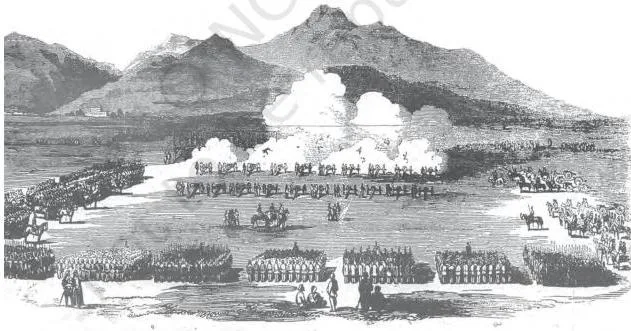
This Illustrated London News engraving (NCERT, p. 281) shows mutineers in Peshawar being blown from the guns. The book reads the scene as a stage: mounted soldiers and uniformed sepoys are made to watch their fellows die, so that the punishment becomes an enactment of brutal power.
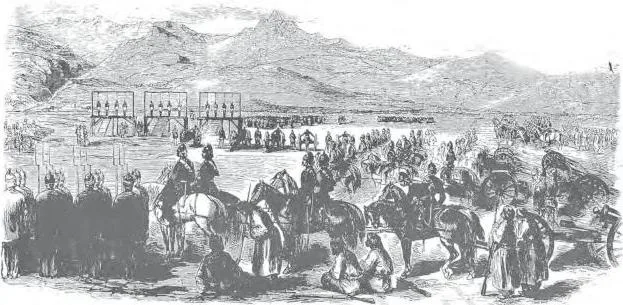
The second Peshawar print (NCERT, p. 282) shows twelve rebels hanging in a row, cannons all around them. Here the book makes its point directly: this is not routine punishment but “the performance of terror” — punishment had to be theatrically performed in the open so everyone would see the consequences of rebellion.
‘The Clemency of Canning’
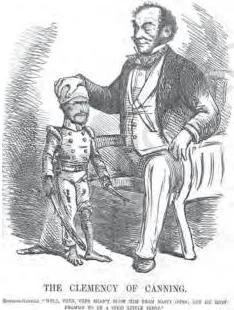
Here Canning, the Governor General, is drawn as a looming father figure, a protective hand over a sepoy who still holds an unsheathed sword and a dagger. The caption mocks the mercy: “well, then they shan’t blow him from nasty guns; but he must promise to be a good little sepoy” (NCERT, pp. 282–283).
At a moment when the press clamoured for vengeance, leniency itself was ridiculed.
Faces of rebels
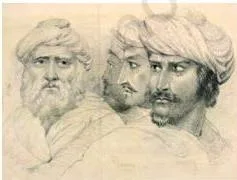
This is the chapter’s closing image (NCERT, p. 284), sitting beside the final questions. These portraits are one of the few places where the rebels themselves appear directly — the chapter reminds us throughout that their own records are almost entirely lost (NCERT, pp. 270–271).
Key terms from the chapter, explained
The chapter uses several terms that carry historical weight. Here they are, in plain words, with the NCERT page where each appears, so you can find them in your own book.
| Term | What it means | NCERT page |
|---|---|---|
| firangi | A term of Persian origin, possibly derived from Frank; used in Urdu and Hindi, often in a derogatory sense, for foreigners | p. 259 |
| bell of arms | A storeroom in which weapons are kept | p. 259 |
| mutiny | Collective disobedience of rules and regulations within the armed forces | p. 262 |
| revolt | A rebellion of people against established authority; in 1857, chiefly the civilian uprising | p. 262 |
| Resident | The Governor General’s representative at the court of a state not under direct British rule | p. 267 |
| Subsidiary Alliance | Wellesley’s 1798 system: British protection, British troops in the ally’s territory, the ally paying for them and surrendering its foreign policy | p. 267 |
| taluqdar | A landholder who controlled land, power and armed retainers in the Awadh countryside | pp. 268–269 |
| Summary Settlement of 1856 | The first British revenue settlement in Awadh, which treated taluqdars as interlopers and removed them wherever possible | p. 269 |
| chaurasee des | “Eighty-four villages”, the area of Shah Mal’s clan ties | p. 263 |
| ishtahar | A notification or proclamation issued to spread the rebels’ ideas | p. 271 |
| arzi | A petition or application, such as the surviving rebel sepoys’ arzi | p. 273 |
| sowar | A mounted soldier | p. 273 |
| khalasi | A labourer in the army magazine; the khalasi at Dum Dum whose remark started the cartridge rumour | p. 264 |
Common mistakes students make in this chapter
Six errors recur in student answers, and the textbook itself corrects each one. Read the error first, then the rule, then how to check your own answer.
| Mistake | Correct rule | How to check your answer |
|---|---|---|
| Treating the greased cartridges as the whole cause of 1857 | The book builds a chain: annexations, taluqdar dispossession, revenue overassessment, sepoy grievances, racial distance and rumours (NCERT, pp. 264–269) | Name at least one political, one economic and one religious grievance alongside the cartridges |
| Confusing mutiny and revolt | The margin distinction at p. 262: 1857 was both a sepoy mutiny and a civilian revolt | Say who acted: sepoys for mutiny; peasants, zamindars, rajas, jagirdars for revolt |
| Believing Bahadur Shah accepted leadership willingly | His first reaction was horror and rejection; he complied only when surrounded by sepoys (NCERT, p. 262) | State that the sepoys pressed him and that he had no other option but to comply |
| Reading the chapatti circulation as a coded rebel plan | The book says its meaning is not clear even today; people read it as an omen of an upheaval (NCERT, p. 265) | Do not claim the chapattis were a secret plan — the chapter explicitly does not know |
| Taking the proclamations as the voice of every rebel | Village rebels attacked moneylenders and burned account books — a more egalitarian vision the proclamations never mention (NCERT, p. 274) | Show both faces: the leaders’ unifying vision and the villagers’ assault on hierarchy |
| Using British paintings as neutral records | They demonised rebels, cast Britons as saviours, and shaped demands for revenge (NCERT, pp. 277–284) | For any visual, name the artist and publication and state what argument the image makes |
Exam notes: how to use this chapter in your answers
The chapter’s closing questions are the best guide to what you should be able to do with this material. They train four separate skills, so revision can target your weakest one.
- Short answers (100–150 words each) test precise recall: why mutinous sepoys turned to erstwhile rulers, the evidence for planning and coordination, the extent to which religious beliefs shaped events, the measures taken to ensure unity, and the steps the British took to quell the uprising (NCERT, pp. 284–285).
- Essays (250–300 words) demand an argument: why the revolt was particularly widespread in Awadh, what the rebels wanted and where the visions of different groups differed, what visual representations tell us and how historians analyse them, and an examination of one visual and one text source for the point of view of victor and vanquished (NCERT, p. 285).
- Map work asks you to plot Calcutta, Bombay and Madras, place the areas where the revolt was most widespread, and judge their distance from the colonial cities (NCERT, p. 285).
- Projects train source criticism: read a biography of a rebel leader and compare the sources it used, or watch a film on 1857 and analyse how it represents the British, the rebels and those who stayed loyal (NCERT, p. 285).
The Discuss prompts are the book’s built-in source practice. Most ask the same historian’s move you need in essays: identify the source, say who made it, and state what it claims about the rebels.
The prompt on reconstructing the rebels’ point of view (pp. 274–275) and the one asking you to identify the artist’s perspective in each visual (p. 283) are the two hardest — practise them.
For visual-source answers, use a fixed routine: name the artist and publication — Barker, Paton, Beato, Punch, Illustrated London News — say what is shown, read the caption, then state the argument the image makes.
The four-step cartoon method above, worked on Justice, is the same routine in slow motion.
Use the timeline (p. 284) as a revision anchor: the annexation phase, the outbreak phase, and the reconquest phase. Every answer can hang on those three arcs.
One caution: textbook contents and the examinable syllabus are not always identical — check the current official CBSE syllabus before you decide what to revise.
The chapter in brief
The chapter has no printed summary, so here is the argument in condensed form. A sepoy mutiny at Meerut on 10 May 1857 reached the Red Fort the next morning, and Bahadur Shah, surrounded and given no choice, blessed it — giving the revolt legitimacy in the name of the Mughal emperor (NCERT, pp. 258–260).
Cantonment after cantonment rose in the same pattern, and ordinary people joined, turning mutiny into rebellion. Grievances linked every group: the exiled Nawab of Awadh, taluqdars dispossessed by the Summary Settlement of 1856, peasants crushed by overassessment, and sepoys from the villages that suffered — all bound by fears the greased cartridges made real (NCERT, pp. 264–270).
What the rebels wanted survives in a few proclamations, most fully the Azamgarh Proclamation, which promised each group its place in a restored pre-British world (NCERT, pp. 271–273).
The British answered with martial law, a two-pronged reconquest, village-by-village warfare and rewards to loyal landholders (NCERT, pp. 275–277).
The revolt was then fought a second time in images — British paintings, cartoons and photographs that demanded revenge, and nationalist imageries that made 1857 the First War of Independence (NCERT, pp. 277–284).
Sources and data verification
This listing is maintained for the 2026-27 academic session using the NCERT textbook information available to us. NCERT remains the authority for confirming the latest edition.
Four facts anchor this page, so you can verify it without hunting.
- The textbook. This page describes Rebels and the Raj, chapter 2 of the NCERT Class 12 History textbook Themes in Indian History Part III, official edition on ncert.nic.in, printed pages 258–285.
- What this page covers. The chapter’s sections, figures, key concepts, closing questions and visual sources — and nothing outside the chapter.
- The session. This page is maintained for the current academic session.
- Who settles what. NCERT settles textbooks, editions and PDFs; CBSE settles curriculum, syllabus and examinations. For the official chapter file, go to ncert.nic.in; for the examinable syllabus, check cbseacademic.nic.in.
Reference: NCERT Class 12 History textbook, chapter 2, official edition on ncert.nic.in.
Related resources
For more on this period and book, continue with the Class 12 History book pages, the chapter before it in the same book, the chapter that follows it, and the broader Class 12 study hub.
The textbook itself closes by pointing to further reading: Gautam Bhadra’s Four Rebels of Eighteen-Fifty-Seven, Rudrangshu Mukherjee’s Awadh in Revolt, Tapti Roy’s Raj of the Rani and Eric Stokes’s Peasants and the Raj, beside websites holding accounts of 1857 by British officials and letters of Rani Lakshmibai (NCERT, p. 285).
Frequently asked questions about Rebels and the Raj
Why did the sepoys mutiny in 1857?
The immediate cause was the rumour that the new Enfield cartridges were greased with the fat of cows and pigs, so that biting them would destroy the faith of Hindu and Muslim sepoys alike (NCERT, p. 264).
The chapter’s deeper answer is that this rumour worked only because much else had already gone wrong: annexations, dispossessed taluqdars, revenue overassessment, sepoy grievances about pay and racial abuse, and missionary activity (NCERT, pp. 264–269). The cartridges were the spark; the firewood was already stacked.
What did the rebels want in 1857?
The proclamations show rebels who wanted the pre-British world restored: light revenue for zemindars, open trade for merchants, high posts for public servants, employment for artisans — all under a Badshahi government (NCERT, pp. 272–273).
Beneath that unifying vision, village rebels who burned account books and attacked moneylenders wanted something more egalitarian still (NCERT, p. 274). The rebel leadership, meanwhile, harked back to the eighteenth-century Mughal world (NCERT, pp. 274–275).
Why was the revolt particularly widespread in Awadh?
Awadh was annexed in 1856, its loved Nawab exiled, and his court dissolved — destroying many livelihoods at once (NCERT, pp. 266–268).
Taluqdars lost land as their share of villages fell from 67 to 38 per cent under the Summary Settlement, peasants faced revenue increases of 30 to 70 per cent, and most Bengal Army sepoys came from Awadh villages, so soldier and villager shared the same grievances (NCERT, p. 269). These joined grievances made Awadh, more than anywhere else, a popular revolt.
What was the Azamgarh Proclamation?
The Azamgarh Proclamation of 25 August 1857 is one of the main surviving documents of what the rebels wanted — an ishtahar addressed to the people of Hindostan (NCERT, p. 272).
In five sections it promises zemindars light revenue and security of their estates, merchants free trade, public servants higher pay and posts, artisans employment, and pundits and fakirs a share in the holy war (NCERT, pp. 272–273). Historians use it as the fullest statement of the rebels’ political vision.
How did the British repress the revolt of 1857?
They first legalised repression: the Acts of May and June 1857 put North India under martial law and made death the only punishment for rebellion (NCERT, p. 275).
They then reconquered with two forces, from Calcutta and the Punjab, recapturing Delhi only in late September 1857 and subduing Awadh in March 1858 (NCERT, pp. 275–276). Alongside force, they weakened rebel unity by promising loyal big landholders their estates (NCERT, p. 276).
How do historians use pictures of the revolt?
Historians treat the images of 1857 as evidence of the makers’ perspective rather than as neutral records. British paintings such as In Memoriam and cartoons such as Justice cast Britons as victims and saviours and helped create public support for brutal repression (NCERT, pp. 279–281).
Photographs by Beato staged desolation as a warning, and nationalist images made the Rani of Jhansi a warrior symbol (NCERT, pp. 276–277, 283–284). The chapter’s conclusion is that images both reflect and shape feeling (NCERT, p. 283).
Explore Class 12 History Books
- Previous: Colonialism and the
- Next: Mahatma Gandhi and the Nationalist Movement: Civil Disobedience and Beyond
Related chapters:
- Bricks, Beads and Bones
- Kings, Farmers and Towns
- Kinship, Caste and Class