
Framing the Constitution is Theme 12 — Chapter 4 — of the NCERT Class 12 History textbook Themes in Indian History Part III. It opens at page 316 of the printed book and tells the story of how India’s Constitution was debated and drafted between December 1946 and November 1949.
The official PDF is right below, followed by a section-by-section guide to the chapter’s debates, sources and key figures.
Download the NCERT Class 12 History Chapter 4 PDF
The official file is the NCERT PDF of Themes in Indian History Part III (book code lehs304), published on ncert.nic.in; inside it, Theme 12, Framing the Constitution, is the chapter you want.
Open the NCERT Class 12 History Chapter 4 Framing the Constitution PDF to read the chapter exactly as printed — its source-led sections, the committee and member tables, the timeline and the end-of-chapter exercises.
| What the chapter holds | Count | Where it is used |
|---|---|---|
| Printed pages | 29 | |
| Sections in the chapter | 9 | |
| Figures with NCERT captions | 7 | |
| Tables | 6 | |
| Official NCERT PDF | Download the chapter PDF | the chapter exactly as NCERT publishes it |
Framing the Constitution at a glance
The count table on this page shows how much the chapter holds. What matters for studying is its shape: the chapter moves from the crisis of 1946–47 to the Assembly’s vision, then through three great debates — on rights, on state power, on language — and closes with a timeline and exercises.
It is a text-and-source-based chapter: it teaches through debate extracts and illustrations, not through worked numerical examples.
Here is where each part of the chapter sits in the printed book:
| Chapter section | NCERT pages | What it deals with |
|---|---|---|
| A Tumultuous Time | 317–321 | The crisis years — Partition, the princely states, the making of the Assembly and its dominant voices. |
| The Vision of the Constitution | 322–326 | Nehru’s Objectives Resolution of 13 December 1946 and the claim that the Assembly expressed the people’s will. |
| Defining Rights | 327–333 | Separate electorates, religious minorities, tribals and Depressed Castes — who counted as a minority. |
| The Powers of the State | 334–336 | The Union, State and Concurrent lists, fiscal federalism and the strong-Centre debate. |
| The Language of the Nation | 336–340 | The Hindustani ideal, the plea for Hindi, southern fears and the official-language compromise. |
| Timeline and exercises | 341–343 | A chronology from 1945 to 1949, short answers, essays, map work and a project. |
What the chapter covers, section by section
This walkthrough follows the chapter in order, so you can read it alongside the book or jump to the debate you need for an answer. Each part below says what the section is trying to do, who the key speakers were, and where the argument lands.
A Tumultuous Time: why the Assembly began in crisis
You cannot understand these debates without this starting point: the Constitution was written during some of the most violent months of Indian history, and the violence shaped what members were willing to compromise on. The chapter opens by listing the pressures on the Assembly:
- Fresh political memories. The Quit India struggle of 1942, Subhas Chandra Bose’s attempt to win freedom through armed struggle with foreign aid, and the rising of the ratings of the Royal Indian Navy in Bombay and other cities in spring 1946 (NCERT, p. 317).
- Hindu-Muslim unity and its failure. The popular upsurges showed remarkable Hindu-Muslim unity, yet Congress and the Muslim League repeatedly failed to settle. The Great Calcutta Killings of August 1946 began nearly a year of rioting across northern and eastern India, ending in massacres during the transfer of populations at Partition (NCERT, p. 317).
- Independence and refugees. 15 August 1947 brought an outburst of joy and hope, but millions of Muslims, Hindus and Sikhs were on the move between the two new nations, and many perished on the way (NCERT, p. 317–318).
- Princely states. About one-third of the subcontinent was under nawabs and maharajas; with the British gone their status was ambiguous, and some began to dream of independent power in an India of many partitions (NCERT, p. 318).
The Assembly’s composition made it unusual: members were not elected by universal franchise. Provincial elections were held in the winter of 1945–46, and the elected provincial legislatures chose the representatives. The Congress swept the general seats; the Muslim League captured most reserved Muslim seats but boycotted the Assembly; the Socialists initially stayed away, calling it a British creation.
In effect 82 per cent of members were Congressmen — but the Congress was not a party with one voice: it held socialists, defenders of landlordism, and assertively secular members together (NCERT, p. 318–319).
The debates were not closed to the public. Arguments were reported in newspapers, proposals publicly debated, and the public asked to send in views. Linguistic minorities wanted protection of their mother tongue, religious minorities asked for special safeguards, and dalits demanded an end to caste oppression and reservation of seats in government bodies (NCERT, p. 320).
The chapter prints the important committees and their presidents on page 320; the ones students most often need are:
| Committee | President |
|---|---|
| Drafting Committee | B. R. Ambedkar |
| Union Power Committee | Jawaharlal Nehru |
| Union Constitution Committee | Jawaharlal Nehru |
| Provincial Constitution Committee | Vallabhbhai Patel |
| Advisory Committee | Vallabhbhai Patel |
| Rules of Procedure Committee | Rajendra Prasad |
| Steering Committee | Rajendra Prasad |
| States Committee | Jawaharlal Nehru |
| Flag Committee | J. B. Kripalani |
| Supreme Court Committee | S. Varadachariar |
| Fundamental Rights Sub-Committee | J. B. Kripalani |
| Minorities Sub-Committee | H. C. Mookerjee |
Six members mattered most. Nehru moved the Objectives Resolution and the resolution on the national flag — a horizontal tricolour of saffron, white and dark green, with a navy-blue wheel at the centre. Patel worked behind the scenes, drafting reports and reconciling opposing views. Rajendra Prasad, as President of the Assembly, steered the discussion.
B. R. Ambedkar, the lawyer and economist, chaired the Drafting Committee, helped by lawyers K. M. Munshi and Alladi Krishnaswami Aiyar; civil servants B. N. Rau and S. N. Mukherjee prepared background papers and put the proposals into legal language (NCERT, p. 320–321).
The Vision of the Constitution: the Objectives Resolution
The chapter’s centre of gravity is the Objectives Resolution that Jawaharlal Nehru moved on 13 December 1946. Everything that follows — rights, state power, language — is tested against the ideals it set out.
- The Resolution proclaimed India an Independent Sovereign Republic, guaranteed citizens justice, equality and freedom, and assured adequate safeguards for minorities, backward and tribal areas, and Depressed and Other Backward Classes (NCERT, p. 322).
- In Source 1, “We are not going just to copy”, Nehru’s mind went back to the American Constituent Assembly, the French revolutionaries’ oath at the tennis court, and the Russian revolution. The point was to locate India inside a longer history of struggle for liberty — but not to borrow a blueprint: the government India established had to fit the temper of its people (NCERT, p. 322–323).
- Asked why the word “democratic” was missing, Nehru answered that republic implied democracy, and the Resolution gave the content of democracy — even the content of economic democracy. He stood for socialism, but the shape of democracy was for the House to decide (NCERT, p. 324).
- Source 2 brings in Somnath Lahiri, a Communist member, who argued that the Assembly sat “under the shadow of British guns”: the interim government still acted under the Viceroy’s directions, so the final power remained with the British. He urged declaring independence there and then (NCERT, p. 325).
- Nehru’s reply is one of the chapter’s key ideas: governments are the expression of the will of the people — they do not come into being by State Papers, and the Assembly’s strength came from the masses behind it (NCERT, p. 326).
- The vision was different in kind from earlier reforms. The Acts of 1909, 1919 and 1935 were enacted by the colonial government, not debated by Indians; even in 1935 the electorate covered only 10 to 15 per cent of adults, with no universal adult franchise. The 1937 elections showed the shift already under way — Congress came to power in eight of the eleven provinces (NCERT, p. 326–327).
Defining Rights: separate electorates, minorities and Depressed Castes
This is the chapter’s most passionate debate — and the one where the word minority itself was contested. The question was whether protection meant separating communities or integrating them into one political nation.
- B. Pocker Bahadur (Madras, 27 August 1947) pleaded that minorities could not be wished away or erased out of existence. Only separate electorates, he argued, would give Muslims a meaningful voice, because a true representative could be chosen only by the community itself (NCERT, p. 327–328).
- Most nationalists answered that separate electorates were a British device to divide the people — Dhulekar said the English had played their game under the cover of safeguards. Patel called separate electorates a “poison” in the body politic, a demand that divided the nation and led to Partition (NCERT, p. 327–328).
- In Source 3, Patel challenged the Assembly to name one free country with separate electorates. The British element was gone, he said, but they had left their mischief behind, and India should not perpetuate it (NCERT, p. 328–329).
- In Source 4, Govind Ballabh Pant called separate electorates “suicidal to the minorities”: isolated forever, minorities could never become part of a great nation. His wider argument — there cannot be any divided loyalty — insisted that all loyalties centre on the State and that the citizen, not the community, must count (NCERT, p. 329–330).
- Begum Aizaz Rasul opposed separate electorates as self-destructive; by 1949 most Muslim members agreed that they were against the interests of the minorities (NCERT, p. 330).
- N. G. Ranga (Source 6) redefined the real minorities in economic terms — “the masses of this country”, the poor and the downtrodden. Legal rights meant little to a landless villager; people needed “props” and “a ladder” (NCERT, p. 331).
- Jaipal Singh spoke for the tribals, who had been disgracefully treated and neglected for thousands of years, suffering continuous exploitation and dispossession. He did not ask for separate electorates but for reservation of seats in the legislature, so that others would be compelled to hear the tribal voice (NCERT, p. 331–332).
- For the Depressed Castes, the chapter traces a change: Ambedkar had demanded separate electorates during the national movement and Gandhi had opposed them; after the Partition violence, Ambedkar no longer argued for separate electorates. The Assembly recommended that untouchability be abolished, temples thrown open, and seats in legislatures and jobs in government reserved for the lowest castes (NCERT, p. 332–333).
- J. Nagappa pointed out that the Depressed Castes were 20 to 25 per cent of the population — marginalised, not numerically small. K. J. Khanderkar said simply: “We were suppressed for thousands of years” (NCERT, p. 333).
- The book’s table on page 332 lists fifteen women members, including Sarojini Naidu, Hansa Mehta, Sucheta Kripalani, Begum Aizaz Rasul and Dakshayani Velayudhan. Velayudhan asked for the removal of social disabilities, not safeguards; Hansa Mehta said women had never asked for privileges — they had asked for social, economic and political justice (NCERT, p. 333).
The Powers of the State: a strong Centre versus the provinces
Every federal constitution must decide how much power the centre keeps. This debate decided it for India — and the answer leaned firmly towards the Centre.
- The Draft Constitution created three lists of subjects: Union, State and Concurrent. More items sat under exclusive Union control than in other federations, the Union also controlled minerals and key industries, and Article 356 allowed the Centre to take over a state administration on the Governor’s recommendation (NCERT, p. 334).
- The fiscal system was complex: the Centre kept customs duties and company taxes wholly, shared income tax and excise duties with the states, and assigned estate duties to them. The states could levy land and property taxes, sales tax, and the hugely profitable tax on bottled liquor (NCERT, p. 334).
- Nehru wrote that with Partition a settled fact, a weak central authority would be injurious — the Centre had to ensure peace, coordinate vital matters of common concern, and speak effectively for the country in the international sphere (NCERT, p. 334).
- K. Santhanam warned that the Centre was likely to break: there was almost an obsession that adding powers to the Centre would make it strong, and the fiscal provisions would impoverish the provinces. His dark prediction was that all provinces would rise in “revolt against the Centre” (NCERT, p. 334–335).
- The strong-Centre case was made forcefully in the Assembly: Ambedkar wanted a strong and united Centre — much stronger than that under the Government of India Act of 1935 — Gopalaswami Ayyangar wanted the Centre as strong as possible, and Balakrishna Sharma argued that only a strong centre could plan development, mobilise resources and defend the country (NCERT, p. 335).
- The context mattered: before Partition the Congress had accepted considerable provincial autonomy to reassure the Muslim League; after Partition that political pressure was gone, and the violence pushed members towards centralisation (NCERT, p. 336).
- In Source 9, A. Ramaswamy Mudaliar cautioned against moral grandstanding — wanting a strong Centre did not make anyone a better patriot (NCERT, p. 335).
- The result: the Constitution showed a distinct bias towards the rights of the Union over those of its constituent states (NCERT, p. 336).
The Language of the Nation: Hindi, Hindustani and the official language compromise
The language debate ran over many months and produced some of the sharpest exchanges in the Assembly. The key exam skill is to keep official language and national language apart.
- The Hindustani ideal. By the 1930s the Congress had accepted Hindustani as the national language. Gandhi wanted a language the common people could understand — Hindustani, the composite blend of Hindi and Urdu, enriched by diverse cultures, able to unify Hindus and Muslims and the north and the south (NCERT, p. 336).
- The split. From the late nineteenth century, Hindi was increasingly Sanskritised and Urdu increasingly Persianised as communal conflicts deepened, so language became tied to religious identity. Gandhi kept faith in the composite character of Hindustani (NCERT, p. 336).
- Source 10, from the Harijan Sevak of 12 October 1947, gives Gandhi’s test: this Hindustani should be neither Sanskritised Hindi nor Persianised Urdu but “a happy combination of both”, freely admitting words from regional and foreign languages (NCERT, p. 337).
- The plea for Hindi. R. V. Dhulekar wanted Hindi used for constitution-making and declared that members who did not know Hindustani were not worthy of the Assembly; Nehru had to restore peace. On 13 September 1949 he demanded that Hindi be declared the national language and called the official-language formula the consummation of a historic process (NCERT, p. 337–338).
- The compromise. The Language Committee proposed that Hindi in the Devanagari script be the official language, that English continue for fifteen years, and that each province choose one of its regional languages for official work. It deliberately used “official” and not “national” to calm emotions (NCERT, p. 337).
- The fear of domination. G. Durgabai told the House that the south felt this propaganda for Hindi cut at the very root of provincial languages. She had taught Hindi on Gandhi’s call, but now the composite Hindustani she had accepted was being changed, with Urdu words removed — an erosion that bred fear (NCERT, p. 338–339).
- Voices of accommodation followed: Shankarrao Deo would give Hindi his whole-hearted support only if his suspicions were not strengthened, and T. A. Ramalingam Chettiar asked for mutual adjustment, with no forcing of things on people (NCERT, p. 339).
Timeline and end-of-chapter exercises
The chapter closes by fixing the chronology and giving you questions to test yourself. The dates worth memorising are few:
- 1945–46: Labour Government in Britain; general elections in India in December–January (NCERT, p. 341).
- 16 May 1946: the Cabinet Mission announces its constitutional scheme (NCERT, p. 341).
- 16 August 1946: the Muslim League declares Direct Action Day (NCERT, p. 341).
- 2 September 1946: the Congress forms the Interim Government, with Nehru as Vice-President; the League joins on 13 October (NCERT, p. 341).
- 9 December 1946: the Constituent Assembly begins its sessions; Nehru moves the Objectives Resolution four days later (NCERT, p. 341; p. 322).
- 15 August 1947: Independence and Partition (NCERT, p. 317).
- December 1949: the Constitution is signed (NCERT, p. 341).
The framing itself ran from December 1946 to November 1949, and the Constitution came into effect on 26 January 1950 (NCERT, p. 316).
The exercises test understanding, not memory of quotes.
They open with four questions to answer in 100–150 words — the ideals of the Objectives Resolution, how different groups defined minority, the arguments for greater provincial power, and why Gandhi wanted Hindustani as the national language — then four essays of 250–300 words, a map exercise on the languages spoken in each state, and two project options (choose one): a recent constitutional change, or a comparison of the Indian Constitution with that of America, France or South Africa on secularism, minority rights or Centre-state relations (NCERT, p. 342–343).
Use the mid-text source questions as quick checks: why Nehru left out “democratic” (p. 324), why Lahiri said the Assembly sat under the shadow of British guns (p. 326), how Pant defined a loyal citizen (p. 330), and how Ranga defined minority (p. 331).
Key ideas in Framing the Constitution
If you have only one read of this chapter left, these are the six ideas an answer must be built on. Each carries its page reference so you can reopen the full argument when you need it.
How the Assembly was made. Not elected by universal franchise. Provincial legislatures, elected in the winter of 1945–46, chose the 300 members. The Congress dominated — 82 per cent — while the Muslim League boycotted and the Socialists initially stayed out. The work took eleven sessions, with sittings spread over 165 days.
Yet the Congress was internally divided on socialism, landlordism, communalism and secularism, so the debates were real (NCERT, p. 316, 318–319).
The Objectives Resolution and the will of the people. The Resolution of 13 December 1946 promised an Independent Sovereign Republic with justice, equality and freedom, and safeguards for minorities, backward and tribal areas, and Depressed and Other Backward Classes.
Against Lahiri’s charge that the Assembly was a British creation, Nehru answered that governments are the expression of the will of the people (NCERT, p. 322, 326).
Rights and the meaning of minority. Pocker Bahadur defined minorities religiously and wanted separate electorates; Patel and Pant rejected them as British mischief and as suicidal isolation; Ranga redefined the real minorities as the poor masses; Jaipal Singh made the case for the tribals; Velayudhan and Hansa Mehta asked for social justice, not privileges.
The settlement: reserved seats and protection, but no separate electorates, with untouchability abolished (NCERT, p. 327, 331, 333).
The federal bargain and the strong Centre. Three lists — Union, State, Concurrent — with more under the Union than in other federations; Article 356 let the Centre take over a state; fiscal rules gave the Centre the major taxes.
Nehru, Ambedkar, Ayyangar and Sharma argued for strength; Santhanam warned the Centre would break; Mudaliar warned against wrapping the argument in patriotism (NCERT, p. 334–336).
The language compromise. The Assembly adopted Hindi in Devanagari as the official language, with English continuing for fifteen years and regional languages for the provinces. It deliberately refused to call any language “national”. Gandhi’s composite Hindustani ideal lost out to this formula, but the fear of domination voiced by Durgabai shaped the gradual transition (NCERT, p. 337–338).
Two near-universal agreements. On universal adult franchise — granted to every adult in one stroke, an unprecedented act of faith — and on a secular state in the Indian sense: equal treatment of all religions, but a judicious distance between state and religion rather than absolute separation (NCERT, p. 339–340).
Definitions: terms from the chapter
A quick glossary for the night before the exam: each term in one clear sentence, with the page where the chapter uses it.
| Term | Meaning | NCERT page |
|---|---|---|
| Objectives Resolution | Resolution moved by Nehru on 13 December 1946 outlining the defining ideals of the Constitution — an Independent Sovereign Republic with justice, equality, freedom and safeguards for minorities and backward classes. | 322 |
| Constituent Assembly | The body that framed the Constitution between December 1946 and November 1949; it had 300 members chosen by provincial legislatures, not by universal franchise. | 316, 318 |
| Separate electorates | A system in which only members of one community vote for that community’s representatives; demanded by Pocker Bahadur and rejected by the Assembly. | 328 |
| Reserved seats | Seats set aside in legislatures for particular groups, without separate electorates; Jaipal Singh asked for these for tribals. | 331–332 |
| Union List | Subjects placed under the exclusive control of the Central Government. | 334 |
| State List | Subjects vested with the states. | 334 |
| Concurrent List | Subjects on which the Centre and the states shared responsibility. | 334 |
| Article 356 | Provision allowing the Centre to take over a state administration on the recommendation of the Governor. | 334 |
| Official language | The language used for the work of government — Hindi in Devanagari, with English continuing for fifteen years. | 337 |
| National language | A language of national identity for the whole country; Dhulekar wanted Hindi declared this, but the Assembly never did. | 338 |
| Hindustani | The composite blend of Hindi and Urdu that Gandhi wanted as the people’s language — neither Sanskritised Hindi nor Persianised Urdu. | 336–337 |
| Universal adult franchise | The right of every adult citizen to vote, granted in India at one stroke. | 339 |
| Secularism | In the Indian variant — equal treatment of all religions by the state, with a judicious distance between state and religion, not absolute separation. | 340 |
Figures in Framing the Constitution, explained
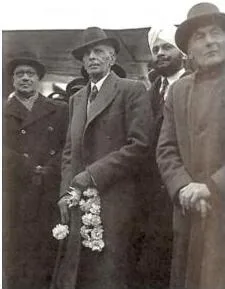
The chapter’s images are historical evidence, not decoration. Each one below carries its NCERT caption, then a note on what it shows and why it matters.
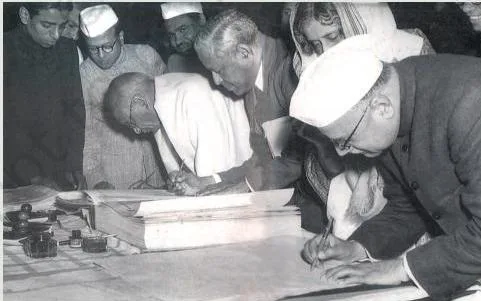
The chapter opens with the finished document itself. The Constitution was signed in December 1949 after three years of clause-by-clause debate — the image fixes the result of the whole process before the story of how it was made begins (NCERT, p. 316).
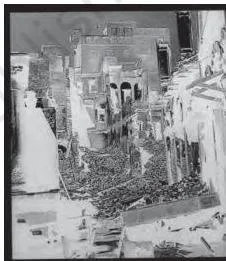
This image sits in the middle of the chapter’s account of violence and refugees. The joy of 15 August 1947 was real and unforgettable — but the Assembly met in the same weeks that millions were moving between the two new nations (NCERT, p. 317).
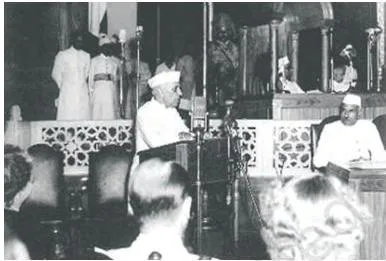
Nehru speaking at midnight, 14 August 1947 — the moment of his “tryst with destiny” address to the Assembly. The chapter places this speech at the climax of the national struggle, directly inside the story of constitution-making (NCERT, p. 318).
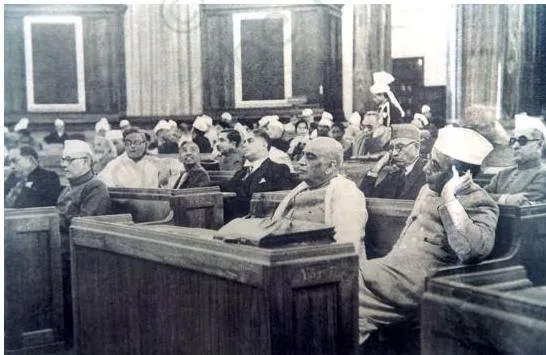
The Assembly in session. The image shows the physical setting of the debates and reminds you of Patel’s role: not the most visible orator in these pages, but the man working behind the scenes on reports and reconciliation (NCERT, p. 319).
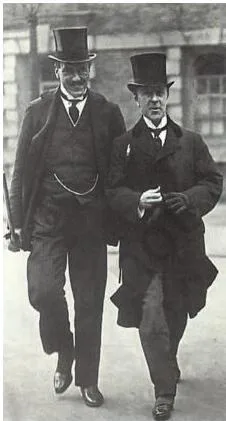
Montague belongs to the passage on the earlier, British-made reforms — the contrast that makes the Assembly’s work new. Those Acts were enacted by the colonial government and gave only limited representation; this Constitution was debated and formulated by Indians themselves (NCERT, p. 326).
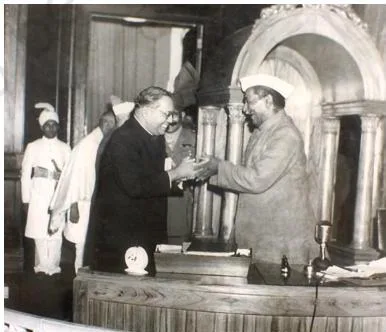
The final image — Fig 12.9 in the book — shows Ambedkar and Rajendra Prasad greeting each other at the handing over of the Constitution. It accompanies the chapter’s closing argument: the Constitution emerged through conflict and give-and-take, and members changed their positions as the three years passed (NCERT, p. 340).
Six mistakes to avoid in Framing the Constitution
These are the specific confusions this chapter creates, named before you make them in an answer. Each row gives the correction and the page that disproves the mistake.
| Mistake | Correct rule | How to check your answer |
|---|---|---|
| The Constituent Assembly was elected by universal franchise. | Members were chosen by the provincial legislatures elected in the winter of 1945–46; the Assembly was never directly elected. | Ask who voted — provincial MLAs, not the adult public (NCERT, p. 318). |
| Hindi was declared the national language. | Hindi in Devanagari became the official language; no language was declared national. | Look for the word “official” in the Language Committee’s formula; Dhulekar lost the fight for “national” (NCERT, p. 337–338). |
| Ambedkar always demanded separate electorates. | He demanded them during the national movement, but after the Partition violence he no longer argued for them. | Trace the change in section 3.3 (NCERT, p. 333). |
| The Constitution copied Western models. | Nehru placed India inside the history of the American, French and Russian revolutions but insisted “we are not going just to copy”. | Read Source 1 — the system must fit the temper of the people (NCERT, p. 322–323). |
| Secularism means complete separation of state and religion. | Indian secularism means equal treatment of all religions plus a judicious distance between state and religion. | State schools ban compulsory religious instruction, yet the state bans untouchability — both count as secular (NCERT, p. 340). |
| Hindustani is either Sanskritised Hindi or Persianised Urdu. | It is the composite blend of both — a happy combination — with words from regional and foreign languages. | Use Gandhi’s own test in Source 10 (NCERT, p. 337). |
How to revise Framing the Constitution for the exam
This chapter is examined through debates and source extracts, so revision means knowing who said what and why — not memorising quotes blindly. Use this three-step strategy.
- For every extract, fix three things: the speaker, the position they defend, and the reason they give. The chapter’s ten sources are your practice set (NCERT, p. 322–338).
- Check yourself with the mid-text questions — each one asks exactly this of a single source.
- Test yourself with the chapter’s Discuss prompts, listed below.
The who-said-what table is the core revision tool for this chapter:
| Voice | What they argued | NCERT page |
|---|---|---|
| Jawaharlal Nehru | Moved the Objectives Resolution; the Assembly expressed the will of the people; India would not copy Western models. | 322, 326 |
| Somnath Lahiri | The Assembly was working the British plan, under the shadow of British guns; declare independence at once. | 325 |
| Sardar Patel | Separate electorates were the British legacy; no free country had them; they were a poison that divided the nation. | 328–329 |
| Govind Ballabh Pant | Separate electorates were suicidal for minorities; there cannot be divided loyalty; the citizen must count. | 329–330 |
| N. G. Ranga | The real minorities were the masses of the country; rights needed props and a ladder. | 331 |
| Jaipal Singh | Tribals had been exploited and dispossessed for thousands of years; they needed reserved seats, not separate electorates. | 331–332 |
| Hansa Mehta | Women had never asked for privileges — they asked for social, economic and political justice. | 333 |
| R. V. Dhulekar | Hindi must be the language of the nation; attacked Hindustani supporters and the official-language formula. | 337–338 |
| G. Durgabai | The south feared Hindi domination; the composite character of Hindustani had to be protected. | 338 |
| A. Ramaswamy Mudaliar | Wanting a strong Centre did not make anyone a better patriot. | 335 |
Each Discuss prompt in the chapter is a ready-made practice question. Answer each in two or three sentences before looking back at the chapter:
- How did the political situation of the time shape the nature of the Assembly’s debates? — the chapter asks you to use Chapter 11 for this (NCERT, p. 321).
- What ideas did Nehru outline in his speech on the Objectives Resolution? (NCERT, p. 327)
- What different arguments were put forward against separate electorates in Sources 3 and 4? (NCERT, p. 329)
- What different arguments were put forward by those advocating a strong Centre? (NCERT, p. 336)
Keep the chronology straight from 1942 to 1950 — an answer that puts the Objectives Resolution before the Assembly’s first session, or the signing before the language debate, loses credibility at once:
| Year | Event |
|---|---|
| 1942 | Quit India movement, the most widespread popular struggle against the Raj (NCERT, p. 317). |
| Spring 1946 | Royal Indian Navy ratings’ rising in Bombay and other cities (NCERT, p. 317). |
| 16 May 1946 | Cabinet Mission announces its constitutional scheme (NCERT, p. 341). |
| 16 August 1946 | Muslim League declares Direct Action Day (NCERT, p. 341). |
| 9 December 1946 | Constituent Assembly begins its sessions (NCERT, p. 341). |
| 13 December 1946 | Nehru moves the Objectives Resolution (NCERT, p. 322). |
| 15 August 1947 | Independence and Partition (NCERT, p. 317). |
| 13 September 1949 | Language debate; the official-language compromise is reported (NCERT, p. 337). |
| December 1949 | Constitution signed (NCERT, p. 341). |
| 26 January 1950 | Constitution comes into effect (NCERT, p. 316). |
Quick revision summary of Framing the Constitution
A two-minute version of the chapter’s own closing argument, built from its final pages.
- The process. The Constitution was framed between December 1946 and November 1949, debated clause by clause, signed in December 1949 and effective from 26 January 1950. At the time it was the longest constitution in the world (NCERT, p. 316).
- The outcome. The Constitution emerged through intense debate, give-and-take and the forging of a middle ground between opposed positions — not from a single triumphant vision (NCERT, p. 339–340).
- Universal adult franchise. Every adult Indian received the vote at one stroke — an unprecedented act of faith — where the United States and Britain had granted it in stages over long struggles (NCERT, p. 339–340).
- Secularism. There was no ringing pronouncement of secularism in the Preamble; instead its features were spelt out through Fundamental Rights — freedom of religion (Articles 25–28), cultural and educational rights (Articles 29–30) and rights to equality (Articles 14, 16, 17). The state treated all religions equally and kept a judicious distance, not absolute separation (NCERT, p. 340).
Related NCERT chapters and resources
This listing is maintained for the 2026-27 academic session using the NCERT textbook information available to us. NCERT remains the authority for confirming the latest edition.
Continue with the chapter that leads into this one — Theme 11 of the same book, which covers the national movement and Partition that frame this chapter’s opening. For the full set of chapters, see the Class 12 History notes index, the Class 12 study material hub and the CBSE notes home page.
The textbook itself points you to the primary source: the digitalised Constituent Assembly Debates on the Parliament of India website, where you can read the full speeches behind the chapter’s extracts volume by volume and date by date (NCERT, p. 342). The chapter’s further-reading list begins with Granville Austin’s The Indian Constitution: The Cornerstone of a Nation.
Sources and data verification
This page is based on the NCERT Class 12 History textbook Themes in Indian History Part III, Theme 12, “Framing the Constitution” — pages 316 to 343 of the printed edition and the official PDF linked above. It covers Theme 12 only; the other themes of Part III are separate chapters.
This page is maintained for the current academic session. NCERT settles textbook editions and their PDFs; CBSE settles the curriculum, syllabus and examinations. Textbook contents and the examinable syllabus are not always identical, so check the current official CBSE syllabus for the session in which you are appearing. All page numbers follow the printed NCERT edition.
Frequently asked questions about Framing the Constitution
Which chapter is Framing the Constitution in Class 12 History?
It is Theme 12 of Themes in Indian History Part III — Chapter 4 of that volume — opening at page 316 of the printed textbook.
What was the Objectives Resolution introduced by Nehru on 13 December 1946?
It was the resolution that outlined the defining ideals of the Constitution: India as an Independent Sovereign Republic, with justice, equality and freedom for citizens, and adequate safeguards for minorities, backward and tribal areas, and Depressed and Other Backward Classes. It provided the framework within which all constitution-making proceeded (NCERT, p. 322).
Why did the Constituent Assembly reject separate electorates?
Most nationalists saw them as a British device to divide the people. Patel argued that no free country had them; Pant argued they would isolate minorities permanently and create divided loyalties. Partition itself made the Assembly fiercely opposed, and by 1949 most Muslim members agreed they were against minority interests.
The Assembly instead chose reserved seats for the Depressed Castes and tribals (NCERT, p. 328–333).
Was Hindi declared the national language of India?
No. The Assembly chose Hindi in Devanagari as the official language, with English continuing for fifteen years and provinces free to use their own regional languages. The Language Committee deliberately used “official” rather than “national”; no language was ever declared the national language (NCERT, p. 337).
Who were the important members and committees of the Constituent Assembly?
The six dominant voices were Nehru, Patel, Rajendra Prasad, Ambedkar, K. M. Munshi and Alladi Krishnaswami Aiyar. The most important committees were the Drafting Committee (Ambedkar), the Union Constitution and Union Power Committees (Nehru), the Provincial Constitution and Advisory Committees (Patel), and the Rules of Procedure and Steering Committees (Rajendra Prasad) (NCERT, p. 320–321).
How many members did the Constituent Assembly have and how were they chosen?
It had 300 members. They were not elected by universal franchise: provincial legislatures, elected in the winter of 1945–46, chose the representatives. The Congress won most general seats, the Muslim League won most reserved Muslim seats but boycotted the Assembly, and 82 per cent of members belonged to the Congress (NCERT, p. 318–319).
Reference: NCERT Class 12 History textbook (Themes in Indian History Part III), chapter 4 — Theme 12, “Framing the Constitution”, official edition on ncert.nic.in.
Explore Class 12 History Books
Related chapters:
- Bricks, Beads and Bones
- Kings, Farmers and Towns
- Kinship, Caste and Class