
This page gives you the official Peasants, Zamindars Class 12 NCERT History Chapter 4 PDF — the chapter “Peasants, Zamindars and the State” (subtitle: Agrarian Society and the Mughal Empire, c. sixteenth–seventeenth centuries) from Themes in Indian History Part II. NCERT numbers this unit Theme 8, so its figures carry Fig. 8.1, 8.2 and so on; this site lists it as Chapter 4.
The chapter runs across 31 printed pages (book pages 195–225), and the free official PDF is right below.
Download the Peasants, Zamindars Class 12 PDF
Download the NCERT Class 12 History Chapter 4 Peasants, Zamindars PDF (Themes in Indian History Part II) to get the complete official chapter text — every section, painting, source box and exercise exactly as printed in the NCERT edition.
The file is NCERT’s free, official chapter PDF, covering book pages 195–225 of Themes in Indian History Part II. It is the edition published on ncert.nic.in, so the text and page numbers match the printed textbook.
| What the chapter holds | Count | Where it is used |
|---|---|---|
| Printed pages | 31 | |
| Sections in the chapter | 10 | |
| Figures with NCERT captions | 12 | |
| Tables | 1 | |
| Official NCERT PDF | Download the chapter PDF | the chapter exactly as NCERT publishes it |
Chapter at a Glance: What Is Inside This PDF
The chapter opens by setting the scene: about 85 per cent of the population lived in villages, and the state drew the bulk of its income from agricultural production (p. 196).
From there it works through its main sections — peasants and agricultural production; the village community; women in agrarian society; the forest world beyond settled villages; the zamindars; the land revenue system; the flow of silver; and the Ain-i Akbari as a document.
Between the sections the book plants “Discuss” prompts that ask you to compare — for example, this period’s irrigation with what you learned about Vijayanagara, and these panchayats with today’s gram panchayats. The chapter ends with a landmarks timeline of the Mughal Empire, followed by short-answer questions, essays, a map exercise and a project option.
For parents and teachers: this is the NCERT edition of Themes in Indian History Part II (Class 12, History). The book numbers this unit Theme 8, which is why every figure carries a Fig. 8.x label. The table below shows how much material the chapter holds.
What This Chapter Covers: The Making of the Mughal Countryside
This chapter answers one big question: who produced food in Mughal India, who claimed a share of that produce, and how did the state take its own share? Follow the argument in this order:
- The opening claim: peasants and landed elites both claimed shares of the produce, creating relationships of cooperation, competition and conflict that together made up rural society (pp. 196–197).
- The state’s need: revenue assessors, collectors and record keepers entered the villages to make sure cultivation happened and the state got its regular share of taxes (p. 196).
- The peasant base: who the peasants were, how much land they held, and how freely they moved (pp. 198–199).
- The village community: the panchayat, the headman, caste assemblies, artisans and the money in the village (pp. 201–207).
- Women’s labour and status in an economy where the household was the unit of production (pp. 207–208).
- The forest world beyond the villages — its people, its trade, and the state’s inroads into it (pp. 208–212).
- The zamindars at the “very narrow apex” of the rural pyramid (p. 212).
- The machinery of revenue: assessment and collection, the classification of land, and the mansabdari system (pp. 214–216).
- Silver and world trade, which made a cash economy and cash revenue possible (pp. 216–218).
- The historian’s warning: the major sources are court chronicles such as the Ain-i Akbari — a view from the top — so the chapter keeps asking whose voice we are hearing (pp. 197–198).
Key Concepts: How the Chapter Rebuilds Rural Society
This chapter is a story told in concepts and Persian terms. Each idea below is explained the way a teacher would, with the textbook page beside it.
Sources and Their Limits: Why the Ain Is a View From the Top
Peasants did not write about themselves, so everything we know about them comes from the literate top of society. That is why the chapter examines its sources before its people.
The most important chronicle is the Ain-i Akbari by Abu’l Fazl, which recorded how the state ensured cultivation, collected revenue and regulated its relations with zamindars. Its central purpose was to present Akbar’s empire as harmonious, with any revolt seen as bound to fail — so whatever the Ain says about peasants remains a view from the top (p. 197).
Historians correct this by adding regional sources: detailed revenue records from Gujarat, Maharashtra and Rajasthan, and East India Company records for eastern India. These record conflicts between peasants, zamindars and the state, and in doing so reveal peasants’ expectations of fairness from the state (pp. 197–198).
Peasants and the Land: Who Cultivated and Who Owned
Before asking how revenue worked, the chapter asks who the peasants were and what they actually owned.
The standard Indo-Persian term for a peasant was raiyat (plural riaya) or muzarian; the sources also use kisan and asami (p. 198).
Seventeenth-century sources distinguish two kinds of peasants: khud-kashta, who cultivated land in the village where they lived, and pahi-kashta, who cultivated elsewhere on a contractual basis — out of choice when terms were better, or out of compulsion after a famine (p. 198).
Mobility struck Babur forcefully: in Hindustan, he wrote, villages could be depopulated and repopulated in a moment (p. 198). Holdings were modest — seldom more than a pair of bullocks and two ploughs; about six acres was affluent in Gujarat, five acres the Bengal average, and ten acres made a rich asami.
Cultivation ran on individual ownership, and peasant lands were bought and sold like any other property (pp. 198–199).
Crops, Seasons, Irrigation and New Plants
The productive base of the whole system: what was grown, in which seasons, and with what technology.
Agriculture ran on two cycles — the kharif (autumn) and rabi (spring) — so most regions produced two crops a year (do-fasla), and some produced three (p. 200). Rainfall decided the staple: rice where rainfall reached 40 inches or more a year, then wheat, then millets (p. 199). The Ain counts 39 crops in Agra, 43 in Delhi, and 50 varieties of rice in Bengal alone (p. 200).
Staples did not mean subsistence only. The state encouraged jins-i kamil (“perfect crops”) such as cotton and sugarcane because they brought in more revenue — subsistence and commercial production were intertwined in an average holding (pp. 200–201). Technology included the light wooden plough, the seed drill, broadcasting of seed, and irrigation by Persian wheel or bucket.
The state dug canals too, such as the shahnahr in the Punjab under Shah Jahan (p. 200). New crops arrived from across the world — maize, tomatoes, potatoes, chillies, pineapple, papaya — and tobacco spread rapidly after 1604 despite Jahangir’s ban (p. 200). Population grew slowly through all this, rising by about 50 million, roughly 33 per cent, between 1600 and 1800 (p. 200).
The Village Community: Panchayat, Headman and Jati Panchayat
The village was more than a collection of farmers — it was a self-regulating community with its own institutions.
Three constituents made up the community: the cultivators, the panchayat and the village headman (muqaddam or mandal) (p. 202). The headman, chosen by the consensus of elders and ratified by the zamindar, supervised village accounts with the help of the accountant or patwari (p. 202).
The panchayat raised funds from contributions and spent them on entertaining revenue officials, community welfare, and bunds and canals; it upheld caste boundaries, levied fines, and could even expel a person, making them an outcaste who lost the right to practise their profession (pp. 202–204).
Each caste or jati also had its own jati panchayat. In Rajasthan these arbitrated civil disputes over land, marriage norms and ritual precedence (p. 203). Petitions from the lowest rungs complain of extortionate taxation and begar (unpaid labour), and peasants’ ultimate weapon was to desert the village — effective because uncultivated land was easy to find (pp. 203–205).
Caste shaped the whole structure: menials like the majur, halalkhoran and mallahzada sat at the bottom, while the Ahirs, Gujars and Malis rose through cattle rearing and horticulture (pp. 201–202).
Village Artisans and the Money in the Village
Not everyone in the village farmed — and even farmers worked at crafts between seasons.
The line between cultivator and artisan was fluid: families took up dyeing, textile printing, pottery and tool repair in the lulls of the agricultural calendar (p. 205).
Artisans were paid by a share of the harvest, by an allotment of land that could become a hereditary holding (miras or watan in Maharashtra), or through negotiated goods-for-services deals later called the jajmani system (pp. 205–206). Cash was not unknown: weavers and producers of cotton, silk and indigo received advances or wages in money (pp. 205–206).
This is where the chapter’s monetisation argument begins. The French traveller Tavernier found it remarkable that even a very small Indian village had its shroff, or money changer, who acted as banker and made remittances of money (p. 206). A cash nexus had already developed through trade between villages and towns (p. 205).
Women in Agrarian Society
Women’s work is easy to overlook in a revenue-centred chapter, which is exactly why the chapter gives it a full section.
Men tilled and ploughed, while women sowed, weeded, threshed and winnowed. Because production was based on the whole household, a gendered split between home and world was not possible (p. 207). Yet taboos persisted — menstruating women were barred from the plough, the potter’s wheel and betel groves.
Spinning and embroidery depended on female labour, and the more commercialised a product, the greater the demand on women’s work; peasant and artisan women even went to markets when necessary (p. 207).
Women were valued as child bearers in a labour-dependent society, while high mortality produced distinct customs in rural communities — bride-price rather than dowry, and legitimate remarriage (p. 207). Household heads kept women under strict control, yet women petitioned panchayats for redress, usually recorded only as the mother, sister or wife of a man (p. 207).
Among the landed gentry, women inherited property, sold inherited land, and even headed zamindaris — the famous Rajshahi zamindari in Bengal had a woman at its helm (pp. 207–208).
Forests and Tribes: The World Beyond the Villages
About 85 per cent of people lived in villages, but huge swathes of the subcontinent were forest — and that world was part of the story.
The term jangli described a livelihood of gathering forest produce, hunting and shifting agriculture — not a lack of civilisation (p. 208). Among the Bhils, spring was for collecting, summer for fishing, the monsoon for cultivation, and autumn and winter for hunting (p. 208).
To the state, the forest was a place of refuge (mawas) for those who “pay no taxes”, in Babur’s words (pp. 208–209).
The state pressed in with demands such as peshkash that could include elephants, while the imperial hunt symbolised the emperor’s reach (p. 209). The Bengali poem Chandimangala tells of Kalaketu clearing forests and settling newcomers, who “having cleared the forest, established markets” (pp. 209–210).
Trade linked hills and plains: gold, copper, musk, honey and yak tails came down; cloth, salt and ornaments went up (p. 211).
Forest products such as gum lac became major exports, tribal chiefs became zamindars and even kings — the Ahom kings of Assam ran the paik system and held a royal monopoly on capturing wild elephants — and sufi pirs helped Islam spread in newly settled areas (pp. 211–212).
Zamindars: The Apex of the Rural Pyramid
The chapter’s title pairs peasants with zamindars because the two groups defined each other.
Zamindars were landed proprietors who did not directly cultivate, enjoying privileges from superior caste status and from services (khidmat) to the state (p. 212). They held private lands called milkiyat, which they could sell, bequeath or mortgage; they collected revenue for the state, kept fortresses (qilachas) and commanded cavalry, artillery and infantry.
In the visual of rural society as a pyramid, zamindars made up its “very narrow apex” (p. 212). Abu’l Fazl notes an upper-caste Brahmana-Rajput combine, a large representation of intermediate castes, and a liberal sprinkling of Muslim zamindaris (pp. 212–213).
Some zamindaris began by conquest confirmed by an imperial order (sanad), but more important was slow consolidation — colonising new lands, buying rights, and clan-based expansion by the Rajputs and Jats (p. 213). Zamindars settled cultivators with cash loans, sold the produce of their milkiyat lands, and established markets (haats) (p. 213).
The Ain gives their combined military strength a “parallel army” scale: over 384,000 cavalry and over four million infantry (p. 213). Despite being exploitative, they kept a relationship of reciprocity with peasants: bhakti saints did not condemn them, and peasants often supported zamindars against the state (pp. 213–214).
Land Revenue: Jama, Hasil and the Classifying of Land
Land revenue was the economic mainstay of the Mughal Empire, so the chapter explains exactly how it was assessed and collected.
Revenue arrangements had two stages: assessment (jama) and collection (hasil). The revenue collector, the amil-guzar, was told to prefer cash but keep payment in kind open; the state maximised its claims, but local conditions limited what it could realise (p. 214). Both cultivated and cultivable lands were measured, and in 1665 Aurangzeb ordered village-by-village, peasant-wise records (p. 214).
Akbar classified land into four classes: polaj (cultivated every year), parauti (left fallow to recover), chachar (fallow three or four years) and banjar (uncultivated five years or more). The produce of good, middling and bad plots was averaged, and one-third of the medium produce was taken as royal dues (p. 215).
Collection in kind used four methods: kankut (estimating the standing grain), batai or bhaoli (dividing the stacked crop), khet-batai (dividing the sown fields) and lang batai (dividing the cut grain in heaps) (pp. 215–216). The whole apparatus sat on the mansabdari system, whose officers were paid mostly by revenue assignments (jagirs) and transferred periodically (p. 215).
Worked example — the gap between assessing and collecting: suppose a pargana’s jama for the year was fixed at 50,000 rupees. A failed monsoon meant the amil-guzar collected only 38,000 rupees as hasil.
The gap of 12,000 rupees shows why the chapter insists on keeping assessment and collection distinct: the state maximised what it claimed, but local conditions set the real limit on what it received.
The Flow of Silver and Global Trade
The Mughal land revenue worked in cash, which only makes sense if the chapter explains where the cash came from.
The Mughal Empire was one of the large Asian empires — with the Ming, Safavid and Ottoman — whose stability created vibrant overland trade from China to the Mediterranean (p. 216). After the voyages of discovery, India’s trade with Europe expanded massively.
Huge amounts of silver bullion flowed into Asia to pay for Indian goods, and since India had no natural resources of silver, this inflow mattered enormously: the silver rupya stayed remarkably stable, minting and circulation expanded as never before, and the state could extract taxes and revenue in cash (p. 216).
The traveller Giovanni Careri observed around 1690 that all the gold and silver circulating in the world at last centred on India (pp. 217–218). The chapter reproduces a silver rupya of Akbar and one of Aurangzeb beside this argument (p. 216).
The Ain-i Akbari as a Historical Document
The chapter begins with the Ain and ends by examining the Ain itself — understanding this document is the real skill of the chapter.
The Ain-i Akbari was completed in 1598, after five revisions, as the third book of the three-book Akbar Nama (p. 218). It has five books (daftars); the third, mulk-abadi, carries the fiscal information and the “Account of the Twelve Provinces”, with eight-column tables for each sarkar listing parganas, forts, measured area, cash revenue, suyurghal grants, zamindars, their castes and their troops (p. 219).
Abu’l Fazl describes collecting this information by interrogating officials, ordering provinces to send records, using record-office files and cross-checking oral testimony — his own phrase for the whole project was “moistening the rose garden of fortune” (pp. 219–220). The standard translations are by Henry Blochmann (1873) and H.S. Jarrett (1891 and 1894) (p. 220).
The chapter is honest about the Ain’s limits: numerous errors in totalling from slips of arithmetic or transcription; skewed data, with prices and wages drawn mainly from the Agra region; and zamindar-caste information missing for Bengal and Orissa.
Yet it departs from earlier chronicles by recording the empire and its people, not just wars and dynasties, which makes it a benchmark for studying India at the turn of the seventeenth century (pp. 220–221).
Reading the Figures: The Chapter’s Paintings as Evidence
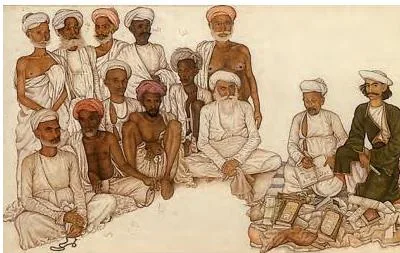
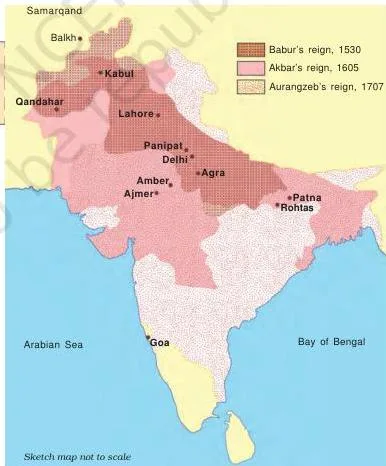
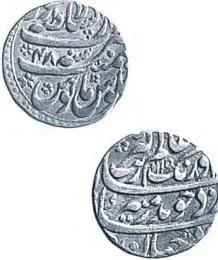
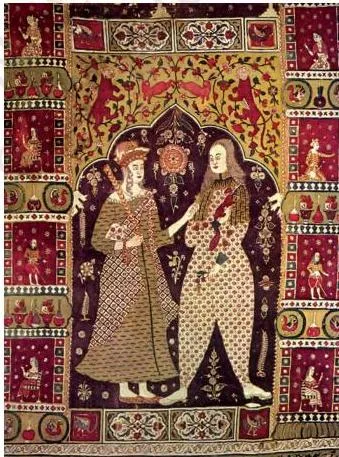
The chapter’s paintings are the closest we get to pictures of the people its texts describe. But like the Ain itself, they were made for and commissioned by the elite — so read them as evidence with a point of view.
Fig. 8.1 — A Rural Scene: The Chapter in One Image
The chapter opens with a court-made painting of country life. Look at what the painter chose to show — people at work, animals, a lived-in landscape — and connect it to the statistic that opens the chapter: about 85 per cent of the population lived in villages (p. 196).
The image tells us the countryside mattered to the empire, while reminding us the picture was painted at the top, looking down.
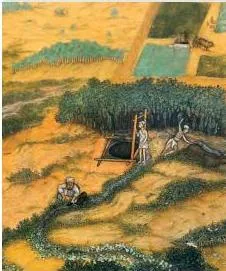
Fig. 8.2 — The Persian Wheel: Technology in Action
This reconstructed device is the irrigation technology Babur described in the Babur Nama: two circles of rope fitted with pitchers over a well, a second wheel and axle, one bullock turning the whole thing, and a trough carrying the water to the fields (p. 199).
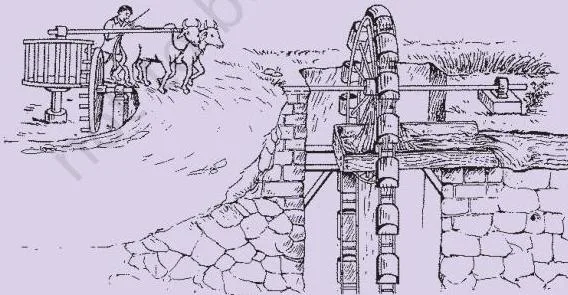
Babur found the wheel in Lahore and Dipalpur, while around Agra, Chandwar and Bayana people used a bucket-and-roller that needed two people — one to drive the bullock and one to empty the bucket. The chapter’s own discuss prompt asks you to compare these devices with the irrigation of Vijayanagara (p. 199).
The Shroff at Work: Money in the Smallest Village
The chapter’s monetisation argument comes alive in this image of a shroff, or money changer. Tavernier found it remarkable that a village had to be very small indeed not to have one (p. 206).
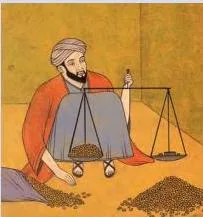
Shroffs weighed and exchanged coins, acted as bankers, made remittances, and set the rupee against the paisa and cowrie shells. Their presence even in small villages is why revenue could be assessed and collected in cash across the Mughal heartland (p. 206).
Figs 8.8a and 8.8b — Women Building Fatehpur Sikri
These two images support the women’s section directly: peasant and artisan women worked not only in the fields, but at construction sites and in markets (p. 207).
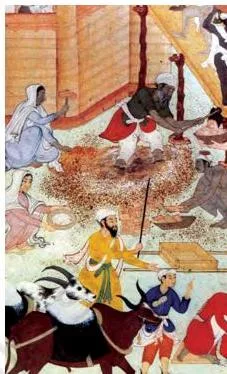
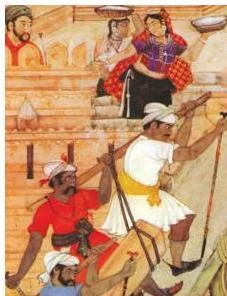
The detail that these were migrant women connects back to the chapter’s earlier point about peasant mobility. Together, the two figures are the chapter’s direct visual rebuttal to any assumption that women were confined to the home (pp. 207–208).
Fig. 8.14 — Abu’l Fazl Presenting the Akbar Nama
The image shows the author before his patron, handing over the completed Akbar Nama. It symbolises exactly what the chapter says about the Ain: a court document, written at royal command and recited in the royal hearing — a view from the centre (p. 218).
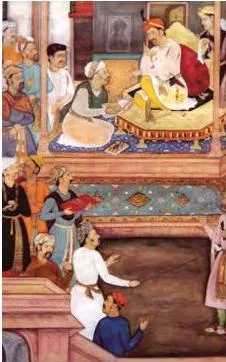
Keep this image in mind when you read Abu’l Fazl’s account of cross-checking oral testimony and revising the text five times: the Ain was careful scholarship, but it was scholarship performed for the emperor (pp. 218–220).
Fig. 8.15 — Jewellers: The Craft Side of Rural Production
Goldsmiths were among the village artisans the chapter lists. Their work could be seasonal, and specialised services were paid by a share of the harvest, an allotment of land, or negotiated goods-for-services deals (pp. 204–206).
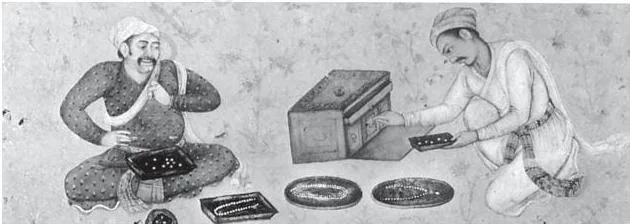
Placed near the end of the chapter, the painting is a reminder of the range of skilled production that agrarian society supported beyond the field and the pasture (p. 222).
Fig. 8.16 — A Woman Selling Sweets: Women in the Market
This small image ties two threads of the chapter together: women’s labour and monetisation. The women’s section said peasant and artisan women went to the markets when necessary; the money sections showed cash reaching deep into village life (pp. 207, 216).
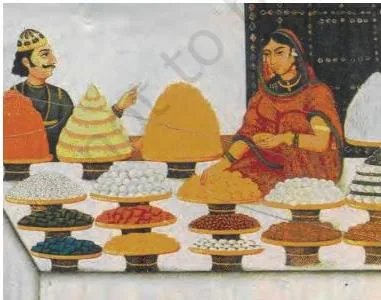
A woman selling sweets for cash shows both worlds meeting: female labour in the marketplace, and a monetary transaction at village level (p. 223).
Key Terms and Definitions
History chapters are dense with terms, and this one is effectively a vocabulary test of the Mughal countryside. Keep this table open while you read.
| Term | What it means | NCERT page |
|---|---|---|
| raiyat / muzarian | The usual Indo-Persian terms for a peasant (plural riaya) | 198 |
| kisan / asami | Other terms for a cultivator | 198 |
| khud-kashta | Peasant who cultivated land in the village where they resided | 198 |
| pahi-kashta | Non-resident peasant who cultivated elsewhere on contract, by choice or compulsion | 198 |
| do-fasla | Producing two crops in a year | 200 |
| jins-i kamil | “Perfect crops” such as cotton and sugarcane, valued for the revenue they brought | 200 |
| muqaddam / mandal | Village headman, chosen with the elders’ consensus and ratified by the zamindar | 202 |
| patwari | Village accountant who prepared the records with the headman | 202 |
| jati panchayat | Assembly of a caste or jati, arbitrating civil disputes | 203 |
| begar | Unpaid forced labour demanded by superiors or state officials | 203 |
| majur | Agricultural labourer or menial worker | 201 |
| halalkhoran / mallahzada | Menial groups in Muslim communities; the mallahzadas of Bihar were compared to slaves | 201 |
| miras / watan | Hereditary holding of land, as acquired by artisans in Maharashtra | 205 |
| jajmani system | Mutually negotiated goods-for-services exchange between artisans and households | 205 |
| jangli | Forest dweller whose livelihood was gathering, hunting and shifting agriculture | 208 |
| mawas | Place of refuge, said of forests behind which people resisted paying taxes | 208 |
| pargana | Administrative subdivision of a Mughal province | 209 |
| peshkash | Tribute collected by the Mughal state | 209 |
| milkiyat | The zamindar’s private land, cultivated for personal use | 212 |
| qilacha | A zamindar’s fortress | 212 |
| sanad | Imperial order confirming a right or title | 213 |
| haat | Market, often established by zamindars | 213 |
| jama | Revenue assessed | 214 |
| hasil | Revenue actually collected | 214 |
| amil-guzar | Revenue collector | 214 |
| polaj | Land cultivated every year, never allowed to lie fallow | 215 |
| parauti | Land left out of cultivation for a time to recover its strength | 215 |
| chachar | Land that has lain fallow for three or four years | 215 |
| banjar | Land uncultivated for five years or more | 215 |
| kankut | Collecting in kind by estimating the standing grain | 215 |
| batai / bhaoli | Dividing the reaped and stacked crop between state and cultivator | 215 |
| khet-batai | Dividing the fields after they are sown | 215 |
| lang batai | Dividing the cut grain in heaps after harvesting | 215 |
| mansabdari | The empire’s military-cum-bureaucratic apparatus | 215 |
| jagir | Assignment of revenue by which most mansabdars were paid | 215 |
| naqdi | Payment in cash | 215 |
| suyurghal | Grants of revenue made in charity | 219 |
| shroff | Money changer and banker, found even in very small villages | 206 |
| suba | Province of the empire | 219 |
| sarkar | Subdivision of a suba, below the province | 219 |
| daftar | Office, especially of the diwan who supervised the fiscal system | 214 |
| manzil-abadi | First book of the Ain: the imperial household and its maintenance | 219 |
| sipah-abadi | Second book: the military and civil administration | 219 |
| mulk-abadi | Third book: the fiscal side of the empire, with revenue rates and the Twelve Provinces | 219 |
Common Mistakes Students Make in This Chapter
This chapter is mostly interpretation, so the errors students make are about how they read the sources, not about facts they forgot. Avoid these ten.
| Mistake | Why it happens | The correction |
|---|---|---|
| Quoting the Ain as neutral fact | It reads as a detailed, precise official record | It is a court chronicle with a political purpose — presenting Akbar’s empire as harmonious; treat it as a view from the top (pp. 197, 218). |
| Reading the “little republic” as proof of village equality | The British phrase sounds fraternal and collective | The chapter says individual ownership and caste and gender inequities persisted; a powerful group ran the village and dispensed justice (p. 205). |
| Confusing jama with hasil | Both are revenue terms and are often paired | Jama is the amount assessed, hasil the amount collected; local conditions set the gap between them (p. 214). |
| Assuming pahi-kashta peasants were always poor refugees | Non-resident cultivation sounds like displacement | They moved both out of choice, for better terms, and out of compulsion, after famine (pp. 198–199). |
| Calling Mughal agriculture purely subsistence | Most peasants grew food staples | Cash crops (jins-i kamil) such as cotton and sugarcane were encouraged for revenue; subsistence and commercial production were intertwined (pp. 200–201). |
| Translating jangli as “uncivilised” | Modern usage of the word carries that meaning | It describes a livelihood of gathering, hunting and shifting agriculture, not a lack of civilisation (pp. 208–209). |
| Assuming peasant women were secluded at home | Familiarity with elite norms is projected onto all groups | A gendered home/world split was impossible when production was household-based; women worked in fields, markets and construction sites (p. 207). |
| Mixing up polaj, parauti, chachar and banjar | All four are land classes and sound alike | Order them by fallow: annually cultivated, resting, fallow 3–4 years, uncultivated 5+ years (p. 215). |
| Treating zamindars as salaried state officials | They collected revenue on the state’s behalf | They were landed proprietors with privileges, private lands (milkiyat), forts and troops, who could sell or mortgage their estates (pp. 212–213). |
| Believing the Ain’s numbers are perfectly accurate | The eight-column tables look meticulously exact | Errors in totalling and skewed data exist; prices and wages come mainly from the Agra region (p. 220). |
How to Use This Chapter for Exams
The chapter ends with its own exercises, and practising them in that shape is the fastest revision you can do. Here is what each format demands and which section answers it.
Short answers (100–150 words). The closing set asks you to write on the problems of using the Ain; whether agriculture was subsistence agriculture; the role of women in agricultural production; the significance of monetary transactions; and the importance of land revenue for the Mughal fiscal system.
Each maps to one section: the Ain section, the crops section, the women’s section, the artisans-and-money and silver sections, and the land revenue section.
Essays (about 250–300 words). The topics are caste as a factor in agrarian society; how the lives of forest dwellers were transformed; the role of zamindars; and how panchayats and headmen regulated rural society.
A full answer should state a position in the first paragraph, then support it with two or three kinds of evidence — a term, a source, a specific example — and close with a judgement. The village community section serves the caste and panchayat essays; the forests and zamindar sections serve the other two.
Map work. On an outline map of the world, mark the areas that had economic links with the Mughal Empire and trace possible routes of communication. Use the silver section for the trade geography (pp. 216–218).
Project (choose one). You can study a nearby village — its people, crops, animals, artisans, women’s land ownership and panchayat — and compare it with the sixteenth and seventeenth centuries; or you can read a small section of the Ain (10–12 pages) and report on how a historian would use it.
Model answer — problems in using the Ain as a source (about 150 words):
The Ain-i Akbari was compiled by Abu’l Fazl at Akbar’s command and completed in 1598 after five revisions (p. 218). It is the richest surviving source on the empire’s agrarian arrangements, but it has three problems.
First, a political purpose: it presents Akbar’s empire as harmonious and every revolt as “predestined to fail” (p. 197), so its picture of peasants is a view from the top. Second, numerous errors in totalling, mostly slips of arithmetic or transcription (p. 220).
Third, skewed data: prices and wages come mainly from areas around Agra, and zamindar-caste information is missing for Bengal and Orissa (p. 220).
Historians deal with these limits by supplementing the Ain with regional revenue records from Gujarat, Maharashtra and Rajasthan, and with East India Company records for eastern India (pp. 197–198), which also record conflicts and reveal peasants’ expectations of fairness from the state.
Notice the structure: introduce the source and its date, name the problems, then name the remedy. That same skeleton works for any source-based question. For the land revenue question, the jama and hasil example in this page’s land revenue section is the kind of short reasoning expected — define the two terms, then show with numbers why the gap mattered.
One honest note: textbook contents and the examinable syllabus are not always identical — check the current official CBSE syllabus for Class 12 History before deciding what to study.
One-Page Revision Summary
The whole chapter is one chain: the state needed revenue, so it needed to know, measure and control the countryside. Compress that chain into these points.
- Sources are elite — the Ain, the Babur Nama, court chronicles — so historians correct them with regional revenue records and Company records (pp. 197–198).
- Peasants — raiyat, khud-kashta, pahi-kashta — owned land individually, held modest plots, and could move easily (pp. 198–199).
- Two or three crops a year; subsistence staples and jins-i kamil cash crops grew side by side in one holding (pp. 199–201).
- The village regulated itself through the panchayat, the headman and the jati panchayats; the peasant’s last weapon was desertion (pp. 201–205).
- Women laboured in fields, markets and construction sites, held customary rights, and even headed zamindaris (pp. 207–208).
- Forest dwellers were not “uncivilised”; their world was being transformed by trade, state demands and settlement (pp. 208–212).
- Zamindars sat at the apex of the rural pyramid, with private lands, forts and troops (pp. 212–214).
- Revenue: jama assessed, hasil collected; land classified from polaj to banjar; payment in cash or kind by kankut and batai; mansabdars paid by jagirs (pp. 214–216).
- Silver from world trade made the cash economy — and therefore cash revenue — possible (pp. 216–218).
- The Ain itself: five revisions, five books, rich tables, and real limits (pp. 218–221).
Hold the landmarks spine in one line: Babur at Panipat 1526 → Akbar 1556–1605 → Shah Jahan 1628–58 → Aurangzeb 1658–1707 → the diwani of Bengal 1765 → Bahadur Shah II deposed 1857 (p. 222).
Related NCERT Chapters and Resources
This listing is maintained for the 2026-27 academic session using the NCERT textbook information available to us. NCERT remains the authority for confirming the latest edition.
These links help because the chapter itself sends readers to other chapters: its irrigation discussion compares with Vijayanagara (p. 199), and its mentions of bhakti saints and sufi pirs connect to the Bhakti-Sufi Traditions chapter (pp. 202, 212).
Open the Class 12 History notes hub to reach the Vijayanagara and Bhakti-Sufi chapters, or go straight to the Class 12 History Theme 11 notes for the theme that follows this one. You can also browse the Class 12 notes hub for other subjects, or start from the main notes library.
To verify the current edition of Themes in Indian History Part II, use the official NCERT textbook portal, which hosts the book list and all chapter files for the current session.
Sources and Data Verification
This page draws its facts from one named source, so you can check every claim against it.
- What the figures describe: the NCERT textbook Themes in Indian History Part II (Class 12, History), chapter “Peasants, Zamindars and the State” — Theme 8 in the book, Chapter 4 on this site — official edition published on ncert.nic.in, covering book pages 195–225.
- What this page covers: this chapter only, not the rest of the book and not the CBSE syllabus as a whole.
- How current it is: maintained for the current academic session using the NCERT information available to us.
- Who settles what: NCERT settles textbooks, editions and PDFs; CBSE settles the curriculum, syllabus and examinations for Class 12.
Reference: NCERT Class 12 History textbook, chapter 4, official edition on ncert.nic.in.
Frequently Asked Questions
What is the difference between khud-kashta and pahi-kashta peasants?
Khud-kashta peasants cultivated land in the village where they resided, while pahi-kashta peasants cultivated land in another village on a contractual basis. People became pahi-kashta either by choice — when a distant village offered better revenue terms — or by compulsion, such as economic distress after a famine (p. 198).
Why do historians describe the Ain-i Akbari as a view from the top?
Because the Ain was a court chronicle written by Abu’l Fazl at Akbar’s command, with the political purpose of presenting the empire as harmonious and any revolt as bound to fail. What it says about peasants therefore comes from the literate apex of society, not from peasants themselves (pp. 197, 218).
What are jama and hasil in the Mughal land revenue system?
Jama is the amount of revenue assessed on a piece of land or a pargana; hasil is the amount actually collected. The state tried to maximise the jama, but local conditions such as a failed harvest limited the hasil — which is why the chapter keeps the two stages distinct (p. 214).
Who were the zamindars and what made them powerful?
Zamindars were landed proprietors who did not directly cultivate. Their power came from superior caste status, services to the state, private lands (milkiyat) they could sell or mortgage, revenue collection on the state’s behalf, and military resources — fortresses (qilachas) and armed contingents of cavalry, artillery and infantry (pp. 212–213).
What does the “little republic” phrase mean and why is it misleading?
Some nineteenth-century British officials described the Indian village as a “little republic” of fraternal partners sharing resources. The chapter says this was not rural egalitarianism: individual ownership of assets and deep caste and gender inequities persisted, and a group of powerful individuals ran the village, exploited the weaker sections and dispensed justice (p. 205).
How did silver bullion reach Mughal India?
India had no silver of its own. After the voyages of discovery opened up the New World, silver bullion flowed into Asia to pay for Indian goods — the empires of the Ming, Safavid and Ottoman dynasties, plus overland and maritime trade, carried it toward India.
This inflow kept the silver rupya stable and let the state collect revenue in cash (pp. 216–218).
Explore Class 12 History Books
- Previous: An Imperial Capital
- Next: Colonialism and the
Related chapters:
- Bricks, Beads and Bones
- Kings, Farmers and Towns
- Kinship, Caste and Class