
Colonialism and the Class 12 History Chapter 1 — this page carries the official NCERT Class 12 History Chapter 1, “Colonialism and the Countryside: Exploring Official Archives”, from Themes in Indian History Part III. The chapter runs 31 printed pages (pp. 226-256), and the official chapter PDF is directly below, followed by a section-by-section guide to what is inside it.
Download the NCERT Class 12 History Chapter 1 Colonialism and the Countryside PDF — the official file from ncert.nic.in, complete with every figure, source box and exercise, exactly as NCERT printed it — when you want to read or print the chapter straight from the source.
The textbook page on ncert.nic.in shows the current edition of Themes in Indian History Part III and lets you download the whole book as one PDF.
| What the chapter holds | Count | Where it is used |
|---|---|---|
| Printed pages | 31 | |
| Sections in the chapter | 14 | |
| Figures with NCERT captions | 16 | |
| Tables | 1 | |
| Official NCERT PDF | Download the chapter PDF | the chapter exactly as NCERT publishes it |
Colonialism and the Class 12 History Chapter 1: what is inside the PDF
The chapter opens under the sub-title “Exploring Official Archives”. A chapter table on this page lists the file’s exact numbers — number of sections, figures and exercises — so the guide below does not repeat them.
The body moves through four parts: “Bengal and the Zamindars”, “The Hoe and the Plough”, “A Revolt in the Countryside” and “The Deccan Riots Commission”. It closes with a timeline, question sets — short answers, short essays, an outline-map exercise and projects — and a short reading list for going further.
Every part is built from official sources: the Fifth Report of 1813, Francis Buchanan’s survey journals, and the Deccan Riots Report of 1878. That is the chapter’s real subject — how colonial rule reordered rural life, and how carefully its records must be read.
What this chapter covers: three regions, one colonial revenue order
The chapter can feel like three separate stories — Bengal, the Rajmahal hills, the Deccan. It is actually one story: Company revenue policy moved across India, and at each stop the same pattern repeated. A law created winners and losers, people resisted or adapted, and the records that survive were written from the rulers’ side.
The opening pages set the frame: laws decide who grows richer and who poorer, who acquires land and who loses it, and where peasants go when they need money (NCERT, p. 226).
| Part of the chapter | Region | Revenue system | Who paid whom |
|---|---|---|---|
| Bengal and the Zamindars | Bengal — Burdwan, Dinajpur | Permanent Settlement, 1793 | Ryots paid rent to zamindars; zamindars paid fixed revenue to the Company (pp. 228-230) |
| The Hoe and the Plough | Rajmahal hills | No settlement with the Paharias; Damin-i-Koh demarcated for the Santhals, 1832 | Santhals paid revenue to the state as settled peasants (pp. 236-242) |
| A Revolt in the Countryside | Bombay Deccan — Poona, Ahmednagar | Ryotwari settlement | Revenue settled directly with the ryot, not through an intermediary (pp. 246-248) |
The chapter itself warns that people were never just subjects of laws: they resisted, and in resisting they reshaped how the laws worked (NCERT, p. 226). The Deccan part ends with the Deccan Riots Commission, whose 1878 report preserved the evidence and also shaped how the revolt is read (NCERT, pp. 255-256).
Key concepts, explained in the order the chapter teaches them
Each concept below is a mechanism — who gained, who lost, and why. Read them in order, because each builds on the last.
The Permanent Settlement (1793) and what a zamindar actually was
By the 1770s, Bengal’s rural economy was in crisis — recurrent famines and declining output. Company officials believed that secure property rights and a permanently fixed revenue demand would attract investment, expand agriculture, and create a loyal class of improving landlords (NCERT, pp. 228-229).
The settlement was made with the rajas and taluqdars of Bengal, reclassified as zamindars. Their revenue demand was fixed in perpetuity, but the zamindar was not a landowner in the village — he was a revenue collector of the state. He collected rent from the villages under him, paid the Company its fixed share, and kept the difference (NCERT, p. 229).
The chapter opens with the 1797 auction at Burdwan. The raja had piled up arrears, so his estates were sold — yet over 95 per cent of the sale was fictitious. Servants and agents bought the estates back on their master’s behalf, and the raja kept control of his zamindari (NCERT, pp. 227-228).
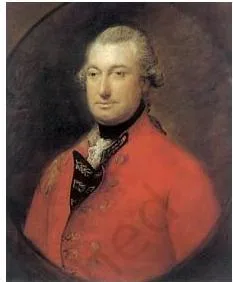
Cornwallis was Governor-General of Bengal when the Permanent Settlement was introduced in 1793. The portrait matters as evidence: it fixes the face of the policy — a military commander turned administrator whose reforms redrew rural Bengal (NCERT, p. 229).
Why zamindars defaulted
The settlement assumed zamindars would invest like improving landlords. In the 1790s, nearly everything went the other way.
- The demand was pegged high. Since it could never be raised again, officials set it as high as possible, expecting the burden to decline as prices and output rose (NCERT, p. 229).
- Prices collapsed. Agricultural prices were depressed, so ryots could not pay rent; if the zamindar could not collect, he could not pay the Company (NCERT, pp. 229-230).
- Revenue was invariable. It had to be paid punctually whatever the harvest; under the Sunset Law, missing the sunset deadline on the due date meant the estate was auctioned (NCERT, p. 230).
- Zamindar power was cut down. Troops were disbanded, customs duties abolished, and the zamindar’s cutcheries (courts) were placed under a Company-appointed Collector (NCERT, p. 230).
Collecting rent was a standing fight. The zamindar’s officer, the amlah, went village to village, but defaulters faced long court cases — in Burdwan alone over 30,000 rent suits were pending in 1798 (NCERT, p. 230).
Jotedars: the power behind the zamindar
While zamindars struggled, a group of rich peasants was quietly consolidating real power in the villages.
Francis Buchanan’s survey of Dinajpur describes jotedars who held thousands of acres, controlled local trade and moneylending, and worked much of their land through sharecroppers — adhiyars or bargadars — who brought their own ploughs and handed over half the produce (NCERT, pp. 231-232).
In other districts the same kind of person was called a haoladar, a gantidar or a mandal (NCERT, p. 231).
Buchanan’s Source 1 shows why zamindars feared them: jotedars paid only a few rupees of revenue, held more land than their deeds allowed, complained at the police station when summoned to the cutcherry, and urged the petty ryots not to pay (NCERT, pp. 231-232).
| Zamindar | Jotedar | |
|---|---|---|
| Legal position | Revenue collector of the state under the Permanent Settlement | No official office — a rich peasant |
| Where they lived | Often in towns | In the village, with direct control over poor cultivators |
| Basis of power | The state contract and its courts | Land, trade, moneylending, sharecroppers |
| Relation to land | Collected rent from many villages as one estate | Thousands of acres, cultivated largely by adhiyars and bargadars |
| How they clashed | Prosecuted defaulters through long court cases | Delayed revenue, resisted zamindar officials, bought estates at auction |
| Fate | Survived the 1790s; collapsed only in the Great Depression of the 1930s | Consolidated power as zamindars declined |
The comparison is grounded in NCERT, pp. 229-233. Power lay where the money and the people were — and that was the jotedar’s village, not the zamindar’s court.
The Fifth Report and how to read an official report
This is the chapter’s core skill: treating official documents as evidence with an author, a purpose, and a bias.
The Fifth Report, submitted to the British Parliament in 1813, ran to 1,002 pages — over 800 of them appendices carrying petitions of zamindars and ryots, collectors’ reports, and revenue statistics (NCERT, p. 233). It was born of British politics: groups opposed to the Company’s monopoly wanted its charter revoked, and a damning report on Company rule fed those debates (NCERT, pp. 233-234).
For a century and a half, the report shaped how rural Bengal’s colonial history was understood.
But recent research, working from zamindari archives and district records, shows it cannot be accepted uncritically: written to condemn Company maladministration, the Fifth Report exaggerated the collapse of zamindari power and overestimated the scale of land transfers — the Burdwan case alone shows zamindars keeping estates through fictitious sales (NCERT, pp. 235-236).
Paharias and Santhals: hoe versus plough
The second part moves to a drier world, where the tool a community used for farming symbolised its entire way of life.
The Paharias lived with the forest. They practised shifting cultivation — cutting and burning patches, sowing pulses and millets with hoes in the ash-enriched soil, then leaving the patch fallow and moving on. They collected mahua flowers for food, silk cocoons and resin for sale, and wood for charcoal (NCERT, p. 237).
Raids on the plains were survival, a way of asserting power, and a means of negotiating peace: zamindars paid tribute to hill chiefs, and traders paid tolls to use the passes (NCERT, pp. 237-238).
British policy toward them swung from extermination in the 1770s to Augustus Cleveland’s pacification in the 1780s — paying chiefs annual allowances, which often cost those chiefs their standing among their own people (NCERT, p. 239).
| Paharias | Santhals | |
|---|---|---|
| Symbol | The hoe | The plough |
| Way of farming | Shifting cultivation — clear, burn, grow, move on | Settled plough agriculture with commercial crops |
| Relation to the forest | Forest produce was food and income | Cleared the forest to extend fields |
| Outcome | Pushed into barren upper hills and impoverished | Given Damin-i-Koh, then squeezed by taxes, moneylenders and zamindars |
| Resistance | Raids and armed opposition to outsiders | Santhal rebellion of 1855-56 |
The chapter calls the contest between the two a long battle (NCERT, p. 239). The Santhals had begun entering Bengal around the 1780s, hired by zamindars to reclaim land; when the Paharias refused the plough, the British turned to them.
In 1832 a large area was demarcated as Damin-i-Koh, declared the land of the Santhals, with at least one-tenth to be cleared and cultivated within ten years (NCERT, pp. 240-241). Settlement then exploded — from 40 Santhal villages in 1838 to 1,473 by 1851, and from 3,000 people to over 82,000 (NCERT, p. 241).
The Santhals’ own story soured quickly: heavy taxes on the land they had cleared, moneylenders (dikus) charging high interest and taking land over unpaid debts, and zamindars asserting control over the Damin. After the rebellion of 1855-56, the state carved out Santhal Pargana — 5,500 square miles from Bhagalpur and Birbhum — to conciliate them (NCERT, p. 242).
Ryotwari settlement and the making of peasant debt
The third region used a completely different system, one shaped by the economist David Ricardo.
Ricardian ideas said a landowner should keep only the “average rent” of his land; any surplus should go to the state in tax, or the cultivator would become a rentier who never improves the land. Bengal’s zamindars looked exactly like such rentiers.
So in the Bombay Deccan the Company settled revenue directly with the ryot: soil types were measured, revenue capacity assessed, and the land resurveyed every 30 years with rates increased (NCERT, pp. 247-248).
The first settlements of the 1820s demanded so much that peasants deserted their villages. Prices fell sharply after 1832 for over a decade and a half, and famine in 1832-34 killed one-third of the Deccan’s cattle and half its human population, as the book records.
Survivors had nothing left — they borrowed to pay revenue, buy seed and cattle, and marry their children (NCERT, pp. 248-249).
To see how such debt grew, take a loan of Rs 300 at 3 per cent per month — rates of this scale appear in the ryots’ own petitions. A bond ran for three years, because the Limitation Law of 1859 made loan bonds valid for only three years; at every renewal the moneylender folded unpaid interest into a new principal (NCERT, pp. 253-254).
| Stage | What happens | New debt |
|---|---|---|
| Loan taken | Rs 300 borrowed; interest Rs 9 a month | Rs 300 |
| After 3 years | Interest = Rs 9 × 36 = Rs 324; fresh bond for principal + interest | Rs 624 |
| After 6 years | Interest on Rs 624 = Rs 18.72 a month; about Rs 674 added | Rs 1,298 |
| After 9 years | 3% of Rs 1,298 ≈ Rs 38.94 a month; about Rs 1,402 added | Rs 2,700 |
| After 12 years | 3% of Rs 2,700 = Rs 81 a month; Rs 2,916 added | ≈ Rs 5,616 |
So a Rs 300 loan became roughly Rs 5,600 in twelve years. The customary norm of the countryside — interest could not exceed the principal — would have capped interest at Rs 300. The gap between that custom and what the bonds demanded is exactly what the ryots called injustice (NCERT, pp. 253-255).
The cotton boom, the credit crash and the revolt of 1875
A war on the other side of the world turned Deccan villages upside down.
Before 1861, three-fourths of Britain’s raw cotton came from America, and British manufacturers dreaded losing it. When the American Civil War broke out in 1861, imports from America fell from over 2,000,000 bales to 55,000 bales in a single year, and India was told to fill the gap (NCERT, p. 250).
In the Deccan, the boom meant easy credit: advances of Rs 100 for every acre planted with cotton, and sahukars willing to lend long-term. Cotton acreage doubled between 1860 and 1864, and by 1862 over 90 per cent of Britain’s cotton imports came from India (NCERT, p. 251).
When the war ended in 1865, American cotton returned, exports fell, and credit dried up as merchants demanded repayment — just as a new revenue settlement raised the state’s demand by 50 to 100 per cent (NCERT, p. 252). Enraged ryots turned on the sahukars.
On 12 May 1875 at Supa in Poona district they demanded their bahi khatas — account books — and burnt them, along with debt bonds and grain shops. The revolt spread to Ahmednagar and beyond, over 6,500 square km and more than thirty villages; 951 people were arrested (NCERT, p. 246).
The ryots’ anger was aimed at moneylenders who had broken the countryside’s rules: charging interest beyond the principal (one investigated case showed over Rs 2,000 interest on a Rs 100 loan), refusing receipts, and using the Limitation Law to force fresh bonds every three years (NCERT, pp. 253-254).
Reading the chapter’s figures as historical sources
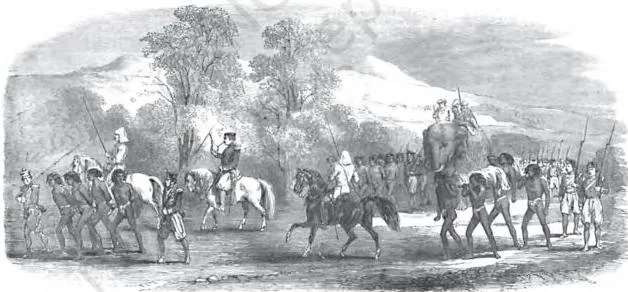
This listing is maintained for the 2026-27 academic session using the NCERT textbook information available to us. NCERT remains the authority for confirming the latest edition.
Every image in this chapter is itself a source — a painting, a magazine engraving, a graph — each made by someone with a viewpoint.
Images of Bengal’s zamindari order
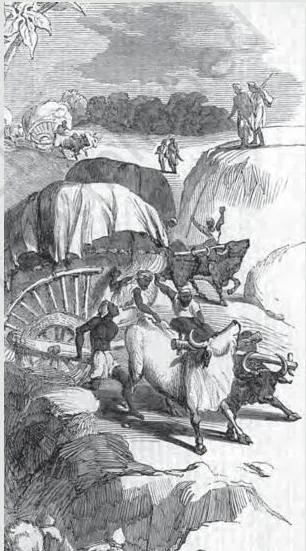
The chapter opens with village cotton on its way to the mandi. The engraving shows the commodity trade that framed everyday village life — and Britain’s interest in India’s raw cotton (NCERT, p. 227).
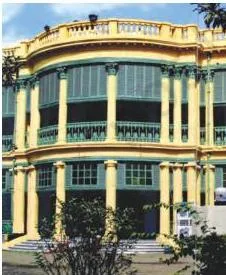
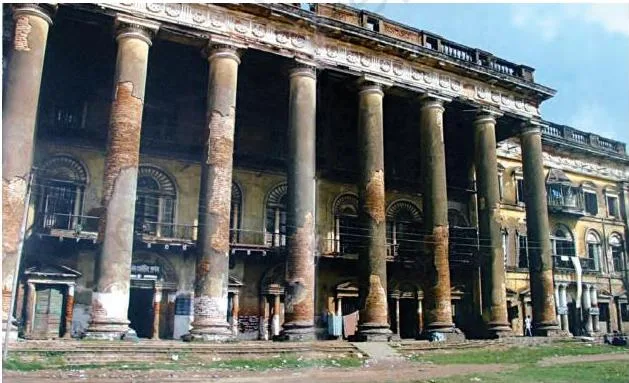
By the late nineteenth century, rich zamindars had city palaces with ballrooms and Corinthian columns. The image is wealth put on display — the wealth the same family fought to protect at the 1797 auction (NCERT, p. 228).
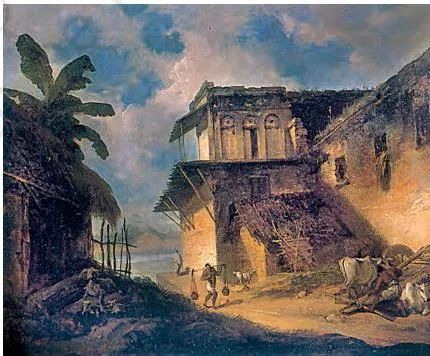
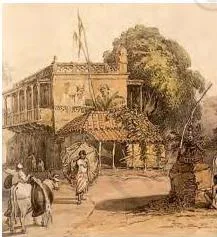
Chinnery’s village scene shows how a British artist chose to see Bengal — calm and picturesque. Like the Hodges paintings of the Rajmahal hills later in the chapter, it belongs to a tradition that searched for the “picturesque” rather than to official record (NCERT, pp. 231, 237-238).
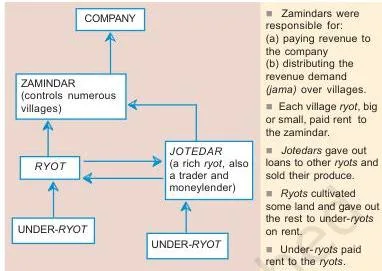
Fig 9.5 is a flow diagram, and the book’s exercise asks you to insert five terms along its arrows: rent, revenue, interest, loan, produce. The chapter text supplies each relationship:
- Produce flowed from cultivators upward — sharecroppers handed over half the harvest to the jotedar (NCERT, p. 231).
- Rent was what the zamindar collected from the villages of his estate (NCERT, p. 229).
- Revenue was what the zamindar paid the Company — and what jotedars delayed paying him (NCERT, pp. 229, 231).
- Loans moved from moneylenders to peasants, and interest moved back (NCERT, pp. 249, 253).
Read with the five terms in place, the diagram is a map of power: whoever controlled produce, rent or credit controlled the countryside.
How the Rajmahal hills were pictured
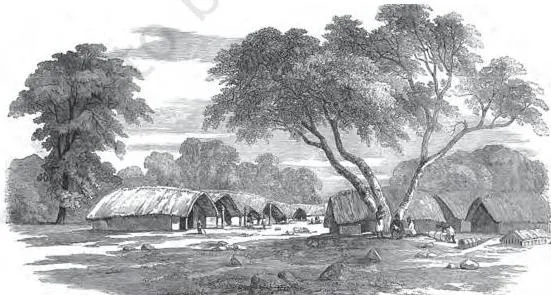
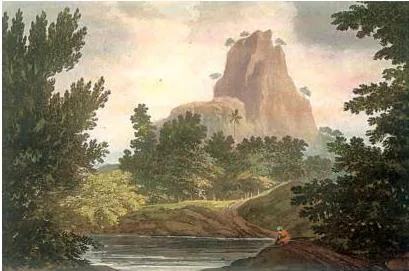
Sketched in the early 1850s, the village looks peaceful, calm and idyllic, untouched by the outside world. The book’s exercise asks you to contrast it with Fig 9.12 — the same country, pictured by the same magazine after the rebellion (NCERT, p. 240).
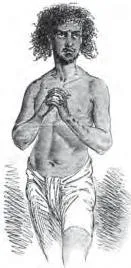
Sidhu Manjhi led rebels who wanted to create an ideal world of their own, against zamindars, moneylenders and the colonial state (NCERT, p. 242).
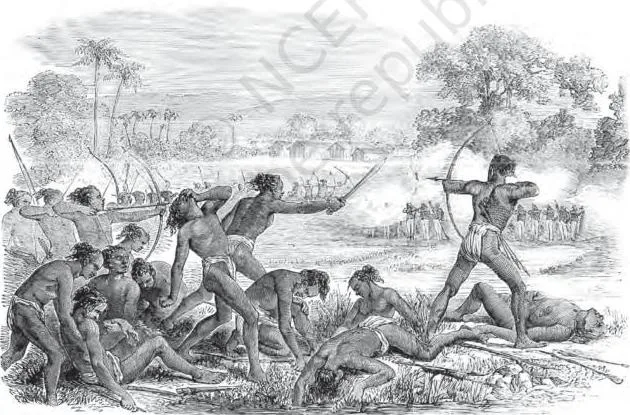
The caption makes the historian’s point: the rebellion changed the British perception of the Santhals. Villages that had seemed calm now appeared as places of violence and savagery — the same people, two readings (NCERT, p. 242).
The cotton economy in pictures
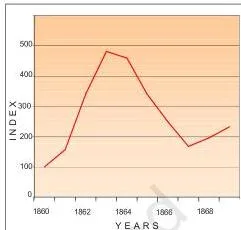
The graph’s line rises with the American Civil War, as Britain scrambled for Indian cotton, and slides after 1865 as American supply returns. Match it to the text: the peak years are the credit boom; the slide is the crash that produced the revolt (NCERT, pp. 249-252).
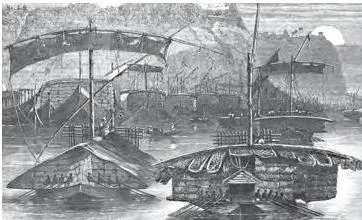
Before the railway age, Mirzapur was the collection centre for Deccan cotton, and boats carried bales down the Ganges (NCERT, p. 251).
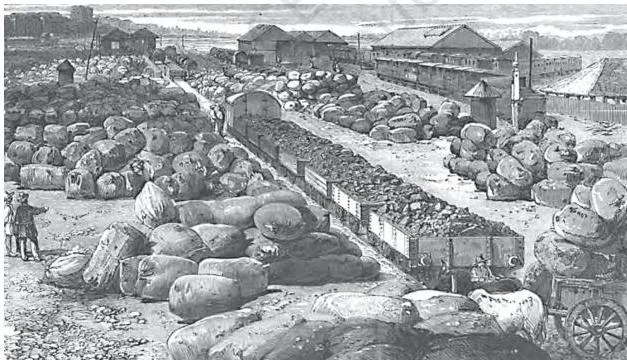
Railways did not simply replace the old modes. River traffic declined, but the bullock cart in the foreground still waited to carry bales from the station to the port. The chapter also shows pre-railway transport in Fig 9.17 — bullocks straining under cotton on rough roads — and asks what the artist is suggesting about the cost of moving cotton (NCERT, pp. 250-251).
Key terms and definitions from the chapter
This chapter is dense with Bengali, Persian, Hindi and official British terms — and the same kind of person is called different names in different regions, as with jotedar, haoladar, gantidar and mandal (NCERT, p. 231).
| Term | Plain meaning | NCERT page |
|---|---|---|
| zamindar | Revenue collector of the state under the Permanent Settlement — not a landowner inside the village | pp. 229-230 |
| ryot | British spelling of raiyat, a peasant; in Bengal ryots often leased land to under-ryots | p. 230 |
| mahal | An estate; the villages of one zamindari formed one revenue estate in Company calculations | p. 228 |
| taluqdar | “One who holds a taluq”, a territorial connection; rajas and taluqdars were reclassified as zamindars | p. 230 |
| jotedar | Rich peasant of North Bengal who controlled land, trade and moneylending | p. 231 |
| adhiyar / bargadar | Sharecropper who brought his own plough and gave half the produce to the jotedar | p. 231 |
| amlah | Officer of the zamindar who came around the village to collect rent | p. 230 |
| cutcherry | The zamindar’s court, brought under the supervision of a Company-appointed Collector | p. 230 |
| benami | Literally “anonymous”; transactions in a fictitious or minor name, as in the Burdwan resales | p. 233 |
| lathyal | One who wields the lathi; a strongman of the zamindar who attacked outside buyers | p. 233 |
| proja | Subjects; ryots who felt loyalty to their zamindar saw themselves as his proja | p. 233 |
| Paharias | Hill folk of the Rajmahal hills — shifting cultivators who lived off forest produce | p. 237 |
| mahua | A flower the Paharias collected for food | p. 237 |
| Damin-i-Koh | The land demarcated for the Santhals in the Rajmahal foothills in 1832 | pp. 241-242 |
| Santhals | Settlers who entered Bengal around the 1780s, cleared forests and took to the plough | p. 241 |
| dikus | The Santhals’ name for the moneylenders and outsiders taking their land | p. 242 |
| sahukar | A moneylender who also traded as a grain dealer | p. 246 |
| bahi khata | Account book; the Deccan ryots demanded and burnt these in the 1875 revolt | p. 246 |
| Permanent Settlement | The 1793 Bengal settlement that fixed the state’s revenue demand in perpetuity | p. 229 |
| ryotwari settlement | Deccan system settling revenue directly with the ryot; land resurveyed every 30 years | pp. 247-248 |
| Sunset Law | Rule that a zamindari was auctioned if revenue was not paid by sunset on the due date | p. 230 |
| Fifth Report | 1813 parliamentary report on Company administration; 1,002 pages, mostly appendices | p. 233 |
Common mistakes students make in this chapter
This chapter trips students because so much of it reaches us through official records — and official records carry official interests.
| Mistake | What the chapter shows | How to check your answer |
|---|---|---|
| “Zamindars owned the land” | The zamindar was a revenue collector of the state, not a landowner in the village (p. 230) | If you wrote “the zamindar’s land”, re-read p. 229 and say “collected rent from” |
| “The Burdwan auction ruined the raja” | Over 95 per cent of the sale was fictitious — agents bought estates back benami (pp. 227-228, 233) | Your answer should mention fictitious or benami purchases |
| “The Fifth Report is reliable because it is official” | It was written to condemn Company misrule; research shows it exaggerated zamindari collapse (pp. 235-236) | Ask: who wrote it, and why? |
| “Santhals were the original hill people” | They came into the region from outside around the 1780s; Damin-i-Koh was demarcated only in 1832 (pp. 240-242) | Check your dates: 1780s entry, 1832 demarcation |
| “The Deccan revolt was against the British revenue demand” | Rebels attacked sahukars and burnt account books; the commission’s “blame the moneylender” verdict is itself an official interpretation (pp. 246-247, 255-256) | Quote what the ryots actually burnt — bahi khatas and bonds |
| “Moneylending began under colonial rule” | It was widespread earlier; what changed was the breakdown of customary norms such as interest never exceeding the principal (p. 253) | Mention “customary norms” in your answer |
| “The Limitation Law of 1859 protected peasants” | It was meant to, but moneylenders forced ryots to sign fresh bonds every three years, rolling interest into new principal (p. 254) | Your answer should say “new bond every three years” |
Using the chapter’s questions for exam preparation
The chapter closes with its own question sets — short answers, short essays, an outline-map exercise and a choice of projects. Practising against them is the most efficient use of the chapter; here are answer plans for the four recurring questions.
Why were many zamindaris auctioned after the Permanent Settlement?
- Revenue demand was pegged high at settlement because it could never be raised again (p. 229).
- The 1790s brought depressed prices, so ryots could not pay rent and zamindars could not pay the Company (pp. 229-230).
- Revenue was invariable and the Sunset Law made default fatal (p. 230).
- Zamindar autonomy was restricted — troops disbanded, cutcheries supervised — so collection became harder (p. 230).
How was Paharia livelihood different from Santhal livelihood?
- Paharias: hoe, shifting cultivation, forest produce (mahua, silk, resin, charcoal), mobility (pp. 236-239).
- Santhals: plough, settled fields, commercial crops, dealing with traders and moneylenders (pp. 240-242).
- End with the outcome: Paharias confined to barren upper hills and impoverished; Santhals given Damin-i-Koh, then squeezed by taxes and debt (pp. 241-242).
How did the American Civil War affect the lives of Deccan ryots?
- Boom: cotton prices soared, credit flowed, Rs 100 advances per acre, acreage doubled (pp. 250-251).
- Crash after 1865: exports fell, credit dried up, merchants demanded repayment (p. 252).
- New revenue settlement raised demand 50-100 per cent at the worst moment (p. 252).
- Result: heavier debt and the 1875 revolt (pp. 246, 253-255).
What are the problems of using official sources?
- Who wrote them and why: the Fifth Report exaggerated zamindari collapse to condemn Company rule (pp. 233-236).
- Buchanan observed as a Company employee with specific instructions about what to record (pp. 244-245).
- The Deccan Riots Commission refused to blame government demand; its own verdict is an official interpretation (pp. 255-256).
- Best answer closes with the chapter’s method: read official reports against newspapers, unofficial accounts, legal records and oral sources (p. 256).
Map work and projects
For the map question, locate Burdwan and Dinajpur (Bengal), the Rajmahal hills and Damin-i-Koh, Poona/Supa and Ahmednagar (Deccan), and the cotton route from Mirzapur to Bombay.
The field project — interviewing older people in a rural community about how livelihood has changed over 75 years — is worth doing if time allows (NCERT, p. 256).
Textbook contents and the examinable syllabus are not always identical — check the current official syllabus.
Quick revision: the chapter in five minutes
The chapter has no separate summary box, so here is the argument in four moves, then the dates.
(1) Bengal. The Permanent Settlement of 1793 made zamindars revenue collectors rather than owners. A high fixed demand plus bad years led to auctions that often failed through fictitious sales. The real power in the villages slipped to the jotedars (pp. 227-236).
(2) Rajmahal hills. The Paharias lived by the hoe, the forest and shifting cultivation; the British could not pacify them. The Santhals’ plough cleared and settled the land; Damin-i-Koh was demarcated in 1832, and the Santhals rebelled in 1855-56 (pp. 236-243).
(3) Deccan. The ryotwari settlement taxed the ryot directly. High demand, famine and falling prices pushed peasants into debt; the American Civil War inflated credit, then the peace collapsed it. In 1875 ryots burnt the sahukars’ account books (pp. 246-255).
(4) The commission. The Deccan Riots Commission blamed moneylenders, not the state — a reminder that official records carry official interests (pp. 255-256).
| Year | Event | Region |
|---|---|---|
| 1765 | The East India Company acquires the Diwani of Bengal | Bengal |
| 1773 | Regulating Act passed by the British Parliament | Company rule |
| 1780s | Santhals begin to come into Bengal; hired to reclaim land | Bengal → Rajmahal |
| 1793 | Permanent Settlement in Bengal | Bengal |
| 1800s | Santhals settle in the Rajmahal hills | Rajmahal |
| 1818 | First revenue settlement in the Bombay Deccan (the chapter’s main text dates the first settlements to the 1820s) | Deccan |
| 1832 | Damin-i-Koh demarcated for the Santhals | Rajmahal |
| 1855-56 | Santhal rebellion; Santhal Pargana created | Rajmahal |
| 1861 | Cotton boom begins with the American Civil War | Deccan |
| 1875 | Deccan ryots rebel; account books burnt | Deccan |
Note how even the book’s own timeline compresses: its body text dates the Santhals’ entry to Bengal to the 1780s and the first Deccan settlements to the 1820s. Timelines simplify — which is exactly the source-criticism habit this chapter wants you to learn.
Related chapters and where to go next
In the same book, the previous chapter, Peasants, Zamindars and the State, sets the pre-colonial context for the zamindars, and the next chapter, Rebels and the Raj, carries the story of resistance into 1857. The Themes in Indian History Part III book page lists every chapter with its PDF, and the Class 12 NCERT books page covers all subjects.
For earlier rural history, the notes on kings, farmers and towns show how states first drew on rural production. For revision across the year, see the Class 12 History revision notes, the wider Class 12 notes and the main CBSE notes index.
The chapter’s closing list, “If you would like to know more, read”, points to works of agrarian history — for example Ratnalekha Ray’s Change in Bengal Agrarian Society and Sumit Guha’s The Agrarian Economy of the Bombay Deccan (NCERT, p. 256).
Reference: NCERT Class 12 History textbook, chapter 1, official edition on ncert.nic.in.
Sources and data verification
The figures and page references on this page describe the NCERT Class 12 History textbook Themes in Indian History Part III, Chapter 1, “Colonialism and the Countryside: Exploring Official Archives”, official edition on ncert.nic.in.
This page covers that chapter only — not other chapters of the book, other subjects, or other classes.
The listing is maintained for the current academic session using the NCERT information available to us. NCERT settles textbooks, editions and PDFs; CBSE settles curriculum, syllabus and examinations.
No independent expert review of this page is claimed; page numbers and quotations trace to the printed chapter (pp. 226-256).
Frequently asked questions on Colonialism and the Countryside
What was the Permanent Settlement of 1793 and who were the zamindars?
The Permanent Settlement fixed the revenue demand of Bengal in perpetuity, made with the rajas and taluqdars, who were reclassified as zamindars. A zamindar was a revenue collector of the state, not a landowner in the village: he collected rent from the villages, paid the Company its fixed revenue, and kept the difference (NCERT, pp. 228-230).
Why did zamindars fail to pay revenue, and why were their estates auctioned?
Because the demand was pegged very high, prices were depressed in the 1790s, revenue was fixed regardless of the harvest, and zamindar autonomy was restricted. Under the Sunset Law, missing payment by sunset on the due date meant auction — as happened to the Raja of Burdwan in 1797, though over 95 per cent of that sale was fictitious (NCERT, pp. 227-231).
Who were the jotedars and why were they powerful in rural Bengal?
Jotedars were rich peasants, strongest in North Bengal, who held vast lands, controlled moneylending and trade, and employed sharecroppers (adhiyars or bargadars). They lived in the village, commanded poor cultivators, resisted zamindar officials, delayed revenue payment, and sometimes bought zamindari estates at auction (NCERT, pp. 231-232).
Why did the Santhals rebel against British rule in 1855-56?
By the 1850s the Santhals faced heavy taxes on the land they had cleared, moneylenders (dikus) charging high interest and seizing land over unpaid debts, and zamindars asserting control over the Damin. They rebelled to create a world where they would rule; after the revolt, the state carved out Santhal Pargana to conciliate them (NCERT, p. 242).
Why did the Deccan ryots burn account books in 1875?
They were trapped in debt built by the cotton-boom crash and by moneylenders who violated customary norms — charging interest far beyond the principal and forcing fresh bonds every three years under the Limitation Law of 1859. On 12 May 1875, ryots at Supa demanded and burnt the sahukars’ bahi khatas and bonds (NCERT, pp. 246, 250-255).
What is the Fifth Report and why should it be read critically?
The Fifth Report, submitted to the British Parliament in 1813, ran to 1,002 pages and documented the Company’s administration in Bengal. It is invaluable, but it was written to condemn Company misrule, and recent research shows it exaggerated the collapse of zamindari power and the scale of land transfers (NCERT, pp. 233-236).
Explore Class 12 History Books
Related chapters: