
The structure of amines class 12 chapter is Unit 9, “Amines”, in NCERT Chemistry Part II, and the official chapter PDF is right below. This page tells you what the file contains — classification, nomenclature, basicity, diazonium salts — and explains the ideas the exercises test, so you can study the chapter faster.
The book described throughout is the NCERT Chemistry Part II edition for the 2026-27 academic session.
| What the chapter holds | Count | Where it is used |
|---|---|---|
| Printed pages | 22 | |
| Sections in the chapter | 8 | |
| Figures with NCERT captions | 16 | |
| Tables | 3 | |
| Worked examples | 3 | solved step by step in our NCERT Solutions |
| Exercise questions | 14 | answered in our NCERT Solutions |
| Official NCERT PDF | Download the chapter PDF | the chapter exactly as NCERT publishes it |
Chapter at a glance: what this unit holds
The chapter splits into two halves. Part I, Amines, covers structure, classification, nomenclature, six preparation methods, physical properties and chemical reactions. Part II, Diazonium Salts, covers preparation by diazotisation, replacement of the diazonium group, and coupling to azo dyes.
Three tables carry the chapter’s reference data: Table 9.1 lists common and IUPAC names of amines, Table 9.2 compares boiling points of amines, alcohols and alkanes of similar molar mass, and Table 9.3 gives \( pK_b \) values in the aqueous phase. The unit closes with a Summary and an exercise set.
What this chapter covers: from ammonia to azo dyes
This section maps the chapter’s flow, so you can see how one idea sets up the next before you read the details.
- What an amine is: ammonia with one, two or three H atoms replaced by alkyl or aryl groups; the nitrogen stays trivalent and pyramidal with a lone pair.
- Classification and naming: primary, secondary and tertiary; simple and mixed amines; then common and IUPAC names.
- Six preparations: from nitro compounds, halides (ammonolysis), nitriles, amides, phthalimide, and by Hofmann degradation.
- Physical properties: solubility and boiling points, both governed by hydrogen bonding.
- Chemical reactions: basicity first, then alkylation, acylation, carbylamine test, nitrous acid and Hinsberg’s reagent.
- Aromatic substitution in aniline: why the \( -NH_2 \) group is strongly activating, and how acetylation controls it.
- Diazonium salts: preparation by diazotisation, replacement of the \( -N_2 \) group, and coupling to azo dyes.
The chapter’s own objectives are to make you able to name and classify amines, prepare them, explain their properties, distinguish the three classes, and use diazonium salts in synthesis. Everything in the exercises reduces to one of those jobs.
Reading the chapter’s key figures

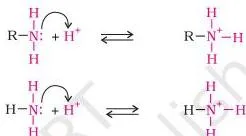
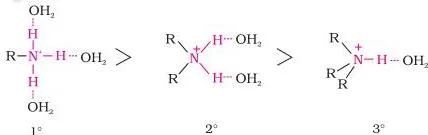

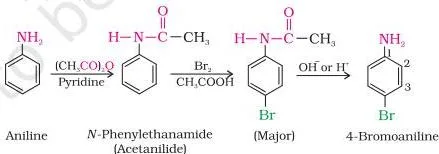
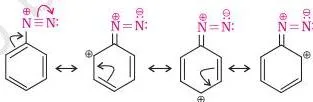
Six diagrams in this chapter carry the real argument; each is shown here with a line or two on what to see in it.
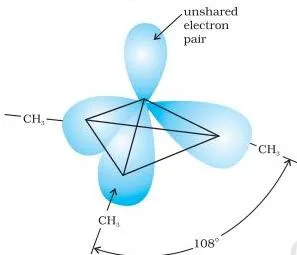
Trimethylamine is the chapter’s shape lesson. The nitrogen is \( sp^3 \) hybridised, so the molecule starts from a tetrahedral template, but the C–N–C angle is 108°, not the tetrahedral 109.5°. The unshared pair of electrons on nitrogen occupies the fourth orbital and compresses the bond angles.
That same lone pair is why amines act as Lewis bases and nucleophiles throughout the chapter.
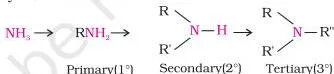
The figure shows how classification is purely a head-count. One replacement gives a primary amine (\( RNH_2 \)), two give secondary (\( R_2NH \)), and three give tertiary (\( R_3N \)). The same logic applies whether the groups are alkyl or aryl, which is why this picture stays useful during nomenclature.
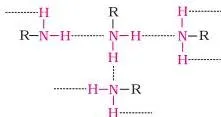
This is the source of the boiling-point order. A primary amine has two N–H hydrogens, so its molecules associate strongly; a secondary amine has one; a tertiary amine has none. Fewer hydrogen bonds means a lower boiling point, so isomeric primary, secondary and tertiary amines boil in the order 1° > 2° > 3°.
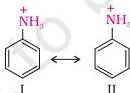
Here is the whole argument for aniline’s weak basicity in one picture. Aniline itself is a resonance hybrid of five structures, but the anilinium ion can manage only two. More resonance structures mean more stability, so aniline is more stable than its protonated form — protonation becomes unfavourable and basicity drops below ammonia’s.

Acetylation works because it redistributes the lone pair. In acetanilide the nitrogen lone pair is drawn toward the carbonyl oxygen, so it is far less available for donation into the benzene ring. That quietens the ring and makes controlled monosubstitution possible — the point of the next figure.
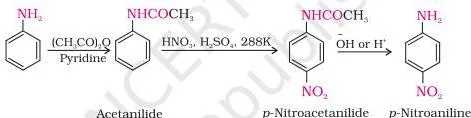
Direct nitration of aniline is messy: the acidic medium protonates the amino group, and the meta-directing anilinium ion forces m-nitroaniline in alongside the o- and p-products. Protect the group first, nitrate, then hydrolyse the amide back, and the p-nitro derivative dominates. This three-step logic answers several “account for” questions in the exercises.
The structure of amines: a pyramidal nitrogen with a lone pair
Every property in this chapter — basicity, hydrogen bonding, reactivity of the ring — traces back to one structural feature: a lone pair of electrons on a pyramidal nitrogen atom.
Amines are ammonia derivatives. Replacing one, two or three of ammonia’s hydrogen atoms by alkyl or aryl groups gives a primary, secondary or tertiary amine. Like ammonia, the nitrogen is trivalent and \( sp^3 \) hybridised, and its geometry is pyramidal; the unshared pair sits in the fourth orbital.
Because the lone pair is there, the C–N–E angle (E = C or H) is squeezed below the tetrahedral 109.5° — it is 108° in trimethylamine, as Fig. 9.1 above shows. The same lone pair makes amines Lewis bases and nucleophiles, which is why almost every reaction in the chapter starts from it.
- Primary (1°): one hydrogen replaced — e.g. \( CH_3CH_2NH_2 \), ethanamine.
- Secondary (2°): two hydrogens replaced — e.g. \( (CH_3CH_2)_2NH \), N-ethylethanamine.
- Tertiary (3°): all three replaced — e.g. \( (CH_3CH_2)_3N \), N,N-diethylethanamine.
Amines are called simple when all alkyl or aryl groups are the same, and mixed when they differ. \( (CH_3CH_2)_2NH \) is simple; \( CH_3NHCH_2CH_3 \) is mixed. The classification image above shows the same idea for the three classes.
Naming amines: common names, IUPAC names and the N locant
Naming is a rule-based skill — exercise 9.1 tests it directly — and three rules cover nearly every amine.
- Common names: name the alkyl group, then add “amine” as one word — methylamine, ethylamine. When two or three identical groups are present, use di- or tri-: dimethylamine.
- IUPAC names: replace the final “e” of the alkane with “amine”. \( CH_3NH_2 \) is methanamine; \( CH_3CH_2NH_2 \) is ethanamine.
- The N locant: substituents attached to the nitrogen atom are located with the letter N — \( CH_3NHCH_2CH_3 \) is N-methylethanamine, not 2-… anything.
Two special cases matter. Diamines keep the “e” of the alkane: \( H_2NCH_2CH_2NH_2 \) is ethane-1,2-diamine. And in arylamines the suffix “e” of the arene is replaced by “amine”, so \( C_6H_5NH_2 \) is benzenamine in IUPAC (aniline is an accepted name too).
| Amine | Common name | IUPAC name |
|---|---|---|
| \( CH_3CH_2CH_2CH_2NH_2 \) | n-Butylamine | Butan-1-amine |
| \( CH_3CH_2CH_2NHCH_3 \) | Methylpropylamine | N-Methylpropan-1-amine |
| \( (CH_3CH_2)_3N \) | Triethylamine | N,N-Diethylethanamine |
| \( H_2NCH_2CH_2NH_2 \) | Ethylenediamine | Ethane-1,2-diamine |
| \( C_6H_5NHCH_3 \) | N-Methylaniline | N-Methylbenzenamine |
Table 9.1 in the book holds the full list; the rows above apply the same rules to different compounds. Notice that the N locant marks substituents on nitrogen, never on carbon.
The six methods of preparing amines, compared
The chapter gives six routes to amines. The comparison table below lets you see at a glance which starting material, which reagent and which limitation go together.
| Method | Reagent / conditions | Product | Key fact or limitation |
|---|---|---|---|
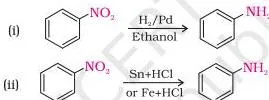
| Reduction of nitro compounds | \( H_2 \) with finely divided Ni, Pd or Pt; or metal + acid (Fe/HCl) | Primary amine \( R-NH_2 \) | Fe/HCl is preferred because the FeCl₂ formed hydrolyses back to HCl — only a little acid is needed. |
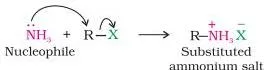
| Ammonolysis of alkyl halides | Ethanolic ammonia, sealed tube, 373 K | Mixture of 1°, 2°, 3° amines + quaternary ammonium salt | Excess ammonia makes the primary amine the major product; reactivity order RI > RBr > RCl. |
| Reduction of nitriles | \( LiAlH_4 \) or \( H_2 \)/Ni | Primary amine \( R-CH_2-NH_2 \) | Adds one carbon — the “ascent of the amine series”. |
| Reduction of amides | \( LiAlH_4 \), then water | Primary amine \( R-CH_2-NH_2 \) | Same carbon skeleton as the amide; no carbon count changes. |
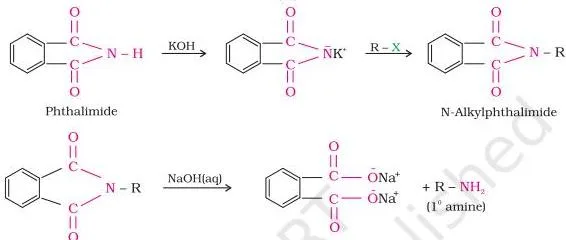
| Gabriel phthalimide synthesis | Phthalimide + ethanolic KOH, then alkyl halide, then alkaline hydrolysis | Pure primary amine | Fails for aromatic amines: aryl halides do not undergo nucleophilic substitution with the phthalimide anion. |
| Hofmann bromamide degradation | Amide + \( Br_2 \) in aqueous/ethanolic NaOH | Primary amine \( R-NH_2 \) | The amine has one carbon less than the amide; an alkyl or aryl group migrates from the carbonyl carbon to nitrogen. |
Worked example: converting 1-chloropropane to butan-1-amine through a nitrile
Step 1: Convert the halide to a nitrile with ethanolic sodium cyanide.
The nitrile route adds one carbon — exactly what a three-carbon halide needs to become a four-carbon amine.
\[ CH_3CH_2CH_2Cl \xrightarrow{\text{ethanolic NaCN}} CH_3CH_2CH_2C \equiv N \]
Step 2: Reduce the nitrile with lithium aluminium hydride or catalytic hydrogenation.
\[ CH_3CH_2CH_2C \equiv N \xrightarrow{\text{LiAlH}_4} CH_3CH_2CH_2CH_2NH_2 \]
Final answer: butan-1-amine — a primary amine with one carbon more than the starting halide.
Worked example: using the carbon count to find the amide for a Hofmann reaction
- Step 1: The Hofmann bromamide degradation removes one carbon: the amine that comes out has one carbon fewer than the amide that went in.
- Step 2: Butan-1-amine has four carbons, so the starting amide must have five — that is pentanamide, \( CH_3CH_2CH_2CH_2CONH_2 \).
Final answer: pentanamide \( CH_3CH_2CH_2CH_2CONH_2 \) gives butan-1-amine \( CH_3CH_2CH_2CH_2NH_2 \) with the loss of one carbon.
Physical properties: solubility and the boiling point order
Physical properties in this chapter reduce to one idea: wherever hydrogen bonding can happen, it shows up in solubility and boiling point.
- Lower aliphatic amines are gases with a fishy odour; primary amines with three or more carbons are liquids, and still higher ones are solids.
- Aniline and other arylamines are colourless when pure but darken on storage because of atmospheric oxidation.
- Lower amines dissolve in water by forming N–H···O hydrogen bonds with water. Solubility falls as molar mass rises, because the hydrophobic alkyl part grows.
- Among isomeric amines, boiling points fall in the order primary > secondary > tertiary, matching how many N–H hydrogens are free for intermolecular hydrogen bonding (Fig. 9.2).
- Amines are soluble in organic solvents such as alcohol, ether and benzene.
The book poses a question worth answering properly: which is more soluble in water, butan-1-ol or butan-1-amine? Butan-1-ol wins. The electronegativity of oxygen (3.5) is higher than that of nitrogen (3.0), so alcohols are more polar than amines and form stronger hydrogen bonds with water.
Basicity of amines: pKb and the three effects behind the order
Basicity is where the chapter’s hardest exam questions come from, because the obvious prediction — more alkyl groups means a stronger base — fails in water.
Basicity is measured by \( K_b \) or \( pK_b = -\log K_b \). A larger \( K_b \), or a smaller \( pK_b \), means a stronger base. Ammonia’s \( pK_b \) is 4.75; aliphatic amines lie between 3 and 4.22; aniline’s is 9.38.
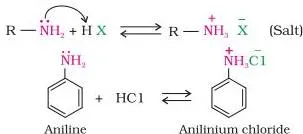
Amines form salts with mineral acids, and these salts are water-soluble but ether-insoluble — the basis for separating amines from non-basic organic compounds. A base like NaOH regenerates the free amine from its salt.
Three effects decide the basicity order of amines in water, and the book names all three:
- Inductive effect (+I): alkyl groups push electron density onto nitrogen, making the lone pair more available and stabilising the substituted ammonium ion by spreading its positive charge.
- Solvation effect: water stabilises the ammonium ion by hydrogen bonding; the larger the ion, the less it is solvated and the less stabilised it is.
- Steric hindrance: bulky alkyl groups physically block water from reaching the N–H hydrogens, cutting solvation further.
In the gas phase only the inductive effect operates, so the order is the expected one: tertiary > secondary > primary > NH₃. In water the other two effects join in, and the orders flip to the ones the book gives:
\[ (C_2H_5)_2NH \gt (C_2H_5)_3N \gt C_2H_5NH_2 \gt NH_3 \]
\[ (CH_3)_2NH \gt CH_3NH_2 \gt (CH_3)_3N \gt NH_3 \]
The lesson: solvation and steric effects favour secondary amines with small groups, which is why the dialkylamine sits on top in both series. Table 9.3 holds the \( pK_b \) values behind these orders.
Aromatic amines lose to ammonia because the lone pair is delocalised into the ring. Aniline is a resonance hybrid of five structures, but the anilinium ion has only two — so aniline is comparatively stable and reluctant to accept a proton. The resonance figure above makes the same point.
Substituents shift the balance: electron-releasing groups like \( -OCH_3 \) and \( -CH_3 \) raise basicity, while electron-withdrawing groups like \( -NO_2 \), \( -SO_3H \), \( -COOH \) and \( -X \) lower it.
Reactions that distinguish primary, secondary and tertiary amines
The chapter’s stated objective is to tell the three classes apart, and three reactions do exactly that. Exercises 9.2 and 9.6 ask you to use them.
| Test | Primary (1°) | Secondary (2°) | Tertiary (3°) |
|---|---|---|---|
| Carbylamine test: CHCl₃ + alcoholic KOH, heat | Foul-smelling isocyanide (carbylamine) forms — positive test | No reaction | No reaction |
| Nitrous acid (NaNO₂ + HCl) | Aliphatic 1°: N₂ gas + alcohol; the nitrogen is measured quantitatively to estimate amino acids and proteins. Aromatic 1°: diazonium salt at 273–278 K | Reacts in a different manner | Reacts in a different manner |
| Hinsberg’s reagent: benzenesulphonyl chloride (now p-toluenesulphonyl chloride) | Sulphonamide with an acidic N–H — dissolves in alkali | Sulphonamide with no N–H — not acidic, insoluble in alkali | No reaction |
Taken together, the three behaviours let you both identify and separate a mixture of amines. The carbylamine test is a test for primary amines only, which is why it is also called the isocyanide test.
Aniline’s electrophilic substitution: why acetylation protects it
Aniline is so reactive that it substitutes too much and in the wrong places. The chapter shows what goes wrong, then how acetylation fixes it.
- Why it is reactive: the \( -NH_2 \) group is o- and p-directing and powerfully activating, because resonance piles electron density onto the ortho and para positions.
- Bromination: aniline + bromine water at room temperature gives a white precipitate of 2,4,6-tribromoaniline.
- Nitration: the strongly acidic medium protonates aniline to the anilinium ion, which is meta-directing — so m-nitroaniline forms alongside o- and p-products, plus tarry oxidation products.
- Sulphonation: aniline + conc. \( H_2SO_4 \), heated to 453–473 K, gives sulphanilic acid (p-aminobenzenesulphonic acid) as the major product.
- Friedel–Crafts fails: aniline forms a salt with AlCl₃, the nitrogen gains a positive charge, and the ring becomes strongly deactivated.
The fix is protection. Acetylate the \( -NH_2 \) group with acetic anhydride or acetyl chloride first; the amide’s lone pair is pulled toward the carbonyl oxygen, so the ring is far less activated. Then substitute, and finally hydrolyse the amide back to the amine. The acetanilide resonance figure and the nitration scheme above show both halves of this trick.
Acylation and benzoylation are not only protective steps: they are general reactions of primary and secondary amines with acid chlorides, anhydrides or esters, and they form amides. A base stronger than the amine, such as pyridine, removes the HCl and drives the reaction forward. For example:
\[ CH_3CH_2NH_2 + C_6H_5COCl \rightarrow CH_3CH_2NHCOC_6H_5 + HCl \]
Ethanamine + benzoyl chloride gives N-ethylbenzamide. Tertiary amines have no N–H hydrogen, so they cannot be acylated this way.
Diazonium salts: the chapter’s second half
The second half of the chapter rests on one idea: the diazonium group is an excellent leaving group, so it makes substitutions possible on a benzene ring that direct reactions cannot do.
The general formula is \( Ar-N_2^+X^- \), named by adding “diazonium” to the parent arene followed by the anion — \( C_6H_5N_2^+Cl^- \) is benzenediazonium chloride. Converting a primary aromatic amine to its diazonium salt is diazotisation:
\[ C_6H_5NH_2 + NaNO_2 + 2HCl \xrightarrow{273-278\ \text{K}} C_6H_5N_2^+Cl^- + NaCl + 2H_2O \]
Arenediazonium salts are stable for only a short time in cold solution (273–278 K) and decompose when warmed or in the dry state, so they are used immediately after preparation. Aliphatic diazonium salts are far less stable and lose nitrogen at once.
Benzenediazonium chloride is a colourless crystalline solid, readily soluble in cold water; the fluoroborate salt, in contrast, is water-insoluble and stable at room temperature.
The comparison table below maps each replacement reaction to the group it introduces.
| Reagent | Group introduced | Reaction / note |
|---|---|---|
| \( Cu_2Cl_2 \)/HCl | \( -Cl \) | Sandmeyer reaction |
| \( Cu_2Br_2 \)/HBr | \( -Br \) | Sandmeyer reaction |
| CuCN/KCN | \( -CN \) | Sandmeyer reaction |
| Copper powder + HCl or HBr | \( -Cl \) or \( -Br \) | Gattermann reaction; yield is lower than Sandmeyer’s |
| KI | \( -I \) | Iodine cannot be introduced into the ring directly |
| \( HBF_4 \), then heat | \( -F \) | Aryl fluorides cannot be made by direct halogenation |
| \( H_3PO_2 \) or ethanol | \( -H \) | Reductive removal of the diazo group |
| Warm water (up to 283 K) | \( -OH \) | Hydrolysis gives phenol |
| Sodium nitrite solution + Cu, with the fluoroborate | \( -NO_2 \) | Introduces the nitro group |
Reactions that keep the diazo group are coupling reactions. Benzenediazonium chloride couples with phenol at the para position to give p-hydroxyazobenzene, and with aniline to give p-aminoazobenzene. The products are coloured because of the extended conjugation across the \( -N=N- \) link, and they are used as dyes.
These replacements matter because they install groups that direct substitution cannot: aryl fluorides and iodides are not made by direct halogenation, and the cyano group cannot be introduced by nucleophilic substitution of chlorobenzene. In one round trip — diazotise, then replace — a chemist can attach \( -F \), \( -Cl \), \( -Br \), \( -I \), \( -CN \), \( -OH \) or \( -NO_2 \) to a ring.
That is the skill behind the conversions in exercise 9.8.
Key definitions from this chapter
These are the terms the chapter expects you to use correctly in answers, each in plain words.
- Amine: a compound derived from ammonia by replacing one, two or three hydrogen atoms with alkyl or aryl groups.
- Primary / secondary / tertiary amine (1°, 2°, 3°): one, two or three hydrogen atoms of ammonia replaced, respectively.
- Simple and mixed amines: a secondary or tertiary amine is simple when all its groups are the same, mixed when they differ.
- Quaternary ammonium salt: the product when a tertiary amine reacts further with an alkyl halide — four groups on a positively charged nitrogen.
- Ammonolysis: cleavage of the C–X bond of an alkyl halide by ammonia, replacing the halogen with \( -NH_2 \).
- Acylation: replacement of the N–H hydrogen of a primary or secondary amine by an acyl group, using an acid chloride, anhydride or ester; an amide forms.
- Benzoylation: acylation specifically with benzoyl chloride, \( C_6H_5COCl \).
- Carbylamine reaction (isocyanide test): heating a primary amine with CHCl₃ and alcoholic KOH to give a foul-smelling isocyanide (R–NC); 2° and 3° amines do not respond.
- Hinsberg’s reagent: benzenesulphonyl chloride, \( C_6H_5SO_2Cl \), used to distinguish the three classes of amines; p-toluenesulphonyl chloride is now used in its place.
- Diazotisation: conversion of a primary aromatic amine to its diazonium salt with nitrous acid at 273–278 K.
- Sandmeyer reaction: replacement of the diazonium group by \( -Cl \), \( -Br \) or \( -CN \) using Cu(I) reagents — \( Cu_2Cl_2 \)/HCl, \( Cu_2Br_2 \)/HBr, CuCN/KCN.
- Gattermann reaction: the same replacements using copper powder with the corresponding halogen acid; the yield is lower than in the Sandmeyer reaction.
- Coupling reaction: reaction of a diazonium salt with phenol or aniline to form a coloured azo compound joined through \( -N=N- \).
- Azo dye: a coloured aromatic compound containing an \( -N=N- \) link between two rings, made by a coupling reaction.
- Lewis base: a species that donates an electron pair; amines qualify because of the lone pair on nitrogen.
Common mistakes in structure of amines
These are the errors the chapter most often produces. Each row names the mistake before you make it, then gives the correction.
| Mistake | Correct rule | How to check your answer |
|---|---|---|
| “Tertiary amines are always the strongest bases.” | True only in the gas phase. In water, solvation and steric hindrance flip the order, and a dialkylamine usually wins. | Recall the two aqueous orders: \( (C_2H_5)_2NH \) and \( (CH_3)_2NH \) sit on top, not the trialkylamines. |
| “Sandmeyer and Gattermann are the same reaction.” | Sandmeyer uses Cu(I) salts (\( Cu_2Cl_2 \), \( Cu_2Br_2 \), CuCN) with the corresponding acid; Gattermann uses copper powder plus HX. | Look at the reagent: any Cu(I) compound means Sandmeyer; plain copper powder means Gattermann. |
| “Gabriel synthesis can make any primary amine.” | It fails for aromatic amines: aryl halides cannot undergo nucleophilic substitution with the phthalimide anion. | If the target is an arylamine like aniline, choose a different route. |
| “Nitration of aniline gives only o- and p-nitroaniline.” | The acidic medium protonates aniline to the meta-directing anilinium ion, so m-nitroaniline also forms, along with tarry products. | Acetylate before nitrating if you need the p-isomer as the major product. |
| “In the Hofmann reaction, count the carbons forwards.” | The amine has one carbon fewer than the amide. Propan-1-amine needs butanamide; butan-1-amine needs pentanamide. | Count carbon atoms on both sides of the equation before writing it. |
| “Aliphatic and aromatic diazonium salts behave alike.” | Aliphatic diazonium salts are unstable and release nitrogen at once; aromatic ones survive for a short time in cold solution (273–278 K). | Expect the aromatic salt to be prepared in the cold and used immediately, never in the dry state. |
Exam notes: how the exercises test this chapter
Use the exercise numbers to target practice: each block tests a different skill, and the table maps them so revision time goes to the right place.
| Exercises | Skill being tested |
|---|---|
| 9.1 | Naming amines (common + IUPAC) and classifying them as 1°, 2° or 3°. |
| 9.2 and 9.6 | Distinguishing the three classes — carbylamine test, nitrous acid, Hinsberg’s reagent. |
| 9.4 | Ordering by basicity, \( pK_b \), boiling point and water solubility, then explaining the order. |
| 9.5 and 9.8 | Conversions between functional groups using the chapter’s preparations and replacements. |
| 9.9 | Reaction chains: identifying the intermediates A, B and C. |
| 9.10 | Structure elucidation: working out a compound from its reactions. |
| 9.11 | Completing reactions with the correct products. |
| 9.3, 9.12, 9.13 and 9.14 | “Account for” and reasoning answers — the how and why behind each reaction. |
Textbook contents and the examinable syllabus are not always identical — check the current official CBSE Class 12 Chemistry syllabus. The skill that recurs most in this unit is judging whether a preparation adds, keeps or removes a carbon: nitriles add one, the Hofmann reaction removes one, and reductions of nitro compounds and amides keep the count.
What to remember from this chapter
This is the chapter’s own Summary rebuilt in shorter words — the night-before screen.
- Amines are ammonia with one, two or three H atoms replaced by alkyl or aryl groups — primary, secondary or tertiary.
- The nitrogen is \( sp^3 \) hybridised and pyramidal with a lone pair, which makes amines Lewis bases and nucleophiles.
- Preparations: nitro reduction, ammonolysis, nitrile reduction (adds one C), amide reduction, Gabriel synthesis (pure 1°, not for aryl), Hofmann degradation (loses one C).
- Hydrogen bonding controls physical properties: solubility in water falls with molar mass; boiling points run 1° > 2° > 3°.
- Aqueous basicity balances inductive, solvation and steric effects; in water dialkylamines lead, in the gas phase tertiary amines do.
- Alkylamines are stronger bases than ammonia; aniline is weaker than ammonia because five resonance structures beat two.
- The lone pair drives the reactions: alkylation, acylation, benzoylation, carbylamine test, nitrous acid, Hinsberg’s reagent.
- Carbylamine and Hinsberg’s tests separate the three classes; nitrous acid also distinguishes them.
- Acetylation protects aniline’s ring — the amide lone pair goes to the carbonyl oxygen, so controlled substitution (e.g. p-nitroaniline) becomes possible.
- Diazonium salts swap \( N_2 \) for Cl, Br, I, F, CN, OH, H or \( NO_2 \), and couple with phenols and amines to make azo dyes.
One fact the chapter ends on: the tertiary amine trimethylamine is used as an insect attractant.
Related resources
This chapter sits inside the Class 12 Chemistry programme. The Class 12 Chemistry notes page holds the other units, the Class 12 hub organises study material by subject, and the CBSE notes index is the fastest way to move between classes.
If you are revising the full book in order, the previous chapter, Aldehydes, Ketones and Carboxylic Acids, sets up reactions this unit uses, such as the reduction of amides. The coordination compounds chapter (Werner’s theory) is a good inorganic unit to tackle alongside it.
The official NCERT portal publishes the current Class 12 Chemistry Part II textbook, and the CBSE website carries the Class 12 Chemistry syllabus — open both if you want to verify the edition or check the examinable portions.
Sources and data verification
The chapter described on this page is Unit 9, “Amines”, in NCERT Chemistry Part II for Class 12. This page is maintained for the 2026-27 session from the NCERT information available to us.
NCERT settles textbook content, editions and PDFs; CBSE settles the curriculum, syllabus and examinations. The figures, tables, exercise numbers and reactions described here are NCERT’s own, from the official chapter. No expert review process beyond the sources named is claimed.
Frequently asked questions about the structure of amines
Why is the nitrogen atom in amines pyramidal?
Because nitrogen is \( sp^3 \) hybridised and one of the four orbitals holds an unshared pair of electrons. The three bonds to H or C and the lone pair point roughly to the corners of a tetrahedron, and the lone pair compresses the bond angles below 109.5° — to 108° in trimethylamine.
Why is the order of basic strength of amines different in the gas phase and in water?
In the gas phase only the inductive effect operates, so more alkyl groups means a stronger base (3° > 2° > 1° > NH₃). In water, solvation stabilises the ammonium ion, and steric hindrance from bulky groups blocks solvation — the larger the ion, the less stable it is.
The two extra effects flip the order, and dialkylamines end up on top in both the methyl and ethyl series.
How do you distinguish primary, secondary and tertiary amines?
Three tests do it. Carbylamine: only a primary amine gives a foul-smelling isocyanide with CHCl₃ and alcoholic KOH. Nitrous acid: an aliphatic primary amine liberates N₂, and an aromatic primary amine gives a diazonium salt at 273–278 K. Hinsberg’s reagent: the primary amine’s sulphonamide dissolves in alkali, the secondary amine’s does not, and the tertiary amine does not react.
p-Toluenesulphonyl chloride is now used in place of benzenesulphonyl chloride.
Why is aniline a weaker base than ammonia?
The lone pair on nitrogen is in conjugation with the benzene ring, so it is less available for protonation. Aniline is a resonance hybrid of five structures while the anilinium ion has only two, meaning aniline is more stable than its protonated form — proton uptake becomes harder, and the \( pK_b \) rises to 9.38 against ammonia’s 4.75.
What is the difference between the Sandmeyer and Gattermann reactions?
Both replace the diazonium group with Cl or Br, but Sandmeyer uses Cu(I) salts — \( Cu_2Cl_2 \)/HCl and \( Cu_2Br_2 \)/HBr — while Gattermann uses copper powder with the corresponding halogen acid. The book notes that Sandmeyer gives the better yield. Sandmeyer also introduces the cyano group via CuCN/KCN.
Why is Gabriel phthalimide synthesis not used to prepare aromatic primary amines?
Because aryl halides cannot undergo nucleophilic substitution with the phthalimide anion. The reaction works well for alkyl halides and gives a pure primary amine, but aromatic halides are too unreactive toward this nucleophile.
Reference: NCERT Class 12 Chemistry textbook, chapter 4, official edition on ncert.nic.in.
Explore Class 12 Chemistry Books
Class 12 Chemistry on LearnCBSE:
Related chapters: