
This page is about Electrochemistry Class 12 Chapter 2 of the NCERT Chemistry Part I textbook, maintained for the 2026-27 academic session. The official chapter PDF is right below. After the download, the page explains what the chapter actually teaches — from the Daniell cell and the Nernst equation to conductivity, electrolysis, batteries and corrosion.
Electrochemistry Class 12 Chapter 2 PDF Download
NCERT publishes this chapter as unit 2 of Chemistry Part I, and the official file on ncert.nic.in is identical to the printed textbook.
Open the Electrochemistry Class 12 Chapter 2 PDF to read the complete chapter — the cell concepts, the conductivity and electrolysis sections, the standard electrode potential table, the worked examples and the end exercises, exactly as printed.
Reference: NCERT Class 12 Chemistry textbook, Chapter 2, official edition on ncert.nic.in.
| What the chapter holds | Count | Where it is used |
|---|---|---|
| Printed pages | 30 | |
| Sections in the chapter | 16 | |
| Figures with NCERT captions | 11 | |
| Tables | 7 | |
| Worked examples | 1 | solved step by step in our NCERT Solutions |
| Exercise questions | 18 | answered in our NCERT Solutions |
| Official NCERT PDF | Download the chapter PDF | the chapter exactly as NCERT publishes it |
Chapter at a Glance
The table below lists what is inside this chapter — its numbered sections, diagrams, worked examples, data tables and exercise questions.
What This Chapter Covers
Electrochemistry builds one idea on another, so it helps to see the whole structure before reading. The table maps each numbered section to what it teaches.
| Section | What it teaches |
|---|---|
| 2.1 Electrochemical Cells | The Daniell cell as the model: a redox reaction split into two half-cells, producing 1.1 V when ion concentrations are 1 mol dm⁻³. |
| 2.2 Galvanic Cells | How the Gibbs energy of a spontaneous reaction becomes electrical work; half-cells, electrode potential, cell notation and \( E_{cell} = E_{right} – E_{left} \). |
| 2.2.1 Measurement of Electrode Potential | The standard hydrogen electrode as the zero reference, and how the values in Table 2.1 are measured. |
| 2.3 Nernst Equation | How potential changes when concentrations are not 1 M; the links to \( K_c \) and \( \Delta_r G \). |
| 2.4 Conductance of Electrolytic Solutions | Resistivity, conductivity and molar conductivity; how they are measured; Kohlrausch law. |
| 2.5 Electrolytic Cells and Electrolysis | Using electrical energy to force a reaction; Faraday’s laws; what decides the products. |
| 2.6 Batteries | Primary batteries (dry cell, mercury cell) and secondary batteries (lead storage, nickel-cadmium). |
| 2.7 Fuel Cells | Galvanic cells fed continuously with fuel and oxidant, such as the H₂–O₂ cell. |
| 2.8 Corrosion | Rusting explained as an electrochemical cell, with the methods of prevention. |
Short Intext Questions appear after several sections, with answers to some given at the end of the chapter. A special boxed reading, The Hydrogen Economy, closes the unit before the Summary.
Galvanic Cells and Electrolytic Cells: Two Directions for the Same Chemistry
A galvanic cell turns a spontaneous redox reaction into electricity. The same cell chemistry runs backwards when an external voltage is applied — it is then an electrolytic cell.
The Daniell cell: one reaction in two half-cells
In the Daniell cell, zinc and copper electrodes dip in the solutions of their respective salts. The overall reaction is \( \text{Zn(s)} + \text{Cu}^{2+}(\text{aq}) \rightarrow \text{Zn}^{2+}(\text{aq}) + \text{Cu(s)} \), and the cell gives 1.1 V when both ion concentrations are 1 mol dm⁻³ (NCERT, Section 2.1).
The reaction happens in two places: \( \text{Cu}^{2+} + 2e^- \rightarrow \text{Cu(s)} \) (reduction) at the copper electrode, and \( \text{Zn(s)} \rightarrow \text{Zn}^{2+} + 2e^- \) (oxidation) at the zinc electrode. These two portions are the half-cells or redox couples. A salt bridge connects the electrolytes internally; a wire through a voltmeter connects the electrodes externally.
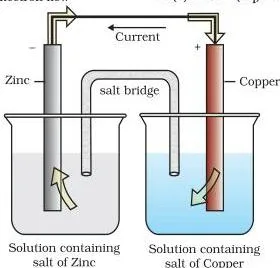
Read Figure 2.1 as a circuit: electrons leave the zinc electrode, travel through the wire to the copper electrode, and ions move through the salt bridge to keep both solutions neutral. Oxidation happens at the anode (zinc, negative), reduction at the cathode (copper, positive).
Opposing the cell with an external voltage
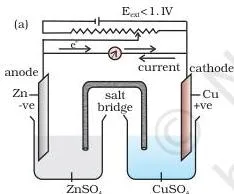
If an external voltage \( E_{ext} \) is applied against the cell and raised slowly, the cell behaves differently at three values (Figure 2.2):
- \( E_{ext} \lt 1.1\ \text{V} \): electrons flow Zn → Cu, zinc dissolves, copper deposits — the cell works.
- \( E_{ext} = 1.1\ \text{V} \): no current and no reaction — the opposing voltages cancel.
- \( E_{ext} \gt 1.1\ \text{V} \): electron flow reverses (Cu → Zn), zinc deposits and copper dissolves — the cell is now electrolytic.
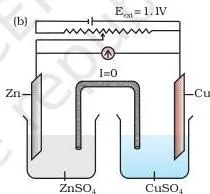
This single experiment carries the whole chapter: the same electrode pair can run the reaction forward (galvanic) or force it backwards (electrolytic).
Electrode potential and the standard hydrogen electrode
Each electrode develops a potential difference against its solution — the electrode potential. When all species in the half-cell are at unit concentration, it is the standard electrode potential \( E^\circ \). A single electrode potential can never be measured; only the difference between two electrodes can (NCERT, Section 2.2.1).
So chemists fixed one reference: the standard hydrogen electrode (SHE), written \( \text{Pt(s)} \mid \text{H}_2(\text{g}) \mid \text{H}^+(\text{aq}) \), is assigned zero potential at all temperatures for the reaction \( \text{H}^+(\text{aq}) + e^- \rightarrow \frac{1}{2}\text{H}_2(\text{g}) \).
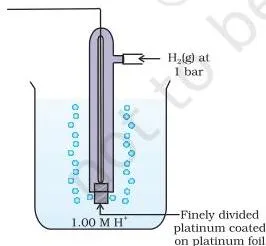
In Figure 2.3, the platinum electrode is coated with platinum black — finely divided platinum deposited electrochemically. The electrode dips in acid, hydrogen gas at 1 bar pressure is bubbled through it, and the H⁺ concentration is 1 M. Platinum is inert: it does not react, it only conducts electrons and provides surface (NCERT, Section 2.2.1).
When the SHE is the left (anode) half-cell, the measured cell emf is simply the other electrode’s standard reduction potential. With the convention that the anode goes on the left and the cathode on the right:
\[ E_{cell} = E_{right} – E_{left} \]
For the cell \( \text{Cu(s)} \mid \text{Cu}^{2+}(\text{aq}) \parallel \text{Ag}^+(\text{aq}) \mid \text{Ag(s)} \), the emf is \( E_{Ag^+|Ag} – E_{Cu^{2+}|Cu} \). For the Daniell cell, Table 2.1 gives \( E^\circ_{Cu^{2+}|Cu} = 0.34\ \text{V} \) and \( E^\circ_{Zn^{2+}|Zn} = -0.76\ \text{V} \), so \[ E^\circ_{cell} = 0.34\ \text{V} – (-0.76\ \text{V}) = 1.10\ \text{V} \]
In cell notation, a single vertical line marks a phase boundary (metal | solution) and a double vertical line marks the salt bridge. Table 2.1 lists standard electrode potentials at 298 K. Higher in the table means stronger oxidising power on the left: fluorine at +2.87 V is the strongest oxidising agent, while lithium at −3.05 V is the strongest reducing agent in aqueous solution.
This is also how feasibility is judged. A species on the left of a half-reaction oxidises the reduced form of any couple lower in the table. Since \( E^\circ_{Cu^{2+}|Cu} \) is +0.34 V, hydrogen ions cannot oxidise copper — which is why copper does not dissolve in HCl (NCERT, Section 2.2.1).
Galvanic cell vs electrolytic cell
The comparison to remember — the sign flip here traps many students:
| Feature | Galvanic cell | Electrolytic cell |
|---|---|---|
| Energy direction | Chemical energy → electrical energy | Electrical energy → chemical energy |
| Reaction | Spontaneous redox reaction | Non-spontaneous reaction forced by external voltage |
| Anode sign | Negative | Positive |
| Cathode sign | Positive | Negative |
| Example | Daniell cell, dry cell | Electrolysis of CuSO₄ solution, of molten NaCl |
Nernst Equation: Potential When Concentrations Are Not 1 M
The standard potentials in Table 2.1 only apply when every species is at unit concentration. Real cells almost never are, so the Nernst equation corrects the potential for the actual concentrations.
For an electrode \( \text{M}^{n+}(\text{aq}) + ne^- \rightarrow \text{M(s)} \), with the solid metal’s concentration taken as unity (NCERT, Section 2.3):
\[ E_{(M^{n+}/M)} = E^\circ_{(M^{n+}/M)} – \frac{RT}{nF} \ln \frac{1}{[M^{n+}]} \]
For a general cell reaction \( aA + bB \rightarrow cC + dD \), the cell version is \[ E_{cell} = E^\circ_{cell} – \frac{RT}{nF} \ln Q = E^\circ_{cell} – \frac{RT}{nF} \ln \frac{[C]^c [D]^d}{[A]^a [B]^b} \]
At 298 K, substituting \( R = 8.314\ \text{J K}^{-1}\ \text{mol}^{-1} \) and \( F = 96487\ \text{C mol}^{-1} \), and converting the natural log to base 10, the constants fold into one number:
\[ E_{cell} = E^\circ_{cell} – \frac{0.059}{n} \log Q \]
The same number \( n \) of electrons must be used for both electrodes — the balanced half reactions decide it (NCERT, Section 2.3). For the Daniell cell, \( E_{cell} = E^\circ_{cell} – \frac{0.059}{2} \log \frac{[Zn^{2+}]}{[Cu^{2+}]} \), so the cell potential rises when \( [Cu^{2+}] \) rises and falls when \( [Zn^{2+}] \) rises.
Why this matters: the Nernst equation also links electrochemistry to two quantities from earlier classes. At equilibrium the cell stops working, \( E_{cell} = 0 \), so at 298 K \[ \log K_c = \frac{nE^\circ_{cell}}{0.059} \]
For the Daniell cell this gives \( \log K_c \approx 37.3 \), so \( K_c \approx 2 \times 10^{37} \) — a reaction so product-favoured it effectively runs to completion (NCERT, Section 2.3.1). And because the electrical work equals the drop in Gibbs energy (NCERT, Section 2.3.2):
\[ \Delta_r G = -nFE_{cell}, \qquad \Delta_r G^\circ = -nFE^\circ_{cell} = -RT \ln K \]
Note that \( E_{cell} \) is intensive while \( \Delta_r G \) is extensive: double the reaction, \( n \) doubles and \( \Delta_r G \) doubles, but \( E_{cell} \) stays the same. A spontaneous reaction always has \( E^\circ_{cell} \gt 0 \) and \( \Delta_r G^\circ \lt 0 \).
Worked example (new numbers): the cell \( \text{Mg(s)} \mid \text{Mg}^{2+}(0.080\ \text{M}) \parallel \text{Ag}^+(0.0005\ \text{M}) \mid \text{Ag(s)} \) has \( E^\circ_{cell} = 3.17\ \text{V} \).
Find its potential at 298 K.
Step 1: Write the half reactions.
Anode: \( \text{Mg(s)} \rightarrow \text{Mg}^{2+}(\text{aq}) + 2e^- \).
Cathode: \( 2\text{Ag}^+(\text{aq}) + 2e^- \rightarrow 2\text{Ag(s)} \).
The electron count for both electrodes is \( n = 2 \).
Step 2: Write the reaction quotient.
Solids are omitted, so \( Q = \frac{[\text{Mg}^{2+}]}{[\text{Ag}^+]^2} = \frac{0.080}{(0.0005)^2} \).
Step 3: Substitute at 298 K using the 0.059 log form.
\[ E_{cell} = 3.17 – \frac{0.059}{2} \log \frac{0.080}{(0.0005)^2} = 3.17 – 0.0295 \log (3.2 \times 10^5) \]
\[ = 3.17 – 0.0295 \times 5.505 = 3.17 – 0.162 \approx 3.01\ \text{V} \]
Final answer: \( E_{cell} \approx 3.01\ \text{V} \). Since \( E_{cell} \gt 0 \), the cell reaction as written is spontaneous.
Conductivity and Molar Conductivity: What Changes When You Dilute
This section is about how well a solution carries current, and why dilution changes that. The names and units matter — most marks lost here are unit errors, not calculation errors.
The terms in the order the chapter defines them
Resistance \( R \) is proportional to length \( l \) and inversely proportional to area \( A \): \( R = \rho \frac{l}{A} \), where resistivity \( \rho \) has units \( \Omega\ \text{m} \). Its inverse is conductance \( G = \frac{1}{R} \) in siemens (S), and the inverse of resistivity is conductivity \( \kappa \) in \( \text{S m}^{-1} \) (NCERT, Section 2.4).
Molar conductivity bundles these into one useful quantity (NCERT, Section 2.4.1):
\[ \Lambda_m = \frac{\kappa}{c} \]
It has units of \( \text{S m}^2\ \text{mol}^{-1} \), and \( 1\ \text{S m}^2\ \text{mol}^{-1} = 10^4\ \text{S cm}^2\ \text{mol}^{-1} \). Because conductivity is often quoted in \( \text{S cm}^{-1} \) while molarity is in \( \text{mol L}^{-1} \), the practical conversion is \[ \Lambda_m\ (\text{S cm}^2\ \text{mol}^{-1}) = \frac{\kappa\ (\text{S cm}^{-1}) \times 1000}{\text{molarity}\ (\text{mol L}^{-1})} \]
Table 2.2 shows why conductivity varies so much: metals like silver, copper and gold cluster around \( 10^3\)-\(10^4\ \text{S m}^{-1} \), pure water is only \( 3.5 \times 10^{-5}\ \text{S m}^{-1} \), and glass or Teflon fall far below.
Metallic (electronic) conductance is carried by electrons and falls with temperature; electrolytic (ionic) conductance is carried by ions and rises with temperature.
How conductivity is measured
Two problems stop us from measuring a solution’s resistance like a wire. Direct current changes the solution’s composition by electrolysis, and a solution cannot be clamped like a metal. So the chapter uses an alternating current (AC) source on a Wheatstone bridge and a specially built conductivity cell with two platinum electrodes coated with platinum black (NCERT, Section 2.4.1).
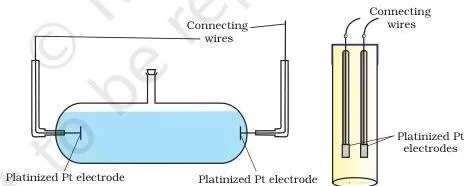
Figure 2.4 shows two designs of conductivity cells. Both rest on the same idea: the solution between the electrodes is a column of length \( l \) and area \( A \), so its resistance is \( R = \rho l/A \).
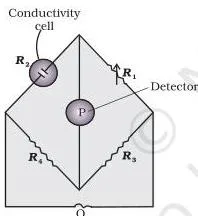
Figure 2.5 is the measuring circuit: two fixed resistances, a variable resistance and the cell as the unknown, fed by an AC oscillator and balanced when no current passes through the detector.
The cell constant \( G^* = l/A \) is found once using a solution of known conductivity (KCl, with values in Table 2.3). After that, \( \kappa = G^*/R \) for any solution.
What dilution does: strong vs weak electrolytes
On dilution, conductivity always decreases — each unit volume holds fewer ions. Molar conductivity always increases — the volume containing one mole of electrolyte grows, and that volume increase more than compensates for the fall in \( \kappa \) (NCERT, Section 2.4.2).
For a strong electrolyte, \( \Lambda_m \) rises slowly and linearly with dilution: \( \Lambda_m = \Lambda_m^\circ – A\sqrt{c} \). A plot of \( \Lambda_m \) against \( \sqrt{c} \) is therefore a straight line whose intercept at \( \sqrt{c} = 0 \) is the limiting molar conductivity \( \Lambda_m^\circ \).
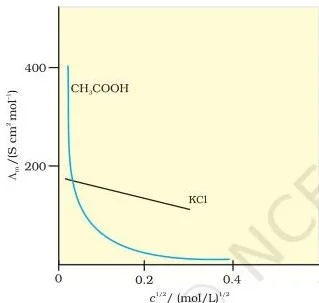
Figure 2.6 is the key comparison. KCl (strong) gives a nearly straight, gently falling line. Acetic acid (weak) gives a steep curve that keeps climbing — weak electrolytes dissociate more as they are diluted, adding ions as well as volume. Because the curve is steep, extrapolating it to zero concentration would be guesswork.
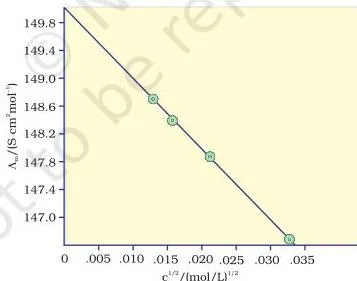
Figure 2.7 shows the strong-electrolyte method for KCl: the points fall on a straight line, and extending it back to \( \sqrt{c} = 0 \) reads off \( \Lambda_m^\circ \approx 150.0\ \text{S cm}^2\ \text{mol}^{-1} \).
Kohlrausch law and the dissociation constant
Kohlrausch law of independent migration of ions states that the limiting molar conductivity of an electrolyte is the sum of the separate contributions of its ions (NCERT, Weak Electrolytes):
\[ \Lambda_m^\circ = \nu_+ \lambda_+^\circ + \nu_- \lambda_-^\circ \]
Here \( \nu_+ \) and \( \nu_- \) are the numbers of cations and anions per formula unit, and \( \lambda^\circ \) are the ions’ limiting molar conductivities from Table 2.4. For acetic acid, \( \Lambda^\circ_{HAc} = \lambda^\circ_{H^+} + \lambda^\circ_{CH_3COO^-} = 349.6 + 40.9 = 390.5\ \text{S cm}^2\ \text{mol}^{-1} \).
This law matters most for weak electrolytes, whose \( \Lambda_m^\circ \) cannot be measured or extrapolated. With the degree of dissociation \( \alpha = \frac{\Lambda_m}{\Lambda_m^\circ} \), the dissociation constant is \[ K_a = \frac{c\alpha^2}{1-\alpha} = \frac{c\Lambda_m^2}{\Lambda_m^\circ(\Lambda_m^\circ – \Lambda_m)} \]
Worked example (new numbers): a 0.00150 M solution of acetic acid has \( \kappa = 5.6 \times 10^{-5}\ \text{S cm}^{-1} \).
Given \( \Lambda_m^\circ = 390.5\ \text{S cm}^2\ \text{mol}^{-1} \), find \( \Lambda_m \), \( \alpha \) and \( K_a \).
Step 1: Convert units.
\( \kappa \) is in \( \text{S cm}^{-1} \) and molarity in \( \text{mol L}^{-1} \), so multiply by 1000:
\[ \Lambda_m = \frac{5.6 \times 10^{-5} \times 1000}{0.00150} = 37.3\ \text{S cm}^2\ \text{mol}^{-1} \]
Step 2: Degree of dissociation compares measured to limiting molar conductivity:
\[ \alpha = \frac{37.3}{390.5} = 0.0955 \approx 0.096 \]
Step 3: Dissociation constant of the weak acid:
\[ K_a = \frac{0.00150 \times (0.0955)^2}{1 – 0.0955} \approx 1.5 \times 10^{-5}\ \text{mol L}^{-1} \]
Final answer: \( \Lambda_m \approx 37.3\ \text{S cm}^2\ \text{mol}^{-1} \), \( \alpha \approx 0.096 \), \( K_a \approx 1.5 \times 10^{-5} \).
Electrolysis and Faraday’s Laws: How Much Metal Does a Current Deposit
An electrolytic cell uses an external voltage to force a reaction that would not run by itself. The calculation skill is simple once the charge logic is clear: how many moles of electrons does one mole of product need?
Faraday’s laws
Faraday’s first law: the amount of chemical reaction at an electrode is proportional to the quantity of electricity passed. Second law: the same charge liberates masses proportional to the chemical equivalent weights — the molar mass divided by the electrons needed per formula unit (NCERT, Faraday’s Laws of Electrolysis).
The quantity of electricity is \( Q = It \), with \( I \) in amperes and \( t \) in seconds, giving coulombs. One mole of electrons carries the Faraday:
\[ F = 6.02 \times 10^{23} \times 1.6021 \times 10^{-19} = 96487\ \text{C mol}^{-1} \approx 96500\ \text{C mol}^{-1} \]
The charge needed depends on the half reaction: \( \text{Ag}^+ + e^- \rightarrow \text{Ag} \) needs 1F per mole, \( \text{Mg}^{2+} + 2e^- \rightarrow \text{Mg} \) needs 2F, and \( \text{Al}^{3+} + 3e^- \rightarrow \text{Al} \) needs 3F.
Worked example (new numbers): silver is deposited from silver nitrate solution by a steady current of 2.0 A flowing for 40 minutes.
What mass of silver deposits at the cathode?
Step 1: Convert time to seconds and find the charge.
\( t = 40 \times 60 = 2400\ \text{s} \), so \[ Q = It = 2.0 \times 2400 = 4800\ \text{C} \]
- Step 1: Write the reduction half reaction to find \( n \): \( \text{Ag}^+ + e^- \rightarrow \text{Ag} \), so \( n = 1 \).
- Step 2: Use mass \( = \frac{\text{molar mass} \times Q}{nF} \), with \( M(\text{Ag}) = 108\ \text{g mol}^{-1} \):
\[ m = \frac{108 \times 4800}{1 \times 96487} \approx 5.37\ \text{g} \]
Final answer: about 5.37 g of silver is deposited at the cathode.
Products of electrolysis
What forms at each electrode depends on the material being electrolysed and on the electrodes themselves. An inert electrode (platinum or gold) only supplies or removes electrons; a reactive electrode takes part in the reaction (NCERT, Section 2.5.1).
Where several species compete, the one with the higher \( E^\circ \) is reduced at the cathode and the one with the lower \( E^\circ \) is oxidised at the anode, with concentrations corrected by the Nernst equation. Two classic results:
- Molten NaCl: only Na⁺ and Cl⁻ exist, so the products are sodium metal and chlorine gas.
- Aqueous NaCl: water adds H⁺ and OH⁻. At the cathode, \( E^\circ(\text{H}^+|\text{H}_2) = 0.00\ \text{V} \) beats \( E^\circ(\text{Na}^+|\text{Na}) = -2.71\ \text{V} \), so hydrogen is produced. At the anode, water has the lower oxidation potential (1.23 V against 1.36 V for chloride), so oxygen should form — but it does not.
That surprise is overpotential. Oxygen evolution is kinetically slow: though it is thermodynamically feasible, it needs extra voltage beyond the \( E^\circ \) value to proceed at a practical rate. In concentrated NaCl solution, chlorine is therefore evolved instead, and the net electrolysis gives NaOH, H₂ and Cl₂ (NCERT, Section 2.5.1).
The same electrochemistry runs major industries: impure copper is refined by making it the anode and depositing pure copper at the cathode; sodium and magnesium are made by electrolysing their fused chlorides; and aluminium is produced by electrolysis of aluminium oxide in molten cryolite.
Batteries, Fuel Cells and Corrosion: Electrochemistry in Daily Life
Every battery is a packaged galvanic cell. Corrosion is the same electrochemistry running where we do not want it.
Primary batteries
A primary battery works once and then dies — its reaction cannot be reversed. The familiar dry cell (Leclanche cell) uses a zinc container as the anode, a carbon rod cathode surrounded by powdered MnO₂ and carbon, and a moist paste of \( \text{NH}_4\text{Cl} \) and \( \text{ZnCl}_2 \). It gives about 1.5 V (NCERT, Section 2.6.1).
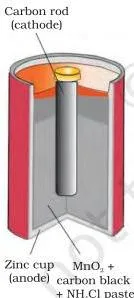
In Figure 2.8, the zinc container is the outer wall and the carbon rod is the central electrode. The approximate reactions are: anode, \( \text{Zn(s)} \rightarrow \text{Zn}^{2+} + 2e^- \); cathode, \( \text{MnO}_2 + \text{NH}_4^+ + e^- \rightarrow \text{MnO(OH)} + \text{NH}_3 \), with manganese reduced from +4 to +3.
The mercury cell (Zn–Hg amalgam anode, HgO cathode, KOH–ZnO paste) gives about 1.35 V and keeps this voltage constant through its life, because its overall reaction involves no ion whose concentration changes.
Secondary batteries
A secondary battery is recharged by passing current through it in the opposite direction. The lead storage battery of automobiles and inverters uses a lead anode and a grid of lead packed with PbO₂ as cathode, in 38% \( \text{H}_2\text{SO}_4 \) (NCERT, Section 2.6.2).
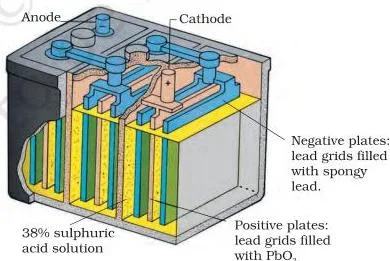
Figure 2.10 shows the plates dipping in sulphuric acid. During discharge, both electrodes form lead sulphate:
\[ \text{Pb(s)} + \text{PbO}_2\text{(s)} + 2\text{H}_2\text{SO}_4\text{(aq)} \rightarrow 2\text{PbSO}_4\text{(s)} + 2\text{H}_2\text{O(l)} \]
On charging, the reaction reverses: PbSO₄ at the electrodes is converted back to Pb and PbO₂. The nickel-cadmium cell is the other secondary battery described — it lasts longer than the lead storage cell but costs more to make.
| Feature | Primary battery | Secondary battery |
|---|---|---|
| Rechargeable? | No — the reaction runs once, then the cell is dead | Yes — charging reverses the discharge reaction |
| Examples | Dry cell, mercury cell | Lead storage battery, nickel-cadmium cell |
| Anode material | Dry cell: zinc container; mercury cell: Zn–Hg amalgam | Lead: Pb; Ni-Cd: Cd |
| Cathode material | Dry cell: carbon rod + MnO₂; mercury cell: HgO | Lead: PbO₂; Ni-Cd: Ni(OH)₃ |
| Electrode reactions | Dry cell: Zn → Zn²⁺ + 2e⁻; MnO₂ + NH₄⁺ + e⁻ → MnO(OH) + NH₃ | Lead (discharge): Pb + PbO₂ + 2H₂SO₄ → 2PbSO₄ + 2H₂O |
| Cell potential | Dry cell ≈ 1.5 V; mercury cell ≈ 1.35 V (constant) | — |
Fuel cells
A fuel cell is a galvanic cell fed continuously: fuel and oxidant are supplied at the electrodes and products are removed, so it never needs recharging. The hydrogen–oxygen fuel cell was used in the Apollo space programme, where the water it produced was condensed and added to the astronauts’ drinking supply (NCERT, Section 2.7).
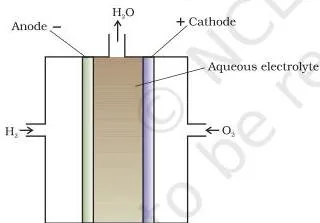
In Figure 2.12, hydrogen and oxygen are bubbled through porous carbon electrodes in concentrated NaOH, with platinum or palladium catalysts. The reactions are:
\[ \text{Cathode: } \text{O}_2\text{(g)} + 2\text{H}_2\text{O(l)} + 4e^- \rightarrow 4\text{OH}^-\text{(aq)} \]
\[ \text{Anode: } 2\text{H}_2\text{(g)} + 4\text{OH}^-\text{(aq)} \rightarrow 4\text{H}_2\text{O(l)} + 4e^- \]
\[ \text{Overall: } 2\text{H}_2\text{(g)} + \text{O}_2\text{(g)} \rightarrow 2\text{H}_2\text{O(l)} \]
Fuel cells convert chemical energy with about 70% efficiency, against roughly 40% for thermal plants — and they are pollution-free.
Corrosion: rust is a tiny electrochemical cell
Corrosion is a metal being oxidised by atmospheric oxygen.
Rusting of iron needs both water and air, and it works as an electrochemical cell on the metal surface: at an anodic spot, iron is oxidised, \( 2\text{Fe(s)} \rightarrow 2\text{Fe}^{2+} + 4e^- \) (\( E^\circ = -0.44\ \text{V} \)); at a cathodic spot elsewhere on the same object, oxygen is reduced, \( \text{O}_2 + 4\text{H}^+ + 4e^- \rightarrow 2\text{H}_2\text{O} \) (\( E^\circ = 1.23\ \text{V} \)) (NCERT, Section 2.8).
The electrons travel through the metal itself from anode spot to cathode spot. The ferrous ions are further oxidised by atmospheric oxygen to ferric ions, which appear as rust — hydrated ferric oxide, \( \text{Fe}_2\text{O}_3 \cdot x\text{H}_2\text{O} \).
Prevention cuts off the cell: keep the surface from air with paint or chemical coatings, cover it with another metal such as Sn or Zn, or attach a sacrificial electrode of a more reactive metal (Mg or Zn) that corrodes in place of the iron.
The chapter closes with The Hydrogen Economy: hydrogen made by electrolysing water using solar energy, burned in fuel cells, produces only water — a renewable, non-polluting energy cycle built entirely on electrochemical principles (NCERT, The Hydrogen Economy).
Reading the Chapter’s Diagrams: What Each Figure Tells You
Each NCERT figure in this chapter carries one idea. Use this checklist when you revise:
- Fig. 2.1 (Daniell cell): oxidation at zinc (anode), reduction at copper (cathode), electrons in the wire, ions through the salt bridge.
- Fig. 2.2 (opposing voltage): below 1.1 V the cell runs; at exactly 1.1 V it stops; above 1.1 V the reaction reverses and the cell turns electrolytic.
- Fig. 2.3 (SHE): platinum black surface, H₂ at 1 bar, H⁺ at 1 M — the assigned-zero reference.
- Fig. 2.4 (conductivity cells): platinum electrodes coated with platinum black; the solution column between them has length \( l \) and area \( A \).
- Fig. 2.5 (measurement): Wheatstone bridge fed by an AC oscillator — direct current would electrolyse the solution.
- Fig. 2.6 (molar conductivity vs \( \sqrt{c} \)): straight line for KCl, steep curve for acetic acid — extrapolation works only for strong electrolytes.
- Fig. 2.7 (KCl extrapolation): the intercept at \( \sqrt{c} = 0 \) gives \( \Lambda_m^\circ \approx 150.0\ \text{S cm}^2\ \text{mol}^{-1} \).
- Fig. 2.8 (dry cell): zinc container anode, carbon cathode, MnO₂ paste — a 1.5 V primary cell.
- Fig. 2.10 (lead battery): Pb and PbO₂ plates in 38% \( \text{H}_2\text{SO}_4 \); discharge builds PbSO₄, charging reverses it.
- Fig. 2.12 (fuel cell): H₂ and O₂ in, water out, electricity produced continuously — the Apollo cell.
Key Terms and Definitions From the Chapter
A quick lookup — the symbol and unit are given where the chapter defines one.
| Term | Meaning | Symbol / unit |
|---|---|---|
| Electrochemical cell | Two electrodes dipping in electrolytic solution(s); converts chemical and electrical energy into each other. | — |
| Galvanic cell | Converts chemical energy of a spontaneous redox reaction into electrical energy. | — |
| Electrolytic cell | Uses electrical energy to carry out a non-spontaneous reaction. | — |
| Half-cell / redox couple | One electrode with its electrolyte; the site of one half reaction. | — |
| Salt bridge | Internal connection between the two half-cell electrolytes. | — |
| Electrode potential | Potential difference between an electrode and its solution. | \( E \), volt (V) |
| Standard electrode potential | Electrode potential when all species are at unit concentration. | \( E^\circ \), V |
| Cell potential / emf | Difference between cathode and anode reduction potentials; called emf when no current flows. | \( E_{cell} \), V |
| Resistivity | Resistance of a column 1 m long with 1 m² cross-section. | \( \rho \), \( \Omega\ \text{m} \) |
| Conductivity | Inverse of resistivity. | \( \kappa \), \( \text{S m}^{-1} \) |
| Conductance | Inverse of resistance. | \( G \), siemens (S) |
| Molar conductivity | Conductivity divided by concentration. | \( \Lambda_m \), \( \text{S m}^2\ \text{mol}^{-1} \) |
| Limiting molar conductivity | Molar conductivity at zero concentration (infinite dilution). | \( \Lambda_m^\circ \) |
| Cell constant | Ratio of electrode distance to area for a conductivity cell. | \( G^* \), \( \text{m}^{-1} \) |
| Faraday | Charge carried by one mole of electrons. | \( F = 96487\ \text{C mol}^{-1} \) |
| Overpotential | Extra voltage needed when a feasible electrode reaction is kinetically slow. | V |
| Fuel cell | Galvanic cell continuously supplied with fuel and oxidant. | — |
| Corrosion | Oxidation of a metal by oxygen (rusting); an electrochemical process. | — |
| Sacrificial electrode | More reactive metal (Mg, Zn) that corrodes to protect the object. | — |
The Formulas of This Chapter in One Table
Every working formula from the chapter, with what the symbols mean. The forms using 0.059 hold at 298 K.
| Formula | Meaning | Symbols and units |
|---|---|---|
| \( E_{cell} = E_{right} – E_{left} \) | Cell emf from the two electrode potentials; anode written left, cathode right. | \( E \) in V |
| \( E = E^\circ – \frac{RT}{nF} \ln \frac{1}{[M^{n+}]} \) | Nernst equation for a single electrode. | \( R = 8.314\ \text{J K}^{-1}\ \text{mol}^{-1} \), \( F = 96487\ \text{C mol}^{-1} \), \( T \) in K |
| \( E_{cell} = E^\circ_{cell} – \frac{0.059}{n} \log Q \) | Nernst equation at 298 K, base 10. | \( Q \) = reaction quotient; \( n \) = electrons in the balanced half reactions |
| \( E^\circ_{cell} = \frac{0.059}{n} \log K_c \) | Equilibrium constant from standard emf at 298 K. | \( K_c \) dimensionless |
| \( \Delta_r G = -nFE_{cell} \); \( \Delta_r G^\circ = -nFE^\circ_{cell} = -RT \ln K \) | Gibbs energy of the cell reaction. | \( \Delta_r G \) in J mol⁻¹ |
| \( R = \rho \frac{l}{A} \); \( G = \kappa \frac{A}{l} \) | Resistance and conductance of a column of solution. | \( \rho \) in \( \Omega\ \text{m} \), \( \kappa \) in \( \text{S m}^{-1} \) |
| \( G^* = \frac{l}{A} = \kappa R \) | Cell constant of a conductivity cell. | \( \text{m}^{-1} \) |
| \( \Lambda_m = \frac{\kappa}{c} \) | Molar conductivity. | \( c \) = concentration; \( \Lambda_m \) in \( \text{S m}^2\ \text{mol}^{-1} \) |
| \( \Lambda_m\ (\text{S cm}^2\ \text{mol}^{-1}) = \frac{\kappa\ (\text{S cm}^{-1}) \times 1000}{\text{molarity}} \) | Unit conversion for cm-based conductivity. | molarity in mol L⁻¹ |
| \( \Lambda_m = \Lambda_m^\circ – A\sqrt{c} \) | Strong electrolytes: linear fall with \( \sqrt{c} \). | \( A \) depends on the electrolyte type |
| \( \Lambda_m^\circ = \nu_+ \lambda_+^\circ + \nu_- \lambda_-^\circ \) | Kohlrausch law of independent migration of ions. | \( \nu \) = ions per formula unit; \( \lambda^\circ \) = ion limiting molar conductivities |
| \( \alpha = \frac{\Lambda_m}{\Lambda_m^\circ} \) | Degree of dissociation. | — |
| \( K_a = \frac{c\alpha^2}{1-\alpha} = \frac{c\Lambda_m^2}{\Lambda_m^\circ(\Lambda_m^\circ – \Lambda_m)} \) | Dissociation constant of a weak electrolyte. | \( K_a \) in mol L⁻¹ |
| \( Q = It \) | Charge passed during electrolysis. | \( I \) in A, \( t \) in s, \( Q \) in C |
| \( m = \frac{MQ}{nF} \) | Mass deposited or liberated at an electrode. | \( M \) = molar mass in g mol⁻¹, \( m \) in g |
Common Mistakes in Electrochemistry (and How to Avoid Them)
These are the characteristic errors — each one named before you make it, with the correction.
| Mistake | Correct rule | How to check your answer |
|---|---|---|
| 1. Thinking conductivity and molar conductivity both fall on dilution. | \( \kappa \) falls (fewer ions per unit volume) but \( \Lambda_m \) rises (volume per mole grows) — for both weak and strong electrolytes. | Ask: is the quantity measured per unit volume or per mole? |
| 2. Using the wrong \( n \) in the Nernst equation. | \( n \) is the electron count in the balanced half reactions — the same for both electrodes. | Write both half reactions and count electrons before substituting. |
| 3. Flipping anode/cathode signs between cell types. | Galvanic: anode negative, cathode positive. Electrolytic: anode positive, cathode negative. | Remember the Daniell cell — electrons leave the zinc (negative) anode. |
| 4. Unit errors in \( \Lambda_m = \kappa/c \). | \( \kappa \) in \( \text{S cm}^{-1} \) with molarity in \( \text{mol L}^{-1} \) needs the \( \times 1000 \) factor for \( \text{S cm}^2\ \text{mol}^{-1} \). | Typical values are tens to hundreds of \( \text{S cm}^2\ \text{mol}^{-1} \). |
| 5. Extrapolating a weak electrolyte’s \( \Lambda_m \) to zero concentration. | Weak electrolytes rise steeply near zero — the plot is not a straight line. Use Kohlrausch law instead. | If the plot is steep and curved, stop — do not draw the line. |
| 6. Predicting electrolysis products from \( E^\circ \) alone. | Overpotential can reverse the expected order — chlorine, not oxygen, is evolved from concentrated NaCl. | Remember aqueous NaCl gives NaOH, H₂ and Cl₂. |
| 7. Mixing up the signs of \( E^\circ_{cell} \) and \( \Delta_r G^\circ \). | A spontaneous reaction has \( E^\circ_{cell} \gt 0 \) and \( \Delta_r G^\circ \lt 0 \). | The two must disagree in sign — one is negative whenever the other is positive. |
How to Use This Chapter for Board Preparation
Two numerical routines cover most of the calculation questions in this chapter. Practise them until the steps are automatic.
Nernst equation numericals: four steps
- Write the cell in notation — anode on the left, cathode on the right, single line for a phase boundary, double line for the salt bridge.
- Write both half reactions and fix \( n \) — the same electron count for both electrodes.
- Build \( Q \) = [products]/[reactants] with stoichiometric powers; omit solids and pure liquids.
- Substitute into \( E = E^\circ – \frac{0.059}{n} \log Q \) at 298 K and state \( E \) with its unit.
Faraday electrolysis numericals: three steps
- Find the charge: \( Q = It \), with time in seconds.
- Write the reduction (or oxidation) half reaction to find \( n \) — electrons per mole of substance.
- Use \( m = \frac{MQ}{nF} \), with \( F = 96487\ \text{C mol}^{-1} \).
Use the Intext Questions after each section as checkpoints — answers to some are given at the end of the chapter — then do the full Exercises set. The exercises mix three types: direct concept questions (2.1–2.3, 2.7, 2.18), numericals (2.5, 2.8–2.16) and reasoning (2.4, 2.6, 2.17). A full-marks reasoning answer states the \( E^\circ \) values used and the sign of \( E^\circ_{cell} \).
Read Table 2.1 like a ladder. Higher up, the oxidised form on the left is a stronger oxidising agent; lower down, the reduced form on the right is a stronger reducing agent. Feasibility comes from the sign of \( E^\circ_{cell} = E^\circ_{cathode} – E^\circ_{anode} \): positive means the reaction runs.
For example, the cell \( \text{Cu} \mid \text{Cu}^{2+} \parallel \text{H}^+ \mid \text{H}_2 \) has \( E^\circ_{cell} = 0.00 – 0.34 = -0.34\ \text{V} \), which is why copper does not dissolve in HCl.
Textbook contents and the examinable syllabus are not always identical — always check the current official CBSE syllabus before planning what to study. For organised revision notes and more worked problems, browse the Class 12 Chemistry notes.
Revision Summary: The Chapter in a Page
One read of this list should recall the whole argument of the chapter:
- Two cell types, one chemistry. Galvanic cells convert the chemical energy of a spontaneous redox reaction into electrical work; electrolytic cells use electrical energy to force a non-spontaneous reaction. The same Daniell cell chemistry runs both ways, depending on whether the external voltage exceeds 1.1 V.
- Standard potentials need a reference. Only differences in electrode potential are measurable, so the SHE (Pt | H₂ (1 bar) | H⁺ (1 M)) is assigned zero. Then \( E^\circ_{cell} = E^\circ_{cathode} – E^\circ_{anode} \).
- Nernst connects potential to concentration. At 298 K, \( E = E^\circ – \frac{0.059}{n} \log Q \); at equilibrium \( \log K_c = \frac{nE^\circ}{0.059} \), and \( \Delta_r G^\circ = -nFE^\circ_{cell} = -RT \ln K \).
- Conductivity falls, molar conductivity rises on dilution. Strong electrolytes follow \( \Lambda_m = \Lambda_m^\circ – A\sqrt{c} \) (a straight line); weak electrolytes curve steeply, so \( \Lambda_m^\circ \) comes from Kohlrausch law \( \Lambda_m^\circ = \nu_+\lambda_+^\circ + \nu_-\lambda_-^\circ \).
- Electrolysis is quantitative. \( Q = It \), \( F = 96487\ \text{C mol}^{-1} \), mass \( = MQ/nF \); the products are decided by electrode type, \( E^\circ \) values and overpotential.
- Batteries and fuel cells are galvanic cells in practice. Primary batteries die after one use; secondary batteries recharge; fuel cells run continuously on supplied reactants.
- Corrosion is electrochemistry too. Anodic and cathodic spots on iron produce rust, \( \text{Fe}_2\text{O}_3 \cdot x\text{H}_2\text{O} \); prevention blocks the cell, including sacrificial Mg or Zn electrodes.
- The Hydrogen Economy rests on two electrochemical steps: making hydrogen by electrolysing water, and burning it in fuel cells to get back only water.
Related Resources
Electrochemistry is Chapter 2 of Chemistry Part I. If you are revising the whole year, the Class 12 Chemistry notes collect the chapters in one place, and the Class 12 hub links every subject’s material.
The next chapter, Chemical Kinetics notes, follows directly from here — and for organic chemistry, the Haloalkanes and Haloarenes notes sit in the same series. For anything else, the full CBSE notes library is the fastest way to search.
Sources and Data Verification
- Textbook: NCERT Chemistry Part I, Class 12, Chapter 2 “Electrochemistry”, from the current NCERT edition. The official PDF is published by NCERT on ncert.nic.in.
- Scope: this page covers that single chapter — its sections, figures and exercises — and does not cover the rest of the book or any other book.
- Session: the listing is maintained for the current academic session; NCERT occasionally revises textbooks between sessions.
- Authorities: NCERT settles textbook editions and PDFs; CBSE settles the curriculum, syllabus and examinations.
Reference: NCERT Class 12 Chemistry textbook, Chapter 2, official edition on ncert.nic.in.
Frequently Asked Questions
Why does the conductivity of a solution decrease on dilution but molar conductivity increase?
Because the two quantities count different things. Conductivity \( \kappa \) is the conductance of one unit volume of solution, so dilution reduces the number of ions in that volume and \( \kappa \) falls.
Molar conductivity \( \Lambda_m = \kappa/c \) is the conductance of the volume containing one mole of electrolyte — that volume grows on dilution, and the increase more than compensates for the fall in \( \kappa \). The result: \( \kappa \) falls while \( \Lambda_m \) rises (NCERT, Section 2.4.2).
What is the difference between a galvanic cell and an electrolytic cell?
A galvanic cell produces electricity from a spontaneous reaction; an electrolytic cell uses electricity to force a non-spontaneous reaction. In a galvanic cell the anode is negative and the cathode positive; in an electrolytic cell the signs flip — the anode is positive and the cathode negative.
The Daniell cell itself becomes electrolytic when the external opposing voltage exceeds 1.1 V and the reaction runs backwards.
How is the equilibrium constant of a cell reaction calculated from its standard emf?
Set the Nernst equation’s cell potential to zero at equilibrium. At equilibrium no current flows, so \( E_{cell} = 0 \) and the concentrations in \( Q \) become \( K_c \). At 298 K, \( \log K_c = \frac{nE^\circ_{cell}}{0.059} \). For the Daniell cell this gives \( K_c \approx 2 \times 10^{37} \) (NCERT, Section 2.3.1).
Why is the limiting molar conductivity of a weak electrolyte found using Kohlrausch law instead of extrapolation?
Because a weak electrolyte’s \( \Lambda_m \) rises steeply near zero concentration, so there is no straight line to extend. Extrapolation works only for strong electrolytes, whose plot of \( \Lambda_m \) against \( \sqrt{c} \) is linear.
Weak electrolytes like acetic acid are almost fully dissociated only at infinite dilution, where the conductivity is too low to measure accurately, so \( \Lambda_m^\circ \) is calculated by adding ion contributions: \( \Lambda_m^\circ = \nu_+\lambda_+^\circ + \nu_-\lambda_-^\circ \) (NCERT, Weak Electrolytes).
How does rusting of iron work as an electrochemical cell and how can it be prevented?
Rusting is a galvanic cell set up on the iron surface itself. At an anodic spot, iron is oxidised, \( 2\text{Fe(s)} \rightarrow 2\text{Fe}^{2+} + 4e^- \) (\( E^\circ = -0.44\ \text{V} \)); at a cathodic spot, oxygen is reduced, \( \text{O}_2 + 4\text{H}^+ + 4e^- \rightarrow 2\text{H}_2\text{O} \) (\( E^\circ = 1.23\ \text{V} \)).
The electrons travel through the metal, and the ferrous ions are further oxidised to rust, \( \text{Fe}_2\text{O}_3 \cdot x\text{H}_2\text{O} \). Prevention means breaking the cell: paint or coat the surface, protect it with a metal like Sn or Zn, or attach a sacrificial electrode of Mg or Zn that corrodes instead (NCERT, Section 2.8).
What is the Faraday constant and how is it used in electrolysis calculations?
The Faraday is the charge carried by one mole of electrons: \( F = 6.02 \times 10^{23} \times 1.6021 \times 10^{-19} = 96487\ \text{C mol}^{-1} \), roughly 96500 for quick work.
In calculations, find the charge first with \( Q = It \), then convert to moles of electrons using the half reaction: \( m = \frac{MQ}{nF} \) gives the mass deposited, where \( n \) is the electrons needed per mole of substance (NCERT, Quantitative Aspects of Electrolysis).
Explore Class 12 Chemistry Books
Class 12 Chemistry on LearnCBSE:
Related chapters: