
The aldehydes, ketones and carboxylic acids class 12 chapter is Chapter 3 of NCERT’s Class 12 Chemistry Part II textbook — 32 printed pages in the current 2026-27 reprint — and the official PDF is right below, followed by a section-by-section guide to everything the book contains.
Use this page two ways: grab the chapter file first so you can read it yourself, then return here for the mechanisms, naming rules, acidity logic and exam-style practice that the chapter assumes you already know.
Download the NCERT Class 12 Chemistry Chapter 3 Aldehydes, Ketones and Carboxylic Acids PDF — the official chapter file straight from ncert.nic.in, so you can work through the figures and the twenty closing exercises on paper or on your phone.
If you want to confirm the current edition or download the whole book instead, the official NCERT textbook portal lists every title.
Reference: NCERT Class 12 Chemistry Part II textbook, chapter 3, official edition on ncert.nic.in.
| What the chapter holds | Count | Where it is used |
|---|---|---|
| Printed pages | 32 | |
| Sections in the chapter | 17 | |
| Figures with NCERT captions | 32 | |
| Tables | 6 | |
| Worked examples | 3 | solved step by step in our NCERT Solutions |
| Exercise questions | 20 | answered in our NCERT Solutions |
| Official NCERT PDF | Download the chapter PDF | the chapter exactly as NCERT publishes it |
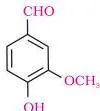
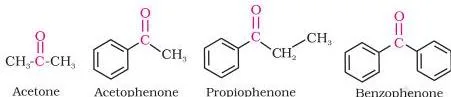
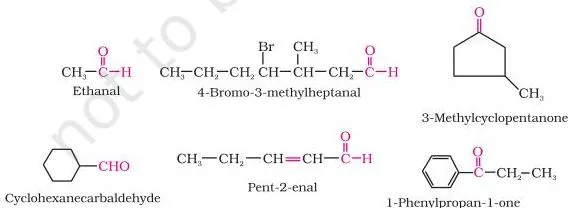



Aldehydes, Ketones and Carboxylic Acids Class 12: Chapter 3 at a Glance
The table below lists what the chapter holds — its sections, figures, worked examples and exercise questions — so you know the chapter’s size before you start reading.
How the Chapter Is Organised: Three Families, One Functional Group
This chapter studies three families that share one functional group — the carbonyl group, \( \textgreater\text{C=O} \) — and it treats each family in the same order: nomenclature, structure, preparation, physical properties, reactions, then uses.

Read the figure above as the chapter’s opening frame. In an aldehyde (R–CHO) the carbonyl carbon carries one carbon and one hydrogen; in a ketone (R–CO–R) it carries two carbon atoms; in a carboxylic acid (R–COOH) the carbonyl is attached to a hydroxyl group, and that combined –COOH unit is called the carboxyl group.
The chapter has two halves. Aldehydes and ketones come first, then carboxylic acids in the same order. It closes with its own Summary and a twenty-question exercise set, and it assumes you have already met alcohol oxidation and Grignard reagents in the previous chapter — both return here constantly.
The Carbonyl Group: Why Aldehydes and Ketones React This Way
Everything in this chapter depends on the structure of one functional group, so the book establishes that structure before any reaction. Understand the carbonyl group and every mechanism that follows becomes the same story.
- The carbonyl carbon is sp² hybridised and forms three sigma bonds. Its fourth valence electron sits in a p-orbital and forms a pi bond with oxygen.
- The carbon, the oxygen and the two attached atoms lie in one plane, with bond angles near 120°, and the pi electron cloud lies above and below that plane.
- Oxygen is more electronegative than carbon, so the group is polar: the carbon is the electrophilic (Lewis acid) centre and the oxygen is the nucleophilic (Lewis base) centre. Carbonyl compounds have substantial dipole moments — larger than ethers’ — explained by resonance between a neutral and a dipolar structure.
The consequence drives the whole chapter: nucleophiles attack the carbon of a carbonyl — the opposite of alkene chemistry, where electrophiles attack. That is why the next sections are all nucleophilic additions.
Naming Carbonyl Compounds: Common and IUPAC Rules
Every exercise in this chapter assumes you can name the compound first. Learn the pattern once, and the IUPAC names stop being a memory load.
- Aldehydes: replace the alkane ending –e with –al. The chain is numbered from the carbonyl carbon.
- Ketones: replace –e with –one. Number the chain from the end nearer the carbonyl group.
- Carboxylic acids: replace –e with –oic acid. The carboxyl carbon is numbered 1.
- Ring aldehydes: add the suffix carbaldehyde after the cycloalkane name; benzenecarbaldehyde is normally just called benzaldehyde.
Common names use Greek letters: the α-carbon is the one directly bonded to the carbonyl, then β, γ, δ and so on. The common names themselves come from Latin or Greek sources — formic acid from ants (formica), acetic acid from vinegar (acetum).
Work three of your own: 2-methylpropanal (an aldehyde with a methyl branch on carbon 2), pentan-2-one (a five-carbon ketone with the carbonyl on carbon 2), and benzene-1,2-dicarbaldehyde (two aldehyde groups on neighbouring ring carbons). The book’s Table 8.1 (aldehydes and ketones) and Table 8.3 (carboxylic acids) hold the full lists of common and IUPAC names.
Reading NCERT’s Key Diagrams: Carbonyl and Carboxyl Structures
These structural diagrams appear throughout the chapter, and the mechanisms are far easier once you can read them. Each one carries a piece of the same story: where the electrons sit and where they move.
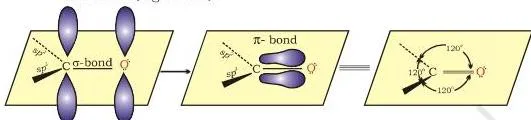

Fig. 8.1 comes in two parts. The first shows the sigma framework — flat, trigonal, with the pi cloud above and below the plane. The second shows the neutral (A) and dipolar (B) resonance structures; the dipolar form is what gives the carbon its electrophilic character.
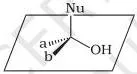
Fig. 8.2 is the chapter’s central mechanism. The nucleophile approaches roughly perpendicular to the plane, the carbon rehybridises from sp² to sp³, a tetrahedral alkoxide intermediate forms, and that intermediate captures a proton from the medium to give the neutral addition product. Net result: Nu⁻ and H⁺ added across the C=O.
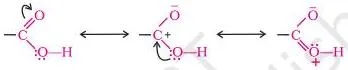
The carboxyl diagram shows why acids behave differently from aldehydes: the three bonds lie in one plane at about 120°, and resonance delocalises charge onto the second oxygen. That extra stabilisation makes the carboxyl carbon less electrophilic than an aldehyde’s carbonyl carbon — so acids do not undergo nucleophilic addition the way aldehydes do.
Key Terms You Must Be Able to Define
Exercise 8.1 of this chapter asks for ten definitions, and every one comes from a nucleophilic addition reaction. Learn the term with the reaction that produces it and you will not confuse them.
| Term | Plain definition | Reaction that produces it |
|---|---|---|
| Cyanohydrin | Carbonyl compound with –OH and –CN on the same carbon | Carbonyl + HCN (base-catalysed; CN⁻ adds first) |
| Hemiacetal | Product of adding one alcohol molecule across the C=O | Carbonyl + 1 mol alcohol in dry HCl |
| Acetal | Gem-dialkoxy compound from two alcohol molecules | Carbonyl + 2 mol alcohol in dry HCl |
| Ketal | Cyclic acetal from a ketone and a diol | Ketone + ethylene glycol |
| Imine | \(\textgreater\text{C=NH}\) derivative | Carbonyl + ammonia |
| Schiff’s base | Substituted imine, \(\textgreater\text{C=NR}\) | Carbonyl + amine |
| Oxime | \(\textgreater\text{C=N–OH}\) derivative | Carbonyl + hydroxylamine |
| Hydrazone | \(\textgreater\text{C=N–NH}_2\) derivative | Carbonyl + hydrazine |
| Phenylhydrazone / 2,4-DNP derivative | \(\textgreater\text{C=N–NH–C}_6\text{H}_5\) (phenyl) or with NO₂ groups (2,4-DNP); these give yellow, orange or red solids | Carbonyl + phenylhydrazine / 2,4-dinitrophenylhydrazine — used to characterise aldehydes and ketones |
| Semicarbazone | \(\textgreater\text{C=N–NH–C(=O)–NH}_2\) | Carbonyl + semicarbazide; only the NH₂ attached to the C=O reacts |
| Aldol | A β-hydroxy aldehyde | Carbonyl compound with an α-hydrogen + dilute alkali |
Two family definitions close the list. A carboxylic acid is a carbonyl group attached to a hydroxyl group — the carboxyl group. Fatty acids are the higher C₁₂–C₁₈ aliphatic acids found in natural fats as esters of glycerol.
Preparing Aldehydes and Ketones: The Routes You Must Know
A small set of routes makes aldehydes and ketones, and most are shared between the two families. The skill is knowing which reagent gives which product.
| Method | Starting material | Reagent / condition | Product or named reaction |
|---|---|---|---|
| Oxidation of alcohols | Primary alcohol | PCC | Aldehyde |
| Hydrogenation of acyl chloride | Acyl chloride | H₂ over Pd/BaSO₄ | Aldehyde — Rosenmund reduction |
| Reduction of nitriles | Nitrile (RCN) | SnCl₂ + HCl, then hydrolysis | Aldehyde — Stephen reaction |
| Selective reduction | Nitrile or ester | DIBAL-H, then hydrolysis | Aldehyde |
| From toluene | Methylbenzene | CrO₂Cl₂ (hydrolysis) | Benzaldehyde — Etard reaction |
| From toluene | Methylbenzene | CrO₃ in acetic anhydride, then hydrolysis | Benzaldehyde |
| Side-chain chlorination | Toluene | Cl₂, then hydrolysis of benzal chloride | Benzaldehyde (commercial method) |
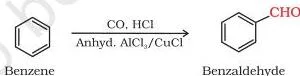
| Formylation of arenes | Benzene | CO + HCl, anhydrous AlCl₃ or CuCl | Benzaldehyde — Gatterman–Koch reaction |
| Oxidation of alcohols | Secondary alcohol | CrO₃ or similar | Ketone |
| Ozonolysis | Alkenes | O₃, then Zn dust / water | Aldehydes, ketones, or both |
| Hydration of alkynes | Alkynes | H₂SO₄ + HgSO₄ | All alkynes except ethyne give ketones |
| Acyl chloride + organocadmium | Acyl chloride | R₂Cd | Ketone |
| Nitrile + Grignard | Nitrile | RMgX, then hydrolysis | Ketone |
| Friedel–Crafts acylation | Benzene | Acyl chloride + anhydrous AlCl₃ | Aryl ketone |
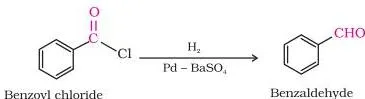
The first figure shows the Rosenmund reduction in action: the acyl chloride is hydrogenated, but the barium sulphate “poisons” the palladium catalyst so the reaction stops cleanly at the aldehyde instead of going further to the alcohol.

The second figure is the Friedel–Crafts acylation, the cleanest route to an aromatic ketone: benzene plus an acyl chloride, with anhydrous aluminium chloride as the catalyst, gives the aryl ketone directly. After this section, attempt the book’s worked Example 8.1 — it asks you to pick the reagent for each transformation, which is exactly the skill this table builds.
Nucleophilic Addition: The Reaction That Defines the Carbonyl Group
This is the idea the whole chapter turns on. Because the C=O is polar, the carbon is electrophilic, so nucleophiles add — and a whole list of reactions is the same mechanism with different nucleophiles.
Recap the mechanism from Fig. 8.2: perpendicular attack, sp² to sp³ rehybridisation, a tetrahedral alkoxide intermediate, then proton capture. Now the reactivity rule: aldehydes are more reactive than ketones for two reasons. Sterically, ketones have two groups blocking the approaching nucleophile. Electronically, two alkyl groups donate more electron density to the carbonyl carbon and lower its electrophilicity.
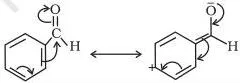
The figure above explains a famous trap: resonance with the benzene ring reduces the carbonyl’s polarity, so benzaldehyde is less reactive than propanal toward nucleophiles — even though both are aldehydes.
| Nucleophile | Product | Key point |
|---|---|---|
| HCN | Cyanohydrin | Base-catalysed; CN⁻ is the stronger nucleophile |
| NaHSO₃ | Bisulphite addition product | Equilibrium lies to the right for most aldehydes, left for most ketones — used to separate and purify aldehydes |
| Grignard reagent | Alcohol | Covered in the previous chapter |
| Alcohols | Hemiacetal, then acetal | Dry HCl catalyst |
| Diols | Cyclic ketal | e.g. ethylene glycol + ketone |
| Ammonia / H₂N–Z | Imine, oxime, hydrazone, semicarbazone | Book’s Table 8.2 lists all the derivatives |
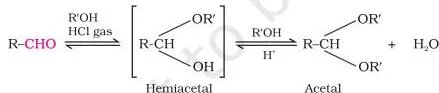
The acetal figure explains why dry HCl is needed: protonating the carbonyl oxygen pulls electron density away and makes the carbon more electrophilic, so the alcohol attack happens more readily. Remember the reverse too — acetals and ketals hydrolyse back to the carbonyl compound with aqueous mineral acid.
Reduction, Oxidation, Aldol and Cannizzaro Reactions
These reactions are how the chapter tells carbonyl compounds apart, and the oxidation tests here are the ones examiners reuse most.
Reduction. NaBH₄, LiAlH₄ or catalytic hydrogenation reduce aldehydes to primary alcohols and ketones to secondary alcohols. To remove the carbonyl completely, use the Clemmensen reduction (Zn–Hg with concentrated HCl) or the Wolff–Kishner reduction (hydrazine, then KOH in ethylene glycol) — both convert \( \textgreater\text{C=O} \) to \( \textgreater\text{CH}_2 \).
Oxidation. Aldehydes oxidise easily to carboxylic acids, even with mild agents: Tollens’ reagent gives a bright silver mirror, and Fehling’s reagent gives a red-brown Cu₂O precipitate. Aromatic aldehydes do not respond to Fehling’s test. Ketones need vigorous conditions, and their oxidation cleaves carbon–carbon bonds to give a mixture of smaller carboxylic acids.
Haloform reaction. Any aldehyde or ketone with a CH₃CO group — or a CH₃CH(OH) group that oxidises to one — gives a yellow precipitate with iodine and sodium hydroxide. This is the test for a methyl ketone.
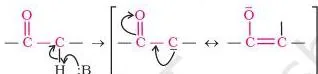
The figure above shows why α-hydrogens are acidic: the carbonyl withdraws electron density, and the conjugate base (the enolate) is stabilised by resonance. That acidity powers the next two reactions.
- Aldol condensation: dilute alkali, needs at least one α-hydrogen, gives a β-hydroxy aldehyde or ketone (the aldol/ketol) that dehydrates to an α,β-unsaturated compound.
- Cannizzaro reaction: concentrated alkali, requires no α-hydrogen; one molecule is oxidised to the acid salt and one is reduced to the alcohol (disproportionation).
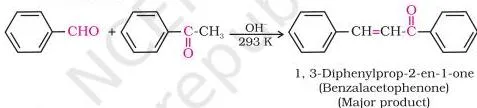
The cross-aldol figure carries a warning: when two different aldehydes both have α-hydrogens, the mixture gives four products, because either molecule can act as the nucleophile or the electrophile.
Finally, aromatic aldehydes and ketones undergo electrophilic substitution on the ring, where the carbonyl group acts as a deactivating and meta-directing group.
| Test | Positive result | What it tells you |
|---|---|---|
| Tollens’ (ammoniacal AgNO₃) | Bright silver mirror | Aldehyde present (ketones give nothing) |
| Fehling’s (CuSO₄ + Rochelle salt, alkaline) | Red-brown Cu₂O precipitate | Aliphatic aldehyde; aromatic aldehydes do not respond |
| 2,4-DNP reagent | Yellow, orange or red solid | Aldehyde or ketone present |
| Iodoform (I₂ + NaOH) | Yellow precipitate | CH₃CO group (methyl ketone) or CH₃CH(OH) group |
| NaHCO₃ | Brisk CO₂ effervescence | Carboxylic acid (phenols do not react) |
Carboxylic Acids: How They Are Prepared
Nearly every route to a carboxylic acid is either an oxidation or a hydrolysis. Once you see that, the list of methods shrinks to two ideas with several reagents.
| Starting material | Conditions | Product / note |
|---|---|---|
| Primary alcohols, aldehydes | KMnO₄ (neutral, acidic or alkaline); Jones reagent (CrO₃ + H₂SO₄) | Carboxylic acid |
| Alkylbenzenes | Vigorous oxidation (chromic acid or KMnO₄) | Aromatic acid — the whole side chain becomes COOH |
| Nitriles, amides | Hydrolysis with H⁺ or OH⁻ catalyst | Nitrile → amide → acid (mild conditions stop at amide) |
| Grignard reagent | CO₂ (dry ice), then acidify | RMgX → RCOOH — adds one carbon |
| Acyl halides, anhydrides | Water or aqueous base, then acidify | Carboxylic acid |
| Esters | Acidic hydrolysis (direct acid); basic hydrolysis then acidify | Carboxylic acid |
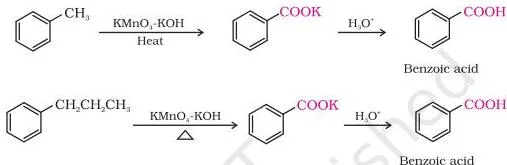
Read one detail from the figure carefully: the entire side chain is oxidised to the carboxyl group, no matter how long it is — but tertiary side chains are not attacked. The nitrile and Grignard routes share a practical value: both convert an alkyl halide into an acid with one more carbon, ascending the series.
After this table, the book’s Example 8.5 is the right practice set.
Carboxylic Acids: Physical Properties and the Dimer
Physical properties follow from one idea — intermolecular forces — and the book compares carbonyl compounds with their neighbours to prove it. This ranking is the chapter’s own:
\( \text{n-butane} \lt \text{methoxyethane} \lt \text{propanal} \lt \text{acetone} \lt \text{propan-1-ol} \)
- n-Butane boils lowest: only weak van der Waals forces.
- Methoxyethane (an ether) is next — a small dipole, no hydrogen bonding.
- Propanal and acetone sit above it because their dipole–dipole interactions are stronger than an ether’s.
- Propan-1-ol boils highest because alcohol molecules associate through intermolecular hydrogen bonding.
So aldehydes and ketones boil higher than hydrocarbons and ethers of similar mass, but lower than alcohols of similar mass. The same logic explains solubility: the lower members (methanal, ethanal, propanone) are miscible with water because they hydrogen-bond with it, and solubility falls as the chain grows.
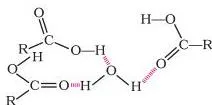
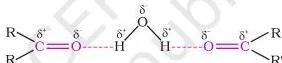
Now the acid dimer, which explains why carboxylic acids boil higher than alcohols of comparable molecular mass: two acid molecules are held by two intermolecular hydrogen bonds in a cyclic dimer that survives even in the vapour phase and in aprotic solvents. Separating those molecules takes more energy, hence the higher boiling point.
The remaining facts follow: acids up to nine carbons are colourless liquids with unpleasant odours; higher ones are wax-like solids. Acids up to four carbons mix with water; solubility drops as the hydrocarbon chain grows, and benzoic acid is nearly insoluble in cold water. Acids stay soluble in less polar solvents like benzene, ether and chloroform.
Why Carboxylic Acids Are Acidic: pKa and Substituent Effects
This section answers the question the chapter keeps circling: why carboxylic acids are acidic, and why one acid is stronger than another. Start with the dissociation in water:
\[ \text{RCOOH} + \text{H}_2\text{O} \rightleftharpoons \text{H}_3\text{O}^+ + \text{RCOO}^- \]
The acid dissociation constant is \( K_a = \frac{[\text{H}_3\text{O}^+][\text{RCOO}^-]}{[\text{RCOOH}]} \), and \( pK_a = -\log K_a \). The smaller the pKa, the stronger the acid. The book’s reference values: trifluoroacetic acid 0.23, benzoic acid 4.19, acetic acid 4.76.
The core explanation — why acids beat phenols. The carboxylate conjugate base is stabilised by two equivalent resonance structures with the negative charge on the more electronegative oxygen. The phenoxide ion has more resonance structures, but they are non-equivalent and put the negative charge on less electronegative carbon atoms.
So carboxylate is more stabilised than phenoxide, and carboxylic acids are stronger acids than phenols and alcohols.
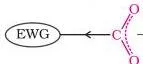
The substituent figure shows the rule that orders every acidity question: electron withdrawing groups stabilise the conjugate base and raise acidity; electron donating groups destabilise it and lower acidity. The effect weakens with distance, so ClCH₂COOH is stronger than ClCH₂CH₂COOH. The book’s substituent order is Ph < I < Br < Cl < F < CN < NO₂ < CF₃.
Compress the full acid-strength order: CF₃COOH is the strongest, then acids carrying electron withdrawing groups, then formic acid, then benzoic acid, then acetic and higher alkyl acids. One twist worth remembering: direct phenyl or vinyl attachment raises acidity despite resonance donation, because the sp² carbon is more electronegative.
Reactions of Carboxylic Acids
Carboxylic acids react at three places — the O–H bond, the C–O bond, and the ring or α-carbon. Organising the list that way makes it manageable.
O–H bond cleavage: acids form salts with metals and alkalies, and — unlike phenols — they react with NaHCO₃ to evolve CO₂. That bicarbonate test is the standard way to detect a carboxyl group.
C–O bond reactions:
- Anhydride formation on heating with H₂SO₄ or P₂O₅.
- Esterification with alcohols in acid — a nucleophilic acyl substitution.
- Acyl chloride formation with PCl₅, PCl₃ or SOCl₂. SOCl₂ is preferred because SO₂ and HCl are gases that escape, leaving a pure product.
- Ammonia gives the ammonium salt, which on heating gives the amide.
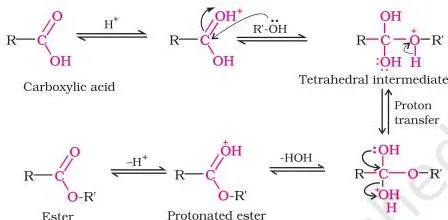
Walk the esterification mechanism step by step from the figure: protonation of the carbonyl oxygen activates the carbonyl; the alcohol adds as a nucleophile; proton transfer in the tetrahedral intermediate converts –OH into –OH₂⁺, a better leaving group; neutral water is eliminated; the protonated ester finally loses a proton to give the ester.
Reduction: LiAlH₄ or diborane reduces acids to primary alcohols. NaBH₄ does not reduce the carboxyl group — a common trap.
Decarboxylation: heating the sodium salt with sodalime gives the hydrocarbon with one carbon fewer. Kolbe electrolysis of the aqueous salt gives a hydrocarbon with twice the carbons of the alkyl group.
α-Halogenation: Cl₂ or Br₂ with red phosphorus gives an α-halocarboxylic acid — the Hell–Volhard–Zelinsky reaction.

The ring-substitution figure ends the reactions: the carboxyl group is deactivating and meta-directing, and Friedel–Crafts reaction does not occur because the aluminium chloride catalyst binds to the carboxyl group.
Uses of Aldehydes, Ketones and Carboxylic Acids
This is a short, factual section — easy marks once the names are linked to their products. The pairings below are all from the book directly.
| Compound | Use |
|---|---|
| Methanal | Formalin (40% solution) preserves biological specimens; makes bakelite and urea-formaldehyde glues |
| Ethanal | Manufacture of acetic acid, ethyl acetate, vinyl acetate, polymers and drugs |
| Benzaldehyde | Perfumery and dye industries |
| Acetone, ethyl methyl ketone | Industrial solvents |
| Methanoic acid | Rubber, textile, dyeing, leather and electroplating industries |
| Ethanoic acid | Solvent and vinegar in the food industry |
| Hexanedioic acid | Manufacture of nylon-6,6 |
| Sodium benzoate | Food preservative |
| Esters of benzoic acid | Perfumery |
| Higher fatty acids | Soaps and detergents |
Common Mistakes Students Make in This Chapter
These are the traps the book itself flags through its summary, intext questions and final exercises. The wrong claim comes first in each row; the reasoning is NCERT’s.
| Mistake | Correct rule | How to check your answer |
|---|---|---|
| “Benzaldehyde is more reactive than propanal toward nucleophiles.” | Resonance with the ring reduces the carbonyl’s polarity, making benzaldehyde less electrophilic and less reactive. | Ask where the carbonyl electrons can go — resonance lowers the positive character of the carbon. |
| “All aldehydes reduce Fehling’s solution.” | Aromatic aldehydes do not respond to Fehling’s test. | Tollens’ works for both aliphatic and aromatic aldehydes; Fehling’s only for aliphatic. |
| “Aldol condensation and Cannizzaro reaction need the same conditions.” | Aldol uses dilute alkali and needs at least one α-hydrogen; Cannizzaro uses concentrated alkali and requires no α-hydrogen. | Count the α-hydrogens on the carbonyl carbon’s neighbours first. |
| “NaBH₄ reduces carboxylic acids.” | NaBH₄ does not reduce the carboxyl group. Use LiAlH₄ or diborane. | NaBH₄ is the gentle reagent — it stops at alcohols only from aldehydes and ketones. |
| “Phenoxide has more resonance structures, so phenol should be the stronger acid.” | More structures is not enough. The carboxylate ion’s two structures are equivalent, with charge on electronegative oxygen; phenoxide’s are non-equivalent, with charge on carbon. | Compare where the negative charge actually sits, not how many arrows you can draw. |
| “Both NH₂ groups of semicarbazide react with the carbonyl.” | Only the NH₂ attached to the C=O reacts (Exercise 8.18). | The other NH₂ is part of the –NHCONH₂ unit and does not add. |
| “Number a ketone chain from either end; call every ring aldehyde benzaldehyde.” | Number from the end nearer the carbonyl; a ring aldehyde gets the suffix carbaldehyde (benzaldehyde is accepted only for the unsubstituted parent). | Write the structure and number it twice — the lower locant always wins. |
Worked Example: Identifying a Carbonyl Compound Step by Step
Structure-determination problems combine the chapter’s tests in one question. Here is an original one with every step shown.
Problem.
An organic compound P has the molecular formula C₄H₈O.
It gives an orange-red precipitate with 2,4-DNP reagent and a yellow precipitate with iodine in sodium hydroxide, but it produces no silver mirror with Tollens’ reagent.
Vigorous oxidation of P gives ethanoic acid and propanoic acid.
Identify P and write the equations.
Step 1 — 2,4-DNP positive.
A 2,4-DNP derivative means P is an aldehyde or a ketone.
Step 2 — Tollens’ negative.
Ketones do not reduce Tollens’ reagent.
Since P gives no silver mirror, P is not an aldehyde — so P is a ketone.
Step 3 — iodoform positive.
The yellow precipitate proves a CH₃CO group, so P is a methyl ketone.
The only C₄H₈O methyl ketone is butan-2-one, CH₃COCH₂CH₃.
Step 4 — check with oxidation.
Vigorous oxidation of a ketone cleaves the carbon–carbon bonds beside the carbonyl:
\[ \text{CH}_3\text{COCH}_2\text{CH}_3 \xrightarrow[\text{heat}]{[\text{O}]} \text{CH}_3\text{COOH} + \text{CH}_3\text{CH}_2\text{COOH} \]
That gives ethanoic acid and propanoic acid — exactly what the problem states.
P is butan-2-one.
The iodoform equation:
\[ \text{CH}_3\text{COCH}_2\text{CH}_3 \xrightarrow{\text{I}_2/\text{NaOH}} \text{CHI}_3 \downarrow + \text{CH}_3\text{CH}_2\text{COONa} \]
Final answer: P is butan-2-one, CH₃COCH₂CH₃ — the yellow solid is iodoform (CHI₃) and the oxidation products confirm the structure.
One-line challenge. Which is stronger, 2-bromobutanoic acid or 3-bromobutanoic acid? The closer the electron-withdrawing bromine sits to the carboxyl group, the more it stabilises the conjugate base — so 2-bromobutanoic acid is the stronger acid.
How to Practise: Mapping the Chapter’s Exercises
The book closes the chapter with a large exercise set. Map each question to the skill it tests, and practise with intent instead of doing all twenty blindly.
| Exercises | Skill they test |
|---|---|
| 8.1 | Definitions of the ten terms — covered by the key-terms table on this page |
| 8.2, 8.3, 8.4 | IUPAC naming and drawing structures |
| 8.5 | Drawing derivatives of carbonyl compounds |
| 8.6 | Reactions of cyclohexanecarbaldehyde with Grignard, Tollens’, semicarbazide, ethanol in acid, and Zn–Hg/HCl |
| 8.7 | Deciding aldol vs Cannizzaro vs neither |
| 8.8 | Conversions starting from ethanal |
| 8.9 | Cross-aldol products from propanal and butanal |
| 8.10, 8.11, 8.19 | Structure determination from reactions — the method shown in the worked example on this page |
| 8.12 | Ordering reactivity towards HCN and ordering acid strength |
| 8.13 | Simple chemical tests to distinguish pairs of compounds |
| 8.14 | Syntheses starting from benzene |
| 8.15 | Two-step conversions |
| 8.16 | Describing named reactions: acetylation, Cannizzaro, cross aldol, decarboxylation |
| 8.17 | Completing syntheses from missing material, reagent or products |
| 8.18 | Reasoning explanations — including why only one NH₂ of semicarbazide reacts |
| 8.20 | Explaining why carboxylic acids are stronger acids than phenols |
The intext questions embedded between the sections are quick self-checks — attempt each one as you finish the section it follows. Note that textbook contents and the examinable syllabus are not always identical — check the current official CBSE syllabus for what is examinable this session.
One-Screen Recap of the Whole Chapter
This table compresses each family into the three things you must be able to write in an exam answer: how it is made, what it does, and how to recognise it.
| Family | One-line preparation | One-line key reaction | One-line distinguishing test |
|---|---|---|---|
| Aldehydes | Oxidation of primary alcohols (PCC), Rosenmund reduction, Stephen reaction | Nucleophilic addition; easily oxidised to acids | Tollens’ silver mirror (also positive for aromatic aldehydes); Fehling’s red-brown ppt (aliphatic only) |
| Ketones | Oxidation of secondary alcohols, ozonolysis, alkyne hydration, Friedel–Crafts acylation | Nucleophilic addition (slower than aldehydes); oxidation cleaves C–C bonds | Iodoform test if it has a CH₃CO group; no Tollens’ mirror |
| Carboxylic acids | Oxidation of alcohols/aldehydes/alkylbenzenes, nitrile hydrolysis, Grignard + CO₂ | Esterification, acyl chloride formation, reduction to primary alcohols | NaHCO₃ gives CO₂ effervescence — phenols do not |
The named reactions are the chapter’s memory load. One table, all eleven:
| Reaction | Reagents | What it makes | Key condition |
|---|---|---|---|
| Rosenmund reduction | H₂ / Pd-BaSO₄ | Aldehyde from acyl chloride | Poisoned catalyst stops at aldehyde |
| Stephen reaction | SnCl₂ + HCl, then hydrolysis | Aldehyde from nitrile | Goes through the imine |
| Etard reaction | CrO₂Cl₂, then hydrolysis | Benzaldehyde from toluene | Stops oxidation at aldehyde stage |
| Gatterman–Koch | CO + HCl, AlCl₃ or CuCl | Benzaldehyde from benzene | Formylation of the ring |
| Friedel–Crafts acylation | Acyl chloride + anhydrous AlCl₃ | Aryl ketone from benzene | Anhydrous conditions |
| Clemmensen reduction | Zn–Hg + conc. HCl | \( \textgreater\text{CH}_2 \) from \( \textgreater\text{C=O} \) | Acidic conditions |
| Wolff–Kishner reduction | NH₂NH₂, then KOH / ethylene glycol | \( \textgreater\text{CH}_2 \) from \( \textgreater\text{C=O} \) | Basic conditions, heat |
| Aldol condensation | Dilute alkali | β-Hydroxy carbonyl, then α,β-unsaturated compound | At least one α-hydrogen |
| Cannizzaro reaction | Concentrated alkali | Alcohol + acid salt | No α-hydrogen |
| Hell–Volhard–Zelinsky | Cl₂ or Br₂ + red phosphorus | α-Halocarboxylic acid | α-Position halogenation |
| Kolbe electrolysis | Electrolysis of aqueous sodium salt | Hydrocarbon with twice the carbons | Decarboxylative coupling |
The big ideas in one breath: the polar carbonyl drives nucleophilic addition; aldehydes are more reactive than ketones; the presence of an α-hydrogen decides between aldol and Cannizzaro; carboxylate resonance decides acidity; and Tollens’ and Fehling’s tests separate aldehydes from ketones.
Physically, carbonyl compounds are polar, the small ones hydrogen-bond with water, and carboxylic acids associate into hydrogen-bonded dimers — which is why they boil highest of the three families.
Related Resources
This chapter builds directly on alcohol oxidation and Grignard chemistry from the previous chapter, and its acid derivatives lead into the amines chapter. The notes below cover both directions and the surrounding course.
- Alcohols, Phenols and Ethers — the previous chapter, which supplies the oxidation and Grignard chemistry this chapter assumes.
- The d- and f-Block Elements, where the chromium and manganese oxidants (CrO₃, KMnO₄) used throughout this chapter come from.
- Class 12 Chemistry notes hub — the full set of chapter resources, including Amines, which follows this chapter.
- Class 12 hub — notes and resources for every subject.
Sources and Data Verification
This page describes the NCERT Class 12 Chemistry Part II textbook, Chapter 3, “Aldehydes, Ketones and Carboxylic Acids”, from the current NCERT reprint as published on ncert.nic.in.
- What the page covers: the chapter’s contents and study guidance — not the CBSE syllabus, which is set separately by CBSE.
- Which books: the NCERT Class 12 Chemistry Part II textbook, Chapter 3 only; it does not cover other chapters or books.
- Academic session: the page is maintained for the current session using the NCERT information available to us.
- Who settles what: NCERT settles textbook editions and PDFs; CBSE settles the curriculum, syllabus and examinations.
- Figures and counts shown here come from the textbook itself. No external expert review is claimed.
Reference: NCERT Class 12 Chemistry Part II textbook, chapter 3, official edition on ncert.nic.in.
Quick Answers to Common Questions
Why are aldehydes more reactive than ketones in nucleophilic addition reactions?
Two reasons. Sterically, a ketone has two relatively large substituents blocking the approach of the nucleophile, while an aldehyde has only one. Electronically, two alkyl groups donate more electron density to the carbonyl carbon and lower its electrophilicity more effectively than one does. Both effects make the aldehyde’s carbonyl carbon a better target for attack.
Why does benzaldehyde not respond to Fehling’s test even though it is an aldehyde?
Fehling’s test works only for aliphatic aldehydes — the book states plainly that aromatic aldehydes do not respond to this test. If you need to test an aromatic aldehyde, use Tollens’ reagent, which does give a silver mirror for benzaldehyde.
What is the difference between aldol condensation and Cannizzaro reaction?
The deciding factor is the α-hydrogen. Aldol condensation needs at least one α-hydrogen and uses dilute alkali, building a β-hydroxy carbonyl compound. Cannizzaro reaction happens with aldehydes that have no α-hydrogen, uses concentrated alkali, and is a disproportionation — one molecule is oxidised to the acid salt while another is reduced to the alcohol.
Why is formic acid a stronger acid than acetic acid?
Acetic acid carries a methyl group, and alkyl groups donate electron density. That donation destabilises the acetate conjugate base, so acetic acid is weaker. Formic acid has only a hydrogen attached, so its conjugate base is more stable — hence formic acid is the stronger acid (the book’s acidity order shows HCOOH above CH₃COOH).
Which reagents reduce a carboxylic acid to a primary alcohol?
Lithium aluminium hydride (LiAlH₄) or diborane. Sodium borohydride, NaBH₄, does not reduce the carboxyl group — that is a common trap. NaBH₄ is fine for reducing aldehydes and ketones to alcohols, but a carboxylic acid needs the stronger reagent.
How can propanal and propanone be distinguished in the laboratory?
Use Tollens’ or Fehling’s test: propanal (an aldehyde) gives a silver mirror with Tollens’ reagent and a red-brown precipitate with Fehling’s solution, while propanone gives nothing in either. Alternatively, use the iodoform test — propanone has a CH₃CO group and gives a yellow precipitate with iodine and sodium hydroxide, which propanal does not.
Explore Class 12 Chemistry Books
Class 12 Chemistry on LearnCBSE:
Related chapters: