
This page holds the official NCERT Class 12 Chemistry Part I, Unit 5 PDF on Werner’s theory of coordination compounds — the chapter where coordination chemistry begins. The chapter runs 23 printed pages, from the cobalt–ammonia experiments that founded the theory to metal carbonyls and applications, and the official PDF is one download away.
Below the download you get a section-by-section map of the chapter, the silver nitrate evidence behind Werner’s two valences, every diagram worth studying, and the definitions and bonding models the exercises test — all keyed to the chapter’s own section, table and figure numbers.
Download Werner’s Theory of Coordination Compounds Class 12 PDF
This is the chapter file published by NCERT for its own textbook — the same content your printed copy is set from. Use it to read section 5.1’s silver nitrate experiment, the IUPAC naming rules, the worked examples and the full exercise set in their original layout before you start revising.
Grab the Werner’s Theory of Coordination Compounds Class 12 PDF straight from ncert.nic.in so you can follow the section-by-section map below with the actual pages in front of you.
| What the chapter holds | Count | Where it is used |
|---|---|---|
| Printed pages | 23 | |
| Sections in the chapter | 17 | |
| Figures with NCERT captions | 22 | |
| Tables | 5 | |
| Worked examples | 1 | solved step by step in our NCERT Solutions |
| Exercise questions | 4 | answered in our NCERT Solutions |
| Official NCERT PDF | Download the chapter PDF | the chapter exactly as NCERT publishes it |
Chapter 5 at a Glance: What Is Inside
The table below shows the chapter’s contents at a glance — its syllabus sections, figures, worked examples and exercise questions — so you know the size of the unit before you start reading.
The unit’s seven main blocks
- 5.1 Werner’s theory — primary and secondary valences, with the evidence that led to them.
- 5.2 Key terms — coordination entity, central atom, ligands, coordination number and more.
- 5.3 Nomenclature — writing formulas and IUPAC names of mononuclear complexes.
- 5.4 Isomerism — geometrical, optical, linkage, coordination, ionisation and solvate.
- 5.5 Bonding — Valence Bond Theory and Crystal Field Theory, with their limitations.
- 5.6 Metal carbonyls — structures and synergic bonding.
- 5.7 Importance and applications — from analysis and metallurgy to medicine.
What This Chapter Teaches, Section by Section
The unit follows one arc: an experimental puzzle (silver nitrate precipitation) gives rise to Werner’s two valences, which gives rise to the vocabulary of coordination entities, then naming, then isomerism, then two models of bonding, then real uses. Work through the sections in this order:
| Section | What it covers | Why it matters |
|---|---|---|
| 5.1 Werner’s theory | Silver nitrate and conductivity evidence; primary and secondary valences; coordination polyhedra | Explains why coordination compounds exist as stable entities |
| 5.2 Key terms | Coordination entity, central atom/ion, ligands, chelate, denticity, coordination number, sphere, polyhedron, oxidation number, homoleptic/heteroleptic | Every later section speaks this vocabulary |
| 5.3 Nomenclature | Rules for writing formulas and IUPAC names of mononuclear compounds | Turns a structure into a name and a name into a structure |
| 5.4 Isomerism | Geometrical, optical, linkage, coordination, ionisation and solvate isomerism | Explains why identical formulas can have different properties |
| 5.5 Bonding | VBT (hybridisation and magnetism) and CFT (d-orbital splitting and colour), with limitations of each | The two models you compare in exam answers |
| 5.6 Metal carbonyls | Homoleptic carbonyl structures; sigma donation and pi back donation (synergic bonding) | A special bond that explains carbonyl stability |
| 5.7 Importance and applications | Analysis, water hardness, metallurgy, biology, catalysis, electroplating, photography, medicine | Shows why the chapter matters outside the exam |
Key Concepts: Six Ideas That Hold the Chapter Together
These six ideas are the thread of Unit 5, and every exercise in the chapter tests one of them. Master them in this order before touching the problems.
1. Primary and secondary valences
Werner proposed that a metal in a coordination compound forms two kinds of linkages. The primary valence is normally ionisable and satisfied by negative ions — what we now read as the oxidation state. Thus \( \text{CrCl}_3 \), \( \text{CoCl}_2 \) and \( \text{PdCl}_2 \) show primary valences of 3, 2 and 2.
The secondary valence is non-ionisable, satisfied by neutral molecules or negative ions, fixed for a given metal, and equal to what we now call the coordination number. In every cobalt–ammonia complex in Table 5.1, the secondary valence is six.
2. What the square bracket means
Everything inside the square bracket is a single entity that survives in solution — it does not dissociate when the compound dissolves. In \( \text{K}_4[\text{Fe}(\text{CN})_6] \), the bracketed \( [\text{Fe}(\text{CN})_6]^{4-} \) is the coordination sphere and \( \text{K}^+ \) outside is the counter ion.
The atom at the centre is the central atom/ion, a Lewis acid; the groups bound to it are ligands. Writing the bracket correctly is the first step in every formula and naming question.
3. How to write and name a complex
In a formula, the central atom comes first, then the ligands in alphabetical order, and the whole entity is enclosed in square brackets. In a name, the cation is named first, then the ligands alphabetically, then the metal — with the special neutral-ligand names aqua, ammine, carbonyl and nitrosyl.
Anionic complexes add -ate (or a Latin stem such as ferrate for iron). So \( [\text{Co}(\text{NH}_3)_6]\text{Cl}_3 \) is hexaamminecobalt(III) chloride, and \( \text{K}_3[\text{Fe}(\text{CN})_6] \) is potassium hexacyanidoferrate(III).
4. Why isomers differ
Isomers have the same chemical formula but a different arrangement of atoms, so they differ in physical or chemical properties — the green and violet forms of \( \text{CoCl}_3\cdot 4\text{NH}_3 \) in Table 5.1 are isomers. Section 5.4 divides isomerism into stereoisomerism (geometrical and optical — same bonds, different spatial arrangement) and structural isomerism (linkage, coordination, ionisation and solvate — different bonds).
5. Inner orbital versus outer orbital complexes
Valence Bond Theory explains geometry and magnetic behaviour through hybridisation. An octahedral complex that uses an inner \( (n-1)d \) orbital is inner orbital (\( d^2sp^3 \), low spin), like \( [\text{Co}(\text{NH}_3)_6]^{3+} \). One that uses an outer \( nd \) orbital is outer orbital (\( sp^3d^2 \), high spin), like \( [\text{CoF}_6]^{3-} \). The choice shows up directly in the number of unpaired electrons.
6. Crystal field splitting and colour
Crystal Field Theory treats ligands as point charges that split the five d orbitals. In an octahedral field the three \( t_{2g} \) orbitals fall by \( \frac{2}{5}\Delta_o \) and the two \( e_g \) orbitals rise by \( \frac{3}{5}\Delta_o \).
The gap \( \Delta_o \) decides the electron arrangement (high or low spin) and, through a d-d transition, the colour — a complex that absorbs blue-green light appears violet, as \( [\text{Ti}(\text{H}_2\text{O})_6]^{3+} \) shows.
The Silver Nitrate Experiment Behind Werner’s Theory
This experiment is the founding evidence of the chapter. Werner treated one mole of each cobalt(III) chloride–ammonia complex with excess silver nitrate in the cold and counted how many moles of silver chloride precipitated: chloride ions inside the coordination sphere stayed in solution, the ones outside were precipitated.
| Complex (colour) | Moles of AgCl per mole of complex | Conductivity of solution |
|---|---|---|
| \( [\text{Co}(\text{NH}_3)_6]\text{Cl}_3 \) (yellow) | 3 | 1:3 electrolyte |
| \( [\text{CoCl}(\text{NH}_3)_5]\text{Cl}_2 \) (purple) | 2 | 1:2 electrolyte |
| \( [\text{CoCl}_2(\text{NH}_3)_4]\text{Cl} \) (green) | 1 | 1:1 electrolyte |
| \( [\text{CoCl}_2(\text{NH}_3)_4]\text{Cl} \) (violet) | 1 | 1:1 electrolyte |
Two conclusions follow. First, six groups in all — chloride ions, ammonia molecules or both — stay bonded to cobalt in every case. Second, conductivity matches electrolyte type: three, two, one and one ionisable chlorides. Werner called the number of groups bound directly to the metal the secondary valence; here it is six in every complex.
His postulates (Section 5.1) are: metals show primary and secondary valences; primary valences are normally ionisable and satisfied by negative ions; secondary valences are non-ionisable and equal the coordination number, fixed for a metal; and the groups bound through secondary linkages take characteristic spatial arrangements — the coordination polyhedra.
Worked example (original values): A compound of formula \( \text{CoCl}_3\cdot 5\text{H}_2\text{O} \) precipitates 2 moles of AgCl per mole of compound with excess \( \text{AgNO}_3 \).
Find its formula and secondary valence.
- Step 1: Two chloride ions are precipitated, so two chlorides sit outside the sphere; the remaining one must be inside, bonded to cobalt.
- Step 2: Cobalt keeps six secondary linkages, so the inner sphere needs five water molecules to join the one chloride: 1 + 5 = 6.
\[ [\text{CoCl}(\text{H}_2\text{O})_5]\text{Cl}_2 \]
Final answer: the complex is \( [\text{CoCl}(\text{H}_2\text{O})_5]\text{Cl}_2 \), secondary valence 6.
Figures to Study: Reading NCERT’s Diagrams
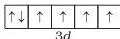
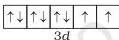
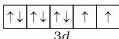
Exam questions in this chapter ask you to identify, count and draw isomers and to interpret splitting diagrams, so treat the figures as working tools. Work through them in this order.
Coordination polyhedra
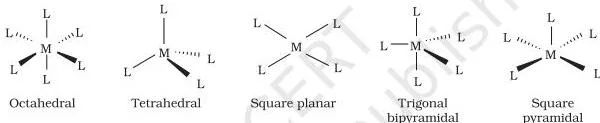
Figure 5.1 shows the three shapes the chapter returns to constantly: octahedral (six ligands), tetrahedral (four) and square planar (four in one plane). These correspond to Werner’s idea that secondary linkages have definite spatial arrangements. \( [\text{Co}(\text{NH}_3)_6]^{3+} \)
is octahedral, \( [\text{Ni}(\text{CO})_4] \) tetrahedral and \( [\text{PtCl}_4]^{2-} \) square planar — the first decision in any drawing question is which of these to sketch.
Geometrical isomers (cis/trans and fac/mer)
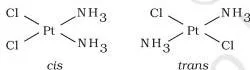
Figure 5.2 shows square planar \( \text{Pt}(\text{NH}_3)_2\text{Cl}_2 \) in its two forms: cis with the two chloride ligands on adjacent corners and trans with them opposite. Both are neutral molecules of the same formula yet different compounds.
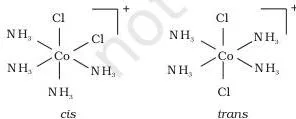
Figure 5.3 carries the same idea into an octahedral complex: the two chlorides can sit adjacent (cis) or opposite (trans). Octahedral and square planar complexes show this isomerism; tetrahedral complexes do not, because the relative positions of unidentate ligands around a tetrahedron are equivalent.
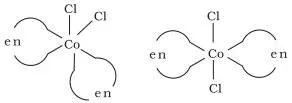
Figure 5.4 shows that geometrical isomerism also appears when didentate ligands are present, in complexes of the type \( [\text{MX}_2(\text{L-L})_2] \) — here \( [\text{CoCl}_2(\text{en})_2] \). The chelate ring locks the shape, giving a cis form and a trans form.
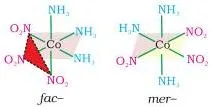
Figure 5.5 introduces the facial and meridional isomers of octahedral \( [\text{Ma}_3\text{b}_3] \) complexes such as \( [\text{Co}(\text{NH}_3)_3(\text{NO}_2)_3] \). Three identical ligands on the corners of one triangular face give the fac isomer; spread around the meridian of the octahedron they give the mer isomer.
Optical isomers
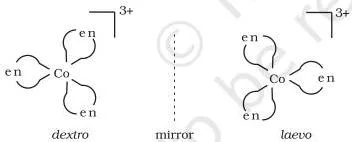
Figure 5.6 shows the two optical isomers (enantiomers) of \( [\text{Co}(\text{en})_3]^{3+} \): mirror images that cannot be superimposed. They are labelled d and l by the direction in which they rotate plane-polarised light — d rotates it to the right, l to the left.
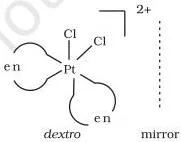
Figure 5.7 makes the classic distinction: of the two geometrical forms of \( [\text{PtCl}_2(\text{en})_2]^{2+} \), only the cis isomer is chiral; the trans form has a plane of symmetry, so it shows no optical activity.
Crystal field splitting and colour
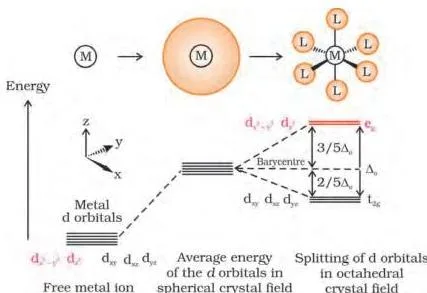
Figure 5.8 is the core diagram of Crystal Field Theory: five degenerate d orbitals split in an octahedral field into three lower \( t_{2g} \) orbitals and two higher \( e_g \) orbitals, separated by \( \Delta_o \). The \( e_g \) set rises by \( \frac{3}{5}\Delta_o \) and the \( t_{2g} \) set falls by \( \frac{2}{5}\Delta_o \).
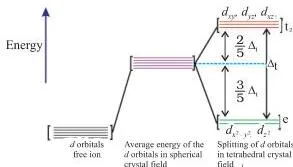
Figure 5.9 shows the tetrahedral split, which is inverted relative to the octahedral case and smaller: \( \Delta_t = \frac{4}{9}\Delta_o \). Because the split is small, low spin configurations are rarely observed in tetrahedral complexes, and no g subscript is used with the levels.
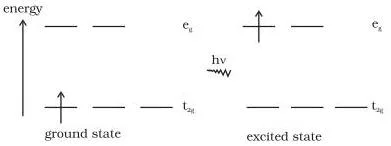
Figure 5.10 shows the electron jump that gives \( [\text{Ti}(\text{H}_2\text{O})_6]^{3+} \) its violet colour. Titanium(III) is a 3d1 system; its single electron sits in \( t_{2g} \) and absorbs blue-green light (about 498 nm) to reach the empty \( e_g \) level — the d-d transition of crystal field theory.
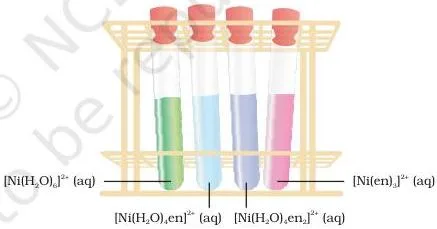
Figure 5.11 shows the same nickel(II) solution changing from green to pale blue to blue-purple as the didentate ligand en progressively replaces water: \( [\text{Ni}(\text{H}_2\text{O})_6]^{2+} \) green, then \( [\text{Ni}(\text{H}_2\text{O})_4(\text{en})]^{2+} \) pale blue, then blue-purple, then violet \( [\text{Ni}(\text{en})_3]^{2+} \). Different ligands mean different \( \Delta_o \), and therefore different absorbed colours.
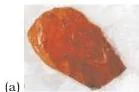
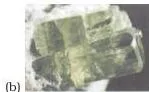
Figures 5.12(a) and 5.12(b) show the same dopant ion producing different gemstone colours. Ruby is aluminium oxide (\( \text{Al}_2\text{O}_3 \)) holding about 0.5–1% \( \text{Cr}^{3+} \) (d3) in octahedral sites, giving red; in emerald, \( \text{Cr}^{3+} \) occupies octahedral sites in the mineral beryl (\( \text{Be}_3\text{Al}_2\text{Si}_6\text{O}_{18} \)), shifting the absorption so the gem transmits green.
Metal carbonyls
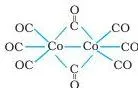
Figure 5.13 gathers the structures of representative homoleptic metal carbonyls: tetrahedral \( \text{Ni}(\text{CO})_4 \), trigonal bipyramidal \( \text{Fe}(\text{CO})_5 \), octahedral \( \text{Cr}(\text{CO})_6 \), plus \( \text{Mn}_2(\text{CO})_{10} \) (two square pyramidal units joined by an Mn–Mn bond) and \( \text{Co}_2(\text{CO})_8 \) (a Co–Co bond bridged by two CO groups).
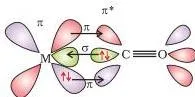
Figure 5.14 explains why the metal–carbon bond is so strong: the M–C σ bond forms when the carbon’s lone pair is donated into a vacant metal orbital, and the M–C π bond forms when a filled metal d orbital donates into the vacant antibonding \( \pi^* \) orbital of CO. This two-way synergic bonding strengthens the bond between CO and the metal.
Definitions You Must Know
These terms (Section 5.2) are the language of every later topic, and board answers are expected to use them precisely. Learn each term with its example, not as an isolated sentence.
| Term | Meaning | Example from the chapter |
|---|---|---|
| Coordination entity | Central metal atom/ion bonded to a fixed number of ions or molecules | \( [\text{CoCl}_3(\text{NH}_3)_3] \), \( [\text{Ni}(\text{CO})_4] \) |
| Central atom/ion | The atom/ion to which a fixed number of groups bind in a definite geometrical arrangement; a Lewis acid | \( \text{Ni}^{2+} \) in \( [\text{NiCl}_2(\text{H}_2\text{O})_4] \) |
| Ligand | Ion or molecule that donates an electron pair to the central atom/ion | \( \text{Cl}^- \), \( \text{H}_2\text{O} \), \( \text{NH}_3 \) |
| Unidentate ligand | Ligand that binds through a single donor atom | \( \text{Cl}^- \), \( \text{H}_2\text{O} \), \( \text{NH}_3 \) |
| Didentate ligand | Ligand that binds through two donor atoms | en, \( \text{C}_2\text{O}_4^{2-} \) |
| Polydentate ligand | Ligand with several donor atoms in a single molecule | \( \text{N}(\text{CH}_2\text{CH}_2\text{NH}_2)_3 \) |
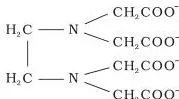
| Chelate ligand | Di- or polydentate ligand using two or more donor atoms on a single metal ion; chelate complexes are more stable | \( \text{EDTA}^{4-} \) (hexadentate) |
| Denticity | The number of ligating groups a ligand uses to bind a metal | \( \text{EDTA}^{4-} \) binds through 2 N + 4 O |
| Ambidentate ligand | Ligand with two different donor atoms, either of which can bind | \( \text{NO}_2^- \), \( \text{SCN}^- \) |
| Coordination number | Number of ligand donor atoms directly bonded to the metal; only sigma bonds are counted | 6 in \( [\text{PtCl}_6]^{2-} \), 4 in \( [\text{Ni}(\text{NH}_3)_4]^{2+} \) |
| Coordination sphere | The central atom/ion plus its bound ligands, enclosed in square brackets | \( [\text{Fe}(\text{CN})_6]^{4-} \) in \( \text{K}_4[\text{Fe}(\text{CN})_6] \) |
| Counter ion | Ionisable group written outside the bracket that balances the charge | \( \text{K}^+ \) in \( \text{K}_4[\text{Fe}(\text{CN})_6] \) |
| Coordination polyhedron | Spatial arrangement of the ligand atoms directly attached to the central atom/ion | Octahedral, tetrahedral, square planar |
| Oxidation number | Charge the central atom would carry if all ligands were removed with their shared electron pairs; written as a Roman numeral | \( \text{Cu(I)} \) in \( [\text{Cu}(\text{CN})_4]^{3-} \) |
| Homoleptic complex | Complex in which the metal binds only one kind of donor group | \( [\text{Co}(\text{NH}_3)_6]^{3+} \) |
| Heteroleptic complex | Complex in which the metal binds more than one kind of donor group | \( [\text{Co}(\text{NH}_3)_4\text{Cl}_2]^+ \) |
One distinction often asked as a definition: a double salt and a coordination compound both form from stable compounds in stoichiometric ratio, but only the double salt dissociates completely in water.
Carnallite (\( \text{KCl}\cdot\text{MgCl}_2\cdot 6\text{H}_2\text{O} \)), Mohr’s salt (\( \text{FeSO}_4\cdot(\text{NH}_4)_2\text{SO}_4\cdot 6\text{H}_2\text{O} \)) and potash alum (\( \text{KAl}(\text{SO}_4)_2\cdot 12\text{H}_2\text{O} \)) give simple ion tests, whereas the complex ion \( [\text{Fe}(\text{CN})_6]^{4-} \) does not break into \( \text{Fe}^{2+} \) and \( \text{CN}^- \).
Formulas, Hybridisation and the Spectrochemical Series
This chapter has few calculations but several symbols you must be able to decode. The list below is the whole set.
Coordination number with didentate ligands
The coordination number counts ligand donor atoms, and only sigma bonds count. Because oxalate and en are didentate, \( [\text{Fe}(\text{C}_2\text{O}_4)_3]^{3-} \) and \( [\text{Co}(\text{en})_3]^{3+} \) both have coordination number 6 with just three ligand molecules (Section 5.2(d)).
Hybridisation and geometry (Table 5.2)
| Coordination number | Type of hybridisation | Geometry |
|---|---|---|
| 4 | \( sp^3 \) | Tetrahedral |
| 4 | \( dsp^2 \) | Square planar |
| 5 | \( sp^3d \) | Trigonal bipyramidal |
| 6 | \( sp^3d^2 \) | Octahedral (outer orbital) |
| 6 | \( d^2sp^3 \) | Octahedral (inner orbital) |
Crystal field splitting and pairing energy
In an octahedral field the \( e_g \) orbitals rise by \( \frac{3}{5}\Delta_o \) and \( t_{2g} \) fall by \( \frac{2}{5}\Delta_o \). For a d4 ion the fourth electron has two options. If \( \Delta_o \lt P \) (weak field ligand), it enters \( e_g \) giving \( t_{2g}^3e_g^1 \) — a high spin complex.
If \( \Delta_o \gt P \) (strong field ligand), it pairs in \( t_{2g} \) giving \( t_{2g}^4e_g^0 \) — a low spin complex. P is the pairing energy.
The spectrochemical series orders ligands by the field strength they produce (Section 5.5.4):
\[ I^- \lt Br^- \lt SCN^- \lt Cl^- \lt S^{2-} \lt F^- \lt OH^- \lt C_2O_4^{2-} \lt H_2O \lt NCS^- \lt \text{edta}^{4-} \lt NH_3 \lt \text{en} \lt CN^- \lt CO \]
In tetrahedral fields the splitting is inverted and smaller: \( \Delta_t = \frac{4}{9}\Delta_o \), so low spin complexes are rare.
Magnetic moment and geometry: a worked example
A complex’s spin-only magnetic moment reveals its unpaired electrons, and that reveals its geometry. The worked example below uses the same reasoning as Example 5.7 but on a different complex.
Problem: The spin-only magnetic moment of the 4-coordinate ion \( [\text{FeCl}_4]^- \) is 5.9 BM.
Is the complex tetrahedral or square planar?
- Step 1: Iron is in the +3 state, so the electron configuration is 3d5 — five electrons in the d orbitals.
- Step 2: The spin-only moment is \( \mu = \sqrt{n(n+2)} \) BM for n unpaired electrons.
A moment of 5.9 BM matches \( \sqrt{35} \), which means n = 5: five unpaired electrons.
Step 3: Five unpaired electrons means no pairing took place.
Square planar geometry needs \( dsp^2 \) hybridisation, which requires pairing two electrons to free a d orbital.
Tetrahedral \( sp^3 \) uses only s and p orbitals, leaving all five d electrons unpaired.
Final answer: The complex is tetrahedral (\( sp^3 \), high spin). The 5.9 BM moment rules out the square planar option.
Common Mistakes in Coordination Compounds
The chapter’s intext questions and worked examples are designed around the errors below. Name the mistake before you make it.
| Mistake | Correct rule | How to check your answer |
|---|---|---|
| Treating primary valence as the coordination number | Primary valence = ionisable charge (today’s oxidation state); secondary valence = coordination number, fixed for the metal | Ask: which bonds survive in solution? Only the secondary ones do |
| Counting a didentate ligand as one donor | en and oxalate each contribute two donor atoms; CN counts donor atoms, not ligand molecules | \( [\text{Fe}(\text{C}_2\text{O}_4)_3]^{3-} \) must have CN 6, not 3 |
| Guessing ligand order in names | Both formula and name list ligands alphabetically; neutral ligands use aqua, ammine, carbonyl, nitrosyl | Check the name’s ligand order matches the alphabetical sequence |
| Forgetting -ate or Latin names for anionic complexes | A complex anion ends in -ate; iron becomes ferrate, copper cuprate | If the bracket carries a negative charge, the metal name must end in -ate |
| Drawing cis/trans isomers for tetrahedral complexes | Tetrahedral complexes with unidentate ligands show no geometrical isomerism — all positions are equivalent | Draw the tetrahedron; rotating it superimposes every arrangement |
| Claiming trans-\( [\text{PtCl}_2(\text{en})_2]^{2+} \) is optically active | Only the cis isomer is chiral; the trans form has a plane of symmetry | Try to superimpose the mirror image; if you can, it is not chiral |
| Choosing high/low spin without comparing \( \Delta_o \) and P | Weak field (\( \Delta_o \lt P \)) → high spin; strong field (\( \Delta_o \gt P \)) → low spin | Locate the ligand in the spectrochemical series first |
| Confusing the colour absorbed with the colour observed | The observed colour is complementary to the absorbed colour | If a complex absorbs green light, it appears red |
How to Prepare This Chapter for Exams
This chapter rewards practising the same four skills repeatedly. The exercise numbers below are the chapter’s own practice set — work through them, then redo the ones you got wrong.
- Write formulas from IUPAC names — intext question 5.1 and Exercise 5.6: start with the metal, then ligands alphabetically, then balance the charge.
- Write names from formulas — intext question 5.2 and Exercise 5.7: cation first, ligands alphabetically, -ate ending for anionic complexes.
- Draw and count isomers — Exercises 5.9 to 5.12 and intext question 5.3: no geometrical isomerism in tetrahedral complexes; only the cis form of \( [\text{PtCl}_2(\text{en})_2]^{2+} \) is chiral.
- Predict magnetic behaviour and geometry with VBT and CFT — Exercises 5.15, 5.16, 5.19 to 5.21 and intext questions 5.5 to 5.10, using the reasoning of Example 5.7.
Exercises 5.28 to 5.31 are single-answer questions that test the same ideas from the other side — counting ions, comparing magnetic moments, stability and absorption wavelengths. Textbooks and the examinable syllabus are not always identical, so check the current official CBSE syllabus for exactly what is examinable this session. No question set is predictable; prepare the skills, not individual questions.
Chapter 5 Revision Summary
This is the chapter’s own summary restated for a night-before revision.
- Werner’s theory: a metal uses a primary (ionisable, today’s oxidation state) and a secondary (non-ionisable, today’s coordination number) valence; secondary linkages take fixed spatial arrangements. Werner predicted the shapes of many coordination entities from isomerism.
- Valence Bond Theory: explains formation, geometry and magnetic behaviour through hybridisation (inner orbital \( d^2sp^3 \) vs outer orbital \( sp^3d^2 \)), but gives no quantitative magnetism, no colour and no distinction of weak and strong ligands.
- Crystal Field Theory: treats ligands as point charges that split the d orbitals; explains colour through d-d transitions and high/low spin through \( \Delta_o \) vs P, but cannot explain why anionic ligands sit at the weak end of the spectrochemical series.
- Metal carbonyls: stabilised by synergic bonding — σ donation from CO to the metal plus π back donation from the metal to CO’s \( \pi^* \) orbital.
- Importance: coordination compounds appear in analysis (EDTA), metallurgy (gold cyanide, nickel carbonyl), biology (chlorophyll, haemoglobin, vitamin B12), industry (Wilkinson catalyst, electroplating), photography (hypo fixer) and medicine (cis-platin, chelate therapy).
Related Chapters and Resources
This listing is maintained for the 2026-27 academic session using the NCERT textbook information available to us. NCERT remains the authority for confirming the latest edition.
The chapter opens by recalling that transition metals form many complex compounds, so the previous unit on the d and f block elements is the right revision before this one.
For the rest of the course, use the Class 12 Chemistry notes hub and the Class 12 hub; for the naming logic behind organic amines, see the structure of amines notes. The main notes index covers every class. The official textbook file itself lives on ncert.nic.in.
Sources and Data Verification
- This page describes NCERT Class 12 Chemistry Part I, Unit 5 Coordination Compounds, from the official NCERT edition published on ncert.nic.in. All section, table, figure and exercise references follow that edition.
- The chapter contents and figures describe that edition only; other printings or digital re-typesettings may lay out pages differently.
- This listing is maintained for the current academic session using the NCERT information available to us.
- NCERT settles textbook editions and PDFs; CBSE settles the curriculum, syllabus and examinations.
Frequently Asked Questions
What are primary and secondary valences in Werner’s theory?
In Werner’s theory a metal shows two types of linkages. The primary valence is normally ionisable and satisfied by negative ions — today it is recognised as the oxidation state, which is why CrCl3 shows a primary valence of 3.
The secondary valence is non-ionisable, satisfied by neutral molecules or negative ions, and is fixed for a metal; it corresponds to the coordination number, and the ligands bound through it take a characteristic spatial arrangement. In every cobalt–ammonia complex in Table 5.1, the secondary valence is six.
Why is [Ni(CN)4]2- diamagnetic but [NiCl4]2- paramagnetic?
Both are nickel(II) (d8) complexes, so the difference is the ligand. \( \text{CN}^- \) is a strong field ligand: it pairs the 3d electrons of \( \text{Ni}^{2+} \), frees one 3d orbital, and the complex uses \( dsp^2 \) hybridisation to become square planar with no unpaired electrons — hence diamagnetic. \( \text{Cl}^- \)
is a weak field ligand that cannot pair electrons, so \( [\text{NiCl}_4]^{2-} \) stays \( sp^3 \) tetrahedral with two unpaired electrons and is paramagnetic (Section 5.5.1 and intext answer 5.6).
How do I find the coordination number of a complex with didentate ligands?
The coordination number counts ligand donor atoms, not ligand molecules, and only sigma bonds are counted. A didentate ligand such as ethane-1,2-diamine (en) or oxalate (\( \text{C}_2\text{O}_4^{2-} \)) contributes 2, so \( [\text{Fe}(\text{C}_2\text{O}_4)_3]^{3-} \) and \( [\text{Co}(\text{en})_3]^{3+} \) both have coordination number 6 even though only three ligands are present (Section 5.2(d)).
What is the spectrochemical series and how does it decide high spin or low spin?
The spectrochemical series arranges ligands in order of increasing crystal field splitting they cause: \( I^- \lt Br^- \lt SCN^- \lt Cl^- \lt S^{2-} \lt F^- \lt OH^- \lt C_2O_4^{2-} \lt H_2O \lt NCS^- \lt \text{edta}^{4-} \lt NH_3 \lt \text{en} \lt CN^- \lt CO \).
For a d4 to d7 ion, the choice is decided by comparing \( \Delta_o \) with the pairing energy P: when \( \Delta_o \lt P \) the ligand is weak field and gives a high spin complex (the fourth electron enters \( e_g \), \( t_{2g}^3e_g^1 \)); when \( \Delta_o \gt P \) the ligand is strong field and gives a low spin complex (the fourth electron pairs in \( t_{2g} \), \( t_{2g}^4e_g^0 \)).
What is the difference between a double salt and a coordination compound?
Both form by combining stable compounds in a stoichiometric ratio, but in water they behave differently.
Double salts such as carnallite (\( \text{KCl}\cdot\text{MgCl}_2\cdot 6\text{H}_2\text{O} \)), Mohr’s salt (\( \text{FeSO}_4\cdot(\text{NH}_4)_2\text{SO}_4\cdot 6\text{H}_2\text{O} \)) and potash alum (\( \text{KAl}(\text{SO}_4)_2\cdot 12\text{H}_2\text{O} \)) dissociate completely into their simple ions.
A coordination compound keeps its complex ion intact: the \( [\text{Fe}(\text{CN})_6]^{4-} \) of \( \text{K}_4[\text{Fe}(\text{CN})_6] \) does not break into \( \text{Fe}^{2+} \) and \( \text{CN}^- \).
Why does [Ti(H2O)6]3+ appear violet?
\( \text{Ti}^{3+} \) is a 3d1 system and the complex is octahedral, so its single electron sits in the lower \( t_{2g} \) level. Light of about 498 nm (blue-green) is absorbed to jump that electron into the empty \( e_g \) level — the d-d transition of crystal field theory. The wavelength left over is seen as the complementary colour, violet (Table 5.3 and Fig. 5.10).
Reference: NCERT Class 12 Chemistry textbook, chapter 5, official edition on ncert.nic.in.
Explore Class 12 Chemistry Books
Class 12 Chemistry on LearnCBSE:
Related chapters: