
Haloalkanes and haloarenes class 12 is Unit 6 of the NCERT Chemistry Part II textbook, and the first unit of the second book in Class 12 Chemistry. It runs about 34 printed pages and moves from naming these compounds to predicting their reactions. The official chapter PDF from NCERT is right below.
Haloalkanes and Haloarenes Class 12 PDF Download
Open the NCERT Class 12 Chemistry Haloalkanes and Haloarenes PDF for the official Unit 6 chapter file, which matches the printed textbook edition and keeps every structure, reaction table and figure intact. It opens directly from ncert.nic.in, the only official source.
If you prefer to browse, the NCERT e-textbook portal hosts the complete current edition of Class 12 Chemistry Part II, so you can confirm the chapters before you print anything.
| What the chapter holds | Count | Where it is used |
|---|---|---|
| Printed pages | 34 | |
| Sections in the chapter | 20 | |
| Figures with NCERT captions | 30 | |
| Tables | 8 | |
| Worked examples | 3 | solved step by step in our NCERT Solutions |
| Exercise questions | 22 | answered in our NCERT Solutions |
| Official NCERT PDF | Download the chapter PDF | the chapter exactly as NCERT publishes it |
Chapter at a Glance
The table on this page lists what Unit 6 holds — its sections, figures, worked examples, tables and exercise questions — so you know the size of the chapter before you start.
After the teaching sections, the chapter closes with Exercises and Answers to Some Intext Questions.
What This Chapter Covers, Section by Section
This is a reactions chapter: nearly everything follows from one idea, the polar carbon–halogen bond. It is the first unit of Chemistry Part II, so it also re-uses three Class 11 tools — Markovnikov’s rule for alkene addition, resonance and the inductive effect.
- 6.1 Classification — sorting halo compounds by number of halogen atoms and by the hybridisation of the carbon bearing the halogen.
- 6.2 Nomenclature — common names vs IUPAC names, plus gem- and vic-dihalides.
- 6.3 Nature of the C–X bond — why the bond is polar and how bond length, bond enthalpy and dipole moment change down the halogen group.
- 6.4 Methods of preparation — haloalkanes from alcohols, alkanes, alkenes and halogen exchange; haloarenes from arenes and from amines.
- 6.6 Physical properties — boiling points, density and solubility.
- 6.7 Chemical reactions — nucleophilic substitution (SN1 and SN2), elimination, and reactions with metals.
- 6.8 Polyhalogen compounds — six commercial compounds and their uses and hazards.
The unit ends with its own Summary, the Exercises block, and Answers to Some Intext Questions.
Key Concepts in Haloalkanes and Haloarenes
The chapter studies what happens when a halogen replaces a hydrogen in a hydrocarbon. One atom changes the molecule’s polarity, boiling point and reactivity so completely that the replacement defines a whole family of reactions.
Classification: Mono, Di and Polyhalogen Compounds
The class of a compound decides which reactions it can do, so sorting comes first. The chapter sorts twice — by how many halogen atoms are present, and by the hybridisation of the carbon that carries the halogen.
- Mono, di, polyhalogen (tri-, tetra-): one, two or more halogen atoms in the molecule.
- Alkyl halides (R–X): halogen on an sp³ carbon of an alkyl group; further split into primary (\(1^\circ\)), secondary (\(2^\circ\)) or tertiary (\(3^\circ\)) by the carbon that holds the halogen.
- Allylic halides: halogen on an sp³ carbon adjacent to a carbon–carbon double bond.
- Benzylic halides: halogen on an sp³ carbon attached to an aromatic ring.
- Vinylic halides: halogen on the sp² carbon of the C=C bond itself.
- Aryl halides: halogen directly bonded to an sp² carbon of an aromatic ring.
The allylic–vinylic pair is the one most often confused. Allylic means the halogen is one carbon away from the double bond, on an sp³ carbon; vinylic means it sits directly on the double-bonded sp² carbon.
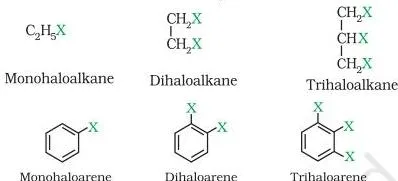
The chart above is the first cut: count the halogen atoms and you land in mono, di or polyhalogen compounds. The classes the chapter spends most time on are the monohalo ones, sorted further by the carbon that carries the halogen.
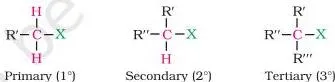
This is the simplest case: the halogen sits on an sp³ carbon of an alkyl group, and the halide is primary, secondary or tertiary depending on that carbon, not on the halogen.

Here the sp³ carbon holding X sits next to a C=C. That double bond changes the chemistry of the halide, which is why allylic halides get their own class.
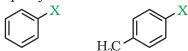
Moving the halogen straight onto the ring’s sp² carbon gives an aryl halide — the least reactive class in this chapter, for reasons covered later.
Nomenclature: Common Names, IUPAC Names and gem-Dihalides
Two naming systems run through the chapter, and the questions are in IUPAC. The common system says “alkyl + halide” (n-propyl bromide); IUPAC treats the halogen as a substituent, so the same molecule is 1-bromopropane.
For monosubstituted benzene both systems agree — bromobenzene is bromobenzene. The o-, m-, p- prefixes of the common system become the locants 1,2; 1,3; 1,4 in IUPAC (Section 6.2).
Dihaloalkanes split into gem-dihalides, both halogens on the same carbon (ethylidene chloride → \( \text{CH}_3\text{CHCl}_2 \), 1,1-dichloroethane), and vic-dihalides, halogens on adjacent carbons (ethylene dichloride, 1,2-dichloroethane). Example 6.1 shows why systematic naming matters: eight structural isomers share the formula \( \text{C}_5\text{H}_{11}\text{Br} \), and only IUPAC names separate them cleanly.
Five steps turn any structure into an IUPAC name:
- Find the longest carbon chain that contains the halogen — it gives the parent name.
- Number the chain from the end that gives the substituents the lowest locants.
- Name each halogen as a prefix — fluoro, chloro, bromo, iodo — with its locant.
- Add di-, tri-, tetra- when the same halogen appears more than once, each with its own number.
- Alphabetise the substituent prefixes and assemble the name as one word.
Apply the checklist: name a six-membered ring with a bromine on one carbon and a chlorine three carbons away.
Steps 1–2: the ring is the parent; numbering runs so the substituents sit on 1 and 3.
Steps 3–5: bromo gets locant 1, chloro gets locant 3, and b comes before c alphabetically.
Final answer: 1-bromo-3-chlorocyclohexane.
Nature of the C–X Bond: Polarity, Length and Dipole Moment
Almost every reaction in the chapter happens at one spot: the polarised carbon–halogen bond. The halogen is more electronegative than carbon, so the carbon carries a partial positive charge, the halogen a partial negative charge, and electron-rich nucleophiles are drawn to that carbon (Section 6.3).
Three trends run down the halogen group (Table 6.2). Bond length grows from C–F (139 pm) to C–I (214 pm) as the halogen enlarges. Bond enthalpy falls from C–F to C–I, meaning the C–I bond is the easiest to break. Dipole moments stay near 1.6–1.9 D, with methyl chloride the highest of the four methyl halides.
Now the classic trap, Exercise 6.4: \( \text{CCl}_4 \) has four polar C–Cl bonds, yet its dipole moment is zero. The four bonds are arranged tetrahedrally around carbon, identical in size and pointing at the tetrahedron’s corners, so their dipoles cancel exactly. Symmetry, not absence of polarity, explains the zero.
Preparation of Haloalkanes: From Alcohols, Alkanes, Alkenes and Halogen Exchange
Conversion questions in the exercises lean directly on these routes, so the reason for each choice matters as much as the equation. Four routes cover the chapter.
From alcohols (Section 6.4.1): the –OH group is replaced by halogen using concentrated halogen acids, phosphorus halides, red phosphorus plus halogen, or thionyl chloride. Reactivity with a given acid runs \(3^\circ \gt 2^\circ \gt 1^\circ\). The book prefers thionyl chloride because its two by-products, \( \text{SO}_2 \) and \( \text{HCl} \), are gases that escape, leaving a pure alkyl chloride:
\[ \text{R-OH} + \text{SOCl}_2 \rightarrow \text{R-Cl} + \text{SO}_2 + \text{HCl} \]
These alcohol routes fail for phenols: their C–O bond has partial double-bond character and is hard to break.
From alkanes: free radical chlorination or bromination gives a complex mixture of isomeric mono- and polyhaloalkanes, so the yield of any one compound is low. Example 6.3 shows monochlorination of 2-methylbutane giving four different products.
From alkenes: HX adds across the double bond, and the product follows Markovnikov’s rule (from Unit 13 of Class XI). Bromine adds to give colourless vic-dibromides, and the discharge of the reddish-brown bromine colour is the standard laboratory test for a double bond.
Halogen exchange (Section 6.4.3): iodides are made by the Finkelstein reaction — heating the chloride or bromide with NaI in dry acetone:
\[ \text{R-X} + \text{NaI} \xrightarrow{\text{dry acetone}} \text{R-I} + \text{NaX} \]
The NaCl or NaBr precipitates out, and Le Chatelier’s principle pulls the reaction forward. Fluorides are made by the Swarts reaction, heating the chloride or bromide with a metallic fluoride such as AgF, Hg₂F₂, CoF₂ or SbF₃.
Preparation of Haloarenes: Electrophilic Substitution and Sandmeyer’s Reaction
Aryl halides cannot be made by the alcohol routes, because the ring’s C–O bond will not break. The chapter gives two dedicated routes.
Direct halogenation: aryl chlorides and bromides come from electrophilic substitution of the arene with chlorine or bromine, using a Lewis acid catalyst such as iron or iron(III) chloride. Iodination is reversible and needs an oxidising agent (HNO₃ or HIO₄) to destroy the HI that forms. Fluorination is not done this way because fluorine is too reactive.
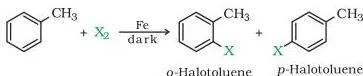
The scheme above is the direct route: the electrophilic halogen, helped by the Lewis acid, substitutes onto the ring. The ortho and para isomers form together and are separated by their large difference in melting points.
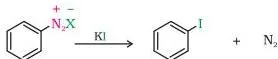
Sandmeyer’s reaction: a primary aromatic amine in cold aqueous mineral acid reacts with sodium nitrite to give a diazonium salt. Mixing the fresh salt with cuprous chloride or cuprous bromide replaces the diazonium group with –Cl or –Br. Iodine needs no copper salt — simple shaking with potassium iodide is enough.
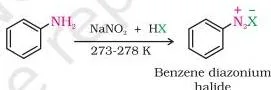
The second scheme shows the diazonium route, which places the halogen exactly where the amino group stood. That positional control is why amines are such useful starting materials for haloarenes.
Physical Properties: Boiling Points, Density and Solubility
These patterns let you predict behaviour instead of memorising numbers. The argument is always the same: stronger intermolecular forces, or weaker ones.
Boiling points of chlorides, bromides and iodides sit well above those of comparable hydrocarbons, because dipole–dipole and van der Waals forces are stronger. For the same alkyl group the order is RI > RBr > RCl > RF, since van der Waals forces grow with halogen size and mass. Branching lowers the boiling point: among the bromobutane isomers, 2-bromo-2-methylpropane boils lowest.
Fig 6.1, taught below, plots these curves.
Density rises with the number of halogen atoms and with their atomic mass; bromo, iodo and polychloro derivatives are heavier than water.
Solubility: haloalkanes are very slightly soluble in water. Dissolving would mean breaking water’s hydrogen bonds, while the new attractions are weaker than those bonds. In organic solvents the attractions are comparable, so haloalkanes dissolve freely.
A separate pattern: para-dihalobenzenes melt higher than their ortho and meta isomers, because the symmetrical para molecule packs better into the crystal lattice.
SN1 and SN2: Two Mechanisms, Two Reactivity Orders
A nucleophile replaces the halogen at the partial positive carbon. The replacement can happen in one concerted step (SN2) or through a carbocation (SN1), and which route a molecule takes decides its rate, its products and its stereochemistry.
| Feature | SN2 | SN1 |
|---|---|---|
| Kinetics | Second order — rate depends on both the halide and the nucleophile | First order — rate depends only on the halide |
| Steps | One step; bond making and bond breaking are simultaneous | Two steps; the C–X bond breaks first |
| Intermediate | None — a short-lived transition state with carbon holding five groups | A carbocation, formed in the slow, reversible first step |
| Stereochemistry | Inversion of configuration | Racemisation |
| Solvent | The book ties the rate to steric hindrance and the leaving group rather than to solvent | Polar protic solvents — water, alcohol, acetic acid |
| Substrate preference | Methyl fastest: \( \text{CH}_3\text{X} \gt 1^\circ \gt 2^\circ \gt 3^\circ \) | Tertiary fastest: \( 3^\circ \gt 2^\circ \gt 1^\circ \gt \text{CH}_3\text{X} \) |
Common nucleophiles and their products (Table 6.4): hydroxide or water gives an alcohol; alkoxide gives an ether; NaI gives an alkyl iodide; ammonia gives an amine; KCN gives a nitrile; AgCN gives an isocyanide; KNO₂ gives an alkyl nitrite; AgNO₂ gives a nitroalkane; LiAlH₄ gives a hydrocarbon.
Why KCN and AgCN differ is Example 6.5, and it is an important pair. Cyanide is an ambident nucleophile — it has two nucleophilic centres, carbon and nitrogen.
KCN is ionic, so free cyanide ions attack through carbon, because the C–C bond formed is more stable than C–N; the product is an alkyl cyanide. AgCN is covalent, so nitrogen donates the pair and the product is an isocyanide. Nitrite behaves the same way: through oxygen it gives alkyl nitrites, through nitrogen, nitroalkanes.
Two words separate the mechanisms: SN1 is about the stability of the carbocation, SN2 is about space around the carbon. The name itself helps — the “2” of SN2 means both molecules meet in the rate step, so a crowded substrate is the enemy; the “1” of SN1 means one molecule ionises alone, so the ease of forming a stable carbocation rules.
| Reaction | Reactivity order (fastest first) | Reason |
|---|---|---|
| SN2 | \( \text{CH}_3\text{X} \gt 1^\circ \gt 2^\circ \gt 3^\circ \) | Steric hindrance blocks the incoming nucleophile |
| SN1 | \( 3^\circ \gt 2^\circ \gt 1^\circ \gt \text{CH}_3\text{X} \) | More substituted carbocations are more stable |
| Both (same alkyl group) | \( \text{R-I} \gt \text{R-Br} \gt \text{R-Cl} \gg \text{R-F} \) | Iodide is the best leaving group |
Worked example: arrange 1-iodobutane, 1-iodo-2-methylpropane, 2-iodobutane and 2-iodo-2-methylpropane in order of SN2 and SN1 reactivity.
Step 1 — identify the class: 1-iodobutane is primary; 1-iodo-2-methylpropane is primary but branched at the next carbon; 2-iodobutane is secondary; 2-iodo-2-methylpropane is tertiary.
Step 2 — SN2, steric hindrance: the straight-chain primary halide has the least crowded reaction site, so it is fastest; the branched primary is slower, the secondary slower still, and the tertiary slowest.
Step 3 — SN1, carbocation stability: the tertiary halide forms the most stable carbocation and is fastest; the secondary comes next.
Of the two primary halides, the branched one gives the more stable carbocation because the neighbouring group donates electron density by the inductive effect.
Final orders: SN2 — 1-iodobutane > 1-iodo-2-methylpropane > 2-iodobutane > 2-iodo-2-methylpropane. SN1 — 2-iodo-2-methylpropane > 2-iodobutane > 1-iodo-2-methylpropane > 1-iodobutane.
Stereochemistry: Chirality, Optical Activity, Inversion and Racemisation
Three-dimensional shape is the evidence that tells SN1 from SN2. Certain compounds rotate plane-polarised light, and that rotation lets you watch what a mechanism actually does to a molecule (Section 6.7.1c).
- Rotation to the right = dextrorotatory (+); to the left = laevorotatory (−).
- A molecule whose mirror image cannot be superimposed is chiral — your hands are the model (Fig 6.4).
- A carbon with four different groups is an asymmetric carbon; the molecule is usually chiral.
- Non-superimposable mirror-image pair = enantiomers (Fig 6.7); identical physical properties, opposite rotation.
- Equal amounts of both enantiomers = racemic mixture, zero net rotation, prefix dl or (±). Racemisation is the change of one enantiomer into the racemic mixture.
Two examples carry the logic. Propan-2-ol’s mirror image, rotated 180°, superimposes on the original, so the molecule is achiral (Fig 6.5). Butan-2-ol has four different groups at the central carbon; its mirror image will not superimpose, so it is chiral (Fig 6.6).
Note the book’s caution: the sign of optical rotation is not necessarily related to the absolute configuration of the molecule.
Now the pay-off. In SN2 the nucleophile attacks from the side opposite the halogen, so an optically active halide gives the inverted configuration — the book’s image is an umbrella turning inside out in wind. In SN1 the slow step forms a planar sp² carbocation; the nucleophile can attack from either face, so the product is racemised.
Worked example: optically active 2-chloropentane treated with aqueous hydroxide follows SN2, so the product 2-pentanol has the inverted configuration at the chiral carbon. A tertiary halide under the same conditions would follow SN1, and the product would be racemic rather than a single enantiomer.
Elimination Reactions and the Zaitsev Rule
A haloalkane with a β-hydrogen can lose HX instead of swapping X. Heating with alcoholic KOH removes the β-hydrogen together with the α-halogen and forms an alkene — a β-elimination, named after the hydrogen’s position.
When more than one alkene is possible, the Zaitsev rule picks the major product: the preferred alkene is the one with the greater number of alkyl groups attached to the doubly bonded carbons. The chapter’s own example is 2-bromopentane, which gives pent-2-ene as the major product.
Substitution and elimination compete. A bulky base prefers to abstract a proton rather than crowd the carbon. Primary halides favour SN2, tertiary halides favour SN1 or elimination, and secondary halides choose according to base strength. The deciding reagent is the solvent: aqueous KOH gives the alcohol (substitution), alcoholic KOH gives the alkene (elimination) — the exact point of Exercise 6.20.
Reactions with Metals: Grignard Reagents and the Wurtz Reaction
Most organic chlorides, bromides and iodides react with certain metals to give organometallic compounds, which carry carbon–metal bonds. Two reactions matter here.
Grignard reagents: an alkyl halide reacts with magnesium in dry ether to give \( \text{RMgX} \):
\[ \text{R-X} + \text{Mg} \xrightarrow{\text{dry ether}} \text{R-MgX} \]
The carbon–magnesium bond is covalent but highly polar, with carbon pulling electron density from electropositive magnesium. Because the reagent reacts with any proton source — even water, alcohols and amines — it must be kept anhydrous, which is why dry ether is the medium. That same reaction with water is a genuine method for converting a halide into a hydrocarbon.
Wurtz reaction: two alkyl halide molecules couple with sodium in dry ether, doubling the carbon count:
\[ 2\text{RX} + 2\text{Na} \xrightarrow{\text{dry ether}} \text{R-R} + 2\text{NaX} \]
Alkylarenes and biaryls are made similarly — the Wurtz-Fittig and Fittig reactions belong to the haloarenes part of the chapter.
Haloarenes: Low Reactivity, the NO2 Effect and o,p-Direction
Aryl halides are extremely unreactive towards nucleophilic substitution, and the chapter gives four reasons. Then it shows the two ways to force the reaction anyway.
- Resonance: halogen lone pairs conjugate with the ring’s π electrons, giving the C–Cl bond partial double-bond character — harder to break.
- Hybridisation: the sp² carbon is more electronegative and holds the bond tighter; the C–Cl bond is 169 pm in haloarenes versus 177 pm in haloalkanes.
- No SN1: the phenyl cation would not be stabilised by resonance, so the SN1 route is ruled out.
- Repulsion: the electron-rich ring discourages the approach of electron-rich nucleophiles.
Reactivity can be forced. Chlorobenzene converts to phenol with aqueous NaOH at 623 K and 300 atmospheres pressure. A nitro group at the ortho or para position withdraws electron density and stabilises the carbanion formed on attack, speeding the reaction — a meta nitro group has no effect, because no resonance structure places the negative charge on the carbon bearing the NO₂ group.
Electrophilic substitution takes the opposite path. The halogen is ring-deactivating but o,p-directing: further substitution lands at ortho and para positions. Example 6.9 resolves the contradiction — inductive withdrawal controls overall reactivity (net deactivation) while resonance controls orientation. The inductive effect is the stronger of the two.
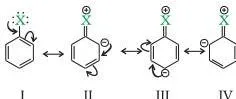
The resonance structures above show why the halogen directs to ortho and para: those positions carry increased electron density, while the meta positions do not.
Two sodium couplings close the section: Wurtz-Fittig joins an alkyl and an aryl halide into an alkylarene; Fittig joins two aryl halides into a biaryl.
Polyhalogen Compounds: Uses and Environmental Effects
The chapter closes with six commercial compounds. The pattern to notice: the stability that makes them useful is exactly what makes some of them hazardous.
| Compound | Uses | Health and environmental effects |
|---|---|---|
| Dichloromethane | Paint remover, aerosol propellant, solvent in drug manufacture, metal cleaning and finishing | Harms the central nervous system; skin burns and cornea damage on contact; environmental effects not detailed in the chapter |
| Chloroform | Solvent for fats, alkaloids and iodine; feedstock for the refrigerant freon R-22; once a general anaesthetic | Depresses the central nervous system; chronic exposure may damage the liver and kidneys; oxidised by air and light to poisonous phosgene, so stored in closed dark bottles |
| Iodoform | Former antiseptic | Its antiseptic action comes from liberated iodine; replaced because of its objectionable smell |
| Carbon tetrachloride | Manufacture of refrigerants and aerosol propellants, feedstock for chlorofluorocarbons, former cleaning fluid and fire extinguisher | Evidence links exposure to liver cancer; dizziness, nausea and nerve damage; rises to the atmosphere and depletes the ozone layer |
| Freons | Aerosol propellants, refrigeration, air conditioning; Freon 12 (\( \text{CCl}_2\text{F}_2 \)) made by the Swarts reaction | Extremely stable; diffuse unchanged into the stratosphere and upset the natural ozone balance |
| DDT | First chlorinated organic insecticide; effective against the mosquito that spreads malaria and lice that carry typhus | Fat-soluble and stored in fatty tissues, so it builds up in animals; highly toxic to fish; banned in the United States in 1973 |
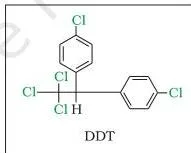
The DDT structure above explains its history. First prepared in 1873, its insecticidal power was discovered by Paul Muller of Geigy Pharmaceuticals in 1939, earning him the 1948 Nobel Prize. Because DDT resists rapid metabolism, it is deposited and stored in fatty tissues and accumulates in animals — the property that led to its 1973 ban in the United States.
Figures in This Chapter, Explained
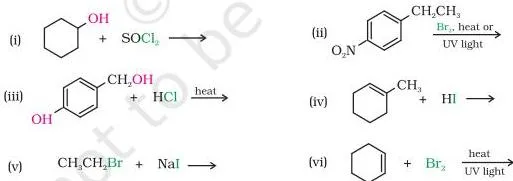
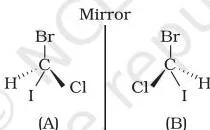
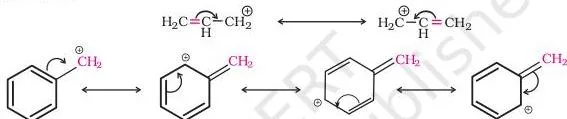
Each numbered figure below is the one in your book. Read the caption, then the line on what to look at and what it proves.
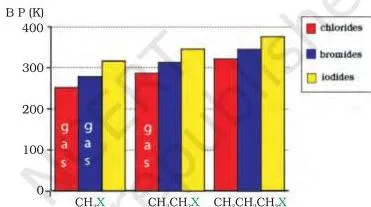
Fig 6.1 plots boiling points across the alkyl halides. The curves rise as the halogen gets larger and heavier, and each curve lies well above its parent hydrocarbon — the visual proof that van der Waals forces grow with halogen size.

Fig 6.2 is the SN2 mechanism in balls. The red hydroxide ion approaches the carbon as the green halide departs; both events happen in the same instant, with no intermediate shown.
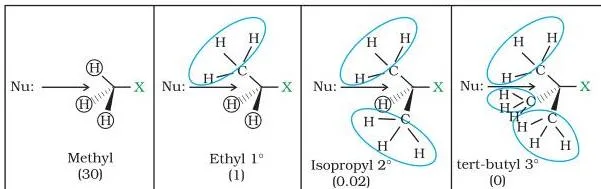
Fig 6.3 shows why the SN2 rate collapses along the series: the relative rates fall sharply from methyl to tertiary as bulky alkyl groups block the nucleophile’s approach.
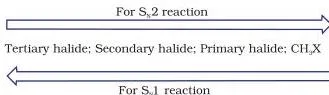
The SN1 scheme isolates the slow, reversible first step — the C–Br bond breaking to give a carbocation and a bromide ion. Everything else in SN1 follows from that step being rate-determining.
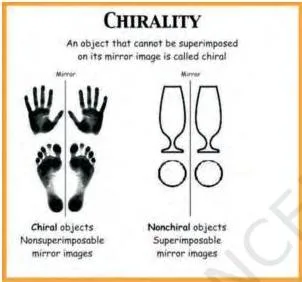
Fig 6.4 makes chirality concrete with everyday objects. A hand and its mirror image do not coincide; that non-superimposability is exactly what chiral molecules share.
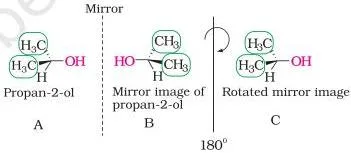
Fig 6.5 walks through propan-2-ol: B is the mirror image of A, rotate B by 180° and you get C, and C superimposes on A. The central carbon’s four groups are not all different, so the molecule is achiral.
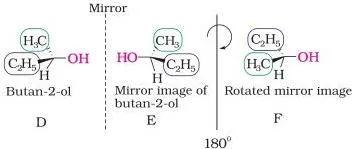
Fig 6.6 repeats the test on butan-2-ol. Rotating the mirror image by 180° still does not superimpose it on the original, because the central carbon carries four different groups; butan-2-ol is chiral.
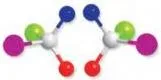
Fig 6.7 shows a chiral molecule beside its mirror image. The pair are enantiomers — non-superimposable mirror images that rotate plane-polarised light in opposite directions.
Key Terms and Definitions from Unit 6
Definitions in the chapter’s own sense, in shorter words, with the section that introduces each term.
- Haloalkane — halogen attached to the sp³ carbon of an alkyl group (6.1).
- Haloarene — halogen attached to an sp² carbon of an aromatic ring (6.1).
- Allylic halide — halogen on an sp³ carbon adjacent to a C=C bond (6.1).
- Benzylic halide — halogen on an sp³ carbon attached to an aromatic ring (6.1).
- Vinylic halide — halogen on the sp² carbon of a C=C bond (6.1).
- Aryl halide — halogen directly on the sp² carbon of an aromatic ring (6.1).
- gem-Dihalide — both halogens on the same carbon (6.2).
- vic-Dihalide — halogens on adjacent carbons (6.2).
- Ambident nucleophile — a nucleophile with two nucleophilic centres, such as cyanide or nitrite (6.7.1).
- Nucleophilic substitution — a nucleophile replaces a leaving group at an electron-deficient carbon (6.7.1).
- SN1 reaction — unimolecular, first order, goes through a carbocation (6.7.1).
- SN2 reaction — bimolecular, second order, one concerted step (6.7.1).
- Carbocation — a carbon with a positive charge and six valence electrons; planar sp² in SN1 (6.7.1).
- Optical activity — rotation of plane-polarised light by a compound (6.7.1c).
- Dextrorotatory — rotates plane-polarised light clockwise, written (+); (6.7.1c).
- Laevorotatory — rotates plane-polarised light anticlockwise, written (−); (6.7.1c).
- Optical isomerism — the phenomenon of (+) and (−) isomers of a compound (6.7.1c).
- Chiral — not superimposable on its mirror image; optically active (6.7.1c).
- Achiral — superimposable on its mirror image; optically inactive (6.7.1c).
- Asymmetric carbon — a carbon bearing four different groups (6.7.1c).
- Enantiomers — stereoisomers related as non-superimposable mirror images (6.7.1c).
- Racemic mixture — equal amounts of both enantiomers; zero net rotation, prefix dl or (±); (6.7.1c).
- Racemisation — conversion of one enantiomer into a racemic mixture (6.7.1c).
- Retention of configuration — the spatial arrangement around an asymmetric centre is preserved (6.7.1c).
- Inversion of configuration — the arrangement is flipped, like an umbrella in wind (6.7.1c).
- Zaitsev rule — the preferred alkene has more alkyl groups on the doubly bonded carbons (6.7.2).
- Grignard reagent — \( \text{RMgX} \), made from an alkyl halide and magnesium in dry ether (6.7.3).
- Finkelstein reaction — NaI in dry acetone converts alkyl chlorides or bromides to iodides (6.4.3).
- Swarts reaction — a metallic fluoride converts alkyl chlorides or bromides to fluorides (6.4.3).
- Sandmeyer’s reaction — a diazonium salt reacts with cuprous chloride or bromide to give an aryl halide (6.4, haloarenes).
- Wurtz reaction — two alkyl halides couple with sodium in dry ether to give a higher alkane (6.7.3).
- Wurtz-Fittig reaction — an alkyl and an aryl halide couple with sodium to give an alkylarene (haloarenes section).
- Fittig reaction — two aryl halides couple with sodium to give a biaryl (haloarenes section).
- Freons — chlorofluorocarbons of methane and ethane (6.8.5).
- Phosgene — carbonyl chloride, the poisonous product of chloroform’s oxidation by air and light (6.8.2).
Common Mistakes Students Make in This Chapter
Each of these traps is pointed out in the book itself, and each has a settled correction. Check yours before you move on.
| Mistake | Correct rule | How to check your answer |
|---|---|---|
| Writing KCN and AgCN products the same way | KCN gives alkyl cyanides (attack through carbon); AgCN gives isocyanides (attack through nitrogen) | Look at the product formula: \( \text{RCN} \) is a cyanide, \( \text{RNC} \) is an isocyanide (Example 6.5) |
| Thinking SN2 racemises the product | SN2 inverts the configuration; SN1 racemises | SN1 has a planar carbocation; SN2 has back-side attack (Section 6.7.1c) |
| Reading the sign of rotation as the configuration | The sign of optical rotation is not necessarily related to absolute configuration | Two compounds with the same configuration can rotate light in opposite directions (Section 6.7.1c) |
| Using H₂SO₄ with KI to make alkyl iodides | H₂SO₄ oxidises HI to iodine, so no alkyl iodide forms | Use the iodide salt without sulphuric acid, e.g. in 95% orthophosphoric acid (Intext Q 6.2) |
| Expecting a meta –NO₂ group to speed up aryl substitution | Only ortho and para –NO₂ stabilise the carbanion; meta does nothing | Check the resonance structures: meta places no negative charge on the NO₂ carbon (haloarenes section) |
| Forgetting the solvent decides substitution vs elimination | Aqueous KOH gives alcohol; alcoholic KOH gives alkene | Exercise 6.20 is built on exactly this contrast |
| Assuming CCl₄ has a large dipole moment | Four polar C–Cl bonds cancel in the tetrahedral molecule; the dipole moment is zero | Draw the tetrahedron and add the four bond dipoles as vectors (Exercise 6.4) |
What the Chapter Expects You to Be Able to Do
The unit opens with its own objectives, and each objective maps to particular exercises. Practising those questions is the most direct preparation.
| Skill from the unit’s objectives | Exercises that practise it |
|---|---|
| Naming haloalkanes and haloarenes by IUPAC rules and classifying them | 6.1, 6.2, 6.3 |
| Writing preparations and conversions | 6.7, 6.11, 6.19 |
| Predicting SN1 and SN2 reactivity and writing mechanisms | 6.9, 6.15, 6.16, 6.17 |
| Handling elimination and the Zaitsev rule | 6.10, 6.20, 6.21 |
| Explaining properties: dipole moments, solubility, melting points | 6.4, 6.12, 6.18 |
| Writing reaction products under given conditions | 6.14, 6.22 |
| Uses and effects of polyhalogen compounds, and organometallic reagents | 6.13; Grignard questions appear in 6.12(iii) and 6.22(ii) |
What a full answer needs: for naming, the correct parent chain, lowest locants and alphabetical prefixes; for reactions, the reagent and condition written with the equation; for explain-why questions, the principle first and then its consequence.
Textbook contents and the examinable syllabus are not always identical — check the current official syllabus before the exam.
A useful order to revise in: classification, then nomenclature, then the C–X bond, then the reactions (SN1/SN2, elimination, metals), then haloarenes, and finally the polyhalogen compounds.
Haloalkanes and Haloarenes: The Chapter on One Page
Everything above compressed into the unit’s own closing summary, in new words.
- What they are: halogen(s) replacing hydrogen in aliphatic or aromatic hydrocarbons; classified by the number of halogens and the hybridisation of the carbon bearing the halogen.
- The key bond: the C–X bond is polarised; carbon is partially positive, halogen partially negative.
- Preparation: free radical halogenation of alkanes; addition of halogen acids to alkenes; replacement of the –OH of alcohols using halogen acids, phosphorus halides or thionyl chloride; halogen exchange for fluorides and iodides; aryl halides by electrophilic substitution and Sandmeyer’s reaction.
- Physical properties: higher boiling points than parent hydrocarbons, slight solubility in water, full solubility in organic solvents.
- Reactions: nucleophilic substitution as SN1 and SN2 — inversion for SN2, racemisation for SN1; elimination following the Zaitsev rule; Grignard reagents and the Wurtz reaction with metals.
- Haloarenes: far less reactive than haloalkanes, for resonance, hybridisation, no SN1, and electron-rich ring reasons.
- Polyhalogen compounds: useful industrially; some, like carbon tetrachloride and freons, deplete the ozone layer, and DDT accumulates in fatty tissues.
Related Chapters and Resources
This listing is maintained for the 2026-27 academic session using the NCERT textbook information available to us. NCERT remains the authority for confirming the latest edition.
Continue from this unit into the Class 12 Chemistry notes on this site, which also carries unit pages for other topics such as electrochemistry. Step back to the Class 12 study material hub or the CBSE notes home page. The next unit in this same book is Alcohols, Phenols and Ethers.
Sources and data verification
The contents described above come from the NCERT Class 12 Chemistry Part II textbook, Unit 6 (Haloalkanes and Haloarenes), as published on ncert.nic.in. This page covers Unit 6 only; the other units of Chemistry Part II have their own pages.
This listing is maintained for the current session using the NCERT edition available on ncert.nic.in. NCERT settles textbook editions, contents and PDFs; CBSE settles the curriculum, syllabus and examinations. Textbook contents and the examinable syllabus may differ — confirm against the official CBSE syllabus.
Frequently Asked Questions
What is the difference between SN1 and SN2 reactions in haloalkanes?
SN1 is a two-step reaction whose rate depends only on the halide (first order). It goes through a carbocation, mostly racemises the product, and is favoured by polar protic solvents like water, alcohol and acetic acid.
SN2 is a one-step reaction whose rate depends on both the halide and the nucleophile (second order). It inverts the configuration, and methyl and primary halides react fastest because steric hindrance is least (Section 6.7.1).
Why does KCN give alkyl cyanides but AgCN gives isocyanides?
Because the cyanide ion is an ambident nucleophile — it can attack through carbon or through nitrogen. KCN is ionic, so the free cyanide ion attacks through carbon, forming the more stable C–C bond and giving an alkyl cyanide (RCN). AgCN is largely covalent, so nitrogen donates the electron pair and an isocyanide (RNC) forms (Example 6.5).
Why are haloarenes less reactive than haloalkanes towards nucleophilic substitution?
Four reasons appear in the chapter: resonance gives the C–X bond partial double-bond character; the sp² ring carbon holds the bond more tightly than an sp³ carbon; the phenyl cation is not resonance-stabilised, so SN1 cannot happen; and the electron-rich ring repels nucleophiles.
Severe conditions (NaOH at 623 K and 300 atm) or a nitro group at ortho/para positions force the reaction (haloarenes section).
Why is the dipole moment of chlorobenzene lower than that of cyclohexyl chloride?
In chlorobenzene the halogen is on an sp² carbon, which holds the C–Cl electron pair more tightly, and resonance spreads the halogen’s lone pair into the ring, giving the bond partial double-bond character and reducing charge separation.
The sp³ carbon of cyclohexyl chloride can do neither, so its C–Cl bond stays more polar (Exercise 6.12(i)).
Why are Grignard reagents prepared in dry and anhydrous conditions?
Grignard reagents react with any source of protons — even water, alcohols and amines — to give the corresponding hydrocarbon. Any trace of moisture therefore destroys the reagent before it can react with your intended substrate, so the preparation is carried out in dry ether (reaction with metals section).
Why does p-dichlorobenzene have a higher melting point than o- and m-dichlorobenzene?
Because of symmetry. The para isomer is the more symmetrical molecule, so it fits into the crystal lattice more efficiently than the ortho and meta isomers, and better packing means a higher melting point (Section 6.6).
Reference: NCERT Class 12 Chemistry Part II textbook, Unit 6 (Haloalkanes and Haloarenes), official edition on ncert.nic.in.
Explore Class 12 Chemistry Books
Class 12 Chemistry on LearnCBSE:
Related chapters: