
The official NCERT Class 12 Chemistry Part I Chapter 4 is The d- and f-Block Elements, a 29-page unit from the NCERT 2026-27 reprint. This page puts the d- and f-block elements class 12 PDF from ncert.nic.in right below, and then explains what is inside the chapter section by section.
Download the d- and f-Block Elements Class 12 Chapter PDF
If you want the official chapter file open beside you while you read this page, Download the NCERT Class 12 Chemistry Chapter 4 d- and f-Block Elements PDF and follow the sections below with your own book. The file is the NCERT edition published on the official site, and everything from Section 4.1 to the exercises is explained on this page.
For the complete book list, NCERT keeps every class and subject on its official textbook portal.
| What the chapter holds | Count | Where it is used |
|---|---|---|
| Printed pages | 29 | |
| Sections in the chapter | 29 | |
| Figures with NCERT captions | 8 | |
| Tables | 18 | |
| Worked examples | 2 | solved step by step in our NCERT Solutions |
| Exercise questions | 24 | answered in our NCERT Solutions |
| Official NCERT PDF | Download the chapter PDF | the chapter exactly as NCERT publishes it |
Chapter 4 at a Glance
The table below shows how much the chapter holds — its sections, figures, worked examples and exercise questions. The unit’s centre of gravity is the first transition series (Sc to Zn) and the two potassium oxidants \( \text{K}_2\text{Cr}_2\text{O}_7 \) and \( \text{KMnO}_4 \); the f-block series are treated more briefly and descriptively.
What This Chapter Covers, Section by Section
Use this map to jump straight to the part of the chapter you need. Each row names the NCERT section and what it teaches.
| Section | What it teaches | Where |
|---|---|---|
| 4.1 Position in the Periodic Table | Where the d-block sits, groups 3–12, and the four rows of transition metals (3d, 4d, 5d, 6d) | NCERT §4.1 |
| 4.2 Electronic Configurations | The \( (n-1)d^{1-10}ns^{1-2} \) general rule, the Pd exception, and the Cr and Cu exceptions | NCERT §4.2 |
| 4.3.1–4.3.2 Physical Properties; Atomic and Ionic Sizes | Metallic character, high melting points with mid-series maxima, and shrinking radii across a series | NCERT §4.3.1–4.3.2 |
| 4.3.3 Ionisation Enthalpies | Why successive ionisation enthalpies rise less steeply than in main-group elements | NCERT §4.3.3 |
| 4.3.4 Oxidation States | The greatest variety occurs mid-series; Mn shows +2 to +7; states differ by one | NCERT §4.3.4 |
| 4.3.5–4.3.8 Electrode Potentials and Chemical Reactivity | The \( E^\circ(\text{M}^{2+}/\text{M}) \) trend, the positive \( E^\circ \) of copper, and stability of higher oxidation states | NCERT §4.3.5–4.3.8 |
| 4.3.9 Magnetic Properties | The spin-only formula \( \mu = \sqrt{n(n+2)} \) for first-series ions | NCERT §4.3.9 |
| 4.3.10 Formation of Coloured Ions | d-d transitions absorbing visible light; the observed colour is complementary | NCERT §4.3.10 |
| 4.3.11–4.3.14 Complexes, Catalysis, Interstitial Compounds, Alloys | Why transition metals form complexes, catalyse reactions, trap small atoms and alloy readily | NCERT §4.3.11–4.3.14 |
| 4.4.1 Oxides and Oxoanions; \( \text{K}_2\text{Cr}_2\text{O}_7 \) and \( \text{KMnO}_4 \) | Oxide trends from \( \text{Sc}_2\text{O}_3 \) to \( \text{Mn}_2\text{O}_7 \); preparation and oxidising action of the two potassium salts | NCERT §4.4.1 |
| 4.5 The Lanthanoids | 4f filling, the +3 state, and the lanthanoid contraction | NCERT §4.5 |
| 4.6 The Actinoids | 5f filling, wide oxidation states, radioactivity and the actinoid contraction | NCERT §4.6 |
| 4.7 Applications | Steels, catalysts, batteries, coinage metals, photography and pigments | NCERT §4.7 |
| Summary | The book’s own closing recap of the whole unit | NCERT Summary |
| Exercises | The chapter’s question set, drilling configurations, oxidants, magnetism and the f-block | NCERT Exercises |
Notice the weighting: the first transition series (Sc to Zn) gets the deep treatment, the two compounds potassium dichromate and potassium permanganate are taught as preparation plus reactions, and the f-block sections (lanthanoids and actinoids) stay more descriptive.
Key Concepts: What This Chapter Actually Teaches
The whole unit rests on one fact: when the d or f subshell is only partly filled, the element develops properties the s- and p-block never show — variable oxidation states, colour, magnetism, catalysis and complex formation. The first transition series gets most of the book’s attention because its chemistry is the richest and it carries most of the chapter’s examples.
What Makes an Element a Transition Metal
Before anything else, the chapter fixes who counts as a transition metal, because “d-block” and “transition metal” are not the same thing. The definition decides two famous exam cases, zinc and silver.
By the IUPAC definition used in this chapter, transition metals are metals with an incomplete d subshell either in the neutral atom or in any of their ions (NCERT, p. 1).
Zinc fails the test: its ground state is \( 3d^{10} \) and \( \text{Zn}^{2+} \) is still \( 3d^{10} \), so no zinc ion has an incomplete d subshell. Silver passes: the atom is \( 4d^{10} \), but \( \text{Ag}^{2+} \) has \( 4d^9 \) — that is the argument of the chapter’s intext question 4.1 (NCERT, p. 4).
Group 12 metals (Zn, Cd, Hg, Cn) are still studied together with the series as end members, though they are not transition metals. Example 4.1 makes the same point with scandium: Sc \( (3d^1) \) is a transition element and Zn \( (3d^{10}) \) is not (NCERT, p. 3).
Electronic Configurations: The General Rule and Its Two Exceptions
This section gives the rule for how the d orbitals fill, then shows why the rule breaks. Both the rule and the exceptions are asked directly in the exercises.
The general outer configuration of the d-block is \( (n-1)d^{1-10}ns^{1-2} \) — the inner d orbitals hold anywhere from one to ten electrons while the outer s orbital holds one or two. Palladium is an exception with \( 4d^{10}5s^0 \) (NCERT, p. 2).
Chromium and copper break the expected filling order because the energy gap between 3d and 4s is small, and half-filled and fully filled sets of orbitals are extra stable. So Cr is \( 3d^5 4s^1 \), not \( 3d^4 4s^2 \), and Cu is \( 3d^{10} 4s^1 \), not \( 3d^9 4s^2 \) (NCERT, p. 2).
When ions form, the ns electrons leave first: 4s before 3d (NCERT, p. 7). The ion configurations to know blind: \( \text{Cr}^{3+} = 3d^3 \), \( \text{Mn}^{2+} = 3d^5 \), \( \text{Fe}^{3+} = 3d^5 \), \( \text{Cu}^{+} = 3d^{10} \), \( \text{Zn}^{2+} = 3d^{10} \).
Why Sizes Shrink: Atomic and Ionic Radii, and the Lanthanoid Contraction
Across any transition series the radii shrink steadily, and understanding why explains one of the stranger facts of the whole table — why the 4d and 5d metals look nearly identical.
Each new electron enters a d orbital while the nuclear charge rises by one, and d electrons shield the outer electrons poorly. So the net electrostatic pull on the outer electrons strengthens and both atomic and ionic radii decrease across the series (NCERT, p. 5). The variation within one series is quite small.
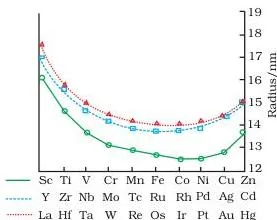
The graph above, Fig 4.3, shows the size stepping up from the 3d to the 4d series — and then staying almost flat from the 4d to the 5d series. The reason is the intervention of the 4f orbitals: their filling causes the lanthanoid contraction, a regular size decrease that cancels the expected growth of the 5d elements (NCERT, p. 5).
The consequence is the famous pair: Zr (160 pm) and Hf (159 pm) are almost the same size, which is why they occur together in minerals and are so difficult to separate (NCERT, p. 5).
Oxidation States and the Electrode Potential Story
Transition metals stand out because one metal forms many oxidation states, and the electrode potential values in Table 4.2 of the chapter explain which states are stable. This section ties the first half of the chapter together.
The greatest variety of oxidation states appears in or near the middle of the series: manganese runs all the way from +2 to +7. Early members (Sc, Ti) have too few d electrons for high states; late members (Cu, Zn) have too many d electrons and too few orbitals free for sharing (NCERT, p. 8).
Unlike the p-block, where oxidation states differ by two, transition states differ by unity — V shows +2, +3, +4 and +5. The stability of the higher states falls after manganese, so Fe, Co and Ni settle at +2/+3, Cu at +1/+2 and Zn only at +2 (NCERT, p. 8).
Within a group the heavier member behaves differently from the p-block rule: Cr(VI) as acidified dichromate is a strong oxidising agent, but Mo(VI) and W(VI) compounds are not (NCERT, p. 8).
The \( E^\circ(\text{M}^{2+}/\text{M}) \) values across the series become less negative, and Fig 4.4 compares the observed values with values calculated from thermochemical data. The standout is copper: its \( E^\circ \) is positive, +0.34 V, because the high energy spent on atomisation and ionisation is not repaid by hydration enthalpy — hence copper cannot liberate hydrogen from acids (NCERT, p. 10).
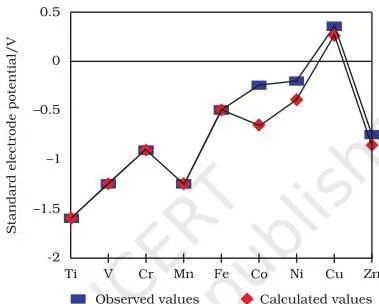
Mn, Ni and Zn sit more negative than the trend predicts: \( \text{Mn}^{2+} \) \( (d^5) \) and \( \text{Zn}^{2+} \) \( (d^{10}) \) gain stability from their configurations, while Ni has the most negative hydration enthalpy (NCERT, pp. 10, 13).
Example 4.4 uses these ideas for the most-asked contrast in the unit: Cr²⁺ is reducing and Mn³⁺ is oxidising even though both are \( d^4 \). The full reasoning appears in the Common Mistakes section below (NCERT, p. 10).
Magnetic Moments: The Spin Only Formula
Magnetic behaviour is the chapter’s cleanest way to count unpaired electrons without a spectrometer. The formula works only because, for first-series ions, only electron spin matters.
Diamagnetic substances are weakly repelled by a magnetic field; paramagnetic ones are attracted; ferromagnetic ones are attracted very strongly, an extreme form of paramagnetism. Most transition metal ions are paramagnetic because of unpaired electrons (NCERT, p. 13).
For the first transition series, orbital angular momentum is effectively quenched, so the moment comes from spin alone. The spin-only formula is \( \mu = \sqrt{n(n+2)} \), where n is the number of unpaired electrons and \( \mu \) is the moment in Bohr magnetons (BM). A single unpaired electron gives 1.73 BM (NCERT, pp. 13–14).
Step 1: Write the ground configuration of vanadium (Z = 23), a member of the 3d series.
\[ \text{V: } 3d^3 4s^2 \]
Step 2: Remove electrons for the +3 ion.
The 4s electrons leave before the 3d, so \( \text{V}^{3+} \) loses \( 4s^2 \) and one 3d electron.
\[ \text{V}^{3+}: 3d^2 \]
Step 3: Count unpaired electrons.
Two electrons in the 3d set occupy two different orbitals with parallel spins, so n = 2.
\[ \mu = \sqrt{n(n+2)} = \sqrt{2(2+2)} = \sqrt{8} \approx 2.83\ \text{BM} \]
Final answer: the spin-only moment of \( \text{V}^{3+} \) is \( \sqrt{8} \approx 2.83 \) BM.
Ions with \( d^0 \) or \( d^{10} \) configurations (\( \text{Sc}^{3+} \), \( \text{Ti}^{4+} \), \( \text{Zn}^{2+} \)) have no unpaired electrons and give \( \mu = 0 \). The calculated and observed values in the chapter’s Table 4.7 confirm the pattern (NCERT, p. 14).
Why Transition Ions Are Coloured
Colour is another consequence of unpaired d electrons, and the chapter gives a one-sentence explanation that answers most questions on it. The rule of thumb — \( d^0 \) and \( d^{10} \) ions are colourless — follows directly.
When an electron jumps from a lower d orbital to a higher one, the energy of excitation corresponds to light in the visible region. The colour you see is the complementary colour of the light absorbed (NCERT, p. 15). The exact frequency depends on the ligand; in water, the aquated ions give the colours below.
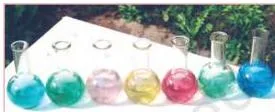
Read the tubes left to right: \( \text{V}^{4+} \) is blue, \( \text{V}^{3+} \) green, \( \text{Mn}^{2+} \) pink, \( \text{Fe}^{3+} \) yellow, \( \text{Co}^{2+} \) pink, \( \text{Ni}^{2+} \) green and \( \text{Cu}^{2+} \) blue. Each colour means a d-d transition is happening.
Ions with \( d^0 \) (\( \text{Sc}^{3+} \), \( \text{Ti}^{4+} \)) and \( d^{10} \) (\( \text{Zn}^{2+} \)) have no d electron to excite and are colourless — that is exactly the reasoning exercise 4.18 asks you to reproduce.
The Two Workhorse Oxidants: Potassium Dichromate and Potassium Permanganate
The chapter ends the d-block part with the two compounds you must be able to prepare and use as oxidants. Both preparations are step sequences, and the permanganate products depend on pH — the single most tested detail in this unit.
Potassium dichromate starts from chromite ore \( \text{FeCr}_2\text{O}_4 \), fused with sodium carbonate in air to give a yellow solution of sodium chromate. Acidifying converts it to orange sodium dichromate, and adding potassium chloride swaps the cation: \( \text{Na}_2\text{Cr}_2\text{O}_7 + 2\text{KCl} \rightarrow \text{K}_2\text{Cr}_2\text{O}_7 + 2\text{NaCl} \) (NCERT, p. 17).
The chromate and dichromate ions are interconvertible with pH, and chromium stays +6 in both (NCERT, p. 18):
\[ 2\text{CrO}_4^{2-} + 2\text{H}^+ \rightarrow \text{Cr}_2\text{O}_7^{2-} + \text{H}_2\text{O} \]
Yellow chromate in alkaline solution shifts to orange dichromate in acid. The dichromate ion is two tetrahedra sharing one corner, with a Cr–O–Cr angle of about \( 126^\circ \).
In acid, dichromate is a strong oxidising agent (NCERT, p. 18):
\[ \text{Cr}_2\text{O}_7^{2-} + 14\text{H}^+ + 6\text{e}^- \rightarrow 2\text{Cr}^{3+} + 7\text{H}_2\text{O} \quad (E^\circ = 1.33\ \text{V}) \]
It oxidises iodides to iodine, \( \text{H}_2\text{S} \) to sulphur, Sn(II) to Sn(IV) and Fe(II) to Fe(III). With iron(II) the full ionic equation is:
\[ \text{Cr}_2\text{O}_7^{2-} + 14\text{H}^+ + 6\text{Fe}^{2+} \rightarrow 2\text{Cr}^{3+} + 6\text{Fe}^{3+} + 7\text{H}_2\text{O} \]
Potassium permanganate is prepared by fusing \( \text{MnO}_2 \) (pyrolusite) with KOH and an oxidising agent such as \( \text{KNO}_3 \), giving dark green potassium manganate. The manganate then disproportionates in neutral or acidic solution, or is electrolytically oxidised, to permanganate (NCERT, p. 18).

The green manganate ion is paramagnetic (one unpaired electron) and tetrahedral; the permanganate ion is intense purple, also tetrahedral and diamagnetic (NCERT, p. 19).
Permanganate gives three different products depending on the medium (NCERT, p. 19):
| Medium | Product | Half-reaction and E° |
|---|---|---|
| Acidic | \( \text{Mn}^{2+} \) | \( \text{MnO}_4^- + 8\text{H}^+ + 5\text{e}^- \rightarrow \text{Mn}^{2+} + 4\text{H}_2\text{O} \), \( E^\circ = +1.52\ \text{V} \) |
| Neutral or faintly alkaline | \( \text{MnO}_2 \) | \( \text{MnO}_4^- + 4\text{H}^+ + 3\text{e}^- \rightarrow \text{MnO}_2 + 2\text{H}_2\text{O} \), \( E^\circ = +1.69\ \text{V} \) |
| Strongly alkaline | \( \text{MnO}_4^{2-} \) (manganate) | \( \text{MnO}_4^- + \text{e}^- \rightarrow \text{MnO}_4^{2-} \), \( E^\circ = +0.56\ \text{V} \) |
One practical warning the book prints: permanganate titrations in hydrochloric acid are unsatisfactory because HCl is oxidised to chlorine (NCERT, p. 20). In acid, permanganate also oxidises oxalates (at about 333 K), nitrites to nitrates and iodides to iodine.
Lanthanoids vs Actinoids at a Glance
The f-block sections are more descriptive, and the questions that come from them are mostly comparisons. One picture — the lanthanoid contraction graph — explains most of the f-block chemistry.
Lanthanoids fill the 4f orbitals, with \( 6s^2 \) common to all. The tripositive ion \( \text{Ln}^{3+} \) is the most stable state, with configuration \( 4f^n \) (NCERT, p. 21). Unusual +2 and +4 states appear where empty, half-filled or filled f subshells give extra stability: \( \text{Ce}^{4+} \) \( (f^0) \), \( \text{Tb}^{4+} \) \( (f^7) \), \( \text{Eu}^{2+} \) \( (f^7) \), \( \text{Yb}^{2+} \) \( (f^{14}) \).
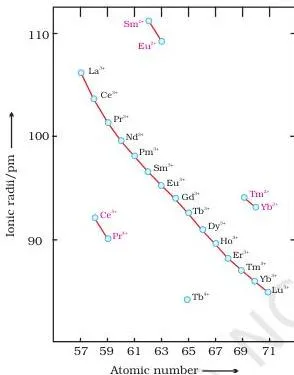
Read Fig 4.6 as a nearly straight slide: the \( \text{Ln}^{3+} \) radius falls regularly from lanthanum to lutetium — that is the lanthanoid contraction (NCERT, p. 21). Its great consequence is on the third transition series, where the 5d metals end up almost the same size as their 4d counterparts (Zr 160 pm, Hf 159 pm).
Actinoids fill the 5f orbitals with \( 7s^2 \) common. They show a wider range of oxidation states — +4 in Th, +5 in Pa, +6 in U, +7 in Np in the first half — because the 5f, 6d and 7s levels are comparable in energy (NCERT, p. 24). Most are radioactive, which makes their study difficult.
The actinoid contraction is greater from element to element than the lanthanoid contraction, because 5f electrons shield the nuclear charge even more poorly (NCERT, p. 24).
| Feature | Lanthanoids | Actinoids |
|---|---|---|
| Orbitals filled | 4f, with \( 6s^2 \) common | 5f, with \( 7s^2 \) common |
| Most stable oxidation state | +3 (\( \text{Ln}^{3+} = 4f^n \)) | +3, but higher states are common in the first half |
| Range of oxidation states | Mainly +3; some +2 and +4 | +3 to +7 in the first half (Th +4, Pa +5, U +6, Np +7) |
| Contraction and its cause | Lanthanoid contraction; one 4f electron shields another poorly | Actinoid contraction, greater element to element; 5f shielding is even poorer |
| General characteristics | Silvery soft metals; many +3 ions coloured; mischmetall alloy | Radioactive; wide reactivity; uneven and complex chemistry |
The comparison above is built from sections 4.5 and 4.6 (NCERT, pp. 20–25). Electronic configurations, oxidation states and the two contractions are exactly the points the chapter asks you to set side by side.
Reading the Chapter’s Figures: Melting Points, Atomisation and the Lanthanoid Reaction Map
Three figures remain — the trend graphs the chapter uses to build its property arguments, and the lanthanoid reaction map. Each one carries a conclusion you can quote.
Fig 4.1 — melting points. Each series rises to a maximum near its middle and then falls, with anomalous values for Mn and Tc. High melting points arise because more electrons — from \( (n-1)d \) as well as ns — take part in the interatomic metallic bonding (NCERT, p. 4).
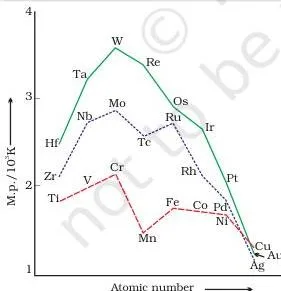
Fig 4.2 — enthalpies of atomisation. The same mid-series maximum appears: about one unpaired electron per d orbital gives the strongest interatomic interaction. The 4d and 5d metals give higher enthalpies than the 3d series, which explains the frequent metal–metal bonding in heavy transition metal compounds (NCERT, p. 5).
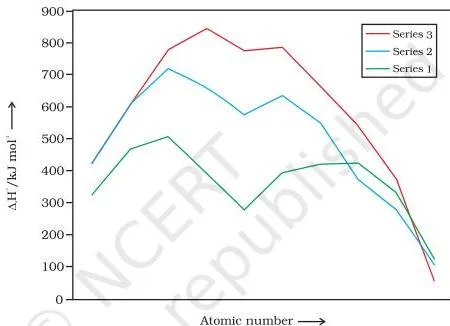
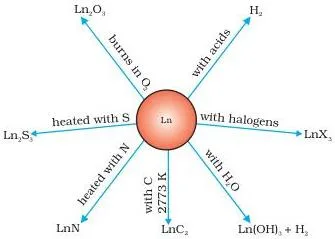
Fig 4.7 — chemical reactions of the lanthanoids. Read this as a four-corner reaction map: lanthanoid metals react with oxygen to give \( \text{M}_2\text{O}_3 \), with water to give \( \text{M(OH)}_3 \) and hydrogen, and with halogens, hydrogen and carbon to give halides, hydrides and carbides; they liberate hydrogen from dilute acids (NCERT, p. 22).
With Figs 4.3 to 4.6 already read in the Key Concepts section, that is the chapter’s whole figure set covered.
Key Terms and Definitions from This Chapter
A quick glossary, each term in the book’s sense, with the section it belongs to.
| Term | Meaning |
|---|---|
| Transition elements | Metals with an incomplete d subshell in the neutral atom or in any of their ions (IUPAC definition, chapter opening, p. 1) |
| d-block | Groups 3–12, where the penultimate d orbitals are progressively filled (§4.1) |
| f-block | The two series in which 4f and 5f orbitals are progressively filled, placed in a separate panel at the bottom of the table (chapter opening, p. 1) |
| Lanthanoid contraction | Regular decrease in atomic and ionic radii from La to Lu, from imperfect shielding of one 4f electron by another (§4.5.2, p. 21) |
| Actinoid contraction | Similar size decrease across the actinoids, greater element to element, from poor shielding by 5f electrons (§4.6.2, p. 24) |
| Spin-only formula | \( \mu = \sqrt{n(n+2)} \) BM, the magnetic moment from unpaired spins when orbital angular momentum is quenched (§4.3.9, p. 13) |
| Bohr magneton (BM) | The unit of magnetic moment; one unpaired electron gives 1.73 BM (§4.3.9) |
| Interstitial compounds | Compounds formed when small atoms such as H, C or N sit trapped in a metal’s crystal lattice; hard, high-melting, metallic-conducting and chemically inert (§4.3.13, p. 16) |
| Disproportionation | A process in which one oxidation state becomes less stable and changes into two states, one lower and one higher (Example 4.9, p. 17) |
| Quenching of orbital angular momentum | The suppression of the orbital contribution to the magnetic moment for first-series ions, leaving spin as the only contributor (§4.3.9, p. 13) |
Common Mistakes Students Make in This Chapter
The chapter’s own examples and intext answers mark out where readers go wrong — each error below is one the book specifically corrects. Fix them before they cost you marks.
| The mistake | What is actually true | How to check from the book |
|---|---|---|
| Calling Zn, Cd and Hg transition metals | They have full \( d^{10} \) in the atom and in common ions, so no incomplete d subshell exists | Apply the IUPAC test from Example 4.1 and intext 4.1 (NCERT, pp. 3–4) |
| Writing Cr as \( 3d^4 4s^2 \) and Cu as \( 3d^9 4s^2 \) | Cr is \( 3d^5 4s^1 \) and Cu is \( 3d^{10} 4s^1 \); half-filled and fully filled d sets are extra stable | Ground-state configuration table (NCERT, p. 2) |
| Treating zinc’s low atomisation enthalpy as random | Zinc’s metallic bonding uses no 3d electrons; every other 3d metal uses theirs | Intext 4.2 answer (NCERT, p. 29) |
| Assuming Cu+ is stable in water | Cu+ disproportionates: \( 2\text{Cu}^{+} \rightarrow \text{Cu}^{2+} + \text{Cu} \), and the E° favours it | Intext 4.9 answer (NCERT, p. 29) |
| Using one KMnO4 product for every medium | Acid gives \( \text{Mn}^{2+} \), neutral or faintly alkaline gives \( \text{MnO}_2 \), strong alkali gives manganate | Half-reactions with E° values (NCERT, p. 19) |
| Saying Cr2+ and Mn3+ behave alike because both are \( d^4 \) | Cr2+ loses an electron to reach \( d^5 \) (reducing); Mn3+ gains one to reach \( d^5 \) (oxidising) | Example 4.4 (NCERT, p. 10) |
| Forgetting the lanthanoid contraction when comparing Zr and Hf | Their radii (160 and 159 pm) are almost equal, so they co-occur and are hard to separate | Section 4.5.2 (NCERT, p. 21) |
What This Chapter’s Exercises Ask You to Practise
The chapter’s own exercise set shows what NCERT thinks matters in this unit. The same skills recur across the questions, and each type has a shape a full answer must follow.
| Skill the exercises drill | Exercises | What a full answer must include |
|---|---|---|
| Writing electronic configurations of ions | 4.1, 4.36 | Write the orbital occupancy (for example \( 3d^3 \)), remembering that 4s electrons leave first |
| Stability of oxidation states | 4.2–4.5 | Give the ion’s configuration and argue with \( d^5 \) or \( d^{10} \) stability |
| Lanthanoid contraction | 4.7 | Definition, cause (poor 4f shielding) and consequences (Zr/Hf similarity) |
| Paramagnetism, colour and catalysis | 4.11 | Unpaired electrons for magnetism; the d-d transition for colour; variable oxidation states for catalysis |
| Preparation and oxidising reactions of \( \text{K}_2\text{Cr}_2\text{O}_7 \) and \( \text{KMnO}_4 \) | 4.14–4.16, 4.26 | Each preparation step with its reagent and condition; balanced ionic equations and the products per medium |
| Comparing lanthanoids and actinoids | 4.20, 4.33 | Both series’ configurations, oxidation states and contractions set side by side |
| Spin-only magnetic moment calculations | 4.31, 4.38 | Quote \( \mu = \sqrt{n(n+2)} \), state n, and give the answer in BM |
| Disproportionation | 4.22 | Define it and give two balanced aqueous examples |
One qualification: textbook contents and the examinable syllabus are not always identical — check the current official CBSE syllabus for Class 12 Chemistry before deciding what to revise. What can be said from the book itself is that these are the ideas the chapter keeps returning to, which makes them the safest possible study list.
The Whole Chapter in Two Minutes
The chapter’s own closing recap, rebuilt in plainer words. If you have two minutes before class, read these nine lines.
- The d-block is groups 3–12 in the middle of the table, with inner d orbitals filled progressively; the f-block sits in a separate panel at the bottom, with 4f and 5f orbitals filled.
- Three transition series are well recognised — the 3d (Sc to Zn), 4d (Y to Cd) and 5d (La, Hf to Hg) — plus the 6d series (Ac, Rf to Cn).
- Transition metals show typical metallic properties, with melting points and enthalpies of atomisation peaking near the middle of each series, where one unpaired electron per d orbital gives strong interatomic bonding.
- Successive ionisation enthalpies rise less steeply than in main-group elements, so variable numbers of \( (n-1)d \) electrons can be lost — producing variable oxidation states, paramagnetism, catalysis, coloured ions, interstitial compounds and complexes.
- Chemical reactivity varies widely; all first-series metals except copper dissolve in 1M H+, and copper is noble with a positive \( E^\circ \).
- Potassium dichromate (from chromite ore) and potassium permanganate (from pyrolusite, \( \text{MnO}_2 \)) are strong oxidising agents.
- The lanthanoid contraction — a steady size decrease across the lanthanoids — has far-reaching consequences for the elements that follow them in the third transition series.
- Actinoid chemistry is more complex: many oxidation states and radioactivity make the study difficult.
- Applications run from steels and alloys to catalysts, complexes, batteries and organic syntheses (NCERT, p. 25).
Related Resources
This chapter is part of the Class 12 Chemistry Part I book — Chapter 3 (Chemical Kinetics) precedes it and Chapter 5 (Coordination Compounds) follows it. For the whole unit list, start at the Class 12 Chemistry notes; to move across subjects use the Class 12 hub or the main CBSE notes index.
Two related chapter-study pages worth opening: Aldehydes, Ketones and Carboxylic Acids and Werner’s theory of coordination compounds, which builds the ligand ideas this chapter introduces.
Sources and Data Verification
- The chapter described on this page is NCERT Class 12 Chemistry Part I, Chapter 4, The d- and f-Block Elements — the rationalised edition, official PDF on ncert.nic.in.
- This page covers only that chapter of Chemistry Part I; it does not describe Chemistry Part II or any other book.
- The page is maintained for the current academic session using the NCERT information available to us.
- NCERT settles the textbook, its editions and the PDFs; CBSE settles the curriculum, syllabus and examinations.
Reference: NCERT Class 12 Chemistry textbook, chapter 4, official edition on ncert.nic.in.
Frequently Asked Questions
Why is zinc not a transition metal even though it is in the d-block?
Zinc fails the IUPAC test: a transition metal has an incomplete d subshell in the neutral atom or in any of its ions. Zinc’s ground state is \( 3d^{10} \) and its common ion \( \text{Zn}^{2+} \) is also \( 3d^{10} \), so neither has an incomplete d subshell (NCERT, p. 1; Example 4.1). It is still studied as the end member of the 3d series.
What is lanthanoid contraction and why does it make zirconium and hafnium so similar?
Lanthanoid contraction is the regular decrease in atomic and ionic radii from lanthanum to lutetium, caused by the imperfect shielding of one 4f electron by another (NCERT, p. 21).
It shrinks the 5d elements so much that Zr and Hf end up nearly the same size (160 pm vs 159 pm), which is why they occur together in nature and are so hard to separate.
Why is Cu+ not stable in aqueous solution?
Cu+ disproportionates in water: \( 2\text{Cu}^{+} \rightarrow \text{Cu}^{2+} + \text{Cu} \), and the E° for this is favourable (NCERT, p. 29). The much more negative hydration enthalpy of \( \text{Cu}^{2+}(\text{aq}) \) more than compensates for the second ionisation enthalpy of copper, so the +2 state is preferred (NCERT, p. 12).
How does potassium permanganate behave differently in acidic, neutral and alkaline solutions?
The product depends on the medium: acid gives \( \text{Mn}^{2+} \) (\( E^\circ = +1.52\) V), neutral or faintly alkaline solution gives \( \text{MnO}_2 \) (\( E^\circ = +1.69\) V), and strongly alkaline solution gives the green manganate ion \( \text{MnO}_4^{2-} \) (\( E^\circ = +0.56\) V) (NCERT, p. 19). In acid it oxidises iodides, Fe(II), oxalates, sulphides and nitrites.
How do you calculate the spin only magnetic moment of a transition metal ion?
Use \( \mu = \sqrt{n(n+2)} \) in Bohr magnetons, where n is the number of unpaired electrons (NCERT, p. 13). Count n from the ion’s d configuration — for example, a \( d^2 \) ion such as \( \text{V}^{3+} \) gives \( \sqrt{8} \approx 2.83 \) BM. The orbital contribution is quenched for first-series ions.
Why is Cr2+ reducing while Mn3+ is oxidising when both have a d4 configuration?
Both reactions head towards the extra-stable \( d^5 \) configuration. \( \text{Cr}^{2+} \) reaches \( d^5 \) by losing an electron, so it is a reducing agent, while \( \text{Mn}^{3+} \) reaches \( d^5 \) by gaining one, so it is an oxidising agent (Example 4.4, NCERT, p. 10). The half-filled configuration is what makes both changes favourable.
Explore Class 12 Chemistry Books
Class 12 Chemistry on LearnCBSE:
Related chapters: