
This page holds the official Alcohols, Phenols and Ethers Class 12 chapter — Unit 7 of the NCERT Class 12 Chemistry Part II textbook (and its second chapter in print). The chapter runs from printed page 193 to page 226 of the 2026-27 NCERT reprint, and the official PDF of the whole unit is linked right below.
Beyond the download you get a section map of the chapter, a page-by-page reading of its key figures, the acidity and oxidation rules students tend to mix up, and a closing recap built from the unit’s own Summary — enough to revise without hunting through the PDF.
Download Alcohols, Phenols and Ethers Class 12 PDF
The official Alcohols, Phenols and Ethers Class 12 NCERT PDF is published by NCERT on its textbook portal; open it when you want to read, print or search the exact printed chapter of Chemistry Part II in the current edition.
| What the chapter holds | Count | Where it is used |
|---|---|---|
| Printed pages | 34 | |
| Sections in the chapter | 17 | |
| Figures with NCERT captions | 28 | |
| Tables | 7 | |
| Worked examples | 3 | solved step by step in our NCERT Solutions |
| Exercise questions | 24 | answered in our NCERT Solutions |
| Official NCERT PDF | Download the chapter PDF | the chapter exactly as NCERT publishes it |
Chapter at a Glance
The table below lists what this chapter holds: its sections, figures, worked examples and exercise questions.
What This Chapter Covers
NCERT teaches this unit in the order below. Knowing where each idea sits makes the chapter easier to revise.
- Objectives and introduction — what alcohols, phenols and ethers are and why the unit matters (pp. 193–194).
- Classification of alcohols, phenols and ethers (pp. 194–195).
- IUPAC nomenclature, with Tables 7.1 and 7.2 as reference sets (pp. 195–197).
- Structures of the functional groups — bond lengths and bond angles (p. 198).
- Preparation of alcohols — hydration, hydroboration-oxidation, reduction, Grignard route (pp. 199–201).
- Preparation of phenols — four routes, including the industrial cumene process (pp. 201–202).
- Physical properties — boiling points and solubility through hydrogen bonding (pp. 203–204).
- Chemical reactions of alcohols and phenols — acidity, esterification, C–O cleavage, dehydration, oxidation (pp. 204–209).
- Reactions of phenols — nitration, halogenation, Kolbe’s reaction, Reimer–Tiemann, oxidation (pp. 210–213).
- Commercially important alcohols, methanol and ethanol (p. 214).
- Ethers — preparation, physical properties, cleavage by HI, electrophilic substitution (pp. 215–219).
- Summary, Exercises and answers to in-text questions (pp. 221–226).
The unit is the middle of the book’s organic sequence: it follows Haloalkanes and Haloarenes and leads into Aldehydes, Ketones and Carboxylic Acids, and the carbocation and SN2 ideas used here return in the next unit.
Key Concepts: What This Chapter Teaches
The ten sections below cover what the unit actually teaches, each traced to the page where the book states it. Read them once to understand the chapter, then use the mistake table and the closing recap for revision.
Classification of Alcohols, Phenols and Ethers
Classification is the group-and-predict step: once you can sort a compound, you know which reactions it will show. The unit sorts by the number of –OH groups and by the carbon the –OH sits on (NCERT, p. 194).
- Mono-, di-, tri- and polyhydric compounds carry one, two, three or many –OH groups. Methanol is monohydric; ethane-1,2-diol is dihydric; propane-1,2,3-triol is trihydric (NCERT, p. 194).
- Primary, secondary and tertiary alcohols — the –OH carbon is bonded to one, two or three other carbons. Butan-1-ol is primary, butan-2-ol secondary, 2-methylpropan-2-ol tertiary (NCERT, p. 194).
- Allylic alcohols have –OH on a carbon next to a C=C, e.g. prop-2-en-1-ol; benzylic alcohols have –OH on a carbon next to a benzene ring, e.g. phenylmethanol. Both can themselves be primary, secondary or tertiary (NCERT, p. 194).
- Vinylic alcohols bond –OH directly to a double-bond carbon, e.g. ethenol, \( \text{CH}_2=\text{CH}-\text{OH} \) (NCERT, p. 194).
- Phenols repeat the same mono-, di-, trihydric scheme on an aromatic ring (NCERT, p. 194).
- Ethers are symmetrical with identical groups on oxygen (ethoxyethane) or unsymmetrical with different groups (ethoxybenzene) (NCERT, p. 195).
Nomenclature: The IUPAC Rules, with Original Examples
Naming is a decision path, not a list to memorise. Three parents give three patterns (NCERT, pp. 195–197).
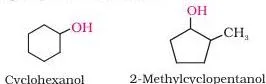
- Alcohols: change the alkane ending to ‘ol’ (ethane → ethanol). Number the longest chain from the end nearest the –OH group so the hydroxyl carbon gets the lowest locant. Polyhydric alcohols keep the ‘e’ and add di-, tri- before ‘ol’: ethane-1,2-diol, propane-1,2,3-triol. Cyclic alcohols take the prefix cyclo- with the –OH carbon as C-1 (NCERT, p. 195).
- Phenols: the parent is phenol. Use ortho/meta/para, or 1,2-/1,3-/1,4- locants, for substituent positions. Dihydroxy derivatives are benzenediols — catechol, resorcinol and hydroquinone (NCERT, p. 196).
- Ethers: common names list the two groups alphabetically, then add ‘ether’ (ethylmethyl ether; dimethyl ether for identical groups). IUPAC names take the larger group as the parent hydrocarbon and name the smaller group as an –oxy prefix: methoxymethane, 1-methoxypropane, ethoxybenzene (NCERT, p. 197).
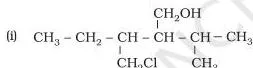
Try one of each before moving on. Name \( \text{CH}_3\text{CH(OH)CH}_2\text{CH(CH}_3\text{)CH}_3 \): the longest chain containing –OH has five carbons, OH sits at C-2, and the methyl branch is at C-4 → 4-methylpentan-2-ol.
Name \( \text{CH}_3\text{CH}_2\text{OCH}_2\text{CH}_2\text{CH}_3 \): the larger group is propyl, so the ethoxy group sits at C-1 → 1-ethoxypropane. Now draw 3-methylbutan-1-ol from the name: \( \text{HOCH}_2\text{CH}_2\text{CH(CH}_3\text{)CH}_3 \).
Tables 7.1 and 7.2 in the book are the complete reference sets for these names (NCERT, pp. 196–197).
Structures and Bonding in the Functional Groups
The bond data in this unit do real work: they explain why phenol is the acidic member of the family. The structures figure (Fig. 7.1) carries the numbers (NCERT, p. 198).
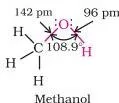
- Alcohols: the C–O bond is a sigma bond between sp³ carbon and sp³ oxygen. The C–O–H bond angle is slightly less than the tetrahedral \(109^\circ 28’\), because oxygen’s lone pairs repel the bond pairs (NCERT, p. 198).
- Phenols: –OH is attached to an sp² ring carbon. The C–O bond is 136 pm, shorter than methanol’s 141 pm, because the oxygen lone pair conjugates with the ring (partial double-bond character) and the sp² carbon withdraws electron density (NCERT, p. 198). A more polar O–H bond releases H⁺ more easily — that is the seed of the acidity argument in Section 7.4.4.
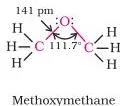
- Ethers: two bond pairs and two lone pairs sit in an approximate tetrahedron. The C–O–C bond angle is slightly greater than tetrahedral because the two alkyl groups repel each other; the C–O bond stays near 141 pm (NCERT, p. 198).
Read the figure alongside this section — it is walked through in detail below.
Preparation of Alcohols: Five Routes and When Each Is Used
All five routes build the C–OH bond, but each leaves the –OH on a different carbon. Choose the route by the alcohol you want.
- Acid-catalysed hydration of alkenes — alkene + H₂O with H⁺ gives an alcohol by Markovnikov addition: the –OH lands on the more substituted carbon. The mechanism runs in three steps — protonation of the double bond to a carbocation, nucleophilic attack by water, then deprotonation (NCERT, p. 199).
- Hydroboration-oxidation — diborane (B₂H₆) adds to the alkene to give a trialkyl borane; oxidation with H₂O₂ in aqueous NaOH replaces B with –OH. Boron attaches to the sp² carbon carrying more hydrogen atoms, so the overall addition is anti-Markovnikov: the –OH lands on the less substituted carbon. The yield is excellent and no carbocation forms, so no rearrangement occurs (NCERT, pp. 199–200). H.C. Brown first reported the reaction in 1959 and shared the 1979 Nobel Prize in Chemistry with G. Wittig.
- Reduction of aldehydes and ketones — catalytic hydrogenation (H₂ with Pt, Pd or Ni) or NaBH₄/LiAlH₄. Aldehydes give primary alcohols; ketones give secondary (NCERT, p. 200).
- Reduction of carboxylic acids and esters — LiAlH₄ reduces both to primary alcohols. Because LiAlH₄ is expensive, industry converts the acid to its ester first and hydrogenates that (NCERT, p. 200).
- Grignard reagents — RMgX adds to the carbonyl carbon to form an adduct, and hydrolysis gives the alcohol: methanal → primary, other aldehydes → secondary, ketones → tertiary (NCERT, p. 201).
Work these with new molecules before reading on.
Worked example 1.
Hydrate but-1-ene with water and a catalytic acid, then name the product.
Step 1.
But-1-ene is \( \text{CH}_3\text{CH}_2\text{CH}=\text{CH}_2 \).
Markovnikov addition puts the –OH on the more substituted carbon of the double bond, C-2.
\[ \text{CH}_3\text{CH}_2\text{CH}=\text{CH}_2 + \text{H}_2\text{O} \xrightarrow{\text{H}^+} \text{CH}_3\text{CH}_2\text{CH(OH)CH}_3 \]
Final answer: butan-2-ol, a secondary alcohol.
Worked example 2.
Subject the same alkene, but-1-ene, to hydroboration-oxidation and compare the product.
Step 1.
Borane adds so that boron attaches to the terminal carbon (the sp² carbon with more hydrogens); oxidation then replaces B with –OH at that carbon.
\[ \text{CH}_3\text{CH}_2\text{CH}=\text{CH}_2 \xrightarrow{(1)\ \text{B}_2\text{H}_6,\ (2)\ \text{H}_2\text{O}_2/\text{OH}^-} \text{CH}_3\text{CH}_2\text{CH}_2\text{CH}_2\text{OH} \]
Final answer: butan-1-ol, a primary alcohol — the anti-Markovnikov product (NCERT, p. 200).
Worked example 3.
Treat butan-2-one with ethylmagnesium bromide, then hydrolyse the adduct.
Step 1.
The Grignard reagent adds its ethyl group to the carbonyl carbon of \( \text{CH}_3\text{COCH}_2\text{CH}_3 \), forming an alkoxide adduct.
Step 2.
Hydrolysis with water converts the adduct to the alcohol, \( \text{CH}_3\text{C(OH)(C}_2\text{H}_5\text{)CH}_2\text{CH}_3 \).
Final answer: 3-methylpentan-3-ol, a tertiary alcohol — ketones give tertiary alcohols with Grignard reagents (NCERT, p. 201).
The two alkene routes must never be confused. This comparison table is the one to memorise.
| Feature | Acid-catalysed hydration | Hydroboration-oxidation |
|---|---|---|
| Reagents | H₂O with catalytic H⁺ (dilute acid) | B₂H₆ (diborane), then H₂O₂ in aqueous NaOH |
| Intermediate | Carbocation (can rearrange) | Trialkyl borane (no carbocation) |
| Regioselectivity | Markovnikov — –OH on the more substituted carbon | Anti-Markovnikov — –OH on the less substituted carbon |
| Alcohol from but-1-ene | Butan-2-ol (secondary) | Butan-1-ol (primary) |
| Notes | Rearrangement possible via carbocation | Excellent yield, no rearrangement (NCERT, pp. 199–200) |
Preparation of Phenols: Four Routes
All four routes start from a benzene derivative and exchange a group for –OH; the cumene route alone makes most of the world’s phenol.
| Route | Reagents and conditions | Note |
|---|---|---|
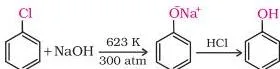
| From haloarenes | Chlorobenzene fused with NaOH at 623 K and 320 atm; acidify the sodium phenoxide | High temperature and pressure (NCERT, p. 202) |
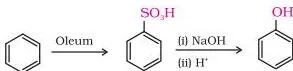
| From benzenesulphonic acid | Benzene + oleum → benzenesulphonic acid; fuse with molten NaOH; acidify | Laboratory route in two steps (NCERT, p. 202) |
| From diazonium salts | Aromatic primary amine + NaNO₂/HCl at 273–278 K → diazonium salt; warm with water or dilute acid | Starts from amines (NCERT, p. 202) |
| From cumene | Cumene (isopropylbenzene) + air → cumene hydroperoxide; dilute acid → phenol + acetone | Industrial route; acetone is the by-product (NCERT, p. 202) |
Physical Properties: Boiling Points and Solubility
Two ideas explain nearly every property question in this unit: hydrogen bonding between –OH groups, and hydrogen bonding between –OH and water (NCERT, p. 203).
- Boiling points: alcohols and phenols boil far higher than ethers, hydrocarbons and haloalkanes of comparable mass, because only the –OH compounds form intermolecular hydrogen bonds. The book’s own trio: ethanol (mass 46, b.p. 351 K), methoxymethane (46, 248 K), propane (44, 231 K) (NCERT, p. 203).
- Branching: more branching lowers the boiling point, because a smaller surface area means weaker van der Waals forces (NCERT, p. 203).
- Solubility: –OH hydrogen-bonds with water, so small alcohols and phenols dissolve well — many lower alcohols are miscible with water in all proportions. Solubility falls as the alkyl or aryl group grows because the hydrophobic part takes over (NCERT, p. 204).
Example 7.3 in the book exercises exactly this reasoning (NCERT, p. 204): part (a) runs methanol → ethanol → propan-1-ol → butan-2-ol → butan-1-ol → pentan-1-ol, and part (b) runs n-butane → ethoxyethane → pentanal → pentan-1-ol.
Acidity of Alcohols and Phenols
Acidity is the unit’s central idea: why phenol, and not an alcohol, dissolves in aqueous NaOH. The evidence comes first — alcohols and phenols react with Na, K and Al to give alkoxides or phenoxides plus H₂, and phenol alone also reacts with aqueous NaOH (NCERT, p. 205).
- Brønsted acids: R–OH donates a proton to a stronger base (NCERT, p. 205).
- Alcohols are weaker acids than water: an alkoxide pulls a proton off water, which is why alkoxides are stronger bases than hydroxide. Among alcohols the order is 1° > 2° > 3°, because electron-releasing alkyl groups reduce the polarity of the O–H bond (NCERT, p. 205).
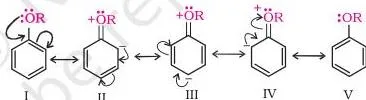
- Why phenols win: the sp² ring carbon withdraws electron density, polarising O–H, and the phenoxide ion spreads its negative charge across the ring through resonance (structures I–V), while the alkoxide ion keeps the charge on one oxygen. Delocalisation stabilises phenoxide and favours ionisation of phenol (NCERT, p. 206).
- Substituent effects: electron-withdrawing groups such as –NO₂ raise acidity, most strongly at ortho and para positions, where the phenoxide charge delocalises effectively; electron-releasing alkyl groups lower it, so cresols are weaker acids than phenol (NCERT, pp. 206–207).
Table 7.3 is the complete pKa ladder (NCERT, p. 207). Remember: the lower the pKa, the stronger the acid.
| Compound | pKa | What it tells you |
|---|---|---|
| p-Nitrophenol | 7.1 | Strongest of the listed phenols — –NO₂ at para withdraws best |
| o-Nitrophenol | 7.2 | Nitro at ortho almost as effective |
| m-Nitrophenol | 8.3 | Meta position cannot delocalise the charge as well |
| Phenol | 10.0 | The reference acid of the family |
| m-Cresol / o- / p-Cresol | 10.1 / 10.2 / 10.2 | Alkyl groups release electrons and weaken the acid |
| Ethanol | 15.9 | Far weaker — phenol is about a million times more acidic (NCERT, p. 207) |
Reactions of Alcohols: Halides, Dehydration, Oxidation
Alcohols react in three families, and each family has a signature product or test you can predict.
- C–O cleavage with HX: alcohols give alkyl halides with hydrogen halides. The Lucas test (conc. HCl + ZnCl₂) separates the classes: tertiary alcohols turn turbid immediately, secondary slowly, primary not at room temperature (NCERT, p. 208). Memory hook: Turbid = Tertiary.
- Phosphorus tribromide converts alcohols to alkyl bromides (NCERT, p. 208).
- Dehydration: protic acids (conc. H₂SO₄ or H₃PO₄) remove water to form alkenes. Ethanol with conc. H₂SO₄ at 443 K gives ethene. Ease of dehydration runs 3° > 2° > 1° because the carbocation intermediate is stabilised in that order. Mechanism: protonation of –OH, slow loss of water to give the carbocation, then loss of a proton (NCERT, p. 208).
- Oxidation: primary alcohols give aldehydes with mild agents (PCC, or CrO₃ in anhydrous medium) and carboxylic acids with acidified KMnO₄; secondary alcohols give ketones with CrO₃; tertiary alcohols resist oxidation — under strong conditions their C–C bonds cleave to a mixture of smaller carboxylic acids (NCERT, p. 209). Passing 1° or 2° alcohol vapours over hot copper at 573 K gives the same carbonyl products by dehydrogenation.
Rule of thumb for oxidation: primary → aldehyde → carboxylic acid; secondary → ketone; tertiary → no reaction. The body carries out the same chemistry — methanol is oxidised to methanal and then methanoic acid, which can cause blindness and death. That is why denatured alcohol is dangerous.
Reactions of Phenols: Ring Substitution and Beyond
Phenol’s ring is the reactive site here: the –OH group activates it and sends incoming electrophiles to the ortho and para positions (NCERT, p. 210).
- Nitration: dilute HNO₃ at 298 K gives o- and p-nitrophenol, separable by steam distillation; concentrated HNO₃ gives 2,4,6-trinitrophenol (picric acid) in poor yield — better prepared through phenol-2,4-disulphonic acid (NCERT, p. 211).
- Halogenation — the condition trap: bromine water gives 2,4,6-tribromophenol, a white precipitate; bromine in CS₂ or CHCl₃ at low temperature gives monobromophenols. No Lewis acid is needed, because the –OH group polarises the bromine molecule (NCERT, p. 211).
- Kolbe’s reaction: the phenoxide ion from phenol + NaOH is so reactive that it undergoes electrophilic substitution even with CO₂, a weak electrophile, giving o-hydroxybenzoic acid (NCERT, p. 212).
- Reimer–Tiemann reaction: phenol + CHCl₃ + NaOH introduces –CHO at the ortho position; the substituted benzal chloride intermediate hydrolyses to salicylaldehyde (NCERT, p. 213).
- Zinc dust: heating phenol with zinc dust removes oxygen and gives benzene (NCERT, p. 213).
- Oxidation: chromic acid oxidises phenol to benzoquinone, a conjugated diketone; air slowly gives dark mixtures of quinones (NCERT, p. 213).
Ethers: Preparation, Properties and Reactions
Ethers are the least reactive of the three classes — their chemistry is two preparations, one cleavage and one ring reaction (NCERT, p. 217).
- Preparation by dehydration of alcohols: ethanol with conc. H₂SO₄ at 413 K gives ethoxyethane, while 443 K gives ethene. The ether forms by SN2 attack of an unprotonated alcohol molecule on a protonated alcohol. The method suits only primary, unhindered alcohols — secondary and tertiary alcohols eliminate instead. It also cannot make ethyl methyl ether: bimolecular dehydration needs a pair of identical alcohol molecules, and with two different alcohols you get a mixture of three ethers (NCERT, p. 215).
- Williamson synthesis: an alkoxide ion reacts with a primary alkyl halide by SN2 to give the ether; it works for symmetrical and unsymmetrical ethers, and for phenols through the phenoxide ion. With a tertiary alkyl halide it fails — the alkoxide acts as a base and elimination gives an alkene only: sodium methoxide with tert-butyl bromide gives exclusively 2-methylpropene (NCERT, pp. 215–216).
- Physical properties: the C–O bonds are polar, so ethers have a dipole moment, yet boiling points sit near those of alkanes — n-pentane 309.1 K, ethoxyethane 307.6 K, butan-1-ol 390 K — because ethers cannot hydrogen-bond to each other. Solubility in water resembles that of same-mass alcohols: ethoxyethane dissolves 7.5 g per 100 mL water, butan-1-ol 9 g (NCERT, p. 217).
- Cleavage with HI or HBr: the ether is protonated, then iodide attacks the less substituted carbon by SN2; reactivity runs HI > HBr > HCl. With a tertiary group the cleavage is SN1 through a stable carbocation. Anisole cleaves at the O–CH₃ bond to give CH₃I and phenol, and phenol does not react further because its sp² carbon cannot undergo the needed nucleophilic substitution (NCERT, pp. 217–218).
- Electrophilic substitution of anisole: the alkoxy group activates the ring and directs ortho/para — bromination in ethanoic acid gives the para isomer in 90% yield, Friedel–Crafts alkylation and acylation both work, and nitration gives o- and p-nitroanisole (NCERT, p. 219).
Worked example 4.
Heat 1-ethoxypropane, \( \text{CH}_3\text{CH}_2\text{OCH}_2\text{CH}_2\text{CH}_3 \), with concentrated HI.
Step 1.
The ether is protonated, then iodide attacks the less substituted (ethyl) carbon by SN2 — the lower alkyl group forms the alkyl iodide (NCERT, p. 217).
\[ \text{CH}_3\text{CH}_2\text{OCH}_2\text{CH}_2\text{CH}_3 + \text{HI} \rightarrow \text{CH}_3\text{CH}_2\text{I} + \text{CH}_3\text{CH}_2\text{CH}_2\text{OH} \]
Step 2.
With excess HI, the freshly formed propan-1-ol reacts further to give a second iodide.
\[ \text{CH}_3\text{CH}_2\text{CH}_2\text{OH} + \text{HI} \rightarrow \text{CH}_3\text{CH}_2\text{CH}_2\text{I} + \text{H}_2\text{O} \]
Final answer: iodoethane and 1-iodopropane (NCERT, p. 217).
Key Diagrams in This Chapter, Read Line by Line

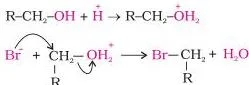
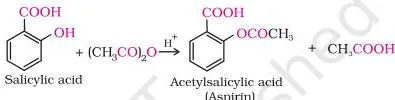
NCERT prints few figures in this unit, and each one carries an argument rather than decoration. The eight below are the ones to read carefully — each caption tells you what to look at and what it proves.
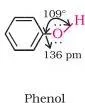
Fig. 7.1 is the unit’s data sheet.
It draws the three functional groups side by side so you can compare the numbers printed under them: in methanol the C–O–H angle is squeezed slightly below the tetrahedral \(109^\circ 28’\) because oxygen’s lone pairs repel the bond pairs; in phenol the C–O bond is 136 pm, shorter than methanol’s 141 pm, because the oxygen lone pair is partly shared with the ring and the carbon is sp²; in methoxymethane the two methyl groups push the bond angle a little past tetrahedral while the C–O bond stays near 141 pm.
Those three numbers drive the whole acidity argument that follows (NCERT, p. 198).
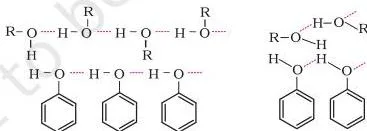
This hydrogen-bonding figure explains the boiling-point data of the chapter: neighbouring –OH groups link through O–H···O bridges that must be broken before the liquid boils. That is why ethanol (351 K) boils far above methoxymethane (248 K) and propane (231 K) of nearly the same mass — ethers and hydrocarbons simply cannot form these intermolecular bonds (NCERT, p. 203).
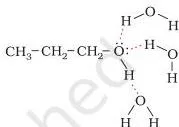
The same hydrogen bonding explains solubility. The diagram shows an alcohol’s –OH oxygen forming hydrogen bonds with water molecules, which is why small alcohols mix with water in all proportions. As the alkyl group grows, the hydrophobic chain outweighs the –OH group and solubility falls (NCERT, p. 204).
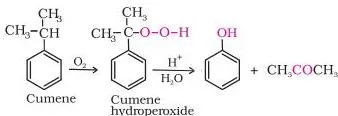
The cumene scheme is the industrial heart of the chapter. Read it as two steps — cumene (isopropylbenzene) is oxidised by air to cumene hydroperoxide, and dilute acid converts that to phenol plus acetone.
The figure makes the by-product visible, which is why students remember that the cumene route also produces acetone in large quantities; most of the world’s phenol comes from this method (NCERT, p. 202).
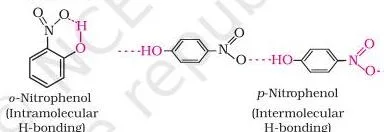
This figure shows why steam distillation separates the nitration products. In o-nitrophenol the –OH hydrogen-bonds intramolecularly to the nearby nitro group, so each molecule remains an independent volatile unit. In p-nitrophenol the –OH groups hydrogen-bond intermolecularly, associating molecules into larger, less volatile clusters. The picture is worth the whole explanation (NCERT, p. 211).

The Reimer–Tiemann scheme is usually remembered as ‘phenol + CHCl₃/NaOH gives salicylaldehyde’, and this figure supplies the step summaries often skip: chloroform with alkali generates the electrophile that attaches at the ortho position, forming a substituted benzal chloride, which then hydrolyses to the aldehyde. Write the intermediate, then the product, and the reaction is complete (NCERT, p. 213).
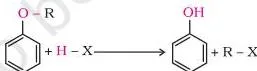
This diagram answers the anisole cleavage question before it is asked. The arrow breaks the alkyl–oxygen bond, not the aryl–oxygen bond, because the aryl–O bond carries partial double-bond character from conjugation with the ring. So anisole with HI gives methyl iodide and phenol, and the phenol stays untouched by further HI (NCERT, pp. 217–218).
The last figure shows the alkoxy group at work: resonance pushes electron density into the ring, making the ortho and para positions electron-rich and therefore the targets of an incoming electrophile. This is why anisole brominates without an iron catalyst and why nitration gives o- and p-nitroanisole — the same directing logic as phenol, and the same figure logic (NCERT, p. 219).
Key Terms and Definitions
A quick glossary for decoding the unit’s vocabulary. Each term is defined in one or two lines with the page where the book introduces it.
| Term | Meaning | NCERT page |
|---|---|---|
| Alcohol | Compound with one or more –OH groups on aliphatic carbon atoms, e.g. CH₃OH | 193 |
| Phenol | Compound with –OH directly attached to an aromatic ring carbon, e.g. C₆H₅OH | 193 |
| Ether | Compound with an oxygen bonded to two alkyl or aryl groups, R–O–R′ | 193 |
| Mono-/di-/tri-/polyhydric | Carrying one, two, three or many –OH groups | 194 |
| Primary / secondary / tertiary alcohol | –OH carbon bonded to one, two or three other carbons | 194 |
| Allylic alcohol | –OH on an sp³ carbon adjacent to a carbon–carbon double bond | 194 |
| Benzylic alcohol | –OH on an sp³ carbon next to an aromatic ring | 194 |
| Vinylic alcohol | –OH bonded directly to a double-bond carbon (sp²) | 194 |
| Symmetrical / unsymmetrical ether | Same groups on oxygen, or two different groups | 195 |
| Hydroboration-oxidation | Alkene + B₂H₆, then H₂O₂/OH⁻, giving an anti-Markovnikov alcohol | 200 |
| Grignard reagent | RMgX; adds to carbonyls to give primary, secondary or tertiary alcohols | 201 |
| Lucas reagent | Conc. HCl + ZnCl₂; distinguishes 1°, 2° and 3° alcohols by turbidity | 208 |
| Esterification | Alcohol or phenol + carboxylic acid / acid chloride / anhydride → ester | 207 |
| Acetylation | Introducing the acetyl (CH₃CO) group; acetylation of salicylic acid gives aspirin | 207 |
| Dehydration | Removal of water from an alcohol to give an alkene (or an ether) | 208 |
| Fermentation | Zymase converts glucose to ethanol and CO₂ in anaerobic conditions | 214 |
| Denaturation | Making alcohol unfit to drink by adding copper sulphate and pyridine | 214 |
| Williamson synthesis | Alkoxide + primary alkyl halide → ether by SN2 | 215 |
| Kolbe’s reaction | Sodium phenoxide + CO₂ → o-hydroxybenzoic acid | 212 |
| Reimer–Tiemann reaction | Phenol + CHCl₃ + NaOH → salicylaldehyde (–CHO at ortho) | 213 |
| Picric acid | 2,4,6-Trinitrophenol | 211 |
| Salicylaldehyde | o-Hydroxybenzaldehyde, the Reimer–Tiemann product | 213 |
| Benzoquinone | Conjugated diketone from chromic-acid oxidation of phenol | 213 |
| Cumene | Isopropylbenzene, the industrial raw material for phenol | 202 |
Common Mistakes Students Make in This Chapter
These are the errors the chapter itself warns against, in the order students actually make them. Each row gives the wrong idea, the correction and a quick way to check your answer.
| Mistake | Correct rule | How to check your answer |
|---|---|---|
| Numbering the carbon chain from the wrong end | Number from the end nearest the –OH group so the hydroxyl carbon gets the lowest locant (NCERT, p. 195) | 4-Methylpentan-2-ol: the OH carbon is C-2, never C-4 |
| Expecting hydration and hydroboration-oxidation of the same alkene to give the same alcohol | Hydration is Markovnikov (–OH on the more substituted carbon); hydroboration-oxidation is anti-Markovnikov (–OH on the less substituted carbon) (NCERT, pp. 199–200) | But-1-ene gives butan-2-ol by hydration, butan-1-ol by hydroboration-oxidation |
| Using a tertiary alkyl halide in Williamson synthesis | Elimination competes: you get an alkene, not an ether (NCERT, p. 216) | Sodium methoxide + tert-butyl bromide gives only 2-methylpropene |
| Mixing up ethanol’s two dehydration temperatures | 413 K → ethoxyethane; 443 K → ethene (NCERT, p. 215) | Higher temperature favours elimination — the alkene wins at 443 K |
| Expecting turbidity from a primary alcohol in the Lucas test at room temperature | Only tertiary alcohols give immediate turbidity; primary alcohols do not react at room temperature (NCERT, p. 208) | Butan-1-ol stays clear; 2-methylpropan-2-ol clouds instantly |
| Writing 2,4,6-tribromophenol for bromine in CS₂ | Bromine water gives 2,4,6-tribromophenol; CS₂ or CHCl₃ at low temperature gives monobromophenols (NCERT, p. 211) | Read the solvent and temperature before writing the product |
| Claiming tertiary alcohols oxidise normally | Tertiary alcohols resist oxidation; strong oxidants cleave C–C bonds into a mixture of smaller acids (NCERT, p. 209) | No hydrogen on the OH carbon means no normal oxidation is possible |
| Forgetting that excess HI converts the alcohol product to a second alkyl iodide | With excess HI, both alkyl groups of an ether end up as iodides (NCERT, p. 217) | 1-Ethoxypropane + excess HI → iodoethane + 1-iodopropane |
The book plants two further traps worth knowing: it asks you to explain why bimolecular dehydration cannot make ethyl methyl ether (NCERT, p. 215), and Exercise 7.33 shows a hydride shift rearranging a secondary carbocation to a tertiary one before the halide forms (NCERT, p. 224). Both are exactly the kind of reasoning the chapter wants you to practise.
Exam Notes: How the Chapter’s Questions Are Built
The chapter’s exercises fall into four skill clusters. Practise deliberately by cluster, and a full answer needs the ingredients listed in the last column.
| Skill cluster | Exercise numbers | What a full answer must include |
|---|---|---|
| Nomenclature and structure drawing | 7.1, 7.2, 7.3, 7.7, 7.23 | Correct parent chain, locants for every substituent, correct IUPAC ending |
| Mechanisms | 7.11, 7.19, 7.26, 7.30, 7.33 | Steps in order — protonation, intermediate, deprotonation — with the intermediate named |
| Conversions and synthesis design | 7.9, 7.10, 7.13, 7.17, 7.20, 7.24, 7.32 | Balanced equations with reagents and conditions written on the arrow |
| Property reasoning and comparisons | 7.4, 7.5, 7.8, 7.14, 7.15, 7.16, 7.22, 7.27, 7.29 | State the principle (hydrogen bonding, resonance, inductive effect), then apply it |
The remaining questions — 7.6, 7.12, 7.18, 7.21, 7.25, 7.28 and 7.31 — test definitions, reagent recall and writing named reactions, so they reward knowing the glossary table above. The chapter’s own Summary (NCERT, p. 221) is the book’s official list of what matters, and it is a reliable revision checklist.
One honest caution: textbook contents and the examinable syllabus are not always identical, so check the current official CBSE syllabus for what carries weight this session.
The Chapter in Brief
A last-minute recap, rebuilt from the chapter’s own Summary in plainer words (NCERT, p. 221).
- Classification: by number of –OH groups (mono-, di-, tri-, polyhydric) and by the carbon bearing –OH (1°, 2°, 3°, allylic, benzylic, vinylic); ethers are simple or mixed by their two groups.
- Alcohols come from hydration of alkenes (Markovnikov), hydroboration-oxidation (anti-Markovnikov), reduction of carbonyl compounds, acids and esters, and from Grignard reagents.
- Phenols come from haloarenes, benzenesulphonic acid, diazonium salts, and industrially from cumene.
- Boiling points and solubility both run on hydrogen bonding; branching lowers boiling points, and large hydrophobic groups cut solubility.
- Acidity: electron-withdrawing groups raise it (most at ortho/para), electron-releasing groups lower it; phenol is about a million times more acidic than ethanol.
- Alcohol reactions: HX and the Lucas test, PBr₃, dehydration to alkenes (3° > 2° > 1°), and the oxidation ladder — 1° to aldehyde to acid, 2° to ketone, 3° resistant.
- Phenol reactions: the –OH group activates the ring and directs ortho/para — nitration, bromination (condition-dependent), Kolbe’s reaction, Reimer–Tiemann; zinc dust gives benzene; chromic acid gives benzoquinone.
- Ethers: made by acid dehydration (413 K) and Williamson synthesis; boiling points like alkanes, solubility like alcohols; cleaved by HI; the alkoxy group directs ortho/para.
- Commercially: methanol from CO + H₂; ethanol by fermentation; denaturation makes alcohol unfit to drink.
The reaction map below is the fastest way to test yourself on the preparations.
| Starting material | Reagents (and conditions) | Product |
|---|---|---|
| Alkene | H₂O, catalytic H⁺ | Alcohol (Markovnikov) |
| Alkene | B₂H₆, then H₂O₂/NaOH | Primary alcohol (anti-Markovnikov) |
| Aldehyde | H₂/Pd or NaBH₄ | Primary alcohol |
| Ketone | H₂/Pd or NaBH₄ | Secondary alcohol |
| Methanal + RMgX | then H₂O | Primary alcohol |
| Other aldehyde + R′MgX | then H₂O | Secondary alcohol |
| Ketone + R′MgX | then H₂O | Tertiary alcohol |
| Ethanol | conc. H₂SO₄, 413 K | Ethoxyethane |
| Ethanol | conc. H₂SO₄, 443 K | Ethene |
Related Resources
The unit that precedes this one is covered in the Haloalkanes and Haloarenes — Class 12 Chemistry Chapter 1 notes; the unit that follows, Aldehydes, Ketones and Carboxylic Acids, continues the same reaction logic in the next chapter of the book.
For the whole book, see the NCERT Class 12 Chemistry book page, and for every subject at this level, the Class 12 NCERT books hub. Notes for other classes live in the CBSE notes index, and when your revision moves to physical chemistry, the Chemical Kinetics notes are the natural next stop.
Reference: NCERT Class 12 Chemistry textbook, chapter 2, official edition on ncert.nic.in.
The official chapter files, including the complete Class 12 Chemistry Part II PDF, are published by NCERT on its textbook portal.
Sources and Data Verification
- What the figures describe: the figure captions, page numbers and section names on this page come from the NCERT Class 12 Chemistry Part II textbook, Unit 7, Alcohols, Phenols and Ethers, in the edition republished for the academic session stated at the top of this page.
- What this page covers: this page treats this one chapter only — not the rest of Chemistry Part II, not Chemistry Part I, and not any reference book.
- Who settles what: NCERT settles textbook editions, chapter contents and the official PDFs; CBSE settles the curriculum, syllabus and examinations. A chapter appearing in a textbook does not by itself prove what is examinable this session — that is set by the current official syllabus.
Frequently Asked Questions
Why is phenol a stronger acid than ethanol?
Because its conjugate base is far more stable. When phenol loses H⁺, the phenoxide ion spreads the negative charge around the ring by resonance (structures I–V in the book), while the ethoxide ion holds the charge on one oxygen; the sp² ring carbon also withdraws electron density, polarising the O–H bond.
The pKa values make the gap concrete: phenol 10.0 and ethanol 15.9 — roughly a million-fold difference (NCERT, pp. 206–207).
What is the difference between acid catalysed hydration and hydroboration oxidation of an alkene?
The two methods give opposite regiochemistry. Acid-catalysed hydration goes through a carbocation and follows Markovnikov’s rule — the –OH lands on the more substituted carbon (propene → propan-2-ol). Hydroboration-oxidation adds borane as a trialkyl borane with no carbocation, so the –OH lands on the less substituted carbon — anti-Markovnikov (propene → propan-1-ol), in excellent yield and without rearrangement (NCERT, pp. 199–200).
Why does Williamson synthesis fail with a tertiary alkyl halide?
Because the alkoxide is a strong base as well as a nucleophile. With a tertiary alkyl halide, elimination outcompetes substitution: sodium methoxide with tert-butyl bromide gives exclusively 2-methylpropene and no ether (NCERT, p. 216). To prepare a tert-alkyl ether, reverse the partners — a tertiary alkoxide with a primary alkyl halide, as shown in Example 7.6.
What happens when anisole is heated with hydrogen iodide?
Methyl iodide and phenol form. HI protonates the ether oxygen, then iodide attacks the O–CH₃ bond, which is the weaker bond because the aryl–oxygen bond has partial double-bond character from conjugation with the ring. Phenol does not react further with HI (NCERT, pp. 217–218).
Why is ortho nitrophenol steam volatile but para nitrophenol is not?
Because of where each molecule’s hydrogen bond points. In o-nitrophenol, –OH hydrogen-bonds intramolecularly to the nearby nitro group, so the molecule stays a single volatile unit. In p-nitrophenol, –OH groups hydrogen-bond intermolecularly between molecules, associating them into larger, less volatile clusters — which is exactly why steam distillation separates the two isomers (NCERT, p. 211).
How is phenol prepared from cumene?
Cumene (isopropylbenzene) is oxidised by air to cumene hydroperoxide, and treating that with dilute acid gives phenol plus acetone, which is recovered as a valuable by-product. This is the main industrial route — the book notes that most of the worldwide production of phenol comes from cumene (NCERT, p. 202).
Explore Class 12 Chemistry Books
- Previous: Haloalkanes and Haloarenes
- Next: Aldehydes, Ketones and Carboxylic Acids
Class 12 Chemistry on LearnCBSE:
Related chapters: