
Need aldehydes ketones and carboxylic acids class 12 notes that hold together the night before the exam? This page condenses Chapter 8 of the NCERT Chemistry Part II textbook into a revision-ready sequence — carbonyl group structure, IUPAC naming, eleven name reactions, the three distinguishing tests, and the carboxylic acid acidity ladder.
The notes follow the order a teacher builds ideas in, not the textbook’s section order. You start with the carbonyl group, move through nomenclature, preparation, reactions and tests, then the full acids half. Worked examples use original compounds so you practise the pattern, never a memorised answer. NCERT page numbers are cited inline for every key idea.
The Carbonyl Group: Why These Three Families Sit Together
Everything in this chapter flows from one functional group: the carbon-oxygen double bond, \( C=O \), called the carbonyl group. It is one of the most important functional groups in organic chemistry, found in fabrics, flavourings, plastics and drugs (NCERT, p. 228).
The carbonyl carbon is \( sp^2 \)-hybridised and forms three sigma bonds. The fourth valence electron sits in a p-orbital and overlaps with an oxygen p-orbital to make a pi bond.
So the carbonyl carbon and the three atoms attached to it lie in one plane, with the pi-electron cloud above and below that plane; bond angles are about \( 120^\circ \) (NCERT, p. 231).

Because oxygen is more electronegative, the double bond is polarised: the carbonyl carbon becomes an electrophilic (Lewis acid) centre and the carbonyl oxygen a nucleophilic (Lewis base) centre. This polarity is explained by resonance between a neutral form (A) and a dipolar form (B) that carries a positive charge on carbon and a negative charge on oxygen.

What sits next to the \( C=O \) decides the family:
| Family | Attached to \( C=O \) | General form | Example |
|---|---|---|---|
| Aldehyde | One carbon and one hydrogen | \( RCHO \) | Ethanal, \( CH_3CHO \) |
| Ketone | Two carbon atoms | \( R_2C=O \) | Propanone, \( CH_3COCH_3 \) |
| Carboxylic acid | Carbon/hydrogen and \( OH \) | \( RCOOH \) | Ethanoic acid, \( CH_3COOH \) |
These molecules are widespread in plants and animals and add flavour and fragrance to nature — vanillin (vanilla beans), salicylaldehyde (meadow sweet) and cinnamaldehyde (cinnamon). Acetone is a common industrial solvent, and many members are used to prepare adhesives, paints, resins and perfumes (NCERT, p. 228).
Key Terms of Carbonyl Chemistry: A Quick Lookup
This is your one-mark definition bank. Each term below is defined the way a markscheme expects, with a one-line reaction example (NCERT, pp. 237–238, 245, 253).
| Term | Meaning | Example |
|---|---|---|
| Carbonyl group | The polar \( C=O \) double bond; carbon is electrophilic, oxygen nucleophilic. | Present in ethanal \( CH_3CHO \). |
| Cyanohydrin | Product of HCN addition to a carbonyl compound, \( RCH(OH)CN \). | \( CH_3CHO + HCN \rightarrow CH_3CH(OH)CN \). |
| Hemiacetal | One-equivalent alcohol addition product on an aldehyde, carrying both \( OH \) and \( OR \). | Ethanal + \( CH_3OH \) (dry HCl). |
| Acetal | gem-Dialkoxy compound from two alcohol molecules adding to an aldehyde. | Ethanal + 2 \( CH_3OH \). |
| Ketal | The ketone analogue of an acetal; cyclic ketals form with ethylene glycol. | Cyclohexanone + ethylene glycol. |
| Imine | Carbonyl derivative with \( \gt C=NH \), from ammonia. | Acetone + \( NH_3 \). |
| Schiff’s base | Substituted imine, \( \gt C=NR \), from a primary amine. | Benzaldehyde + aniline. |
| Oxime | Carbonyl derivative \( \gt C=N-OH \) from hydroxylamine. | Cyclopropanone + \( NH_2OH \). |
| Hydrazone | Derivative \( \gt C=N-NH_2 \) from hydrazine. | Propanal + \( NH_2NH_2 \). |
| Phenylhydrazone | Derivative \( \gt C=N-NH-C_6H_5 \) from phenylhydrazine. | Acetone + \( C_6H_5NHNH_2 \). |
| 2,4-DNP derivative | Hydrazone from 2,4-dinitrophenylhydrazine; yellow, orange or red solid used for characterisation. | Benzaldehyde + 2,4-DNP reagent. |
| Semicarbazone | Derivative \( \gt C=N-NH-CO-NH_2 \) from semicarbazide. | Cyclobutanone + semicarbazide. |
| Aldol | β-Hydroxy aldehyde (or ketol for ketones) from dilute-alkali coupling. | Ethanal \( \xrightarrow{dil. NaOH} \) 3-hydroxybutanal. |
| Carboxyl group | \( -COOH \): a carbonyl attached to a hydroxyl, hence the name carboxyl. | Acetic acid \( CH_3COOH \). |
| Decarboxylation | Loss of \( CO_2 \) from a carboxylic acid (usually its sodium salt) to give a hydrocarbon. | \( CH_3COONa \xrightarrow{NaOH/CaO} CH_4 \). |
Nomenclature: Common and IUPAC Names
Two naming systems run through this chapter, and examiners ask for both. Learn the rules below and the conversion table that follows (NCERT, pp. 229–230, 244).
- Common names of aldehydes: take the acid’s common name and replace -ic acid with -aldehyde (formic → formaldehyde, acetic → acetaldehyde). Positions use Greek letters \( \alpha \), \( \beta \), \( \gamma \), \( \delta \), with \( \alpha \)-carbon directly attached to the \( CHO \).
- Common names of ketones: name the two alkyl or aryl groups attached to \( C=O \) (dimethyl ketone = acetone); alkyl phenyl ketones add the acyl prefix to -phenone.
- IUPAC aldehydes: alkane ending -e → -al; number the chain from the aldehyde carbon; substituents appear alphabetically with locants.
- IUPAC ketones: -e → -one; number from the end nearer the carbonyl carbon.
- Cyclic aldehydes: add the suffix -carbaldehyde; benzene with \( CHO \) is benzenecarbaldehyde, though benzaldehyde is IUPAC-accepted.
| Structure | Common name | IUPAC name |
|---|---|---|
| \( HCHO \) | Formaldehyde | Methanal |
| \( CH_3CHO \) | Acetaldehyde | Ethanal |
| \( (CH_3)_2CHCHO \) | Isobutyraldehyde | 2-Methylpropanal |
| \( CH_3CH_2CH_2CH_2CHO \) | Valeraldehyde | Pentanal |
| \( CH_2=CHCHO \) | Acrolein | Prop-2-enal |
| \( m \)-Bromobenzaldehyde | — | 3-Bromobenzenecarbaldehyde |
| \( CH_3COCH_2CH_2CH_3 \) | Methyl n-propyl ketone | Pentan-2-one |
| \( (CH_3)_2CHCOCH(CH_3)_2 \) | Diisopropyl ketone | 2,4-Dimethylpentan-3-one |
For acids, IUPAC replaces -e with -oic acid and numbers the carboxyl carbon as one; poly acids use dicarboxylic/tricarboxylic endings (NCERT, p. 244). Memory hook: formic acid from Latin formica (ant), acetic from acetum (vinegar), butyric from butyrum (butter) — the names record where the acids were first found.
Physical Properties: Boiling Point and Solubility
The repeated exam question “arrange in order of increasing boiling point” is really one reasoning ladder. NCERT gives this ranking for compounds of molecular mass 58–60 (NCERT, p. 235):
| Compound | \( b.p. \) (K) | Molecular mass |
|---|---|---|
| \( n \)-Butane | 273 | 58 |
| Methoxyethane | 281 | 60 |
| Propanal | 322 | 58 |
| Acetone | 329 | 58 |
| Propan-1-ol | 370 | 60 |
Why this order? Three levels of intermolecular force operate. Alkanes rely only on weak van der Waals forces. Aldehydes, ketones and ethers add dipole-dipole interactions, and the carbonyl group makes aldehydes/ketones more polar than ethers. Alcohols — and even more so carboxylic acids — form intermolecular hydrogen bonds, which dominate.
- Hydrogen bonding (alcohols, acids) beats dipole-dipole (aldehydes, ketones, ethers) beats van der Waals (alkanes).
- Carboxylic acids boil higher than alcohols of similar mass because they associate even in the vapour phase, existing largely as dimers.
Solubility: the lower members (methanal, ethanal, propanone) are miscible with water in all proportions because they form hydrogen bonds with it. Solubility drops rapidly as the alkyl chain lengthens. All aldehydes and ketones dissolve in organic solvents like benzene, ether, methanol and chloroform.
Preparation of Aldehydes and Ketones: Method Table
“Name the reagent” transformation questions (Example 8.1 style) test exactly this table. Learn the method, the starting material and the one reagent that earns the mark (NCERT, pp. 231–234).
| Method | Starting material | Reagent and condition | Product |
|---|---|---|---|
| Oxidation of alcohols | 1° alcohol | PCC (for aldehydes) | Aldehyde |
| Oxidation of alcohols | 2° alcohol | Oxidising agent | Ketone |
| Dehydrogenation | Alcohol vapours | Ag or Cu catalyst, heat (industrial) | Aldehyde/ketone |
| Ozonolysis | Alkene | \( O_3 \) then Zn/\( H_2O \) | Aldehydes, ketones or both |
| Hydration of alkynes | Ethyne | \( H_2SO_4 \)/\( HgSO_4 \) | Ethanal |
| Hydration of alkynes | Other alkynes | \( H_2SO_4 \)/\( HgSO_4 \) | Ketones |
| Rosenmund reduction | Acyl chloride | \( H_2 \)/Pd-BaSO₄ (poisoned catalyst) | Aldehyde |
| Stephen reaction | Nitrile | \( SnCl_2 \)/HCl, then hydrolysis | Aldehyde |
| DIBAL-H reduction | Nitrile or ester | \( AlH(i-Bu)_2 \), then \( H_2O \) | Aldehyde |
| Etard reaction | Toluene | \( CrO_2Cl_2 \), then hydrolysis | Benzaldehyde |
| Chromic oxide route | Toluene | \( CrO_3 \) in acetic anhydride, then aqueous acid | Benzaldehyde |
| Side-chain chlorination | Toluene | \( Cl_2 \), then hydrolysis of benzal chloride | Benzaldehyde (commercial) |
| Gatterman-Koch | Benzene | \( CO \) + HCl, anhyd. \( AlCl_3 \)/\( CuCl \) | Benzaldehyde |
| Dialkylcadmium route | Acyl chloride + \( R_2Cd \) | From \( R-Mg-X \) + \( CdCl_2 \) | Ketone |
| Nitrile + Grignard | Nitrile | \( RMgX \) in ether, then hydrolysis | Ketone |
| Friedel-Crafts acylation | Benzene | Acyl chloride, anhyd. \( AlCl_3 \) | Aromatic ketone |
Etard, CrO₃/acetic anhydride, side-chain chlorination and Gatterman-Koch are aromatic-specific — they build benzaldehyde and its derivatives from toluene or benzene. Ozonolysis and alkyne hydration work on aliphatic starting materials.
Nucleophilic Addition: Mechanism and Reactivity
Alkenes undergo electrophilic addition; carbonyl compounds undergo the opposite — nucleophilic addition — because the polar \( C=O \) leaves carbon electron-poor. The mechanism (NCERT, p. 236):
- A nucleophile attacks the electrophilic carbonyl carbon from a direction roughly perpendicular to the \( sp^2 \) plane.
- The carbon changes hybridisation \( sp^2 \rightarrow sp^3 \).
- A tetrahedral alkoxide intermediate forms.
- The intermediate captures \( H^+ \) from the medium, giving the neutral addition product.

Reactivity order: aldehydes \( \gt \) ketones. Two reasons. Sterically, a ketone carries two fairly large alkyl groups that crowd the approaching nucleophile, while an aldehyde has only one. Electronically, two alkyl groups donate more electron density, lowering the electrophilicity of the carbonyl carbon.
Misconception autopsy — benzaldehyde vs propanal: although benzaldehyde is an aldehyde, it is less reactive than propanal in nucleophilic addition. Resonance with the aromatic ring delocalises the carbonyl pi-electrons, reducing the polarity of the \( C=O \) bond, so the carbonyl carbon is less electrophilic (NCERT, p. 236). This is why aromatic aldehydes behave differently from aliphatic ones in the tests below.
| Nucleophile | Product | Note |
|---|---|---|
| \( HCN \) | Cyanohydrin, \( RCH(OH)CN \) | Base-catalysed; useful synthetic intermediates |
| \( NaHSO_3 \) | Hydrogensulphite adduct | Equilibrium lies right for aldehydes; water-soluble, so used to separate/purify them |
| Grignard reagent \( RMgX \) | Alcohol (Unit 7) | Needs dry ether |
| Alcohols | Hemiacetal → acetal (ketals for ketones) | Dry HCl catalyst; cyclical with ethylene glycol |
| \( H_2N-Z \) | \( \gt C=N-Z \) derivatives | Acid-catalysed; dehydration of intermediate drives equilibrium |
The \( H_2N-Z \) row is Table 8.2: with Z = H you get an imine, Z = R a Schiff’s base, Z = OH an oxime, Z = \( NH_2 \) a hydrazone, Z = \( C_6H_5NH \) a phenylhydrazone, Z = 2,4-dinitrophenyl a 2,4-DNP derivative (yellow/orange/red solids for characterisation), and Z = \( NHCONH_2 \) a semicarbazone (NCERT, p. 237).
Reduction, Oxidation and the Three Distinguishing Tests
Reduction to alcohols: \( NaBH_4 \), \( LiAlH_4 \) or catalytic hydrogenation give 1° alcohols from aldehydes and 2° alcohols from ketones (NCERT, p. 238).
Reduction to hydrocarbons: the carbonyl group becomes a \( CH_2 \) group by Clemmensen reduction (zinc amalgam + concentrated HCl) or Wolff-Kishner reduction (hydrazine, then \( KOH \)/ethylene glycol, heat). Equations appear in the formula sheet below.
Oxidation: aldehydes oxidise easily even with mild agents such as Tollens’ and Fehling’s reagents. Ketones resist oxidation — they need vigorous conditions and strong oxidising agents, and the reaction breaks a C–C bond to give a mixture of smaller carboxylic acids (NCERT, p. 239). That difference is the basis of the three classic tests.
| Test | Reagent | Positive observation | Which compounds respond |
|---|---|---|---|
| Tollens’ | Ammoniacal \( AgNO_3 \) | Bright silver mirror | Aldehydes |
| Fehling’s | \( CuSO_4 \) + Rochelle salt (solutions A and B, equal amounts) | Red-brown \( Cu_2O \) precipitate | Aliphatic aldehydes; aromatic aldehydes like benzaldehyde do NOT |
| Iodoform | \( I_2 \) + \( NaOH \) (sodium hypoiodite) | Yellow \( CHI_3 \) precipitate | Methyl ketones and the \( CH_3CH(OH)- \) group; does not attack a C=C present |
In alkaline Tollens’ and Fehling’s, the product is the carboxylate anion \( RCOO^- \), not the free acid — a common error in equation-writing:
\[ RCHO + 2[Ag(NH_3)_2]^+ + 3OH^- \rightarrow RCOO^- + 2Ag \downarrow + 2H_2O + 4NH_3 \]
\[ RCHO + 2Cu^{2+} + 5OH^- \rightarrow RCOO^- + Cu_2O \downarrow + 3H_2O \]
Aldol Condensation, Cannizzaro and Aromatic Ring Substitution
Why are \( \alpha \)-hydrogens acidic? The carbonyl group strongly withdraws electron density, and the conjugate base (the enolate) is stabilised by resonance (NCERT, p. 241). That acidity drives the aldol reaction.
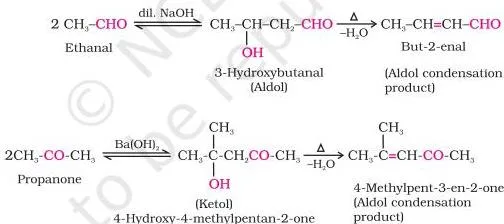
- Aldol reaction: aldehydes/ketones with at least one \( \alpha \)-hydrogen react in dilute alkali to give a \( \beta \)-hydroxy aldehyde (aldol) or \( \beta \)-hydroxy ketone (ketol).
- Aldol condensation: on heating, the aldol loses water to give an \( \alpha ,\beta \)-unsaturated carbonyl compound. The dehydration step is what makes it a condensation.
- Cross aldol: two different aldehydes and/or ketones, both with \( \alpha \)-H, give a mixture of four products. With ethanal + propanal, either partner can act as the nucleophile (enolate) adding to the other as electrophile, so all four combinations form.
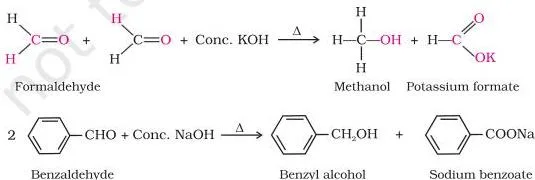
Cannizzaro reaction: aldehydes with no \( \alpha \)-hydrogen (formaldehyde, benzaldehyde) undergo self oxidation-reduction — a disproportionation — on heating with concentrated alkali. One molecule is reduced to the alcohol, the other oxidised to the carboxylic acid salt (NCERT, p. 242).
Aromatic ring substitution: aromatic aldehydes and ketones undergo electrophilic substitution in which \( -CHO \) / \( -COR \) acts as a deactivating and meta-directing group (NCERT, p. 242).
Carboxylic Acids: Structure, Nomenclature and Acidity
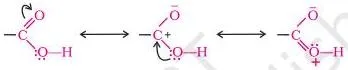
A carboxyl group is a carbonyl attached to a hydroxyl — hence the name. In carboxylic acids the bonds to the carboxyl carbon lie in one plane and are separated by about \( 120^\circ \). Resonance makes the carboxylic carbon less electrophilic than a plain carbonyl carbon (NCERT, p. 245).
| Structure | Common name | IUPAC name |
|---|---|---|
| \( HCOOH \) | Formic acid | Methanoic acid |
| \( CH_3COOH \) | Acetic acid | Ethanoic acid |
| \( CH_3CH_2CH_2COOH \) | Butyric acid | Butanoic acid |
| \( HOOC-COOH \) | Oxalic acid | Ethanedioic acid |
| \( HOOC-CH_2-COOH \) | Malonic acid | Propanedioic acid |
| \( C_6H_5COOH \) | Benzoic acid | Benzenecarboxylic acid |
| \( o \)-\( C_6H_4(COOH)_2 \) | Phthalic acid | Benzene-1,2-dicarboxylic acid |
Acidity: acid strength is measured by \( K_a \) or, more conveniently, by \( pK_a = -\log K_a \). The smaller the \( pK_a \), the stronger the acid. NCERT quotes (p. 250):
| Acid | \( pK_a \) |
|---|---|
| Hydrochloric acid | −7.0 |
| Trifluoroacetic acid | 0.23 |
| Benzoic acid | 4.19 |
| Acetic acid | 4.76 |
| Phenol | ~10 |
| Ethanol | ~16 |
Why is \( RCOOH \) stronger than phenol and alcohols? The conjugate base — the carboxylate ion — is stabilised by two equivalent resonance structures with the negative charge on the more electronegative oxygen atom. The phenoxide ion has more resonating structures, but they are non-equivalent and carry negative charge on less electronegative carbon atoms.
Equivalent, oxygen-centred delocalisation stabilises the carboxylate far more (NCERT, p. 250).
Substituent effect: electron-withdrawing groups (F, Cl, Br, I, CN, NO₂, CF₃) stabilise the carboxylate and strengthen the acid; electron-donating groups (alkyl) destabilise it and weaken the acid. Strengthening order: \( Ph \lt I \lt Br \lt Cl \lt F \lt CN \lt NO_2 \lt CF_3 \).
Direct attachment of a phenyl or vinyl group increases acidity — contrary to what resonance alone would suggest — because the \( sp^2 \) carbon is more electronegative (NCERT, p. 250).
Preparation and Reactions of Carboxylic Acids
Six preparation routes and eight reaction families. The preparation table (NCERT, pp. 245–247):
| Method | Starting material | Reagents | Note |
|---|---|---|---|
| Oxidation | 1° alcohols, aldehydes | \( KMnO_4 \) (neutral/acidic/alkaline), \( K_2Cr_2O_7 \), Jones reagent (\( CrO_3 \)/\( H_2SO_4 \)) | Mild agents enough for aldehydes |
| Oxidation of alkylbenzenes | Alkylbenzene | Vigorous chromic acid or \( KMnO_4 \) | Entire side chain → \( COOH \); tertiary groups unaffected |
| Hydrolysis | Nitriles, amides | \( H^+ \) or \( OH^- \) catalyst | Mild conditions stop at amide |
| Grignard + \( CO_2 \) | \( RMgX \) | Dry ice, then \( H_3O^+ \) | Adds one carbon — ascending the series |
| Hydrolysis | Acyl halides, anhydrides | Water or aqueous base | Base gives carboxylate, then acidify |
| Hydrolysis of esters | Ester | Acidic: acid directly; basic: carboxylate → acidify | — |
The reactions (NCERT, pp. 251–253):
- Anhydride formation: heat with \( H_2SO_4 \) or \( P_2O_5 \).
- Esterification: \( RCOOH + R’OH \rightleftharpoons RCOOR’ + H_2O \), catalysed by \( H^+ \).
- Acyl chlorides: \( PCl_5 \), \( PCl_3 \) or \( SOCl_2 \); \( SOCl_2 \) is preferred because \( SO_2 \) and HCl escape as gases.
- Amides: ammonia gives the ammonium salt, which on heating forms the amide.
- Reduction to 1° alcohols: \( LiAlH_4 \) or diborane \( B_2H_6 \). \( NaBH_4 \) does not reduce \( -COOH \); \( B_2H_6 \) leaves ester, nitro and halo groups untouched.
- Decarboxylation: sodium salt + sodalime (\( NaOH \)/\( CaO \), 3:1) on heating gives the hydrocarbon; Kolbe electrolysis doubles the carbons.
- Hell-Volhard-Zelinsky (HVZ): \( Cl_2 \) or \( Br_2 \) with red phosphorus halogenates the \( \alpha \)-position.
- Ring substitution: \( -COOH \) is deactivating and meta-directing; aromatic acids do not undergo Friedel-Crafts because the \( AlCl_3 \) catalyst complexes with the carboxyl group.
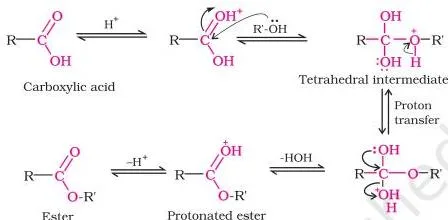
Esterification mechanism (nucleophilic acyl substitution): protonation of the carbonyl oxygen activates the carbonyl toward nucleophilic addition of the alcohol. Proton transfer in the tetrahedral intermediate converts \( -OH \) into \( -OH_2^+ \), a better leaving group, which is eliminated as neutral water; the protonated ester then loses a proton (NCERT, p. 251).
Formula Sheet: Key Reactions With General Equations
Here \( R \)/\( R’ \) = alkyl or aryl group, \( X \) = halogen, \( Nu^- \) = nucleophile, and \( Z \) is the substituent in \( H_2N-Z \). Organic equations carry no units — conditions and catalysts above or below the arrow are what earn the mark.
| Reaction | General equation |
|---|---|
| Cyanohydrin formation | \( RCHO + HCN \rightarrow RCH(OH)CN \) |
| Tollens’ test | \( RCHO + 2[Ag(NH_3)_2]^+ + 3OH^- \rightarrow RCOO^- + 2Ag + 2H_2O + 4NH_3 \) |
| Fehling’s test | \( RCHO + 2Cu^{2+} + 5OH^- \rightarrow RCOO^- + Cu_2O + 3H_2O \) |
| Iodoform test (methyl ketone) | \( RCOCH_3 + NaOI \rightarrow RCOONa + CHI_3 \) |
| Clemmensen reduction | \( \gt C=O \xrightarrow{Zn-Hg/HCl} \gt CH_2 \) |
| Wolff-Kishner reduction | \( \gt C=O \xrightarrow{NH_2NH_2} \gt C=NNH_2 \xrightarrow{KOH/ethylene\,glycol,\,heat} \gt CH_2 + N_2 \) |
| Aldol condensation | \( 2RCH_2CHO \xrightarrow{dilute\,NaOH} RCH_2CH(OH)CH(R)CHO \xrightarrow{\Delta} RCH_2CH=C(R)CHO \) |
| Cannizzaro (no \( \alpha \)-H) | \( 2RCHO \xrightarrow{conc.\,NaOH} RCH_2OH + RCOONa \) |
| Esterification | \( RCOOH + R’OH \rightleftharpoons RCOOR’ + H_2O \) (\( H^+ \) catalyst) |
| Acyl chloride | \( RCOOH + SOCl_2 \rightarrow RCOCl + SO_2 + HCl \) |
| Decarboxylation | \( RCOONa \xrightarrow{NaOH/CaO,\,heat} RH + Na_2CO_3 \) |
| HVZ \( \alpha \)-halogenation | \( RCH_2COOH + X_2/red\,P \rightarrow RCH(X)COOH \) |
Worked Examples: Naming, Reactivity and Tests
Four original problems that follow the exact marking logic of this chapter. Work through each step — the intermediate is where the marks live.
Example 1: IUPAC naming of a branched aldehyde and ketone
Method: Find the longest chain containing the functional group, number from the end nearer the \( CHO \) (aldehyde) or \( C=O \) (ketone), and place substituents alphabetically.
Step 1: \( CH_3CH_2CH(CH_3)CH_2CH_2CHO \) — longest chain through the aldehyde carbon has six carbons → hexanal.
Number from the \( CHO \)-carbon; the methyl sits on carbon 4.
Final answer: 4-methylhexanal.
Step 2: \( CH_3CH_2COCH(CH_3)CH_2CH_3 \) — longest chain through the ketone carbon has six carbons → hexanone.
Number from the end nearer \( C=O \) (left), so the carbonyl is at C-3; the methyl is at C-4.
Final answer: 4-methylhexan-3-one.
Example 2: Reactivity order toward HCN
Method: Nucleophilic addition to HCN is faster when the carbonyl carbon is less crowded (steric) and more electrophilic (electronic).
Step 1: Rank butanal, pentan-2-one and 2,2-dimethylpropanal.
The aldehyde has only one alkyl group; the ketone has two; the bulky \( t \)-butyl group of 2,2-dimethylpropanal crowds the approach most.
\[ 2,2\text{-dimethylpropanal} \lt \text{pentan-2-one} \lt \text{butanal} \]
Final answer: increasing reactivity toward HCN: 2,2-dimethylpropanal \( \lt \) pentan-2-one \( \lt \) butanal, justified by steric hindrance and electron donation from alkyl groups.
Example 3: Distinguishing butanal from butan-2-one
Method: Use Tollens’ first (aldehyde vs ketone), then iodoform (which ketone has a methyl group on the carbonyl).
Step 1 — Tollens’: warm each sample with ammoniacal \( AgNO_3 \).
Butanal gives a bright silver mirror; butan-2-one gives no mirror.
Step 2 — Iodoform: treat the ketone sample with \( I_2 \)/\( NaOH \).
Butan-2-one is a methyl ketone and gives a yellow \( CHI_3 \) precipitate; butanal does not.
Final answer: butanal alone gives the silver mirror; butan-2-one alone gives the yellow iodoform precipitate.
Example 4: Ordering acid strength from pKa values
Method: Smaller \( pK_a \) = stronger acid.
Use the textbook values for trifluoroacetic acid (0.23), benzoic acid (4.19) and acetic acid (4.76).
\[ \text{acetic acid (4.76)} \lt \text{benzoic acid (4.19)} \lt \text{trifluoroacetic acid (0.23)} \]
Final answer: increasing acid strength: acetic \( \lt \) benzoic \( \lt \) trifluoroacetic, because three fluorine atoms withdraw electron density powerfully and stabilise the carboxylate ion.
Common Mistakes in Carbonyl Chemistry
| Students write X | Correct is Y, because Z | How to check |
|---|---|---|
| “Tollens’ reagent oxidises ketones too” | Only aldehydes give the silver mirror; ketones lack an aldehydic \( H \). | Re-read the equation — the \( RCHO \) H is the one being oxidised. |
| “Benzaldehyde gives Fehling’s test” | Aromatic aldehydes do not respond to Fehling’s, even though they reduce Tollens’. | Memorise: Fehling’s is for aliphatic aldehydes only. |
| Swapping reduction conditions | Clemmensen = acidic (\( Zn-Hg \)/conc. HCl); Wolff-Kishner = basic (\( NH_2NH_2 \) then \( KOH \)/ethylene glycol). | “Kishner and KOH both start with K.” |
| “Phenoxide has more resonating structures, so phenol is stronger” | Equivalence matters: the carboxylate has two equivalent O-centred structures that stabilise it more. | Count where the negative charge sits — oxygen (carboxylate) vs carbon (phenoxide). |
| “All aldehydes give Cannizzaro” | Only aldehydes without \( \alpha \)-H (HCHO, benzaldehyde); the rest give aldol. | Check for an \( \alpha \)-carbon carrying at least one H. |
| “\( NaBH_4 \) reduces \( -COOH \) “ | \( NaBH_4 \) does not touch the carboxyl group; use \( LiAlH_4 \) or \( B_2H_6 \). | \( NaBH_4 \) is selective for aldehydes and ketones. |
| Numbering ketones from the wrong end | \( CH_3COCH_2CH_2CH_3 \) is pentan-2-one, not pentan-3-one. | Number from the end nearer the \( C=O \). |
Exam Notes: What Earns the Mark
Observed patterns from this chapter, phrased the way an examiner thinks. No predictions — these are the steps the question itself demands (NCERT objectives, p. 228).
- Name reactions are the highest-yield items. A one-line general equation with the correct reagent and condition is enough: Rosenmund, Stephen, Etard, Gatterman-Koch, Friedel-Crafts acylation, Aldol, Cannizzaro, Clemmensen, Wolff-Kishner, HVZ, Kolbe.
- “Name the reagent” transformation questions (Example 8.1 style) test the preparation table. Writing just “PCC” or “DIBAL-H” above the arrow gets the mark — no mechanism needed (NCERT, p. 234).
- In distinguishing tests, the observation is the marks-earning part — silver mirror, red-brown precipitate, yellow precipitate — not the reagent name alone.
- Mechanism answers need all three steps: nucleophilic attack, \( sp^2 \rightarrow sp^3 \) tetrahedral intermediate, proton transfer. Missing any one costs the mark.
- pKa inversion trap: smaller \( pK_a \) = stronger acid. Students consistently invert this in the acidity question.
- Physical chemistry style tables — boiling point ranking, pKa ordering — are the chapter’s most predictable numerical items.
Aldehydes Ketones and Carboxylic Acids Class 12 Notes: Revision Summary
The night-before version of the whole chapter. First, the reaction map — every named reaction grouped by starting material, reagent and product (NCERT, pp. 254–255):
| Named reaction | Starting material | Reagent and condition | Product |
|---|---|---|---|
| Rosenmund | Acyl chloride | \( H_2 \)/Pd-BaSO₄ | Aldehyde |
| Stephen | Nitrile | \( SnCl_2 \)/HCl, then hydrolysis | Aldehyde |
| Etard | Toluene | \( CrO_2Cl_2 \), then hydrolysis | Benzaldehyde |
| Gatterman-Koch | Benzene | \( CO \) + HCl, \( AlCl_3 \)/\( CuCl \) | Benzaldehyde |
| Friedel-Crafts acylation | Benzene | Acyl chloride, anhyd. \( AlCl_3 \) | Aromatic ketone |
| Clemmensen | Aldehyde/ketone | \( Zn-Hg \)/conc. HCl | \( CH_2 \) (hydrocarbon) |
| Wolff-Kishner | Aldehyde/ketone | \( NH_2NH_2 \), then \( KOH \)/ethylene glycol, heat | \( CH_2 \) (hydrocarbon) |
| Aldol | Aldehyde/ketone with \( \alpha \)-H | Dilute alkali | β-Hydroxy aldehyde/ketone, then \( \alpha ,\beta \)-unsaturated carbonyl |
| Cannizzaro | Aldehyde without \( \alpha \)-H | Concentrated alkali | Alcohol + carboxylate salt |
| HVZ | Carboxylic acid | \( X_2 \)/red phosphorus | \( \alpha \)-Halocarboxylic acid |
| Kolbe electrolysis | Sodium carboxylate | Electrolysis of aqueous solution | Hydrocarbon with doubled carbons |
Test-observation micro-table:
| Reagent | Positive observation | Which compounds respond |
|---|---|---|
| Tollens’ (ammoniacal \( AgNO_3 \)) | Bright silver mirror | Aldehydes |
| Fehling’s solution | Red-brown \( Cu_2O \) precipitate | Aliphatic aldehydes only |
| \( I_2 \)/\( NaOH \) (iodoform) | Yellow \( CHI_3 \) precipitate | Methyl ketones, \( CH_3CH(OH)- \) groups |
| \( NaHCO_3 \) | Brisk effervescence of \( CO_2 \) | Carboxylic acids (detects \( -COOH \)) |
Memory devices: “Kishner and KOH both start with K — Wolff-Kishner needs basic KOH; Clemmensen uses acidic Zn-Hg/HCl.” For reactivity, picture the carbonyl carbon as the north pole of a magnet: nucleophiles are attracted to it, and two bulky alkyl groups on a ketone are like two guards blocking the approach.
Five-line night-before checklist:
- Nomenclature: \( -al \), \( -one \), \( -oic \) acid, number from the functional group end.
- Reactivity: aldehydes \( \gt \) ketones; benzaldehyde is the exception (resonance).
- Three tests: silver mirror (Tollens’), red-brown \( Cu_2O \) (Fehling’), yellow \( CHI_3 \) (iodoform).
- Acidity: smaller \( pK_a \) = stronger; EWG strengthens, EDG weakens.
- Name reactions with reagent + condition on the arrow.
These carbonyl reactions connect forward to the functional-group conversions covered in our alcohols, phenols and ethers revision notes (Grignard additions, oxidation of alcohols) and our amines class 12 notes (imines, amides, reductive routes). For the wider set, browse the full Class 12 chemistry notes and the complete Class 12 notes collection on CBSE notes.
To verify any equation or page reference against the official source, open the NCERT Class 12 Chemistry Part II textbook PDF.
FAQs on Aldehydes, Ketones and Carboxylic Acids
Why are aldehydes more reactive than ketones in nucleophilic addition reactions?
Aldehydes are more reactive for two reasons. Sterically, a ketone has two alkyl groups that crowd the approaching nucleophile, while an aldehyde has only one. Electronically, two alkyl groups donate more electron density to the carbonyl carbon, making it less electrophilic (NCERT, p. 236).
Why does benzaldehyde reduce Tollens’ reagent but not Fehling’s solution?
Both reagents oxidise aldehydes, but Fehling’s solution responds only to aliphatic aldehydes. Aromatic aldehydes such as benzaldehyde do not give the red-brown cuprous oxide precipitate with Fehling’s, yet they still produce the silver mirror with Tollens’ reagent (NCERT, p. 239).
What is the difference between aldol condensation and Cannizzaro reaction?
Aldol condensation needs at least one \( \alpha \)-hydrogen and uses dilute alkali as catalyst; the product is a β-hydroxy aldehyde/ketone that dehydrates to an \( \alpha ,\beta \)-unsaturated carbonyl. Cannizzaro reaction happens only for aldehydes without an \( \alpha \)-hydrogen (formaldehyde, benzaldehyde) and uses concentrated alkali, giving a disproportionation into an alcohol and a carboxylate salt (NCERT, pp. 241–242).
Why is a carboxylic acid a stronger acid than phenol even though the phenoxide ion has more resonating structures?
Resonance stability depends on the equivalence of the structures, not their number. The carboxylate ion is stabilised by two equivalent resonance structures with the negative charge on oxygen. The phenoxide ion has more structures, but they are non-equivalent and place negative charge on less electronegative carbon atoms, so they stabilise it far less (NCERT, p. 250).
How would you distinguish propanal from propanone in the laboratory?
Warm each with Tollens’ reagent. Propanal gives a bright silver mirror; propanone gives none. Alternatively, use Fehling’s solution — propanal gives a red-brown \( Cu_2O \) precipitate and propanone does not — or run the iodoform test, which propanone (a methyl ketone) would pass with a yellow \( CHI_3 \) precipitate and propanal would not.
Which reagent reduces a carboxylic acid to a primary alcohol and why is sodium borohydride not used?
Lithium aluminium hydride, \( LiAlH_4 \), or diborane, \( B_2H_6 \), reduce a carboxylic acid to a primary alcohol. Sodium borohydride is not used because it does not reduce the carboxyl group — \( NaBH_4 \) is selective for aldehydes and ketones (NCERT, p. 253).
Reference: NCERT Class 12 Chemistry textbook, chapter Aldehydes, Ketones and Carboxylic Acids.
Explore Class 12 Chemistry Notes
Class 12 Chemistry on LearnCBSE:
Related chapters: