
This chapter is split into three functional group families — alcohols, phenols and ethers. This page gives you the complete alcohols phenols and ethers class 12 notes: how to name each class, the ways they are prepared, their physical properties, and the reactions you must know for exams — acidity, Lucas test, dehydration, oxidation, electrophilic substitution and ether cleavage.
By the end, you’ll be able to compare acid strength, apply the Lucas test, carry out Williamson synthesis, and write stepwise mechanisms (NCERT, p. 1–3).
Types of Alcohols, Phenols and Ethers
Classification makes the chemistry manageable. Alcohols and phenols are grouped by the number of –OH groups (mono-, di-, tri-, polyhydric), while alcohols are further split by the hybridisation of the carbon carrying the –OH group (NCERT, p. 2).


When the –OH is on an sp³ carbon, the alcohol is primary (1°), secondary (2°) or tertiary (3°) depending on how many carbon atoms that carbon is bonded to. The figures below show the general structures.
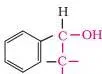
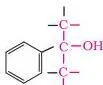
Special classes you must recognise (NCERT, p. 2–3):
- Allylic alcohol — –OH on a carbon next to a C=C bond, e.g. \( CH_2=CH-CH_2OH \) (prop-2-en-1-ol).
- Benzylic alcohol — –OH on a carbon next to a benzene ring, e.g. \( C_6H_5-CH_2OH \).
- Vinylic alcohol — –OH directly on a C=C carbon, e.g. \( CH_2=CH-OH \).
Ethers are classified by the groups on oxygen: simple/symmetrical (same groups, e.g. \( C_2H_5OC_2H_5 \)) or mixed/unsymmetrical (different groups, e.g. \( C_2H_5OCH_3 \)) (NCERT, p. 3).
The geometry of the functional groups
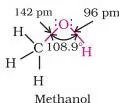
The structure of the –OH and –O– groups is a favourite one-mark question (NCERT, p. 6–7).
- Alcohols: oxygen is sp³ hybridised, bonded to carbon by a sigma bond. The C–O–H bond angle is slightly less than the tetrahedral angle (109°-28′) because lone pairs on oxygen repel the bond pairs.
- Phenols: –OH is attached to an sp² hybridised ring carbon. The C–O bond length is 136 pm, shorter than in methanol, because the oxygen lone pair is partly conjugated with the ring (partial double-bond character).
- Ethers: the four electron pairs around oxygen (two bonds, two lone pairs) are roughly tetrahedral, but the C–O–C angle is a little larger than the tetrahedral angle due to repulsion between the two bulky R groups. The C–O bond length is 141 pm, close to that in alcohols.
IUPAC Nomenclature – Quick Tables
Naming is guaranteed marks if you follow a fixed order of operations: pick the longest chain, number from the end nearest the –OH, and give the position of every substituent and the –OH itself (NCERT, p. 3–4).
| Class | How to name | Example |
|---|---|---|
| Alcohols | Replace final ‘e’ of alkane with ‘ol’; add locants. | \( CH_3CH(OH)CH_3 \) → Propan-2-ol |
| Diols | Keep the ‘e’, add ‘diol’ with locants. | \( HOCH_2CH_2OH \) → Ethane-1,2-diol |
| Triols | Keep the ‘e’, add ‘triol’. | \( HOCH_2CH(OH)CH_2OH \) → Propane-1,2,3-triol |
| Phenols | Simple hydroxybenzene derivatives; use ortho/meta/para or numbers. | \( o-CH_3C_6H_4OH \) → 2-Methylphenol |
| Ethers | Treat the larger group as parent, the other as an alkoxy substituent. | \( CH_3OC_2H_5 \) → Ethoxyethane |
Common names still appear in questions: CH₃OH is methyl alcohol, C₂H₅OH is ethyl alcohol, C₆H₅OCH₃ is anisole, C₆H₅OC₂H₅ is phenetole (NCERT, p. 3–5).


Cyclic alcohols take the prefix cyclo and the –OH is assumed to be on C-1 (NCERT, p. 4).
Preparation Methods at a Glance
You need each method’s start material, reagent, condition and example. These three tables cover the whole chapter.
Preparation of alcohols
| Method | Start material + reagent | Example (with condition) | Key note |
|---|---|---|---|
| Acid-catalysed hydration | Alkene + \( H_2O \), catalytic \( H^+ \) | Propene + \( H_2O \) → Propan-2-ol | Follows Markovnikov rule. |
| Hydroboration-oxidation | Alkene + \( (BH_3)_2 \), then \( H_2O_2/OH^- \) | Propene → Propan-1-ol | Anti-Markovnikov; B goes to the sp² carbon with more H. |
| Reduction of carbonyl | Aldehyde/ketone + \( H_2/Pd \) or \( NaBH_4 \) or \( LiAlH_4 \) | Butanal → Butan-1-ol (1°); Butanone → Butan-2-ol (2°) | Aldehydes give 1°, ketones give 2°. |
| Reduction of acids/esters | \( RCOOH \) + \( LiAlH_4 \) | \( CH_3COOH \) → Ethanol | LiAlH₄ is strong but expensive; esters reduced catalytically. |
| Grignard reaction | Carbonyl + \( RMgX \), then \( H_2O \) | \( HCHO \) + \( CH_3CH_2CH_2MgBr \) → Butan-1-ol | Methanal → 1°, other aldehydes → 2°, ketones → 3°. |
The Grignard logic decides the product class: with methanal you always get a primary alcohol, with other aldehydes a secondary alcohol, and with ketones a tertiary alcohol (NCERT, p. 9).
Preparation of phenols
| Method | Start material + condition | Key note |
|---|---|---|
| From haloarenes | Chlorobenzene fused with NaOH at 623 K, 320 atm, then acidify | Gives sodium phenoxide, then phenol. |
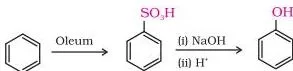
| From benzenesulphonic acid | Benzene + oleum → sulphonic acid, fuse with molten NaOH, acidify | Two-step via sodium phenoxide. |
| From diazonium salts | Aryl diazonium salt warmed with water or dilute acid | Diazonium made from aryl amine + \( NaNO_2/HCl \) at 273–278 K. |
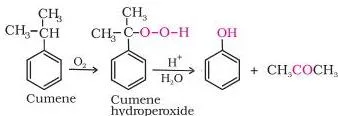
| From cumene (industrial) | Cumene oxidised by air → cumene hydroperoxide → dilute acid | Gives phenol + acetone by-product. |
Preparation of ethers
| Method | Start material + condition | Example | Limitation |
|---|---|---|---|
| Dehydration of alcohols | Alcohol + \( H_2SO_4 \) at 413 K | Ethanol → Ethoxyethane | Only works well for primary, unhindered alcohols; 2°/3° give alkenes. |
| Williamson synthesis | Alkoxide + primary alkyl halide | Sodium ethoxide + bromoethane → Ethoxyethane | Best with 1° halide; 3° halide gives alkene (elimination). |
At 443 K with \( H_2SO_4 \), ethanol dehydrates to ethene; at 413 K the main product is ethoxyethane (NCERT, p. 23). The temperature decides the product.
Physical Properties Comparison
The single most tested fact: alcohols and phenols boil much higher than ethers, haloalkanes and hydrocarbons of comparable molecular mass. The reason is intermolecular hydrogen bonding (NCERT, p. 11).
| Compound | Molecular mass | Boiling point |
|---|---|---|
| Ethanol | 46 | 351 K |
| Methoxymethane | 46 | 248 K |
| Propane | 44 | 231 K |
Note that ethanol and methoxymethane have the same mass, yet differ by ~100 K in boiling point.
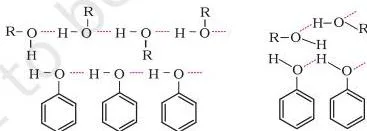
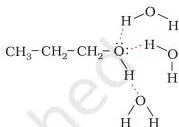
Solubility: alcohols and phenols dissolve in water because the –OH can hydrogen-bond with water. Solubility decreases as the hydrophobic alkyl/aryl part grows (NCERT, p. 12). Ethers are comparably soluble to alcohols of the same mass because the ether oxygen also forms hydrogen bonds with water.
Key Chemical Reactions – Logic and Mechanisms
Organise every reaction by which bond breaks(NCERT, p. 12): the O–H bond breaks when the alcohol acts as a nucleophile; the C–O bond breaks when the protonated alcohol acts as an electrophile.
1. O–H bond cleavage: acidity
Reaction with metals: alcohols and phenols give alkoxides/phenoxides and hydrogen, e.g. \( 2ROH + 2Na \rightarrow 2RONa + H_2 \). Phenols also dissolve in aqueous NaOH, which alcohols do not — this is the classic distinction (NCERT, p. 13).
Why are phenols more acidic than alcohols? The phenoxide ion is stabilised by delocalisation of the negative charge over the ring, while the alkoxide has a localised charge on oxygen. A more stable conjugate base means a stronger acid.
The sp² ring carbon is also more electronegative than an sp³ carbon, which pulls electron density away from O–H (NCERT, p. 13–14).
Effect of substituents on phenol acidity (NCERT, p. 14):
- Electron-withdrawing groups (EWG) like –NO₂ increase acidity, especially at ortho and para positions, because they stabilise the phenoxide. More EWG = stronger acid.
- Electron-releasing groups (ERG) like –CH₃ decrease acidity. Cresols are weaker acids than phenol.
| Compound | Formula | pKa |
|---|---|---|
| o-Nitrophenol | \( o-O_2N-C_6H_4-OH \) | 7.2 |
| m-Nitrophenol | \( m-O_2N-C_6H_4-OH \) | 8.3 |
| p-Nitrophenol | \( p-O_2N-C_6H_4-OH \) | 7.1 |
| Phenol | \( C_6H_5-OH \) | 10.0 |
| o-Cresol | \( o-CH_3-C_6H_4-OH \) | 10.2 |
| Ethanol | \( C_2H_5OH \) | 15.9 |
Smaller pKa = stronger acid. Phenol is about a million times more acidic than ethanol (NCERT, p. 14).

2. Esterification
Alcohols and phenols react with carboxylic acids, acid chlorides and acid anhydrides to form esters. The reaction with acid chloride needs pyridine to neutralise the HCl produced and drive the equilibrium right. Acetylation of salicylic acid forms aspirin (NCERT, p. 15).
3. C–O bond cleavage in alcohols
Reaction with HX: \( ROH + HX \rightarrow RX + H_2O \). This is the basis of the Lucas test (conc. HCl + anhydrous ZnCl₂):
- Tertiary alcohol: immediate turbidity (halide forms fast).
- Secondary alcohol: cloudy within ~5 minutes.
- Primary alcohol: no turbidity at room temperature.
Memory device: “Lucas test – primary: no cloud at RT; secondary: cloudy in 5 mins; tertiary: immediate.” The turbidity appears because the alkyl halide is immiscible with the aqueous reagent (NCERT, p. 16).
Dehydration: loss of water to give an alkene. Ethanol needs conc. \( H_2SO_4 \) at 443 K; secondary and tertiary alcohols dehydrate under milder conditions. Ease of dehydration: Tertiary > Secondary > Primary, because the carbocation intermediate is more stable when more substituted (NCERT, p. 16–17).
Oxidation: the O–H and a C–H bond break to form a C=O.
- Primary alcohol → aldehyde (with PCC or \( CrO_3 \) in anhydrous medium) → carboxylic acid (with strong oxidiser like acidified \( KMnO_4 \)).
- Secondary alcohol → ketone (with \( CrO_3 \)).
- Tertiary alcohol — resistant to oxidation under normal conditions; strong oxidisers cleave C–C bonds to give a mixture of smaller acids.
Dehydrogenation over hot Cu at 573 K gives aldehydes (from 1°) and ketones (from 2°), while 3° alcohols dehydrate to alkenes (NCERT, p. 18).
4. Reactions of phenols – electrophilic substitution
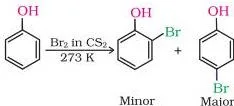
The –OH group activates the ring and directs incoming groups to ortho and para positions (NCERT, p. 19).
| Reaction | Condition | Product |
|---|---|---|
| Nitration | Dilute \( HNO_3 \), 298 K | o- and p-nitrophenol mixture |
| Nitration | Conc. \( HNO_3 \) (or via disulphonic acid) | 2,4,6-trinitrophenol (picric acid) |
| Bromination | Bromine in \( CHCl_3 \) or \( CS_2 \), low temp | Monobromophenols (o and p) |
| Bromination | Bromine water | 2,4,6-tribromophenol (white precipitate) |
| Kolbe’s reaction | Phenoxide + \( CO_2 \), then acidify | o-Hydroxybenzoic acid (salicylic acid) |
| Reimer–Tiemann | Phenol + \( CHCl_3 \) + NaOH | Salicylaldehyde |
| Zinc dust | Heat with Zn | Benzene |
| Oxidation | Chromic acid | Benzoquinone |
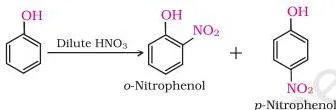
Steam volatility of nitrophenols: o-nitrophenol shows intramolecular hydrogen bonding, so molecules do not associate and it is steam volatile. p-nitrophenol shows intermolecular H-bonding, causing association, so it is less volatile and stays behind (NCERT, p. 19).

5. Reactions of ethers
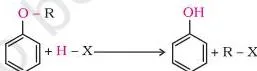
Cleavage of C–O bond: ethers are the least reactive functional group and need drastic conditions, with excess HX. Order of reactivity: HI > HBr > HCl (NCERT, p. 25–26).
- Dialkyl ethers give two alkyl halides: \( ROR + HI \rightarrow RI + ROH \), then \( ROH + HI \rightarrow RI + H_2O \).
- Alkyl aryl ethers cleave at the alkyl–oxygen bond (it is weaker than the aryl–O bond, which has partial double-bond character). Example: ethoxybenzene + HI → phenol + ethyl iodide (the aryl–O bond survives).
- Mixed ethers with two alkyl groups: the smaller (less substituted) alkyl group leaves as the halide by an \( S_N2 \) path when both are primary/secondary. But if one group is tertiary, a stable tertiary carbocation forms and the mechanism is \( S_N1 \), so the tertiary halide is produced.
Electrophilic substitution on anisole: the –OCH₃ group activates the ring and directs ortho/para, just like –OH. Anisole brominates in ethanoic acid even without a Lewis acid catalyst, and the para isomer is obtained in 90% yield (NCERT, p. 27).
Worked Examples (Step-by-Step)
Question 1: Give the IUPAC name of 2,4-dimethylphenol and draw its structure.
- Step 1: Identify the parent: a phenol, so the benzene ring is the parent and the –OH is the principal group.
- Step 2: Number the ring so the –OH carbon is C-1.
The methyl groups are at positions 2 and 4 (giving the lowest locants).
Step 3: Write substituents alphabetically before the parent name.
Final answer: The name is 2,4-dimethylphenol. In the structure, a benzene ring carries –OH at C-1 and –CH₃ at C-2 and C-4. The common name would be 2,4-dimethyl phenol, with the –OH group directly attached to the ring.
Question 2: Predict the major product when cyclohexanol is treated with thionyl chloride (SOCl₂).
- Step 1: Recognise the reaction type: alcohols react with thionyl chloride to replace the –OH group with chlorine, forming an alkyl chloride.
- Step 2: The products are the chloride and gaseous by-products (SO₂ and HCl), which leave the mixture, driving the reaction to completion.
- Step 3: The ring remains intact because no rearrangement is involved for this secondary alcohol.
Final answer: Chlorocyclohexane is formed: \( C_6H_{11}OH + SOCl_2 \rightarrow C_6H_{11}Cl + SO_2 + HCl \). The product is a secondary alkyl chloride.
Question 3: Predict the product of acid-catalysed hydration of 3-methylbut-2-ene.
- Step 1: Apply Markovnikov’s rule to the unsymmetrical alkene: the H⁺ adds to the carbon with more hydrogens, and the –OH ends up on the more substituted carbon.
- Step 2: Protonation gives the more stable carbocation — the tertiary carbocation at C-2 (not the secondary at C-3).
- Step 3: Water attacks the carbocation, then deprotonation gives the alcohol.
Final answer: 3-methylbutan-2-ol, \( (CH_3)_2C(OH)CH_2CH_3 \) — wait, the correct structure is \( (CH_3)_2CH-CH(OH)CH_3 \). The –OH goes to the more substituted carbon (C-2), which carries the –CH₃ group.
Question 4: Show how sodium phenoxide and ethyl bromide give an ether (Williamson synthesis).
- Step 1: Identify the alkoxide: sodium phenoxide (\( C_6H_5O^-Na^+ \)) is the nucleophile.
- Step 2: The alkyl halide must be primary for best results — ethyl bromide is an unhindered primary halide.
- Step 3: The phenoxide attacks the carbon of the C–Br bond in an \( S_N2 \) substitution, releasing Br⁻.
Final answer: \( C_6H_5ONa + C_2H_5Br \rightarrow C_6H_5OC_2H_5 + NaBr \). The product is ethoxybenzene (phenetole), an aryl alkyl ether.
Common Mistakes and Corrections
| Mistake | Correct rule | How to check your answer |
|---|---|---|
| “Tertiary alcohols are stronger acids than primary.” | Primary alcohols are stronger acids. Electron-releasing alkyl groups in 3° alcohols push electron density onto O, weakening the O–H polarity. | Compare pKa: ethanol (15.9) is more acidic than tert-butanol. More alkyl = less acidic. |
| “Phenol is a weaker acid than ethanol because it has a benzene ring.” | Phenol is stronger (pKa 10 vs 15.9) because the phenoxide ion is resonance-stabilised. | Phenol dissolves in NaOH but ethanol does not — the test for the stronger acid. |
| “Williamson synthesis always works with any alkyl halide.” | Use a primary halide. A tertiary halide (e.g. tert-butyl chloride) gives elimination → alkene instead. | If the halide is 3°, expect alkene + NaX + alcohol, not ether. |
| “In Lucas test, primary alcohols give turbidity quickly.” | Primary alcohols do not give turbidity at room temperature; tertiary do immediately. | Remember the order: 3° immediate, 2° in 5 mins, 1° no cloud at RT. |
| “Ethers with an aryl group cleave at the aryl–O bond.” | Alkyl aryl ethers cleave at the alkyl–O bond because the aryl–O bond has partial double-bond character. | Ethoxybenzene + HI → phenol + ethyl iodide (phenol survives). |
| “Oxidation of a tertiary alcohol gives a ketone.” | Tertiary alcohols resist oxidation (no H on the OH-bearing carbon). | Only 1° gives aldehyde/acid and 2° gives ketone; 3° needs drastic conditions that break C–C bonds. |
| “Ethers have high boiling points like alcohols.” | Ethers boil much lower than alcohols of similar mass — no intermolecular H-bonding. | Compare ethoxyethane (308 K) vs butan-1-ol (390 K) vs pentane (309 K). |
Exam Tips and Scoring Patterns
From the chapter’s end-of-chapter exercises, the recurring asked skills are (NCERT, p. 30–33):
- Draw structure from IUPAC name — practised in Q. 7.2 (e.g. 2-methylbutan-2-ol, 1-ethoxypropane, cyclohexylmethanol). Number the chain from the –OH end and check every substituent.
- Name a compound — Q. 7.1 and 7.23 cover alcohols and ethers. For ethers, the larger group is the parent; the smaller becomes an alkoxy prefix.
- Compare acid strength — Q. 7.14 and 7.15 ask you to justify phenol vs ethanol and o-nitrophenol vs o-methoxyphenol. A full-marks answer cites resonance stabilisation of the phenoxide and the position of the –NO₂.
- Write a mechanism — Q. 7.11 (hydration of ethene), 7.19 (acid dehydration of ethanol), 7.30 (HI with methoxymethane). Mechanisms carry 3–5 marks: write every step, label the slow step, show the protonation and deprotonation.
- Give the reason for a physical property — Q. 7.4 (propanol vs butane), 7.8 (o-nitrophenol steam volatile), 7.22 (ethanol vs methoxymethane). Always name hydrogen bonding as the cause.
- Devise a synthesis — Q. 7.13 and 7.20 test Grignard, hydration, reduction and Williamson routes. State the reagent and the condition, e.g. “propene + H₂O/H⁺ gives propan-2-ol.”
For a 3–4 mark “give the mechanism” question, do not skip steps — the protonation of the alkene/ether, the carbocation formation (rate-determining), and the final deprotonation are all needed for full credit.
Quick Revision Recap
| Class | Key preparation | Key reaction | Exam fact |
|---|---|---|---|
| Alcohol | Hydration, hydroboration, reduction, Grignard | Lucas test, dehydration, oxidation | 1° → aldehyde/acid; 2° → ketone; 3° resists oxidation. |
| Phenol | Haloarene, sulphonic acid, diazonium, cumene | Nitration, bromination, Kolbe, Reimer–Tiemann | –OH activates ring, directs ortho/para. |
| Ether | Dehydration of alcohol, Williamson | Cleavage by HI, Friedel–Crafts | HI > HBr > HCl; aryl–O bond survives. |
Reagent quick list
- Lucas test: conc. HCl + anhydrous ZnCl₂.
- Mild oxidation of 1° alcohol to aldehyde: PCC or \( CrO_3 \) (anhydrous).
- Strong oxidation to acid: acidified \( KMnO_4 \).
- Hydration of alkene: \( H_2O \), catalytic \( H^+ \).
- Reduction of ester/acid: \( LiAlH_4 \).
- Ether formation: Williamson — alkoxide + primary alkyl halide.
Acidity order memory aid
“Nitro Increases, Methyl Decreases” (NIMD): EWG (like –NO₂) raises acidity, ERG (like –CH₃) lowers it. General order: phenol < nitrophenol < dinitrophenol < trinitrophenol, while cresols < phenol.
Ether cleavage rule
HI > HBr > HCl, and the alkyl–O bond breaks in aryl alkyl ethers. If one alkyl group is tertiary, \( S_N1 \) gives the tertiary halide; otherwise the less substituted alkyl group becomes the halide by \( S_N2 \).
Frequently Asked Questions
Why is phenol more acidic than ethanol? Explain with resonance structures.
The direct answer: the phenoxide ion is stabilised by resonance delocalisation of the negative charge over the benzene ring, while the ethoxide ion has a localised charge on oxygen. A more stable conjugate base means a stronger acid, so phenol (pKa 10.0) is about a million times more acidic than ethanol (pKa 15.9)
How does a nitro group affect acidity? Why is para-nitrophenol a stronger acid than phenol?
The –NO₂ group is electron-withdrawing. It stabilises the phenoxide ion by delocalising the negative charge, and this effect is strongest at the ortho and para positions. p-Nitrophenol (pKa 7.1) is therefore a much stronger acid than phenol (pKa 10.0). Ortho and para isomers are stronger than meta because the meta position cannot delocalise the negative charge effectively.
Why can’t Williamson ether synthesis be used to prepare t-butyl ethyl ether from t-butyl chloride and sodium ethoxide?
Because sodium ethoxide is a strong base as well as a nucleophile. With a tertiary halide like t-butyl chloride, elimination dominates over substitution, giving 2-methylpropene (an alkene) instead of the ether. The correct route is to use sodium t-butoxide with a primary halide, e.g. sodium t-butoxide + ethyl bromide gives t-butyl ethyl ether (NCERT, p. 24).
What is the Lucas test? When does a primary alcohol give turbidity?
The Lucas test distinguishes 1°, 2° and 3° alcohols by their reaction with a mixture of conc. HCl and anhydrous ZnCl₂. A primary alcohol does not give turbidity at room temperature; turbidity appears only on heating, because the primary carbocation is too unstable to form quickly. Tertiary alcohols give immediate cloudiness; secondary give turbidity within about five minutes.
Why is o-nitrophenol steam volatile and p-nitrophenol not?
o-Nitrophenol forms an intramolecular hydrogen bond, so its molecules do not associate and it vaporises easily with steam. p-Nitrophenol forms intermolecular hydrogen bonds, causing molecules to associate into larger clusters that are less volatile, so it stays behind during steam distillation (NCERT, p. 19).
Why do ethers have lower boiling points than alcohols?
Ethers cannot form intermolecular hydrogen bonds between their own molecules (no –OH). Alcohols do, so they need more energy to separate molecules into the vapour phase. Ethoxyethane boils at 308 K, while butan-1-ol of similar mass boils at 390 K (NCERT, p. 25).
For the official NCERT textbook used for this chapter, see the NCERT Class 12 Chemistry Part II PDF on ncert.nic.in.
Reference: NCERT Class 12 Chemistry textbook, chapter Alcohols, Phenols and Ethers.
Explore Class 12 Chemistry Notes
Class 12 Chemistry on LearnCBSE:
Related chapters: