
The d and f block elements class 12 notes on this page compress Unit 4 of the rationalised NCERT Chemistry-I textbook into one revision page: where the d- and f-blocks sit, electronic configurations, every important trend (sizes, ionisation enthalpies, oxidation states, electrode potentials), magnetic behaviour, K₂Cr₂O₇ and KMnO₄, and the lanthanoids and actinoids. They follow the current rationalised NCERT syllabus.
Work through the sections in order, then check the mistakes table, exam notes and the final revision table the night before your test. You can verify any value against the official NCERT Unit 4 PDF (lech104.pdf) if you want the textbook detail behind a figure.
The d-Block Position, the Four Series and the IUPAC Definition
The d-block is the large middle section of the periodic table, Groups 3 to 12 (NCERT, p. 89). The f-block sits in a separate panel at the bottom; in its elements the 4f and 5f orbitals fill progressively.
There are four d-series and two f-series (NCERT, p. 90):
- 3d series: Sc to Zn
- 4d series: Y to Cd
- 5d series: La and Hf to Hg
- 6d series: Ac and Rf to Cn
- 4f lanthanoids: Ce to Lu
- 5f actinoids: Th to Lr
The name “transition metals” originally meant elements whose properties sat between the s- and p-blocks. The modern IUPAC definition is stricter (NCERT, p. 90): a transition metal has an incomplete d subshell either in the neutral atom or in its ions.
Group 12 — Zn, Cd, Hg — has a full d¹⁰ configuration in the ground state and in its common oxidation states, so it is not a transition metal by this definition. Still, as the end members of their series, their chemistry is studied alongside the transition metals.
Electronic Configurations: The (n−1)d¹⁻¹⁰ns¹⁻² Rule and Its Exceptions
The general outer configuration of a d-block element is (n−1)d¹⁻¹⁰ns¹⁻² (NCERT, p. 90). The symbol (n−1) marks the inner d orbitals, which may hold 1 to 10 electrons, and the outermost ns orbital holds 1 or 2.
There is one striking exception to the general formula: Pd (Z = 46) is 4d¹⁰5s⁰, not 4d⁸5s². The two famous first-series exceptions are:
- Cr (Z = 24) = 3d⁵4s¹, not 3d⁴4s²
- Cu (Z = 29) = 3d¹⁰4s¹, not 3d⁹4s²
Why do these happen? The energy gap between the (n−1)d and ns orbitals is very small, and half-filled and completely filled sets of orbitals are extra stable. Pushing one 4s electron into the 3d set buys that extra stability for Cr (d⁵) and Cu (d¹⁰).
The d orbitals also protrude further from the atom than s and p orbitals, so they feel the surroundings strongly — this is why d-block ions form coloured ions, complexes and multiple oxidation states (NCERT, p. 91).
Memory device — the first row in order (Sc, Ti, V, Cr, Mn, Fe, Co, Ni, Cu, Zn):
“Sweet Tina Visited Crazy Monkey Forests; Come Nick’s Cucumber Zone.”
Each word’s start (Sweet, Tina, Visited, Crazy, Monkey, Forests, Come, Nick’s, Cucumber, Zone) keys the symbols Sc, Ti, V, Cr, Mn, Fe, Co, Ni, Cu, Zn — the order you need for every trend question.
Physical Properties: Melting Points and Enthalpy of Atomisation
Nearly all transition metals show typical metallic behaviour — high tensile strength, ductility, malleability, high thermal and electrical conductivity, and metallic lustre (NCERT, p. 92). With the exceptions of Zn, Cd, Hg and Mn, they adopt one or more of the standard metallic lattice structures — body-centred cubic (bcc), hexagonal close-packed (hcp) or cubic close-packed (ccp).
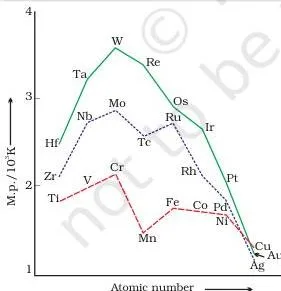
Their melting and boiling points are high because both the (n−1)d electrons and the ns electrons take part in interatomic metallic bonding. In any row, the melting point rises to a maximum near the middle of the series — one unpaired electron per d orbital favours the strongest interatomic interaction — and then falls (NCERT, p. 92).
Mn and Tc are the anomalous dips.
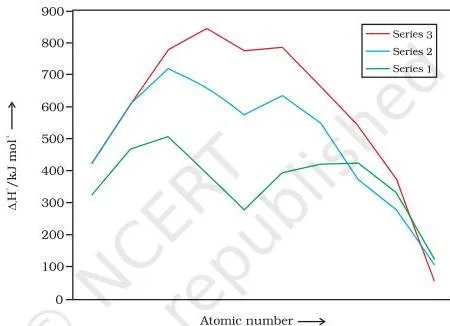
Enthalpy of atomisation follows the same mid-series maximum. Two points to remember:
- The second and third series have higher enthalpies of atomisation than the first series — which is why metal–metal bonding is far more common in heavy transition metals (NCERT, p. 93).
- Zn is the lowest (126 kJ mol⁻¹) because its 3d orbitals are completely filled and contribute no electrons to metallic bonding (NCERT, p. 94).
Atomic and Ionic Sizes and the Lanthanoid Contraction
Across a series, ions of the same charge shrink steadily: each new electron enters a d orbital as nuclear charge rises by one, but a d electron shields poorly, so the effective nuclear pull on the outer electrons grows and the radius falls (NCERT, p. 93). Atomic radii follow the same pattern, though the variation is small.
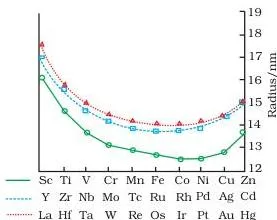
The comparison between series is the exam favourite: radii increase from the 3d to the 4d series, but the 5d series is virtually the same size as the 4d.
The cause is the lanthanoid contraction (NCERT, p. 93): the 4f orbitals must be filled before the 5d series begins, and each added 4f electron shields the one before it imperfectly, so the whole ion tightens regularly from La to Lu.
The 4f contraction almost exactly cancels the size jump expected for the 5d series. The proof the exam likes: Zr = 160 pm and Hf = 159 pm are almost identical, so the two elements occur together in nature and are very hard to separate.
As radius shrinks and atomic mass grows, density rises sharply from Ti (Z = 22) to Cu (Z = 29) (NCERT, p. 94).
Analogy: adding one 4f electron at a time is like stacking one more floor on a building — each new floor’s weight compresses everything below. The ion gets steadily tighter even though you are adding matter.
Ionisation Enthalpies: Exchange Energy and the d⁵, d¹⁰ Breaks
First ionisation enthalpy increases along each series as nuclear charge rises, but the key point is that successive ionisation enthalpies rise far less steeply than in the p-block (NCERT, p. 95). The 3d electrons shield the 4s electrons from the growing nuclear charge effectively, so the radii and ionisation energies move only slightly.
When a d-block element forms an ion, ns electrons are lost before (n−1)d electrons. So M²⁺ ions have a d-electron count that ignores the s electrons.
The trend breaks at two special ions (NCERT, p. 95): the second ionisation enthalpy breaks for Mn²⁺ and the third for Fe³⁺ — both end in a half-filled d⁵. The reason is exchange energy.
What is exchange energy, and why does it matter? When several electrons occupy a set of degenerate (equal-energy) orbitals, the lowest energy state is the one with maximum single occupation and parallel spins (Hund’s rule). The stabilisation gained from these parallel-spin pairs is called exchange energy, and it is roughly proportional to the number of possible parallel pairs.
A half-filled d⁵ set has the maximum number of such pairs.
Losing that stabilisation makes ionisation harder. That explains two facts you must be able to state:
- The third ionisation enthalpy of Fe is lower than that of Mn — Fe²⁺ (d⁶) loses a d electron to reach d⁵, while Mn²⁺ (d⁵) must sacrifice d⁵ itself.
- Mn²⁺ (d⁵) is stable, and Fe³⁺ (d⁵) is stable, precisely because the half-filled set resists further ionisation.
The same logic explains why second ionisation enthalpy is unusually high for Cr⁺ (d⁵) and Cu⁺ (d¹⁰) — removing one electron from a stable half- or fully-filled set costs a lot.
Oxidation States: The Great Variety from +2 to +7
The most distinctive feature of a transition element is the spread of oxidation states it can show, all arising from the incomplete d subshell (NCERT, p. 96). Crucially, transition-metal states differ by one — V²⁺, V³⁺, V⁴⁺, V⁵⁺ — whereas non-transition elements normally change in steps of two.
Mn (Z = 25) shows the most states, +2 to +7, because it has the maximum number of unpaired electrons (NCERT, p. 96). The extremes of the series are poor:
- Early elements (Sc, Ti) have too few d electrons to lose or share.
- Late elements (Cu, Zn) have too many d electrons and too few orbitals to share them.
The maximum stable oxidation state equals the sum of the s and d electrons up to manganese (NCERT, p. 96): the +7 state in MnO₄⁻, +6 in CrO₄²⁻, +5 in VO₂⁺, and the +4 (TiO₂/TiO²⁺) state for Ti. After Mn the stability of higher states drops abruptly — Fe stays at +2/+3, Co +2/+3, Ni +2, Cu +1/+2, Zn +2.
Two more facts worth memorising:
- Low states (even 0) occur with π-acceptor ligands. In Ni(CO)₄ and Fe(CO)₅ the metal’s oxidation state is zero (NCERT, p. 97).
- Within a group, heavier members favour higher states. Cr(VI) as dichromate in acid is a strong oxidant, but MoO₃ and WO₃ are not (NCERT, p. 97).
Electrode Potentials M²⁺/M and M³⁺/M²⁺: Reading the Trend
Across the series, E°(M²⁺/M) becomes less negative, matching the rise in the sum of the first two ionisation enthalpies (NCERT, p. 98). Three values sit more negative than the trend predicts:
- Mn — Mn²⁺ gains the half-filled d⁵ stability.
- Zn — Zn²⁺ is a full d¹⁰.
- Ni — Ni has the most negative hydration enthalpy of the row.
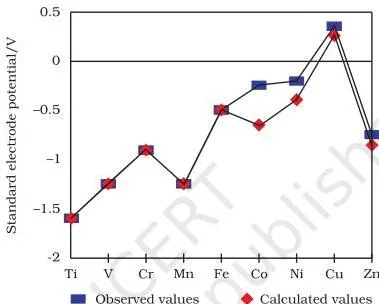
Copper is the famous exception: E°(Cu²⁺/Cu) = +0.34 V. Because the value is positive, Cu cannot liberate H₂ from acids — the energy needed to atomise and ionise Cu is not repaid by its hydration enthalpy, so only oxidising acids (nitric, hot concentrated sulphuric) attack it (NCERT, p. 98).
For the M³⁺/M²⁺ couple, the data read like this (NCERT, p. 99):
- Low E° for Sc — Sc³⁺ has a noble-gas configuration and is very stable.
- High E° for Mn — Mn²⁺ (d⁵) is especially stable.
- Low E° for Fe — Fe³⁺ (d⁵) gains extra stability.
- Low E° for V — V²⁺ has a half-filled t₂g level.
Why is Cr²⁺ reducing and Mn³⁺ oxidising, when both are d⁴? Cr²⁺ wants to change d⁴ → d⁵ (half-filled t₂g), so it donates an electron. Mn³⁺ changes to Mn²⁺ (d⁵) by accepting one (NCERT, p. 98). So:
- Ti²⁺, V²⁺ and Cr²⁺ are strong reducing agents — they even liberate H₂ from dilute acid, e.g. 2Cr²⁺(aq) + 2H⁺(aq) → 2Cr³⁺(aq) + H₂(g).
- Mn³⁺ and Co³⁺ are the strongest oxidising agents in aqueous solution (NCERT, p. 101).
Magnetic Properties: The Spin-Only Formula in Practice
Three magnetic behaviours appear (NCERT, p. 101):
- Diamagnetic — repelled by a magnetic field; all electrons paired.
- Paramagnetic — attracted; arises from unpaired electrons.
- Ferromagnetic — attracted very strongly; an extreme form of paramagnetism.
In first-row transition compounds the orbital contribution to magnetism is effectively quenched, so the magnetic moment depends only on the number of unpaired electrons. The spin-only formula is (NCERT, p. 101):
\[ \mu = \sqrt{n(n+2)} \quad \text{(in Bohr magnetons, BM)} \]
where n = number of unpaired electrons. A single unpaired electron gives 1.73 BM. For heavier ions the observed moment sits slightly above the spin-only calculation because the orbital contribution is not fully quenched.
Worked example: spin-only magnetic moment of Fe³⁺
Step 1: Write the ground-state configuration.
Fe (Z = 26) = [Ar] 3d⁶4s².
Step 2: Form the Fe³⁺ ion.
The ns electrons leave first, then one 3d electron: Fe³⁺ = 3d⁵.
Step 3: Count unpaired electrons.
With five electrons in five 3d orbitals (Hund’s rule, no strong field here), n = 5.
Step 4: Substitute into the spin-only formula.
\[ \mu = \sqrt{5(5+2)} = \sqrt{35} = 5.92\ \text{BM} \]
Final answer: Fe³⁺ has a spin-only magnetic moment of 5.92 BM — the same value as Mn²⁺, because both are d⁵.
Coloured Ions, Complexes, Catalysts, Interstitial Compounds and Alloys
Why transition ions are coloured
When an electron is excited from a lower d orbital to a higher one, the absorbed photon’s frequency usually lies in the visible region; the colour we see is the complementary colour of the light absorbed (NCERT, p. 103). Ions with d⁰ (Sc³⁺, Ti⁴⁺) or d¹⁰ (Zn²⁺) have no d–d transition possible and are colourless.
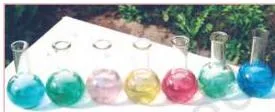
Figure walkthrough — what to notice in the sequence:
- Each ion shows a distinct colour — V⁴⁺ blue, V³⁺ green, Mn²⁺ pink, Fe³⁺ yellow, Co²⁺ pink, Ni²⁺ green, Cu²⁺ blue — because each dⁿ count absorbs a different wavelength.
- Ions with the same d count often fall in the same colour family: Mn²⁺ (d⁵) and Co²⁺ pink, V³⁺ (d²) and Ni²⁺ (d⁸) green, V⁴⁺ (d¹) and Cu²⁺ (d⁹) blue.
- The water ligand determines the exact absorption; change the ligand (Unit 5) and the colour shifts.
- Colour is missing only at d⁰ and d¹⁰ — the empty and full sets.
Complex formation, catalysis, interstitial compounds, alloys
Complexes. The small size, high ionic charge and available d orbitals of transition metals let them bind many anions or neutral molecules (NCERT, p. 103). Examples: [Fe(CN)₆]³⁻, [Fe(CN)₆]⁴⁻, [Cu(NH₃)₄]²⁺, [PtCl₄]²⁻. Full detail sits in the coordination compounds class 12 notes (Unit 5).
Catalysis. Transition metals work as catalysts because they adopt multiple oxidation states and form complexes. The classic two-step iodide–persulphate reaction is catalysed by the Fe³⁺/Fe²⁺ couple (NCERT, p. 104):
\[ 2\text{Fe}^{3+} + 2\text{I}^- \rightarrow 2\text{Fe}^{2+} + \text{I}_2 \]
\[ 2\text{Fe}^{2+} + \text{S}_2\text{O}_8^{2-} \rightarrow 2\text{Fe}^{3+} + 2\text{SO}_4^{2-} \]
The first step oxidises iodide; the second regenerates Fe³⁺. The overall reaction 2I⁻ + S₂O₈²⁻ → I₂ + 2SO₄²⁻ happens far faster than uncatalysed because the metal ion cycles between states.
Interstitial compounds. When small atoms like H, C or N slip into the crystal lattice of a metal, the result is an interstitial compound — TiC, Mn₄N, Fe₃H, VH₀.₅₆, TiH₁.₇ (NCERT, p. 104). They are usually non-stoichiometric and neither typically ionic nor covalent. Their four trademarks:
- Very high melting points, higher than the pure metal
- Very hard (some borides approach diamond hardness)
- Keep metallic conductivity
- Chemically inert
Alloys. An alloy forms when the metallic radii of the components lie within about 15% of each other — which transition metals easily satisfy (NCERT, p. 104). Known examples: brass (Cu–Zn), bronze (Cu–Sn), and steels hardened with Cr, V, W, Mo or Mn.
Disproportionation describes one oxidation state splitting into one lower and one higher state. The Cu⁺ case: 2Cu⁺ → Cu²⁺ + Cu. Cu²⁺(aq) survives because its much more negative hydration enthalpy outweighs copper’s second ionisation enthalpy (NCERT, p. 99). Manganese(VI) also disproportionates in acid: 3MnO₄²⁻ + 4H⁺ → 2MnO₄⁻ + MnO₂ + 2H₂O.
Oxides and Oxoanions: The Trend from Basic to Acidic
As the oxidation number of a metal rises, its oxides lose ionic character and gain covalent, acidic character (NCERT, p. 105):
- Low oxides are basic — MnO, FeO, CoO, NiO.
- Higher oxides become amphoteric or acidic — Cr₂O₃ amphoteric, V₂O₅ amphoteric (mainly acidic).
- Mn₂O₇ is a covalent green oil that gives HMnO₄; CrO₃ gives H₂CrO₄ and H₂Cr₂O₇.
The highest oxidation number in the oxides equals the group number, attained in Sc₂O₃ up to Mn₂O₇; beyond Group 7 no oxide of Fe above Fe₂O₃ is stable. Oxocations stabilise high states: VO₂⁺ (V⁵⁺), VO²⁺ (V⁴⁺), TiO²⁺ (Ti⁴⁺).
Oxygen stabilises the highest states better than fluorine because it forms multiple bonds to the metal — the highest Mn fluoride is MnF₄, but the highest oxide is Mn₂O₇.
Potassium Dichromate K₂Cr₂O₇: Preparation and Oxidising Action
Dichromates come from the chromite ore FeCr₂O₄ in three steps (NCERT, p. 105):
- Fuse with Na₂CO₃ in air — 4FeCr₂O₄ + 8Na₂CO₃ + 7O₂ → 8Na₂CrO₄ + 2Fe₂O₃ + 8CO₂. The yellow sodium chromate solution is filtered off.
- Acidify with H₂SO₄ — 2Na₂CrO₄ + 2H⁺ → Na₂Cr₂O₇ + 2Na⁺ + H₂O. Orange sodium dichromate (Na₂Cr₂O₇·2H₂O) crystallises.
- Treat with KCl — Na₂Cr₂O₇ + 2KCl → K₂Cr₂O₇ + 2NaCl. Orange K₂Cr₂O₇ crystals separate because the sodium salt is more soluble.
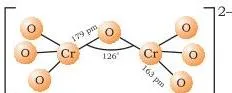
Chromate and dichromate interconvert with pH (NCERT, p. 105):
\[ 2\text{CrO}_4^{2-} + 2\text{H}^+ \rightleftharpoons \text{Cr}_2\text{O}_7^{2-} + \text{H}_2\text{O} \]
Acid pushes the equilibrium to orange dichromate; alkali pulls it back to yellow chromate. Chromium’s oxidation state is +6 in both. CrO₄²⁻ is tetrahedral; Cr₂O₇²⁻ is two tetrahedra sharing one corner, with a Cr–O–Cr bond angle of 126°.
In acid, dichromate’s oxidising half-reaction is the one to quote (NCERT, p. 105):
\[ \text{Cr}_2\text{O}_7^{2-} + 14\text{H}^+ + 6\text{e}^- \rightarrow 2\text{Cr}^{3+} + 7\text{H}_2\text{O} \quad (E^\circ = +1.33\ \text{V}) \]
It oxidises I⁻ → I₂, H₂S → S, Sn²⁺ → Sn⁴⁺ and Fe²⁺ → Fe³⁺. Add the two half-reactions to get the full ionic equation — with Fe²⁺:
\[ \text{Cr}_2\text{O}_7^{2-} + 14\text{H}^+ + 6\text{Fe}^{2+} \rightarrow 2\text{Cr}^{3+} + 6\text{Fe}^{3+} + 7\text{H}_2\text{O} \]
K₂Cr₂O₇ is a primary standard in volumetric analysis and is used in the leather industry and for preparing azo compounds.
Potassium Permanganate KMnO₄: Preparation and Medium-Dependent Half-Reactions
Preparation from pyrolusite (MnO₂) (NCERT, p. 106):
- Fuse MnO₂ with KOH and an oxidant (air or KNO₃) to give dark green manganate: 2MnO₂ + 4KOH + O₂ → 2K₂MnO₄ + 2H₂O.
- K₂MnO₄ disproportionates in neutral or acidic solution: 3MnO₄²⁻ + 4H⁺ → 2MnO₄⁻ + MnO₂ + 2H₂O.
- Commercially, the manganate(VI) is oxidised electrolytically in alkaline solution to permanganate.
In the laboratory, a Mn²⁺ salt is oxidised by peroxodisulphate: 2Mn²⁺ + 5S₂O₈²⁻ + 8H₂O → 2MnO₄⁻ + 10SO₄²⁻ + 16H⁺.
KMnO₄ forms dark purple (nearly black) crystals, isostructural with KClO₄, and decomposes at 513 K into K₂MnO₄, MnO₂ and O₂.

Both ions are tetrahedral with π-bonding between oxygen p orbitals and manganese d orbitals. The green MnO₄²⁻ is paramagnetic (one unpaired electron); the purple MnO₄⁻ is diamagnetic (no unpaired electron).
The product depends entirely on the medium (NCERT, p. 107) — this is the most-tested idea in the chapter:
| Medium | Product | Half-reaction | E° |
|---|---|---|---|
| Acidic | Mn²⁺ | MnO₄⁻ + 8H⁺ + 5e⁻ → Mn²⁺ + 4H₂O | +1.52 V |
| Neutral / faintly alkaline | MnO₂ | MnO₄⁻ + 4H⁺ + 3e⁻ → MnO₂ + 2H₂O | +1.69 V |
| Alkaline | MnO₄²⁻ | MnO₄⁻ + e⁻ → MnO₄²⁻ | +0.56 V |
Classic acidic oxidations: I⁻ → I₂, Fe²⁺ → Fe³⁺ (green to yellow), C₂O₄²⁻ → CO₂ (needs heating to 333 K), H₂S → S, SO₃²⁻ → SO₄²⁻, NO₂⁻ → NO₃⁻. Titrations in HCl are unsatisfactory because the acid itself is oxidised to chlorine.
Although KMnO₄ in theory oxidises water at [H⁺] = 1, the reaction is extremely slow unless Mn²⁺ is present or the temperature rises — a kinetic, not thermodynamic, point (NCERT, p. 107).
The Lanthanoids: Contraction, Oxidation States and Chemistry
The lanthanoids are the fourteen 4f elements Ce to Lu (with La usually included in discussion). All atoms have a common 6s² with variable 4f occupancy, and every Ln³⁺ ion is 4fⁿ (n = 1 to 14) — the +3 state is the most stable for all (NCERT, p. 108–109).
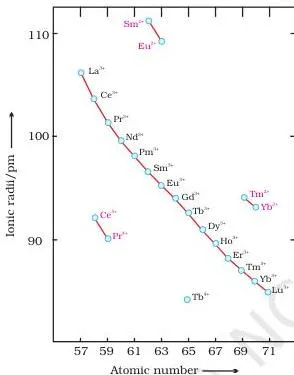
Lanthanoid contraction is the steady decrease in atomic and ionic radii from La to Lu (NCERT, p. 109). Cause: one 4f electron shields another imperfectly — less effectively than d electrons shield each other — so as nuclear charge climbs the whole 4fⁿ ion tightens.
The main consequence: the 5d series ends up nearly the same size as the 4d series (Zr 160 pm vs Hf 159 pm), which is why Zr and Hf occur together and are hard to separate.
Oxidation states. +3 dominates, but empty, half-filled and filled f sets create exceptions (NCERT, p. 109):
- Ce⁴⁺ has a noble-gas configuration; E°(Ce⁴⁺/Ce³⁺) = +1.74 V makes it a strong oxidant, yet it reacts with water so slowly that it is a good analytical reagent.
- Eu²⁺ (f⁷) and Yb²⁺ (f¹⁴) are strong reducing agents returning to +3.
- Tb⁴⁺ (f⁷) is an oxidant; Pr, Nd, Tb and Dy show +4 only in oxides MO₂.
General behaviour. The metals are soft, silvery-white and tarnish rapidly in air; hardness increases with atomic number (Sm is steel-hard). Many Ln³⁺ ions are coloured with narrow absorption bands (the transitions occur within the f level), and ions other than f⁰ and f¹⁴ types are paramagnetic. First ionisation enthalpy is around 600 kJ mol⁻¹.
E°(Ln³⁺/Ln) lies between −2.2 and −2.4 V (Eu −2.0 V). They combine with H₂ when heated, form carbides with carbon, liberate H₂ from dilute acids, burn in halogens, and give basic oxides M₂O₃ and hydroxides M(OH)₃ (real compounds, not hydrated oxides).
Uses: mischmetall (~95% lanthanoid + ~5% Fe) in lighter flints and Mg alloys; mixed lanthanoid oxides as petroleum-cracking catalysts; individual Ln oxides as TV phosphors (NCERT, p. 110). One alloy question you may meet: mischmetall is the lanthanoid-containing alloy.
The Actinoids: Configurations, Oxidation States and the Lanthanoid Comparison
The actinoids are the fourteen 5f elements Th to Lr (with Ac usually included). All are radioactive; the earlier members have long half-lives, but later ones drop to days or minutes (Lr about 3 minutes), and the latter members could only be prepared in nanogram quantities — which makes their study hard (NCERT, p. 111).
Configurations share 7s² with variable 5f and 6d occupancy. The crucial difference from the lanthanoids: 5f orbitals are not as buried as 4f orbitals, so they participate in bonding to a far greater extent (NCERT, p. 111).
Oxidation states. The 5f, 6d and 7s levels have comparable energies, so the actinoids show a wide range of states (NCERT, p. 112). +3 is common, and the first half reaches high states — +4 in Th, +5 in Pa, +6 in U, +7 in Np — before the values fall. The +3 and +4 ions tend to hydrolyse.
The actinoid contraction is the same size-shrinking effect as in the lanthanoids, but greater from element to element because the 5f electrons shield even more poorly.
Reactivity. Actinoid metals are highly reactive, especially when finely divided: boiling water gives a mixture of oxide and hydride, most non-metals react at moderate temperatures, HCl attacks all, nitric acid passivates most (protective oxide layer), and alkalies have no action.
Comparison table — lanthanoids vs actinoids (memorise the four rows):
| Feature | Lanthanoids (4f) | Actinoids (5f) |
|---|---|---|
| Series / configuration | Ce–Lu; atoms share 6s², variable 4f; Ln³⁺ = 4fⁿ | Th–Lr; 7s² with variable 5f/6d; 5f far more involved in bonding |
| Oxidation states | +3 principal; occasional +2 (Eu²⁺, Yb²⁺) and +4 (Ce⁴⁺, Tb⁴⁺) | Wide range; +3 common; first half reaches +4 to +7 (Th → Np) |
| Contraction | Lanthanoid contraction, regular, smaller per element | Actinoid contraction, greater per element (poor 5f shielding) |
| Reactivity / radioactivity | Mostly stable (Pm radioactive); soft metals that tarnish and react with dilute acids | All radioactive, later members short-lived; highly reactive, passivated by HNO₃ |
Magnetic behaviour in the actinoids is more complex than in the lanthanoids, and the early actinoids have lower ionisation enthalpies than the early lanthanoids because their outer electrons are less firmly held (NCERT, p. 112).
Applications of d- and f-Block Elements in Industry
These named uses appear often in short-answer questions (NCERT, p. 113):
- Steels — reduction of iron oxides, plus alloying Cr, Mn, Ni for hardened and stainless steels.
- Pigments and cells — TiO in the pigment industry; MnO₂ in dry cells; Zn and Ni/Cd in batteries.
- Coinage metals — Group 11 (Cu and its alloys); modern “silver” coins are a Cu/Ni alloy.
- Catalysts — V₂O₅ (Contact Process, SO₂ → SO₃), finely divided Fe (Haber process), Ni (hydrogenation of fats), PdCl₂ (Wacker oxidation of ethyne to ethanal), TiCl₄ + Al(CH₃)₃ (Ziegler catalysts for polyethylene).
- Photography — light-sensitive AgBr.
Key Terms and Definitions at a Glance
| Term | Meaning | Example |
|---|---|---|
| Transition element (IUPAC) | A metal with an incomplete d subshell in the neutral atom or in its ions | Sc (3d¹) yes; Zn (3d¹⁰) no |
| Lanthanoid contraction | Regular decrease in atomic/ionic radii from La to Lu from imperfect 4f shielding | Zr 160 pm ≈ Hf 159 pm |
| Actinoid contraction | Same radius decrease in the 5f series, greater per element | U → Np shrink more than 4f |
| Interstitial compound | Small H/C/N atoms trapped inside a metal lattice | TiC, Mn₄N, TiH₁.₇ |
| Alloy | A blend of metals whose radii differ by ≤ ~15% | Brass (Cu–Zn), bronze (Cu–Sn) |
| Disproportionation | One oxidation state changes into one lower and one higher state | 2Cu⁺ → Cu²⁺ + Cu |
| Paramagnetism | Attraction by a magnetic field, from unpaired electrons | Mn²⁺ (d⁵) |
| Diamagnetism | Repulsion by a magnetic field; no unpaired electrons | Zn²⁺ (d¹⁰), MnO₄⁻ |
| Spin-only magnetic moment | μ = √(n(n+2)) BM, fixed by unpaired electron count n | Fe³⁺ → 5.92 BM |
| Oxoanion / oxometal anion | Anion in which the metal holds its highest oxidation state bound to oxygen | VO₂⁺, CrO₄²⁻, MnO₄⁻ |
Common Mistakes Students Make in This Chapter
| Mistake | Correct rule | How to check your answer |
|---|---|---|
| “Zn is a transition element because it sits in the d-block.” | IUPAC needs an incomplete d subshell in the atom or ion; Zn is 3d¹⁰ in both. | Write Zn and Zn²⁺ configurations; if both are d¹⁰, it is not a transition metal. |
| “Cr is 3d⁴4s².” | Cr is 3d⁵4s¹ — the half-filled d set is extra stable. | Count Z = 24 electrons and apply the half-filled rule. |
| “Cu⁺ is stable in water.” | Cu⁺ disproportionates: 2Cu⁺ → Cu²⁺ + Cu. | Hydration enthalpy of Cu²⁺(aq) more than pays for the second ionisation. |
| “Acidic KMnO₄ gives MnO₂.” | Acid gives Mn²⁺ (+1.52 V); MnO₂ forms only in neutral/faintly alkaline medium (+1.69 V). | Pair every medium to its half-reaction before writing the product. |
| “Chromate and dichromate never interconvert.” | They interconvert with pH: 2CrO₄²⁻ + 2H⁺ ⇌ Cr₂O₇²⁻ + H₂O. | Add acid to yellow chromate → orange; add alkali to orange → yellow. |
| “Magnetic moment uses the charge value.” | Use n, the number of unpaired electrons, in μ = √(n(n+2)) with unit BM. | Write dⁿ, count unpaired electrons, substitute n, quote BM. |
Exam Notes: Where the Marks Are in This Chapter
- Half-reaction first. For dichromate, writing the balanced half-reaction Cr₂O₇²⁻ + 14H⁺ + 6e⁻ → 2Cr³⁺ + 7H₂O (E° = +1.33 V) earns the mark; a vague “it oxidises” does not.
- State the medium AND the product for KMnO₄. Acidic → Mn²⁺, neutral/faintly alkaline → MnO₂, alkaline → MnO₄²⁻. Both halves of the answer are needed.
- Magnetic moment questions need the full chain: configuration → count unpaired electrons → substitute into μ = √(n(n+2)) → give the unit (BM). Missing the unit costs a mark.
- “Why is Zn not a transition element?” needs two grounds: full d¹⁰ in the atom and in its ions. Give the IUPAC definition and apply it.
- Lanthanoid contraction: always name a consequence. Zr/Hf nearly identical radii and the difficulty of separating them is the standard follow-up.
- Read E° data, don’t memorise lists. From Table 4.2-style data: Mn³⁺/Co³⁺ have high positive E° (oxidising agents), Ti²⁺/V²⁺/Cr²⁺ have very negative values (strong reducing agents that can liberate H₂). State the d⁴ → d⁵ reasoning for the Cr²⁺/Mn³⁺ pair.
Revision Summary: The d and f Block Elements Class 12 Notes in One Table
| Topic | Key point | Exception / note | NCERT page |
|---|---|---|---|
| Position | d-block Groups 3–12; f-block bottom panel | Group 12 full d¹⁰, not transition metals | p. 89–90 |
| Configuration rule | (n−1)d¹⁻¹⁰ns¹⁻² | Cr 3d⁵4s¹, Cu 3d¹⁰4s¹, Pd 4d¹⁰5s⁰ | p. 90 |
| Lanthanoid contraction | Radii shrink across the 4f series | Zr 160 pm ≈ Hf 159 pm | p. 93 |
| Ionisation enthalpy | Rises slowly; breaks at d⁵ | Third IE of Fe < that of Mn | p. 95 |
| Oxidation states | Many states, Mn +2 to +7 | Differ by one; carbonyls give state 0 | p. 96 |
| E°(M²⁺/M) | Less negative across the series | Cu positive (+0.34 V), can’t give H₂ | p. 98 |
| Magnetic moment | μ = √(n(n+2)) BM | One unpaired e⁻ = 1.73 BM | p. 101 |
| Coloured ions | d–d transition, complementary colour seen | d⁰ and d¹⁰ ions colourless | p. 103 |
| K₂Cr₂O₇ | Chromite → Na₂CrO₄ → Na₂Cr₂O₇ → K₂Cr₂O₇ | Cr₂O₇²⁻ + 14H⁺ + 6e⁻ → 2Cr³⁺ + 7H₂O, E° +1.33 V | p. 105 |
| KMnO₄ | Pyrolusite → K₂MnO₄ → MnO₄⁻ | Medium decides product (Mn²⁺ / MnO₂ / MnO₄²⁻) | p. 106–107 |
| Lanthanoids | +3 principal state | Ce⁴⁺ good analytical reagent | p. 108–109 |
| Actinoids | Wide states, all radioactive | 5f bonds better than 4f; HNO₃ passivates | p. 111–112 |
For the rest of Class 12 chemistry, keep your Class 12 Chemistry notes and the wider Class 12 notes collection handy, or start from the CBSE notes index. The kinetics of the permanganate-water oxidation connects directly to the chemical kinetics class 12 notes.
FAQs on the d- and f-Block Elements
Why is zinc not a transition element even though it lies in the d-block?
By the IUPAC definition, a transition metal must have an incomplete d subshell in its neutral atom or in its ions. Zinc is 3d¹⁰ in its ground state and 3d¹⁰ as Zn²⁺ — the d subshell is always full — so it is not a transition element, even though its chemistry is studied with the 3d series.
Why does the Cu⁺ ion disproportionate in aqueous solution?
2Cu⁺ → Cu²⁺ + Cu is favoured because the hydration enthalpy of Cu²⁺(aq) is far more negative than that of Cu⁺, and that gain more than compensates for copper’s second ionisation enthalpy. In water, Cu²⁺(aq) is simply the more stable ion.
Why is the spin-only magnetic moment lower than the observed value for heavier transition ions?
The spin-only formula μ = √(n(n+2)) assumes the orbital contribution is completely quenched, which holds well for first-row ions. In heavier ions the orbital angular momentum is not fully quenched, so the measured moment comes out slightly above the spin-only value.
How does the product of KMnO₄ reduction change with the medium?
In acidic medium, MnO₄⁻ is reduced to Mn²⁺ (E° = +1.52 V). In neutral or faintly alkaline medium it goes to MnO₂ (E° = +1.69 V). In alkaline medium it falls only to manganate MnO₄²⁻ (E° = +0.56 V). Name the medium and the product together — that is what the examiner checks.
What is the difference between lanthanoid contraction and actinoid contraction?
Both are the steady shrinking of atomic and ionic radii across an f-series caused by imperfect f-electron shielding. The actinoid contraction is greater element to element because 5f electrons shield even more poorly than 4f electrons. The lanthanoid contraction is the more important one for exams because it explains the near-identical radii of Zr and Hf and their difficult separation.
Reference: NCERT Class 12 Chemistry Part I textbook, Unit 4 – The d- and f-Block Elements.
Explore Class 12 Chemistry Notes
Class 12 Chemistry on LearnCBSE:
Related chapters: