
Permutations and combinations class 11 notes — this page gives you the complete chapter in a shorter, exam-ready form. It covers the fundamental principle of counting, arrangements where order matters (permutations), selections where it doesn’t (combinations), every formula you need, fully worked original-number examples, tables that classify every question type, and common exam mistakes.
Use this as your primary revision source before a test.
Wondering why we cannot just list out possibilities? The textbook motivates everything with a suitcase lock: 4 wheels, digits 0–9, no repetition, and you remember only the first digit 7, the number of sequences to guess is \( ^9P_3 = 9 \times 8 \times 7 = 504 \). Listing 504 possibilities is a terrible idea; this chapter gives you the technique to count them in one line.
Everything here is from the ground up: clear definitions, all formulas, worked examples with original numbers (not from the textbook), common mistakes, and exam-oriented shortcuts. Perfect for a quick night-before-the-exam revision or to solidify the concepts for your Class 11 maths exam.
How the Chapter Is Built: Lock, Multiplication Principle, Permutation, Combination
| Chapter Stage | Key Idea | NCERT Pages |
|---|---|---|
| Suitcase-lock motivation | We need to count arrangements without listing them (the lock problem reduces to \( ^9P_3 \). | p. 101 |
| Fundamental principle of counting | If one event happens in \( m \) ways, then another in \( n \) ways, total ways are \( m \times n \). | pp. 101–104 |
| Permutations | Arrangements where order matters, from \( ^nP_r \) to repeated letters. | pp. 105–114 |
| Combinations | Selections where order doesn’t matter, with all properties of \( ^nC_r \). | pp. 115–119 |
| Miscellaneous mixed problems | Application of both permutations and combinations in single problems. | pp. 119–123 |
| Summary & Formula List | Recap of all key formulas. | p. 124 |
For a broader overview of the entire syllabus, check the Class 11 Maths Notes hub, or the complete list of Class 11 Notes. You can also refer to NCERT’s official website for the full curriculum and textbook PDFs.
Start Here: The Multiplication Principle and Counting in Stages
The fundamental principle of counting, often called the multiplication principle, is the engine that powers this entire chapter. It is the only tool you need to solve most of the early problems, and both permutations and combinations are just quicker ways to write its repeated application.
Imagine the problem of Mohan, who has 3 pants and 2 shirts. He can choose a pant in 3 ways, then a shirt in 2 ways, giving \( 3 \times 2 = 6 \) outfits. Similarly, Sabnam’s problem of choosing 2 school bags, 3 tiffin boxes, and 2 water bottles gives \( 2 \times 3 \times 2 = 12 \) ways. The figure below shows exactly how these possibilities branch out visually.
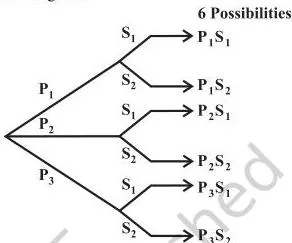
For example, how many different pairs of pants and shirts are possible? The first step has 3 choices (pants), and for each, the second has 2 choices (shirts). This is why it’s multiplication, not addition: we are making a sequence of choices.
- With 4 shirts and 3 ties, you can create \( 4 \times 3 = 12 \) outfits.
- Sabnam’s choice of 2 bags, 3 tiffin boxes, and 2 water bottles gives \( 2 \times 3 \times 2 = 12 \) ways of carrying them.
- You can generalize this to \( m \times n \times p \) for three events, and so on.
When we move to arrangements like signals made from flags, we use a combination of multiplication and addition. For example, if we have 5 flags and we can use 2, 3, 4, or all 5 flags, we calculate the number of signals for each case and then add them (since these are alternative cases). That gives us \( ^5P_2 + ^5P_3 + ^5P_4 + ^5P_5 = 20 + 60 + 120 + 120 = 320 \) possible signals.
Permutation: When the Order of Arrangement Matters
A permutation is simply an arrangement of objects where the order matters. If you are arranging 3 letters “A, B, C” and take all of them, “ABC” is different from “BCA” because the order is different. The fundamental principle of counting forms the base, and permutations are the first big application of it.
A permutation is an arrangement in a definite order of a number of objects taken some or all at a time. The key question to ask is: does changing the order create a new arrangement? If yes, you are dealing with a permutation.
To understand how we count them, imagine we are arranging \( r \) things out of \( n \) distinct items. We have \( r \) spots to fill.
- The first spot can be filled by any of the \( n \) items.
- The second spot can be filled by any of the remaining \( n-1 \) items.
- The third can be filled in \( n-2 \) ways, and so on.
This gives us the formula:
\[ ^nP_r = n(n-1)(n-2)\dots(n-r+1) = \frac{n!}{(n-r)!} \]
Here, \( n! \) (read as “n factorial”) is the product of all positive integers up to \( n \).
| Concept | Definition | Example |
|---|---|---|
| Factorial | \( n! = 1 \times 2 \times \dots \times n \) | \( 5! = 120 \) |
| Permutation | Order matters | Arranging 5 books on a shelf is \( ^5P_5 = 5! = 120 \) |
| Repetition allowed | Each position has all options | \( 5^3 = 125 \) three-letter codes with repetition |
Repeated Objects: Why We Divide by the Repeat Factorials
When we have objects that are not all distinct, we can’t use the simple permutation formula directly. Why? Because swapping the identical objects doesn’t change the arrangement, so we are overcounting. This is where the logic of dividing by factorials comes in. The division is based on the insight that rearranging identical items doesn’t create a new result.
Our figure shows the word ROOT. If we label the two O’s as \( O_1 \) and \( O_2 \), then \( RO_1O_2T \) and \( RO_2O_1T \) are different permutations of the labeled letters. However, they are the same word when we drop the labels.
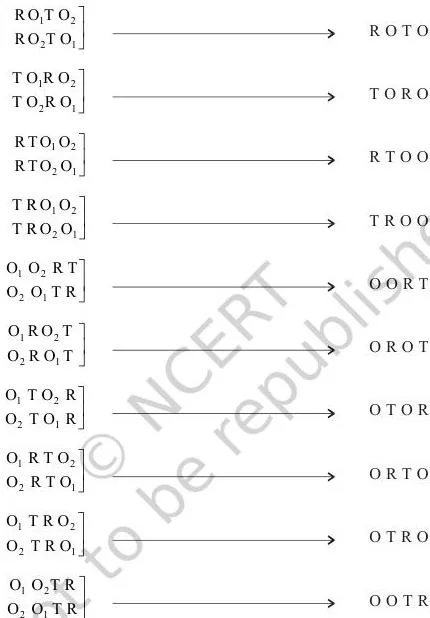
The general formula for the number of permutations of n objects taken all at a time, where p₁ are of one kind, p₂ are of a second kind, etc., is \( \frac{n!}{p_1! \times p_2! \times \dots \times p_k!} \). Why? For each distinct arrangement, you can rearrange the repeated items in p₁!
ways without changing the arrangement; hence we divide.
- For the word ROOT, there are 4 letters with O repeated twice, giving \( \frac{4!}{2!} = 12 \) distinct arrangements.
- For ALLAHABAD, we have 4 A’s, 2 L’s, so \( \frac{9!}{4! \times 2!} = 7560 \) ways.
- For INDEPENDENCE, with N thrice, E four times, and D twice, we get \( \frac{12!}{3! \times 4! \times 2!} \).
This method of dividing by the repetitions of all identical items works because dividing by the factorial of each repeated set corrects for the overcounting.
Combination: When Only the Selection Matters
Often, we don’t care about the order in which we select things; we only care what we selected. This is a combination. The formula is at the heart of the chapter. In the figure below, you see how a team of two can be formed from three players, with order not mattering.

To count selections, we use a simple yet powerful relation with permutations. Since each group or combination of r objects can be rearranged in r! orders, we have \( ^nP_r = ^nC_r \times r! \). Therefore, the combination formula is \( ^nC_r = \frac{^nP_r}{r!} = \frac{n!}{r!(n-r)!} \).
The figure visually demonstrates why \( ^nC_r \) counts only the distinct teams. These are the basic building blocks for more complex counting.
| Property | Formula |
|---|---|
| Basic properties | \( ^nC_0 = 1 \), \( ^nC_n = 1 \) |
| Symmetric property | \( ^nC_r = ^nC_{n-r} \) |
| Equal combinations | \( ^nC_a = ^nC_b \Rightarrow a = b \) or \( a+b = n \) |
| Pascal’s identity | \( ^nC_r + ^nC_{r-1} = ^{n+1}C_r \) |
| Relation | \( ^nP_r = ^nC_r \times r! \) |
Common examples of combinations include counting handshakes, choosing committee members, or selecting cards from a deck. For instance, the number of possible handshakes among 12 people is \( ^{12}C_2 \).
Key Terms and Definitions: A Table to Memorise
All the vocabulary of the chapter, condensed.
| Term | Meaning | Example |
|---|---|---|
| Multiplication Principle | If one job can be done in m ways and another in n ways, together they can be done in mn ways. | 3 shirts and 2 pants gives \( 3 \times 2 = 6 \) outfits. |
| Permutation | Arrangement of objects in a definite order. Order matters. | Arranging 3 books on a shelf: \( 3P_3 = 6 \). |
| Combination | Selection of objects where order does not matter. | Choosing 3 books from 5 to carry: \( ^5C_3 = 10 \). |
| Factorial | The product of all positive integers up to a given number. | \( 5! = 120 \) |
| \( ^nP_r \) | Number of permutations of n things taken r at a time. | \( ^5P_3 = 60 \) |
| \( ^nC_r \) | Number of combinations of n things taken r at a | |
| Repetition Allowed | Each slot can be filled by any of the n objects. | \( n^r \) arrangements. |
All Formulas of This Chapter in One Table
Here is the complete set of formulas you need for your board exams.
| Formula | What the symbols mean | When to use it |
|---|---|---|
| \( m \times n \) | Event 1 in \( m \) ways, Event 2 in \( n \) ways | Multiplication principle (sequential events) |
| \( n! = 1 \times 2 \times \dots \times n \) | \( n \) is a positive integer | Definition of factorial |
| \( n! = n \times (n-1)! \) | Recursive property | Simplifying factorial expressions |
| \( 0! = 1 \) | By definition | Making formulas consistent |
| \( ^nP_r = \frac{n!}{(n-r)!} \) | \( n \) distinct objects, take \( r \) without repetition | Arrangements where order matters (no repeats) |
| \( n^r \) | \( n \) distinct objects, take \( r \) with repetition | Arrangements with repetition allowed |
| \( \frac{n!}{p_1! p_2! \dots p_k!} \) | \( p_1, p_2, \dots \) are identical objects | Arrangements with repeated objects |
| \( ^nC_r = \frac{n!}{r!(n-r)!} \) | \( n \) distinct objects, select \( r \) | Selections where order doesn’t matter |
| \( ^nP_r = ^nC_r \times r! \) | Relation between P and C | Converting between permutations and combinations |
Remember, both \( ^nP_r \) and \( ^nC_r \) only work when \( 0 \le r \le n \).
Permutation or Combination? A Decision Table
The single most common question students face: is this a permutation or a combination? The answer determines your entire approach. Use this decision table as your guide.
| Clue Word (Permutation) | Clue Word (Combination) |
|---|---|
| Arrange | Choose |
| Order | Select |
| Rank | Team |
| Password | Committee |
| Stand in a row | Handshake |
Think of it this way: a password is a permutation because the order of characters or numbers is crucial. Conversely, a pizza is a combination—the order of toppings doesn’t change the pizza you get.
Memory Rule: \( ^nP_r = ^nC_r \times r! \). A permutation is just a combination where every selected group is then rearranged.
Worked Examples: New Numbers, Full Working
Learning by imitating is the most reliable way to approach exam problems. Let’s work through some original problems to see the entire method in action.
Example 1: The Multiplication Principle
How many 3-digit even numbers can be formed using the digits 3, 4, 5, 6, 7, 8 if repetition is allowed?
- Step 1: Understand the constraint. The number must be even, so the unit’s digit must be even. Also, since it’s a 3-digit number, the hundred’s digit cannot be 0 (though 0 is not available here anyway).
- Step 2: Since repetition is allowed, the hundred’s digit can be any of the 6 given digits, and so can the ten’s digit.
- Step 3: The unit’s digit must be even, which can be 4, 6, or 8 (3 choices).
- Step 4: Therefore, the total is \( 6 \times 6 \times 3 = 108 \) even numbers.
Example 2: Permutation (No Repetition)
How many 4-letter codes can be formed using the letters A, B, C, D, E, F without repeating any letter?
- Step 1: This is a permutation problem because the order of letters matters (code ABCD is different from DCBA).
- Step 2: We have \( n = 6 \) distinct letters, and we are choosing \( r = 4 \).
- Step 3: Apply the formula \( ^nP_r = \frac{n!}{(n-r)!} = \frac{6!}{(6-4)!} = \frac{720}{2} = 360 \).
- Final answer: There are 360 such codes.
Example 3: Repeated Letters in a Word
Find the number of distinct arrangements of the letters of the word TATTER.
- Step 1: Count the total letters: T-A-T-T-E-R has 6 letters.
- Step 2: Identify repeated letters: T appears 3 times (*T* is repeated).
- Step 3: Divide the total factorial by the factorial of the repeated letter’s count: \( \frac{6!}{3!} = \frac{720}{6} = 120 \).
- Final answer: There are 120 distinct arrangements.
Example 4: Combination with Conditional Selection
In how many ways can a committee of 4 be formed from 6 boys and 5 girls if it must contain at least 2 girls?
- Step 1: Break down the condition. “At least 2 girls” can mean exactly 2 girls, exactly 3 girls, or exactly 4 girls.
- Step 2: If there are exactly 2 girls, we choose 2 girls out of 5, and 2 boys out of 6: \( ^5C_2 \times ^6C_2 = 10 \times 15 = 150 \).
- Step 3: If there are exactly 3 girls, we choose 3 girls out of 5, and 1 boy out of 6: \( ^5C_3 \times ^6C_1 = 10 \times 6 = 60 \).
- Step 4: If there are exactly 4 girls, all must be chosen: \( ^5C_4 = 5 \).
- Final answer: \( 150 + 60 + 5 = 215 \) ways.
Example 5: The Gap Method for Vowels/Consonants
In how many ways can 4 boys and 3 girls be seated in a row such that no two girls are together?
- Step 1: Arrange the 4 boys first. They can be arranged in \( 4! = 24 \) ways.
- Step 2: Now, create gaps for the girls. There are \( 4+1 = 5 \) possible gaps (one before, between, and after the boys).
- Step 3: Choose 3 of these 5 gaps for the girls and arrange them: \( ^5P_3 = \frac{5!}{2!} = 60 \).
- Final answer: \( 24 \times 60 = 1440 \) ways.
These are practice examples and not the NCERT textbook exercise answers.
Common Mistakes in Permutations and Combinations (and the Correction)
Here is a quick checklist of common pitfalls.
| Students write… | Correct answer is… | Because… |
|---|---|---|
| \( 0! = 0 \) | \( 0! = 1 \) | It’s defined to make formulas work. |
| \( 3! + 4! = 7! \) | \( 6 + 24 = 30 \) | Factorials are not linear; you must calculate each factorial first. |
| Arranging BANANA as \( 6! \) | \( \frac{6!}{3! \times 2!} = 60 \) | Because A and N repeat, dividing corrects for overcounting. |
| Using \( ^nP_r \) for a committee | Use \( ^nC_r \) | Committee selection doesn’t care about order, only selection. |
| Counting numbers with 0 without subtracting zero-leading cases | Subtract cases with 0 fixed in the first place | A number cannot start with 0. |
| Treating ‘at least one’ as a single case | List all valid cases and add them | It includes multiple scenarios that must all be counted. |
Exam Notes: Question Types NCERT Actually Asks
The best way to prepare for the board exam is to see how the questions appear. Here are the common patterns from the textbook.
| Question Pattern | NCERT Source | Skill Tested |
|---|---|---|
| Words from letters | Example 11, 14 | Permutations with repeated letters |
| Vowels always together | Example 16 | Treat the group as a single unit |
| Digits with zero restriction | Example 21, 22, 23 | Handling restrictions on digits |
| Committees with conditions | Example 18 | Combinations and restrictions |
| Cards from a deck | Example 19 | Combinations in a standard deck |
| Dictionary order | Example 22 | Permutations in alphabetical order |
| Seating with gaps | Example 24 | Arrangements with restrictions |
Reading the NCERT Figures: Trees and Grouping Diagrams
Diagrams are not just decoration; they encode the logic of the counting. Here’s what each important figure in the chapter is really telling you:
- Figures 6.1 and 6.2 show how the multiplication principle works as a tree diagram.
- The p.109 grouping figure visually explains why repeated letters reduce the number of unique arrangements.
- Figure 6.3 demonstrates that order does not matter in combinations.
Revision Summary: The Chapter on One Page
A final, super-condensed checklist for your last-minute revision.
- Does order matter?
- No → Use Combination \( ^nC_r = \frac{n!}{r!(n-r)!} \).
- Yes → Are repetitions allowed?
- Yes → \( n^r \)
- No → Are all objects distinct?
- Yes → \( ^nP_r = \frac{n!}{(n-r)!} \)
- No → Divide by repeat factorials \( \frac{n!}{p_1! \times p_2! \times \dots} \)
This decision tree should be your automatic response when facing any counting problem. It tells you exactly which formula to use.
Reference: NCERT Class 11 Mathematics textbook, chapter 6 Permutations and Combinations.
Continue practicing with the Binomial Theorem notes which build directly on combinatorics.
FAQs: Quick Answers Before the Exam
How do I decide whether a question needs nPr or nCr?
Ask yourself: does the order matter? If you are arranging items (e.g., forming words, ranking, arranging digits in a number), use \( ^nP_r \) because different orders give different arrangements. If you are simply selecting items (e.g., forming a committee, choosing players, selecting cards), use \( ^nC_r \) because the order doesn’t change the selection.
The key is to check if swapping two chosen items creates a different, countable outcome.
Why is 0! equal to 1 and not 0?
This is not a coincidence but a definition designed to make formulas consistent. Consider the factorial property \( n! = n \times (n-1)! \). If we set \( n = 1 \), we get \( 1! = 1 \times 0! \), which implies \( 0! = 1 \). This also ensures that formulas like \( ^nC_0 = 1 \) hold true. It’s a convention that simplifies many equations in combinatorics.
When arranging letters that repeat, why do we divide by the factorials of the repeated letters?
Because division corrects for overcounting. When you treat identical letters as distinct, you count each unique arrangement multiple times. By dividing by the factorial of the frequency of each repeated letter, you’re effectively saying each distinct word is counted that many times, so you divide to get the actual number.
For example, in the word “LETTER”, E and T each repeat, so you divide \( 6! \) by \( 2! \times 2! \).
In digit problems that include 0, why do we subtract the cases that start with zero?
Because a number cannot start with the digit 0. When a question asks for a 3-digit number, the hundreds place cannot be 0. If you compute \( ^nP_r \) directly, you are including numbers that start with 0 (like 012, which is just 12).
To fix this, you calculate the total permutations including those starting with 0, then subtract the cases where the first digit is 0 (which is the number of ways to arrange the remaining digits in the remaining positions).
What is the relation between nPr and nCr?
The relation is \( ^nP_r = ^nC_r \times r! \). This means every permutation (arrangement) can be thought of as first choosing a group (combination) and then arranging that group in \( r! \) ways. This is a fundamental link that helps in deriving the formula for combinations and solving complex problems.
What does ‘at least one’ mean in committee questions and how do I count it?
“At least one” means the condition is met if you have one or more. For example, in a committee of 5 from 6 boys and 5 girls with at least 2 girls, you need to add the permutations for exactly 2 girls, exactly 3 girls, and exactly 4 girls (the maximum possible).
This is because these are mutually exclusive cases that together cover all possibilities that satisfy the condition.
Explore Class 11 Mathematics Notes
More for this chapter:
Class 11 Mathematics on LearnCBSE:
Related chapters: