
These trigonometric functions class 11 notes compress Chapter 3 of the NCERT Mathematics textbook into a revision-ready format for the 2026-27 session. You get angle measures, unit-circle definitions, sign rules, every identity family, and worked examples with original numbers — everything needed to revise the night before an exam. Each section maps to the NCERT page numbers so you can cross-check quickly.
Angles and Their Measures: Degree and Radian
An angle is a measure of rotation of a given ray about its initial point (NCERT, p. 1). The original ray is the initial side, the final position is the terminal side, and the point of rotation is the vertex. Rotation anticlockwise gives a positive angle; clockwise gives a negative angle.
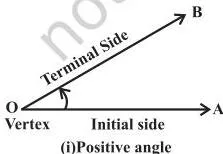
Degree measure
If a rotation is \(\frac{1}{360}\) of a revolution, the angle has measure one degree (\(1^\circ\)). A degree divides into 60 minutes (\(1^\circ = 60’\)), and a minute into 60 seconds (\(1′ = 60”\)) (NCERT, p. 2).
Radian measure
An angle subtended at the centre by an arc of length 1 unit in a unit circle (radius 1) has measure 1 radian (NCERT, p. 3). More generally, in a circle of radius \(r\), an arc of length \(l\) subtends an angle \(\theta\) radian, giving the fundamental relation:
\[ l = r\theta \]
Here \(l\) is the arc length, \(r\) is the radius, and \(\theta\) is the angle in radians. This formula works only when \(\theta\) is in radians, never degrees.
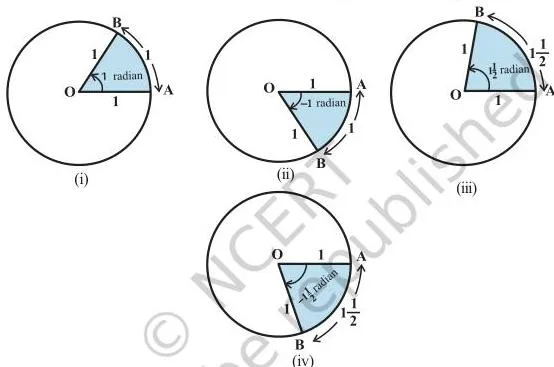
Conversion between degree and radian
Since one complete revolution is \(360^\circ\) and also \(2\pi\) radians, we get the key relation (NCERT, p. 4):
\[ \pi \text{ radian} = 180^\circ \]
This gives the two conversion formulas (NCERT, p. 5):
- Radian measure \(= \frac{\pi}{180} \times \text{Degree measure}\)
- Degree measure \(= \frac{180}{\pi} \times \text{Radian measure}\)
Notational convention: when an angle is written without a degree symbol (like \(\pi\) or \(\frac{\pi}{4}\)), it means radians. So \(\pi = 180^\circ\) and \(\frac{\pi}{4} = 45^\circ\).
Common angle conversion table
| Degree | 30° | 45° | 60° | 90° | 180° | 270° | 360° |
|---|---|---|---|---|---|---|---|
| Radian | \(\frac{\pi}{6}\) | \(\frac{\pi}{4}\) | \(\frac{\pi}{3}\) | \(\frac{\pi}{2}\) | \(\pi\) | \(\frac{3\pi}{2}\) | \(2\pi\) |
Approximate values: \(1 \text{ radian} \approx 57^\circ 16’\) and \(1^\circ \approx 0.01746\) radian (NCERT, p. 4).
Trigonometric Functions on the Unit Circle
Consider a unit circle with centre at the origin. Let \(P(a, b)\) be any point on the circle with \(\angle AOP = x\) radian (NCERT, p. 7). We define:
\[ \cos x = a, \quad \sin x = b \]
Since \(\triangle OMP\) is right-angled, \(OM^2 + MP^2 = OP^2\), so \(a^2 + b^2 = 1\). This gives the fundamental Pythagorean identity:
\[ \cos^2 x + \sin^2 x = 1 \]
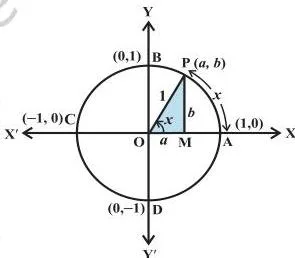
Quadrantal angles
Angles that are integral multiples of \(\frac{\pi}{2}\) are called quadrantal angles. Their coordinates give:
| Angle | Point | \(\cos\) | \(\sin\) |
|---|---|---|---|
| \(0\) | \((1, 0)\) | 1 | 0 |
| \(\frac{\pi}{2}\) | \((0, 1)\) | 0 | 1 |
| \(\pi\) | \((-1, 0)\) | −1 | 0 |
| \(\frac{3\pi}{2}\) | \((0, -1)\) | 0 | −1 |
| \(2\pi\) | \((1, 0)\) | 1 | 0 |
Periodicity
If \(x\) increases or decreases by any integral multiple of \(2\pi\), the point P returns to the same position. Hence (NCERT, p. 7):
\[ \sin(2n\pi + x) = \sin x, \quad \cos(2n\pi + x) = \cos x, \quad n \in \mathbb{Z} \]
Also, \(\sin x = 0\) when \(x = n\pi\), and \(\cos x = 0\) when \(x = (2n+1)\frac{\pi}{2}\), for any integer \(n\).
The other four functions
Defined in terms of sine and cosine (NCERT, p. 7-8):
- \(\csc x = \frac{1}{\sin x}\), \(x \neq n\pi\)
- \(\sec x = \frac{1}{\cos x}\), \(x \neq (2n+1)\frac{\pi}{2}\)
- \(\tan x = \frac{\sin x}{\cos x}\), \(x \neq (2n+1)\frac{\pi}{2}\)
- \(\cot x = \frac{\cos x}{\sin x}\), \(x \neq n\pi\)
From \(\cos^2 x + \sin^2 x = 1\), dividing by \(\cos^2 x\) and \(\sin^2 x\) respectively gives the other two Pythagorean identities:
\[ 1 + \tan^2 x = \sec^2 x, \quad 1 + \cot^2 x = \csc^2 x \]
Standard values table
| Angle | \(0^\circ\) | \(30^\circ\) | \(45^\circ\) | \(60^\circ\) | \(90^\circ\) |
|---|---|---|---|---|---|
| \(\sin\) | 0 | \(\frac{1}{2}\) | \(\frac{1}{\sqrt{2}}\) | \(\frac{\sqrt{3}}{2}\) | 1 |
| \(\cos\) | 1 | \(\frac{\sqrt{3}}{2}\) | \(\frac{1}{\sqrt{2}}\) | \(\frac{1}{2}\) | 0 |
| \(\tan\) | 0 | \(\frac{1}{\sqrt{3}}\) | 1 | \(\sqrt{3}\) | not defined |
Sign of Trigonometric Functions by Quadrant
For a point \(P(a, b)\) on the unit circle, the signs of \(a\) and \(b\) depend on the quadrant (NCERT, p. 9). Since \(\sin x = b\) and \(\cos x = a\):
- Quadrant I \((0 \lt x \lt \frac{\pi}{2})\): both \(a\) and \(b\) positive
- Quadrant II \((\frac{\pi}{2} \lt x \lt \pi)\): \(a\) negative, \(b\) positive
- Quadrant III \((\pi \lt x \lt \frac{3\pi}{2})\): both \(a\) and \(b\) negative
- Quadrant IV \((\frac{3\pi}{2} \lt x \lt 2\pi)\): \(a\) positive, \(b\) negative
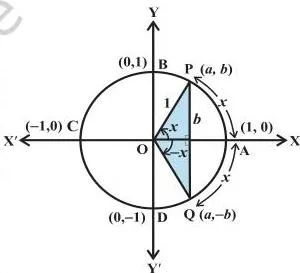
Full sign table
| Function | I | II | III | IV |
|---|---|---|---|---|
| \(\sin x\) | + | + | − | − |
| \(\cos x\) | + | − | − | + |
| \(\tan x\) | + | − | + | − |
| \(\csc x\) | + | + | − | − |
| \(\sec x\) | + | − | − | + |
| \(\cot x\) | + | − | + | − |
Mnemonic — “All Students Take Calculus”: starting from Quadrant I and moving anticlockwise, the first letter of each word tells you which functions are positive: All (all three) in QI, Sin (and csc) in QII, Tan (and cot) in QIII, Cos (and sec) in QIV.
Negative angle identities
From the figure, \(Q\) has coordinates \((a, -b)\), so (NCERT, p. 9):
\[ \cos(-x) = \cos x, \quad \sin(-x) = -\sin x \]
Since \(-1 \leq a \leq 1\) and \(-1 \leq b \leq 1\) for every point on the unit circle:
\[ -1 \leq \sin x \leq 1, \quad -1 \leq \cos x \leq 1 \]
Domain and Range of the Six Trigonometric Functions
The domain and range of each function follow directly from its definition (NCERT, p. 10).
| Function | Domain | Range |
|---|---|---|
| \(\sin x\) | All real numbers \(\mathbb{R}\) | \([-1, 1]\) |
| \(\cos x\) | All real numbers \(\mathbb{R}\) | \([-1, 1]\) |
| \(\tan x\) | \(\mathbb{R}\), \(x \neq (2n+1)\frac{\pi}{2}\) | All real numbers |
| \(\cot x\) | \(\mathbb{R}\), \(x \neq n\pi\) | All real numbers |
| \(\sec x\) | \(\mathbb{R}\), \(x \neq (2n+1)\frac{\pi}{2}\) | \((-\infty, -1] \cup [1, \infty)\) |
| \(\csc x\) | \(\mathbb{R}\), \(x \neq n\pi\) | \((-\infty, -1] \cup [1, \infty)\) |
Why the ranges differ: \(\sin x\) and \(\cos x\) are coordinates of a point on the unit circle, so they stay between −1 and 1. Their reciprocals \(\csc x\) and \(\sec x\) therefore can never lie between −1 and 1 — they jump from −1 to −∞ and from 1 to +∞. \(\tan x\) and \(\cot x\) are ratios, so they can take any real value.
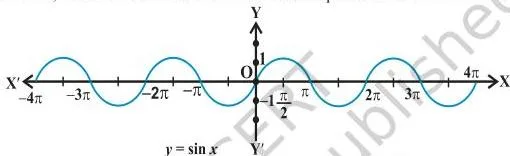
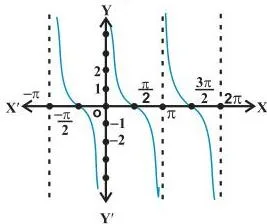
Periodicity: \(\sin x\), \(\cos x\), \(\sec x\), \(\csc x\) repeat after \(2\pi\); \(\tan x\) and \(\cot x\) repeat after \(\pi\) (NCERT, p. 12).
Sum and Difference Identities
These are the core identities from which everything else in the chapter follows (NCERT, p. 15-19).
The four basic identities
\[ \cos(x+y) = \cos x \cos y – \sin x \sin y \]
\[ \cos(x-y) = \cos x \cos y + \sin x \sin y \]
\[ \sin(x+y) = \sin x \cos y + \cos x \sin y \]
\[ \sin(x-y) = \sin x \cos y – \cos x \sin y \]
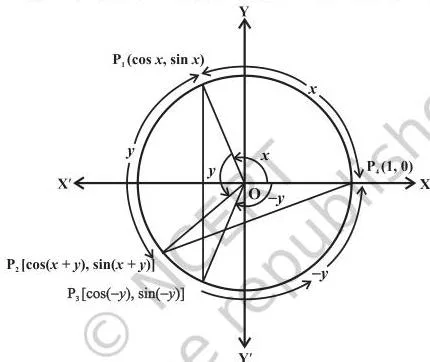
Why the minus sign flips: in \(\cos(x+y)\), the sine terms multiply with a minus; in \(\cos(x-y)\), they add. Replacing \(y\) by \(-y\) in the \(\cos(x+y)\) formula and using \(\cos(-y) = \cos y\), \(\sin(-y) = -\sin y\) converts one into the other.
Related angle identities
Putting specific values into the four basic identities gives (NCERT, p. 17-18):
| Angle | \(\cos\) | \(\sin\) |
|---|---|---|
| \(\frac{\pi}{2} – x\) | \(\sin x\) | \(\cos x\) |
| \(\frac{\pi}{2} + x\) | \(-\sin x\) | \(\cos x\) |
| \(\pi – x\) | \(-\cos x\) | \(\sin x\) |
| \(\pi + x\) | \(-\cos x\) | \(-\sin x\) |
| \(2\pi – x\) | \(\cos x\) | \(-\sin x\) |
Tan and cot sum formulas
If none of \(x\), \(y\), \((x \pm y)\) is an odd multiple of \(\frac{\pi}{2}\) (NCERT, p. 18-19):
\[ \tan(x+y) = \frac{\tan x + \tan y}{1 – \tan x \tan y}, \quad \tan(x-y) = \frac{\tan x – \tan y}{1 + \tan x \tan y} \]
If none of \(x\), \(y\), \((x \pm y)\) is a multiple of \(\pi\):
\[ \cot(x+y) = \frac{\cot x \cot y – 1}{\cot y + \cot x}, \quad \cot(x-y) = \frac{\cot x \cot y + 1}{\cot y – \cot x} \]
Double Angle and Triple Angle Formulas
Replacing \(y\) by \(x\) in the sum formulas gives the double-angle family (NCERT, p. 19-21).
Double angle
\[ \cos 2x = \cos^2 x – \sin^2 x = 2\cos^2 x – 1 = 1 – 2\sin^2 x = \frac{1 – \tan^2 x}{1 + \tan^2 x} \]
\[ \sin 2x = 2\sin x \cos x = \frac{2\tan x}{1 + \tan^2 x} \]
\[ \tan 2x = \frac{2\tan x}{1 – \tan^2 x}, \quad 2x \neq n\pi + \frac{\pi}{2} \]
Why \(\cos 2x\) has four forms: each form comes from substituting \(\sin^2 x = 1 – \cos^2 x\) or \(\cos^2 x = 1 – \sin^2 x\), or dividing by \(\cos^2 x + \sin^2 x = 1\). The skill in exams is choosing the form that matches what you are given — if the question gives \(\sin x\), use \(1 – 2\sin^2 x\); if it gives \(\tan x\), use the fraction form.
Triple angle
\[ \sin 3x = 3\sin x – 4\sin^3 x \]
\[ \cos 3x = 4\cos^3 x – 3\cos x \]
\[ \tan 3x = \frac{3\tan x – \tan^3 x}{1 – 3\tan^2 x}, \quad 3x \neq n\pi + \frac{\pi}{2} \]
Sum to Product and Product to Sum Formulas
These identities convert sums of functions into products (and vice versa). They drive most of the proof questions in Exercise 3.3 (NCERT, p. 21-23).
Sum to product (identity set 20)
\[ \cos x + \cos y = 2\cos\frac{x+y}{2}\cos\frac{x-y}{2} \]
\[ \cos x – \cos y = -2\sin\frac{x+y}{2}\sin\frac{x-y}{2} \]
\[ \sin x + \sin y = 2\sin\frac{x+y}{2}\cos\frac{x-y}{2} \]
\[ \sin x – \sin y = 2\cos\frac{x+y}{2}\sin\frac{x-y}{2} \]
Product to sum (identity set 21)
\[ 2\cos x \cos y = \cos(x+y) + \cos(x-y) \]
\[ -2\sin x \sin y = \cos(x+y) – \cos(x-y) \]
\[ 2\sin x \cos y = \sin(x+y) + \sin(x-y) \]
\[ 2\cos x \sin y = \sin(x+y) – \sin(x-y) \]
How one set becomes the other: add and subtract the \(\cos(x+y)\) and \(\cos(x-y)\) formulas to get the product-to-sum set. Then substitute \(x = \frac{\theta+\phi}{2}\) and \(y = \frac{\theta-\phi}{2}\) to convert back to sum-to-product form.
Trigonometric Functions Class 11 Notes: Worked Examples
These four examples cover the question types that appear most often. All numbers are original.
Example 1: Convert \(52^\circ 30’\) into radians
Step 1: Convert the minutes to degrees.
\(30′ = \frac{30}{60} = 0.5^\circ\), so \(52^\circ 30′ = 52.5^\circ = \frac{105}{2}\) degrees.
Step 2: Apply the conversion formula \(\text{Radian} = \frac{\pi}{180} \times \text{Degree}\).
\[ \frac{\pi}{180} \times \frac{105}{2} = \frac{105\pi}{360} = \frac{7\pi}{24} \]
Final answer: \(52^\circ 30′ = \frac{7\pi}{24}\) radian.
Example 2: Arc length in a circle of radius 21 cm with central angle 40°
- Step 1: Convert the angle to radians: \(\theta = 40^\circ = 40 \times \frac{\pi}{180} = \frac{2\pi}{9}\) radian.
- Step 2: Apply \(l = r\theta\) with \(r = 21\) cm.
\[ l = 21 \times \frac{2\pi}{9} = \frac{42\pi}{9} = \frac{14\pi}{3} \text{ cm} \]
Final answer: \(l = \frac{14\pi}{3}\) cm \(\approx 14.66\) cm.
Example 3: If \(\sin x = \frac{5}{13}\) and \(x\) lies in the second quadrant, find the other five functions
Step 1: Use \(\cos^2 x = 1 – \sin^2 x = 1 – \frac{25}{169} = \frac{144}{169}\).
So \(\cos x = \pm \frac{12}{13}\).
Step 2: Sign decision: \(x\) is in QII, where \(\cos x\) is negative.
Hence \(\cos x = -\frac{12}{13}\).
Step 3: Compute the remaining functions using the definitions.
\[ \tan x = \frac{\sin x}{\cos x} = \frac{5/13}{-12/13} = -\frac{5}{12} \]
\[ \csc x = \frac{13}{5}, \quad \sec x = -\frac{13}{12}, \quad \cot x = -\frac{12}{5} \]
Final answer: \(\cos x = -\frac{12}{13}\), \(\tan x = -\frac{5}{12}\), \(\csc x = \frac{13}{5}\), \(\sec x = -\frac{13}{12}\), \(\cot x = -\frac{12}{5}\).
Example 4: Given \(\sin x = \frac{3}{5}\) (QII) and \(\cos y = \frac{5}{13}\) (QIV), find \(\sin(x-y)\)
Step 1: Find \(\cos x\).
\(\cos^2 x = 1 – \frac{9}{25} = \frac{16}{25}\), so \(\cos x = \pm \frac{4}{5}\).
Since \(x\) is in QII, \(\cos x = -\frac{4}{5}\).
Step 2: Find \(\sin y\).
\(\sin^2 y = 1 – \frac{25}{169} = \frac{144}{169}\), so \(\sin y = \pm \frac{12}{13}\).
Since \(y\) is in QIV, \(\sin y = -\frac{12}{13}\).
Step 3: Apply \(\sin(x-y) = \sin x \cos y – \cos x \sin y\).
\[ \sin(x-y) = \frac{3}{5} \times \frac{5}{13} – \left(-\frac{4}{5}\right) \times \left(-\frac{12}{13}\right) = \frac{15}{65} – \frac{48}{65} = -\frac{33}{65} \]
Final answer: \(\sin(x-y) = -\frac{33}{65}\).
Common Mistakes Students Make
| Mistake | Correct rule | How to check your answer |
|---|---|---|
| Writing \(\sin 2x = 2\sin x\) | \(\sin 2x = 2\sin x \cos x\) — the value depends on \(\cos x\) too | Test with \(x = 30^\circ\): \(\sin 60^\circ = \frac{\sqrt{3}}{2}\) but \(2\sin 30^\circ = 1\) |
| Writing \(\cos(x-y) = \cos x \cos y – \sin x \sin y\) | \(\cos(x-y) = \cos x \cos y + \sin x \sin y\); the minus belongs to \(\cos(x+y)\) | Put \(x = y\): \(\cos 0 = 1\) requires the plus sign |
| Taking the positive square root without checking the quadrant | The quadrant fixes the sign of \(\sin x\) and \(\cos x\) | If \(x\) is in QII, \(\cos x\) must be negative |
| Converting with the wrong factor: \(\text{degree} = \text{radian} \times \frac{\pi}{180}\) | \(\text{Degree} = \frac{180}{\pi} \times \text{Radian}\) — the factor flips | Since \(\pi\) radian = 180°, multiplying by \(\frac{180}{\pi}\) must give degrees |
| Quoting \(\tan\frac{\pi}{2}\) as a number | \(\tan x\) is undefined at \(x = (2n+1)\frac{\pi}{2}\) | \(\cos\frac{\pi}{2} = 0\), so \(\tan\frac{\pi}{2} = \frac{\sin}{\cos}\) divides by zero |
Exam Notes: What Earns Marks
Observed patterns from the NCERT exercises (NCERT, p. 30-32):
- Exercise 3.3 proof questions rely heavily on the sum-to-product identities (set 20) and product-to-sum identities (set 21). The standard move is converting the numerator and denominator separately, as in Example 16: \(\frac{\cos 7x + \cos 5x}{\sin 7x – \sin 5x} = \cot x\).
- The double-angle forms \(\cos 2x = 1 – 2\sin^2 x\) and \(\cos 2x = 2\cos^2 x – 1\) are the usual bridge in half-angle and triple-angle proofs.
- In “find the value” questions, the step that earns the mark is reducing the angle to a standard angle before evaluating — for example, writing \(\frac{31\pi}{3}\) as \(10\pi + \frac{\pi}{3}\) and then using \(\sin\frac{\pi}{3} = \frac{\sqrt{3}}{2}\).
- Writing the identity name beside each line (e.g. “using set 20(i)”) is good practice and helps the examiner follow your logic.
Trigonometric Functions Class 11 Notes: One Page Recap
| Topic | Key facts |
|---|---|
| Angle measures | \(l = r\theta\); \(\text{Radian} = \frac{\pi}{180} \times \text{Degree}\); \(\text{Degree} = \frac{180}{\pi} \times \text{Radian}\) |
| Sign rules | \(\sin\)/csc positive in I–II; \(\cos\)/sec positive in I–IV; \(\tan\)/cot positive in I–III |
| Domain/range | \(\sin\), \(\cos\): \([-1, 1]\); \(\csc\), \(\sec\): outside \([-1, 1]\); \(\tan\), \(\cot\): all reals |
| Identity families | Pythagorean, sum/difference, double/triple angle, sum-to-product, product-to-sum |
The three Pythagorean identities to memorise:
\[ \cos^2 x + \sin^2 x = 1, \quad 1 + \tan^2 x = \sec^2 x, \quad 1 + \cot^2 x = \csc^2 x \]
Frequently Asked Questions
How do I convert degrees to radians quickly without a calculator?
Multiply the degree measure by \(\frac{\pi}{180}\). For common angles, memorise the table: \(30^\circ = \frac{\pi}{6}\), \(45^\circ = \frac{\pi}{4}\), \(60^\circ = \frac{\pi}{3}\), \(90^\circ = \frac{\pi}{2}\), \(180^\circ = \pi\). For any other angle, just apply \(\text{Radian} = \frac{\pi}{180} \times \text{Degree}\) and simplify the fraction.
Why is sin 2x not equal to 2 sin x?
Because \(\sin 2x = 2\sin x \cos x\). The value depends on \(\cos x\) as well, so \(\sin 2x\) is not simply double \(\sin x\). For example, \(\sin 90^\circ = 1\) but \(2\sin 45^\circ = 2 \times \frac{1}{\sqrt{2}} = \sqrt{2} \approx 1.414\). The two are equal only when \(\cos x = 1\), i.e. at \(x = 0\).
How do I remember which trigonometric functions are positive in each quadrant?
Use the mnemonic “All Students Take Calculus”. Starting from Quadrant I and moving anticlockwise: All functions positive in QI, Sin (and csc) positive in QII, Tan (and cot) positive in QIII, Cos (and sec) positive in QIV.
What is the domain and range of tan x and sec x?
\(\tan x\) has domain \(\mathbb{R}\) except \(x = (2n+1)\frac{\pi}{2}\) and range all real numbers. \(\sec x\) has the same domain restriction but range \((-\infty, -1] \cup [1, \infty)\), because \(\sec x = \frac{1}{\cos x}\) and \(\cos x\) stays between −1 and 1.
Which identities should I memorise for the Class 11 board exam?
Prioritise the three Pythagorean identities, the four sum/difference formulas for sin and cos, the double-angle formulas (especially the three forms of \(\cos 2x\)), and the four sum-to-product identities. These appear most often in proof questions. The triple-angle and product-to-sum formulas are also important but appear less frequently.
For the full textbook, verify any formula against the official NCERT textbook page for Class 11 Mathematics, Chapter 3. For more revision material, see the Class 11 Mathematics notes, or the Relations and Functions notes and Complex Numbers and Quadratic Equations notes for related chapters. Browse all CBSE notes or jump to Class 11 notes.
Reference: NCERT Class 11 Mathematics textbook, chapter Trigonometric Functions.
Explore Class 11 Mathematics Notes
More for this chapter:
Class 11 Mathematics on LearnCBSE:
Related chapters: