
These linear inequalities class 11 notes compress Chapter 5 of the NCERT Class 11 Mathematics textbook into a revision-ready format: definitions, the two solving rules, number line graphs, worked examples with original numbers, and the word-problem patterns that appear in exercises. Work through each worked example with the steps shown, then use the quick-revision table at the end for a last-minute recap.
Everything here follows the current NCERT textbook and covers printed pages 90–100. If you want the full unworked exercise sets, keep the official NCERT Chapter 5 PDF open alongside; the tables below are the condensed rules you must recall on exam day.
What You’ll Revise in Class 11 Linear Inequalities
The chapter moves from vocabulary to technique to application. The table groups each part with its printed page range so you can jump straight to the section you need.
| Chapter part | Printed pages | What it covers |
|---|---|---|
| Introduction | p. 90 | Why inequalities appear in real life (height limits, classroom capacity, budget constraints) |
| Inequalities | pp. 90–91 | Types of inequalities and their standard algebraic forms |
| Algebraic solutions and graphs | pp. 92–95 | The two solving rules; representing solutions on a number line |
| Exercise 5.1 | pp. 96–97 | Practice: solve, graph, and word problems |
| Miscellaneous examples | pp. 97–99 | Double inequalities, systems, temperature and mixture applications |
| Miscellaneous exercise | pp. 99–100 | More practice on double inequalities and real-life ranges |
| Summary | p. 100 | Key rules and conventions in one place |
By the end you must be able to do three things fluently: solve a linear inequality in one variable, graph it on a number line, and translate a word problem into an inequality. The rest of this page builds exactly those three skills.
Inequality, Types, and Standard Forms
An inequality is any statement that connects two real numbers or two algebraic expressions using one of the four signs <, >, ≤, or ≥ (NCERT, p. 90). The vocabulary in this chapter is precise, so memorise the type names first — examiners use them in short-answer questions.
| Term | Meaning | Example |
|---|---|---|
| Inequality | Two numbers or expressions related by <, >, ≤ or ≥ | \(3 \lt 5\), \(x \leq 4\) |
| Numerical inequality | Both sides are pure numbers | \(7 \gt 5\) |
| Literal inequality | At least one side contains a variable | \(x \lt 5\), \(y \geq 3\) |
| Double inequality | Two inequalities joined into one statement | \(3 \leq x \lt 5\) |
| Strict inequality | Uses only < or >; the boundary value is not included | \(ax + b \lt 0\) |
| Slack inequality | Uses ≤ or ≥; the boundary value is included | \(ax + b \leq 0\) |
| Linear inequality in one variable | Form \(ax + b \lt 0\) (or >, ≤, ≥) with \(a \neq 0\) | \(2x – 7 \gt 3\) |
| Linear inequality in two variables | Form \(ax + by \lt c\) with \(a \neq 0\), \(b \neq 0\) | \(3x + 2y \leq 6\) |
| Quadratic inequality (not linear) | Contains an \(x^2\) term; this chapter does not solve these | \(ax^2 + bx + c \gt 0\) |
Why it matters: the words “strict” and “slack” tell you whether the boundary value counts as a solution. That single detail decides whether your circle on the number line is open or closed, discussed later in this page.
The Two Solving Rules That Work for Every Linear Inequality
Solving an inequality is nearly identical to solving an equation, with one critical exception. These two rules cover every step (NCERT, p. 92–93).
Rule 1 — Add or subtract the same number on both sides. Equal numbers may be added to or subtracted from both sides of an inequality without changing the sign. This is how you move constant terms across.
Rule 2 — Multiply or divide both sides by the same number. If the number is positive, the inequality sign stays as it is. If the number is negative, the inequality sign reverses.
Why the sign flips: compare what happens with plain numbers. We know \(3 \gt 2\), but multiplying or reflecting through zero gives \( -3 \lt -2 \); the order reverses. Similarly, \( -8 \lt -7 \), yet \((-8)(-2) = 16 \gt 14 = (-7)(-2)\). Multiplying by a negative number reflects the whole number line, so every order reverses and the sign must turn around.
Memory device: “Flip the sign, flip the sign, only when you multiply or divide by a negative number.”
Worked Examples with Original Numbers
Example A: Solve \(6x – 5 \lt 2x + 7\)
Step 1: Add 5 to both sides (Rule 1).
\[ 6x – 5 + 5 \lt 2x + 7 + 5 \Rightarrow 6x \lt 2x + 12 \]
Step 2: Subtract \(2x\) from both sides (Rule 1).
\[ 6x – 2x \lt 2x + 12 – 2x \Rightarrow 4x \lt 12 \]
Step 3: Divide both sides by 4 (Rule 2; 4 is positive, so the sign does not change).
\[ \frac{4x}{4} \lt \frac{12}{4} \Rightarrow x \lt 3 \]
Final answer: \(x \in (-\infty, 3)\).
Example B: Solve \(4 – 3x \geq 2x + 14\) — a sign-flip case
Step 1: Subtract 4 from both sides (Rule 1).
\[ -3x \geq 2x + 10 \]
Step 2: Subtract \(2x\) from both sides (Rule 1).
\[ -3x – 2x \geq 10 \Rightarrow -5x \geq 10 \]
Step 3: Divide both sides by \(-5\) (Rule 2; negative, so the sign reverses from ≥ to ≤).
\[ x \leq \frac{10}{-5} \Rightarrow x \leq -2 \]
Final answer: \(x \in (-\infty, -2]\).
Example C: Average marks word problem
- Step 1: Define the variable — let \(x\) be the marks in the third test.
- Step 2: Translate “average at least 75” into an inequality.
\[ \frac{72 + 81 + x}{3} \geq 75 \]
Step 3: Multiply all three terms by 3 (Rule 2, positive).
\[ 153 + x \geq 225 \]
Step 4: Subtract 153 from both sides (Rule 1).
\[ x \geq 72 \]
Final answer: the student needs at least 72 marks in the third test.
Showing Solutions on a Number Line (Open vs Closed Circles)
When \(x\) is a real number, the solution set is a whole interval, and a number line drawing makes it obvious. The convention is simple (NCERT, p. 94):
- \(x \lt a\) or \(x \gt a\) — leave an open circle at \(a\) because \(a\) itself is not a solution; draw a dark line to the left (for <) or right (for >).
- \(x \leq a\) or \(x \geq a\) — put a dark, filled circle at \(a\) because \(a\) is a solution; dark line to the left or right accordingly.

Fig 5.1 comes from Example 5, where \(7x + 3 \lt 5x + 9\) simplifies to \(x \lt 3\). The open circle at 3 signals that 3 is excluded; the dark line to the left covers every real number smaller than 3.

Fig 5.2 comes from Example 6, where \(\frac{3x – 4}{2} \geq \frac{x + 1}{4} – 1\) reduces to \(x \geq 1\). Compare the two figures: the only difference is the state of the circle at the boundary number. That is the entire skill.
Solving Double Inequalities and Systems of Inequalities
A double inequality like \(a \leq \text{expression} \lt b\) is really two inequalities in one. The trick is to apply the same operation to all three parts at once, never to just two.
Example: Solve \(2 \leq 3x – 4 \leq 8\)
Step 1: Add 4 to all three parts (Rule 1).
\[ 2 + 4 \leq 3x \leq 8 + 4 \Rightarrow 6 \leq 3x \leq 12 \]
Step 2: Divide all three parts by 3 (Rule 2, positive).
\[ 2 \leq x \leq 4 \]
Final answer: \(x \in [2, 4]\).
A system of inequalities is two separate statements that both must hold. The final answer is the intersection of the two solution sets — only the values that satisfy both.
Example: Solve \(3x – 2 \gt 1\) and \(2x + 1 \lt 9\)
- Step 1: Solve the first inequality: \(3x – 2 \gt 1 \Rightarrow 3x \gt 3 \Rightarrow x \gt 1\).
- Step 2: Solve the second inequality: \(2x + 1 \lt 9 \Rightarrow 2x \lt 8 \Rightarrow x \lt 4\).
- Step 3: Take the overlap of the two rays.
Final answer: \(1 \lt x \lt 4\), written as \(x \in (1, 4)\).
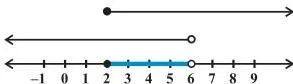
Fig 5.3 illustrates the system in Example 11: \(3x – 7 \lt 5 + x\) gives \(x \lt 6\), while \(11 – 5x \leq 1\) gives \(x \geq 2\). The bold line between 2 and 6 — including 2 but excluding 6 — is exactly the intersection \(2 \leq x \lt 6\) (NCERT, p. 97).
Common Word Problems That Become Inequalities
Real-life problems rarely use equations; they use phrases like “at least” or “more than”. Translate the phrase first, then solve. The table below is your phrase-to-symbol dictionary.
| Phrase | Inequality sign |
|---|---|
| at least, minimum, no less than | \(\geq\) |
| more than, greater than, exceeds | \(\gt\) |
| less than, fewer than | \(\lt\) |
| up to, at most, no more than | \(\leq\) |
Worked word problem (consecutive even integers): Find all pairs of consecutive even positive integers, both larger than 8, whose sum is less than 30.
Step 1: Let the smaller even integer be \(2k\).
The next even integer is \(2k + 2\).
- Step 1: “Both larger than 8” gives \(2k \gt 8 \Rightarrow k \gt 4\).
- Step 2: “Sum less than 30” gives \((2k) + (2k + 2) \lt 30 \Rightarrow 4k + 2 \lt 30 \Rightarrow 4k \lt 28 \Rightarrow k \lt 7\).
- Step 3: Since \(k\) is a positive integer with \(4 \lt k \lt 7\), \(k = 5, 6\).
Final answer: the pairs are \((10, 12)\) and \((12, 14)\).
Real-life application — temperature conversion: suppose a laboratory solution must remain between \(15^\circ\)C and \(25^\circ\)C. Using \(C = \frac{5}{9}(F – 32)\), write \(15 \lt \frac{5}{9}(F – 32) \lt 25\). Multiply all three parts by \(\frac{9}{5}\): \(27 \lt F – 32 \lt 45\). Add 32: \(59 \lt F \lt 77\). So the acceptable range in Fahrenheit is between \(59^\circ\)F and \(77^\circ\)F.
Common Mistakes in Linear Inequalities and How to Avoid Them
Most lost marks in this chapter come from four repeated slips. Check each one against your own working.
| Mistake | Correct rule | How to check your answer |
|---|---|---|
| Writing \( -2x \lt 4 \Rightarrow x \lt -2\) (no flip) | Dividing by \(-2\) reverses the sign: \(x \gt -2\) | Test \(x = 0\): \( -2(0) = 0 \lt 4\) is true, and \(0 \gt -2\). The wrong answer rejects a working value. |
| Operating on only two parts of a double inequality | Apply every operation to all three parts | After each step, the middle expression must still sit between the same two numbers; rewrite all three parts each time. |
| Ignoring the type of numbers allowed (natural vs integer vs real) | “Natural” starts at 1; zero and negatives are excluded; “real” gives an interval | Re-read the question. For \(x \lt \frac{20}{3}\), natural solutions are \(\{1,2,3,4,5,6\}\) but integer solutions include 0 and all negative integers. |
| Reading “at least” as \(\gt\) instead of \(\geq\) | “At least 60” includes exactly 60, so use \(\geq\) | Substitute the boundary value (60) into the inequality; if it satisfies, the sign must be \(\geq\) or \(\leq\). |
Exam Notes: Where Marks Are Won in Linear Inequalities
In a board or class-test solution, examiners award credit step by step. Build your answer so every mark-earning action is visible (NCERT, p. 92–100).
| Question type | Steps that earn marks |
|---|---|
| Solve an inequality | State the original inequality; apply Rule 1 (add/subtract); apply Rule 2 (multiply/divide); show the sign reversal explicitly if you divide by a negative; write the final solution set in interval notation, e.g. \((- \infty, 3)\) or \([8, \infty)\). |
| Graph on a number line | Put the correct circle on the boundary (open for strict, filled for slack); draw the dark line in the correct direction; label the boundary number. |
| Word problem | Define the variable in words first; set up the inequality; solve it; end with a concluding sentence that answers the original question (e.g. “minimum 72 marks”). |
| Double inequality | Work on all three parts simultaneously; keep the variable in the middle; write the answer as one combined interval. |
For word problems, the concluding sentence is the mark students forget most often. The variable definition earns a mark, the setup earns a mark, and the final sentence earns a mark — write all three.
Quick Revision: One-Table Summary of Chapter 5
| Aspect | Rule / fact to remember |
|---|---|
| Definition | Two real numbers or expressions related by <, >, ≤ or ≥ form an inequality (p. 90). |
| Types | Numerical (no variable), literal (has a variable), double (two signs), strict (< >), slack (≤ ≥). |
| Rule 1 | Add or subtract the same number on both sides — sign unchanged. |
| Rule 2 | Multiply/divide by a positive number — sign unchanged; by a negative number — sign reverses. |
| Number line | \(x \lt a\): open circle at \(a\), line to the left. \(x \leq a\): filled circle at \(a\), line to the left. Mirror for > and ≥. |
| Solution set | Interval notation: \((-\infty, 3)\), \([8, \infty)\), \([2, 4]\); or set form \(\{1, 2, 3, 4, 5, 6\}\). |
| Double inequality | Operate on all three parts at once. |
| System | Solve each separately, then take the intersection. |
| Applications | Averages, consecutive integers, mixtures, temperature conversion, lengths/perimeters. |
For the full method behind these rules, see the Class 11 Mathematics notes hub, or jump to permutations and combinations notes and complex numbers and quadratic equations notes for other chapters in the same book. Browse all Class 11 notes or the full CBSE notes collection for other subjects.
Frequently Asked Questions About Linear Inequalities
When do I reverse the inequality sign in linear inequalities?
Only when you multiply or divide both sides by a negative number. Adding, subtracting, or multiplying/dividing by a positive number never changes the sign.
How do I represent \(x \geq 2\) on a number line?
Put a filled (dark) circle at 2, then draw a dark line extending to the right. The filled circle means 2 itself is included in the solution set.
What is the difference between strict and slack inequalities?
Strict inequalities use < or >, so the boundary value is not a solution. Slack inequalities use ≤ or ≥, so the boundary value is included. On a number line this changes your circle from open to filled.
How do I solve a double inequality like \(2 \leq 3x – 4 \leq 5\)?
Apply the same operation to all three parts. Add 4: \(6 \leq 3x \leq 9\). Divide by 3: \(2 \leq x \leq 3\). The answer is the interval \([2, 3]\).
What does the solution set of an inequality mean?
A solution of an inequality is any value of the variable that makes the statement true. The solution set is the collection of all such values — a finite list for natural numbers, or an interval for real numbers (NCERT, p. 92).
Reference: NCERT Class 11 Mathematics textbook, chapter Linear Inequalities.
Explore Class 11 Mathematics Notes
More for this chapter:
Class 11 Mathematics on LearnCBSE:
Related chapters: