
Looking for complex numbers and quadratic equations class 11 notes that compress the whole chapter into one revision page? These notes follow the rationalised NCERT Class 11 Mathematics textbook, Chapter 4, and give you every definition, formula, worked example and exam pointer in a tight, scannable form.
The chapter runs on one idea: no real number squares to a negative number, so the equation \(x^2 = -1\) has no real solution. To fix that, we invent a symbol \(i\) with \(i^2 = -1\), then use it to solve quadratic equations whose discriminant is negative. Everything else — addition, division, modulus, the Argand plane — is that single idea in different clothes.
Use this page the night before a test: learn the definitions, memorise the formula tables, work the four solved examples by hand, then run the final checklist. Where you see a page number, it points to the NCERT textbook if you want the full derivation.
Why We Need Complex Numbers: Nothing Squares to −1
Every real number has a non-negative square: squares like \(2^2 = 4\) and \((-3)^2 = 9\) are always \(\geq 0\). So the equation \(x^2 + 1 = 0\), which asks for a number whose square is \(-1\), has no solution in the real number system (NCERT, p. 76).
The chapter’s stated aim is to solve \(ax^2 + bx + c = 0\) when the discriminant \(D = b^2 – 4ac \lt 0\) — the exact case real numbers cannot handle (NCERT, p. 76).
The fix is a new building block: define the symbol \(i = \sqrt{-1}\), so \(i^2 = -1\). Then \(i\) is a solution of \(x^2 + 1 = 0\), and the real number system is extended into the complex number system (NCERT, p. 77).
A short historical trail (NCERT, p. 88) shows why this took centuries:
- Mahavira (850) and Bhaskara (Ganitasara Sangraha and Bijaganita) noted that a negative quantity has no square root.
- Cardan (1545), solving \(x + y = 10\), \(xy = 40\), obtained \(5 \pm \sqrt{-15}\) and called these numbers ‘useless’.
- Euler first introduced the symbol \(i\) for \(\sqrt{-1}\).
- W. R. Hamilton (about 1830) defined \(a + ib\) as the ordered pair \((a, b)\), giving complex numbers a precise mathematical definition.
Real-life hook: complex numbers are used every day to analyse alternating current (AC) circuits. Because the letter \(i\) already means electric current in that field, electrical engineers write \(j\) for \(\sqrt{-1}\) — same idea, different letter.
Complex Numbers in a Nutshell: Real Part, Imaginary Part, Equality
A complex number looks like \(a + ib\) with \(a, b\) real. The two parts play different roles, and equality is a two-equation engine that drives every ‘find \(x\) and \(y\)’ question (NCERT, p. 77).
| Term | Meaning | Example |
|---|---|---|
| Complex number | A number of the form \(a + ib\), where \(a\) and \(b\) are real numbers | \(2 + i3\), \(-1 + i\sqrt{3}\) |
| Real part, Re z | The real number \(a\) in \(z = a + ib\) | \(\text{Re}(2 + i5) = 2\) |
| Imaginary part, Im z | The real number \(b\) — the coefficient of \(i\), not the product \(bi\) | \(\text{Im}(2 + i5) = 5\) |
| Equality | \(z_1 = z_2\) if and only if \(a = c\) and \(b = d\) | \(3 + i\sqrt{2} = 3 + i\sqrt{2}\) |
Why the equality rule matters: one complex equation like \(2x + i(5x – y) = 8 – 3i\) splits into two real equations — one from the real parts, one from the imaginary parts. Solve them simultaneously and you get values of \(x\) and \(y\).
Adding, Subtracting and Multiplying Complex Numbers
Addition and subtraction work component-wise — like “add like terms”. Multiplication is where the sign trap appears, because \(i^2 = -1\) forces a \(-bd\) term (NCERT, p. 78).
\[ z_1 + z_2 = (a + c) + i(b + d) \]
\[ z_1 – z_2 = (a – c) + i(b – d) \]
\[ z_1 z_2 = (ac – bd) + i(ad + bc) \]
To see where \(-bd\) comes from, expand \((a + ib)(c + id) = ac + iad + ibc + i^2 bd = ac + i(ad + bc) – bd\). The \(i^2 bd\) piece becomes \(-bd\). A quick check: \((1 + 2i)(3 – i) = 3 – i + 6i – 2i^2 = 3 + 5i + 2 = 5 + 5i\).
The operations obey the same algebraic laws you know from real numbers (NCERT, pp. 77-78):
| Law | Statement | What it guarantees |
|---|---|---|
| Closure | \(z_1 + z_2\) and \(z_1 z_2\) are complex numbers | The operations never leave the system |
| Commutative | \(z_1 + z_2 = z_2 + z_1\); \(z_1 z_2 = z_2 z_1\) | Order does not matter |
| Associative | \((z_1 + z_2) + z_3 = z_1 + (z_2 + z_3)\); same for products | Grouping does not matter |
| Additive identity | \(0 = 0 + i0\) | \(z + 0 = z\) |
| Additive inverse | \(-z = -a + i(-b)\) | \(z + (-z) = 0\) |
| Multiplicative identity | \(1 = 1 + i0\) | \(z \cdot 1 = z\) |
| Multiplicative inverse | \(z^{-1} = \frac{a}{a^2+b^2} + i\frac{-b}{a^2+b^2}\) for \(z \neq 0\) | \(z \cdot z^{-1} = 1\) |
| Distributive | \(z_1(z_2 + z_3) = z_1z_2 + z_1z_3\) | Expansion works exactly as with reals |
Dividing Complex Numbers: The Multiplicative Inverse and the Conjugate Trick
Division is defined as multiplication by the inverse: \(\frac{z_1}{z_2} = z_1 \times \frac{1}{z_2}\), provided \(z_2 \neq 0\) (NCERT, p. 78). The practical method turns the denominator real by multiplying top and bottom by its conjugate.
\[ z^{-1} = \frac{1}{a + ib} = \frac{a}{a^2+b^2} + i\frac{-b}{a^2+b^2} = \frac{\bar{z}}{|z|^2} \]
The step that actually appears in exams: multiply numerator and denominator by the conjugate of the denominator. The denominator then becomes the real number \(|z_2|^2\). Mini-example: \(\frac{1}{3 + 2i} = \frac{1}{3+2i} \times \frac{3-2i}{3-2i} = \frac{3-2i}{13} = \frac{3}{13} – \frac{2}{13}i\).
Division by zero is undefined. The quotient \(\frac{z_1}{z_2}\) exists only when \(z_2 \neq 0\), and the inverse formula also requires a non-zero number — the denominator \(a^2 + b^2\) in \(z^{-1}\) is zero exactly when \(a = b = 0\).
Powers of i and Square Roots of Negative Numbers
Powers of \(i\) cycle through only four values. Because \(i^3 = -i\) and \(i^4 = 1\) (NCERT, p. 79), every power repeats with period 4.
| Exponent pattern | Value |
|---|---|
| \(i^{4k}\) | \(1\) |
| \(i^{4k+1}\) | \(i\) |
| \(i^{4k+2}\) | \(-1\) |
| \(i^{4k+3}\) | \(-i\) |
| \(i^{-1}, i^{-2}, i^{-3}, i^{-4}\) | \(-i, -1, i, 1\) |
Memory device: divide the exponent by 4 and read the remainder — 0 → 1, 1 → i, 2 → −1, 3 → −i. For \(i^{53}\), \(53 \div 4\) leaves remainder 1, so \(i^{53} = i\) with no arithmetic beyond dividing.
The √−a rule and its trap
For a positive real number \(a\): \(\sqrt{-a} = \sqrt{a} \, i\) (NCERT, p. 80). For example, \(\sqrt{-25} = 5i\), and the square roots of \(-3\) are \(\sqrt{3}i\) and \(-\sqrt{3}i\).
The trap: \(\sqrt{a} \times \sqrt{b} = \sqrt{ab}\) holds when at most one of \(a, b\) is negative — never when both are. Assume it for both negative and you force a contradiction (NCERT, p. 80):
\[ i^2 = \sqrt{-1}\,\sqrt{-1} = \sqrt{(-1)(-1)} = \sqrt{1} = 1, \quad \text{but } i^2 = -1 \]
The fix that keeps the sign straight: convert each square root first. \(\sqrt{-4}\,\sqrt{-9} = (2i)(3i) = 6i^2 = -6\), not 6.
Modulus, Conjugate and Identities: The Formula Set
This is the memorisation block. Learn the formula with its symbol meaning, and you can reconstruct every computation in the chapter (NCERT, pp. 82, 85-86).
| Concept | Formula | What each symbol means |
|---|---|---|
| Modulus | \(|z| = \sqrt{a^2 + b^2}\) | A non-negative real number: the distance of \((a, b)\) from the origin |
| Conjugate | \(\bar{z} = a – ib\) | The complex number with the imaginary part sign flipped |
| Bridge identity | \(z\bar{z} = |z|^2\) | Product of a number and its conjugate equals the square of the modulus |
| Multiplicative inverse | \(z^{-1} = \frac{\bar{z}}{|z|^2}\) | Requires \(z \neq 0\); rewrites \(1/z\) in \(a + ib\) form |
| Product of moduli | \(|z_1 z_2| = |z_1| |z_2|\) | Modulus of a product = product of moduli |
| Quotient of moduli | \(\left|\frac{z_1}{z_2}\right| = \frac{|z_1|}{|z_2|}\) | Needs \(|z_2| \neq 0\) |
| Conjugate of product | \(\overline{z_1 z_2} = \bar{z}_1 \bar{z}_2\) | Conjugate of a product = product of conjugates |
| Conjugate of sum/difference | \(\overline{z_1 \pm z_2} = \bar{z}_1 \pm \bar{z}_2\) | Conjugation is linear |
| Conjugate of quotient | \(\overline{\left(\frac{z_1}{z_2}\right)} = \frac{\bar{z}_1}{\bar{z}_2}\) | Needs \(z_2 \neq 0\) |
The algebraic identities from section 4.3.7 (NCERT, p. 81) carry over verbatim from real numbers:
- \((z_1 \pm z_2)^2 = z_1^2 \pm 2z_1z_2 + z_2^2\)
- \((z_1 + z_2)^3 = z_1^3 + 3z_1^2z_2 + 3z_1z_2^2 + z_2^3\)
- \((z_1 – z_2)^3 = z_1^3 – 3z_1^2z_2 + 3z_1z_2^2 – z_2^3\)
- \(z_1^2 – z_2^2 = (z_1 + z_2)(z_1 – z_2)\)
The identity \(z\bar{z} = |z|^2\) is the bridge to ‘prove \(x^2 + y^2 = 1\)’ questions (like Miscellaneous Example 8, NCERT pp. 85-86): write \(x + iy\) in \(a + ib\) form, then \(x^2 + y^2 = (x + iy)(x – iy)\), and the denominator squares cancel.
The Argand Plane: Plotting Complex Numbers and Their Conjugates
Every complex number \(x + iy\) corresponds to exactly one point \((x, y)\) in the plane, and vice versa. The plane with a complex number assigned to each point is called the complex plane or Argand plane (NCERT, p. 83).
The horizontal axis is the real axis (numbers \(a + i0\)), and the vertical axis is the imaginary axis (numbers of the form \(0 + ib\)).
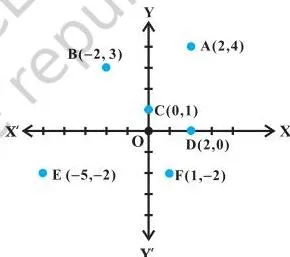
Note from the figure that purely real numbers like \(2 + 0i\) sit on the horizontal axis, and purely imaginary numbers like \(0 + 1i\) sit on the vertical axis.
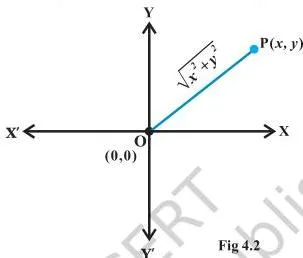
This is the geometric meaning of the modulus: it is not an abstract formula but a distance. So \(|z|\) is always a non-negative real number (NCERT, p. 84).
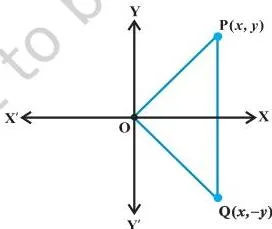
Figure 4.3 gives the conjugate its visual meaning: \(z = x + iy\) is at \(P(x, y)\), its conjugate \(x – iy\) is at \(Q(x, -y)\), and the two points are mirror images across the real axis (NCERT, p. 85).
Complex Numbers Solve Quadratic Equations with Negative Discriminants
Here the chapter closes the loop to its title. The quadratic formula \(x = \frac{-b \pm \sqrt{D}}{2a}\) works for every quadratic; the only question is what \(\sqrt{D}\) means when \(D \lt 0\). Using \(\sqrt{-a} = \sqrt{a}\,i\) (NCERT, p. 80):
\[ x = \frac{-b \pm i\sqrt{-D}}{2a} = \frac{-b}{2a} \pm \frac{\sqrt{-D}}{2a} i \]
So the two roots are \(u + vi\) and \(u – vi\) with \(u = \frac{-b}{2a}\) and \(v = \frac{\sqrt{-D}}{2a}\) — always a conjugate pair, because they differ only in the sign of the imaginary part.
Worked check — solve \(x^2 – 4x + 13 = 0\): here \(a = 1, b = -4, c = 13\), so \(D = 16 – 52 = -36\). Then \(\sqrt{-36} = 6i\), and \(x = \frac{4 \pm 6i}{2} = 2 \pm 3i\). The roots \(2 + 3i\) and \(2 – 3i\) are conjugates, confirming the pattern. This is exactly the situation Cardan met with \(5 \pm \sqrt{-15}\) when he solved \(x + y = 10, xy = 40\) in 1545 (NCERT, p. 88) — what he called ‘useless’ is now standard machinery.
These are the same quadratics you first met solving \(ax^2 + bx + c = 0\) with real roots. For the mechanics of that step, see the linear inequalities notes for the next chapter in the Class 11 sequence.
Worked Examples: Four Core Skills, Step by Step
These four questions mirror the NCERT methods but use original numbers, so you can work them without remembering a printed answer. Every number is original — verify the working yourself in the official NCERT Chapter 4 PDF if you want the source methods.
Example 1: Equating real and imaginary parts
Method: A complex equation splits into one real-part equation and one imaginary-part equation (method of Example 1, NCERT p. 77).
Set up: Solve \(2x + i(5x – y) = 8 – 3i\) for real \(x\) and \(y\).
Step 1: Equate real parts: \(2x = 8\).
\[ x = \frac{8}{2} = 4 \]
- Step 1: Equate imaginary parts: \(5x – y = -3\).
- Step 2: Substitute \(x = 4\): \(5(4) – y = -3\), so \(20 – y = -3\), giving \(y = 23\).
Final answer: \(x = 4\), \(y = 23\).
Example 2: Dividing by a complex number using the conjugate
Method: Multiply numerator and denominator by the conjugate of the denominator so the denominator becomes the real number \(|z_2|^2\) (NCERT, pp. 78-79).
Set up: Express \(\frac{7+4i}{3-i}\) in the form \(a + ib\).
\[ \frac{7+4i}{3-i} = \frac{7+4i}{3-i} \times \frac{3+i}{3+i} \]
- Step 1: Multiply numerators: \((7+4i)(3+i) = 21 + 7i + 12i + 4i^2 = 21 + 19i – 4 = 17 + 19i\).
- Step 2: Multiply denominators: \((3-i)(3+i) = 9 – i^2 = 9 + 1 = 10\).
\[ = \frac{17 + 19i}{10} = \frac{17}{10} + \frac{19}{10}i \]
Final answer: \(\frac{17}{10} + \frac{19}{10}i\).
Example 3: Evaluating powers of i
Method: Divide the exponent by 4 and read the remainder — 0 → 1, 1 → i, 2 → −1, 3 → −i (NCERT, p. 79).
Set up: Evaluate \(i^{53} + i^{27}\).
- Step 1: \(53 = 4 \times 13 + 1\), remainder 1, so \(i^{53} = i\).
- Step 2: \(27 = 4 \times 6 + 3\), remainder 3, so \(i^{27} = -i\).
\[ i^{53} + i^{27} = i + (-i) = 0 = 0 + i0 \]
Final answer: \(0\), written as \(0 + i0\).
Example 4: Finding a multiplicative inverse
Method: Use \(z^{-1} = \frac{\bar{z}}{|z|^2}\) (method of Example 5, NCERT p. 82).
Set up: Find the multiplicative inverse of \(5 + 2i\).
- Step 1: Conjugate: \(\bar{z} = 5 – 2i\).
- Step 2: \(|z|^2 = 5^2 + 2^2 = 25 + 4 = 29\).
\[ z^{-1} = \frac{5 – 2i}{29} = \frac{5}{29} – \frac{2}{29}i \]
Final answer: \(\frac{5}{29} – \frac{2}{29}i\).
Common Mistakes in Complex Numbers: Signs, Squares and Square Roots
These are the chapter-specific slips that cost marks. Each row names the error, the correct rule, and a way to check yourself.
| Mistake | Correct rule | How to check your answer |
|---|---|---|
| \(\sqrt{-4}\,\sqrt{-9} = \sqrt{36} = 6\) | \(-6\). \(\sqrt{a}\,\sqrt{b} = \sqrt{ab}\) fails when both are negative — write \(\sqrt{-4} = 2i\), \(\sqrt{-9} = 3i\), so \((2i)(3i) = 6i^2 = -6\) (NCERT, p. 80) | Convert each \(\sqrt{-a}\) to \(\sqrt{a}\,i\) first, then multiply |
| “The imaginary part of \(5 – 3i\) is \(-3i\)” | It is \(-3\). Im z is the real number b, the coefficient of \(i\) (NCERT, p. 77) | Strip the \(i\): \(\text{Im}(5 – 3i) = -3\) |
| \((a + ib)(c + id) = (ac + bd) + i(\dots)\) | \((ac – bd) + i(ad + bc)\) because \(i^2 = -1\) makes the \(bd\) term negative (NCERT, p. 78) | Check the real part’s sign: the \(i^2\) term must be negative |
| \(|z| = a^2 + b^2\) | \(|z| = \sqrt{a^2 + b^2}\) — a distance, always non-negative (NCERT, p. 82) | Square your answer; it must equal \(a^2 + b^2\) |
| In division, multiplying only the numerator by the conjugate | Multiply both numerator and denominator by the conjugate | The denominator must come out as the real number \(|z_2|^2\) |
| Conjugate of \(2 – 5i\) written as \(-2 + 5i\) | \(2 + 5i\) — only the imaginary part flips sign (NCERT, p. 82) | Keep the real part unchanged; flip the sign of the \(i\) term only |
| Stopping at \(5/8\) when \(a + ib\) form is asked | Write \(5/8 + i0\) — the \(a + ib\) form keeps the zero imaginary part explicit (NCERT, p. 81) | Re-read the question: did it ask for \(a + ib\)? |
Exam Pointers: The Question Families in This Chapter
The marking pattern in NCERT’s own questions (no year claims — just what the chapter’s exercises consistently demand):
| Skill trained | Chapter questions | What earns the mark |
|---|---|---|
| Express in \(a + ib\): products, sums, cubes of \(i\) | Exercise 4.1, Q1-10 (NCERT pp. 82-83) | Replace \(i^2\) by \(-1\) at every step; finish in \(a + ib\) form |
| Multiplicative inverse | Exercise 4.1, Q11-13 | State \(z^{-1} = \frac{\bar{z}}{|z|^2}\), or multiply by the conjugate |
| Combined rationalisation of a quotient | Exercise 4.1, Q14 | Simplify numerator and denominator, then multiply both by the conjugate |
| Modulus, conjugate and proof questions | Miscellaneous exercise, Q1-14 (NCERT pp. 86-87) | Use \(z\bar{z} = |z|^2\) and \(|z_1z_2| = |z_1||z_2|\), then reduce fully |
Examiner’s-eye notes on the marks-carrying steps:
- When equating real and imaginary parts, write both equations explicitly before solving — that is where the method marks sit.
- In every division, state \(z_2 \neq 0\) before multiplying by the conjugate.
- Always convert the final answer to \(a + ib\) form, even when the imaginary part vanishes (write \(+ i0\)).
- For modulus and conjugate checks, verify with \(z\bar{z} = |z|^2\) — it catches sign slips instantly.
Complex Numbers and Quadratic Equations Class 11 Notes: One Page Recap
Three boxes to have cold the night before the exam.
Box 1 — The i-cycle
\[ i^{4k} = 1,\quad i^{4k+1} = i,\quad i^{4k+2} = -1,\quad i^{4k+3} = -i \]
Divide the exponent by 4, read the remainder.
Box 2 — Operation formulas with the signs students forget
- \(z_1 + z_2 = (a+c) + i(b+d)\)
- \(z_1 z_2 = (ac – bd) + i(ad + bc)\) — the \(-bd\) from \(i^2 = -1\)
- \(z^{-1} = \frac{a}{a^2+b^2} + i\frac{-b}{a^2+b^2} = \frac{\bar{z}}{|z|^2}\), for \(z \neq 0\)
- \(|z| = \sqrt{a^2 + b^2}\), \(\bar{z} = a – ib\), \(z\bar{z} = |z|^2\)
- \(\sqrt{-a} = \sqrt{a}\,i\) for \(a \gt 0\)
Box 3 — Can you do this? (6-item checklist)
- Define a complex number \(a + ib\) with its real and imaginary parts.
- Split a complex equation into real-part and imaginary-part equations.
- Multiply and divide complex numbers, reaching \(a + ib\) form.
- Simplify \(i^n\) for large or negative \(n\) using the remainder method.
- Compute \(|z|\) and \(\bar{z}\) and use \(z\bar{z} = |z|^2\).
- Solve a quadratic with \(D \lt 0\), writing the conjugate roots as \(u \pm vi\).
If each item is instant, you have the chapter. For more, explore the Class 11 Mathematics notes, including the earlier chapter on trigonometric functions whose distance formulas connect to the Argand plane, and linear inequalities for the next chapter. The full set of Class 11 pages lives in the Class 11 notes section of CBSE notes.
Quick Questions Students Ask
Why is √−1 written as i, and what is i²?
Because no real number squares to \(-1\), the chapter introduces a new symbol defined by \(i = \sqrt{-1}\) (NCERT, p. 77). Squaring both sides gives \(i^2 = -1\), so \(i\) is a solution of \(x^2 + 1 = 0\).
Why is √a × √b = √ab wrong when both a and b are negative?
Because applying it forces a contradiction: \(i^2 = \sqrt{-1}\,\sqrt{-1} = \sqrt{1} = 1\), which clashes with the defining rule \(i^2 = -1\) (NCERT, p. 80). The rule \(\sqrt{a} \times \sqrt{b} = \sqrt{ab}\) holds only when at most one of \(a, b\) is negative. Convert each \(\sqrt{-a}\) to \(\sqrt{a}\,i\) before multiplying.
Is the imaginary part of 4 − 7i equal to −7 or −7i?
\(-7\). In \(z = a + ib\), the imaginary part Im z is the real coefficient \(b\), not the product \(bi\). So \(\text{Im}(4 – 7i) = -7\).
How do you divide (3 + 4i) by (1 − 2i)?
Multiply numerator and denominator by the conjugate of the denominator, \(1 + 2i\): \(\frac{(3+4i)(1+2i)}{(1-2i)(1+2i)} = \frac{-5 + 10i}{5} = -1 + 2i\). The denominator becomes \(|1 – 2i|^2 = 5\), a real number.
Why do quadratic equations with a negative discriminant have conjugate pair roots?
Because \(\sqrt{D}\) becomes \(i\sqrt{-D}\), so the formula gives \(x = \frac{-b}{2a} \pm \frac{\sqrt{-D}}{2a}i\). The two roots share the real part and differ only in the sign of the imaginary part — exactly the definition of a conjugate pair.
What is the difference between the modulus |z| and the conjugate z̄?
\(|z| = \sqrt{a^2 + b^2}\) is a non-negative real number measuring the distance of the point \((a, b)\) from the origin. \(\bar{z} = a – ib\) is another complex number with the sign of the imaginary part flipped. The two connect through \(z\bar{z} = |z|^2\).
Reference: NCERT Class 11 Mathematics textbook, chapter Complex Numbers and Quadratic Equations.
Explore Class 11 Mathematics Notes
More for this chapter:
Class 11 Mathematics on LearnCBSE:
Related chapters: