
Revising for a test or the board exam? These relations and functions class 11 notes compress the whole chapter into one page: ordered pairs, Cartesian products, relations with their domain and range, the one-image test that decides when a relation is a function, every standard function with its graph, and the algebra of real functions.
Everything maps to the NCERT Class 11 Mathematics textbook (Chapter 2) for the 2026-27 session, with each definition written the way you want to read it the night before. Jump to any topic from the contents below, or read straight through.
Relations and Functions Class 11 Notes — What to Revise
This chapter is built in a clear order. Each idea rests on the one before it, so revise in this sequence:
- Ordered pairs — a pair of objects where position matters.
- Cartesian product \( A \times B \) — the set of all ordered pairs you can form from two sets.
- Relation — a subset of \( A \times B \) picked out by a rule linking first and second elements.
- Function — a special relation where every element of A has exactly one image.
- Standard real functions — identity, constant, polynomial, rational, modulus, signum, greatest integer, linear.
- Algebra of functions — adding, subtracting, multiplying and dividing two functions.
Before this chapter, make sure you are comfortable with class 11 sets notes, because sets, subsets and set-builder notation appear on almost every page here. You will reuse these function ideas later in trigonometric functions, so locking the basics down now pays off twice.
Ordered Pairs and the Cartesian Product of Sets
An ordered pair is a pair of elements written in a fixed order inside brackets, like \( (p, q) \), where \( p \) comes from a set P and \( q \) from a set Q (NCERT, p. 1). The order is part of the identity of the pair.
Two ordered pairs are equal only when the corresponding entries match: \( (a, b) = (x, y) \) means \( a = x \) and \( b = y \) (NCERT, p. 2). The order rule is the whole point, so this deserves a memory device.
Memory device: “Same slot, same value.” Compare first entry with first entry, second with second — only then are the pairs equal.
Now take two sets \( A = \{\text{red}, \text{blue}\} \) and \( B = \{p, q\} \). The Cartesian product \( A \times B \) is the set of all ordered pairs with a first element from A and a second element from B:
\[ A \times B = \{(\text{red}, p), (\text{red}, q), (\text{blue}, p), (\text{blue}, q)\} \]
Notice that \( (\text{red}, p) \neq (p, \text{red}) \). The first element must come from A, so \( p \times \text{red} \) is not even in \( A \times B \). The diagram below shows how ordered pairs are built by pairing every element of the first set with every element of the second.
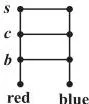
The formal definition: for non-empty sets P and Q, \( P \times Q = \{(p, q) : p \in P, q \in Q\} \) (NCERT, p. 1). If either set is empty, the product is empty: \( A \times \emptyset = \emptyset \).
Why the size multiplies
If \( n(A) = p \) and \( n(B) = q \), then \( n(A \times B) = p \times q \) (NCERT, p. 2). Reason: each of the p elements of A pairs with each of the q elements of B, so you get \( p \times q \) distinct pairs. In the example above, \( 2 \times 2 = 4 \) pairs.
Cartesian Product: Key Results at a Glance
These are the six results examiners reuse most. Copy them into your revision sheet.
| Result | What it means / example |
|---|---|
| \( (a, b) = (x, y) \iff a = x \text{ and } b = y \) | Equality only when both components match — order cannot be swapped. |
| \( n(A \times B) = n(A) \times n(B) \) | With \( n(A) = 3 \), \( n(B) = 2 \), the product has 6 pairs. |
| \( A \times \emptyset = \emptyset \) | An empty set contributes no pairs, so the product is empty. |
| \( A \times B \neq B \times A \) (in general) | \( (a, b) \) and \( (b, a) \) differ unless \( a = b \); the two products are equal only when \( A = B \) (or one is empty). |
| If A or B is infinite, \( A \times B \) is infinite | An infinite first set keeps producing infinitely many pairs. |
| \( A \times A \times A = \{(a, b, c) : a, b, c \in A\} \) | An ordered triplet — three coordinates, used for 3-D space. |
One result worth internalising: \( \mathbf{R} \times \mathbf{R} \) is the coordinate plane and \( \mathbf{R} \times \mathbf{R} \times \mathbf{R} \) is 3-D space, because every point is an ordered pair or triplet of real numbers (NCERT, p. 3). That is why “cartesian” here links to the Cartesian plane you have drawn since class 9.
What Is a Relation? Domain, Codomain and Range
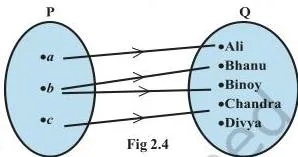
A relation R from a set A to a set B is a subset of \( A \times B \) chosen by describing a relationship between the first element and the second element of each ordered pair (NCERT, p. 5). The second element of a pair is called the image of the first element.
Worked fresh example
- Step 1: Take \( A = \{2, 3, 5\} \) and \( B = \{4, 9, 15, 7\} \).
- Step 2: Define \( R = \{(x, y) : y \text{ is a multiple of } x, \ x \in A, y \in B\} \).
Check each x:
- \( x = 2 \): multiples of 2 in B are 4, so \( (2, 4) \).
- \( x = 3 \): multiples of 3 in B are 9 and 15, so \( (3, 9), (3, 15) \).
- \( x = 5 \): multiple of 5 in B is 15, so \( (5, 15) \).
\[ R = \{(2, 4), (3, 9), (3, 15), (5, 15)\} \]
Step 3: Extract the three sets (NCERT, p. 5–6):
\[ \text{Domain} = \{2, 3, 5\}, \quad \text{Range} = \{4, 9, 15\}, \quad \text{Codomain} = \{4, 9, 15, 7\} \]
Conclusion: The range \( \{4, 9, 15\} \) is a proper subset of the codomain because 7 is in B but is never an image. Also note this relation is not a function — the element 3 has two images, 9 and 15.
The arrow diagram below is the standard visual: a line from each first element to its image in the second set (NCERT, p. 5).
Roster, Set-builder and Arrow Diagrams
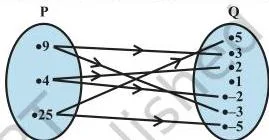
Every relation can be written in three equivalent ways. The same relation appears in all three forms below.
| Form | How it looks | Example: \( R = \{(x, y) : x \text{ is the square of } y\} \) |
|---|---|---|
| Set-builder | A rule in braces describing allowed pairs | \( R = \{(x, y) : x \text{ is the square of } y; x \in P, y \in Q\} \) |
| Roster | All pairs listed out in braces | \( R = \{(9, 3), (9, -3), (4, 2), (4, -2), (25, 5), (25, -5)\} \) |
| Arrow diagram | Arrows from each first element to its image | One arrow from 9 to 3 and one from 9 to -3, and so on |
How many relations exist?
A relation is any subset of \( A \times B \). If \( n(A) = p \) and \( n(B) = q \), then \( n(A \times B) = pq \), and the number of subsets of a set with \( pq \) elements is \( 2^{pq} \) (NCERT, p. 6). So the total number of relations from A to B is \( 2^{pq} \).
Example: \( A = \{x, y, z\} \) and \( B = \{1, 2\} \) give \( pq = 3 \times 2 = 6 \), so there are \( 2^6 = 64 \) possible relations.
When Is a Relation a Function? The One-and-Only-One-Image Test
A relation f from A to B is a function if every element of A has one and only one image in B (NCERT, p. 7). In other words, no two distinct ordered pairs in f have the same first element, and every element of A appears as a first element.
You can apply this as a reliable three-step test:
- List every ordered pair in the relation.
- Scan the first elements only. If any first element appears twice with two different second elements, it fails at once.
- Check that every element of A actually appears as a first element — if some element of A has no image at all, it is not a function.
Why does this definition matter? A function is a dependable machine: the same input always produces the same output. Any relation that lets one input produce two different outputs breaks that promise, so it is not a function (NCERT, p. 7).
Classify these five relations
| Relation | Function? | Reason |
|---|---|---|
| \( \{(2, 1), (3, 1), (4, 2)\} \) | Yes | Each first element 2, 3, 4 has exactly one image. |
| \( \{(2, 2), (2, 4), (3, 3), (4, 4)\} \) | No | First element 2 has two images: 2 and 4. |
| \( \{(1, 2), (2, 3), (3, 4), (4, 5), (5, 6), (6, 7)\} \) | Yes | Every first element 1–6 has exactly one image. |
| \( \{(1, 3), (1, 5), (2, 5)\} \) | No | First element 1 has two images: 3 and 5. |
| \( \{(2, 1), (5, 1), (8, 1), (11, 1), (14, 1), (17, 1)\} \) | Yes | A constant function — every input maps to 1. |
If f is a function and \( (a, b) \in f \), we write \( f(a) = b \). Here b is the image of a, and a is the preimage of b (NCERT, p. 7). A function whose domain and range are both R (or subsets of R) is called a real function (NCERT, p. 8).
Domain, Codomain and Range: One Table to Learn
This table is the single revision block you need for the three sets. The example uses \( f(x) = 2x \) with \( x \in \{1, 2, 3\} \) and codomain R.
| Term | Meaning | Example with \( f(x) = 2x \), \( x \in \{1, 2, 3\} \) |
|---|---|---|
| Domain | Set of all first elements — the allowed inputs. | \( \{1, 2, 3\} \) |
| Codomain | The whole target set B declared in \( f : A \rightarrow B \). | \( \mathbf{R} \) |
| Range | Set of all second elements — the images that actually occur. | \( \{2, 4, 6\} \) |
The exam-critical sentence: range is always a subset of the codomain (NCERT, p. 6). The codomain is the full “possible answers” set you declare at the start; the range collects only the answers the function really produces.
Standard Real Functions and Their Graphs
Seven functions appear again and again in exams. For each, learn the rule, the domain, the range and the shape of the graph (NCERT, p. 9–15).
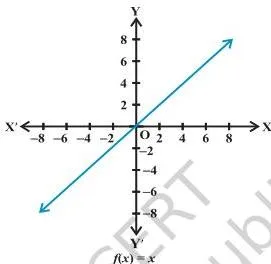
1. Identity function
Rule: \( f(x) = x \). Domain = R, range = R. The graph is a straight line through the origin (NCERT, p. 9).
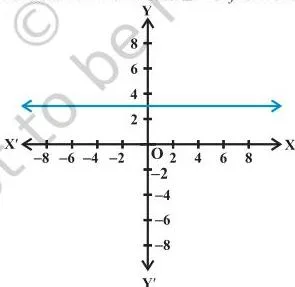
2. Constant function
Rule: \( f(x) = c \) for a fixed constant c. Domain = R, range = \( \{c\} \). The graph is a horizontal line parallel to the x-axis (NCERT, p. 9).
3. Polynomial functions
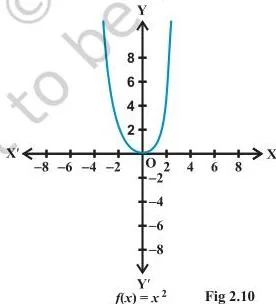
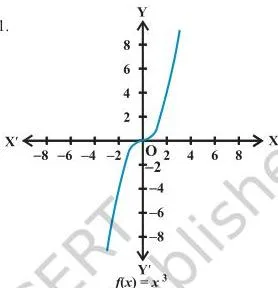
Rule: \( f(x) = a_0 + a_1x + a_2x^2 + \dots + a_nx^n \) with non-negative integer n (NCERT, p. 9). The two most tested are \( x^2 \) and \( x^3 \).
- \( f(x) = x^2 \): domain R, range all non-negative reals \( [0, \infty) \); upward-opening parabola (NCERT, p. 10).
- \( f(x) = x^3 \): domain R, range R; smooth cubic curve through the origin (NCERT, p. 11).
4. Rational functions
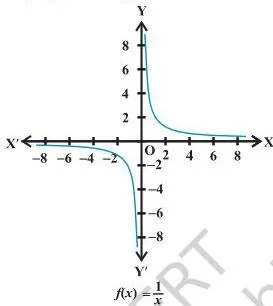
A rational function has the form \( \frac{f(x)}{g(x)} \) where both are polynomials, and it is defined only where \( g(x) \neq 0 \) (NCERT, p. 11). The model example is \( f(x) = \frac{1}{x} \): domain is R minus 0, range is also R minus 0, and the graph is a hyperbola in two branches (NCERT, p. 12).
5. Modulus function
Rule: \( f(x) = |x| \), defined piecewise (NCERT, p. 12):
\[ f(x) = \begin{cases} x, & x \geq 0 \\ -x, & x \lt 0 \end{cases} \]
The modulus returns the distance from 0, so it is never negative. Domain = R, range = \( [0, \infty) \). The graph is a V-shape: the line \( y = x \) for positive x and \( y = -x \) for negative x (NCERT, p. 12).
6. Signum function
Rule (NCERT, p. 12–13):
\[ f(x) = \begin{cases} 1, & x \gt 0 \\ 0, & x = 0 \\ -1, & x \lt 0 \end{cases} \]
The signum only tells you the sign of x: 1 for positive numbers, −1 for negative numbers, 0 for zero. Domain = R, range = \( \{-1, 0, 1\} \).
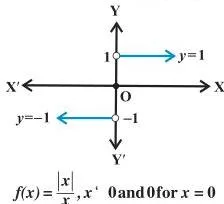
7. Greatest integer function
Rule: \( f(x) = [x] \), the greatest integer less than or equal to x (NCERT, p. 13). Examples: \( [x] = -1 \) for \( -1 \leq x \lt 0 \), \( [x] = 0 \) for \( 0 \leq x \lt 1 \), \( [x] = 1 \) for \( 1 \leq x \lt 2 \), and so on. Domain = R, range = Z, the integers. The graph is a staircase of steps.
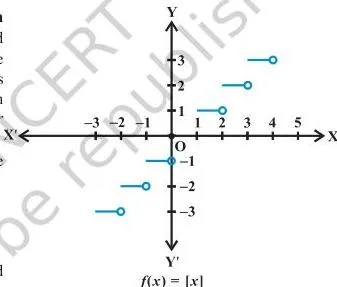
Quick comparison table
| Function | Rule | Domain | Range | Graph |
|---|---|---|---|---|
| Identity | \( f(x) = x \) | R | R | Line through origin |
| Constant | \( f(x) = c \) | R | \( \{c\} \) | Horizontal line |
| Quadratic | \( f(x) = x^2 \) | R | \( [0, \infty) \) | Upward parabola |
| Cubic | \( f(x) = x^3 \) | R | R | Cubic curve |
| Reciprocal | \( f(x) = \frac{1}{x} \) | \( \mathbf{R} – \{0\} \) | \( \mathbf{R} – \{0\} \) | Two-branch hyperbola |
| Modulus | \( f(x) = |x| \) | R | \( [0, \infty) \) | V-shape |
| Signum | \( f(x) = \text{sgn}(x) \) | R | \( \{-1, 0, 1\} \) | Three horizontal segments |
| Greatest integer | \( f(x) = [x] \) | R | Z | Step graph |
| Linear | \( f(x) = mx + c \) | R | R | Straight line |
Algebra of Real Functions
Given two real functions \( f \) and \( g \) defined on the same domain X, you can combine them pointwise — the operation happens at each x separately (NCERT, p. 13–14).
- Addition: \( (f + g)(x) = f(x) + g(x) \)
- Subtraction: \( (f – g)(x) = f(x) – g(x) \)
- Scalar multiplication: \( (\alpha f)(x) = \alpha f(x) \), where \( \alpha \) is a real number
- Product: \( (fg)(x) = f(x) \cdot g(x) \)
- Quotient: \( \left( \frac{f}{g} \right)(x) = \frac{f(x)}{g(x)} \), provided \( g(x) \neq 0 \)
The domain of any combined function is the intersection of the two original domains — you can only evaluate the result where both functions exist. For the quotient, you must also remove every x where \( g(x) = 0 \), because dividing by zero is undefined (NCERT, p. 14). That single condition \( g(x) \neq 0 \) is the most common lost mark in this chapter.
Worked fresh example
Step 1: Let \( f(x) = x^2 \) and \( g(x) = 3x – 2 \), both on \( \mathbf{R} \).
\[ (f + g)(x) = x^2 + 3x – 2 \]
\[ (f – g)(x) = x^2 – (3x – 2) = x^2 – 3x + 2 \]
\[ (fg)(x) = x^2(3x – 2) = 3x^3 – 2x^2 \]
\[ \left( \frac{f}{g} \right)(x) = \frac{x^2}{3x – 2}, \quad x \neq \frac{2}{3} \]
Final answer: Sum, difference and product are defined on R; the quotient is defined on \( \mathbf{R} – \left\{\frac{2}{3}\right\} \) because \( g(x) = 0 \) at \( x = \frac{2}{3} \).
Worked Examples: Original Problems Solved Step by Step
These three problems cover the skills examiners test most: equating ordered pairs, and finding the domain of a rational function.
Worked Example 1: Equating ordered pairs with different variables
Given: \( (2x + 1, y – 3) = (5, 7) \).
Step 1: Equality of ordered pairs means first components match and second components match (NCERT, p. 2).
\[ 2x + 1 = 5 \quad \text{and} \quad y – 3 = 7 \]
- Step 1: Solve the first equation: \( 2x = 4 \), so \( x = 2 \).
- Step 2: Solve the second: \( y = 10 \).
Final answer: \( x = 2, \ y = 10 \).
Worked Example 2: Equating ordered pairs where both sides contain variables
Given: \( (z + 1, 2w – 1) = (6, 9) \).
- Step 1: Equate first components: \( z + 1 = 6 \), so \( z = 5 \).
- Step 2: Equate second components: \( 2w – 1 = 9 \).
\[ 2w = 10 \quad \Rightarrow \quad w = 5 \]
Final answer: \( z = 5, \ w = 5 \). Fast check: \( (5+1, 10-1) = (6, 9) \).
Worked Example 3: Domain of a rational function
Given: \( f(x) = \frac{x^2 + 2}{x^2 – 4x + 3} \).
- Step 1: A fraction is defined only when the denominator is non-zero.
- Step 2: Factor the denominator: \( x^2 – 4x + 3 = (x – 1)(x – 3) \).
- Step 3: The denominator is zero when \( x = 1 \) or \( x = 3 \).
- Step 4: Exclude both values.
Final answer: Domain = \( \mathbf{R} – \{1, 3\} \).
Common Mistakes in Relations and Functions (With Fixes)
Every mistake below comes from a specific concept in this chapter. Fix the concept and the error disappears.
| Mistake | Correct rule | How to check your answer |
|---|---|---|
| Treating \( (p, q) \) and \( (q, p) \) as equal. | Order matters: \( (p, q) = (q, p) \) only when \( p = q \). | Compare first entry with first entry, second with second. |
| Assuming \( A \times B = B \times A \). | In general \( A \times B \neq B \times A \); equality holds only when both sets are equal (or empty). | Write one pair like \( (a, b) \) and ask if \( (b, a) \) belongs to the other product. |
| Forgetting to exclude x where the denominator is zero. | For \( \frac{f}{g} \), domain excludes every x with \( g(x) = 0 \). | Solve \( g(x) = 0 \) and remove those values from R. |
| Confusing range with codomain. | Range = images that actually occur; codomain = whole declared set B. Range \( \subseteq \) codomain. | Is every element of B used as an image? If not, the unused ones are codomain but not range. |
| Saying a relation with a repeated first element is a function. | Same first element with two different images fails the one-image test. | Scan the first elements; flag any that appear twice with different outputs. |
| Thinking a disconnected graph cannot be a function. | Continuity is not part of the function test — only the one-image rule matters. | Check each input for a single output; a step graph is still a function. |
Exam Notes: How to Fetch the Marks
These are the steps examiners look for in a full-marks answer. Following them costs little and saves marks often.
- Quote the definition before using it. When applying the function test, write “every element of A has one and only one image” first, then check the pairs. The definition itself earns a mark.
- Show the equality step for ordered pairs. Write \( 2x + 1 = 5 \) and \( y – 3 = 7 \) explicitly before solving — never skip straight to the answers.
- List domain, range and codomain with correct set notation. Use braces and set-builder form, e.g. \( \mathbf{R} – \{1, 3\} \), not plain words.
- Domain problems on fractions: state “defined for all real x except …”, solve the denominator equation, then write the domain in set form. The excluded values are the point of the question.
- Draw labelled graphs when a standard function is asked. Mark the intercepts and the correct shape (parabola, hyperbola, V, steps).
- Total number of relations: quote \( 2^{pq} \) where \( p = n(A) \), \( q = n(B) \), and compute \( pq \) separately so the arithmetic is visible.
- Algebra of functions: for a quotient, always append \( g(x) \neq 0 \) with the excluded values. That condition is the mark most students drop.
For the original definitions and fully worked examples, open the official NCERT Class 11 Mathematics textbook chapter on Relations and Functions — it is the authoritative source to confirm any rule. For wider revision, browse all class 11 maths notes, the class 11 notes hub, or the main CBSE notes page.
Quick Revision: One-Page Recap Sheet
Read this block five minutes before the paper opens. If each row makes instant sense, you are ready.
| What to remember | Quick example |
|---|---|
| Cartesian product definition | \( A \times B = \{(a, b) : a \in A, b \in B\} \) |
| Size of a Cartesian product | \( n(A) = 3, n(B) = 2 \Rightarrow n(A \times B) = 6 \) |
| Equality of ordered pairs | \( (a, b) = (x, y) \iff a = x \text{ and } b = y \) |
| Empty set result | \( A \times \emptyset = \emptyset \) |
| Relation definition | Subset of \( A \times B \) linking first to second elements |
| Domain, range, codomain | First elements, second elements, whole target set; range \( \subseteq \) codomain |
| Number of relations | \( 2^{pq} \) with \( p = n(A) \), \( q = n(B) \) |
| Function test | Every element of A has one and only one image |
| Rational function domain | Exclude x where \( g(x) = 0 \) |
| Algebra of functions | \( (f \pm g)(x) = f(x) \pm g(x) \); \( \left(\frac{f}{g}\right)(x) \) needs \( g(x) \neq 0 \) |
Frequently Asked Questions
What is the difference between domain, codomain and range?
The domain is the set of all first elements (allowed inputs). The codomain is the whole target set declared in \( f : A \rightarrow B \). The range is the set of second elements that actually occur as images. Range is always a subset of the codomain, but they can be equal.
Why is every function a relation but not every relation a function?
A relation is any subset of \( A \times B \). A function is a relation that adds one extra condition: every element of the domain has exactly one image. So every function qualifies as a relation, but a relation that lets one input produce two different outputs is not a function.
When is \( A \times B \) equal to \( B \times A \)?
In general the two products differ because order matters inside each pair. They are equal when \( A = B \), or when either set is empty (both products collapse to \( \emptyset \)).
How do you find the range of a rational function?
Set \( y = f(x) \) and solve for x in terms of y. The range is every real y for which a real x exists, excluding any y that makes the expression undefined. For \( f(x) = \frac{1}{x} \), solving \( y = \frac{1}{x} \) gives \( x = \frac{1}{y} \), so y cannot be 0 and the range is \( \mathbf{R} – \{0\} \).
What is the difference between the modulus function and the greatest integer function?
The modulus \( |x| \) gives the distance of x from 0, so its outputs are always non-negative and its graph is a V-shape. The greatest integer \( [x] \) gives the largest integer less than or equal to x, so its outputs are integers (range Z) and its graph is a staircase of steps.
Reference: NCERT Class 11 Mathematics textbook, chapter Relations and Functions.
Explore Class 11 Mathematics Notes
More for this chapter:
Class 11 Mathematics on LearnCBSE:
Related chapters: