
This page collects the permutations and combinations class 11 formulas from NCERT Chapter 6 into one scannable sheet. It covers the multiplication principle, factorial notation, permutations \( ^{n}P_{r} \) and \( n^{r} \), arrangements when some objects are identical, combinations \( ^{n}C_{r} \), and the identities that connect them.
Each formula is grouped by topic, with its symbols explained, its validity condition stated and a line saying when to use it. Three worked examples and a chapter-specific mistake table show the formulas in action.
For the explanations and derivations behind these formulas, see the Class 11 maths formulas page; to verify any statement, refer to the Rationalised NCERT Class 11 Mathematics textbook on ncert.nic.in.
Formulas at a Glance
The whole chapter in index form: every formula on this page, in the order it appears below.
| Purpose (what you are finding) | Formula |
|---|---|
| Total ways for two successive events | \( m \times n \) |
| Total ways for three successive events | \( m \times n \times p \) |
| Factorial of a natural number | \( n! = 1 \times 2 \times 3 \times \dots \times n \) |
| Zero factorial (convention) | \( 0! = 1 \) |
| Factorial in terms of the previous one | \( n! = n \times (n-1)! \) |
| Permutations of n distinct objects taken r at a time | \( ^{n}P_{r} = \frac{n!}{(n-r)!}, \quad 0 \leq r \leq n \) |
| Arranging all n distinct objects (put r = n in \( ^{n}P_{r} \)) | \( ^{n}P_{n} = n! \) |
| Permutations with repetition allowed | \( n^{r} \) |
| Arrangements when objects are not all distinct | \( \frac{n!}{p_{1}!\,p_{2}!\dots p_{k}!} \) |
| Combinations (selections) of n objects taken r at a time | \( ^{n}C_{r} = \frac{n!}{r!\,(n-r)!}, \quad 0 \leq r \leq n \) |
| Edge values of combinations (conventions) | \( ^{n}C_{n} = 1, \quad ^{n}C_{0} = 1 \) |
| Complementary combinations | \( ^{n}C_{n-r} = ^{n}C_{r} \) |
| Equal combinations give both possible relations | \( ^{n}C_{a} = ^{n}C_{b} \Rightarrow a = b \ \text{or} \ n = a + b \) |
| Adding adjacent combinations | \( ^{n}C_{r} + ^{n}C_{r-1} = ^{n+1}C_{r} \) |
| Bridge between arrangements and selections | \( ^{n}P_{r} = ^{n}C_{r} \times r!, \quad 0 \lt r \leq n \) |
All Formulas, Grouped by Topic
The formulas below follow the order of the chapter: count first, then arrange, then select. NCERT page references are given at each group.
Fundamental Principle of Counting
The multiplication principle counts the combined outcomes of events that happen in succession. If the first event can occur in \( m \) ways and a following event in \( n \) ways, the total number of occurrences in that given order is \( m \times n \) (NCERT, p. 102).
\[ m \times n \]
For three successive events, with \( p \) ways for the third, the count extends naturally:
\[ m \times n \times p \]
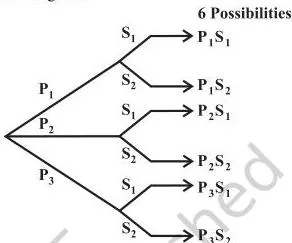
The tree diagram below makes the principle visible: for every bag there are 3 tiffin boxes, and for every bag–tiffin pair there are 2 bottles, giving \( 2 \times 3 \times 2 = 12 \) outcomes. Every permutation and combination formula in this chapter is just a structured way of applying this principle.
Factorial Notation
The product of the first \( n \) natural numbers is written \( n! \), read “n factorial” (NCERT, p. 105):
\[ n! = 1 \times 2 \times 3 \times \dots \times (n-1) \times n \]
Two facts are used constantly. By convention \( 0! = 1 \), and factorials unwind one step at a time:
\[ n! = n \times (n-1)! \]
This recurrence is why \( 5! = 5 \times 4! \) and why divisions such as \( \frac{7!}{5!} = 7 \times 6 \) can be evaluated without multiplying everything out.
Permutations of Distinct Objects
A permutation is an arrangement in a definite order of objects taken some or all at a time (NCERT, p. 105). Filling \( r \) places in succession — \( n \) choices, then \( n-1 \), and so on — gives the product form (NCERT, p. 106):
\[ ^{n}P_{r} = n(n-1)(n-2)\dots(n-r+1), \quad 0 \lt r \leq n \]
The factorial form is the convenient one for computation (NCERT, p. 107):
\[ ^{n}P_{r} = \frac{n!}{(n-r)!}, \quad 0 \leq r \leq n \]
It comes from multiplying the product \( n(n-1)\dots(n-r+1) \) by \( \frac{(n-r)!}{(n-r)!} \). When \( r = n \), this gives \( ^{n}P_{n} = n! \); arranging no object counts as one way, so \( ^{n}P_{0} = 1 \).
The chapter-opening suitcase question is exactly such a count: a 4-wheel lock needs one specific digit sequence, and with the first digit fixed as 7, the remaining 3 wheels drawn from 9 digits need \( ^{9}P_{3} = \frac{9!}{6!} = 504 \) checks — no listing required.
Permutations with Repetition Allowed
When each of the \( r \) places can be filled by any of the \( n \) objects, every place has \( n \) independent choices. This is Theorem 2 of the chapter (NCERT, p. 108):
\[ n^{r} \]
Because repetition is allowed, \( r \) may even exceed \( n \) — the only requirement is that every position can reuse any object.
Permutations When Not All Objects Are Distinct
If \( p_{1} \) objects are of one kind, \( p_{2} \) of a second kind, and so on up to \( p_{k} \), with the rest all different, the number of distinct arrangements of all \( n \) objects is (Theorem 4, NCERT, p. 110):
\[ \frac{n!}{p_{1}!\,p_{2}!\dots p_{k}!} \]
For one repeated kind it simplifies to \( \frac{n!}{p!} \) (Theorem 3, NCERT, p. 110). Why it works: treat identical objects as temporarily distinct — that gives \( n! \) arrangements — but each true arrangement is then counted \( p_{1}! \times p_{2}! \times \dots \) times, so we divide.
Combinations and Their Identities
A combination is a selection in which order does not matter (NCERT, p. 115). The number of ways of selecting \( r \) objects from \( n \) distinct objects is (NCERT, p. 116):
\[ ^{n}C_{r} = \frac{n!}{r!\,(n-r)!}, \quad 0 \leq r \leq n \]
There is exactly one way to select all objects and one way to select none:
\[ ^{n}C_{n} = 1, \quad ^{n}C_{0} = 1 \]
Three identities (NCERT, p. 117) shorten most problems:
\[ ^{n}C_{n-r} = ^{n}C_{r} \]
Selecting \( r \) objects is the same as rejecting \( n-r \) objects, so the two counts are equal.
\[ ^{n}C_{a} = ^{n}C_{b} \Rightarrow a = b \ \text{or} \ n = a + b \]
\[ ^{n}C_{r} + ^{n}C_{r-1} = ^{n+1}C_{r}, \quad 1 \leq r \leq n \]
The third identity follows by adding the two fractions over the common denominator \( r!(n-r+1)! \), as in the textbook proof (NCERT, p. 117). Finally, the bridge between arranging and selecting (Theorem 5, NCERT, p. 116): every selection of \( r \) objects can be rearranged in \( r! \) ways, so \[ ^{n}P_{r} = ^{n}C_{r} \times r!, \quad 0 \lt r \leq n \]
What Each Symbol Means
| Symbol | What it means | Unit / nature |
|---|---|---|
| \( n \) | Total number of distinct objects available | Positive integer (a count) |
| \( r \) | Number of objects taken at a time | Integer, \( 0 \leq r \leq n \) |
| \( m, n, p \) | Numbers of ways successive events can occur | Positive integers (counts) |
| \( n! \) | Product \( 1 \times 2 \times \dots \times n \) (n factorial) | Integer; by convention \( 0! = 1 \) |
| \( ^{n}P_{r} \) | Number of permutations (arrangements) of n objects taken r at a time | Whole number (count of arrangements) |
| \( ^{n}C_{r} \) | Number of combinations (selections) of n objects taken r at a time | Whole number (count of selections) |
| \( p_{1}, p_{2}, \dots, p_{k} \) | Numbers of identical objects of each kind | Non-negative integers with \( p_{1} + \dots + p_{k} \leq n \) |
| \( a, b \) | Two lower numbers in combinations such as \( ^{n}C_{a}, ^{n}C_{b} \) | Integers, \( 0 \leq a, b \leq n \) |
When to Use Each Formula
| Situation | Formula | Condition |
|---|---|---|
| Two events happen one after another (choose a pant, then a shirt) | \( m \times n \) | Choices are independent and taken in the given order |
| Three events in succession (bag, tiffin box, bottle) | \( m \times n \times p \) | Same — successive independent choices |
| Arrange r distinct objects chosen from n; order matters, no repeats | \( ^{n}P_{r} = \frac{n!}{(n-r)!} \) | \( 0 \leq r \leq n \) |
| Arrange all n distinct objects | \( n! \) or \( ^{n}P_{n} \) | — |
| Fill r positions, each with any of n objects | \( n^{r} \) | Repetition allowed |
| Rearrange all n objects when some are identical | \( \frac{n!}{p_{1}!\,p_{2}!\dots p_{k}!} \) | \( p_{1} + \dots + p_{k} \leq n \) |
| Select a team, committee, or handshake count; order irrelevant | \( ^{n}C_{r} = \frac{n!}{r!\,(n-r)!} \) | \( 0 \leq r \leq n \) |
| Simplify a combination whose lower number is large | \( ^{n}C_{n-r} = ^{n}C_{r} \) | Replace r by the smaller value \( n-r \) |
| Solve for n from an equality \( ^{n}C_{a} = ^{n}C_{b} \) | \( n = a + b \) | Use only when \( a \neq b \) |
| Combine adjacent combination values | \( ^{n}C_{r} + ^{n}C_{r-1} = ^{n+1}C_{r} \) | \( 1 \leq r \leq n \) |
| Count arrangements when selections are already counted | \( ^{n}P_{r} = ^{n}C_{r} \times r! \) | \( 0 \lt r \leq n \) |
Looking for a formula from another chapter? The maths formulas page indexes formula sheets across classes and subjects.
Worked Examples
These three examples use original numbers. Each shows the usual pattern: name the model, substitute, state the final count.
Worked Example 1: Forming Words from Distinct Letters
Step 1: The word LIGHT has 5 distinct letters.
Each word uses 3 of them in a definite order, with no repetition — this is \( ^{n}P_{r} \) with \( n = 5, r = 3 \).
\[ ^{5}P_{3} = \frac{5!}{(5-3)!} = \frac{5!}{2!} = 5 \times 4 \times 3 = 60 \]
Final answer: 60 words can be formed.
Worked Example 2: Finding n from Equal Combinations
Step 1: The equality \( ^{n}C_{10} = ^{n}C_{3} \) fits the identity \( ^{n}C_{a} = ^{n}C_{b} \Rightarrow a = b \) or \( n = a + b \).
Since \( 10 \neq 3 \), the first possibility is ruled out, so \( n = 10 + 3 = 13 \).
Step 2: Substitute \( n = 13 \) in \( ^{n}C_{10} \), then use \( ^{n}C_{n-r} = ^{n}C_{r} \):
\[ ^{13}C_{10} = ^{13}C_{3} = \frac{13!}{3!\,10!} = \frac{13 \times 12 \times 11}{3 \times 2 \times 1} = 286 \]
Final answer: \( n = 13 \) and \( ^{13}C_{10} = 286 \).
Worked Example 3: Rearranging a Word with Repeated Letters
Step 1: STRAWBERRY has 10 letters, of which R occurs 3 times and every other letter is distinct.
This is the “not all distinct” case with \( n = 10, p_{1} = 3 \).
\[ \frac{n!}{p_{1}!} = \frac{10!}{3!} = \frac{3628800}{6} = 604800 \]
Final answer: 604800 distinct arrangements. If the three R’s were different letters the count would be \( 10! \); dividing by \( 3! \) removes the repeated copies.
Common Mistakes to Avoid
| Mistake | Correct rule | How to check your answer |
|---|---|---|
| Using \( ^{n}C_{r} \) when order matters, or \( ^{n}P_{r} \) when it does not | Order matters → \( ^{n}P_{r} \); order does not matter → \( ^{n}C_{r} \) | Swap two chosen items. Different result = permutation; same result = combination. |
| Counting arrangements of a word with repeated letters as \( n! \) | Divide by the factorial of each repeated letter: \( \frac{n!}{p_{1}!\,p_{2}!\dots} \) | For ALLY: \( 4!/2! = 12 \), not 24 — list a few words and look for duplicates. |
| Writing the last factor of \( ^{n}P_{r} \) as \( n – r \) | The r factors are \( n, n-1, \dots, n-r+1 \) | For \( ^{5}P_{3} \) the third factor is \( 5 – 3 + 1 = 3 \), so \( ^{5}P_{3} = 5 \times 4 \times 3 \). |
| Concluding only \( a = b \) from \( ^{n}C_{a} = ^{n}C_{b} \) | Either \( a = b \) or \( n = a + b \) | If the lower numbers differ, add them: \( ^{n}C_{10} = ^{n}C_{3} \) gives \( n = 13 \). |
| Forgetting \( 0! = 1 \) when evaluating \( ^{n}P_{n} \) or \( ^{n}C_{n} \) | \( 0! = 1 \) by convention, so \( ^{n}P_{n} = n! \) and \( ^{n}C_{n} = 1 \) | Check: selecting all n objects has exactly one way, so \( ^{n}C_{n} \) must equal 1. |
Frequently Asked Questions
How do I decide between a permutation and a combination?
Apply the order test: if swapping two chosen items creates a different result, order matters and you use \( ^{n}P_{r} \); if the result is unchanged, use \( ^{n}C_{r} \). Selecting a committee uses combinations; assigning a chairman and a secretary to two of the same people uses permutations.
Why is 0! defined as 1?
The recurrence \( n! = n \times (n-1)! \) forces it: \( 1! = 1 \times 0! \) requires \( 0! = 1 \). It also keeps the formulas consistent — both \( ^{n}P_{n} = \frac{n!}{0!} = n! \) and \( ^{n}C_{n} = 1 \) depend on \( 0! = 1 \).
What changes when repetition is allowed?
With repetition, every place has \( n \) independent choices, so the count becomes \( n^{r} \) instead of \( ^{n}P_{r} \). For example, 3-letter codes from 8 letters can be made in \( 8^{3} = 512 \) ways with repetition, but only \( ^{8}P_{3} = 336 \) ways without it — repetition always gives more.
Why do we divide by p₁! p₂! … when objects repeat?
Rearranging identical objects among themselves does not create a new arrangement. In a word such as ALLY, the two L’s can swap places without changing the word, so counting \( 4! \) overcounts by \( 2! \); dividing by \( 2! \) removes the doubles. In general, each kind of identical object overcounts by its own factorial, so divide by \( p_{1}!\,p_{2}!\dots p_{k}! \).
Reference: NCERT Class 11 Mathematics textbook, chapter Permutations and Combinations.
Explore Class 11 Maths Formulas
More for this chapter:
Class 11 Maths on LearnCBSE:
Related chapters: