
These introduction to three dimensional geometry class 11 notes compress the chapter into one revision page: why space needs three coordinates, how the axes and coordinate planes are set up, how to read the coordinates of a point, the three-dimensional distance formula, and its standard applications — collinearity, triangles and parallelograms — each tied to its NCERT page with a worked example.
This page is one of the Class 11 Mathematics notes, inside the complete Class 11 notes set. Read it straight through in twenty minutes, or jump straight to any section below.
Why a Point in Space Needs Three Numbers
In a plane, two intersecting mutually perpendicular lines — the coordinate axes — fix a point with two numbers, its x and y coordinates. In space, height matters as much as position. NCERT opens the chapter with objects that move in all three directions at once, like a ball thrown across a room or an aeroplane in flight.
(NCERT, p. 209) The example you can feel in your own room: to locate the lowest tip of an electric bulb hanging from the ceiling, or the central tip of a ceiling fan, two distances are not enough.
You need the perpendicular distance from two adjacent walls and the height from the floor — three distances from three mutually perpendicular planes, the floor and the two walls.

This is the real-life reason the whole framework exists: three mutually perpendicular planes give three perpendicular distances, and those three numbers name the point uniquely. A point in space therefore has three coordinates, one for each coordinate plane — the step that takes you from the plane you already know to solid space.
Coordinate Axes and Coordinate Planes in Space
Take three planes passing through one point O, with each plane perpendicular to the other two. They intersect along three lines: X’OX, Y’OY and Z’OZ — the x-axis, y-axis and z-axis. Together these lines form the rectangular coordinate system, and O is the origin. (NCERT, p. 210)
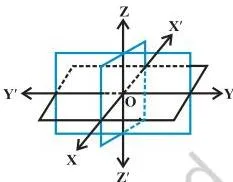
Each pair of axes determines a coordinate plane:
- XY-plane (plane XOY) — taken as the plane of the paper;
- YZ-plane (plane YOZ);
- ZX-plane (plane ZOX), with the line Z’OZ vertical to the paper.
Distances follow a fixed sign convention:
- Upward along OZ is positive, downward along OZ’ is negative;
- to the right of the ZX-plane along OY is positive, to the left along OY’ is negative;
- in front of the YZ-plane along OX is positive, behind it along OX’ is negative.
The three coordinate planes divide space into eight parts called octants, named XOYZ, X’OYZ, X’OY’Z, XOY’Z, XOYZ’, X’OYZ’, X’OY’Z’ and XOY’Z’ and numbered I to VIII. (NCERT, p. 210)
Which Octant? Reading the Sign Table
The signs of the three coordinates decide the octant. NCERT’s Table 11.1 summarises all eight cases. (NCERT, p. 211)
| Coordinate | I | II | III | IV | V | VI | VII | VIII |
|---|---|---|---|---|---|---|---|---|
| x | + | – | – | + | + | – | – | + |
| y | + | + | – | – | + | + | – | – |
| z | + | + | + | + | – | – | – | – |
Mnemonic to remember the sign pattern of the eight octants: the octant’s name carries its signs — a prime on a letter means that coordinate is negative.
- Octant I = XOYZ: all three coordinates positive.
- Octant II = X’OYZ: only x negative; octant III = X’OY’Z: x and y negative; octant V = XOYZ’: only z negative.
- Fallback structure: octants I–IV carry the four (x, y) sign patterns (+, +), (-, +), (-, -), (+, -) with z positive; octants V–VIII repeat the same four patterns with z negative.
So to place a point fast, decide z first: positive means octants I–IV, negative means V–VIII; then decide y, then x.
Check with the table: \((-3, 1, 2)\) has signs (\(-\), \(+\), \(+\)), matching X’OYZ — octant II. \((-3, 1, -2)\) has signs (\(-\), \(+\), \(-\)), matching X’OYZ’ — octant VI: the negative z has dropped it onto the lower floor. And \((4, -2, -5)\), signs (\(+\), \(-\), \(-\)), lies in octant VIII (XOY’Z’).
Reading and Plotting the Coordinates of a Point
A fixed coordinate system lets us go from a point to numbers and back. The first method uses perpendiculars (NCERT, p. 210):
- From P, drop a perpendicular PM to the XY-plane; M is the foot.
- From M, drop a perpendicular ML to the x-axis, meeting it at L.
- Then \(OL = x\), \(LM = y\) and \(MP = z\), so the coordinates of P are \((x, y, z)\).
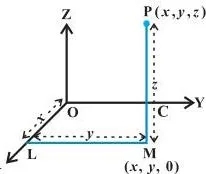
The second method uses three planes parallel to the coordinate planes (NCERT, p. 211):
- Through P, draw three planes parallel to the three coordinate planes.
- These planes meet the x-axis, y-axis and z-axis at A, B and C.
- If \(OA = x\), \(OB = y\) and \(OC = z\), then P has coordinates \((x, y, z)\).
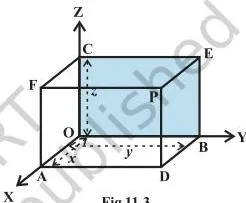
In both views, x, y and z are the perpendicular distances of P from the YZ-plane, ZX-plane and XY-plane respectively. So every point in space corresponds to exactly one ordered triplet of real numbers, and every ordered triplet names exactly one point — a one-to-one correspondence.
(NCERT, pp. 210–211) In Fig 11.3, the vertex F lies in the XZ-plane, where the distance along OY is zero: if P is \((2, 4, 5)\), then F is \((2, 0, 5)\). (NCERT, p. 211) Special positions worth memorising:
- Origin O: \((0, 0, 0)\);
- any point on the x-axis: \((x, 0, 0)\);
- any point in the YZ-plane: \((0, y, z)\). (NCERT, p. 211)
Key Terms in 3D Geometry: A Definitions Table
The chapter introduces a small vocabulary. Keep these terms straight and most questions become routine. (NCERT, pp. 210–216)
| Term | Meaning | Example |
|---|---|---|
| Coordinate axes | Three mutually perpendicular lines X’OX, Y’OY, Z’OZ that form the rectangular coordinate system | x-axis, y-axis, z-axis |
| Coordinate planes | The three planes determined by pairs of axes | XY-plane, YZ-plane, ZX-plane |
| Origin | The common point O where the three axes meet | O = (0, 0, 0) |
| Octant | One of the eight parts into which the coordinate planes divide space | Octant I = XOYZ: all coordinates positive |
| Ordered triplet | The three real numbers (x, y, z) that name a point; the order matters | (2, 4, 5) and (4, 2, 5) are different points |
| Coordinates of a point | The perpendicular distances of the point from the YZ-plane, ZX-plane and XY-plane, in that order | For P (3, -1, 7): x = 3, y = -1, z = 7 |
| Distance formula | The rule for the length between two points in space, built by a double application of Pythagoras | \(PQ = \sqrt{(x_2-x_1)^2 + (y_2-y_1)^2 + (z_2-z_1)^2}\) |
The Distance Formula in Three Dimensions
For points \(P(x_1, y_1, z_1)\) and \(Q(x_2, y_2, z_2)\), the distance between them is \[ PQ = \sqrt{(x_2 – x_1)^2 + (y_2 – y_1)^2 + (z_2 – z_1)^2} \]
Each of the three terms measures one perpendicular offset: the change in x, in y and in z. The result is a length, so answers carry the same unit the coordinates are measured in.
Why it works — Pythagoras twice. Draw planes through P and Q parallel to the coordinate planes; they form a rectangular parallelopiped with body diagonal PQ. In right triangle PAQ, \(PQ^2 = PA^2 + AQ^2\); in right triangle ANQ, \(AQ^2 = AN^2 + NQ^2\). Hence \(PQ^2 = PA^2 + AN^2 + NQ^2\), with \(PA = y_2 – y_1\), \(AN = x_2 – x_1\), \(NQ = z_2 – z_1\).
(NCERT, p. 212) This is the same pattern you used in two dimensions while studying straight lines and conic sections — the 3D version simply adds the third squared offset.
Distance from the origin: putting \(P = O(0,0,0)\) in the formula gives \(OQ = \sqrt{x_2^2 + y_2^2 + z_2^2}\). (NCERT, p. 212) Comparison table — the 2D coordinate system extends to 3D side by side:
| System | Coordinates of a point | Distance formula |
|---|---|---|
| 2D plane geometry | \((x, y)\) — two perpendicular distances | \(\sqrt{(x_2-x_1)^2 + (y_2-y_1)^2}\) |
| 3D space geometry | \((x, y, z)\) — three perpendicular distances | \(\sqrt{(x_2-x_1)^2 + (y_2-y_1)^2 + (z_2-z_1)^2}\) |
Only one thing changes: the number of perpendicular directions. The mechanics — square the differences, add, take the square root — stay identical.
Worked Examples: Distance, Collinearity and Triangles
Method for every distance question: write the formula first (this earns the method mark), substitute with a consistent difference order, then simplify. (NCERT, pp. 212–214)
Example A: Direct distance between two points
- Step 1: Here \(P(1, 5, -2)\) and \(Q(3, -1, 4)\), so \(x_1 = 1, y_1 = 5, z_1 = -2\) and \(x_2 = 3, y_2 = -1, z_2 = 4\).
- Step 2: Write the distance formula \(PQ = \sqrt{(x_2-x_1)^2 + (y_2-y_1)^2 + (z_2-z_1)^2}\).
- Step 3: Compute the differences, later minus earlier throughout: \(x_2-x_1 = 2\), \(y_2-y_1 = -6\), \(z_2-z_1 = 6\).
\[ PQ = \sqrt{(2)^2 + (-6)^2 + (6)^2} = \sqrt{4 + 36 + 36} = \sqrt{76} \]
\[ PQ = 2\sqrt{19} \]
Final answer: The distance is \(2\sqrt{19}\) units.
Example B: Showing three points are collinear
Method: three points are collinear when one lies between the other two — exactly when the sum of two distances equals the third. (NCERT, p. 213)
Step 1: Take \(P(1, 2, 3)\), \(Q(-1, 0, 2)\), \(R(-5, -4, 0)\).
Compute all three pairwise distances.
\[ PQ = \sqrt{(-1-1)^2 + (0-2)^2 + (2-3)^2} = \sqrt{4+4+1} = \sqrt{9} = 3 \]
\[ QR = \sqrt{(-5+1)^2 + (-4-0)^2 + (0-2)^2} = \sqrt{16+16+4} = \sqrt{36} = 6 \]
\[ PR = \sqrt{(-5-1)^2 + (-4-2)^2 + (0-3)^2} = \sqrt{36+36+9} = \sqrt{81} = 9 \]
Step 2: Check the sum: \(PQ + QR = 3 + 6 = 9 = PR\).
Final answer: Since \(PQ + QR = PR\), Q lies between P and R, so P, Q and R are collinear.
Example C: Testing whether three points form a right angled triangle
Method: compute the three squared side lengths; if the largest square equals the sum of the other two, the triangle is right angled. (NCERT, p. 213)
Step 1: Take \(A(0, 0, 0)\), \(B(1, 2, 2)\), \(C(2, -2, 1)\).
Work with squared distances to avoid square roots.
\[ AB^2 = (1-0)^2 + (2-0)^2 + (2-0)^2 = 1 + 4 + 4 = 9 \]
\[ AC^2 = (2-0)^2 + (-2-0)^2 + (1-0)^2 = 4 + 4 + 1 = 9 \]
\[ BC^2 = (2-1)^2 + (-2-2)^2 + (1-2)^2 = 1 + 16 + 1 = 18 \]
Step 2: The largest square is \(BC^2 = 18\).
Compare: \(AB^2 + AC^2 = 9 + 9 = 18 = BC^2\).
Final answer: Since \(AB^2 + AC^2 = BC^2\), triangle ABC is right angled at A.
Classifying Triangles and Parallelograms Using Distance
All these tests reduce to comparing distances you already know how to compute. (NCERT, pp. 213–215)
| Shape / property | Condition to check | How to test with distance |
|---|---|---|
| Collinear points | One point lies between the other two | Sum of two smaller distances equals the largest: \(PQ + QR = PR\) |
| Isosceles triangle | At least two sides equal | Two of AB, BC, CA are equal |
| Right angled triangle | Pythagoras holds | Largest side squared = sum of the other two squared |
| Parallelogram | Opposite sides equal in pairs | \(AB = CD\) and \(BC = AD\) with vertices taken in order |
| Rectangle | Parallelogram with equal diagonals | Parallelogram check, then also \(AC = BD\) |
A parallelogram can also be proved by showing that its diagonals bisect each other. (NCERT, p. 215) Compact example: verify that A(1, 0, 1), B(2, 2, 1), C(0, 2, 1), D(-1, 0, 1) form a parallelogram but not a rectangle.
Step 1: Opposite sides.
Using the distance formula, \[ AB = \sqrt{(2-1)^2 + (2-0)^2 + (1-1)^2} = \sqrt{1+4+0} = \sqrt{5} \]
\[ CD = \sqrt{(-1-0)^2 + (0-2)^2 + (1-1)^2} = \sqrt{1+4+0} = \sqrt{5} \]
\[ BC = \sqrt{(0-2)^2 + (2-2)^2 + (1-1)^2} = 2, \quad DA = \sqrt{(1+1)^2 + (0-0)^2 + (1-1)^2} = 2 \]
- Step 1: \(AB = CD\) and \(BC = DA\), so ABCD is a parallelogram.
- Step 2: Diagonals: \(AC = \sqrt{(0-1)^2 + (2-0)^2 + (1-1)^2} = \sqrt{5}\) and \(BD = \sqrt{(-1-2)^2 + (0-2)^2 + (1-1)^2} = \sqrt{13}\).
Final answer: ABCD is a parallelogram, but \(AC \neq BD\), so it is not a rectangle.
Locus Problems: The Equation of a Set of Points
Standard method (NCERT, pp. 213–215): let the moving point be \(P(x, y, z)\), write the given condition using the distance formula, then expand and simplify. The result is an equation in x, y, z, and it describes the whole set of points.
Centroid rule: if G is the centroid of triangle ABC, each coordinate of G is the mean of the three vertex coordinates:
\[ G\left(\frac{x_1+x_2+x_3}{3}, \frac{y_1+y_2+y_3}{3}, \frac{z_1+z_2+z_3}{3}\right) \]
Example D: Points equidistant from two fixed points
Find the equation of the set of points equidistant from A(1, 1, 0) and B(3, 1, 2).
Step 1: Let P(x, y, z) be any point of the set.
The condition is \(PA = PB\), so \[ (x-1)^2 + (y-1)^2 + z^2 = (x-3)^2 + (y-1)^2 + (z-2)^2 \]
Step 2: \((y-1)^2\) cancels from both sides.
Expand the remaining squares:
\[ x^2 – 2x + 1 + z^2 = x^2 – 6x + 9 + z^2 – 4z + 4 \]
Step 3: Cancel \(x^2\) and \(z^2\), then collect: \(-2x + 2 = -6x – 4z + 14\), so \(4x + 4z = 12\).
\[ x + z = 3 \]
Final answer: The set is the plane \(x + z = 3\), the perpendicular-bisector plane of AB.
Example E: Finding the third vertex from the centroid
The centroid of triangle ABC is G(0, 1, 3); A(2, 4, 6) and B(-2, 0, 2) are given. Find C.
Step 1: Let C = (x, y, z).
The centroid is the mean of the vertices, so \(\frac{x + 2 – 2}{3} = 0\), \(\frac{y + 4 + 0}{3} = 1\), \(\frac{z + 6 + 2}{3} = 3\).
Step 2: Solve each equation: \(x = 0\); \(y + 4 = 3\) gives \(y = -1\); \(z + 8 = 9\) gives \(z = 1\).
Final answer: C = (0, -1, 1).
Common Mistakes Students Make in 3D Geometry
These chapter-specific errors cost real marks in tests — each row gives the mistake, the correct rule, and a way to check. (NCERT, pp. 210–213)
| Mistake | Correct rule | How to check your answer |
|---|---|---|
| Mixed difference order in the distance formula, e.g. \((x_2 – x_1)\) but \((y_1 – y_2)\) | Use one consistent order for all three differences — later minus earlier | Write \((x_2-x_1, y_2-y_1, z_2-z_1)\) out before squaring; squares kill the sign anyway, but a fixed order prevents arithmetic slips |
| Writing a point on the x-axis as \((x, y, 0)\) | A point on the x-axis is \((x, 0, 0)\) | x is the distance from the YZ-plane; on the x-axis the distances from the ZX-plane (y) and the XY-plane (z) are both zero |
| Placing \((-3, 1, -2)\) in octant II | It lies in octant VI | The z sign decides the floor first: z negative means octants V–VIII; among those, y positive means V or VI; x negative selects VI |
| Calling a parallelogram a rectangle without checking diagonals | A rectangle needs equal diagonals, not just equal opposite sides | Compute both diagonals; if \(AC \neq BD\), the parallelogram is not a rectangle |
| Dropping units from distance answers | Distance is a length — write “units” | Every distance step ends with units; the root of a squared quantity brings the unit back |
| Sign errors while expanding \((x – a)^2\) or \((z – c)^2\) in locus problems | Expand as \(x^2 – 2ax + a^2\) | Substitute a test point of the set back into your simplified equation to confirm it satisfies it |
Exam Notes: How This Chapter Asks Its Questions
The NCERT exercise set (Exercises 11.1 and 11.2, plus a short miscellaneous set) concentrates on a few operations — master these and you have the chapter covered. All questions referenced below come from the NCERT textbook, which you can download freely from the official NCERT portal.
- Direct concept (Exercise 11.1, Q1–Q2, Q4): coordinates of a point on an axis or in a plane, and the vocabulary — the XY-plane, coordinates of the form (x, y, 0), and the eight octants. These are one-line answers.
- Octant naming (Exercise 11.1, Q3): read all three signs and match them to Table 11.1; the sign table is the whole reasoning.
- Distance numericals (Exercise 11.2, Q1): four pairs of points; one clean substitution each, final answer in units.
- Reasoning with distances (Exercise 11.2, Q2–Q3): collinearity, isosceles, right-angled and parallelogram checks — all are comparisons of computed distances.
- Locus equations (Exercise 11.2, Q4–Q5, and miscellaneous): equidistant sets and constant-sum sets; the algebra of expansion and simplification is the core of the question.
Mark-earning steps, examiner’s view:
- The written formula line before substitution earns the method mark — never jump straight to numbers.
- Keep the difference order consistent so the arithmetic is easy to follow.
- End with the explicit comparison — \(PQ + QR = PR\) or \(AB^2 + AC^2 = BC^2\) — because that comparison is the proof.
- In locus questions, the final simplified equation is where the last mark sits; expand slowly and cancel terms in a fixed order.
Later chapters like limits and derivatives build new machinery; here the distance formula and careful expansion are the only tools you need.
Rapid Revision Recap: Introduction to Three Dimensional Geometry Class 11 Notes on One Screen
The whole chapter in one table. (NCERT, p. 216)
| Fact | Statement |
|---|---|
| Axes | Three mutually perpendicular lines — the x, y and z-axes — meeting at the origin O |
| Coordinate planes | XY-plane, YZ-plane, ZX-plane, determined by pairs of axes |
| Octants | The three coordinate planes divide space into eight octants, numbered I–VIII |
| Coordinates of a point | P(x, y, z), where x, y, z are the perpendicular distances from the YZ, ZX and XY planes |
| Point on the x-axis | (x, 0, 0) |
| Point on the y-axis | (0, y, 0) |
| Point on the z-axis | (0, 0, z) |
| Point in the YZ-plane | (0, y, z) |
| Distance between two points | \(PQ = \sqrt{(x_2-x_1)^2 + (y_2-y_1)^2 + (z_2-z_1)^2}\) |
| Distance from the origin | \(OQ = \sqrt{x^2 + y^2 + z^2}\) |
Once you finish this chapter, return to the main CBSE notes index to pick the next one.
Frequently Asked Questions on 3D Geometry
What are the coordinates of a point on the z-axis?
\((0, 0, z)\). On the z-axis the distances from the YZ-plane and the ZX-plane are both zero, so x = 0 and y = 0; only z changes. (NCERT, p. 216)
How do I quickly find the octant in which a point lies?
Read the signs of (x, y, z) and match them to the octant’s name — the primed letters mark the negative coordinates. For \((-3, 1, -2)\), the signs (\(-\), \(+\), \(-\)) mean x and z are negative, so the octant is X’OYZ’ — octant VI. (NCERT, p. 211)
Why does the distance formula in 3D have three squared terms?
Because a point in space has three independent perpendicular offsets. The formula builds a rectangular box with PQ as the body diagonal; Pythagoras is applied twice, in triangle ANQ and then in triangle PAQ, and the three squared differences add up. (NCERT, p. 212)
How do I prove that four points form a parallelogram using distance?
Show that opposite sides are equal in pairs — \(AB = CD\) and \(BC = AD\) with the vertices taken in order. To decide whether it is a rectangle, also compare the diagonals: a parallelogram is a rectangle exactly when \(AC = BD\). (NCERT, pp. 214–215)
What is the distance of a point (x, y, z) from the origin?
\(\sqrt{x^2 + y^2 + z^2}\). This is the distance formula with the first point taken as O(0, 0, 0). (NCERT, p. 212)
Reference: NCERT Class 11 Mathematics textbook, chapter Introduction to Three Dimensional Geometry.
Explore Class 11 Mathematics Notes
More for this chapter:
Class 11 Mathematics on LearnCBSE:
Related chapters: