This page collects the electricity class 10 formulas from NCERT Chapter 11 for the 2026-27 session — the ones you need for numericals on electric current, potential difference, resistance, series and parallel combinations, heating effect and electric power. Every formula below comes with the meaning of each symbol and its SI unit, so you can substitute values directly.
The formulas are grouped by topic. After the list you will find a symbol table, when-to-use guidance, three worked examples and chapter-specific mistakes to avoid. For the derivations and full explanations, see the Electricity Class 10 notes; this sheet only gives you the ready-to-use formulas. It belongs to the Class 10 physics formulas collection.
Electricity Class 10 Formulas at a Glance
| Purpose (what you are finding) | Formula |
|---|---|
| Current from charge and time | \( I = \frac{Q}{t} \) |
| Charge that has flowed (from the current formula) | \( Q = It \) |
| Potential difference from work and charge | \( V = \frac{W}{Q} \) |
| Work done to move a charge (from the potential-difference formula) | \( W = VQ \) |
| Voltage across a resistor (Ohm’s law) | \( V = IR \) |
| Resistance from voltage and current | \( R = \frac{V}{I} \) |
| Current through a resistor (Ohm’s law) | \( I = \frac{V}{R} \) |
| Resistance of a wire from its length, area and material | \( R = \rho \frac{l}{A} \) |
| Resistivity of a material (from the resistance formula) | \( \rho = \frac{RA}{l} \) |
| Equivalent resistance — resistors in series | \( R_s = R_1 + R_2 + R_3 + \dots \) |
| Equivalent resistance — resistors in parallel | \( \frac{1}{R_p} = \frac{1}{R_1} + \frac{1}{R_2} + \frac{1}{R_3} + \dots \) |
| Heat produced, from voltage and current | \( H = VIt \) |
| Heat produced, Joule’s law | \( H = I^2Rt \) |
| Electric power, all three forms | \( P = VI = I^2R = \frac{V^2}{R} \) |
| Electrical energy from power and time | \( E = Pt \) |
| Commercial energy unit conversion | \( 1\ \text{kWh} = 3.6 \times 10^6\ \text{J} \) |
All Formulas, Grouped by Topic
Every formula below appears in the NCERT chapter — you can verify any of them against the official NCERT Class 10 Science textbook page.
Electric Current and Circuit
Electric current is the rate of flow of charge across a cross-section of a conductor (NCERT, p. 172):
\[ I = \frac{Q}{t} \]
One ampere is one coulomb per second: \( 1\ \text{A} = 1\ \text{C/s} \). Small currents are written in milliampere (\( 1\ \text{mA} = 10^{-3}\ \text{A} \)) or microampere (\( 1\ \mu\text{A} = 10^{-6}\ \text{A} \)).
Rearrangement used often: \( Q = It \) gives the charge that has flowed when current and time are known.
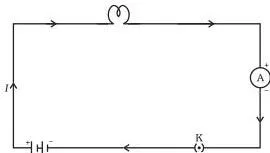
Figure 11.1 shows why the ammeter must be in series: the same current that flows through the bulb has to pass through the ammeter to be measured (NCERT, p. 172).
Electric Potential and Potential Difference
Potential difference between two points is the work done to move a unit charge from one point to the other (NCERT, p. 173):
\[ V = \frac{W}{Q} \]
With work in joules and charge in coulombs, \( V \) comes out in volts: \( 1\ \text{V} = 1\ \text{J/C} = 1\ \text{J C}^{-1} \). One volt is the potential difference across a conductor when 1 J of work moves 1 C of charge.
Rearrangement used often: \( W = VQ \) gives the work done (energy given) to move a charge \( Q \) across a potential difference \( V \).
Ohm’s Law
Ohm’s law states that the potential difference across a given metallic wire is directly proportional to the current through it, provided its temperature remains the same (NCERT, p. 176):
\[ V \propto I, \qquad \frac{V}{I} = R \]
\[ V = IR \]
\[ R = \frac{V}{I}, \qquad I = \frac{V}{R} \]
If \( V = 1\ \text{V} \) and \( I = 1\ \text{A} \), then \( R = 1\ \Omega \); that is, \( 1\ \Omega = 1\ \text{V/A} \). Resistance is the property of a conductor that resists the flow of charges through it.
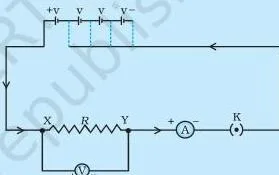
The circuit in Figure 11.2 is used to study Ohm’s law: the voltmeter sits across the nichrome wire while the ammeter is in series, and \( V/I \) stays nearly the same as the number of cells increases (NCERT, p. 176).
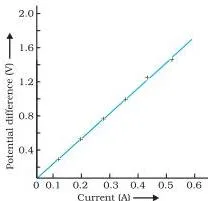
The V-I graph in Figure 11.3 is a straight line through the origin, which is the graphical form of Ohm’s law: as current increases, potential difference increases linearly, and the slope of the line gives the resistance.
Resistance of a Conductor
The resistance of a uniform metallic conductor depends on its length, its area of cross-section, and the nature of its material (NCERT, p. 178):
\[ R \propto l, \qquad R \propto \frac{1}{A} \]
\[ R = \rho\, \frac{l}{A} \]
Here \( \rho \) (rho) is the electrical resistivity of the material, with SI unit \( \Omega\,\text{m} \). Resistivity is a characteristic property of the material, and both resistance and resistivity vary with temperature.
Rearrangement used often: \( \rho = \frac{RA}{l} \) — from a measured resistance, you can find the resistivity and identify the material.
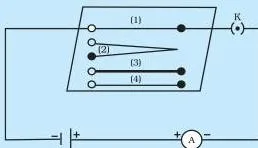
Figure 11.5 shows the circuit that demonstrates these factors: with the same thickness, doubling the length doubles the resistance; a thicker wire of the same length gives lower resistance; and a copper wire of the same size gives a different reading from nichrome (NCERT, p. 178).
Resistors in Series
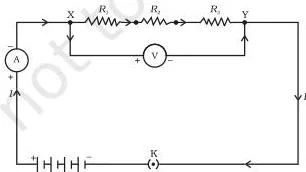
In a series combination the same current flows through every resistor, and the total potential difference equals the sum of the potential differences across the individual resistors (NCERT, p. 184):
\[ V = V_1 + V_2 + V_3, \qquad V_1 = IR_1,\ V_2 = IR_2,\ V_3 = IR_3 \]
\[ R_s = R_1 + R_2 + R_3 + \dots \]
The equivalent resistance of a series combination is greater than any individual resistance.
In Figure 11.6 the three resistors are joined end to end, so the same current passes through each, and the battery voltage is divided among them (NCERT, p. 184).
Resistors in Parallel
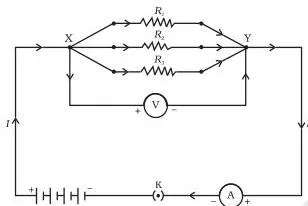
In a parallel combination every resistor has the same potential difference, and the total current equals the sum of the currents through the branches (NCERT, p. 186):
\[ I = I_1 + I_2 + I_3, \qquad I_1 = \frac{V}{R_1},\ I_2 = \frac{V}{R_2},\ I_3 = \frac{V}{R_3} \]
\[ \frac{1}{R_p} = \frac{1}{R_1} + \frac{1}{R_2} + \frac{1}{R_3} + \dots \]
The reciprocal of the equivalent resistance equals the sum of the reciprocals of the individual resistances, so the equivalent resistance of a parallel combination is decreased — smaller than the smallest individual resistance.
In Figure 11.7 the three resistors are connected between the same two points X and Y, so each branch sees the full voltage while the total current splits into \( I_1, I_2, I_3 \) (NCERT, p. 186).
Heating Effect of Electric Current
When a steady current \( I \) flows through a resistor of resistance \( R \), the source supplies energy at the rate (NCERT, p. 188):
\[ P = V\, \frac{Q}{t} = VI \]
This energy is dissipated in the resistor as heat. The heat produced in time \( t \) is:
\[ H = VIt \]
\[ H = I^2Rt \quad \text{(Joule’s law of heating)} \]
Joule’s law says heat is directly proportional to the square of the current, to the resistance, and to the time for which the current flows. This is why an electric iron, toaster or heater warms up, and why the filament of a bulb becomes hot enough to glow.
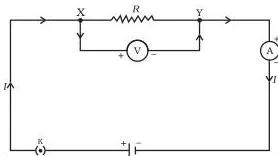
Figure 11.13 shows a purely resistive circuit: with no other form of energy use, the whole electrical energy is converted into heat (NCERT, p. 188).
Electric Power
Electric power is the rate at which electrical energy is consumed in a circuit (NCERT, p. 191):
\[ P = VI \]
\[ P = I^2R = \frac{V^2}{R} \]
The SI unit of power is the watt: \( 1\ \text{W} = 1\ \text{V} \times 1\ \text{A} = 1\ \text{VA} \). Energy consumed in time \( t \) is \( E = Pt \); with power in kW and time in hours, energy comes out in the commercial unit kilowatt hour: \( 1\ \text{kWh} = 3.6 \times 10^6\ \text{J} \).
What Each Symbol Means
The table below gives every symbol used in this chapter’s formulas, its meaning and its SI unit.
| Symbol | What it means | Unit |
|---|---|---|
| \( I \) | Electric current | ampere (A) |
| \( Q \) | Electric charge | coulomb (C) |
| \( t \) | Time for which charge flows | second (s) |
| \( V \) | Potential difference between two points | volt (V), \( 1\ \text{V} = 1\ \text{J/C} \) |
| \( W \) | Work done in moving the charge | joule (J) |
| \( R \) | Resistance of a conductor | ohm (\( \Omega \)) |
| \( R_s \) | Equivalent resistance of a series combination | ohm (\( \Omega \)) |
| \( R_p \) | Equivalent resistance of a parallel combination | ohm (\( \Omega \)) |
| \( R_1, R_2, R_3 \) | Resistances of individual resistors | ohm (\( \Omega \)) |
| \( V_1, V_2, V_3 \) | Potential difference across individual resistors in series | volt (V) |
| \( I_1, I_2, I_3 \) | Current through individual branches in parallel | ampere (A) |
| \( l \) | Length of the wire | metre (m) |
| \( A \) | Area of cross-section of the wire | metre squared (\( \text{m}^2 \)) |
| \( \rho \) (rho) | Electrical resistivity of the material | ohm metre (\( \Omega\,\text{m} \)) |
| \( H \) | Heat produced in the resistor | joule (J) |
| \( P \) | Electric power | watt (W), \( 1\ \text{W} = 1\ \text{J/s} \) |
| \( E \) | Electrical energy consumed | joule (J) or kilowatt hour (kWh) |
When to Use Each Formula
Pick the formula by what the question gives you and what it asks for.
| Formula | Use it when… |
|---|---|
| \( I = \frac{Q}{t} \) | The question gives charge flowing through a wire and the time taken, and asks for current (or one of the other two quantities). |
| \( V = \frac{W}{Q} \) | Work done (energy given) to move a charge between two points is involved; this also answers “how much energy does each coulomb get?”. |
| \( V = IR \) | You know the current through and resistance of a resistor and need the voltage across it. Valid while the conductor’s temperature stays constant. |
| \( R = \frac{V}{I} \) | You know (or have measured) the voltage across and current through a component. For a straight V-I graph, the slope gives R. |
| \( I = \frac{V}{R} \) | An appliance of known resistance is connected to a known supply voltage and you need the current it draws. |
| \( R = \rho \frac{l}{A} \) | A wire’s length, area of cross-section and material are given; find its resistance. Rearranged as \( \rho = \frac{RA}{l} \), it identifies a material using a resistivity table. |
| \( R_s = R_1 + R_2 + \dots \) | Resistors are joined end to end in series: same current through all, and the supply voltage is split between them. |
| \( \frac{1}{R_p} = \frac{1}{R_1} + \frac{1}{R_2} + \dots \) | Resistors are connected between the same two points in parallel: same voltage across all, and the total current splits into the branch currents. |
| \( H = VIt \) or \( H = I^2Rt \) | A resistor is converting electrical energy into heat; use the form that matches the two quantities you know, and put time in seconds. |
| \( P = VI \) | Power of an appliance from its voltage and current; also \( I = \frac{P}{V} \) to find the current drawn from a power rating. |
| \( P = I^2R = \frac{V^2}{R} \) | Power when you know current and resistance, or voltage and resistance. \( \frac{V^2}{R} \) is quickest for an appliance at a fixed supply voltage. |
| \( E = Pt \), \( 1\ \text{kWh} = 3.6 \times 10^6\ \text{J} \) | Energy consumed over a time interval, and electricity-bill problems where cost = (energy in kWh) × (rate per kWh). |
Worked Examples
Each example shows the formula being chosen, the substitution with units, and the final answer. For practice on the textbook’s own questions, work through the Electricity NCERT solutions.
Worked Example 1: Charge that flows through a bulb filament
A bulb filament draws a current of 0.4 A. How much charge passes through the filament in 15 minutes?
Step 1: The formula linking charge, current and time is \( I = \frac{Q}{t} \).
We need \( Q \), so rearrange it as \( Q = It \).
Step 2: Time must be in seconds: \( t = 15 \times 60 = 900\ \text{s} \).
\[ Q = It = 0.4\ \text{A} \times 900\ \text{s} = 360\ \text{C} \]
Final answer: \( Q = 360\ \text{C} \).
Worked Example 2: Resistance and power of a heater
An electric heater connected to a 220 V supply draws a current of 5 A. Find the heater’s resistance and the power it consumes.
Step 1: Resistance comes from Ohm’s law, \( R = \frac{V}{I} \).
Here \( V = 220\ \text{V} \) and \( I = 5\ \text{A} \).
\[ R = \frac{220\ \text{V}}{5\ \text{A}} = 44\ \Omega \]
Step 2: Power comes from \( P = VI \).
\[ P = 220\ \text{V} \times 5\ \text{A} = 1100\ \text{W} = 1.1\ \text{kW} \]
Final answer: Resistance \( 44\ \Omega \), power \( 1.1\ \text{kW} \).
Worked Example 3: Resistance and current of a bulb from its rating
A bulb is marked “60 W – 220 V”. Find the resistance of its filament and the current it draws when operated at 220 V.
Step 1: The rating gives power and voltage, so use the form \( P = \frac{V^2}{R} \), rearranged to \( R = \frac{V^2}{P} \).
\[ R = \frac{(220\ \text{V})^2}{60\ \text{W}} = \frac{48400}{60} \approx 807\ \Omega \]
Step 2: Current from the power formula \( P = VI \), rearranged to \( I = \frac{P}{V} \).
\[ I = \frac{60\ \text{W}}{220\ \text{V}} \approx 0.27\ \text{A} \]
Final answer: \( R \approx 807\ \Omega \), \( I \approx 0.27\ \text{A} \).
Common Mistakes to Avoid
| Mistake | Correct rule | How to check your answer |
|---|---|---|
| Time left in minutes in \( Q = It \) or \( H = I^2Rt \) | Convert time to seconds before substituting: 10 min = 600 s, 1 h = 3600 s. (kWh calculations are the one place hours are intended.) | If your charge or heat figure is 60 or 3600 times too large or too small, the time unit is the cause. |
| Adding resistances as if every combination were series: \( R_p = R_1 + R_2 \) | For parallel use \( \frac{1}{R_p} = \frac{1}{R_1} + \frac{1}{R_2} + \dots \) and take the reciprocal at the end. | \( R_p \) must be smaller than the smallest resistor in the group; if yours is larger, you added instead of adding reciprocals. |
| Applying the full supply voltage to one resistor in a series circuit | Find the circuit current first with \( I = \frac{V}{R_s} \) using the total (battery) voltage; then each resistor takes \( V_1 = IR_1 \). | Add your individual voltages: \( V_1 + V_2 + V_3 \) must equal the supply voltage. |
| Confusing Ohm’s law with the power formulas | \( V = IR \) gives volts; power formulas are \( P = VI \), \( P = I^2R \), \( P = \frac{V^2}{R} \). Use \( I^2R \) when you know \( I \) and \( R \), and \( \frac{V^2}{R} \) when you know \( V \) and \( R \). | Check the unit: a power answer must be in watts (or kW), never in volts. |
| Using a bulb’s rated voltage as if it were the actual supply voltage | The rating “60 W – 220 V” fixes the filament’s resistance. For any other supply voltage, use that actual \( V \) in \( P = \frac{V^2}{R} \). | Halve the supply voltage and the power must drop to one-quarter, because \( P \propto V^2 \) at fixed \( R \). |
| Treating a device’s resistance as constant while it heats up | Ohm’s law holds only at constant temperature; a bulb filament’s resistance rises as it glows, so its V-I graph curves. | If the temperature changes during the problem, do not apply a fixed \( R \) across the whole range. |
Frequently Asked Questions
Why is the parallel combination’s resistance smaller than any single resistor?
In a parallel circuit each resistor provides an extra path for the current, so for the same voltage the total current is larger (\( I = I_1 + I_2 + I_3 \)). A larger current at the same voltage means a smaller resistance.
The formula shows it too: since \( \frac{1}{R_p} \) is the sum of positive reciprocals, \( \frac{1}{R_p} \) is larger than \( \frac{1}{R_1} \), so \( R_p \) is smaller than \( R_1 \).
How do I choose between the two heat formulas?
They are the same heat formula written two ways. Substitute Ohm’s law, \( V = IR \), into \( H = VIt \) and you get \( H = I^2Rt \) (Joule’s law). Use the version that matches the two quantities you know: \( V \) and \( I \), or \( I \) and \( R \).
What is the difference between resistance and resistivity?
Resistance \( R \) of a wire depends on its size and shape — length and area of cross-section — as well as the material: \( R = \rho \frac{l}{A} \). Resistivity \( \rho \) is a property of the material alone, with SI unit \( \Omega\,\text{m} \). Both resistance and resistivity vary with temperature.
Why is one kilowatt hour equal to 3.6 million joules?
Because \( 1\ \text{kWh} = 1000\ \text{W} \times 3600\ \text{s} = 3.6 \times 10^6\ \text{J} \). The watt hour is a small unit, so the commercial unit kilowatt hour (the “unit” on electricity bills) is used instead. For other chapters’ formula sheets, browse the physics formulas index.
Reference: NCERT Class 10 Science textbook, chapter Electricity.
Explore Class 10 Physics Formulas
More for this chapter:
Class 10 Physics on LearnCBSE:
Related chapters: